ISSN (e): 2250-3021, ISSN (p): 2278-8719
Vol. 10, Issue 1, January 2020, ||Series -III|| PP 01-12
Handling Network Security Issues Using AI
Sheetal Thakare, Dr.S.R.Gupta, Dr.M.A.Pund
Dept. of Computer Engineering, Bharati Vidyapeeths College of Engineering, Navi Mumbai, Maharashtra, India
Dept. of Computer Sci. &Engineering, Prof. Ram Meghe Institute of Tech.& Research, Badnera. Affiliated-Amravati University Maharashtra, India
Dept. of Computer Sci. &Engineering, Prof. Ram Meghe Institute of Tech.& Research, Badnera. Affiliated-Amravati University Maharashtra, India
Received 01January 2020; Accepted 15 January 2020.
Abstract: With excessive exposure and use of internet, every system is prone to wide range of attacks. With this perspective, Network security is gathering every ones’ concern. Network attackers are getting more and more innovative with designs. Exponential growth in attacker’s intelligence require mitigation mechanism to be updated with same speed and level of innovation. This pans avenues for advanced technologies and methods to be employed for handling network security issues. Trending ones are artificial intelligence(AI), machine learning (ML) and deep learning(DL). AI is an umbrella covering ML and DL under it. Main features of AI making it big deal for network security are capacity to handle big data, faster detection, quick response, ability of unsupervised processing. Considering mentioned aspects, comprehensive study of AI approaches in handling network security issues is been carried out.
Keywords: network security,machine learning(ML), deep learning(DL), recommender systems, artificial intelligence(AI)
I.
INTRODUCTION
Artificial Intelligence, as the name suggests, is a induced form of intelligence in any kind of entity which naturally does not possess such kind of intelligence. By inducing certain kind of intelligence the entity can act as a matter expert. This is exact concept behind use of AI, finding solution to something, as if found by subject expert. Another main feature of AI to be so popularly employable is speed with which it can analyze data. Expert will take much longer to analyze big data, but with use of AI, it will be a matter of fraction of second. Thus complex situation solution finding is done by this science stream, and as it can take decisions also, like humans, the stream is know as Artificial Intelligence. Algorithms try to model decision making power as in humans. Decision making power is possessed by brain in humans, but creating human brain like structure was found to be way too complex, so modeling decision power mechanism was concentrated upon by AI field masters. So now with availability of suitable data, maximum complex problems can be solved using AI. Using various softwares algorithms are implemented to create AI applications possessing decision making power similar to that of human expert. Such AI applications can be used in absence of experts or in places where experts are not available. AI applications can be employed to take decisions from available data. Such applications need to be trained first, using past data. Using statistical methods available data can be used to generate information. Generated information is employed for prediction or decision making. Above specified flow will be implemented by a sub domain of AI, known as Machine Learning(ML). Deep Learning(DL) will also be useful for the same. Consider case of cancer specialist doctor. Decision on cancer cells are made by him considering size, growth rate, mutation rate, enzymes secreted etc. if such data with cancer features present are used to train AI application using ML, then AI application can be used in Hospitals, in absence of cancer specialist doctor, to make decisions. Thus for every problem, to have it solved by AI application, related dataset with feature set is required.
TABLE I. Advantages & Disadvantages of AI Concepts
Advantages of Artificial Intelligence for network security
TABLE II. Advantages of AI for network security
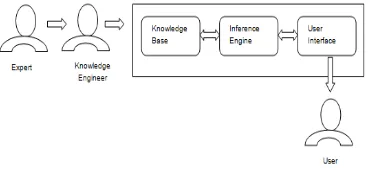
Fig. 2 Security system with AI[6]
II.
RECENT
ADVANCES
IN
AI
FIELD
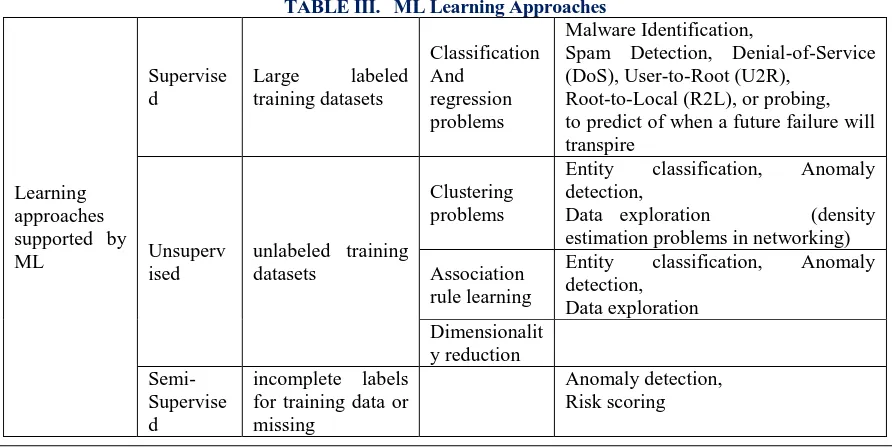
A. Machine Learning and Network FieldIn 1959, Arthur Samuel coined the term “Machine Learning”, as “the field of study that gives computers the ability to learn without being explicitly programmed” [369]. Ability is gained by use of concepts, mainly, clustering, classification, regression and rule extraction. Different learning approaches supported are-supervised, unsupervised, semi-supervised and reinforcement learning.
TABLE III. ML Learning Approaches
Learning approaches supported by ML
Supervise d
Large labeled training datasets
Classification And
regression problems
Malware Identification,
Spam Detection, Denial-of-Service (DoS), User-to-Root (U2R),
Root-to-Local (R2L), or probing, to predict of when a future failure will transpire
Unsuperv ised
unlabeled training datasets
Clustering problems
Entity classification, Anomaly detection,
Data exploration (density estimation problems in networking)
Association rule learning
Entity classification, Anomaly detection,
Data exploration Dimensionalit
y reduction
Semi-Supervise d
incomplete labels for training data or missing
labels
Reinforce ment Learning
agent-based iterative
process, training data in RL constitutes
a set of state-action pairs and rewards (or penalties)
Decision making problems
--
ML Model Building
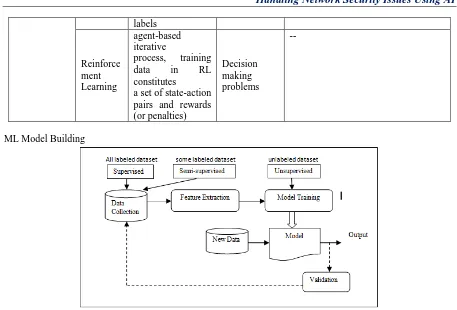
Fig. 3 Training A Model using Machine Learning
Training ML model
Training process is conducted in 3 main phases:
Phase I: Collecting data- This can be implemented in two ways, supervised or semi-supervised. Type of collection will be real time data collection and historical data collection. Historical data, being huge in amount, is a data where from model will learn. It can also act as test dataset. It is readily available with many repositories. Real time data will be input as well as feedback for model. This phase ends by dividing collected data into 3 types of subdivisions. One for train model, known as training set. One for performing validation, also known as development set and other one for testing model, known as test dataset. Training set is employed to shortlist ideal model parameters. Validation (development set) is employed to shortlist suitable ML model type. Lastly test dataset is employed to verify shortlisted model performance. Use of validation dataset is optional, as suitable ML model can be decided beforehand.
Phase II: Extracting features- before proceeding with extracting features, preprocessing of data collection is been done to clean data. Extracting features will shortlist features for training model with respect to them. This saves memory and time required for processing as collected data is huge in amount with some repetitive and some irrelevant features not contributing to result. Related to networking, features extracted can be of packet or flow or connection levels. Either use off the shelf tools (WEKA, NetMate etc.) or employ methods specialized in filter, embedding or wrapper.
TABLE IV. ML Model Building Phases Phase I Collectin g data Supervised, Semi-supervised Real-time data collection, Historical data collection
Training set, Validation set, Testing set (60/20/20)% of total dataset Holdout , k-fold cross-validation Phase II Processin g features Preprocessin g step is used to clean data Features with maximum relevant information are selected to train model on
Features represent statistical information about attribute of data. Packet-level, flow-level, connectio n- level Features selectio n and extractio n tools – WEKA, NetMate Feature selection and extraction methods-filter, embedded, and wrapper based methods Phase III Training model Learning algorithm is selected
Training dataset acts as input
Patterns relating input-output are found
Validatio n of data
Types Of ML Models
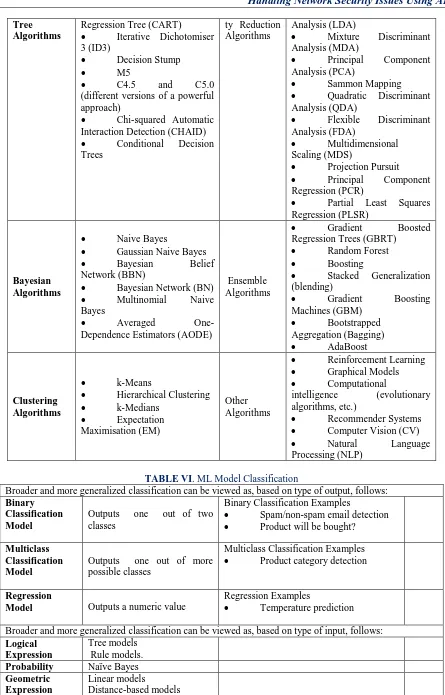
ML models are classified as per the base algorithm used to develop model. Classification can be viewed as follows:
TABLE V. ML Model Examples[5]
Algorithm Model Name Algorithm Model Name
Regression Algorithms
Ordinary Least Squares Regression (OLSR)
Locally Estimated Scatterplot Smoothing (LOESS) Logistic Regression Stepwise Regression Multivariate Adaptive Regression Splines (MARS) Linear Regression
Association Rule Learning Algorithms
Eclat algorithm Apriori algorithm
Instance-based Algorithms
k-Nearest Neighbour (kNN)
Locally Weighted Learning (LWL)
Learning Vector Quantization (LVQ)
Self-Organizing Map (SOM) Artificial Neural Network Algorithms Perceptron Hopfield Network Radial Basis Function Network (RBFN)
Back-Propagation
Regularizati on
Algorithms
Ridge Regression Least-Angle Regression (LARS)
Least Absolute
Shrinkage and Selection Operator (LASSO)
Elastic Net
Deep Learning Algorithms
Deep Boltzmann
Machine (DBM)
Stacked Auto-Encoders Deep Belief Networks (DBN)
Convolutional Neural Network (CNN)
Tree Algorithms
Regression Tree (CART) Iterative Dichotomiser 3 (ID3)
Decision Stump
M5
C4.5 and C5.0
(different versions of a powerful approach)
Chi-squared Automatic Interaction Detection (CHAID) Conditional Decision Trees
ty Reduction Algorithms
Analysis (LDA)
Mixture Discriminant Analysis (MDA)
Principal Component Analysis (PCA)
Sammon Mapping Quadratic Discriminant Analysis (QDA)
Flexible Discriminant Analysis (FDA)
Multidimensional Scaling (MDS)
Projection Pursuit Principal Component Regression (PCR)
Partial Least Squares Regression (PLSR)
Bayesian Algorithms
Naive Bayes
Gaussian Naive Bayes Bayesian Belief Network (BBN)
Bayesian Network (BN) Multinomial Naive Bayes
Averaged
One-Dependence Estimators (AODE)
Ensemble Algorithms
Gradient Boosted Regression Trees (GBRT)
Random Forest Boosting
Stacked Generalization (blending)
Gradient Boosting Machines (GBM)
Bootstrapped Aggregation (Bagging) AdaBoost
Clustering Algorithms
k-Means
Hierarchical Clustering k-Medians
Expectation Maximisation (EM)
Other Algorithms
Reinforcement Learning Graphical Models Computational
intelligence (evolutionary algorithms, etc.)
Recommender Systems Computer Vision (CV) Natural Language Processing (NLP)
TABLE VI. ML Model Classification
Broader and more generalized classification can be viewed as, based on type of output, follows: Binary
Classification Model
Outputs one out of two classes
Binary Classification Examples
Spam/non-spam email detection Product will be bought?
Multiclass Classification Model
Outputs one out of more possible classes
Multiclass Classification Examples Product category detection
Regression
Model Outputs a numeric value
Regression Examples
Temperature prediction
Broader and more generalized classification can be viewed as, based on type of input, follows: Logical
Expression
Tree models Rule models. Probability Naïve Bayes Geometric
Expression
Linear models
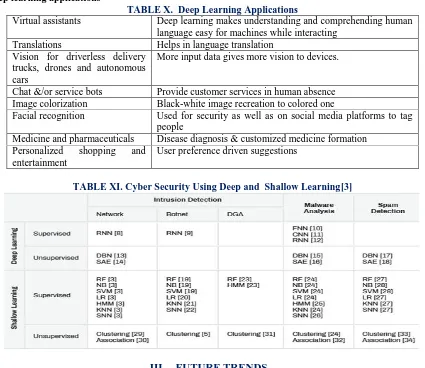
B. Deep Learning and Network Field
Deep learning is sub field of ML, which in turn is a sub domain of AI. “Deep” here indicates multiple/deep layers of neural nets. This concept increases scalability of artificial neural nets. It helps to model and learn complex concept by building it using low-medium-high level feature extraction. Thus layers of neural nets get multiple &/or deeper. Neural Nets with lesser layers are known to use shallow learning.
Fig. 4 Deep Learning Concept[4]
https://machinelearningmastery.com/what-is-deep-learning/ Deep Learning Methods Used in Cyber Security
TABLE VII. Deep Learning Methods[1] Deep Belief
Networks Recurrent neural network (RNN) Convolutional Neural Networks
Generative Adversarial Networks
Recursive Neural Networks
- class of
DNNs composed of multiple layers of hidden units with connections between the layers but not
between units within each layer - DBNs are trained in an unsupervised manner
- trained by adjusting weights in each hidden layer individually to reconstruct the inputs
-Takes variable Lengths input sequences - one element a time inputs processing - output of the hidden unit acts as extra input
- addresses speech
problems, time series
problems along with language problems -more difficult to train because the gradients can easily vanish or explode -holds a memory of the past events in the sequence
-processes input stored in arrays. -Regardless of dimensionality, CNNs are used where there is spatial or temporal ordering -consists of three distinct types of layers -convolution layers,
pooling layers, and the classification layer -convolution layers are the core of the CNN.
-weights define a convolution kernel applied to the original input
- two neural networks compete against each other
-one network acts as a generator and another network acts as a discriminator
-minator. generator
-on reading input ,generates outputs data with real data characteristics
-discriminator reads real data long with generator output to judge input is real or fake.
-thus generator can now generate new data similar to real data.
-uses are image enhancement, caption generation, optical flow estimation
- apply set of weights
recursively to a series of inputs.
- output of a node is used as input for the next step - first two inputs are fed into the model together - output from that is used
as an input along with the next step -uses natural language
processing tasks, image
TABLE VIII. DBN Sub-Types[1]
DBN Sub Types
Deep Autoencoders
Restricted Boltzmann Machines
DBNs or RBMs
Model type Unsupervised neural networks
Two-layer, bipartite, undirected graphical models
Deep autoencoders coupled with classification layers
Class of neural
networks Unsupervised Unsupervised Unsupervised
Input is Vector Data Data
Training way one layer at a time one layer at a time
trained using back propagation, layers require labels to train
Uses
feature compression (encoding),
denoising input, stacked autoencoder, sparse autoencoder
Stacked RBMs
Feature extractor, acoustic modeling, speech recognition, image recognition
Activation function
TABLE IX. Details of Activation Functions[2] Activation
Functions Method Advantages Disadvantages
Binary Step Threshold based step function
Simplicity of design Works only with two classes, zero gradient makes it useless for back-propagation
Linear Function Linear function Ideal for simple tasks Not suitable for complicated task
Sigmoid
f(x)=1/(1+e^-x)
Very high gradient for small interval, non-linear output ,
Back-propagation suitability
Asymmetric around origin, gradient small for region other than -3 to 3
Tanh scaled version of the sigmoid function
tanh(x)=2sigmoid(2x)-1
Symmetric around origin, Back propagates errors, Better version of sigmoid
Gradient vanishes after certain interval
Rectified linear unit
(ReLU) f(x)=max(0,x)
Non linear output, Back propagates errors, Selected neurons activation makes network sparse increasing ease and efficiency of computation.
Gradients approaching zero problem,
Back propagation without updating weights
Leaky ReLU
f(x)=ax, x<0 =x, x≥0
No zero gradient Dead neurons problem unsolved
Deep learning applications
TABLE X. Deep Learning Applications
Virtual assistants Deep learning makes understanding and comprehending human language easy for machines while interacting
Translations Helps in language translation Vision for driverless delivery
trucks, drones and autonomous cars
More input data gives more vision to devices.
Chat &/or service bots Provide customer services in human absence Image colorization Black-white image recreation to colored one
Facial recognition Used for security as well as on social media platforms to tag people
Medicine and pharmaceuticals Disease diagnosis & customized medicine formation Personalized shopping and
entertainment
User preference driven suggestions
TABLE XI. Cyber Security Using Deep and Shallow Learning[3]
III.
FUTURE
TRENDS
Recommender Systems and Network FieldRecommender systems are playing the pivotal role in influencing users and thereby helping e-commerce business by turning users into potential buyers or customers. The users are happy with the recommender system functionality as they are getting suggestions at their feet, derived from existing customers’ experiences and trends of buying. This is very much a need of an hour as we have entered the era of big data. Same is the scenario with network traffic, which is increasing with tremendous speed every second. With the amount of traffic data, vulnerability to threats is also on rise. So if such huge amount of past network traffic data can be analyzed and used with recommender system, then the predictions can be obtained regarding the anomalous situations to be encountered in future and suggestions can be provided immediately for mitigation actions.
Fig.5 Recommendation Techniques
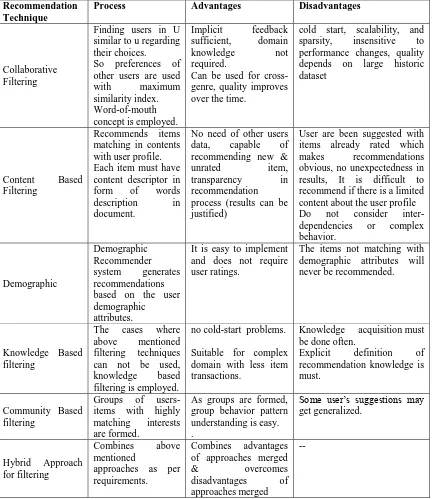
TABLE XII. Summary of recommendation techniques[11] Recommendation
Technique
Process Advantages Disadvantages
Collaborative Filtering
Finding users in U similar to u regarding their choices.
So preferences of other users are used with maximum similarity index. Word-of-mouth concept is employed.
Implicit feedback sufficient, domain knowledge not required.
Can be used for cross-genre, quality improves over the time.
cold start, scalability, and sparsity, insensitive to performance changes, quality depends on large historic dataset
Content Based Filtering
Recommends items matching in contents with user profile. Each item must have content descriptor in form of words description in document.
No need of other users data, capable of recommending new & unrated item, transparency in recommendation process (results can be justified)
User are been suggested with items already rated which makes recommendations obvious, no unexpectedness in results, It is difficult to recommend if there is a limited content about the user profile Do not consider inter-dependencies or complex behavior.
Demographic
Demographic Recommender system generates recommendations based on the user demographic
attributes.
It is easy to implement and does not require user ratings.
The items not matching with demographic attributes will never be recommended.
Knowledge Based filtering
The cases where above mentioned filtering techniques can not be used, knowledge based filtering is employed.
no cold-start problems.
Suitable for complex domain with less item transactions.
Knowledge acquisition must be done often.
Explicit definition of recommendation knowledge is must.
Community Based filtering
Groups of users-items with highly matching interests are formed.
As groups are formed, group behavior pattern understanding is easy. .
Some user’s suggestions may get generalized.
Hybrid Approach for filtering
Combines above mentioned
approaches as per requirements.
Combines advantages of approaches merged & overcomes disadvantages of approaches merged
TABLE XIII. Survey of recommender systems in various domains
PAPER TECHNIQU
E USED
FIELD OF
APPLICATIO N
USE
Using Collaborative Filtering in a new domain: traffic analysis
CERI ’16, June 14 - 16, 2016, Granada, Spain[14]
Collaborative Filtering
Computer Networks
To apply the collaborative filtering techniques to the field of troubleshooting and reducing
threats in an IT infrastructure.
CCFRS – Community based Collaborative Filtering Recommender System Journal of Intelligent & Fuzzy Systems 32 (2017) 2987– 2995[12]
Community based Collaborative Filtering
Digital Library (Books
Domain)
To generating community based individual recommendations for the user.
A Community Based Social Recommender System for Individuals & Groups, SocialCom/PASSAT/BigD ata/EconCom/BioMedCom 2013[16]
Community Based
Social Network of Movies (Movie
Domain)
Movies are recommended based on their community membership, the degree utility value, adjacent nodes, and star ranking.
A Recommender-System for
Telecommunications Network Management
Actions, at:
https://www.researchgate.n et/publication/259785776,2 013[17]
Collaborative Filtering
Telecoms Network management system
The applicability of recommender systems as an approach toassist NOC operators to correctly respond to indications ofincidents in the network they are actively managing.
A Survey of Collaborative Filtering-Based
Recommender Systems for Mobile Internet Applications, Digital Object Identifier 0.1109/ACCESS.2016.257 3314, 2169-3536 2016 IEEE. [18]
Collaborative Filtering
Mobile Internet applications.
To predict the interests of mobile users and to make proper mobile application recommendations.
A Hybrid Trust-Based Recommender System for Online Communities of Practice
IEEE TRANSACTIONS
ON LEARNING
TECHNOLOGIES, VOL. 8, NO. 4, OCTOBER-DECEMBER 2015[19]
Hybrid Approach
Online
Community of Practices ( Online forums to seek answers)
To mitigate two issues, when learners face information overload and there is no knowledge authority within the learning environment, in online CoPs.
User Profiling for University Recommender System using Automatic Information Retrieval
Collaborative Filtering
Education Domain ( University/ Institute Online
User Profiling System for recommendation of various
Procedia Computer Science 78 ( 2016 ) 5 – 12, International Conference on Information Security and Privacy, 11-12 December 2015,
Nagpur, INDIA[20]
Information) the keyword based information to generate a structured Profile and then visualizing the knowledge out of these findings.
ePaper - the Personalized Mobile Newspaper, Journal of the American Society for Information Science and Technology · November 2009 [21]
Collaborative Filtering
Digital News Domain
The ePaper aggregates content (i.e., news items) from various news providers, and delivers personalized newspapers on dedicated mobile, electronic newspaper-like, devices.
TiMers: Time-based Music Recommendation System based on Social Network Services Analysis, IMECS 2015, March 18 - 20, 2015, Hong Kong[22]
Hybrid Approach
Digital Music Extracts the general and personal tastes of music by analyzing current music playback that are collected from the popular radio stations and social network services during a specific time period and generate a list of songs for recommendation by emotion and genre.
IV.
DISCUSSION
AND
SUMMARY
The recommender system methodology is immensely popular among the e-commerce business. The benefited users are satisfied by the results as they no more have to trawl through piles of products available at their fingertips. Similarly as network traffic data is also growing every second, the recommender system can be employed for network security domain to suggest mitigation actions in case anomalous situation is been predicted by traffic prediction module. The network analyst no more has to scroll through logs of traffic traces for suspicious traffic. As the anomalous situation is predicted beforehand, MTTR( mean time to respond) will improve drastically. The various network traffic prediction methods are listed. The survey of various literatures shows use of recommender system in various domains other than e-commerce. Concepts of AI , specifically ML, DL and recommender systems, are thus front runners to handle various network security issues effectively and efficiently.
REFERENCES
[1]. Daniel S. Berman, Anna L. Buczak *, Jeffrey S. Chavis and Cherita L. Corbett, “A Survey of Deep Learning Methods for Cyber Security”,Information 2019, 10, 122; doi:10.3390/info10040122 www.mdpi.com/journal/information
[2]. https://www.analyticsvidhya.com/blog/2017/10/fundamentals-deep-learning-activation-functions-when-to-use-them/
[3]. Giovanni Apruzzese et al., “On the Effectiveness of Machine and Deep Learning for Cyber Security”, 2018 10th International Conference on Cyber Conflict CyCon X: Maximising Effects T. Minárik, R. Jakschis, L. Lindström (Eds.) 2018 © NATO CCD COE Publications, Tallinn
[4]. https://machinelearningmastery.com/what-is-deep-learning/
[5]. https://www.datasciencecentral.com/profiles/blogs/a-tour-of-machine-learning-algorithms-1?overrideMobileRedirect=1
[6]. Swapnil Ramesh Kumbhar, “An Overview on Use of Artificial IntelligenceTechniques in Effective Security Management”, International Journal of Innovative Research in Computerand Communication Engineering, Vol. 2, Issue 9, September 2014
[7]. Boutaba et al., “A comprehensive survey on machinelearning for networking: evolution,applications and research opportunities” Journal of Internet Services and Applications (2018) 9:16 https://doi.org/10.1186/s13174-018-0087-2
[9]. Hu R, Pu P, “Potential acceptance issues of personality-based recommender systems.” In Proceedings of ACM conference on recommender systems (RecSys’09), New York City, NY, USA; October 2009. p. 22–5.
[10]. B. Pathak, R. Garfinkel, R. Gopal, R. Venkatesan, F. Yin, “Empirical analysis of the impact of recommender systems on sales”, Journal of Management Information Systems, 27 (2) (2010), pp. 159-188
[11]. R. Burke, Hybrid Recommender Systems: Survey and Experiments, User Modeling and User-Adapted Interaction, vol. 12, no. 4, pp. 331-370, 2002.
[12]. Chhavi Sharma∗ and PunamBedi, CCFRS – Community based Collaborative Filtering Recommender System Journal of Intelligent & Fuzzy Systems 32 (2017) 2987–2995 DOI:10.3233/JIFS-169242 IOS Press
[13]. Hybrid Web Recommendation Systems, Core Presentation Summary with Discussions, Jae-wookAhn, www.piit.edu
[14]. Using Collaborative Filtering in a new domain: traffic analysis CERI ’16, June 14 - 16, 2016, Granada, Spain
[15]. CCFRS – Community based Collaborative Filtering Recommender System Journal of Intelligent & Fuzzy Systems 32 (2017) 2987–2995
[16]. A Community Based Social Recommender System for Individuals & Groups, SocialCom/PASSAT/BigData/EconCom/BioMedCom 2013
[17]. A Recommender-System for Telecommunications Network Management Actions, at: https://www.researchgate.net/publication/259785776,2013
[18]. A Survey of Collaborative Filtering-Based Recommender Systems for Mobile Internet Applications, Digital Object Identifier 0.1109/ACCESS.2016.2573314, 2169-3536 2016 IEEE.
[19]. A Hybrid Trust-Based Recommender System for Online Communities of PracticeIEEE TRANSACTIONS ON LEARNING TECHNOLOGIES, VOL. 8, NO. 4, OCTOBER-DECEMBER 2015
[20]. User Profiling for University Recommender System using Automatic Information RetrievalProcedia Computer Science 78 ( 2016 ) 5 – 12, International Conference on Information Security and Privacy, 11-12 December 2015, Nagpur, INDIA
[21]. ePaper - the Personalized Mobile Newspaper, Journal of the American Society for Information Science and Technology · November 2009
[22]. TiMers: Time-based Music Recommendation System based on Social Network Services Analysis, IMECS 2015, March 18 - 20, 2015, Hong Kong
[23]. G P Bherde, M A Pund, “ Recent attack prevention techniques in web service applications”, International Conference on Automatic Control and Dynamic Optimization, 2016
![TABLE V. ML Model Examples[5] Algorithm Model Name](https://thumb-us.123doks.com/thumbv2/123dok_us/7798018.1659754/4.595.82.518.444.770/table-v-ml-model-examples-algorithm-model-name.webp)
![Fig. 4 Deep Learning Concept[4]](https://thumb-us.123doks.com/thumbv2/123dok_us/7798018.1659754/6.595.193.397.154.293/fig-deep-learning-concept.webp)
![TABLE IX. Details of Activation Functions[2]](https://thumb-us.123doks.com/thumbv2/123dok_us/7798018.1659754/7.595.83.510.76.350/table-ix-details-of-activation-functions.webp)