Effectiveness of a Peer Mentoring Program in
Engineering Education
Félix Tobajas, Valentín De Armas and Asunción Morales
Department of Electronic Engineering and Automatic (DIEA)University Of Las Palmas de Gran Canaria (ULPGC) Las Palmas de Gran Canaria, Spain
{ftobajas, varmas, amorales}@diea.ulpgc.es
Abstract—The Mentoring Program of the Escuela Técnica Superior de Ingenieros de Telecomunicación (ETSIT) is intended to establish a mechanism based on peer mentoring provided by upper-class students (Mentors) to provide help, support, and resources to incoming first-year students (Mentees). This paper focuses on the experience gained in the creation and development of the ETSIT Mentoring Program during five years. The evolution of the results obtained from the evaluation of various aspects of the ETSIT Mentoring Program, is also presented.
Keywords-engineering education; engineering student retention; peer mentoring;
I. INTRODUCTION
Nowadays, with the number of students entering engineering degrees programs declining, it is important to focus efforts not only on attraction, but also on student retention. In this sense, student support during the transition to University is one of the main influences on whether a student stays or leaves. The challenges for someone transitioning from high school to university can be significant. These challenges can be even greater when the student is entering into engineering. As a support mechanism, successful peer mentoring can impact students’ desire to remain in engineering and at the University [1].
The term mentoring refers to a supportive relationship that is characterized by constructive role-modeling, encouragement towards raised aspirations, and by positive reinforcement for the achievement of goals. Peer mentoring
at University typically involves the support and guidance for new students from more experienced students within the same discipline. Peer mentoring is an important strategy for assisting first year students during their transition to University in order to minimize the attrition rates that are typically high at engineering degrees [2]. The benefits of mentoring programs are both personal and professional, offering the satisfaction of helping peers and increasing the confidence of experienced students.
This paper focuses on the experience gained in the creation and development of a peer mentoring program at
ETSIT (Escuela Técnica Superior de Ingenieros de
Telecomunicación) from the University of Las Palmas de
Gran Canaria (ULPGC) during five years, giving a detailed
description of the program, the logistics involved in its implementation, or the modifications introduced throughout its successive editions to improve their key elements – including the selection and training of Mentors, the organization of the Mentor and Mentee meetings, or the content of the reports that the Mentors have to complete after each meeting–. The evolution of the results obtained from
the Mentor and Mentee satisfaction evaluation of various
aspects of the ETSIT Mentoring Program, are also presented. II. THE ETSITMENTORING PROGRAM
The ETSIT Mentoring Program is intended to establish a mechanism based on peer mentoring provided by Mentors to provide help, support, and resources to incoming first-year students throughout their first semester at the university on a range of academic, social and administrative issues, under the supervision of Teaching Tutors. This peer mentoring program has been in existence since the academic year 2004-2005 and has proven to be successful promoting student involvement and enabling success in Mentees' academic, social, and personal endeavors, as soon as developing in
Mentors professional and transferable skills to take into
engineering practice. For the academic year 2006-2007, improvements based on feedback from the participants in previous editions were introduced in the ETSIT Mentoring Program to its actual form.
A. Organizational structure
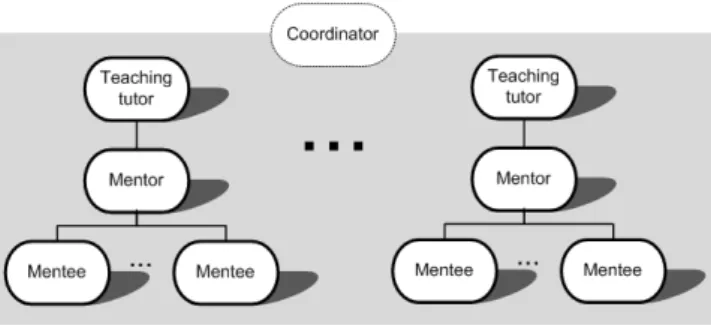
The organizational structure of the ETSIT Mentoring Program is shown in Fig. 1. Mentors are in charge of group of a maximum of 6 Mentees, reporting to their Teaching
Tutor, who is an experienced lecturer preferably teaching on
the first year course. Each Teaching Tutor provides guidance and supervision to the Mentors. Teaching Tutors and
Mentors report to the Coordinator, who has oversight of the
program and is responsible for the assessment, holding the training and weekly mentor meetings, …
In addition, a technical committee coordinates the implementation of the different activities comprising the ETSIT Mentoring Program. This committee is composed by the Dean of the ETSIT, 3 lectures, and 2 undergraduate students. The ETSIT Mentoring Program Technical
Committee meets at least two times throughout the duration
of the program in order to select Teaching Tutors and
Mentors, …
B. Recruiting and selection of Teaching Tutors & Mentors
The success of any mentoring program depends in large part on the skills of the Mentors. It is therefore important that care is taken when recruiting and selecting lecturers and students that will be involved in the mentoring program. The recruitment and selection of Teaching Tutors and Mentors
commence at the end of the previous academic year, as
Mentors need to be have been recruited and trained prior to
the start of the academic year.
There are many strategies that can be used to make contact with the students whom Mentors will be selected. For the particular case of the ETSIT Mentoring Program, potential Mentors are contacted by publishing announcements on notice-boards, and by sending a mass email to students in later years of the degree. Potential
Teaching Tutors are contacted by email.
Before agreeing to participate, potential Mentors are fully informed about the ETSIT Mentoring Program and about their role in it via an information sheet and an information
meeting. The information sheet clearly identifies the aims,
objectives and structure of the mentoring program, what will be expected from students who participate as Mentors, and especially how much time will be required of them. The
information sheet also tells potential Mentors about the
ongoing support they will receive. Finally, students are made aware of how their participation will be acknowledged. The
information meeting is a session to which all students who
have an interest in participating as Mentors are invited. The overriding purpose of such a meeting is to ensure that any student is fully informed about what is involved. The information meeting begins by welcoming and thanking all students for their interest in the mentoring program and having their attention drawn to the details that are provided on the information sheet.
Students who, having heard the detailed information, continue to believe they are able to make the necessary commitment, are asked to complete an application form. The application process consists of completing the application form with contact details, writing a short essay regarding the skills and experience they believe will enhance their ability to be effective Mentors, or the motivation for being involved in the mentoring program, and submitting a copy of their academic grades.
After the applications are received, the ETSIT Mentoring
Program Technical Committee reviews the applications. The
program faced several challenges when it began regarding how to organize the application and review process. Nowadays, students are selected mainly based on their academic progress and perceived interest in mentoring, since the importance of Mentor’s appreciation of the value of mentoring for the success of the program has been proved to be significant. In this sense, the technical committee members are familiar with most of the students who indicate that they would like to be Mentors, so it is not necessary asking them to attend any personal interview. The number of chosen Mentors depends on the available flexibility, that is, the number of applicants in relation to the number of
Mentors required. Teaching Tutors are mainly selected based
on their experience in mentoring, with special emphasis on the enrolment of lectures of first year subjects, since their participation in the ETSIT Mentoring Program has proven to be very important, as it allows closer links with lecturers and staff [3].
C. Training
Before meeting with the first year students, it is necessary to ensure that Mentors undergo appropriate training. The effectiveness of any mentoring program depends on the degree to which Mentors have the appropriate expertise, that is, both the skills and the knowledge. The greater their confidence in their skills and knowledge, the higher the likelihood that mentoring will be effective [4].
Training at the ETSIT Mentoring Program addresses issues related with the facilitation or conduct of the mentoring sessions, and others related to the content of the mentoring program. In this sense, Mentors have training in generic interpersonal communication skills, including building empathy, actively listening, or asking appropriate questions. Training identifies the strategies that Mentors
might use for making their initial contact with their Mentees, for setting up the first meeting, and for running the first mentoring session. Interpersonal skills are put into practice in small group situations at the orientation and one-to-one in follow-up correspondence. In addition, Mentors are versed on campus resources, university activities, academic rules and resources, student associations, ETSIT organization, grants, exchange programs, …
D. Initial coordination session
The ETSIT Mentoring Program is established with a structure and relatively formal program to follow. The content of weekly mentoring sessions is agreed from
Coordinator, Teaching Tutors and Mentors during an initial
coordination session held before recruiting of Mentees and
the start of the mentoring meetings. An outline of the topics that should be covered during the program of mentoring sessions is planned along with some suggestions for the week in which they must be addressed. This initial
coordination session focuses on the content of the mentoring
program, including the material, an identifying specific strategies and suggestive activities that might used for each of the topics or areas of material.
E. Recruiting of Mentees
One of the major challenges when the ETSIT Mentoring Program was implemented was how to inform incoming students about this opportunity. The chosen method is based on a flyer distributed during an announcement in a lecture in the first week of the course, ensuring that students are contacted early and in time for mentoring to begin from the second week of class. The flyer draws first year student’s attention to the existence of the ETSIT Mentoring Program that is designed specifically for them. In addition, the information in the flyer includes the rationale for the mentoring program and its objectives, and briefly describes the expectations of participants in the mentoring program. Students are encouraged to attend a welcoming session
during the second week of the course to learn more about the program and enroll in it.
F. Welcoming session
Before agreeing to participate, potential Mentees are fully informed about the ETSIT Mentoring Program, about what would be expected of them, and what they might hope to gain from being involved in it. The purpose of the welcoming
session is mainly to ensure that any student interested in
being a Mentee is fully informed about the mentoring program, and to mark off the start of the mentoring program for participants. The welcoming meeting begins with a welcome from the Dean of the ETSIT and covers a brief reiteration of the aims and objectives of the program, a comment about the efficacy of mentoring programs and the possible benefits of participating in mentoring, and a few remarks about being an effective Mentee.
Having provided students with the opportunity to ask questions about any aspects of the ETSIT Mentoring Program, those who decide to participate are asked to complete an application form. The form simply asks potential Mentees to record their contact details and about their permission that the information be provided to their
Mentor, who will then make contact with them. Mentoring
groups are formed just at the end of the welcoming session, providing the Mentors and Mentees with the opportunity to get to know each other before the start of the weekly mentoring sessions. Mentors are in charge of group of a maximum of 6 Mentees, with Mentors and Mentees being matched at random.
G. Supporting tools
Once the mentoring program is underway –as soon as
Mentor and Mentees groups are formed–, an intranet
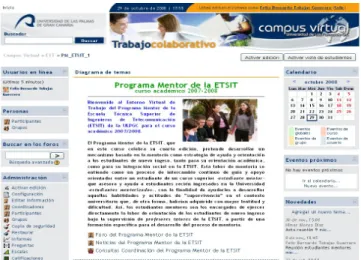
web-based portal is established by the Coordinator, shown in Fig. 2, as a supporting tool for Teaching Tutors and Mentors.
The ETSIT Mentoring Program Portal is exclusively available to the program participants and includes, among other, information related to the ETSIT Mentoring Program, a list of all the Teaching Tutors, Mentors and their Mentees
with their contact details, and indicating the mentoring group to which they belong. In addition, a news forum is set up, so that there can be regular contact between the program
Coordinator and all Teaching Tutors and Mentors who are
involved in the program. Also, supporting information related to the topics proposed to be covered on the weekly mentoring sessions is provided. Finally, the web-based portal eases uploading and reviewing the reports being elaborated by the Mentors at the end of every weekly mentoring session.
H. Weekly mentoring sessions
The Mentors meet Mentees weekly during the first
semester, beginning the second week of class. The first meeting typically lasts 45-50 minutes, with subsequent meetings typically lasting 30 minutes. At the first meeting,
Mentor and Mentees get to know each other better and set up
a weekly meeting time. It is important for the students to know they can terminate the relationship for any reason at any time.
Each week there are certain topics that Mentors will discuss with their Mentees, according to the planning agreed during the initial coordination meeting. These topics regard how to succeed in their first semester classes, being timed to provide the right information and support at the right time. With each meeting, Mentees gradually assume more responsibility for the weekly mentoring sessions. Main topics include academic rules, characteristics of subjects, structure of the first course, search for academic resources, student associations, ETSIT organization and services, … Other topics cover study habits, how to put a bad exam score
in perspective, not repeating the same mistakes, organizational skills, dropping classes, exam survival, …
Mentors discuss any issue of concern with the Mentees, not
being limited to the topics to cover in any weekly mentoring session according to the planning agreed during the initial
coordination session. In addition, Mentees complete three
forms during the weekly sessions regarding previous knowledge of the degree and the motivation of the first year students for its election, their adaptation to the University, and the subjects covered on the first semester. The information obtained from these forms is used, i.e. to detect problems on the lectures of the subjects covered on the first semester of the degree. The second part of the first semester,
Mentees have grown substantially, so topics cover some
visits to research laboratories or telecommunication-related enterprises. Finally, the last meeting is held after the exams, in order for the Mentors to review the academic progress of
the Mentees, being sensitive to students who appear to be at
academic or personal risk.
In addition to weekly mentoring sessions, Mentors meet monthly to share experiences. Also, in order to involve
Teaching Tutors with the Mentor and Mentees weekly
meetings, they are recommended to assist to some specific planned meetings covering critical topics for the first year students, allowing closer links with lecturers and supporting
Mentors.
After each meeting with their Mentees, Mentors elaborate a report of the session and sends it to the Coordinator and their Teaching Tutor. This report is based on a template provided by the Coordinator of the mentoring program, including the meeting date and duration, along with the name of the assistants, the covered topics, and any comments or problems from the Mentees. Once fulfilled, Mentors upload each report using the web-based portal. Reports are available for the Coordinator and the Teaching Tutors.
III. ETSITMENTORING PROGRAM EVALUATION The overriding objective of any evaluation process of a peer mentoring program is to determine the extent to which it has been effective [3]. The success of a mentoring program depends on how well it is able to assess its effectiveness, address any weakness and demonstrate that it is complaining established goals and objectives. However, evaluations of mentoring programs tend to exclusively assess Mentees
satisfaction with a Mentor, with very few studies examining the impact of mentoring program on outcomes [5]. To ensure the quality and effectiveness of a mentoring program, it is necessary to develop a plan to measure program processes and expected outcomes, and create a process to reflect on and disseminate evaluation findings. To ensure the quality and effectiveness of a mentoring program, two different types of evaluation can be conducted depending on the purpose of the measurement [4]:
• Process evaluations (formative evaluations) focus on
whether a program is being implemented as intended, how it is being experienced, and whether changes are needed to address any problems. Process evaluation is an ongoing data collection process that
yields information about the successful activities and those needed to be determined. This information can help to improve the mentoring program. A well planned process evaluation is developed prior to the beginning of the mentoring program, and continues throughout the duration of the program.
• Outcome evaluation (summative evaluations) focus
on what effects mentoring programs are having and help to determine objectively the benefits, costs, and necessary conditions to reach program objectives, and determine whether the mentoring program caused an improvement among the participants on certain aspects of interest.
Despite the importance of the information provided by
the Process evaluations for self-monitoring and continuous
improvement of program effectiveness, this paper will mainly focus on the issues and decisions involved in conducting an Outcome evaluation to assess the effectiveness of the ETSIT Mentoring Program in achieving pre-determined objectives. An Outcome evaluation
implementation involves the specification of expected outcomes, the selection of appropriate instruments to measure outcomes, and the selection and implementation of an evaluation design.
A. Outcome evaluation
Outcome evaluation is a crucial part of any effective
mentoring program as it provides information to increase its effectiveness through a feedback/continuous quality improvement process. Outcome evaluations of mentoring programs generally are of two major types [4]:
1) Single-group designs are the simplest and most
common types of evaluation, since they are less intrusive and costly, and require less effort to complete. An example of a single-group evaluation is a survey completed by all participants at the completion of the program (post test) or before and after the program (pre-post test).
• Post test. Mentoring programs commonly use this
design to determine how Mentees comply some aspects of interest at the completion of the mentoring program. Post-test evaluations can help determine whether the Mentees have achieved certain goals – according to the implicit or explicit objectives established during the planning of mentoring program–, or whether Mentors are satisfied with the mentoring program, among other issues.
• Pre-post test. Mentoring programs use this design to
determine whether Mentors and Mentees actually improved during the mentoring program by comparing the results of a pre test and a post test. Even if pre-post evaluations can’t indicate whether the mentoring program was responsible for the improvement, a pre-post test can be useful to detect differences within the group or to determine whether certain participant characteristics are related to achieving mentoring program goals.
2) Comparison group designs allow to determine whether the mentoring program is the cause of change in program participants, using controls to eliminate possible biases. An example of a comparison group evaluation is a
pre test completed by all participants at the beginning of the program and a post test at the completion of the program to both the target mentoring group and a matched comparison group that does not receive mentoring. By including a comparison group it can be possible to isolate the effects of the program from the effecs of other plausible interpretation of change. However, this type of evaluation requires finding a comparison group that is sufficiently similar to the mentored group. In this sense, students who enlist in a mentoring program may differ –in terms of motivation, compliance, …– from those who do not enlist. Many mentoring programs are not willing to deliberately withhold their program from participants, mostly with the number of students entering engineering degrees programs declining.
The evaluation design adopted determines the confidence in the mentoring program to be the cause of improvements of potential in all participants. Outcome Evaluation of the ETSIT Mentoring Program is based on a single-group design with post test, since all first year students are invited to participate as potential Mentees. The outcomes are mainly measured using anonymous satisfaction surveys completed
by Teaching Tutors, Mentors and Mentees after the fall
meeting, as surveys of student perceptions provide just some information. These surveys have been elaborated as part of the activities of a mentoring network in university environments which includes most of the universities developing mentoring programs in Spain, including the University of Las Palmas de Gran Canaria (ULPGC) [6]. The elaboration of these common surveys has allowed the comparison of the results obtained from different universities on the same issues. The items on the survey cover different aspects of the ETSIT Mentoring Program, including
Personal Benefits, General Benefits, Development of the
Program, Program Recommendation, Teaching
Tutors/Mentors/Mentees evaluation, and a General
Appraisal of the mentoring program.
The results obtained for the 2008-2009 ETSIT Mentoring Program show that it is considered as helpful or very helpful by more than 90% of Mentees, 95% of Mentors and 88% of
Teaching Tutors, with a general appraisal of 8.63, 9.12 and
9.37 (over 10), respectively. In addition, 70% of Mentees
consider that ETSIT Mentoring Program has a positive influence on their academic, social, and personal endeavors, and more than 75% recommend to be enrolled in it, with an 83% willing to participate in the near future as Mentors.
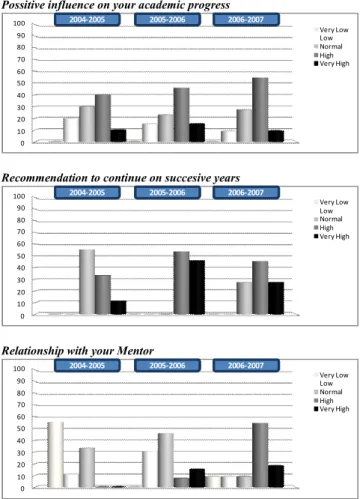
However, as various issues covered through the implementation of mentoring programs are not directly used during the first semester at the university, and in many cases the incoming first-year students don’t have an adequate temporal perspective to value all the aspects in which the mentoring program have influence, the ETSIT Mentoring Program also involves anonymous satisfaction surveys completed by Mentees after staying three years at the university in order to evaluate their perception about the effectiveness of the mentoring program on that period. Some
for Mentees who participate in the ETSIT Mentoring
Program along the academic years 2004-2005, 2005-2006 and 2006-2007, after staying three years at the university. From these results, 57% of students consider that ETSIT Mentoring Program had a high positive influence on their academic progress in mean, more than 72% highly recommend its continuity on successive years, and a 51% of students still continue the relationship with their Mentors.
However, satisfaction surveys often show that participants are at least somewhat satisfied, so results must be interpreted with some caution. High program satisfaction does not equal positive program outcomes, thus satisfaction surveys should be considered as just one part of an overall evaluation. In this sense, retention rate is tracked each academic year as a method of measuring retention of first-year students. In Table I, the overall first-first-year retention rates
of Mentees for the last five academic years are shown. From
these results, improvements introduced from the 2006-2007 academic year indicate that the ETSIT Mentoring Program successfully impacts retention.
TABLE I. OVERALL FIRST-YEAR RETENTION RATES OF MENTEES Academic Year
2004-2005 2005-2006 2006-2007 2007-2008 2008-2009
37% 32% 36% 56% 60%
Possitive influence on your academic progress
0 10 20 30 40 50 60 70 80 90 100 Very Low Low Normal High Very High 2004-2005 2005-2006 2006-2007
Recommendation to continue on succesive years
0 10 20 30 40 50 60 70 80 90 100 Very Low Low Normal High Very High 2004-2005 2005-2006 2006-2007
Relationship with your Mentor
0 10 20 30 40 50 60 70 80 90 100 Very Low Low Normal High Very High 2004-2005 2005-2006 2006-2007
Figure 3. Results obtained from satisfaction surveys completed by Mentees after staying three years at the university.
In addition, a set of measurable indicators are being elaborated within the referred mentoring network in order to evaluate whether or not the mentoring program caused an improvement among the participants, including the degree to which the needs of the incoming first-year students are met, the skills gained by the Mentors, or the degree to which the university as a whole benefits from the mentoring program. These indicators will be used to improve Outcome
evaluation of the ETSIT Mentoring Program at the current
academic course 2009-2010, in order to verify the feasibility in collecting the required data and the relevancy of each indicator in determining the effectiveness of the mentoring program.
IV. CONCLUSIONS
The ETSIT Mentoring Program helps Mentees to develop an enhanced sense of student identity as an engineer, to become effectively integrated into the ETSIT, and to acquire the necessary skills to become independent. Regarding
Mentors, the ETSIT Mentoring Program introduces them to
skills in leadership, teamwork, problem solving, time-management, or communication, helping them get a leg up into professional practice. The effectiveness of this peer mentoring program can be attributed to several factors, including proper Mentor selection and training, weekly targeted meetings with Mentees, well timed information and mentee support, or the enrollment of lecturers teaching on the first year course.
REFERENCES
[1] M. Murray, Beyond the Myths and Magic of Mentoring: How to Facilitate an Effective Mentoring Process, 1st. ed. John Wiley & Sons, 2001.
[2] C. Sánchez, J. Macías, A. Almendra, A. Álvarez, C. Hoffman and P, Chocán, “Proyecto Mentor: Una Experiencia en Sistemas de mentorías por Compañeros en la E.T.S.I. de Telecomunicación de la U.P.M.,” XI Congreso Universitario de Innovación Educativa en las Enseñanzas Técnicas, July 2003.
[3] N. Klasen, Implementing Mentoring Schemes: A Practical Guide to Succesful Programs, 1st ed. Elsevier, 2002.
[4] L. J. Zachary, Creating a Mentoring Culture: The Organization’s Guide, 1st. ed. John Wiley & Sons, 2005.
[5] L. Milne, S. Keating, R. Gabb [Online] Student Peer Mentoring at Victoria University, 2007. Available: http://tls.vu.edu.au/PEC/ Pec_docs/PEC_student_peer_mentoring_ at_VU_final_report.pdf [6] Red de Mentorías en Entornos Universitarios [Online], 2008.