A Taxonomy of Customer Relationship Management Analyses for
Data Warehousing
Colleen Cunningham and Il-Yeol Song
College of Information Science & Technology Drexel University
Philadelphia, PA , 19104 USA
[email protected], [email protected]
Abstract
Customer Relationship Management (CRM) is a strategy that supports an organization’s decision-making process to retain long-term and profitable relationships with its customers. Effective CRM analyses require a detailed data warehouse model that can support various CRM analyses and deep understanding on CRM-related business questions. In this paper, we present a taxonomy of CRM analysis categories. Our CRM taxonomy includes CRM strategies, CRM category analyses, CRM business questions, their potential uses, and key performance indicators (KPIs) for those analysis types. Our CRM taxonomy can be used in selecting and evaluating a data schema for CRM analyses, CRM vendors, CRM strategies, and KPIs.
Keywords: CRM, Customer Relationship Management,
CRM Analyses, Taxonomy, Data Warehousing, KPIs, Key Performance Indicators.
1 Introduction
Customer Relationship Management (CRM) is a strategy that supports an organization’s decision-making process to retain long-term and profitable relationships with its customers. Some define CRM as merely a business strategy (Jackson 2005), while others define it as a data-driven approach to assess customers’ current needs and profitability (Fitzgibbon & White 2005). Furthermore, common variations of CRM include: operational CRM (O-CRM); analytical CRM (A-CRM); collaborative CRM (C-CRM); e-Commerce CRM (e-CRM); and mobile CRM (m-CRM) (Pass & Kuijlen 2001). Operational CRM focuses on the business processes; whereas, analytical CRM focuses on applying analytical tools to transactional data. Collaborative CRM focuses on collaboration between the customer and the company. E-Commerce CRM focuses on web-based interactions with customers. Mobile CRM focuses on providing access to CRM applications via handheld devices. Those definitions, however, only represent a partial view of CRM.
Copyright © 2007, Australian Computer Society, Inc. This
paper appeared at the Twenty-Sixth International Conference
on Conceptual Modeling ER 2007 Tutorials, Posters, Panels
and Industrial Contributions, Auckland, New Zealand.
Conferences in Research and Practice in Information Technology (CRPIT), Vol. 83. John Grundy, Sven Hartmann, Alberto H. F. Laender, Leszek Maciaszek and John F. Roddick, Eds. Reproduction for academic, not-for profit purposes permitted provided this text is included.
In our earlier work, we defined a more complete definition of CRM as a data-driven strategy that utilizes organizational knowledge and technology in order to enable proactive and profitable long-term relationships with customers (Cunningham et al. 2003, Cunningham et al. 2004). It integrates the use of knowledge management, data warehousing, and data mining technologies to enable organizations to make decisions about, among other things, product offerings, marketing strategies, and customer interactions.
This brings us to the business motivation for using CRM. Interestingly, repeat customers can generate more than twice as much gross income as new customers (Winer 2001). Additionally, acquiring new customers can cost five times more than it costs to retain current customers (Massey et al. 2001). As such companies need to develop and manage their relationships with their customers such that the relationships are long-term and profitable. Therefore, companies are turning to CRM techniques and CRM-supported technologies to differentiate between customers that are valuable (or potentially valuable) from those that are not.
While companies realize that there are benefits of CRM, many have not actually achieved the full benefits of implementing CRM. In fact, recent statistics indicate that between 50% and 80% of CRM initiatives fail due to inappropriate or incomplete CRM processes, poor selection and design of supporting technologies (e.g. data warehouses), and the inability to utilize CRM technologies beyond the basic capacity due to the lack of understanding of business analyses (Gardner 1998, Pass and Kuijlen 2001, Myron & Ganeshram 2002, Panker 2002). Furthermore, analytical capabilities and the types of analyses used have been identified as essential components of CRM (Jackson 2005, Roberts et al. 2005, Alvarez 2006). These results show that a good understanding of various CRM analysis types, including a reference taxonomy on those analyses and business questions, and their impact on data warehouse design decisions could significantly improve the success of CRM processes.
While it is clear that the design of the CRM data warehouse model contributes to the success or failure of CRM, there are no agreed upon standardized rules for how to design a data warehouse to support CRM and how to effectively use CRM technologies. Thus, the ultimate long-term purpose of our study is to systematically examine CRM factors that affect design decisions for CRM data warehouses and to build a taxonomy of CRM
analyses and business questions to help CRM analyzers to effectively use CRM systems.
As stated earlier, understanding the types of analyses is essential to CRM, and it is also the first step in any design methodology. Therefore, the specific goal of this paper is to present a CRM taxonomy that includes CRM analysis categories, CRM business questions, their potential uses, and key performance indicators (KPIs) for those analysis types. The taxonomy could be used to guide CRM initiatives in the CRM planning stage. Furthermore, the taxonomy also would serve as a guideline for companies in the selection and evaluation of CRM data warehouse models, tools, vendors, and related technologies.
The rest of the paper is organized as follows: Section 2 presents the CRM analysis taxonomy, including the specific CRM analysis types and their uses. In Section 3, a discussion of how our CRM taxonomy can be used to select and evaluate a data schema for CRM analyses, CRM vendors, CRM strategies and KPIs. Finally, Section 4 concludes our paper with research contributions and future work.
2 A Taxonomy of CRM Analyses
An examination of the different types of CRM analyses is an important step. This section discusses (1) the types of analyses that are relevant to CRM as well as (2) how those analyses are used by business users in the form of business questions. Often, understanding the business use of the data analyses provides additional insights into how the data should be structured, including the identification of additional attributes that should be included in the model.
CRM Analysis
Customer Analysis Customer Service Analysis Profitability Analysis Sales and Marketing Analysis Product Analysis
Segmentation Analysis Customer Retention Analysis Attrition (Churn) Analysis Call Center Analysis Help Desk Analysis Complaint Analysis Market Analysis Campaign Analysis Channel Analysis Market Basket Analysis Product Return Analysis Product Delivery Performance Analysis Brand Management Analysis By Customer By Product By Market By Campaign By Channel Sales Analysis Customer Satisfaction Analysis Up-selling Analysis Cross-selling Analysis Customer Lifetime Value Analysis Customer Behavioral Analysis Demographic Analysis Customer Loyalty Analysis Customer Scoring Analysis Household Analysis Predictive Analysis Web Analysis Direct Channel Analysis Telemarketing Analysis Likelihood to Churn Analysis Lead Analysis RFM Analysis Opportunity Pipeline Analysis Sales Performance Analysis
Figure 1: A Taxonomy of CRM Analysis Types
2.1 CRM Analysis Types
This section describes the classification of various CRM analysis types. The taxonomy of CRM analysis types we present is summarized in Figure 1 in the form of a UML class diagram. It should be noted that each subclass in
Figure 1 has specific types of attributes and implications on data warehouse design as well as on governances for maintaining the data. The specific implications of each analysis subclass will be discussed in a subsequent paper.
2.1.1 Customer Analysis Category
The Customer Analysis category is a very important part of CRM analysis because it provides insight into an organization’s customer base. That insight can be achieved by customer segmentation analysis, customer retention analysis, customer attrition analysis, and customer satisfaction analysis. Customer segmentation analysis allows a company to group similar customers
into groups based upon characteristics that are common to the members of that group.
There are different types of customer segmentation analysis: demographic analysis, customer behavioral analysis, customer lifetime value analysis and household analysis. Demographic analysis pertains to analyzing
inherent characteristics of a customer such as age, gender, income, and geography. Customer behavioral analysis
enables a company to study a customer’s buying propensities. In other words, customer behavioral analysis is used to determine which products and/or services a customer buys or is likely to buy. Customer lifetime value analysis is used to analyze a customer’s historical value
and future value to the company. The analysis of the relationships that exist between customers (i.e., lines of potential customer influence) is known as household analysis. It is important to understand and manage
extended households, because a company’s decision to treat a member of one segment potentially could have a negative impact on a related customer. Customer retention analysis tracks and analyzes the number of
customers that a company is able to keep from one time frame to another (i.e. customer loyalty). Customer attrition (or churn) analysis allows a company to
determine the number of customers lost over a period of time and provides insight into why customers leave. Its goal is to reduce the number of turnover of profitable customers by allowing a company to identify and take appropriate actions to retain customers that are likely to leave. Customer satisfaction analysis allows a company
to gain insights into how a customer perceives the organization by analyzing customer survey responses about the company and its products and services (i.e. measures how satisfied the customer is). The results allow a company to understand the key drivers for customer satisfaction and loyalty.
2.1.2 Profitability Analysis Category
Profitability is defined as revenues minus the sum of all costs. Profitability analysis, however, is very broad and can be thought of as a generalized class of CRM analysis type. The profitability analyses that are relevant to CRM include customer profitability, product profitability, market profitability, channel profitability, and campaign profitability. Customer profitability analysis is the ability
to determine the profitability (or margin) of each customer; whereas, product profitability analysis is the
ability to determine the profitability of each product or service that the business provides.
Customer profitability analysis allows a company to identify not only who its customers are but also which
ones provide the greatest margins to the company’s bottom-line. Market profitability analysis deals with
analyzing profits by geographical locations such as by sold-to locations, ship-to locations, regions, and branches that are within a company’s organization structure.
Channel profitability analysis, on the other hand, deals
with the profitability of the different means of delivery of products and services. Campaign analysis pertains to
analyzing the profitability and successfulness of each campaign program, where successful could be measured
by campaign responsiveness.
2.1.3 Sales and Marketing Analysis Category
Sales and marketing analysis allows an organization to
analyze its sales of products and services through all sales activities as well as the effectiveness of its marketing and campaign efforts. Specific types of sales and marketing analysis include market analysis, campaign analysis, channel analysis, and sales analysis. Market analysis
allows a company to determine appropriate market segments, including understanding customer behaviors in specific markets, profitability in those markets, as well as campaign effectiveness in those markets. Campaign analysis analyzes the impact of different campaign
programs on sales, including which customers respond to which campaigns. Channel analysis is used to study the
different means in which a customer interacts with the company (e.g. direct, web, telemarketing). Sales analysis
is used to examine the overall performance of sales of products and services.
2.1.4 Product Analysis Category
Product analysis allows a company to analyze its product
portfolio. Specific types of product analysis includes:
market basket analysis, product return analysis, product delivery performance analysis, and brand management. Market basket analysis, also known as affinity grouping,
involves identifying which products commonly sell together. Product return analysis allows an organization
to investigate the number of product returned as well as to provide insight as to why products are being returned. Product delivery performance analysis, also known as order fulfillment analysis, deals examines a company’s ability to deliver product and services on time. Brand management analysis allows a company to manage its
product portfolio. It is important, however, to analyze the products and services from the customer’s perspective, which means including in the analysis all brands that influence the customer’s decision to buy. This is different from the traditional approach to brand management, which involves arranging the company-owned brands in a single hierarchy along organizational lines (Lederer and Hill 2001).
2.2 Business Uses of CRM Analysis Types
CRM analysis categories must be associated with their business uses as well as Key Performance Indicators
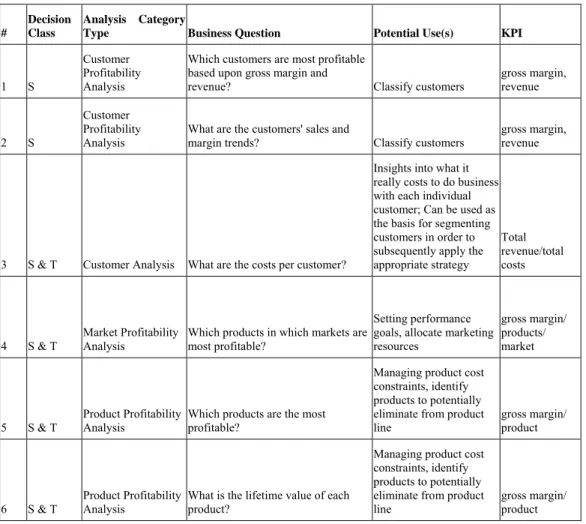
(KPIs). KPIs are used to measure a company’s performance and can help organizations to identify internal areas for process improvements and ultimately influence customer satisfaction and possibly customer retention. KPIs were identified from both experience and literature (Boon et al. 2002, Kellen 2002, Rust et al. 2004). Due to space limitations, Table 1 shows an excerpt of the summary of potential uses for a sample of the different types of CRM analyses and places them in the context of the CRM taxonomy. Table 1 also includes sample KPIs as well as sample business questions in the context of the CRM taxonomy excerpt. The full summary of the CRM taxonomy will be published in a subsequent paper.
3 Discussion
In this section, we discuss how our CRM taxonomy can be used to select and evaluate a data schema for CRM analyses, CRM vendors, CRM strategies and KPIs. We also discuss several queries that correspond to some sample business questions in the CRM taxonomy.
3.1 The Role of the CRM Taxonomy in
Designing Data Warehouses
Both a top-down and a bottom-up approach should be used with the CRM taxonomy to derive an appropriate data warehouse model as follows. The top-down approach would require that for each CRM business process, the relevant types of CRM analysis categories are identified. Then the Goal Metric Question (GQM) paradigm would be used to identify the relevant business goals, business questions, and metrics. For each business question, additional attributes needed to answer the question as well as additional attributes that may influence the metrics would also be identified. The bottom-up approach would require the identification of measures needed to compute each KPI. For each measure, the functional dependencies (FDs) would be determined. Those measures that have the same FDs should belong to the same fact schema, thus there would be a formal way of identifying relevant fact tables. Similarly, for each dimension, the dimension hierarchies would be developed by determining the FDs between dimension attributes. For those dimension attributes that have a FD, they should be represented as a hierarchy from the granular to the broader level.
3.2 Using the CRM Taxonomy to Evaluate
Data Schema for CRM Analyses
In order to objectively quantify the completeness and suitability of a CRM data warehouse model, we proposed two new metrics (Cunningham et al. 2004): CRM success ratio and CRM suitability ratio. The CRM success ratio
(rsuccess) is defined as the ratio of queries that successfully executed to the total number of CRM queries. A query is executed successfully if the results that are returned are meaningful to the analyst. The CRM success ratio can be
used to measure the completeness of CRM data warehouse models. The range of values for rsuccess is between 0 and 1. The larger the value of rsuccess, the more complete the model. The following equation defines the CRM success ratio: rsuccess = Qp / Qn, where Qp is the total number of queries that successfully executed against the model, and Qn is the total number of CRM queries.
The CRM suitability ratio (rsuitability) is defined as the ratio
of the sum of the individual suitability scores to the sum of the number of applicable analyses. The following equation defines the CRM suitability ratio: rsuitability =
ΣN
i=1 (wiCi) / N, where N is the total number of applicable analysis criteria, C is the individual score for each
analysis capability, and w is the weight assigned to each
analysis capability
#
Decision Class
Analysis Category
Type Business Question Potential Use(s) KPI
1 S
Customer Profitability Analysis
Which customers are most profitable based upon gross margin and
revenue? Classify customers gross margin, revenue
2 S
Customer Profitability Analysis
What are the customers' sales and
margin trends? Classify customers
gross margin, revenue
3 S & T Customer Analysis What are the costs per customer?
Insights into what it really costs to do business with each individual customer; Can be used as the basis for segmenting customers in order to subsequently apply the appropriate strategy Total revenue/total costs 4 S & T Market Profitability Analysis
Which products in which markets are most profitable?
Setting performance goals, allocate marketing resources gross margin/ products/ market 5 S & T Product Profitability Analysis
Which products are the most profitable?
Managing product cost constraints, identify products to potentially eliminate from product line gross margin/ product 6 S & T Product Profitability Analysis
What is the lifetime value of each product?
Managing product cost constraints, identify products to potentially eliminate from product line
gross margin/ product
Table 1: Excerpt of a Taxonomy of CRM Analyses (S=Strategic and T=Tactical)
Our CRM taxonomy in conjunction with the CRM suitability ratio (rsuitability) can be used to help an organization to determine the suitability of a data schema based upon the contextual priorities of the decision makers (i.e., based upon the company-specific CRM needs). The organization can use the CRM taxonomy to identify all of the CRM business questions (N) from each
of the CRM analysis category types that are relevant to it. Once a company has made that determination, then it can assign weights to each CRM business question (wi)
within the CRM analysis category types in order to reflect the level of importance that each business question has to the organization. The company can then evaluate whether or not the specific CRM data warehouse schema that is being evaluated can analyze each of the business questions within each of the CRM analysis category type that the organization selected. The closer the CRM suitability ratio (rsuitability) value is to 1, then the more
suitable the CRM data warehouse schema is for that particular company.
Our CRM taxonomy in conjunction with the CRM success ratio (rsuccess) can be used to help an organization to determine the completeness of the data schema for CRM analyses. This is important since the company’s business and analytical needs are likely to change over time; and the CRM data warehouse needs to be able to handle anticipated analytical needs (i.e. what is suitable today may not be suitable tomorrow). For example, a company can compute the CRM success ratio for each CRM analysis category type identified in the CRM taxonomy by dividing the total number of business questions within that category that the CRM data schema can answer by the total number of business questions within that CRM analysis category type. The result will be a measure of the completeness of the data schema to answer questions that are relevant to the specific CRM analysis category. Furthermore, the measure of
completeness for each CRM analysis category type can be summed to provide an overall measure of completeness for the CRM data schema.
3.3 Using the CRM Taxonomy to Evaluate
Analytical CRM Vendors
The CRM taxonomy can be used to select and evaluate analytical CRM vendors. This can be accomplished by first eliminating vendors whose product cannot handle CRM analysis category types (or subtypes) that are important to the organization. Of the vendors that were not eliminated, the CRM suitability ratio (rsuitability) and the CRM success ratio (rsuccess) can be computed. The vendors whose product objectively scored the highest can be further considered by the organization
3.4 Using the CRM Taxonomy to Identify
CRM Strategies and KPIs
Our CRM taxonomy can be used to help an organization identify appropriate strategies and KPIs. A company can review the CRM taxonomy to select the potential uses that it deems appropriate. Furthermore, the CRM taxonomy will allow the company to identify the CRM business questions to ask as well as the KPIs to measure in order to monitor and adjust their CRM programs.
3.5 Analyzing CRM Business Questions
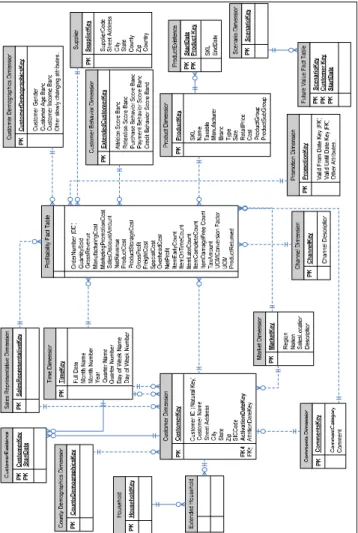
We now discuss a few of the business questions from our CRM taxonomy that were analyzed using Figure 2, which shows the starter model that we presented in an earlier paper (Cunningham et al. 2004). The SQL statement in Figure 3 is used to identify the most profitable customers based upon total revenue and gross margin. By excluding the time dimension, the customer profitability SQL statement identifies the customer’s historical lifetime value to the company. This is an important analysis that, in conjunction with the customer’s future value and the customer service interaction costs, is used to classify customers in one of the four CRM quadrants (Table 1), which subsequently can be used to determine the appropriate strategy for managing the customer.
The SQL statement in Figure 4 is used to determine the margins for each product and subsequently identifies products that potentially may be eliminated from the company’s product line. The ability to be able to determine the lifetime value of each product (irrespective of market) merely by modifying the SQL statement in Figure 4 to exclude the product code further illustrates the flexibility and robustness of the proposed CRM model
4 Conclusions
In this paper, we have presented a detailed taxonomy of CRM analyses together with how it can be used to select and evaluate CRM data warehouse schema, vendors, CRM strategies and KPIs. Our taxonomy can serve as a guideline for companies in the selection and evaluation of
Figure 2: A CRM Data Warehouse Model
Figure 3: Customer Profitability Analysis Query - Which customers are most profitable based upon
gross margin and revenue?
SELECT c.Year, b.MarketKey, b.LocationCode, b.Location, b.Description, b.CompetitorName, d.ProductCode, d.Name, Sum(a.GrossRevenue) AS TotalRevenue, Sum(a.GrossProfit) AS TotalGrossProfit, TotalGrossProfit/ TotalRevenue AS GrossMargin
FROM tblProfitabilityFactTable a, tblMarket b, tblTimeDimension c, tblProductDimension d
WHERE b.MarketKey=a.MarketKey And a.TimeKey=c.TimeKey And a.ProductKey=d.ProductKey
GROUP BY c.Year, b.MarketKey, b.LocationCode, b.Location, b.Description, b.CompetitorName, d.ProductKey, d.ProductCode, d.Name, b.MarketKey
ORDER BY Sum(a.GrossRevenue) DESC;
Figure 4: Product Profitability Analysis Query - Which products in which markets are most
profitable?
CRM data warehouses and related technologies. In addition to the design of the CRM data warehouse model, the selection of appropriate customer strategies and appropriate KPIs also contributes to the success or failure of CRM. To that point, our contributions include the creation of a taxonomy that can be used to select CRM strategies and KPIs. The taxonomy can also be used to
evaluate the capabilities of CRM data warehouse schemas as well as when evaluating vendors. Finally, we plan to: (1) extend the CRM taxonomy to include specific data warehouse design considerations for each of the CRM analysis categories; (2) refine the specific design methodology that incorporates the use of the CRM taxonomy; and (3) relate the specific CRM data warehouse design methodology to a broader data warehouse design approach.
5 References
Alvarez, J. G., Raeside, R., & Jones, W. B. (2006). The importance of analysis and planning in customer relationship marketing : Verification of the need for customer intelligence and modelling. Journal of Database Marketing & Customer Strategy Management, 13(3), 222-230.
Boon, O., Corbitt, B., & Parker, C. (2002, December 2-3). Conceptualising the requirements of CRM from an organizational perspective: A review of the literature. In Proceedings of 7th Australian Workshop on Requirements Engineering (AWRE2002), Melbourne,
Australia.
Cunningham, C., Song, I-Y., Jung, J. T., & Chen, P. (2003, May 18-21). Design and research implications of customer relationship management on data warehousing and CRM decisions. In proc. of 2003 Information Resources Management Association International Conference (IRMA 2003) (pp. 82-85),
Philadelphia, Pennsylvania, USA.
Cunningham, C., Song, I-Y., & Chen, P. (2004). Data Warehouse Design to Support Customer Relationship Management Analyses. In K. Davis & M. Ronthaler (Eds.), Proceedings of the 7th ACM International Workshop on Data Warehousing and OLAP (DOLAP
2004) (pp. 14 – 22), Washington, DC, USA. ACM Press.
Fitzgibbon, C. & White, L. (2005). The role of attitudinal loyalty in the development of customer relationship management strategy within service firms. Journal of Financial Services Marketing, 9(3), 214-230.
Gardner, S.R. (1998). Building the Data Warehouse.
Communications of the ACM, 41(9), 52-60
.
Jackson, T. W. (2005). CRM: From ‘art to science’.
Journal of Database Marketing & Customer Strategy Management, 13(1), 76-92.
Kellen, V. (2002, March). CRM measurement
frameworks. Available: http://www.kellen.net/crmmeas.htm
Lederer, C. & Hill S. (2001). See Your Brands Through Your Customer’s Eyes. Harvard Business Review on Customer Relationship Management, pp. 151-173.
Massey, A. P., Montoya-Weiss, M. M., & Holcom, K. (2001). Re-engineering the customer relationship: Leveraging knowledge assets at IBM. Decision Support Systems, 32(2), 155-170.
Myron, D., & Ganeshram, R. (2002, July). The truth about CRM success & failure. CRM Magazine. Available:
http://www.destinationcrm.com/articles/default.asp?Art icleID=2370
Panker, J. (2002, June). Are reports of CRM failure greatly exaggerated? SearchCRM.com. Available: http://searchcrm.techtarget.com/originalContent/0,2891 42,sid11_gci834332,00.html
Pass, L. & Kuijlen, T. (2001). Towards a general definition of customer relationship management.
Journal of Database Marketing, 9(1), 51-60.
Roberts, M. L., Liu, R. R. & Hazard, K. (2005). Strategy, technology and organisational alignment: Key components of CRM success. Journal of Database Marketing & Customer Strategy Management, 12(4),
315-326.
Rust, R. T., Lemon, K. N., & Zeithaml, V. A. (2004). Return on marketing: Using customer equity to focus marketing strategy. Journal of Marketing, 68(1),
109-139.
Winer, R. S. (2001). A framework for customer relationship management. California Management Review, 43(4), 89-108