Aire Valley Homes Leeds Limited
East North East Homes Leeds Limited
West North West homes Limited
Fire Safety Policy & Procedures
ALMO Business Centre Leeds
Navigation House
Leeds
LS10 1DJ
Date Issued: October 2012 Next Review: November 2013
Ref FS-POL001 Version No: 4
SECTION CONTENTS / INDEX PAGE
1.0 Policy Statement 6
2.0 Purpose 7
3.0 Scope 8
4.0 References 9
5.0 Responsibilities
5.1 West North West Homes Limited, Aire Valley Homes Limited East
North East Homes Limited 10
5.2 Chief Executive 10
5.3 Heads of Departments/Directors 11
5.4 Managers/Team Leaders/Heads of Departments 11
5.5 Employees 12
5.6 Safety Representatives 13
5.7 Fire Safety Team 13
6.0 Definitions
6.1 The Regulatory Reform (Fire Safety) Order 2005 15
6.2 The Responsible Person 16
6.3 Local Responsible Persons 17
6.4 Relevant Persons 17
6.5 Competent Person 17
6.6 Significant Findings 17
6.7 Evacuation Co-ordinator 17
6.8 Manager 17
7.0 General Procedures - Offices
7.1 Local Responsible Persons 18
7.2 Duties of Local Responsible Persons 19
7.3 Enforcement of the Fire Safety Order 19
7.4 Powers of the Enforcing Authority 20
7.5 The Fire Risk Assessment 20
7.6 Conducting a Fire Risk Assessment 21
7.7 The Emergency Evacuation Plan 22
7.8 Fire Wardens and Re-entry Procedures 24
7.9 Fire Drills 25
7.10 Assisted Evacuation 26
7.11 Personal Emergency Evacuation Plans for 26 Employees and Regular Visitors
7.12 Standard Emergency Evacuation Plans for 27 Occasional Visitors
7.13 Evacuation Chairs 28
7.14 General Fire Safety 28
7.14.2 Housekeeping 28
7.15 Close Down Procedures 29
7.16 Equipment and Machinery 29
7.17 Electrical Safety 29
7.18 Cooking 30
7.19 Provision of temporary Heating 30
7.20 Arson 31
7.21 Storage and Use of Dangerous Substances 31
7.23 Fire Fighting Equipment 34
7.24 Fire Warning Systems 35
7.25 Emergency Lighting 36
7.26 Escape Signs 37
7.27 Other Signs and Notice 38
7.28 Means of Escape 39
7.29 Installation, Testing and Maintenance 43
7.30 Fire Safety Records and Recording 45
7.31 Information Instruction and Training 45
7.32 Reducing Unwanted Alarms 48
8.0 Procedures - High Rise Accommodation 4 storeys and above and Sheltered housing
8.1 Fire Safety Team 50
8.2 Duties of the Fire Safety Team 50
8.3 Enforcement of the Fire Safety Order 51
8.4 Powers of the Enforcing Authority 51
8.5 The Fire Risk Assessment 52
8.6 Conducting a Fire Risk Assessment 52
8.7 The Emergency Evacuation Plan 55
8.8 Evacuation 56
8.9 Personal Emergency Evacuation Plans for 56
Tenants of sheltered accommodation
8.10 Systems of evacuation 56
8.11 General Fire Safety 57
8.12 Housekeeping 57
8.13 Storage and Use of Dangerous Substances 57
8.14 Managing Building Work and Alterations 57
8.15 Fire Fighting Equipment 59
8.16 Fire Warning Systems 60
8.17 Emergency Lighting 61
8.18 Escape Signs 62
8.19 Escape sign design 63
8.20 Other safety signs 63
8.21 Fire Action Notices 63
8.22 Means of Escape 64
8.23 Width and capacity of escape relating to community rooms and places of work within flats or sheltered housing schemes 65
8.24 Installation, Testing and Maintenance 66
8.25 Fire safety records and recording 69
8.26 Information Instruction and Training 69
8.27 Unwanted Alarms 69
8.28 Clear Area Policy (Zero Tolerance) and Managed Use Approach 71
9.0 Low Rise up to three storeys – procedures
9.01 The fire risk assessment 72
9.02 The Standards 72
10.0 Commercial Properties leased to other occupiers
10.01 Advice to be given to tenants 74
11.0 The Concordat Agreement with West Yorkshire Fire Authority 76
RECORD OF AMENDMENTS Amendment
The Chain of Responsibility The Body Corporate, Responsible Person Heads of Departments/ Directors ALMO Housing Management ALMO Asset Management Housing Team Managers Building Maintenance / Repair Team Managers Estate Shops - Communal areas High / Low Rise Flats Communal Areas Offices Fire Safety Team - Fire Risk Assessments Health and Safety Team Managers Planned Works Team Managers Mechanical & Electrical Team Managers ABCL Asset Management Teams Sheltered Complexes / Community Centres
FIRE SAFETY POLICY Section 1
1.0 Policy Statement
Aire Valley Homes Ltd, East North East Homes Ltd and West North West Homes Ltd are committed to taking all reasonable steps to protect our team members, residents, visitors, guests and contractors and those in the vicinity of our premises from the effects of fire. In doing so we will concentrate on fire prevention measures designed to eliminate or reduce fire hazards in our premises, thereby reducing the likelihood of a fire occurring and indeed the impact of any fire should one occur.
The likelihood of fire can, however, never be totally removed. We will, therefore, also ensure that we are vigilant and have suitable fire protection measures in place, to afford all occupiers of our buildings sufficient time to safely evacuate the premises or in the case of rented housing accommodation sufficient protective measures to safeguard them in the event of a fire.
We will take all practical steps to ensure that our management teams are provided with the necessary support to effectively manage fire safety in the premises under their control. We will also provide the assistance and training necessary for all team members to competently fulfil their fire safety duties and responsibilities.
We will aim to comply with the “Concordat”, a procedural document to deal with risk within high rise flats, agreed with the enforcing authority, West Yorkshire Fire & Rescue Service.
At a corporate level we will work within the guidelines set by Leeds City Council Fire and Safety Manager and the Leeds City Council Concordat with West Yorkshire Fire & Rescue Service. By means of the above measures, we will endeavour to ensure the fire hazards in our buildings are no greater than would normally be expected and that the risks to life from fire are reduced to a tolerable level in a pragmatic and incremental approach.
In return we expect all team members to contribute and comply with our fire safety procedures. You must ensure, so far as reasonably practicable, that you take care of your own safety, your colleagues’ safety and that of anyone affected by what you do or fail to do at work. In addition, you must not interfere with or misuse anything provided in the interests of fire safety.
The responsibility for implementing the fire safety policy lies with all Directors, Managers and Team Members. We expect them to plan and organise safe systems of work, maintain records and regularly review Fire Safety performance in line with our commitment to compliance with fire safety legislation. These actions will enable us to reduce the likelihood of a fire occurring and minimise the effects in the event that one does.
Fire Safety is, therefore, of paramount importance and, as a minimum, we aim to comply with legislative requirements and the British Standards relating to Fire Safety.
Section 2 2.0 Purpose
2.1 Aire Valley Homes Ltd, East North East Homes Ltd and West North West Homes Ltd have a duty to achieve compliance with the following legislation;
The Health and Safety at Work Etc. Act 1974
The Management of Health and Safety at Work Regulations 1999
The Building Regulations 2000 Approved Document B as amended
The Regulatory Reform (Fire Safety) Order 2005
The Health and Safety( Safety Signs and Signals ) Regulations 1996 2.1.1 The purpose of the policy is to ensure that West North West Homes Ltd , Aire Valley
Homes Limited and East North East Homes Limited achieve and maintain full
compliance with fire legislation and eliminate as far as is reasonably practicable the risk of injury to relevant persons from fire. This includes employees, other persons who may be affected by the companies work activities, or any person using its premises.
2.1.2 Fire is a significant hazard to the safety of both buildings and their occupants. All buildings and human activity represent some form of fire hazard and risk. The aim of Aire Valley Homes Ltd, East North East Homes Ltd and West North West Homes Ltd is to maintain an environment safe from fire by identifying the hazards and reducing the risk in the following areas to a minimum, within it duties:
As an employer
Within any workplace used by employees of West North West Homes Leeds Ltd, Aire Valley Homes Leeds Ltd, East North East Homes Leeds Ltd
As a Management Agent (Section 7)
Within Communal areas and dwellings of Sheltered housing accommodation
High and low rise communal areas of the premises,
To offer and provide fire safety advice for safety in the home
To maintain a policy of installation and maintenance of smoke detection in the home to a standard in line with national guidance
Section 3 3.0 SCOPE
3.1 This procedure applies to all employees. Although the final level of responsibility for implementing the policy rests with management, every employee must take an active role in effectively implementing the policy.
The policy is available for viewing on the intranet and hard copies will be available to site staff and other staff who do not have intranet access on request to their line Manager.
3.1.1 The Regulatory Reform (Fire Safety) Order 2005 (Fire Safety Order) was enacted on 1st October 2006 and replaces previous fire safety legislation. In order to comply Aire Valley Homes Ltd, East North East Homes Ltd and West North West Homes Ltd will:
Provide buildings in which fire precautions appropriate for their use are taken into account during design and construction.
Provide and maintain fire detection; alarm systems; emergency lighting; fire fighting equipment; evacuation signage; means of escape; and protected escape routes.
Ensure competent persons, who have sufficient knowledge and training, are available to implement its fire safety procedures.
Carry out suitable and sufficient fire risk assessments of all premises to assess the risk to relevant persons from fire and to evaluate the adequacy of the protection measures and compliance with all relevant legislation.
Train management and staff in relevant fire safety procedures and safe working practices and procedures relevant to this policy.
Periodically test monitor audit and review all procedures, fire prevention and protection measures and systems.
Section 4
4.0 REFERENCES
4.1 The Regulatory Reform (Fire Safety) Order 2005 www.opsi.gov.uk/si/si2005/20051541.htm
4.2 Communities and Local Government Fire Safety Guides www.firesafetyguides.communities.gov.uk
4.3 The Building Regulations 2000 Approved Document B 2007 (Volume 2 Buildings other than Dwelling houses.)
www.planningportal.gov.uk/england/professionals/en/1115314110382.html 4.4 The Health and Safety (Safety Signs and Signals) Regulations 1996
www.opsi.gov.uk/si/si1996/Uksi_19960341_en_1.htm 4.5 Offices and shops fire Safety Guide
http://www.communities.gov.uk/publications/fire/firesafetyrisk2 4.6 Sleeping accommodation fire safety guide
http://www.communities.gov.uk/publications/fire/firesafetyrisk4 4.7 Fire Safety in Purpose Built flats
http://www.local.gov.uk/c/document_library/get_file?uuid=71e152a6-9e0a-4810-aee6-498167664f79&groupId=10171
4.8 Fire Safety Provisions for certain types of existing housing
http://www.rother.gov.uk/media/pdf/p/p/Lacors_Fire_Safety_Guide_July_2008.pdf
4.9 Protocol between Fire Authorities and Housing Authorities
http://www.cieh.org/library/knowledge/housing/fire%20protocol%20final.pdf
4.10 The LCC - ALMO Fire Concordat Agreement
http://insite.leeds.gov.uk/Root%20document%20library/fire%20corporate%20concordat %20action%20plan%203-11%20(3).pdf
Section 5
5.0 RESPONSIBILITIES
5.1 Aire Valley Homes Ltd, East North East Homes Ltd and West North West Homes Ltd 5.1.1 Aire Valley Homes Ltd, East North East Homes Ltd and West North West Homes Ltd as
the employers are ultimately responsible in law for:
The fire safety of their employees whilst at work;
The conduct of the their undertakings, to ensure the fire safety of the public and other persons not in their employment;
5.1.2 To meet these responsibilities the Aire Valley Homes Ltd, East North East Homes Ltd and West North West Homes Ltd will ensure that:
There is an effective overall policy for the fire safety of employees and other persons who may be affected by the ALMO’s undertaking and that adequate funds are available to meet fire safety requirements;
Any necessary changes are made to Aire Valley Homes Ltd, East North East Homes Ltd and West North West Homes Ltd fire safety policy;
Aire Valley Homes Ltd, East North East Homes Ltd and West North West Homes Ltd is organised and has sufficient numbers of competent staff to meet its responsibility for fire safety.
5.1.3 Any person holding fire safety responsibilities is expected to familiarise themselves with the relevant legislation and supporting guidance or to seek the relevant training or information as required enabling them to carry out their duties.
The day to day responsibilities for fire safety matters are delegated as follows: 5.2 Chief Executive – the Body Corporate
5.2.1 Within the Fire Safety Order there is reference to the ‘Responsible Person’.
The Responsible Person will be responsible not only for the safety of employees, but for that of any person lawfully on the premises or in the immediate vicinity of the premises and at risk from a fire on the premises. In a workplace the employer is the Responsible Person if the workplace is under the employer’s control. The Chief Executive has on behalf of the appropriate ALMO the ultimate responsibility for the safety of employees even where others have obligations in respect of premises in so far as:
To take such general fire precautions as will ensure so far as is reasonably practicable the safety of his employees;
In relation to relevant persons who are not employees, take such general fire precautions as may reasonably be required in the circumstances;
Establish procedures to be followed in the event of serious and imminent danger to relevant persons;
Arrange for fire safety matters to be discussed by the Corporate Management Team;
Ensure arrangements are made for joint consultation of all employees;
Ensure that sufficient numbers of competent staff are appointed to assist in meeting fire safety responsibilities;
Ensure that the Senior Emergency and Safety Management Team periodically consider and review all significant fire safety issues and developments.
5.3 Heads of Departments/Directors
5.3.1 Are responsible for ensuring that the discharge of the fire safety function on behalf of the Chief Executive as it affects each of their directorates/departments, together with the training, administration and day to day working requirements, justify the need for delegation to personnel under their control. For this purpose, Heads of
Departments/Directors are responsible to the Strategic Director for all matters relating to fire safety within their service unit and is achieved by the following:
Implement and administer throughout their directorate all legislation and policy decisions concerning fire safety, and to ensure that employees at all levels are aware of their responsibilities;
Corporate fire safety arrangements, regulations, information, instructions guidance and safe working arrangements (systems of work) are where necessary to safeguard against the risk of fire are disseminated to those employees for whom they are responsible;
Ensure that adequate fire safety information, instruction and training is provided to all employees within their directorate;
Requisition for sufficient funds to meet the foreseeable fire safety requirements of their directorate;
Written records are made and kept for all fire safety arrangements;
Arrangements are made for joint consultation with all employees;
Ensure that “Local” Responsible Persons are nominated who are responsible for fire safety management within their workplace or work area;
Ensure that fire risk assessments are carried out in premises within their Directorate including premises that the ALMO does not own but at which any employees under their control work
Maintain fire safety when reorganising workplaces, changing systems of work or introducing new plant or machinery;
Ensure that the fire safety responsibilities of their Managers are carried out;
Identify the fire safety training requirements for employees and ensure that employees are competent in the fire safety aspects of the work they are required to undertake;
Ensure that where required a sufficient number of Fire Wardens are appointed for buildings or service areas liaising with other service units (in multi functional buildings).
5.4 Managers/Team Leaders/Heads of Departments
5.4.1 Managers are responsible to their Directors for all matters relating to fire safety within the buildings or service units in which they have control. This will be achieved by:
Corporate fire safety arrangements, instructions and guidance are practised and information relating to regulations and codes of practice are disseminated to those employees for whom they are responsible;
Employees under their control comply with safe working arrangements and systems of work as they relate to fire safety;
Suitable and sufficient fire safety information, instruction, training and supervision are provided for all employees in their section or building;
Liaise with the Emergency and Safety Team to ensure that additional fire safety training is provided for the appointed Fire Wardens within their areas of
responsibility in order for them to carry out their roles;
All new employees attend a health & safety induction course that covers basic fire safety procedures and refresher training is carried out periodically;
To maintain and update their own skills, information and knowledge relating to fire safety matters;
Plant, machinery and equipment used at work as it relates to fire safety, is safe, maintained in good working order, used in accordance with the manufacturers instructions and inspection and maintenance records kept;
Adequate training or supervision is available at all times where necessary, especially where young people and lone workers are involved.
Managers are responsible for the maintenance of ALMO properties and ensuring that buildings are safe working environments meeting health and fire safety requirements.
Managers will provide advice and support and guidance to local responsible persons for any part of the premise for which they have any control over the building management.
The reporting and recording of fires, near misses and false alarm activations, and their investigation as appropriate
5.5 Employees
5.5.1 All employees will:
Act in accordance with all fire safety procedures, safe systems of work or instructions that have been initiated by management for their health and safety;
Not intentionally or recklessly interfere with or misuse anything provided in the interests of fire safety;
Not do anything that will place themselves or other people at risk from fire;
Report without delay to their line Manager any defects or concerns regarding fire safety including hazards, maintenance issues, general fire precautions or any preventative or protective measures in place to reduce the risk to
employees from fire;
Participate fully in fire safety training, as agreed with their Manager;
Co-operate in undertaking fire drills and evacuation;
Inform line Managers of any disability that may impact on their safe egress from premises in the event of an emergency situation.
Report any near misses, occurrences of fire or false alarm activations to managers
5.6 Safety Representatives
5.6.1 In addition to their general duties as employees, safety representatives have fire safety responsibilities to their members:
Promote co-operation between management and employees and monitor the local arrangements for affecting the authority’s fire safety policy;
Make periodic inspections of selected areas of the authority’s work places and equipment in the interest of fire safety in conjunction with management and/or The Emergency and Safety Team.
5.7 Fire Safety Team - ABCL
5.7.1 The Fire Safety Team will have the following responsibilities:
Provide advice and assistance as the ALMO’s competent persons, on fire safety matters to enable management to meet their statutory obligations and ensure consistent application of the fire safety policy;
Provide an appropriate enforcement role, when a discernible breach of fire safety legislation or none compliance of any corporate fire safety procedures is apparent. The Fire Safety Team will inform the responsible Team Leader of the problem and advise the appropriate action/s to resolve the issue.
The maintenance, amendment and distribution of the fire safety policy and supporting documents;
Advise and assist management to fulfil their responsibilities for the fire safety of employees and others affected by their actions;
Advise on the design and implementation of safe systems of work, selection, provision and use of appropriate fire safety equipment and safety aspects in the design and use of plant and equipment;
Promote fire safety training for all employees in collaboration with all Heads of Staff, Directors and Team Leaders;
Promote where necessary, fire safety training for all Fire Wardens liaising with health and safety training teams;
Liaise with statutory bodies such as The Health and Safety Executive and the Fire Service as necessary;
Carry out an initial fire risk assessment:
With regards a place of work the assessment will be reviewed in line with schedule of assessments document, to ensure that the provisions required by the legislation are being maintained
A review shall also be requested by Managers if there is a major change in the working conditions or layout of the premise.
With regards communal areas within high rise flats and sheltered accommodation the assessment will be reviewed in line with schedule of assessments document
With regards low rise (up to two floors) will be reviewed in line with the schedule of assessments
The Fire Safety Team will draw to the attention of the appropriate Head of Staff concerns as to any unsafe working practices, procedures, plant or any breach of legislation concerning fire safety and wherever possible, advising on remedial action;
Assist Managers, through on site visits where appropriate, to ensure that contractors comply with all fire safety considerations and other relevant requirements affecting their undertakings on behalf of the ALMO;
Promote a positive fire safety culture in conjunction with line management, encouraging fire safety consciousness at all levels within the organisation;
The ALMO’s safety officers are authorised to enter any place of work owned, occupied or controlled by the ALMO, or any site or work place occupied by a contractor employed by the ALMO, and there, order the immediate stoppage of work where there is serious fire risk, whether they are employed by the ALMO or not.
Follow up the reports of near misses, fires and false alarms and investigate appropriate
Section 6
6.0 DEFINITIONS
6.1 The Regulatory Reform (Fire Safety) Order 2005 6.1.1 Background
The Fire Safety Order applies in England and Wales. It simplifies, rationalises and consolidates existing fire safety legislation and provides for a risk-based approach to fire safety allowing more efficient and effective enforcement by the Fire and Rescue Service.
It covers general fire precautions and other fire safety duties which are needed to protect ‘relevant persons’ in case of fire in and around most ‘premises’. The Order requires fire precautions to be put in place ‘where necessary’ and to the extent that it is reasonable and practicable in the circumstances of the case.
Responsibility for complying with the Fire Safety Order rests with the ‘Responsible Person’. In a workplace, this is the employer and any other person who may have control of any part of the premises, e.g. the occupier or owner. In all other premises the person or people in control of the premises will be responsible. If there is more than one Responsible Person in any type of premises (e.g. a multi-occupied complex), all must take all reasonable steps to co-operate and co-ordinate with each other.
The Responsible Person or a competent person nominated by the Responsible Person must carry out a fire risk assessment which must focus on the safety in case of fire of all ‘relevant persons’.
It should pay particular attention to those at special risk, such as persons who require assisted evacuation, those that are known to have special needs and young persons and must include consideration of any dangerous substance liable to be on the premises.
The fire risk assessment will help identify risks that can be removed or reduced and to decide the nature and extent of the general fire precautions that the responsible person needs to take.
6.1.2 A duty holder has been identified as the “The Responsible Person”.
6.1.3 A key pillar of the order is that it is for the Responsible Person to demonstrate that they have complied with the duties placed upon them by the order.
6.1.4 At the core of the legislation lies the fire risk assessment which is one of the duties imposed on the Responsible Person to protect relevant persons in case of fire. This is an organised appraisal of the work activities and the workplace to enable the potential fire hazards to be identified, to decide who (including employees, visitors and persons in and around the premises) might be in danger in the event of fire, and
their location. The risks arising from the hazards are evaluated and decisions made on whether the existing fire precautions are adequate, or whether more needs to be done. 6.1.5 The fire risk assessment may be carried out by a competent person appointed by the
Responsible Person. The competent persons for the ALMO will be the Fire Safety Team or any appointed fire risk assessor.
6.1.6 Any organisation employing five or more people, if premises are licensed or an alterations notice is in force, must record the significant findings of the assessment. 6.1.7 To comply with The Fire Safety Order the ALMO must:
Appoint one or more competent persons, depending on the size and use of the premises, to carry out any of the preventive and protective measures required by the Order. A competent person is someone with enough training,
measures properly; Having regard to that the ALMO has appointed the following as competent persons
ABCL Fire Safety Team
SBS Fire Safety Solutions
SGS Fire Safety Solutions
Further additional support is also available from Leeds City Council via the LCC - Corporate Fire & Safety Manager.
Provide employees with clear and relevant information on the risks to them identified by the fire risk assessment, about the measures that have been taken to prevent fires, and how these measures will protect them if a fire breaks out;
Consult employees (or their elected representatives) about nominating people to carry out particular roles in connection with fire safety and about proposals for improving the fire precautions;
Before employing a child, provide a parent with clear and relevant information on the risks to that child identified by the fire risk assessment, the measures that have put in place to prevent/protect them from fire and inform any other responsible person of any risks to that child arising from their undertaking;
Inform non-employees, such as temporary or contract workers, of the relevant risks to them, and provide them with information about who are the nominated competent persons, and about the fire safety procedures for the premises;
Co-operate and co-ordinate with other Responsible Persons who also have premises in the building, inform them of any significant risks found and how these can be reduced/controlled. This includes any risks which might affect the safety of employees;
Provide the employer of any person from an outside organisation who is working in the premises (e.g. an agency providing temporary staff) with clear and relevant information on the risks to those employees and the preventive and protective measures taken. They must also be provided with appropriate instructions and relevant information about the risks to them;
Consider the presence of any dangerous substances and the risk this presents to relevant persons from fire;
Establish a suitable means of contacting the emergency services and provide them with any relevant information about dangerous substances;
Provide appropriate information, instruction and training to employees, during their normal working hours, about the fire precautions in the workplace, when they start work, and from time to time throughout the period they are employed;
Ensure that the premises and any equipment provided in connection with fire fighting, fire detection and warning, or emergency routes and exits are covered by a suitable system of maintenance and are maintained by a competent person in an efficient state, in efficient working order and in good repair.
6.2 The Responsible Person
6.2.1 The employer is the Responsible Person if the workplace is under the employer’s control. Unconditional obligations are imposed on employers by the regulations in that the employer has the ultimate responsibility for the safety of their employees in the case of fire even where others have obligations in respect of the premises.
6.2.2 Where there is no employer in the premises the owner or occupier is the Responsible Person.
6.2.3 If there is more than one Responsible Person (e.g. multi occupied premises) they must take all reasonable steps to co-operate and co-ordinate with each other.
6.2.4 In many cases there will be more than one person subject to the obligations of a Responsible Person for premises. The level of responsibility will vary according to the employment position (total responsibility for an employer) and the degree to which the person can exercise control over fire safety in the premises. This is a deliberate aspect of The Fire Safety Order to allow enforcement action to be taken against the person who is culpable and/or in a position to remedy contraventions.
6.2.5 Responsible Person’s duties are extended to include any person who by virtue of any contract has obligations of any extent in respect of maintenance of the premises (and anything in them) i.e. contract for the installation of a fire alarm or sprinkler system.
Directors
6.2.6 Are responsible for ensuring that “Local” Responsible Persons are identified for all premises under their control.
6.3 Local Responsible Persons
6.3.1 Persons nominated by the Responsible Person who are responsible for fire safety management within their workplace, work area, event or function.
6.4 Relevant Persons
6.4.1 Any person lawfully on the premises and any person in the immediate vicinity, but does not include fire fighters carrying out fire fighting duties.
6.5 Competent Person
6.5.1 A person with enough training, experience, knowledge and other qualities to enable them to assist in undertaking the preventative and protective measures.
6.6 Significant Findings
6.6.1 Significant hazards are identified in the fire risk assessment. That is, those hazards which might pose serious risk to workers or others who might be affected by the work activities if they were not properly controlled.
6.6.2 They are the existing measures in place and the extent to which they fail to control the risks (this need not replicate details of measures more fully described in works manuals etc. but could refer to them).
6.6.3 They should include the persons who may be affected by these significant risks or hazards, including any groups of employees who are especially at risk.
6.7 Emergency Incident Officer (EIO) Evacuation Co-ordinator (Fire Wardens)
6.7.1 A role carried out by a senior person in a building at the time of an evacuation involving collating information from Managers or Fire Wardens, liaising with the emergency services on the status of the buildings occupants and re-entry into the building. This role may be undertaken by a senior Fire Warden if appointed.
6.8 Manager
6.8.1 The person (Manager or Supervisor) who is directly responsible for supervising an employee. Or who has responsibility for a workplace where one or more employees may work or visit.
Section 7
7.0 GENERAL PROCEDURES – Places of work 7.1 Local Responsible Persons
7.1.1 Within the orginisation, Heads of staff and Directors of Orginisation are responsible for ensuring that “Local” Responsible Persons are identified for all workplaces or work areas. Dependant on the category of the building this may be Managers or a senior person within the workplace or work area.
7.1.2 External Events
In the event of an orginised external event The senior person organising the external event will be the nominated Responsible Person. The senior person responsible should discuss the event with a member of the Fire Safety Team to ensure that a suitable and sufficient fire risk assessment has been carried out
7.1.3 Hiring or Leasing Premises for Short Term Use
Managers will as part of the contract of hire, establish the fire safety responsibility of those leasing the building and establish and document the Responsible Person for each individual event or function, and make clear their legal duties to them.
7.1.4 Prior to public admission and any dual usage Responsible Persons should carry out an inspection of the premises and record the results of this inspection. Dual usage
includes the use of the premises for stage plays, dances, youth clubs and other community activities. Prior to each event, those parts of the premises, which are to be used by the public, should be examined to ensure that: See notes for guidance 1.
Exit routes are unobstructed.
Exit doors open easily.
Exit routes and doors are indicated with fire safety signs and notices.
Any Fire alarm installed is working, if none is installed, that there is a means for raising the alarm in the event of a fire
Any emergency lighting installed is working, or there is arrangements in place to provide escape lighting
There is a fire evacuation procedure and everybody is aware of its content 7.1.5 Use of Premises Out of Hours
The use of premises after normal hours requires careful consideration of all aspects of fire safety. For example, there is a need for security in parts of the building which are not in use, but the provision of this security may result in exits being locked. When premises are used out of normal hours and facilities are secured, those responsible should be aware of all safety routines, including the whereabouts of the nearest
available telephone. At end of use a thorough close down procedure should be followed to ensure that there are no other possible causes of
ignition present. They should also ensure that all doors and windows are properly secured to prevent unauthorised access to ALMO buildings.
7.1.6 Public Entertainment Licence Premises
A premises check list itemising the Responsible Person’s fire safety management responsibilities prior to public admittance for places of assembly is available on
7.2 Duties of Local Responsible Persons
7.2.1 Take responsibility for the fire safety of the workplace or work area which they manage:
Provide assistance to the Building Manager to ensure that fire hazards are identified, risk assessments are completed satisfactorily, safe working methods are practiced at all times, and all the necessary controls identified in the fire risk assessment are maintained. The fire Safety Checks will form part of the health and safety audit procedure for any office.
Ensure one or more competent persons have been appointed to assist and provide advice on fire safety.
Ensure that any measures required in the fire risk assessment are implemented by the specified deadline and that the fire risk assessment is reviewed at least annually or whenever significant change occurs to the building or the activities carried out.
Ensure that an emergency plan is established and promulgated for the safe evacuation of the premises in the event of a fire. The plan should be based on the outcome of the fire risk assessment. Assistance and advice where
necessary should be sought from the Building Manager and/or The Emergency and Safety Team.
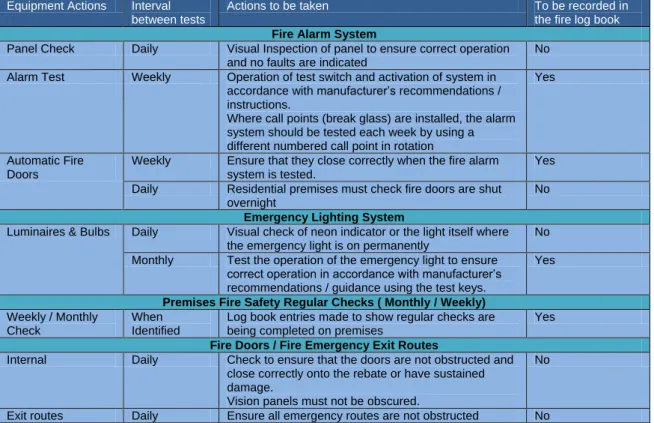
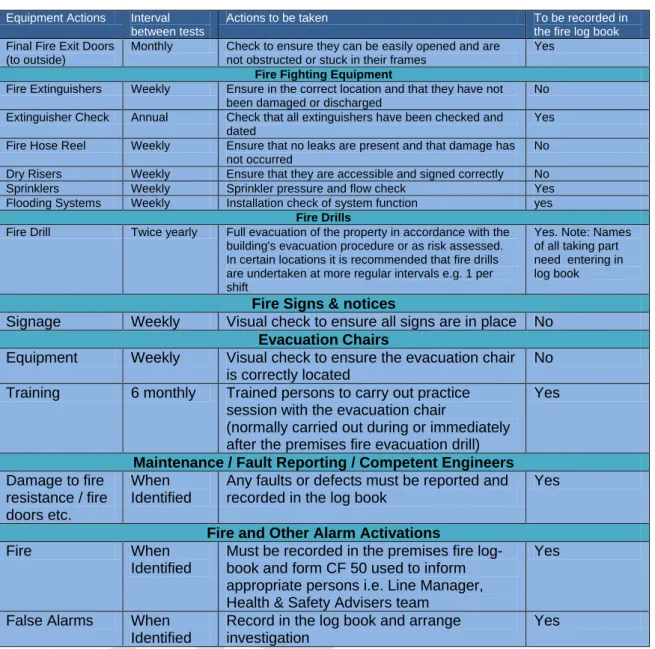
Through liaison with the Building Manager where necessary ensure that the premises and any equipment provided in connection with fire fighting, fire detection and warning, or emergency routes and exits are covered by a suitable system of maintenance, and are maintained by a competent person in an efficient state, in good working order and in good repair.
Ensure the buildings fire log book is maintained and up to date in relation to maintenance, inspections, fire drills, incidents and training.
http://intranet.leeds.gov.uk/files/Intranet2008/2010/13/lcc%20%20log%20book %20ver1.pdf
Ensure regular inspections of the workplace are undertaken to ensure that good housekeeping is maintained and there is an effective means of escape for all relevant persons.
Consult management, employees and their safety representatives about the persons nominated to carry out particular roles in connection with fire safety (e.g. Fire Wardens) and about proposals for improving the fire precautions.
Ensure provision has been made for all people working within the premises to be provided with suitable and relevant fire safety information and training
7.3 Enforcement of the Fire Safety Order
7.3.1 West Yorkshire Fire and Rescue Authority will enforce the Fire Safety Order in most workplaces, exceptions are:
Crown-occupied/owned premises where Crown fire inspectors will enforce;
Premises within armed forces establishments where the defence Fire and Rescue Service will enforce;
Certain specialist premises including construction sites not sharing means of escape from an existing building, ships (under repair or construction) and nuclear installations, where the Health and Safety Executive will enforce;
Sports grounds and stands designated as needing a safety certificate by the local authority, where the local authority will enforce.
7.4 Powers of the Enforcing Authority
7.4.1 The Fire Service has the power to inspect all premises to check that they are compliant with the duties imposed by the Fire Safety Order:
They will look for evidence that a suitable and sufficient fire risk assessment has been carried out, recorded and the significant findings of that assessment have been acted on.
If they are dissatisfied with the outcome of the fire risk assessment or the action taken an Enforcement Notice that requires certain improvements to be made, or in extreme cases a Prohibition Notice that restricts the use of all or part of the premises until improvements are made.
If the premises are considered by the Fire Service to be high risk, they may issue an Alterations Notice that, amongst other things, requires that they be informed before any changes are made to the premises or the way they are used.
Failure to comply with any duty imposed by the Order or any notice issued by the Fire Service is an offence.
The Order does not place the enforcing authority under a specific express duty to issue alterations, enforcement or prohibition notices. It gives them powers to do so where they deem necessary.
The ALMO has the right of appeal to a magistrate’s court against any notice issued and where the ALMO agrees that there is a need for improvements to the fire precautions but disagree with the enforcing authority on the technical solution to be used (e.g. what type of fire alarm system is needed) this may be referred for an independent determination.
During the inspection the inspecting officer may wish to view the following documents:
Fire risk assessment;
Fire precautions log book;
Records of staff training and drills;
Records of testing and maintenance of fire fighting equipment;
Records of testing and maintenance of all fire safety systems including fire alarms, emergency lighting, sprinkler systems and smoke
ventilation systems.
The inspector may also wish to inspect all or part of the premises and to talk to members of staff.
7.5 The Fire Risk Assessment
7.5.1 A fire risk assessment is an organised and methodical look at the premises, the activities carried on there and the likelihood that a fire could start and cause harm to those in and around the premises. The primary purpose of a fire risk assessment is to safeguard life, however many of the preventive and protective measures taken will offer some protection to the property.
7.5.2 The aims of the fire risk assessment are:
To identify the fire hazards;
To reduce the risk of those hazards causing harm to relevant persons to as low as reasonably practicable;
To decide what physical fire precautions and management arrangements are necessary to ensure the safety of people in a building if a fire does occur;
Hazard: anything that has the potential to cause harm from fire;
Risk: the likelihood and consequences of that harm occurring;
7.6 Conducting a Fire Risk Assessment
7.6.1 The Fire Safety Team or appointed assessors will undertake fire risk assessments for all ALMO owned and operated premises in line with West North West Homes Leeds Ltd, Aire Valley Homes Leeds Ltd, and East North East Homes Leeds Ltd fire policy. Ownership of the assessment is important and is best achieved if the Local
Responsible Person for the building is partner to the process.
Every premise used as a workplace or having common areas will receive a full fire risk assessment. Following completion of the risk assessment they will be reviewed on the basis of risk and following a fire or after significant alterations to premises i.e.
Workplace – Initial assessment and then periodically reviewed on the basis of the recommendations of the fire risk assessment
High rise Flats (three storeys and over) – Initial assessment and then at 14 month intervals to observe premise operating throughout the year.
Sheltered Housing – Initial assessment and then at 14 month intervals to observe premise operating throughout the year.
Two storey – Initial assessment and then at 20% of housing stock per year.
7.6.2 All fire risk assessments undertaken on ALMO premises will be recorded and held in a central location. Where appropriate a copy will also be kept on site.
7.6.3 Copies of all fire risk assessments will be available to site management however, all relevant information regarding the assessment should be held in a central point within the organisation, namely the Asset Management Fire Section with all other relevant fire safety information so that it is easily accessible for reference and available when the Enforcing Authority inspects the premises.
7.6.4 ALMO employees will co-operate with other employees in shared accommodation or other persons who rent or lease land or property from the ALMO by sharing fire risk assessment information.
7.6.5 All fire risk assessments will be recorded using the PAS 79 method based on the LCC Standard form and guidance. Forms and guidance can be downloaded from the intranet. http://insite.leeds.gov.uk/toolkits/Pages/Fire-safety.aspx
7.6.6 When considering the identification of fire hazards, people at risk and the evaluation, removal, reduction, and protection from risk particular attention should be given to:
Ensuring that significant dangerous substances are identified and ensuring the risk related to the substance is either eliminated or reduced.
Persons especially at risk e.g. any persons such as disabled, those who may require assisted evacuation, young persons and lone workers.
The necessary and mandatory need for fire compartmentation in line with National Guidance applicable to the building
7.6.7 All persons at risk from fire must be identified. To do this identify where all staff are working, either at permanent workstations or at occasional locations around the
premises, and to consider who else may be at risk, such as service users, visiting contractors etc., and where these people are likely to be found.
7.6.8 Particular attention should be paid to people who may be especially at risk such as:
Employees who work alone and/or in isolated areas, e.g. cleaners, security staff;
People who are unfamiliar with the premises, e.g. seasonal workers, contractors, visitors and customers;
People who require assisted evacuation or those who may have some other reason for not being able to leave the premises quickly, e.g. elderly customers or parents with children;
Other persons in the immediate vicinity of the premises;
People with language difficulties.
7.7 The Emergency Evacuation Plan
7.7.1 An emergency evacuation plan for offices will need to be developed circulated and communicated for dealing with any fire situation in all ALMO buildings. The purpose of an emergency plan is to ensure that all the people in the premises know what to do if there is a fire and that the premises can be safely evacuated. Each building will require specific plans dependant on the type, size, use and occupancy.
http://insite.leeds.gov.uk/DoItOnline/Do%20it%20online%20forms/sample%20fire%20em ergency%20action%20plans%20with%20logo%20feb2012.doc
Note in relation to flats and the “Stay put Policy” there is a standard template in relation to the emergency evacuation procedures, see appendices.
7.7.2 Further guidance for flats with common areas, with regards the action to take if the building cannot be reoccupied due to a major fire is contained in the business continuity plan.
7.7.3 The emergency plan should include where appropriate;
How people will be warned if there is a fire.
What staff, residents should do if they discover a fire.
How the evacuation of the premises should be carried out.
The needs or risks relating to individuals. Consider residents in sheltered accommodation, flats.
Identification and use of protected areas for horizontal evacuation.
Where people should assemble after they have left the premises and procedures for checking whether the premises have been evacuated.
Identification of key escape routes, how people can gain access to them and escape from them to a place of total safety.
Arrangements for fighting fire by any trained staff, the duties and identity of staff that have specific responsibilities if there is a fire e.g. Fire Wardens.
Arrangements for the safe evacuation of people identified as being especially at risk, such as residents and others with disabilities, children and people working alone and members of the public.
Any machines, processes, appliances or power supplies that need to be stopped or isolated if there is a fire.
Specific arrangements, if necessary, for high-fire-risk areas.
Contingency plans, such as restrictions on the use of the building for when life safety systems, such as evacuation lifts, fire detection and warning systems, sprinklers or smoke control systems are out of order.
How the Fire and Rescue Service and any other necessary services will be called and who will be responsible for doing this.
Procedures for meeting the Fire and Rescue Service on their arrival and notifying them of relevant information such as the locations of any persons still in the building or any special risks, e.g. the location of highly flammable materials.
7.7.4 A prerequisite of effective fire emergency procedures is the ability to account for, or identify as missing, all persons who were in a building at the time the alarm was raised. A roll call can be taken in buildings where access and egress can be accurately
controlled.
7.7.5 In large multi-functional, multi occupied or public buildings with uncontrolled access it may be impractical to use an ‘in-and-out book’ to account for all people in the building. In these circumstances the role of Fire Wardens is essential. Part of that role is to carry out a sweep of their designated area, checking for signs of fire and report to the EIO that their part of the building has been evacuated.
7.7.6 Systems which take a nominal roll are in general slow for large buildings and inaccurate for the following reasons:
Staff do not always sign out;
Visitors and contractors forget to sign in and out;
Staff may leave the building for a variety of reasons.
In these cases the attending Fire Officer may be informed that staff or visitors are unaccounted for and Fire Fighters may be committed into the building unnecessarily. The Fire Warden sweep of the building allows the Emergency incident officer (EIO) to inform the Fire Service, to the best of the ALMO’s ability, whether the building is or is not evacuated and the location of any fire.
7.7.7 Visitors
In buildings not open to the public, arrangements should be made to ensure that visitors are logged in and out of a building, using a visitors book or similar. The person hosting the visitor should ensure that they are made aware of the fire evacuation procedures for the premises. In the event of a fire evacuation, the person hosting the visitor(s) is responsible for escorting them to the fire assembly point.
7.7.8 Contractors
Contractors should also be logged in and out of premises. Unless they are to be constantly supervised by ALMO personnel, they should also be given information about the site's fire evacuation procedures that they should then follow in the event of a fire
evacuation. The Contractor Site Information Sheet issued by Managers/Team Leaders can be used for this purpose.
7.7.9 Regardless of the number of people in the premises, it is essential that responsibilities for actions in the event of fire are clearly assigned. There should also be deputies nominated to take over if the key individuals are absent.
7.7.10 In all occupied premises with the exception of flats, a person should be nominated to take control of the evacuation and assume the role of the Evacuation Co-ordinator (EIO). The responsibilities of this role include:
Take overall control of the evacuation;
Ensure that other people with specific duties have taken relevant action;
Account for all persons in the premises;
Liaise with the Fire and Rescue Service;
Initiate any additional response in relation to persons requiring assisted evacuation.
7.8 Fire Wardens and the re-entry procedure
7.8.1 The Regulatory Reform Order places a responsibility on the ALMO to nominate a suitable number of staff to ensure that the evacuation procedures can be effectively implemented and managed and occupants of buildings are evacuated safely in the event of fire. What this means in practice is that the Fire Warden and re-entry procedures are now a requirement.
7.8.2 There are three aspects to this requirement:
Ensuring that everyone leaves the building and is accounted for:
For those buildings or areas where it is a practical proposition for a roll call to take place the Manager or senior person should do this and report the outcome to the Emergency incident officer (EIO). However, in the larger buildings it is often impractical to take formal role calls following an evacuation. Therefore it is necessary to have robust procedures in place for ensuring that everyone leaves the building.
What this means in practice is that Fire Wardens need to be nominated to sweep each floor and encourage people towards the nearest safe exit route. Anyone who is not out of the building or areas that were not able to be checked can then be reported to the EIO and thereafter to the Fire Service when they arrive.
Preventing re-entry until the incident is dealt with:
The principle of nominating Fire Wardens is well established and has been custom and practice within the ALMO for some time. For the majority of
departments they will need to do no more than review their existing arrangements to ensure that sufficient staff is nominated to ensure that all exits are guarded to prevent re-entry. Departments or buildings that currently do not have Fire Wardens nominated should do so.
In buildings occupied by more than one department, co-ordination will be required to ensure that duties are fairly spread between all relevant parties.
Communicating the signal that it is safe to re-enter the building:
The fire warden is responsible for communicating the signal to re-enter the building to the buildings occupants at the assembly point, and dependant on the type of building to Managers and/or Fire Wardens when the Fire Service have indicated that they are satisfied that it is safe for the building to be reoccupied.
7.8.3 Directors through liaison with their Managers and other Directors in multi functional buildings should ensure that a suitable number of staff are nominated to undertake these roles within their buildings or service areas. The Emergency and Safety Team are available to provide further advice and guidance where necessary.
7.8.4 Specific duties of Fire Wardens are available in appendix 1 “Specific Duties of a Fire Warden and EIO, but include:
On hearing the fire alarm, they should check that the floor or section of the premises allocated to them has been fully evacuated by all persons making sure toilets, rest rooms, etc. are checked for signs of fire, if safe to do so.
Assisting and encouraging those on the premises to leave, including where necessary, persons who need assistance to evacuate the building.
Carrying out 'first aid' fire fighting, as appropriate but without putting themselves at personal risk.
Guiding persons to the ‘assembly point’, closing fire doors en route.
Ensuring that the Evacuation Co-ordinator is aware that their area has been checked.
Assisting with the care and control of all persons evacuated from the premises.
Not allowing anyone to re-enter the building until informed that it is safe to do so by the Fire and Rescue Service.
7.8.5 In the larger buildings and where there are significant numbers of mobile people and visitors and it is not practical to keep a formal roll call the Fire Wardens must be familiar with their respective areas and in the event of a fire or activation of the fire alarm ensure that people are directed towards the most appropriate exit. They should regularly inspect their designated areas to ensure that all fire exit routes are free from hindrance and fire precautions provided are effective.
7.8.6 Fire Wardens should have additional training in order to fulfil their role. See Appendix 1 7.8.7 Fire Wardens should be provided with a high visibility jacket to make them clearly
visible in the event of an evacuation.
7.8.8 In larger buildings the use of portable radio communications equipment will greatly assist in the co-ordination of the evacuation.
7.9 Fire Drills
7.9.1 Emergency evacuation plans once developed and once training has been given will need to be evaluated to test their effectiveness. Fire evacuation drills will be carried out in all buildings.
7.9.2 Fire drills should be carried out at sufficient intervals to ensure that all members of staff and others who may occupy the building take part in at least one evacuation drill per year. The frequency may need to be increased dependant on the type and use of the building.
7.9.3 A well planned and executed fire evacuation drill will confirm understanding of the evacuation plan and assist in providing helpful information for future training.
7.9.4 The Local Responsible Person should determine the possible objectives of the evacuation drill such as:
Identifying any weaknesses in the evacuation strategy;
Testing of the procedures after any recent building alterations or changes to working practices or identified in the fire risk assessment;
Familiarising new staff or occupants of the building;
Ensuring that the procedures for the safe evacuation of any persons requiring assistance are satisfactory;
Records should be kept of fire evacuation drills and the length of time taken to completely evacuate the building to a place of ultimate or relative safety dependant on the type and use of the building.
7.9.5 The Health and Safety team will co-ordinate fire evacuation drills for any multi functional buildings.
7.9.6 Guidance and the criteria for the assessment of fire drills are available on appendix 2.
7.10 Assisted Evacuation
7.10.1 The Regulatory Reform (Fire Safety) Order 2005 requires that all people using a building be provided with adequate means of escape in case of fire. This includes a suitable escape plan.
7.10.2 The Equality Act 2010 does not make any change to these requirements: it underpins the current fire safety legislation by requiring that employers or organisations
providing services to the public take responsibility for ensuring that all people, including disabled people, can leave the building they control safely in the event of a fire.
7.10.3 Public bodies have an additional duty called the Disability Equality Duty a
requirement of which is to proactively promote the equality of persons with disabilities and requires that public bodies do even more to ensure that persons requiring assisted evacuation do not face discrimination by not being provided with a safe evacuation plan from a building.
7.10.4 When compiling emergency evacuation plans the following may need to be taken into account:
Mobility impairment, which can limit speed of evacuation
Hearing impairment, which can limit the response to an alarm
Visual impairment, which can limit the ability to escape
Learning difficulties, which can affect the response to an alarm
The particular needs of very young children (e.g. in nurseries) and the elderly will also need to be taken into account.
7.11 Personal Emergency Evacuation Plans for Employees and Regular Visitors
7.11.1 Staff who do not have the ability to recognise that an emergency is taking place or the ability to evacuate a building unaided should notify their line Managers so that a Personal Emergency Evacuation Plan (PEEP) can be devised for them. The PEEP will be devised by an individual’s line Manager in consultation with the Access Officer and other parties. The plan must be tailored to their individual needs and is likely to give detailed information on their movements during an escape. It is also possible that there may be some building adaptation required to facilitate their escape and
reduce the need for personal assistance. Guidance on completing a PEEP and a blank copy of a PEEP can be found in Appendix 3
7.12 Standard Emergency Evacuation Plans for Occasional Visitors
7.12.1 Standard plans contain some standard elements, but they can be adapted to suit particular ALMO premises. In order to provide suitable means of escape for visitors, a set of standard escape options should be available for the building.
A standard plan is used where there are visitors or casual users of the building who may be present infrequently or on only one occasion. The provision of standard PEEP's takes account of the following:
Movements within the building of the persons requiring assistance;
The operational procedures within the building;
The types of escape that can be made available;
The building systems, e.g. the fire alarm;
The existing emergency evacuation plan.
7.12.2 Standard evacuation plans are written procedures that can be used as options for people who require assisted evacuation to choose from. They are generally held at the reception points within the building and are advertised and offered to people as part of the entry/reception procedures. This is an extension of the process of signing into a building. The persons requiring assisted evacuation are offered options for their assistance and are given suitable instructions. This responsibility also applies to the persons requiring assisted evacuation. They are expected to identify themselves when they are informed of the availability of a choice of evacuation plan and co-operate by giving any information necessary for the safe execution of the plan. 7.12.3 Information detailing the availability of assistance should be displayed in reception
areas. A standard notice is available on Appendix 3
7.12.4 Attendants providing assistance and support or who are responsible for allocating standard plans for visitors should receive suitable training and fully understand their role.
7.12.5 Where areas or rooms are pre-booked for meetings and conferences a standard procedure should be introduced to check if any persons requiring assisted evacuation are attending. If so, a suitable plan will be required. In general, staff should use their discretion and where necessary meetings will have to be arranged for ground floor. 7.12.6 Systems of Evacuation
Progressive Horizontal Evacuation. This system can be used in buildings with a phased alarm system or where for example residents in care premises who are dependent on staff to assist with their escape. It involves a person passing from one 'fire compartment' into another on the same level that is not part of the initial
evacuation zone where they can wait in a place of safety whilst the fire is dealt with, or await further instructions to evacuate down a protected route to a place of total safety. A ‘fire compartment’ is a part of a building separated from other parts of the same building by fire-resisting walls, ceilings, floors and doors.
Evacuation by Lift. This method is only possible where lifts have a secondary power supply/battery backup and a structurally protected lobby shaft. Often called
Evacuation by Stairs. This method involves the use of equipment such as 'Evac-Chairs', but is usually only possible if people are being evacuated downwards or horizontally.
Use of Refuges. BS5999 defines refuges as: ‘Relatively safe waiting areas for short
periods. They are not areas where persons requiring assisted evacuation should be left alone indefinitely until rescued by the Fire Service, or until the fire is extinguished. (This should not be confused with the use of refuges in progressive horizontal
evacuation).
7.12.7 A refuge is an area that is separated from the fire by a fire-resisting construction and has access via a safe route to a final fire exit. It provides a temporary space for people to wait for others who will then assist them to evacuate.
7.12.8 For further information on preparing a PEEP, assisted evacuation, examples of evacuation plans and notices contact the Corporate Access Officer, Emergency and Safety Team or go to the DCLG website (Means of Escape for Disabled People) http://www.communities.gov.uk/publications/fire/firesafetyassessmentmeans
7.13 Evacuation Chairs
7.13.1 Evacuation chairs have been provided in some ALMO buildings. They are one method of assisting persons with mobility impairments. Wheelchair users are considered most at risk in terms of escape from upper floors and it is essential that when preparing plans persons are asked the relevant questions tactfully and in a way that produces the best escape plan.
Generally the preferred method of escape is horizontally to another fire compartment or by use of an evacuation lift, but where these options are not available the provision of evacuation chairs is one option if available.
It should be noted that not all wheelchair users can be transferred to an evacuation chair and maintain a sitting position once seated in one. Evacuation chairs should not automatically be assumed to be the solution for all wheelchair users.
7.13.2 Persons who may need to assist with emergency evacuation using evacuation chairs should be suitably trained on induction and regular practice in using the chair should be undertaken. It is recommended that a refresher assessment course is repeated every 3 years.
7.13.3 Where evacuation by use of an evacuation chair has been highlighted by a PEEP or part of a standard evacuation plan for a building. The responsible Team Leader will access the provision and a suitable location for the chair and discuss the relevant training issues required with the persons line Manager and other persons identified on the PEEP.
7.14 General Fire Safety
7.14.1 Elected Members, employees, contractors and visitors to ALMO premises are expected to follow fire safety procedures to ensure the safety of themselves and others. Safety procedures for the safe use of equipment and machinery, electrical and gas appliances, storage use transport and disposal of hazardous or combustible materials should be strictly applied. The ALMO’s smoke free policy should be strictly enforced to support the fire safety arrangements.
Housekeeping
7.14.2 Good housekeeping in ALMO buildings will significantly reduce the chances of a fire starting, so the accumulation of materials in premises should be carefully monitored. This is particularly important in reducing the chance of protected escape routes and final exit doors being obstructed.
7.15 Close Down Procedures
7.15.1 To reduce the risk of fire occurring in ALMO premises out of normal hours, it is important that correct close down procedures are applied, particularly in higher risk areas such as kitchens, laboratories, workshops, work areas and any designated smoking rooms in residential care premises. Close down checks should include checking that:
Refuse and waste has been placed in the proper containers;
Flammable materials are locked away;
Equipment and machinery has been switched off;
Internal doors are closed;
External doors have been secured.
7.16 Equipment and Machinery
7.16.1 Lack of preventive maintenance increases the risk of fire starting in equipment and machinery. All machinery and equipment should be properly maintained by a competent person. The appropriate safety signs and instructions on safe use should be displayed where necessary. Common causes of fire are:
Misuse or lack of maintenance of cooking equipment and appliances;
Allowing ventilation points to become clogged or blocked, causing overheating;
Allowing extraction equipment in catering environments to build up excessive grease deposits;
Loose drive belts or lack of lubrication leading to increased friction;
Disabling or interfering with automatic or manual safety features and cut-outs; leaking valves, glands or joints allowing oils and other flammable liquids to contaminate adjacent floors.
7.17 Electrical Safety
7.17.1 Electricity is a source of heat and a frequent cause of fires in buildings.
The main causes are:
Overheating cables and equipment, e.g. due to overloading circuits, bunched or coiled cables or impaired cooling fans;
Incorrect installation or use of equipment;
Lack of maintenance and testing of equipment;
Damaged or inadequate insulation on cables or wiring;
Combustible materials being placed too close to electrical equipment which may give off heat even when operating normally or may become hot due to a fault.
7.17.2 With the increasing number of electrical appliances in use a consideration of the need for additional sockets or upgrading of electrical circuits may be necessary. An
inspection of the electrical system by a Competent Electrician will help to identify any areas of concern. Inspection of electrical equipment should reveal whether: