Journal of Algebra Combinatorics Discrete Structures and Applications
Game chromatic number of Cartesian and corona
product graphs
Research Article
Syed Ahtsham Ul Haq Bokhary, Tanveer Iqbal, Usman Ali
Abstract: The game chromatic numberχg is investigated for Cartesian productGHand corona productG◦H of two graphsGandH. The exact values for the game chromatic number of Cartesian product graph ofS3Snis found, whereSnis a star graph of ordern+ 1. This extends previous results of Bartnicki
et al. [1] and Sia [5] on the game chromatic number of Cartesian product graphs. LetPmbe the path graph onmvertices andCn be the cycle graph onnvertices. We have determined the exact values for the game chromatic number of corona product graphsPm◦K1 andPm◦Cn.
2010 MSC:05C15, 05C65
Keywords: Game chromatic number, Cartesian product, Corona product
1.
Introduction
We consider the following well-known graph coloring game, played on a simple graphGwith a color set C of cardinality k. Two players, Alice and Bob, alternately color an uncolored vertex of G with a color fromCsuch that no adjacent vertices receive the same color (such a coloring of a graphGis known as proper coloring). Alice has the first move and the game ends when no move is possible any more. If all the vertices are properly colored, Alice wins, otherwise Bob wins. The game chromatic number of G, denoted byχg(G), is the least cardinalitykof the set Cfor which Alice has a winning strategy. In other words, necessary and sufficient conditions for kto be the game chromatic number of a graphGare: i) Bob has winning strategy fork−1colors or less and
ii) Alice has winning strategy forkcolors.
This parameter is well defined, since it is easy to see that Alice always wins if the number of colors is larger than the maximum degree of G. Clearly,χg(G) is at least as large as the ordinary chromatic number χ(G), but it can be considerably more. For example, let Gbe a complete bipartite graphKn,n
minus a perfect matching M and consider the following strategy for Bob. If Alice colors vertexv with color c then Bob responds by coloring the vertex umatched with v in the matching M with the same color c. Note that now c cannot be used on any other vertex in the graph. Therefore, if the number of colors is less than n, Bob wins the game. This shows that there are bipartite graphs with arbitrarily large game chromatic number and thus there is no upper bound onχg(G)as a function ofχ(G).
The obvious bounds for the game chromatic number are:
χ(G)≤χg(G)≤∆(G) + 1 (1) where χ(G)is the chromatic number and∆(G)is the maximum degree of the graphG.
A lot of attempts have been made to determine the game chromatic number for several classes of graphs. This work was first initiated by Faigle et al. [3]. It was proved by Kierstead and Trotter [4] that the maximum of the game chromatic number of a forest is 4, also that33 is an upper bound for the game chromatic number of planar graphs. Bodlaender [2], found that the game chromatic number of Cartesian product is bounded above by constant in the family of planar graphs. Later, Bartnicki et al. [1] determine the exact values of χg(GH)when GandH belong to certain classes of graphs, and showed that, in general, the game chromatic numberχg(GH)is not bounded from above by a function of game chromatic numbers of the graphs G andH. After that, Zhu [6] established a bound for game coloring number and acyclic chromatic number for Cartesian product of two graphs H and S. Sia [5] determined the exact values for the Cartesian product of different families of graph likeSmPn,SmCn,
P2Wn , wherePn,Cn, denotes the path graph and cycle graph withnvertices, respectively. WhileSm is a star graph withm+ 1vertices andWn is a wheel graph with n+ 1 vertices.
In this work, we have extended the study of game chromatic number and found the exact values of the game chromatic number ofS3Sn,Pm◦K1 andPm◦Cn, where◦denote corona product of graphs.
2.
Exact value of
χ
g
(
S
3
S
n
)
ACartesian productof two graphsGandH, denoted byGH, is the graph with vertex setV(G)×
V(H), where two vertices(u, u0)and(v, v0)are adjacent if and only ifu=v andu0v0∈E(H)oru0 =v0
and uv∈E(G). Note that the Cartesian product operation is both commutative and associative up to isomorphism.
Before stating our results, we introduce some definitions and notational conventions. Suppose that Alice and Bob plays the coloring game withkcolors. We say that there is athreatto an uncolored vertex
v if there are k−1 colors in the neighborhood of v, and it is possible to color a vertex adjacent to v
with the last color, so that all k colors would then appear in the neighborhood ofv. The threat to the vertexv is said to beblocked ifvis subsequently assigned a color, or it is no longer possible forvto have all k colors in its neighborhood. We shall also use the convention that color numbers are only used to differentiate distinct colors, and should not be regarded as ascribed to particular colors. For example, if only colors 1 and2 have been used so far and we introduce a new color, color3, then color3 can refer to any color that is not the same as color 1or color2. Finally, we label figures in the following manner: vertices are labeled in the form “color(player)turn”, with the information in parentheses being omitted if the same configuration can be attained in multiple ways.
In the following result, we have found the exact value of χg(S3Sn).
Theorem 2.1. For integern≥3,χg(S3Sn) = 4.
Proof. First, we show that Bob has a winning strategy with three or fewer colors. We give Bob’s winning strategy when there are exactly three colors, it will be easy to see that Bob can win using the same strategy when there are fewer than three colors. Denote the vertices ofS3Snbya1, a2, ..., an+1, b1,
b2, ..., bn+1, c1, c2, ..., cn+1, d1, d2, ....dn+1. The vertexa1has degreen+ 3, three verticesb1, c1andd1have
The graph shown in Figure1 is isomorphic toS3Sn.
Bob’s winning strategy with three colors:
Case 1: LetD={1,2,3} be set of colors. If Alice begins by playing color1in the vertexa1 of highest
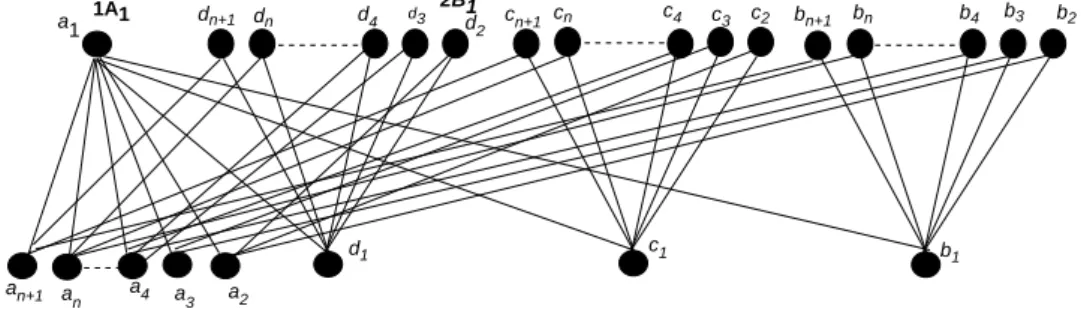
degree. Bob should plays color 2in any of the vertexdk of degree two (sayd2), see Figure1. Alice can
not block the threats to both the verticesd1 anda2, so Bob wins.
a1 1A1 dn+1 dn d4 d3 2B1d2 cn+1 cn c4 c3 c2 bn+1 bn b4 b3 b2
b1 c1
d1 a2
a3 a4 an an+1
Figure 1. Bob’s winning strategy in Case 1for the graph S3Sn
Case 2: If Alice start the game by playing color1 in any of the vertex bi, cj or dk 2≤i, j, k ≤n (sayb2), Bob respond with color2in the vertexa1, see Figure2. Now there are two verticesa2 andb1,
which are under threat. Alice can save only one of these vertices and Bob wins the game.
a1
1A1
2B1 d
2 d3
d4 dn
dn+1 cn+1 cn c4 c3 c2 bn+1 bn b4 b3 b2
b1
c1 d1
a2 a3 a4 an an+1
Figure 2. Bob’s winning strategy in Case 2for the graph S3Sn
Case 3: If Alice begins the game by assigning color to any of the verticesal, 2≤l≤n. Suppose, she plays a color1in the vertexa2. In response, Bob plays color2in the vertexai, wherei6= 2andi >2 say a3. This forces Alice to assign color 3to the vertex a1, because this is the only way, she can block
the threat to this vertex. After that Bob plays color1in the neighbor ofa0
ls(l≥4) and wins the games.
Case 4: If Alice start the game by playing color1 in vertexb1,c1 or d1 (sayb1). Bob should plays
color 2 in any of the vertices ai, where 2 ≤i≤n, for simplicity, say a2. There are two distinct colors
in the neighbor of vertexa1, so Alice must block the threat to this vertex by assigning it the color3. In
the next move Bob plays color1indk (k6= 2) sayd3. Now Alice can’t block the threat ofd1anda3and
Bob wins the game.
Thus χg(S3Sn) ≥ 4. Next, Alice’s winning strategy is given for four colors, which proves that
χg(S3Sn)≤4.
the only vertices which can come under threat. Since al∼bi (l=i),al∼cj (l=j)andal∼dk (l=k). So, whenever, Bob plays a color in a vertex adjacent toai, say cj, Alice will play the color of vertex a1
or color of the vertexcj inbi (adjacent toal). In this way, Alice can prevent these vertices from threats, since every vertex has two same colors in its neighbor. So, in order to win the game, she need only to assign colors in the vertices of degree greater than 4. Below, we have given the Alice strategy to color these vertices with four given colors.
Alice makes her first move by playing color 1 in any of three vertices having degree n+ 1, sayb1. We,
now consider all the cases for Bob’s first move.
Case 1: If Bob plays color2in any of the vertex having degree four, saya2. Alice makes her second
move by playing color 2in the vertexc1. Now Bob has two possibilities for his second move.
Case 1.1: If Bob wants that the vertexa1 be under threat in his second move and assigns color 3
to the vertex a3. Alice, then has to play color4 ina1, in order to prevent this vertex from threat. Alice
is safe to assign suitable color in the vertexd1 in her fourth move. Now all the vertices of degree greater
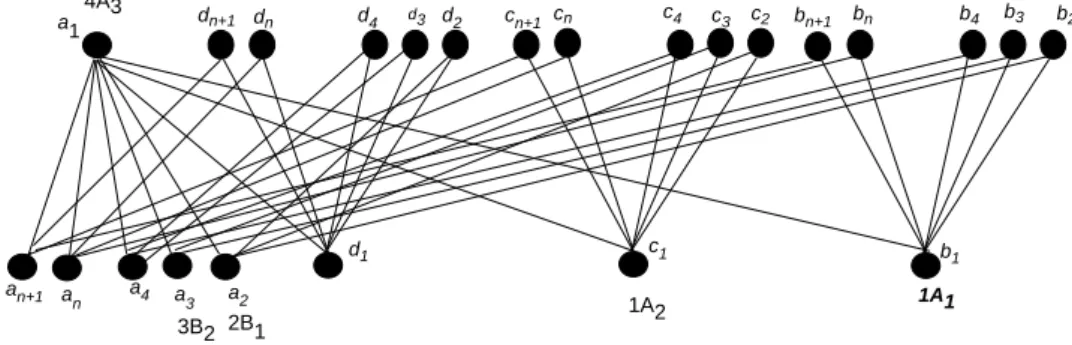
than four have assigned color. After that whenever Bob plays a color in a vertexbiorcjsaycj (adjacent toal), Alice will play the color ofcj inbiwherel=i=jand win the game. (strategy is shown in Figure 3)
a1 dn+1 dn d4 d3 d2 cn+1 cn c4 c3 c2 bn+1 bn b4 b3 b2
b1
c1 d1
a2 a3 a4 an an+1
1A1
1A2 2B1
3B2 4A3
Figure 3. Alice’s winning strategy in Case1for the graph S3Sn
Case 1.2: Bob plays color1 ind0ks, say d3 which is adjacent tod1. In respond, Alice assigns color
2 ina1. In his third move Bob plays according to the following strategy.
i: If Bob plays color 2in the vertexb0isor c0js, Alice then plays color of the vertex cj inbi (i=j). Now vertex al (i=l =j) has two same colors in its neighbors. In this way Alice protects all the vertices of degree four from threat. Alice will play only color ina1, whenever Bob plays color ina0is.
Case 2: In this case, Bob plays his first move in the vertices of degree two and assigns color1indk or cj sayd2. Alice then plays color1 inc1. Now we consider all the cases for Bob’s second move.
Case 2.1: If Bob plays again in the neighbor ofd1 sayd3by assigning it color2. Alice, in respond
plays color3ind1. Now there are following possibilities of Bob’s third move. We distinguish3subcases.
i: If Bob wants that the vertexa1be under threat and plays color2inalsaya2. Alice then should play
color4ina1. Now all the vertices of degree greater than four have assigned color. After that Alice follow
the same strategy as in case 1.
ii: If Bob plays in the neighbor of thatal which has already two distinct colors saya2 and assigns
color2inbiorcj sayc2. Alice can prevent this vertex from threat by playing color of vertexc2in vertex
b2. After that Alice follows the same strategy as in case1.
iii: If Bob wants to plays in the neighbor of thatal which has has no color assigned saya4 and assigns
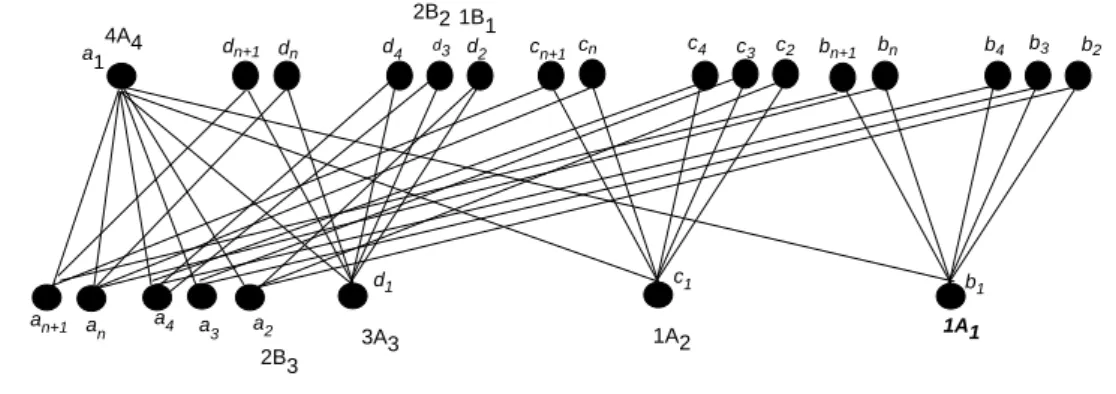
color1ind4 (d4 is adjacent toa4), then Alice plays color2or color4in the vertexa1. In his next move
if, Bob again plays in the neighbor ofa4 and assigns color 3in c4. Alice then should play color of c4 in
b4. Nowa4 has two same colors in its neighbor. Whenever, Bob plays color1in any one of the remaining
a1 dn+1 dn d4 d3 d2 cn+1 cn c4 c3 c2 bn+1 bn b4 b3 b2
b1
c1 d1
a2 a3 a4 an
an+1 1A1
1A2 2B3 3A3
4A4 2B21B1
Figure 4. Alice’s winning strategy in Case2for the graph S3Sn
neighbor of a5. After that Alice follow the same strategy as in case1.
Case 2.2: Now vertices d1 anda2 have one color in its neighbor. If Bob make his second move by
playing the color 2 in bi or cj sayc2, then Alice assigns color of vertex c2 in b2. In this way, Alice can
block the threat of vertex a2. After that Alice follows the same strategies as in case 1and case2.1.
Case 2.3: If Bob plays suitable color incj or bi saycj (k6=j), then Alice plays color of thatcj in
bi (i=j). After that Alice follows the same strategies as in above cases.
Case 3: If Alice assigns color1inb1in her first move and Bob plays color2 inc1. Alice then plays
color ind1. Now all the vertices of degreen+ 1have colored. After that Alice will follow the strategy of
case1and case2 in her next moves to win the game.
Case 4: Bob plays color 2 in the vertexa1 in his first move. Alice then plays color 1 in c1. Now,
irrespective of Bob’s next move. Alice plays color 3in d1. In this way, Alice can succeed to assign color
to all the vertices of degree greater thann+ 1. Now Bob will inbi orcjordk to create threat inal. Alice will respond by following the strategies of case 1and case2and she wins the game.
3.
Exact values of
χ
g
(
P
m
◦
K
1
)
and
χ
g
(
C
m
◦
P
n
)
LetGand H be two graphs of ordern1 andn2, respectively. The corona product G◦H is defined
as the graph obtained from G and H by taking one copy of G andn1copies of H and joining by an edge
each vertex from theith−copy ofH with theith−vertex ofG. We will denote byV ={v
1, v2, . . . , vn}the set of vertices ofGand byHi= (Vi, Ei)the copy ofH such thatvi∼v for everyv∈Vi. It is important to note that the corona product operation is not commutative. In this section we prove the exact values ofχg(Pm◦K1)andχg(Cm◦Pn).
Theorem 3.1. The game chromatic number ofPm◦K1= 3, wherem≥2.
Proof. It is obvious that χg(Pm◦K1)≥ 3. In order to show that χg(Pm◦K1) ≤3, Alice winning
strategy is given.
Alice’s winning strategy with 3 colors: Alice starts the game by playing color1 in the vertex w1.
Suppose, in his first move, Bob plays one of the available color in vertex vi, then Alice responds by playing the same color inwi+1 orwi−1 . In this way she can block the threat to the vertexvi, because it has two same colors in its neighbor. Similarly if Bob plays some color in vertexwi, Alice responds by playing the same color in vi+1 or vi−1. If during the game the following two cases arises, then Alice will
play according to the following strategy.
situation, If d(vi, vm) is odd then Alice assigns the same color in vi−1 (if i > j) or vi+1 (if i < j),
otherwise she plays any available color in the vertex vi.
Case 2: If there are two vertices sayvmandvnthat are already colored and Bob plays a color1in the vertex wi wherem < i < n. In response, Alice plays the same color 1in vi−1, (if d(vi, vm) is even) or invi+1 (if d(vi,vn) is even). In case when vi is at odd distance to bothvm andvn, she will play any available color in the vertex vi.
Similarly if Bob plays some color invi then Alice plays the same color inwi−1 orwi+1 according to the
above two cases.
If during the game, the following situations arise then Alice modifies her strategy according to the situation.
Situation 1: A part of graphPm◦K1 is shown in Figure5.
If Bob plays the color 3 onwi+2. Suppose, Bob already assigned the color 3in the vertex vi+4. Then
v
iv
i+1v
i+2v
i+3w
i+1w
i+2w
i+3w
i+4v
i+4v
i+5
3B
3B
i2A
i+13A
w
i2A
2B
Figure 5. P3◦K1
according to her strategy Alice can not assign the same color in the vertexvi+3. In this case Alice plays
color2in vi+3, because this is the only way she can block the threat to the vertexvi+2.
Situation 2: If Bob plays a color (say 3) in the vertex wi+2 and the vertices vi+4 and vi−1 are
already colored with colors 3 and 2 respectively. In this situation Alice plays the same color as of the vertex vi−1 in wi.
vi vi+1 vi+2 vi+3
wi+1 wi+2 wi+3 wi+4
vi+4 vi+5
2A 3B
3Bi
2Ai+1 3A
2B
wi wi-1
wi-2
vi-1
1Bi+1 1Ai+2
Figure 6. P3◦K1
Proof. The graphC8◦Pn is shown in the Figure7. Bob’s winning strategy for3colors:
a1
a2
a3
a4
a5 a6
a7
a8
b1,1 b1,n
b8,1
b8,n
1A1
2B1 3A2
3A3 1B2
3A4 2B3 3B4
Figure 7. C8◦Pn
Case 1: Alice makes her first move by playing color1in any of the vertex from the inner cycle, say
a1. In response Bob plays the color2in the vertexa3. In her second move Alice will play color3in the
vertexa2because this is the only way she can block the threat to this vertex. In his next moves Bob plays
suitable color in the alternative verticesa5, a7, a9, . . ., respectively, forcing Alice to play suitable color in
the verticesa4, a6, a8, . . .. Continuing in this way, Bob plays his last move according to the following two
situations:
i:If the number of vertices in inner cycle are even then Bob plays any suitable color in the vertexan−1.
Alice cannot block the threat to both the vertices an−2 andan, and Bob wins.
ii: If the number of vertices in inner cycle are odd then Bob in his second last move plays a color in any of the vertexbi,n−1, which is different to that ofa1. In response Alice is forced to play color in the vertex
an−1 because this is the only way to block the threat to this vertex. By playing a color different to both
a1 and an−1 in any of the vertexbi,n−1, Bob can succeed to assign three distinct colors in the neighbor
of the vertexan.
Case 2: Alice makes her first move by playing color 1 in any of the outer vertexbi,n, sayb1,1. In
response Bob plays color2 in the vertexb2,1. In her second move Alice has to play color3in the vertex
a1 because this is the only way she can block the threat to this vertex. In his next moves, Bob plays
in the alternative vertices a3, a5, a7, . . ., respectively, forcing Alice to play in the vertices a2, a4, a6, . . .
Continuing in this way, Bob plays his last move according to Case1. Hence χg(Cm◦Pn)≥4.
Alice’s winning strategy with 4 colors:
The graphCm◦Pn havem+mnvertices. The vertices of degree greater than four are only the vertices of the inner cycle, as shown in the above Figure. Alice, in her strategy assigns color to the vertices
suppose she makes her first move by playing color1 in the vertexa1. In respond, Bob can play the game
in the following two ways.
Case 1: Bob plays in the vertices of inner cycle say ai, for some 2 ≤i ≤m. Alice responds by playing any color from the set of available colors in the uncolored vertices of inner cycle.
Case 2: Bob plays in the verticesbi,j, then Alice assigns a suitable color in the correspondingai. Bob can only win if he succeeded to assign4 distinct colors in the neighborhood of any vertex. But whenever he plays in the outer vertices, bi,j, Alice assigns a suitable color in the corresponding ai. In this way Alice can color all the vertices in the inner cycle and she wins the game.
From both these strategies we conclude that χg(Cm◦Pn) = 4.
Acknowledgment: The authors are very thankful to a referee for careful reading with corrections and useful comments.
References
[1] T. Bartnicki, B. Brešar, J. Grytczuk, M. Kovše, Z. Miechowicz, I. Peterin, Game chromatic number of Cartesian product graphs, Electron. J. Combin. 15 (2008) R72.
[2] H. L. Bodlaender, On the complexity of some coloring games, Int. J. Found. Comput. Sci. 2(2) (1991) 133–147.
[3] U. Faigle, U. Kern, H. Kierstead, W. T. Trotter, On the game chromatic number of some classes of graphs, Ars Combin. 35 (1993) 143–150.
[4] H. A. Kierstead, W. T. Trotter, Planar graph coloring with uncooperative partner, J. Graph Theory 18(6) (1994) 569–584.
[5] C. Sia, The game chromatic number of some families of Cartesian product graphs, AKCE Int. J. Graphs Comb. 6(2) (2009) 315–327.