IC, 2017 – 13(5): 923-945 – Online ISSN: 1697-9818 – Print ISSN: 2014-3214 https://doi.org/10.3926/ic.1001
Integrating Kano Model and Quality Function
Deployment for designing service in hospital front office
Anjar Priyono , Andina Yulita Universitas Islam Indonesia (Indonesia)
[email protected], [email protected]
Received February, 2017 Accepted October, 2017
Abstract
Purpose: The aims of this study are twofold: first, it attempts to investigate service attributes in a hospital front office; and second, to identify strategies to improve those service attributes.
Design/methodology: This study used integration of Quality Function Deployment and Kano Model. The research instrument, which takes the SERVQUAL model as its starting point, was developed using a comprehensive set of techniques, including a literature review of relevant topics, interviews and focus group discussions. Using a sample of 140 customers of an international hospital situated in Yogyakarta, Indonesia, 14 service attributes required by customers were identified. The attributes, which were further categorised into 5 attractive, 4 one-dimensional and 5 ‘must-be’ attributes, were analysed using the Kano Model.
Findings: Using the integrated QFD and Kano Model, the service attributes needed for improvement were identified. The results are different from those when the company used either SERVQUAL or QFD alone. This study also reveals that benchmarking with competitor might produce misleading results. The results are different when the analysis combined a comprehensive method of QFD and Kano Model.
Originality/value: It is the first time that front office quality of hospital is examined using integrated method of SERVQUAL, QFD and Kano Model. The recommendations proposed from this comprehensive method offer novel solution that has never been found in existing study.
Keywords: Service quality, Kano Model, Quality Function Deployment, Hospital front office, House of Quality
Jel Codes: M11, M20, M31
1. Introduction
Fierce competition has caused companies to continuously improve the services that they offer to customers; in order to ensure competitive advantage, service providers should be able to satisfy customers’ needs. Understanding customers’ needs can thus be viewed as a critical source of competitive advantage. However, meeting customers’ need through the provision of services with ordinary attributes will not always maintain or increase market share. For this reason, companies need to better understand what its customers’ requirements are, and how those customers prioritise particular attributes of service provision.
Service quality is important for any service provider aiming to achieve customer satisfaction. In addition, it is also a critical success factor for maintaining competitive advantage (Baki, Sahin Basfirinci, Murat & Cilingir, 2009). On the other hand, measuring service quality is a complex process, due to its intangible nature. As a consequence, measurement of service quality (SERVQUAL) deserves a special attention.
Without doubt, SERVQUAL, developed by Parasuraman, Zithaml and Berry (1988), is the most cited measurement instrument and study in the field of service quality measurement. The model created in the study consists of 5 main constructs, namely tangibles, reliability, responsiveness, assurance and empathy, which are further broken down into 22 specific dimensions. The five constructs are tangibles, reliability, responsiveness, assurance and empathy.
examples include Abdullah (2009) and Abdullah (2006), who develop instruments for measuring service quality in higher education, while Iwaarden and Wiele (2003) compile a list of desirable attributes for websites. Other variations include Hossain and Leo (2009), who examine service quality in retail banking, Randheer, Al-motawa and Prince Vijay (2011), who investigate commuters’ perceptions of public transportation, and Pakdil and Aydin (2007), who study the perceptions and expectations of airline services customers. The attributes proposed in those studies are entirely different from those outlined by Parasuraman, Zithaml and Berry (1985); however, the basic idea underlying the measurement framework was derived from that original study.
The use of SERVQUAL has been subject to criticism for at least three key reasons (Tan & Pawitra, 2001). First, the model assumes that the relationship between service attributes and service performance is linear. Thus, companies can simply increase customers satisfaction by improving the performance of service attributes. Unfortunately, this assumption is not always correct, as customers might take some attributes for granted. As such, the existence of the attributes only avoids customer dissatisfaction, rather than increasing their satisfaction. For example, providing a debit card to banking customers is no longer viewed as a special service attribute, as most banks now provide this facility to their customers. Thus, the existence of this attribute does not much affect customer satisfaction levels.
Second, Parasuraman et al. (1988) claim that SERVQUAL is a practical tool for analysing to what extent customers are satisfied with performance of services offered by firms. SERVQUAL focuses on the differences between customers’ expectations and perceptions. Negative gaps imply that customers are not satisfied because customers’ expectations are higher compared to perceptions. By identifying these gaps, service providers can enhance the quality of their service provision via continuous improvement. However, this is not sufficient in a fierce competitive environment. Shen, Tan and Xie (2010) support this idea, arguing that companies should focus on how to meet or exceed customers’ expectations through innovation. Unfortunately, SERVQUAL was designed without considering the role of innovation (Tan & Pawitra, 2001).
Third, as mentioned above, SERVQUAL can identify gaps between service perception and expectation; unfortunately, though, SERVQUAL does not recommend how to address these gaps. In order to address service gaps, other tools such as Quality Function Deployment (QFD), must also be deployed (Tan & Pawitra, 2001). As such, it is strongly recommended to combine SERVQUAL with other such tools in order to improve service quality.
Pirttila, 1998). In order to address these three areas, a combination of three tools is used: SERVQUAL, QFD and the Kano Model. SERVQUAL is used as a starting point to identify the service attributes that customers are looking for. Even though the method has weaknesses, as outlined above, there are certain generic concepts that can be applied across various industries. For instance, QFD helps companies to identify customer requirements, and measure the performance of the company in comparison to its competitors. Meanwhile, Kano Model helps companies to better understand that the relationship between services attributes and customers’ satisfaction is not linear. Kano Model facilitates companies to emphasize which service attributes result in higher level of customer satisfaction compared to others. It is also able to overcome the three drawbacks of SERVUAL discussed earlier in this paper.
In recent years, a number of studies using SERVQUAL, QFD and Kano Model as an integrated method have been conducted. For instance, Pawitra and Tan (2003) examine Indonesian tourist satisfaction, specifically tourists visiting Singapore, and Baki et al. (2009) examine quality of service in logistics sectors. Using the same method, Garibay, Gutierrez and Figueroa (2010) identify service attributes for online library. These studies have successfully considered the non-linear nature of service quality.
Although those studies used the same method, there are some variations in terms of their method of analysis. The focus of investigation in Garibay et al.'s (2010) study, a university library, does not have direct competitor, meaning there was no need to undertake competitor analysis. However, the absence of competitor analysis in this case does not undermine the usefulness of the research results. On the other hand, the study undertaken by Baki et al. (2009) considers the existence of competitors, which are used as benchmarks for the quality of the service delivered by the case company. The variety of analytical techniques used in the studies utilising the integrated method – i.e. SERVQUAL, QFD and the Kano Model –indicates that its application is flexible, meaning it can be applied in various business contexts.
2. Conceptual background
2.1. Quality Function Deployment (QFD)
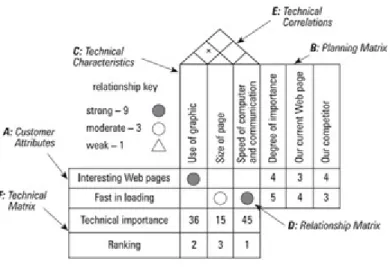
section is often referred as the 'Whats'. Section B analyses identified service attributes from the perspective of companies. Mainly, this part discusses how to fulfill the service attributes required by customers. Comparison of to what extent service attributes have fulfilled the need of customers is also compared with competitors in Section B.
Section C explains how service providers attempt to provide the attributes required by customers or the 'Hows'. Section D connects the 'Whats' to the 'Hows'. Using this section, service providers can identify 'What' changes will happen to service attributes if they alter the 'How'. Section E, located in a room in the House of Quality (HoQ), explains the technical correlation between the strategies of service providers, or the relationship between the 'Hows'. Section F provides important information for service providers, needed to improve the quality of their services. Benchmark, technical differences with competitor, and value targets are among a number of factors listed in this section, which also contains a 'target value' that service providers are expected to achieve.
Figure 1. QFD for a website (Shen et al., 2010)
2.2. Kano Model
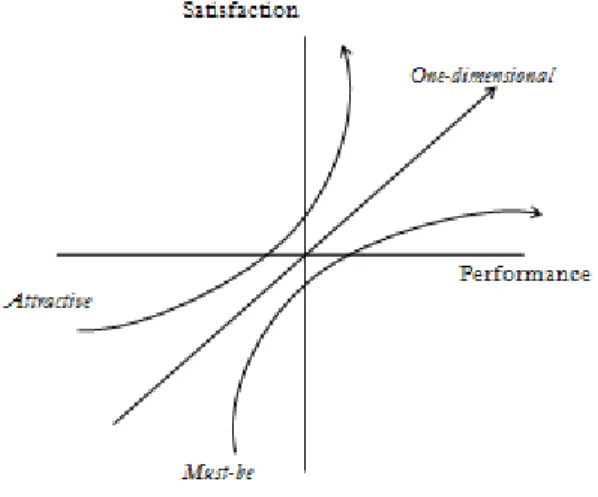
satisfaction, Kano et al. (1994) identify three categories of service attributes: must be, one-dimensional and attractive. This categorisation is depicted in Figure 2, followed by a more detailed description.
Figure 2. The Kano Model
Must be requirements are service attributes that have to be provided by companies. When companies do not offer the service attributed categorised in must be requirements, customers are very disappointed. Meanwhile, the presence of the attributes does not necessarily make customers satisfied; customers take these service characteristics for granted, and do not explicitly demand them (Matzler, Hinterhuber, Bailom & Sauerwein, 1996). In other words, these attributes are necessary, but they are not sufficient to produce customer satisfaction (Busacca & Padula, 2005). Thus, the presence of these attributes is to avoid customer dissatisfaction only (Matzler et al., 1996).
One-dimensional attributes, on the other hand, do have a linear relationship with customer satisfaction. With regard to these attributes, there is a positive relationship between perceived service quality and customers satisfaction. Customers’ satisfaction increases proportionally with the improvement of service attributes performed by companies. Accordingly, this group of service attributes is an important element to increase customers’ satisfaction (Busacca & Padula, 2005).
2.3. Significance of front office service quality
A hospital is a complex system, within which each department is tasked with delivering specific services (Platchek & Kim, 2012). Adding to this complexity is the custom nature of the services required and desired by the customers, who in this context are patients. Patients’ service requirements will not be identical with others; each patient requires customised treatments. As a system, the performance of departments is interrelated with others (Platchek & Kim, 2012; Monti & Nuti, 1996). As such, the performance of a single department within a hospital could affect the performance of other departments. However, there is a need to examine a particular department within a hospital, as each department also has unique characteristics.
There are a number of reasons why the front office is a critical point within a hospital. First, the front office is responsible for collecting payment from patients; this requires additional administrative processes. Inefficient handling of this task at the front office can increase the work load of the back office, which consequently results in reduced cash flow. Empirical findings demonstrate that improvement of payment collection processes at the front office can reduce the work load of the back office, and increase cash on hand by 124% (Essex, 2016).
Another reason why front office is a critical department in a hospital because it functions as a central point of contact across the organisation (Watt, 2007). The front office offers assistance to guests related to the services they require. The department is the nerve centre of the overall organisation, as it stores information regarding what is occurring throughout the hospital (Hogan, 2006). It also plays a key role in forming overall impressions of the service provided by the organisation.
In the healthcare context, a large number of studies have been undertaken examining service quality. For instance, Li et al. (2015) examine service quality in 9 Chinese hospitals using 22 items derived from the dimensions developed by Parasuraman et al. (1988). Using similar dimensions, Chakravarty (2011) examine outpatient department services in reference to the department’s specific characteristics. Other studies examine the quality of the information system used in a hospital, and the level of service it provides, with regard to the perspective of nurses as the users (Cohen, Coleman & Kangethe, 2015; Chang, Pang, Tarn, Liu & Yen, 2015). Despite the significance of the front office to the overall organisation, no study is devoted to the quality of the front office service in a hospital setting.
departures of patients, staffs at the front office should have good knowledge of the healthcare context, they cannot be non-specialised personnel. Front office staff at hotels, restaurants, or other service providers are less likely to be qualified to fill a position on a hospital front office, due to lack of healthcare knowledge.
Previous work has identified several unique characteristics of hospital service. People come to hospital due to the need of health, something which is desperately needed. Customers come to hospital because they have some health problems. Also, patients are difficult to control because they can come and go depend on their health conditions. They even cannot decide when their diseases will disappear and they could leave hospital (Pai and Chary, 2013).
Hospitals should recruit and hire top quality people to fill front office roles (Nelson, 2016). This is because front office staffs in hospitals typically also hold other various roles that are critical to the operations of the hospital, such as phone operators, receptionists, medical secretaries and transcriptionists. In addition, they are required to be able to solve any problems encountered by patients, convenience of booking appointment, promptness of check-in/check-out processes for inpatient care (Kumar & Vetrivel, 2015).
The main challenge of hiring for front office positions is that diverse roles are available but with low pay. The professional role of front office staff is not an easy one; for example, keeping stress levels low amongst staff is difficult. One of the main causes of stress is interacting with unhappy patients, who are principally are unhappy as they simply do not feel well (Nelson, 2016).
As a healthcare provider in a hospital, the hospital chief executive officer (CEO) should ensure that the overall business process within a hospital is high performing, which requires standardised operations, quality control and revenue optimisation. According to survey of CEOs, front office management is one of the biggest challenges faced by hospital chief executive officers (Ansel, 2016).
3. Research method
3.1. Subjects
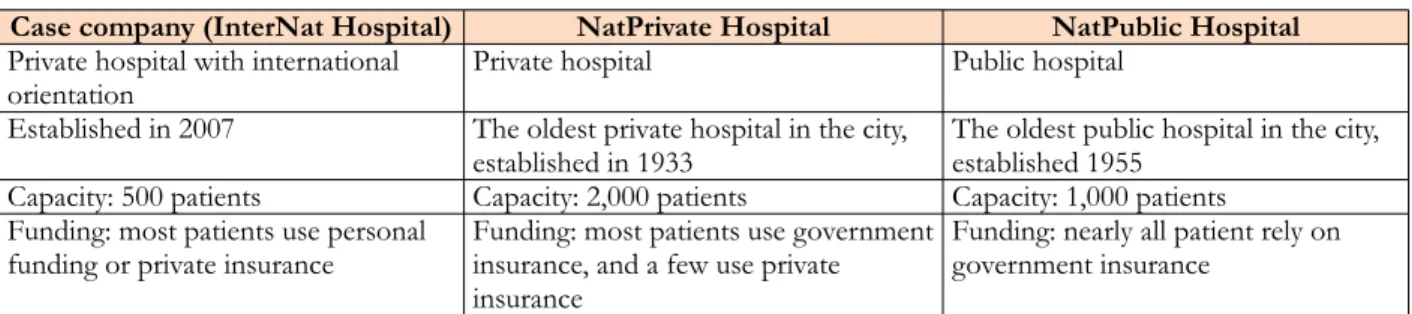
Case company (InterNat Hospital) NatPrivate Hospital NatPublic Hospital
Private hospital with international
orientation Private hospital Public hospital
Established in 2007 The oldest private hospital in the city,
established in 1933 The oldest public hospital in the city, established 1955 Capacity: 500 patients Capacity: 2,000 patients Capacity: 1,000 patients
Funding: most patients use personal
funding or private insurance Funding: most patients use governmentinsurance, and a few use private insurance
Funding: nearly all patient rely on government insurance
Table 1. Description of the case and benchmark companies
The samples were selected using the purposive sampling method. Following the suggestion from Cooper and Schindler (2013), two criteria needed to be satisfied before an individual was selected to participate in the research. First, the sample should have visited the three hospitals under investigation. This purpose of using this criterion was to ensure that the object would be able to benchmark against other hospitals, from their own experience. Second, they should have experienced using the services of InterNat Hospital at least once in the 6 months prior to conducting the research. The time limit of 6 months was set to ensure that participants could accurately recall their experience of using the service.
3.2. Instrument development
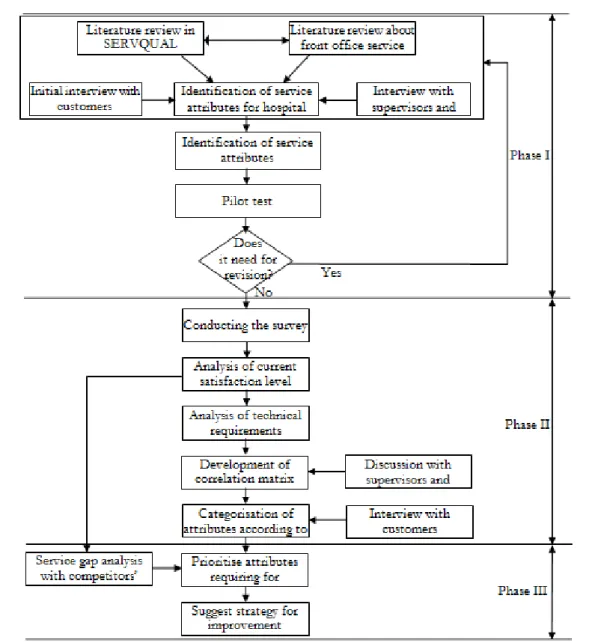
In general, the procedure was divided into three phases: instrument development, current service level assessment, and improvement of the service. Figure 3 presents the procedure of the analysis carried out in this study, integrating SERVQUAL, QFD and the Kano Model. The instrument used in this study was developed through a series of steps. The first phase covers a number of activities, including a literature review on the area of SERVQUAL in general, as well as front-office services and the healthcare industry specifically. The four most commonly used databases were searched, namely Emerald, Ebsco, ScienceDirect, and Proquest. It was found that no research study has thus far investigated the quality of front office services in a hospital context. This corroborates the observation made at the beginning of the paper that there is a lack of understanding of this topic currently.
Figure 3. The procedures of this study
4. Data analysis
In this study, QFD and the Kano Model are combined, as they are complementary in nature. The combination offers a suitable tool to improve quality of services (Sauerwein et al., 1996). The role of the Kano Model is to categorise service attributes according to their i mportance, while QFD is able to link customer needs with technical specifications within the company.
pre-tested using 20 hospital patients to establish the face validity. Once this step was completed, minor revisions were undertaken to fix some grammatical issues that were highlighted (phase I in Figure 3).
In total, 140 respondents participated in this study by completing questionnaires that used a 5-point Likert’s scale. The data was then tested to assess its validity and reliability. Using the Cronbach's Alpha to test reliability, the expected and perceived quality of the hospital’s service were found to have values of 89% and 90% respectively. Meanwhile, the Cronbach's Alpha values for the company’s competitors – NatPrivate and NatPublic Hospital– were calculated at 88% and 90% respectively. These values indicate that the collected data is internally consistent.
4.1. Integrating SERVQUAL, QFD and the Kano Model
In general, this study utilise the method developed by Tan and Pawitra (2001) to integrate service quality measurement, the Kano Model and QFD, as well as techniques proposed by Garibay et al. (2010) to analyse the data. The steps are as follows:
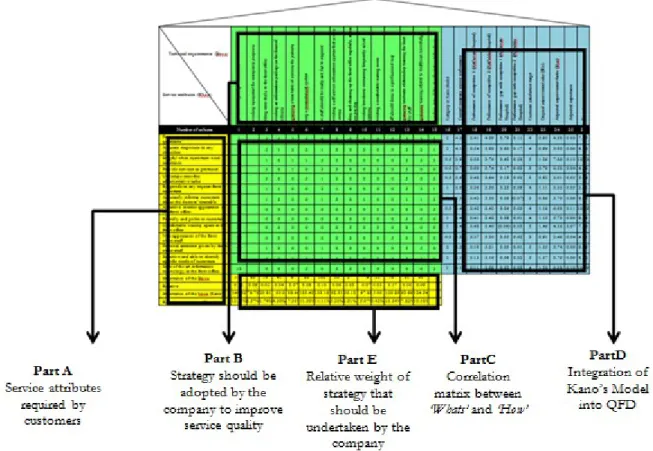
• Identifying the service attributes required by customers. To do this, extensive literature reviews, focus group discussions with customers as well as with the service provider, were undertaken. The starting point for outlining the service attributes was taken from existing studies (Parasuraman et al., 1988; Parasuraman et al., 1985; Parasuraman et al., 1994b; Parasuraman et al., 1994a). Next, some attributes specific to a front office in the healthcare industry were added. The output of this stage is known as establishing the ‘Whats’ in QFD terms, which are presented in Part A of Figure 4 in orange. The detailed results of this study are presented in Table 2.
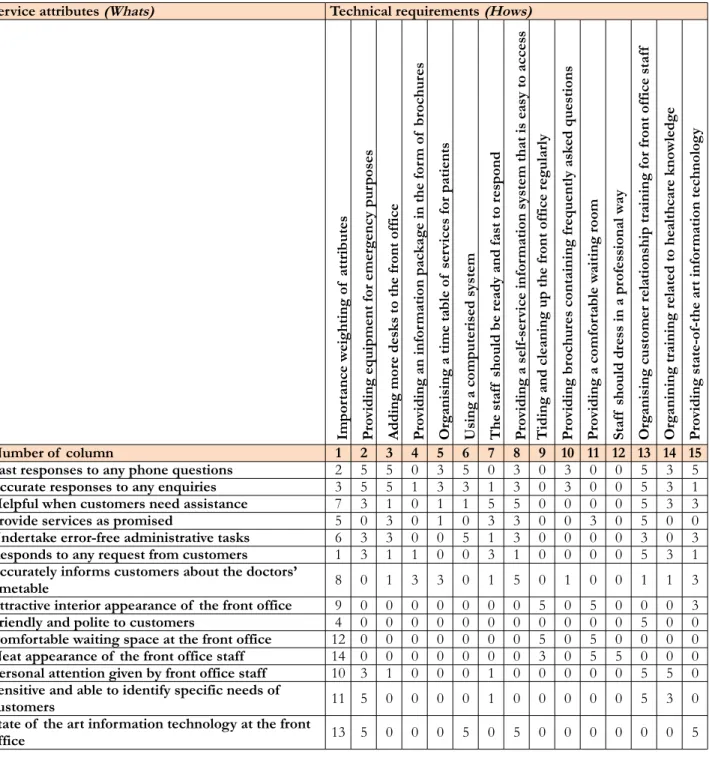
• Analysing how the case company translates ‘Whats’ into service attributes for a front office in a hospital setting is a very specific process, as a hospital front office is different from a front office in other types of industries and services. Thus, the implementation of the ‘Whats’ is specific to the front office of a hospital. In Figure 4, this step is shown in Part B, highlighted in green. The detailed findings of this part are presented in Table 3 followed with discussion.
• Analysing the relationship between the ‘Whats’ and the ‘Hows’, and assigning a score to each, ranging from 5, 3, 1 and 0 for high, medium, low and no relationship, respectively. The degree of the relationship between the attributes was determined based on discussions between the researchers, the staffs and the manager of hospital. In Figure 4, this stage is presented in Part C, highlighted in grey. Like Part B, the details of this part in this study are presented in Table 3.
• Integrating service attributes, identified in the first phase of Figure 3, into the Kano Model. In Figure 4, this step is presented in Part D in blue, and the details are presented in Table 4.
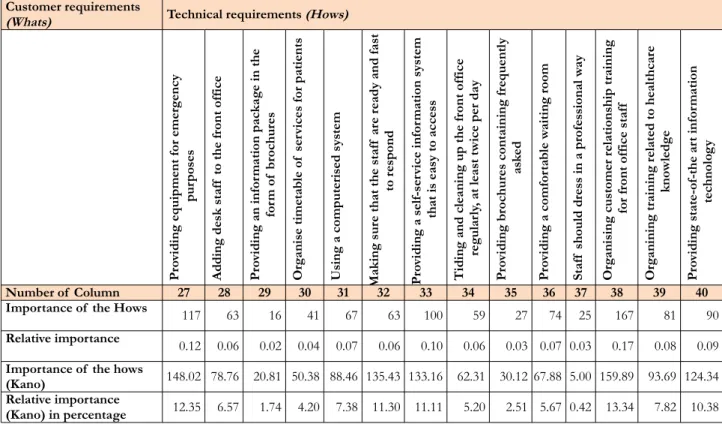
• Identification of the strategies that should be adopted by the hospital to improve its service quality. In Figure 4, this last step is highlighted in yellow in Part E. The identification of strategies in this study is presented in Table 5.
More detail as to how the 5 steps above were undertaken will be provided in the following sub-sections.
4.2. Customers’ requirements of the company
customers had been identified, the next step was to justify the importance of Whats. To do this, semi-structured interviews with customers and front office staff were undertaken.
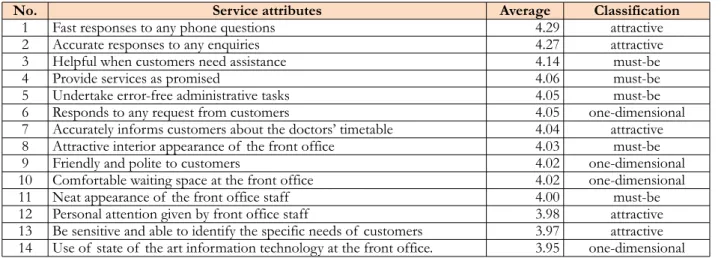
As shown in Table 2, the service attributes are categorised into three groups: attractive, one-dimensional and must-be. The categorisation was based on the discussions between customers, with the assistance of the researchers. Of the 14 attributes, 5 were categorised as attractive, 4 as one-dimensional and 5 as must-be.
In QFD method, the first step is identification of service attributes required by customers, which is also recognised as ‘Voice of Customers’. Customer requirements were identified using a series of techniques, as explained in the Research Method section, and the results are presented in Table 2. In Table 2, as mentioned previously, the classification of service attributes according to the Kano Model is also shown.
No. Service attributes Average Classification
1 Fast responses to any phone questions 4.29 attractive
2 Accurate responses to any enquiries 4.27 attractive
3 Helpful when customers need assistance 4.14 must-be
4 Provide services as promised 4.06 must-be
5 Undertake error-free administrative tasks 4.05 must-be
6 Responds to any request from customers 4.05 one-dimensional
7 Accurately informs customers about the doctors’ timetable 4.04 attractive
8 Attractive interior appearance of the front office 4.03 must-be
9 Friendly and polite to customers 4.02 one-dimensional
10 Comfortable waiting space at the front office 4.02 one-dimensional
11 Neat appearance of the front office staff 4.00 must-be
12 Personal attention given by front office staff 3.98 attractive
13 Be sensitive and able to identify the specific needs of customers 3.97 attractive 14 Use of state of the art information technology at the front office. 3.95 one-dimensional
Table 2. Summary of responses from subjects
Next, the company should identify how to fulfill the needs of its customers (Hows). The identification of strategies to fulfill the Whats used a series of iterative group discussions with service providers and customers. This ensures that the Voice of the Customers (Whats) is considered in the service design. This step is presented in Figure 3, marked as Phase II.
they all deal with information related issues. This is unsurprising, as the front office is the centre of information within the organization; as a shortcut, anyone requiring information would ask the staff at the front office. At this point, the classical QFD analysis has been completed. In the later stages of the analysis, these columns will be used as the starting point for integrating QFD into Kano Model.
Service attributes (Whats) Technical requirements (Hows)
Im po rt an ce w ei gh ti ng o f at tr ib ut es P ro vi di ng e qu ip m en t f or e m er ge nc y pu rp os es A dd in g m or e de sk s to th e fr on t o ff ic e P ro vi di ng a n in fo rm at io n pa ck ag e in th e fo rm o f br oc hu re s O rg an is in g a ti m e ta bl e of s er vi ce s fo r pa ti en ts U si ng a c om pu te ri se d sy st em T he s ta ff s ho ul d be r ea dy a nd fa st to r es po nd P ro vi di ng a s el f-se rv ic e in fo rm at io n sy st em th at is e as y to a cc es s T id in g an d cl ea ni ng u p th e fr on t o ff ic e re gu la rl y P ro vi di ng b ro ch ur es c on ta in in g fr eq ue nt ly a sk ed q ue st io ns P ro vi di ng a c om fo rt ab le w ai ti ng r oo m St af f sh ou ld d re ss in a p ro fe ss io na l w ay O rg an is in g cu st om er r el at io ns hi p tr ai ni ng fo r fr on t of fi ce s ta ff O rg an in in g tr ai ni ng r el at ed to h ea lt hc ar e kn ow le dg e P ro vi di ng s ta te -o f-th e ar t in fo rm at io n te ch no lo g y
Number of column 1 2 3 4 5 6 7 8 9 10 11 12 13 14 15
Fast responses to any phone questions 2 5 5 0 3 5 0 3 0 3 0 0 5 3 5
Accurate responses to any enquiries 3 5 5 1 3 3 1 3 0 3 0 0 5 3 1
Helpful when customers need assistance 7 3 1 0 1 1 5 5 0 0 0 0 5 3 3
Provide services as promised 5 0 3 0 1 0 3 3 0 0 3 0 5 0 0
Undertake error-free administrative tasks 6 3 3 0 0 5 1 3 0 0 0 0 3 0 3
Responds to any request from customers 1 3 1 1 0 0 3 1 0 0 0 0 5 3 1
Accurately informs customers about the doctors’
timetable 8 0 1 3 3 0 1 5 0 1 0 0 1 1 3
Attractive interior appearance of the front office 9 0 0 0 0 0 0 0 5 0 5 0 0 0 3
Friendly and polite to customers 4 0 0 0 0 0 0 0 0 0 0 0 5 0 0
Comfortable waiting space at the front office 12 0 0 0 0 0 0 0 5 0 5 0 0 0 0
Neat appearance of the front office staff 14 0 0 0 0 0 0 0 3 0 5 5 0 0 0
Personal attention given by front office staff 10 3 1 0 0 0 1 0 0 0 0 0 5 5 0
Sensitive and able to identify specific needs of
customers 11 5 0 0 0 0 1 0 0 0 0 0 5 3 0
State of the art information technology at the front
office 13 5 0 0 0 5 0 5 0 0 0 0 0 0 5
4.3. Integrating QFD into the Kano Model
The questionnaire results provide clear insights regarding customer requirements. The insights provided by the questionnaire results are grounded in sound theoretical background; as mentioned in the Research Method section, the questionnaire was developed iteratively, drawing on existing literature and discussion with customers. However, it does not only rely solely on a theoretical foundation, practical information is also referenced, and thus, the relevance of the information is assured.
Customer requirements (Whats) Technical requirements (Hows)
C at eg or y in K an o M od el C ur re nt c om pa ny s er vi ce p er fo rm an ce P er fo rm an ce o f co m pe ti to r 1 (N at P ri va te H os pi ta l) P er fo rm an ce o f co m pe ti to r 2 (N at P ub lic H os pi ta l) P er fo rm an ce g ap w it h co m pe ti to r 1 (N at P ri va te H os pi ta l) P er fo rm an ce g ap w it h co m pe ti to r 2 (N at P ub lic H os pi ta l) C us to m er s at is fa ct io n ta rg et O ri gi na l i m pr ov em en t r at io ( IR O ) A dj us te d im pr ov em en t f ac to r (I Rad j ) A dj us te d im po rt an ce P er ce nt ag e im po rt an ce
Column Number 16 17 18 19 20 21 22 23 24 25 26
Fast responses to any phone
questions 2 4.20 3.41 4.09 0.79 0.11 4 0.95 4.88 0.08 7.95 Accurate responses to any
enquiries 2 4.15 3.54 3.98 0.60 0.17 4 0.96 3.93 0.06 6.40 Helpful when customers need
assistance 0.5 3.98 3.56 3.76 0.42 0.23 5 1.26 7.88 0.13 12.83 Provide services as promised 0.5 3.77 3.60 3.74 0.17 0.03 3 0.79 2.53 0.04 4.12
Undertake error-free
administrative tasks 0.5 3.66 3.48 3.64 0.19 0.02 3 0.82 2.01 0.03 3.28 Responds to any request from
customers 1 3.61 3.36 3.56 0.25 0.06 4 1.11 3.32 0.05 5.41 Accurately informs customers
about the doctors’ timetable 2 3.51 3.42 3.58 0.09 (0.07) 3 0.86 3.70 0.06 6.03 Attractive interior appearance of
the front office 0.5 3.46 3.42 3.43 0.04 0.03 4 1.16 6.68 0.11 10.89 Friendly and polite to customers 1 3.49 3.41 3.48 0.08 0.01 4 1.15 5.73 0.09 9.33
Comfortable waiting space at the
front office 1 3.43 3.48 3.40 (0.06) 0.03 5 1.46 4.38 0.07 7.13 Neat appearance of the front
office staff 0.5 3.31 3.27 3.30 0.05 0.02 3 0.91 2.46 0.04 4.01 Personal attention given by front
office staff 2 3.22 3.19 3.21 0.03 0.01 5 1.55 3.74 0.06 6.09 Sensitive and able to identify
specific needs of customers 2 3.19 3.13 3.16 0.06 0.02 5 1.57 3.76 0.06 6.12 State of the art information
technology at the front office 1 3.14 3.11 3.09 0.02 0.05 4 1.28 6.38 0.10 10.39
The integration of QFD into the Kano Model is presented on the right hand side of Table 4, in column 16-26. As explained in the Research Method section, the Kano Model attempts to categorise customer requirements by considering the non-linear relationship between service quality and customer satisfaction.
Column 16 presents the categorisation of front office service attributes. Of the fourteen attributes, five were categorised as attractive, four as one-dimensional, and five as must-be. Then, a Kano index was assigned to each category –e.g. 2, 1 and 0.5 for attractive, one-dimensional and must-be respectively.
The next column, column 17, presents current perceived service quality. The value in this column describes how customers responded to the questionnaire items. The next step is taking service quality competitors into consideration.
Columns 18-22 present the results of SERVQUAL gap analysis. The gap analysis did not only compare perception and expectation, but also between perceptions of the company’s service and that of its competitors - i.e. NatPrivate Hospital and NatPublic Hospital. The positive results of this analysis indicate that the company is outperforming customers' expectations. Conversely, negative gaps means that customers expectations are much higher in comparison the service delivered by companies.
The benchmarks against competitors reveal that only two attributes have a negative gap, indicating that they need improvement, namely Comfortable waiting space at the front office andAccurately informs customers about the doctors’ timetable. Thus, the hospital case study should assign these two attributes first priority for improvement. In general, the gaps between the other service attributes are positive; i.e. the case company outperforms competitors, meaning so it is not necessary for the company to improve them if it relies on the results from benchmark with competitors only. The results were different when the researchers combined QFD with the Kano Model.
To include Kano Model into analysis, the first step is setting up customer satisfaction target. To achieve this, managers of the hospital and the researchers discussed the customer satisfaction target; the result is shown in column 22. At this stage, the level of satisfaction that customers expected was determined. Next, the value of the original improvement ratio (IR0) was calculated, and then presented in column
23. An IR0 value of more than 1 indicates that the performance of the service attributes needs
improvement, and should receive attention. The higher the IR0 value, the more urgently improvement is
needed. Following the suggestion of Tan and Shen (2010), IR0 is calculated using the following
equation:
Where:
IR0: Original improvement ratio
S1: Current customer satisfaction level
S0: Target value for customer satisfaction
It is important to note that the value here is still raw, in that it has not considered the adjustment factor, as suggested by Tan and Shen (2010). Here, the adjustment factor refers to the value resulting from the categorisation of the Kano Model. The value adjusted improvement ratio was calculated using a formula proposed by Tan and Shen (2010), as follows:
IRadj = (IR0)1/k (2)
Where:
IR0: Original improvement ratio
S1: Current customer satisfaction level
S0: Kano Index – the value for Kano index is as follows: 0.5, 1 and 2 for must-be attributes, one
dimensional and attractive respectively.
Once the adjustment factor has been considered in the calculation, the value is displayed in column 24. As can be seen in the figure, the value of the improvement ratio before and after using the adjustment factor is different.
As shown in Table 4, the three service attributes with highest original improvement ratio (IR0) requiring
improvement are: Sensitive and able to identify specific needs of customers, Personal attention given by front office staff, andComfortable waiting space at the front office. On the other hand, when the adjustment factor is taken into consideration in the calculation (IRadj), the top three attributes requiring improvement are: Helpful when
customers need assistance, Interior appearance of the front office, andState of the art information technology at the front office. The priority of service attributes requiring improvement is different before andafter taking the Kano index into account.
An improvement factor larger than one indicates a need to improve the corresponding service attributes, however, there is no indication regarding which attributes should be given first priority. To identify the priority ranking of the required improvements, IRadj is multiplied by the importance of
As mentioned previously, the results of the calculation revealed that Helpful when customers need assistance has the highest percentage (12.83%), followed by Interior appearance of the front office(10.89), andState of the art information technology at the front office (10.39%). The percentage value indicates to what extent one attribute is important in comparison with others. As an example, the adjusted importance for Undertake free of error administrative tasks is 3.28%, which is roughly one third of the importance of Helpful when customers need assistance(12.83%), which received the highest priority. Therefore, paying attention to the latter attribute will result in much better service improvement, rather than to the former. At this point, the analysis of the required service attributes from the perspective of customers has been completed, using an integrated method of QFD and the Kano Model.
4.4. Identification of strategy for improving service quality
The Kano Model is useful not only for identifying relevant service attributes requiring improvement; it also offers insights regarding how to identify strategies for improving service quality. The process of strategy identification consists of several steps. First, identifying the technical requirements that need improvement, and in what order. To achieve this, importance of the Whats is substituted with the value of Adjusted Importance that takes the Kano Model into account.
Customer requirements
(Whats) Technical requirements (Hows)
P ro vi di ng e qu ip m en t fo r em er ge nc y pu rp os es A dd in g de sk s ta ff to t he fr on t o ff ic e P ro vi di ng a n in fo rm at io n pa ck ag e in t he fo rm o f br oc hu re s O rg an is e ti m et ab le o f se rv ic es f or p at ie nt s U si ng a c om pu te ri se d sy st em M ak in g su re t ha t t he s ta ff a re r ea dy a nd fa st to r es po nd P ro vi di ng a s el f-se rv ic e in fo rm at io n sy st em th at is e as y to a cc es s T id in g an d cl ea ni ng u p th e fr on t o ff ic e re gu la rl y, a t le as t tw ic e pe r da y P ro vi di ng b ro ch ur es c on ta in in g fr eq ue nt ly as ke d P ro vi di ng a c om fo rt ab le w ai ti ng r oo m St af f sh ou ld d re ss in a p ro fe ss io na l w ay O rg an is in g cu st om er r el at io ns hi p tr ai ni ng fo r fr on t o ff ic e st af f O rg an in in g tr ai ni ng r el at ed t o he al th ca re kn ow le dg e P ro vi di ng s ta te -o f-th e ar t in fo rm at io n te ch no lo g y
Number of Column 27 28 29 30 31 32 33 34 35 36 37 38 39 40
Importance of the Hows 117 63 16 41 67 63 100 59 27 74 25 167 81 90
Relative importance 0.12 0.06 0.02 0.04 0.07 0.06 0.10 0.06 0.03 0.07 0.03 0.17 0.08 0.09
Importance of the hows
(Kano) 148.02 78.76 20.81 50.38 88.46 135.43 133.16 62.31 30.12 67.88 5.00 159.89 93.69 124.34 Relative importance
In classical QFD methodology, the relative importance of the ‘Hows’ indicates which technical requirements should be addressed by the company, as the service provider. The higher the importance value, the more critical it is for improvement. The results are presented in the first row of Table 5. In the next row, the relative importance of the ‘Hows’ is presented. This value does not take into consideration the non-linearity of customer satisfaction. Thus, the value should be replaced with the Adjusted Importance column that has considered the Kano categories. The new calculation after the Kano methodology has been taken into account, is as follows: Σ Adjusted Importance × Relationship value of technical requirement. For example, the calculation forProviding equipment for emergency purposes is as follows: (5×0.08) + (5×0.06) + (3×0.13) + (0×0.04) + (3×0.03) + (3×0.05) + (0×0.06) + (0×0.11) + (0×0.09) + (0×0.07) + (0×0.04) + (3×0.06) + (5×0.06) + (5×0.10). The result of the calculation is presented in the last row of Table 5. From the table, we can see that the importance value of Hows is different after taking into account Kano categories. It can be noted that the first priority is Organising customer relationship training for front office staffs (13.34%), followed byProviding equipment for emergency purposes (12.35%), and Making sure that the staff are ready and fast to respond (11.30%).
5. Conclusion and suggestions for future research
This paper has demonstrated the use of an integrated method of SERVQUAL, QFD and the Kano Model. The results of the analysis identified a number of service attributes requiring improvement, and a priority order of technical requirements that should be addressed. These recommendations are different to what they would have been if the researchers had used either service gap analysis or the benchmark method alone.
If the company relies only on the results of the service gap analysis, this would not always be beneficial for the service provider. According to the analysis presented in this paper, the results of the service gap analysis reveal that the majority of its attributes in the must-be category have positive values. This indicates that the perception of the service is higher than expected. Thus, provided that the basic needs in the must-be category are fulfilled, there will be no issue with customer satisfaction. On the other hand, when the Kano methodology into account, the case company needs to improve service attributes that are categorised as must be. Meanwhile, most of attributes classified as attractive and one-dimensional are at an acceptable level.
Thus, if the benchmarking company is going in the wrong direction, the case company will most likely follow. This study has empirically demonstrated that the combined use of QFD and the Kano Model offers more insightful suggestions regarding what actions the company should take. These suggestions are different to those yielded via the classical benchmarking method.
Future research could examine whether the results of this study are confirmed in other countries. There are some differences between countries in terms of healthcare systems, which may affect how the hospital front office operates, and consequently, will influence how customers perceive the quality of its service provision.
Another point of interest for future examination is the categorisation in the Kano Model. A future study could utilise a more detailed categorisation, including ‘very attractive’, ‘slightly attractive’, ‘slightly must-be’ and ‘must-be’ (Kano et al., 1984).
References
Abdullah, F. (2006). Measuring service quality in higher education: HEdPERF versus SERVPERF. Marketing Intelligence and Planning, 24(1), 31-47. https://doi.org/10.1108/02634500610641543
Abdullah, F. (2009). HEdPERF versus SERVPERF: The quest for ideal measuring instrument of service quality in higher education sector.Quality Assurance in Education, 13(4), 305-328.
https://doi.org/10.1108/09684880510626584
Ansel, T. (2016). Three conversations with hospital CEOs on the top challenges they face and the tough decisions they make. Availab le at: http://www.healthcarestrategygroup.com/thought-leadership/articles/three-conversations-hospital-ceos-top-challenges-face-tough-decisions-make/
Baki, B., Sahin Basfirinci, C., Murat, A.R.I., & Cilingir, Z. (2009). An application of integrating SERVQUAL and Kano’s Model into QFD for logistics services: A case study from Turkey.Asia Pacific Journal of Marketing and Logistics, 21(1), 106-126. https://doi.org/10.1108/13555850910926272
Berger, C., Blauth, R., Boger, D., Bolster, C., Burchill, G., DuMouchel, W. et al. (1993). K ano’s methods for understanding customer-defined quality.Center for Quality Management Journal, 2(4), 3-36. Available
at: http://scholar.google.com/scholar?hl=en&btnG=Search&q=intitle:Kano?
s+Methods+for+Understanding+Customer-defined+Quality#0
Chakravarty, C.A. (2011). Evaluation of service quality of hospital outpatient department services. Medical Journal Armed Forces India, 67(3), 221-224. https://doi.org/10.1016/S0377-1237(11)60045-2
Chang, M.Y., Pang, C., Tarn, J.M., Liu, T.S., & Yen, D.C. (2015). Exploring user acceptance of an e-hospital service: An empirical study in Taiwan. Computer Standards and Interfaces, 38, 35-43.
https://doi.org/10.1016/j.csi.2014.08.004
Cohen, J.F., Coleman, E., & Kangethe, M.J. (2015). An importance-performance analysis of hospital information system attributes: A nurses’ perspective.International journal of medical informatics, 86, 82-90. Available at: http://www.sciencedirect.com/science/article/pii/S1386505615300526
https://doi.org/10.1016/j.ijmedinf.2015.10.010
Cooper, D.R., & Schindler, P.S. (2013). Business research methods (12th ed.). New York, United States: McGraw Hill Education.
Cronin, J.J., & Taylor, S.A. (1992). Measuring service quality: A Reexamination and Extension. Journal of Marketing, 56(3), 55. https://doi.org/10.2307/1252296
Essex, D. (2016).Aspen Valley Hospital increases front office payments by 124 % with InstaMed. Available at:
http://www.instamed.com/case_study/case-study-hospital-increases-front-office-payments-by-124-with-instamed/
Garibay, C., Gutierrez, H., & Figueroa, A. (2010). Evaluation of a digital library by means of quality function deployment (QFD) and the Kano model.The Journal of Academic Librarianship, 36(2), 125-132. https://doi.org/10.1016/j.acalib.2010.01.002
Hogan, J. (2006).“A Bakers Dozen” of strategies for hotel front office managers. Hotel Online Special Report. Available at: http://www.hotel-online.com/News/PR2006_3rd/Jul06_FOManager.html
Hossain, M., & Leo, S. (2009). Customer perception on service quality in retail banking in Middle East: the case of Qatar.International Journal of Islamic and Middle Eastern Finance and Management, 2(4), 338-350. https://doi.org/10.1108/17538390911006386
Huiskonen, J., & Pirttila, T. (1998). Sharpening logistics customer service strategy planning by applying Kano’s quality element classification. International Journal of Production Economics, 56-57, 253-260.
https://doi.org/10.1016/S0925-5273(97)00065-0
Kano, N., Seraku, F., & Tsuji, S. (1984). Attractive quality and must-be quality Hinshitsu Quality. The Journal of Japanese Society for Quality Control, 14(2), 39-48.
Li, M., Lowrie, D.B., Huang, C.Y., Lu, X.C., Zhu, Y.C., Wu, X.H. et al. (2015). Evaluating patients’ perception of service quality at hospitals in nine Chinese cities by use of the ServQual scale. Asian Pacific Journal of Tropical Biomedicine, 5(6), 497-504. https://doi.org/10.1016/j.apjtb.2015.02.003
Matzler, K., Hinterhuber, H.H., Bailom, F., & Sauerwein, E. (1996). How to delight your customers. Journal of Product & Brand Management, 5(2), 6-18. https://doi.org/10.1108/10610429610119469
Monti, G., & Nuti, C. (1996). A procedure for assessing the functional reliability of hospital systems. Structural Safety, 18(4), 77-292. https://doi.org/10.1016/S0167-4730(96)00022-7
Nelson, R. (2016). Face up to front office challenges. Available at:
http://www.medpagetoday.com/Columns/PracticePointers/39713
Pai, Y., & Chary, S. (2013). Dimensions of hospital service quality: A critical review perspective of patients from global studies. International Journal of Healthcare Quality Assurance, 26(4), 308-340.
https://doi.org/10.1108/09526861311319555
Pakdil, F., & Aydin, Ö. (2007). Expectations and perceptions in airline services: An analysis using weighted SERVQUAL scores. Journal of Air Transport Management, 13(4), 229-237.
https://doi.org/10.1016/j.jairtraman.2007.04.001
Parasuraman, A., Zeithaml, V.A., & Berry, L.L. (1985). A conceptual model of service quality and its implications for future research. Journal of Marketing, 49(4), 41-50. https://doi.org/10.2307/1251430
Parasuraman, A., Zithaml, V., & Berry, L. (1988). SERVQUAL- A multiple-item scale for measuring consumer perceptions of service quality. Journal of Retailing, 64(1), 12-40.
Parasuraman, A., Zeithaml, V.A., & Berry, L.L. (1994a). Alternative scales for measuring service quality: A comparative assessment based on psychometric and diagnostic criteria. Journal of Retailing, 70(3), 201-230. https://doi.org/10.1016/0022-4359(94)90033-7
Parasuraman, A., Zeithaml, V.A., & Berry, L.L. (1994b). Reassessment of expectations as a comparison standard in measuring service quality: Implications for further research. Journal of Marketing, 58(January), 111-124. Available at:
http://www.jstor.org/stable/10.2307/1251430\nhttp://www.jstor.org/stable/10.2307/1252255
https://doi.org/10.2307/1252255
Pawitra, T.A., & Tan, K.C. (2003). Tourist satisfaction in Singapore-A perspective from Indonesian tourists. Managing Service Quality, 13(5), 339-411. https://doi.org/10.1108/09604520310495868
Randheer, K., Al-motawa, A., & Prince Vijay, J. (2011). Measuring commuters’ perception on service quality using SERVQUAL in public transportation.International Journal of Marketing Studies, 3(1), 21-34. https://doi.org/10.5539/ijms.v3n1p21
Sauerwein, E., Bailom, F., Matzler, K., & Hinterhuber, H.H. (1 996). The Kano Model: How to delight your customers. In International Working Seminar on Production Economics, 313-327.
Shen, X.X., Tan, K.C., & Xie, M. (2010). An integrated approach to innovative product development using Kano’s model and QFD.European Journal of Innovation Management, 3(2), 91-99.
https://doi.org/10.1108/14601060010298435
Sriyam, A. (2010). Customer satisfaction towards service quality of front office staff at the hotel. Srinakharinwirot University.
Sullivan, L.P. (1986). Quality function deployment. Quality Progress, 19(6), 39-50.
Tan, K.C., & Pawitra, T.A. (2001). Integrating SERVQUAL and Kano’s model into QFD for service excellence development. Managing Service Quality: An International Journal, 11(6), 418-430.
https://doi.org/10.1108/EUM0000000006520
Tan, K.C., & Shen, X.X. (2010). Integrating Kano’s model in the planning matrix of quality function deployment. Total Quality Management, 11(8), 1141-1151. https://doi.org/10.1080/095441200440395
van Iwaarden, J., & van der Wiele, T. (2003). Applying SERVQUAL to Websites: An exploratory study. International Journal of Quality & Reliability Management, 20(3), 919-935.
https://doi.org/10.1108/02656710310493634
Watt, P. (2007). Customer service work and emotional labour in the hospitality industry. University of London.
Intangible Capital, 2017 (www.intangiblecapital.org)
Article's contents are provided on an Attribution-Non Commercial 3.0 Creative commons license. Readers are allowed to copy, distribute and communicate article's contents, provided the author's and Intangible Capital's names are included. It must not be used for