AquaLog: An ontology-driven Question Answering
system as an interface to the Semantic Web
Vanessa Lopez, Victoria Uren, Enrico Motta, Michele Pasin.
Knowledge Media Institute & Centre for Research in Computing,The Open University. Walton Hall, Milton Keynes, MK7 6AA, United Kingdom. Fax: +44 1908 653169
AquaLog: An ontology-driven Question Answering system to
interface the Semantic Web
Vanessa Lopez, Enrico Motta, Victoria Uren, Michele Pasin.
Knowledge Media Institute, The Open University.Walton Hall, Milton Keynes, MK7 6AA, United Kingdom. Fax: +44 1908 653169
{v.lopez, e.motta, v.s.uren, m.pasin}@open.ac.uk
Abstract
The
semantic web vision is one in which rich, ontology-based semantic markup willbecome widely available. The availability of semantic markup on the web opens the way to novel, sophisticated forms of question answering. AquaLog is a portable question-answering system which takes queries expressed in natural language and an ontology as input, and returns answers drawn from one or more knowledge bases (KBs). We say that AquaLog is portable because the configuration time required to customize the system for a particular ontology is negligible. AquaLog presents an elegant solution in which different strategies are combined together in a novel way. It makes use of the GATE NLP platform, string metric algorithms, WordNet and a novel ontology-based relation similarity service to make sense of user queries with respect to the target
KB. Moreover it also includes a learning component, which ensures that the performance of the system improves over the time, in response to the particular community jargon used by end users.
Keywords
Semantic Web, Question Answering, Ontologies, Natural Language.1
Introduction
The semantic web vision [7] is one in which rich, ontology-based semantic markup is widely available,
enabling the author to improve content by adding meta-information. This means that with structured or semi-structured documents, texts can be semantically marked-up and ontological support for term definition provided, both to enable sophisticated interoperability among agents, e.g., in the e-commerce area, and to support human web users in locating and making sense of information. For instance, tools such as Magpie [19] support semantic web browsing by allowing users to select a particular ontology and use it as a kind of ‘semantic lens’, which assists them in making sense of the information they are looking at. As discussed by McGuinness in her recent essay on “Question Answering on the Semantic Web” [41], the availability of semantic markup on the web also opens the way to novel, sophisticated forms of question answering, which not only can potentially provide increased precision and recall compared to today’s search engines, but are also capable of offering additional functionalities, such as i) proactively offering additional information about an answer, ii) providing measures of reliability and trust and/or iii) explaining how the answer was derived. Therefore, most emphasis in QA is currently on the use of ontologies on the fly to mark-up and make the retrieval smarter by using query expansion [41].
While semantic information can be used in several different ways to improve question answering, an important (and fairly obvious) consequence of the availability of semantic markup on the web is that this can indeed be queried directly. In other words, we can exploit the availability of semantic statements to provide precise answers to complex queries, allowing the use of inference and object manipulation. Moreover, as semantic markup becomes ubiquitous, it will become important to be able to ask queries and obtain answers, using natural language (NL) expressions, rather than the keyword-based retrieval mechanisms used by the current search engines.
For instance, we are currently augmenting our departmental web site in the Knowledge Media Institute (KMi), http://kmi.open.ac.uk, with semantic markup, by instantiating an ontology describing academic life [1] with information about our personnel, projects, technologies, events, etc., which is automatically extracted from departmental databases and unstructured web pages. In the context of standard, keyword-based search this semantic markup makes it possible to ensure that standard search
queries, such as “Peter Scott home page KMi”, actually return Dr Peter Scott’s home page as their first result, rather than some other resource (as is the case when using current non-semantic search engines on this particular query). Moreover, as pointed out above, we can also query this semantic markup directly. For instance, we can ask a query such as “which are the projects in KMi related to the semantic web area” and, thanks to an inference engine able to reason about the semantic markup and draw inferences from axioms in the ontology, we can then get the correct answer.
This scenario is of course very similar to asking natural language queries to databases (NLIDB), which has long been an area of research in the artificial intelligence and database communities[8, 30, 2, 10, 28], even if in the past decade it has somewhat gone out of fashion [3, 27]. However, it is our view that the semantic web provides a new and potentially very important context in which results from this area of research can be applied. Moreover, interestingly from a research point of view, it provides a new ‘twist’ on the old issues associated with NLDB research.
As pointed out in [24] the key limitation of the NL interfaces to databases is that it presumes the knowledge the system is using to answer the question is a structured knowledge-base in a limited domain. However, an important advantage is that a knowledge based question answering system can help with answering questions requiring situation-specific answers, where multiple pieces of information need to be combined and therefore the answers are being inferred at run time, rather than reciting a pre-written paragraph of text [12].
Hence, in the first instance, the work on the AquaLog query answering system described in this paper is based on the premise that the semantic web will benefit from the availability of natural language query interfaces, which allow users to query semantic markup viewed as a structured knowledge base. Moreover, similarly to the approach we have adopted in the Magpie system, we believe that in the semantic web scenario it makes sense to provide query answering systems on the semantic web, which are portable with respect to ontologies. In other words, just as in the case of tools such as Magpie, where the user is able to
select an ontology (essentially a semantic viewpoint) and then browse the web through this semantic filter, our AquaLog system allows the user to choose an ontology and then ask queries with respect to the universe of discourse covered by the ontology.
Hence, AquaLog, our natural language front-end for the semantic web, is a portable question-answering system which takes queries expressed in natural language and an ontology as input, and returns answers drawn from one or more knowledge bases (KBs), which instantiate the input ontology with domain-specific information. Of relevance, is the valuable work done in AquaLog on the syntactic and semantic analysis of the questions. AquaLog makes use of the GATE NLP platform, string metric algorithms, WordNet and novel ontology-based similarity services for relations and classes to make sense
of user queries with respect to the target knowledge base. Also, AquaLog is coupled with a portable and contextualized learning mechanism to obtain domain-dependent knowledge by creating a lexicon. The learning component ensures that the performance of the system improves over time, in response to the particular community jargon of the end users.
Finally, although AquaLog has primarily been designed for use with semantic web languages, it makes use of a generic plug-in mechanism, which means it can be easily interfaced to different ontology servers and knowledge representation platforms.
The paper is organized as follow: in Section 2 we present an example of AquaLog in action. In Section 3 we describe the AquaLog architecture. In Section 4 we describe the Linguistic Component embedded in AquaLog. In Section 5 the novel Relation Similarity Service. In Section 6 the Learning Mechanism. In Section 7 the evaluation scenario, followed by discussion and directions for future work in Section 8. In Section 9 we summarize related work. In Section 10 we give a summary. Finally, an appendix is attached with examples of NL queries and their equivalent triple representation.
2
AquaLog in Action: Illustrative example
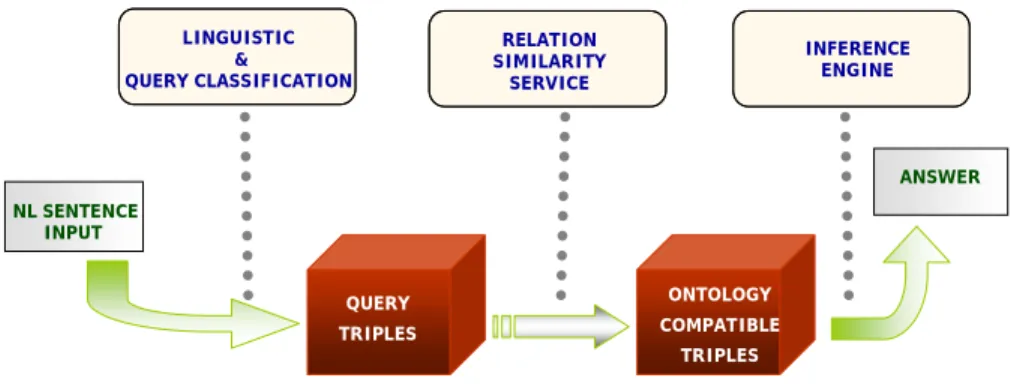
First of all, at a coarse-grained level of abstraction, the AquaLog architecture can be characterized as a cascaded model, in which a NL query gets translated by the Linguistic Component into a set of intermediate triple–based representations, which are referred to as the Query-Triples. Then, the Relation Similarity Service (RSS) component takes as an input these Query-Triples and further processes them to produce the ontology-compliant queries, called Onto-Triples, as shown in Fig. 1.
The data model is triple-based, namely it takes the form of <subject, predicate, object>. There are two main reasons for adopting a triple-based data model. First of all, as pointed out by Katz et al. [31], although not all possible queries can be represented in the binary relational model, in practice these exceptions occur very infrequently. Secondly, RDF-based knowledge representation (KR) formalisms for the semantic web, such as RDF itself [47] or OWL [40] also subscribe to this binary relational model and express statements as <subject, predicate, object>. Hence, it makes sense for a query system targeted at the semantic web to adopt a triple-based model that shares the same format as many millions of other triples on the Semantic Web.
NL SENTENCE INPUT
LINGUISTIC &
QUERY CLASSIFICATION
RELATION SIMILARITY
SERVICE
INFERENCE ENGINE
QUERY TRIPLES
ONTOLOGY COMPATIBLE
TRIPLES
ANSWER
Figure 1. The AquaLog Data Model
For example, in the context of the academic domain in our department, AquaLog is able to translate the question “what is the homepage of Peter who has an interest on the semantic web?" into the following, ontology-compliant logical query, <what is?, has-web-address, peter-scott> & <person?, has-research-interest, Semantic Web area>, expressed as a conjunction of non-ground triples (i.e., triples containing variables).
In particular, consider the query “what is the homepage of Peter?”, the role of the RSS is to map the intermediate form, <what is?, homepage, peter>, obtained by the linguistic component, into the target, ontology-compliant query.
The RSS calls the user to participate in the QA process if no information is available to AquaLog to disambiguate the query directly. Let’s consider the query in Fig. 2. On the left screen we are looking for the homepage of Peter. By using string metrics the system is unable to disambiguate between Peter-Scott, Peter-Sharpe, Peter-Whalley, etc. Therefore, user feedback is required. Moreover, on the right screen user feedback is required to disambiguate the term “homepage” (is the same as “has-web-address”) as it is the first time the system came across this term, no synonyms have been identified in WordNet that relate both labels together, and the ontology does not provide further ways to disambiguate. We ask the system to learn the user’s vocabulary and context for future occasions.
On Fig. 3 we are asking for the web address of Peter, who has an interest in semantic web. In this case AquaLog does not need any assistance from the user, given that, by analyzing the ontology, only one of the “Peters” has an interest in Semantic Web, and only one possible ontology relation, “has-research-interest” (taking into account taxonomy inheritance) exists between “person” and the concept “research area”, of which “semantic web” is an instance. Also the similarity relation between “homepage” and “has-web-address” has been learned by the Learning Mechanism in the context of that query arguments, so the performance of the system improves over the time. When the RSS comes across a similar query it has to access the ontology information to recreate the context and complete the ontology triples. In that way, it realizes that the second part of the query “who has an interest on the Semantic Web” is a modifier of the term “Peter”.
Figure 2. Illustrative example of user interactivity to disambiguate a basic query
3
AquaLog Architecture
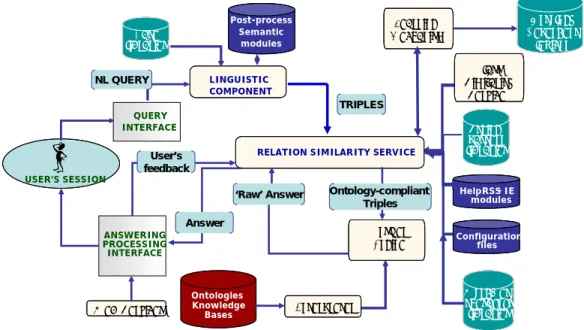
AquaLog is implemented in Java as a modular web application, using a client-server architecture. Moreover, AquaLog provides an API, which allows future integration in other platforms and independent use of its components. Fig. 4 shows the different components of the AquaLog architectural solution. As a result of this design, our existing version of AquaLog is modular, flexible and scalable1.
The Linguistic Component and the Relation Similarity Service (RSS) are the two central components of AquaLog, both of them portable and independent in nature. Currently AquaLog automatically classifies the query following a linguistic criterion. The linguistic coverage can be extended through the use of regular expressions by augmenting the patterns covered by an existing classification or creating a new one. This functionality is discussed in Section 4.
USER’S SESSION QUERY INTERFACE ANSWERING PROCESSING INTERFACE Gate libraries Configuration files LINGUISTIC COMPONENT String pattern libraries Configuration files HelpRSS- IE modules Answer Engine WordNet thesaurus libraries Ontologies Knowledge Bases
RELATION SIMILARITY SERVICE
TRIPLES NL QUERY
‘Raw’ Answer Ontology-compliant Triples Answer User’s feedback Post-process Semantic modules Learning Mechanism Ontology Dependent lexicon Interpreter Class Similarity Service Web Services
Figure 4. The AquaLog Global Architecture
A key feature of AquaLog is the use of a plug-in mechanism, which allows AquaLog to be configured for different Knowledge Representation (KR) languages. Currently we subscribe to the Operational Conceptual Modeling Language(OCML), using our own OCML-based KR infrastructure [52]. However, in future our aim is also to provide direct plug-in mechanisms for the emerging RDF and OWL servers2.
To reduce the number of calls/requests to the target knowledge base and to guarantee real-time question answering, even when multiple users access the server simultaneously, the AquaLog server accesses and caches basic indexing data from the target Knowledge Bases (KBs) at initialization time. The cached information in the server can be efficiently accessed by the remote clients. In our research department, KMi, since AquaLog is also integrated into the KMi Semantic Portal [35], the KB is dynamically and constantly changing with new information obtained from KMi websites through different agents. Therefore, a mechanism is provided to update the cached indexing data on the AquaLog server. This mechanism is called by these agents when they update the KB.
As regards portability, the only entry points which require human intervention for adapting AquaLog to a new domain are the configuration files. Through the configuration files it is possible to specify the parameters needed to initialize the AquaLog server. The most important parameters are: the ontology name
1 AquaLog is available for developers as Open Source licensed under the Apache License, Version 2.0
https://sourceforge.net/projects/aqualog
2 We are able to import and export RDF(S) and OWL from OCML, so the lack of an explicit RDF/OWL plug-in is not a problem in practice.
and server, login details if necessary, the name of the plug-in, and slots that correspond to pretty names. Pretty names are alternative names that an instance may have. Optionally, the main concepts of interest in an ontology can be specified.
The other ontology-dependent parameters required in the configuration files are the ones which specify that the term “who”, “where”, “when” corresponds, for example, to the ontology terms “person/organization”, “location” and “time-position” respectively. The independence of the application from the ontology is guaranteed through these parameters.
There is no single strategy by which a query can be interpreted, because this process is highly dependent on the type of the query. So, in the next sections we will not attempt to give a comprehensive overview of all the possible strategies, but rather we will show a few examples, which are illustrative of the way the different AquaLog components work together.
AquaLog Triple approach.
Core to the overall architecture is the triple-based data representation approach. A major challenge in the development of the current version of AquaLog is to efficiently deal with complex queries in which there could be more than one or two terms. These terms may take the form of modifiers that change the meaning of other syntactic constituents, and they can be mapped to instances, classes, values, or combinations of them, in compliance with the ontology to which they subscribe. Moreover, the wider expressiveness adds another layer of complexity mainly due to the ambiguous nature of human language. So, naturally the question arises of how far the engineering functionality of the triple-based model can be extended to map a triple obtained through a NL query into a triple that can be realized by a given ontology.To accomplish this task, the triple in the current AquaLog version has been slightly extended. Therefore an existing linguistic triple now consists of one, two or even three terms connected through a relationship. A query can be translated into one or more linguistic-triples, and then each linguistic triple can be translated into one or more ontology-compliant-triples. Each triple also has additional lexical features in order to facilitate reasoning about the answer, such as the voice and tense of the relation. Another key feature for each triple is its category (see an example table of query types in the appendix in Section 11).
These categories identify different basic structures of the NL query and their equivalent representation in
the triple. Depending on the category, the triple tells us how to deal with its elements, what inference
process is required and what kind of answer can be expected. For instance, different queries may be represented by triples of the same category, since, in natural language, there can be different ways of asking the same question, i.e. “who works in akt3?” and “Show me all researchers involved in the akt project”. The classification of the triple may be modified during its life cycle in compliance with the target ontology it subscribes to.
In what follows we provide an overview of each component of the AquaLog architecture.
4
Linguistic Component: from Questions to Query Triples
When a query is asked, the Linguistic Component’s task is to translate from NL to the triple format used to query the ontology (Query-Triples). This preprocessing step helps towards the accurate classification of the query and its components by using standard research tools and query classification. Classification identifies the type of question and hence the kind of answer required. In particular, AquaLog uses the GATE [15, 49] infrastructure and resources (language resources, processing resources like ANNIE, serial controllers, pipelines, etc.) as part of the Linguistic Component. Communication between AquaLog and GATE takes place through the standard GATE API.
After the execution of the GATE controller, a set of syntactic annotations associated with the input query are returned. In particular, AquaLog makes use of GATE processing resources for English tokenizer, sentence splitter, POS tagger and VP chunker. The annotations returned after the sequential execution of
these resources include information about sentences, tokens, nouns and verbs. For example, we get voice and tense for the verbs and categories for the nouns, such as determinant, singular/plural, conjunction, possessive, determiner, preposition, existential, wh-determiner, etc. These features, returned for each
3 AKT is a EPSRC founded project in which the Open University is one of the partners. http://www.aktors.org/akt/
annotation, are important to create the triples, for instance, in the case of verb annotations, together with the voice and sense it also includes information that indicates if it is the main verb of the query (the one that separates the nominal group and the predicate). This information is used by the Linguistic Component to establish the proper attachment of prepositional phrases previous to the creation of the Query-Triples (an example is shown in Section 5.3)
When developing AquaLog we extended the set of annotations returned by GATE, by identifying noun terms, relations4, question indicators (which/who/when, etc.) and patterns or types of questions. This is achieved by running, through the use of GATE JAPE transducers, a set of JAPE grammars that we
wrote for AquaLog. JAPE is an expressive, regular expression based rule language offered by GATE5 (see 4.2 for an example of the JAPE grammars written for AquaLog). These JAPE grammars consist of a set of phases, that run sequentially, and each phase is defined as a set of pattern rules, which allow us to
recognize regular expressions using previous annotations in documents. In other words, the JAPE grammars’ power lie in their ability to regard the data stored in the GATE annotation graphs as simple
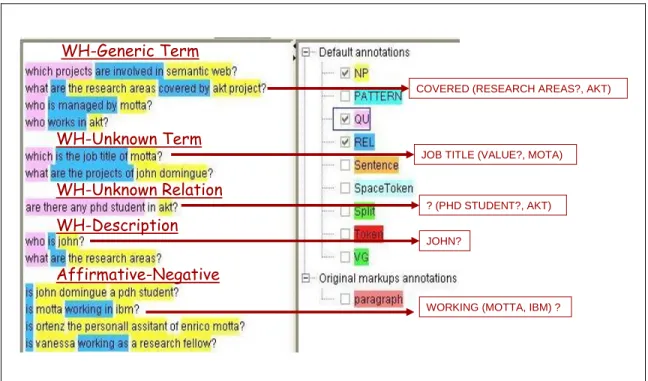
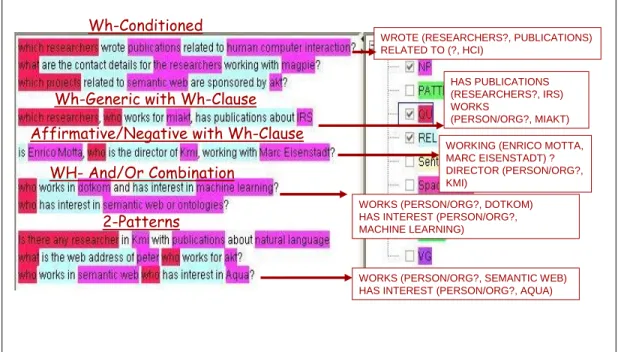
sequences, which can be matched deterministically by using regular expressions6. Examples of the annotation obtained after the use of our JAPE grammars can be seen in Figure 5, 6 and 7.
Currently, the linguistic component, through the JAPE grammars, dynamically identifies around 14
different question types or intermediate representations (examples can be seen in the appendix of this paper), including: basic queries requiring an affirmation/negation or a description as an answer; or the big set of queries constituted by a wh-question, like “are there any phd students in dotkom?” where the relation is implicit or unknown or “which is the job title of John?” where no information about the type of the expected answer is provided, etc.
Categories not only tell us the kind of solution that needs to be achieved, but also they give an indication of the most likely common problems that the Linguistic Component and Relation Similarity Services will need to deal with to understand this particular NL query and in consequence it guides the process of creating the equivalent intermediate representation or Query-Triple. For instance, in the previous example “what are the research areas covered by the akt project?” thanks to the category the Linguistic Component knows that it has to create one triple that represents a explicit relationship between an explicit generic term and a second term. It gets the annotations for the query terms, relations and nouns
preprocesses them and generates the following Query-Triple: <research areas, covered, akt project> in
which “research areas” has correctly been identified as the query term (instead of “what”).
For the intermediate representation, we use the triple-based data model rather than logic, mainly because at this stage we do not have to worry about getting the representation completely right. The role of the intermediate representation is simply to provide an easy and sufficient way to manipulate input for the RSS. An alternative would be to use more complex linguistic parsing, but as discussed by Katz et al. [33, 29], although parse trees (as for example, the NLP parser for Stanford [34]) capture syntactic relations and dependencies, they are often time-consuming and difficult to manipulate.
4.1
Classification of questions
Here we present the different kind of questions and the rationale behind distinguishing these categories. We are dealing with basic queries (Section 4.1.1), basic queries with clauses (Section 4.1.2) and combinations of queries (Section 4.1.3). We considered these three main groups of queries based on the number of triples needed to generate an equivalent representation of the query.
It is important to emphasize that, at this stage, all the terms are still strings or arrays of strings, without any correspondence with the ontology. This is because the analysis is completely domain independent and is entirely based on the GATE analysis of the English language. The Query-Triple is only a formal, simplified way of representing the NL-query. Each triple represents an explicit relationship between terms.
4Hence, for example we exploited the fact that natural language commonly uses a preposition to express a relationship. For instance, in the query “who has a research interest in semantic services in KMi?” the relation of the query is a combination of the verb “has” and the noun “research interest”.
5 http://gate.ac.uk/sale/tao/index.html
4.1.1 LINGUISTIC PROCEDURE FOR BASIC QUERIES
There are several different types of basic queries: we can mention the affirmative negative query type, which are those queries that requires an affirmation or negation as an answer, i.e. “is John Domingue a phd student?”, “is Motta working in ibm?”. Another big set of queries are those constituted by a “wh-question”, such as the ones starting with: what, who, when, where, are there any, does anybody/anyone or how many. Also imperative commands like list, give, tell, name, etc; are treated as wh-queries (see an example table of query types in the appendix in section 11).
In fact, wh-queries are categorized depending on the equivalent intermediate representation. For example, in “who are the academics involved in the semantic web?” the generic triple will be of the form <generic term, relation, second term>, in our example <academics, involved, semantic web>. A query with an equivalent triple representation is “which technologies has KMi produced?”, where the triple will be <technologies, has produced, KMi>. However, a query like “are there any phd students in akt?” has another equivalent representation, where the relation is implicit or unknown <phd students, ?, akt> . Other queries may provide little or no information about the type of the expected answer, e.g. “what is the job title of John?”, or they can be just a generic enquiry about someone or something, e.g. “who is Vanessa?”, “what is an ontology?” (see Fig. 5).
WH-Generic Term
WH-Unknown Term WH-Unknown Relation WH-Description Affirmative-Negative
COVERED (RESEARCH AREAS?, AKT)
JOB TITLE (VALUE?, MOTA)
? (PHD STUDENT?, AKT)
JOHN?
WORKING (MOTTA, IBM) ?
Figure 5. Example of GATE annotations and linguistic triples for basic queries
4.1.2 LINGUISTIC PROCEDURE FOR BASIC QUERIES WITH CLAUSES (3-TERMS QUERIES)
Let us consider the request “List all the projects in the knowledge media institute about the semantic web”, where both “in knowledge media institute” and “about semantic web” are modifiers (i.e. they modify the meaning of other syntactic constituents). The problem here is to identify the constituent to which each modifier has to be attached. The Relation Similarity Service (RSS) is responsible for resolving this ambiguity through the use of the ontology, or in an interactive way by asking for user feedback. The linguistic component’s task is therefore to pass the ambiguity problem to the RSS through the intermediate representation, as part of the translation process.
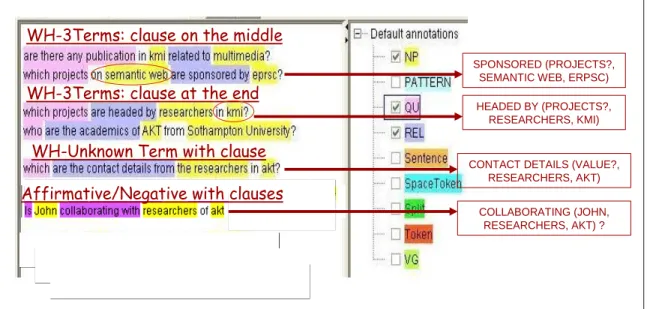
We must remember that all these queries are always represented by just one Query-Triple at the linguistic stage. In the case that modifiers are presented, the triple will consist of three terms instead of two, for instance, in “are there any planet news written by researchers from akt?“, in which we get the terms “planet news”, “researchers” and “akt” (see Fig. 6).
The resultant Query-Triple is the input for the Relation Similarity Services that process the basic queries with clauses as explained in 5.2.
WH-3Terms: clause on the middle
SPONSORED (PROJECTS?, SEMANTIC WEB, ERPSC) WH-3Terms: clause at the end
HEADED BY (PROJECTS?, RESEARCHERS, KMI) WH-Unknown Term with clause
CONTACT DETAILS (VALUE?, RESEARCHERS, AKT) Affirmative/Negative with clauses
COLLABORATING (JOHN, RESEARCHERS, AKT) ?
Figure 6. Example of GATE annotations and linguistic triples for basic queries with clauses 4.1.3 LINGUISTIC PROCEDURE FOR COMBINATION OF QUERIES
Nevertheless, a query can be a composition of two explicit relationships between terms, or a query can be a composition of two basic queries. In this case, the intermediate representation usually consists of two triples, one triple per relationship. For instance, in “are there any planet news written by researchers working in akt?”, where the two linguistic triples will be <planet news, written, researchers> and <which are, working, akt>.
Not only are these complex queries classified depending on the kind of triples they generate but also the resultant triple categories are the driving force to generate an answer by combining the triples in an
appropriate way.
There are three ways in which queries can be combined. Firstly, queries can be combined by using a “and” or “or” conjunction operator, as in “which projects are funded by epsrc and are about semantic web?”. This query will generate two Query-Triples: <funded (projects, epsrc)> and <about (projects, semantic web)> and the subsequent answer will be a combination of both lists obtained after resolving each triple.
Secondly, a query may be conditioned to a second query, as in “which researchers wrote publications related to social aspects?” where the second clause modifies one of the previous terms. In this example, and at this stage, ambiguity cannot be solved by linguistic procedures; therefore the term to be modified by the second clause remains uncertain.
Finally, we can have combinations of two basic patterns, e.g. “what is the web address of Peter who works for akt?” or “which are the projects led by Enrico which are related to multimedia technologies?” (see Fig. 7).
Once the intermediate representation is created, prepositions and auxiliary words, such as: "in", "about", "of", "at", "for", "by", "the", "does", "do", "did" are removed from the Query-Triples because in the current AquaLog implementation their semantics are not exploited to provide any additional information to help in the mapping between Query-Triples into the Ontology-compliant triples (Onto-Triples).
The resultant Query-Triple is the input for the Relation Similarity Services that process the combinations of queries as explained in 5.3.
2-Patterns
WH- And/Or Combination
Affirmative/Negative with Wh-Clause Wh-Generic with Wh-Clause
Wh-Conditioned
WORKS (PERSON/ORG?, SEMANTIC WEB) HAS INTEREST (PERSON/ORG?, AQUA) WORKS (PERSON/ORG?, DOTKOM) HAS INTEREST (PERSON/ORG?, MACHINE LEARNING)
WORKING (ENRICO MOTTA, MARC EISENSTADT) ? DIRECTOR (PERSON/ORG?, KMI)
HAS PUBLICATIONS (RESEARCHERS?, IRS) WORKS
(PERSON/ORG?, MIAKT) WROTE (RESEARCHERS?, PUBLICATIONS) RELATED TO (?, HCI)
Figure 7. Example of GATE annotations and linguistic triples for combination of queries
4.2
The use of JAPE grammars in AquaLog: illustrative example
Consider the basic query in Fig.5 “what are the research areas covered by the akt project?” as an illustrative example in the use of JAPE grammars to classify the query and obtain the correct annotations to create a valid triple. Two JAPE grammar files were written for AquaLog. The first one in the GATE
execution list annotates the nouns: “researchers” and “akt projects”; relations: “are” and “covered by”; and query terms: “what” (see Fig. 8). For instance, consider the rule Rule:NP in Fig. 8. The pattern on the left
hand side (i.e., before “→”) identifies noun phrases. Noun phrases are word sequences that start with zero or more determiners (identified by the (DET)* part of the pattern). Determiners can be followed by zero or more adverbs and adjectives, nouns or coordinating conjunctions in any order (identified by the ((RB)*ADJ)|NOUN|CC)* part of the pattern). A noun phrase mandatorily finishes with a noun (NOUN). RB, ADJ, NOUN and CC are macros and act as placeholders for other rules. For example, the macro LIST
used by the rule Rule:QU1 or the macro VERB used by rule Rule:REL1in the Fig. 8. The macro VERB
contains the disjunction of seven patterns, which means that the macro will fire if a word satisfies any of these seven patterns, e.g. last pattern identified words assigned to the VB POS tags. POS tags are assigned
in the “category” feature of a “Token” annotation used in GATE to encode the information about the
analyzed question. Any word sequence identified by the left hand side of a rule can be referenced in its right hand size, e.g. rel.REL={rule=”REL1”..} is referenced by the macro RELATION in the second
grammar (Fig. 9)
The second grammar file based on the previous annotations (rules) classifies the example query as “wh-genericterm”. The set of JAPE rules used to classify the query can be seen in Fig. 9. The pattern fired
for that query “QUWhich IS_ARE TERM RELATION TERM” is marked in bold. This pattern relies on the
macros QUWhich, IS_ARE, TERM and RELATION.
Thanks to this architecture, that takes advantage of the JAPE grammars, although we can still only
deal with a subset of natural language, it is possible to extend this subset in a relatively easy way by updating the regular expressions in the JAPE grammars. This design choice ensures the easy portability of
Examples of rules for the first jape grammar: -written to generate annotations
Rule:QU1 Priority:65 ( {Token.category=="WDT"} ):qu --> :qu.QU={rule="QU-which"} Rule:QU11 Priority: 60 ( LIST (ME)?(ALL)? ):qu
-->
:qu.QU={rule="QU-list"}
Rule: NP Priority: 50
((DET)* (((RB)* ADJ)|NOUN|CC)* (NOUN)
):np -->
:np.NP= {rule = "NP1"} Rule: REL1
Priority: 60
( (VERB) (VERB)* ( ( (RB)? (JJA)* PREPS (VERB)?) ) ?
) :rel -->
:rel.REL= {rule = "REL1" category="REL_JJ"} Rule: REL1
Priority: 60
( (VERB) (VERB)* (((RB)? DET (NOUNA)* PREPS (VERB)?) )
) :rel -->
:rel.REL= {rule = "REL1" category="REL_NN"}
Rule: REL2 Priority: 60
( (VERB) (VERB)* (RB)? NOUNA PREPS (VERB)?
) :rel -->
:rel.REL= {rule = "REL2" category="REL_NN"}
Macro: VERB
(
{Token.category == FVG, Token.kind == word} | {Token.category == VBN, Token.kind == word}| {Token.category == VBZ, Token.kind == word}| {Token.category == VBG, Token.kind == word} | {Token.category == VBD, Token.kind == word} | {Token.category == VBP, Token.kind == word} | {Token.category == VB, Token.kind == word} )
Macro: LIST
( {Token.string == "Tell"} | {Token.string == "tell"} | {Token.string == "TELL"} | {Token.string == "Give"} | {Token.string == "give"} | {Token.string == "GIVE"} | {Token.string == "List"} | {Token.string == "list"} | {Token.string == "LIST"} | {Token.string == "Show"} | {Token.string == "show"} | {Token.string == "SHOW"} | {Token.string == "Name"} | {Token.string == "name"} | {Token.string == "NAME"} )
Figure 8. Set of JAPE rules used in the query example to generate annotations Examples of rules for the second jape grammar:
-written to classify the query using previous annotations Rule:PATTERN_whgenericterm
Priority:65
( (({Token.category==IN})? QUWhichClass (AUX|AUX_EXT) TERM RELATION) |
(QUWhichClass (Modal)? TERM RELATION) | (QUWhichClass NOUN (NOUN)* RELATION) | (QUWhich IS_ARE TERM (QUWhich)? RELATION TERM) |
(QUWho IS_ARE TERM RELATION) |
(QUWhichClass (QUWhich|QU-who-what|Modal)? RELATION TERM) | (QU-who-what AUX TERM (QUWhich|QU-who-what)? RELATION TERM) | (QUWho RELATION TERM) |
(QU-anybody (QUWhich|QU-who-what)? RELATION TERM) | (QUWhe AUX TERM RELATION) |
(QUWhe RELATION TERM) |
(QUListClass (QUWhich|QU-who-what)? RELATION TERM) ):pattern
-->
:pattern.PATTERN={rule="PATTERN_whgenericterm" category="wh-genericterm"}
Macro: QUWhich (
{QU.rule == "QU-which"} | {QU.rule == "QU-list"} )
Macro: RELATION (
{REL.rule == “REL1"} | {REL.rule == “REL2"} )
Macro: TERM (
{NP.rule == “NP1"} )
5
Relation Similarity Service: from Triples to Answers.
The RSS is the backbone of the question-answering system. The RSS component is invoked after the NL query has been transformed into a term-relation form and classified into the appropriate category. The RSS is the main component responsible for generating an ontology-compliant logical query. Essentially, the RSS tries to make sense of the input query by looking at the structure of the ontology and the information stored in the target KBs, as well as using string similarity matching, generic lexical resources such as WordNet, and a domain-dependent lexicon obtained through the use of a Learning Mechanism, explained in section 5.5.
An important aspect of the RSS is that it is interactive. In other words, when ambiguity arises between two or more possible terms or relations the user will be required to interpret the query.
Relation and concept names are identified and mapped within the ontology through the RSS and the Class Similarity Service (CSS) respectively (the CSS is a component which is part of the Relation Similarity Service). Syntactic techniques like string algorithms are not useful when the equivalent ontology terms have dissimilar labels from the user term. Moreover, relations names can be considered as “second class citizens”, the rationality behind this is that mapping relations based on its name (labels) is more difficult that mapping concepts. Labels, in the case of concepts, often catch the meaning of the semantic entity, while in relations its meaning is given by the type of its domain and its range rather than by its name (typically vaguely defined as e.g. “related to”), with the exception of the cases in which the relations are presented in some ontologies as a concept (e.g. has-author modeled as a concept Author in a given
ontology). Therefore the similarity services should use the ontology semantics to deal with these situations. Proper names, instead, are normally mapped into instances by means of string metric algorithms. The disadvantage of such an approach is that without some facilities for dealing with unrecognized terms, some questions are not accepted. For instance, a question like “is there any researcher called Thompson?” would not be accepted if Thompson is not identified as an instance in the current KB. However, a partial solution is implemented for affirmative/negative types of questions, where we make sense of questions in which only one of two instances is recognized, e.g. in the query “is Enrico working in ibm?”, where “Enrico” is mapped into “Enrico-motta” in the KB, but “ibm” is not found. The answer in this case, is an indirect negative answer, namely the place were Enrico Motta is working.
In any non-trivial natural language system, it is important to deal with the various sources of ambiguity and the possible ways of treating them. Some sentences are syntactically (structurally) ambiguous and although general world knowledge does not resolve this ambiguity, within a specific domain it may happen that only one of the interpretations is possible. The key issue here is to determine some constraints derived from the domain knowledge and to apply them in order to resolve ambiguity [14]. Where the ambiguity cannot be resolved by domain knowledge the only reasonable course of action is to get the user to choose between the alternative readings.
Moreover, since every item on the Onto-Triple is an entry point in the knowledge base or ontology, they are also clickable, giving the user the possibility to get more information about them. Also, AquaLog scans the answers for words denoting instances that the system “knows about”, i.e. which are represented in the knowledge base, and then adds hyperlinks to these words/phrases, indicating that the user can click on them and navigate through the information. In fact, the RSS is designed to provide justifications for every step of the user interaction. Intermediate results obtained through the process of creating the Onto-Triple are stored in auxiliary classes, which can be accessed within the triple.
Note that the category to which each Onto-Triple belongs can be modified by the RSS during its life cycle, in order to satisfy the appropriate mappings of the triple within the ontology.
In what follows, we will show a few examples, which are illustrative of the way the
RSS works.
5.1
RSS procedure for basic queries
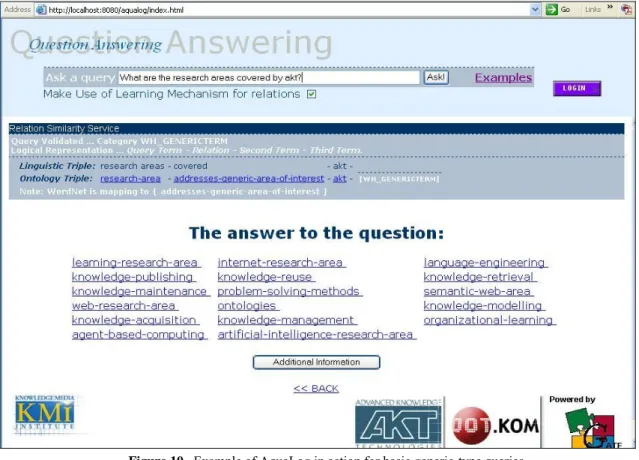
Here we describe how the RSS deals with basic queries. For example, let’s consider a basic question like “what are the research areas covered by akt?” (see Figs. 10 and 11). The query is classified by the
Linguistic component as a basic generic-type (one wh-query represented by a triple formed by an explicit
binary relationship between two define terms) as shown is section 4.1.1.Then, the first step for the RSS is to identify that “research areas” is actually a “research area” in the target KB and “akt” is a “project” through the use of string distance metrics and WordNet synonyms if needed. Whenever a successful match
is found, the problem becomes one of finding a relation which links “research areas” or any of its subclasses to “projects” or any of its superclasses.
Figure 10. Example of AquaLog in action for basic generic-type queries
Figure 11. Example of AquaLog additional information screen from Figure 10 example
By analyzing the taxonomy and relationships in the target KB, AquaLog finds that the only relations between both terms are “addresses-generic-area-of-interest” and “uses-resource”. Using the WordNet lexicon, AquaLog identifies that a synonym for “covered” is “addresses”, and therefore suggests to the user
that the question could be interpreted in terms of the relation “addresses-generic-area-of-interest”. Having done this, the answer to the query is provided. It is important to note that in order to make sense of the triple <research areas, covered, akt>, all the subclasses of the generic term “research areas” need to be considered. To clarify this, let’s consider a case in which we are talking about a generic term “person”, then the possible relation could be defined only for researchers, students or academics, rather than people in general. Due to the inheritance of relations through the subsumption hierarchy a similar type of analysis is required for all the super-classes of the concept “projects”.
Whenever multiple relations are possible candidates for interpreting the query, if the ontology does not provide ways to further discriminate between them, string matching is used to determine the most likely candidate, using the relation name, the learning mechanism, eventual aliases, or synonyms provided by lexical resources such as WordNet [21]. If no relations are found by using these methods, then the user is asked to choose from the current list of candidates.
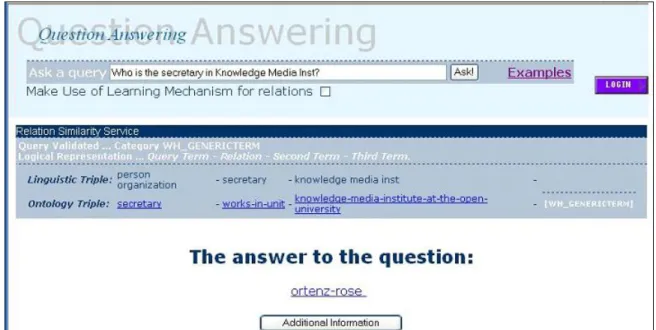
A typical situation the RSS has to cope with is one in which the structure of the intermediate query does not match the way the information is represented in the ontology. For instance, the query “who is the secretary in Knowledge Media Inst?”, as shown in Fig. 12, may be parsed into <person, secretary, kmi>, following purely linguistic criteria, while the ontology may be organized in terms of <secretary, works-in-unit, kmi>. In these cases the RSS is able to reason about the mismatch, re-classify the intermediate query and generate the correct logical query. The procedure is as follows. The question “who is the secretary in Knowledge Media Inst?”, is classified as a “basic generic type “ for the Linguistic Component. The first step is to identify that KMi is a “research institute”, which is also part of an “organization”, in the target
KB, and who could be pointing to a “person” (sometimes an “organization”). Similarly to the previous
example, the problem becomes one of finding a relation which links a “person” (or any of its subclasses like “academic”, “students”..) to a “research institute” (or an “organization”), but in this particular case, there is also a successful matching for “secretary” in the KB, in which “secretary” is not a relation but a subclass of “person”, and therefore the triple is classified from a generic one formed by a binary relation “secretary” between the terms “person” and “research institute” to a generic one in which the relation is unknown or implicit between the terms “secretary”, which is more specific than “person” and “research institute”.
Figure 12. Example of AquaLog in action for relations formed by a concept
If we take the example question presented in [14] “who takes the database course?” it may be that we are asking for “lecturers who teach databases” or for “students who study databases”. In this cases, AquaLog will ask the user to select the appropriate relation within all the possible relations between a generic person (lecturers, students, secretaries...) and a course. Therefore, the translation process from lexical to ontological triples can go ahead without misinterpretations.
Note that some additional lexical features, which help in the translation or put a restriction on the answer, presented in the Onto-Triple are: if the relation is passive, or reflexive or the relation is formed by “is”. The last means that the relation cannot be an “ad-hoc” relation between terms but is a relation of type “subclass-of” between terms related in the taxonomy, as in the query “is John Domingue a PhD student?”.
Also, a particular lexical feature is whether the relation is formed by verbs or by a combination of verbs and nouns; this feature is important because in the case that the relation contains nouns the RSS has to make additional checks to map the relation in the ontology. For example, consider the relation “is the secretary”, the noun “secretary” may correspond to a concept in the target ontology, while e.g. the relation “is the job title” may correspond to the slot “has-job-title” for the concept person
5.2
RSS procedure for basic queries with clauses (3-term queries)
When we described the Linguistic Component in section 4.1.2., we discussed that in the case of the basic queries in which there is a modifier clause, the triple generated is not in the form of a binary-relation but a ternary-relation. That is to say that from one Query-Triple composed of three terms, two Onto-Triples are generated by the RSS. In these cases the ambiguity can also be related to the way the triples are linked.
Depending on the position of the modifier clause (consisting of a preposition plus a term) and the relation within the sentence, we can have two different classifications, one in which the clause is related to the first term by an implicit relation, for instance “are there any projects in KMi related to natural language?” or “are there any projects from researchers related to natural language?”; and one where the clause is at the end and after the relation, as in “which projects are headed by researchers in akt?” or “what are the contact details for researchers in akt?”. The different classifications or query types determine whether the verb is going to be part of the first triple as in the latter example or part of the second triple as in the former example. However, at a linguistic level it is not possible to disambiguate the term in the sentence which the last part of the sentence, “related to natural language” (and “in akt” in the previous examples), refers to.
The RSS analysis relies on its knowledge of the particular application domain to solve such modifier attachment. Alternatively, the RSS may attempt to resolve the modifier attachment by using heuristics.
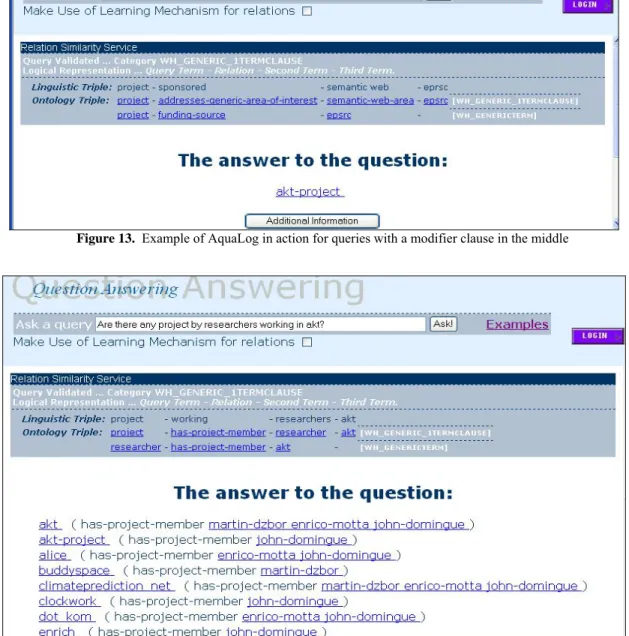
For example, to handle the previous query “are there any projects on the semantic web sponsored by epsrc”, the RSS uses a heuristic which suggests attaching the last part of the sentence “sponsored by epsrc” to the closest term that is represented by a class or non-ground term in the ontology (e.g. in this case the class “project”). Hence the RSS will create the following two Onto-Triples: a generic one <project, sponsored, epsrc> and one in which the relation is implicit <project, ?, semantic web>. The answer is a combination of a list of projects related to semantic web and a list of projects sponsored by epsrc (Fig. 13)
However, if we consider the query “which planet news stories are written by researchers in akt?” and apply the same heuristic to disambiguate the modifier “in akt”, the RSS will select the non-ground term “researchers” as the correct attachment for “akt”. Therefore, to answer this query, first it is necessary to get the list of researchers related to akt, and then to get a list of planet news stories for each of the researchers. It is important to notice that a relation in the linguistic triple may be mapped into more than one relation in the Onto-Triple, as for example “are written” is translated into “owned-by” or “has-author”.
The use of this heuristic to attach the modifier to the non-ground term can be appreciated comparing the ontology triples created in Fig. 13 (“Are there any project on semantic web sponsored by eprsc?”) and Fig. 14 (“Are there any project by researcher working in AKT?”). For the former, the modifier “sponsored by eprsc”, is attached to the query term in the first triple. i.e. “project”. For the later, the modifier “working in akt” is attached to the second term in the first triple, i.e., “researchers”.
Figure 13. Example of AquaLog in action for queries with a modifier clause in the middle
Figure 14. Example of AquaLog in action for queries with a modifier clause at the end
5.3
RSS procedure for combination of queries
Complex queries generate more than one intermediate representation as shown in the linguistic analysis in section 4.1.3. Depending on the type of queries the triples are combined following different criteria.
To clarify the kind of ambiguity we deal with, let’s consider the query “who are the researchers in akt, who have interest in knowledge reuse”. By checking the ontology, or, if needed, by using user feedback, the RSS module can map the terms in the query either to instances or to classes in the ontology, in a way that it can determine that “akt” is a “project” and therefore, it is not an instance of the classes “persons” or “organizations” or any of their subclasses. Moreover, in this case, the relation “researchers” is mapped into a “concept” in the ontology which is a subclass of “person”, and therefore, the second clause “who have an interest in knowledge reuse” is without any doubt assumed to be related to “researchers”. The solution in this case will be a combination of a list of researchers who work for akt and have interest in knowledge reuse (see Fig. 15).
However, there could be other situations where the disambiguation cannot be resolved by use of linguistic knowledge and/or heuristics and/or the context or semantics in the ontology, e.g. in the query “which academic works with Peter who has interest in semantic web?”. In this case, since “academic” and “peter” are respectively a subclass and an instance of “person”, the sentence is truly ambiguous, even for a human reader7. In fact, it can be understood as a combination of the resulting lists of the two questions “which academic works with peter” and “which academic has an interest in semantic web”, or as the relative query “which academic works with peter where the peter we are looking for has an interest in the semantic web”. In such cases, user feedback is always required
.
To interpret a query, different features play different roles. For example, in a query like “which researchers wrote publications related to social aspects?” the second term “publication” is mapped into a concept in our KB, therefore the adopted heuristic is that the concept has to be instantiated using the second part of the sentence “related to social aspects”. In conclusion, the answer will be a combination of the generated triples: <researchers, wrote, publications> <publications, related, akt>. However, frequently this heuristic is not enough to disambiguate and other features have to be used.
It is also important to underline the role that a triple element’s features can play. For instance, an important feature of a relation is whether it contains the main verb of the sentence, namely the lexical verb. We can see this if we consider the following two queries: (1) “which academics work in the akt project sponsored by epsrc?”; (2) “which academics working in the akt project are sponsored by epsrc?”. In both examples, the second term “akt project” is an instance, so the problem becomes to identify if the second clause “sponsored by epsrc” is related to “akt project” or to “academics”. In the first example the main verb is “work”, which separates the nominal group “which academics” and the predicate “akt project sponsored by epsrc”, thus “sponsored by epsrc” is related to “akt project”. In the second, the main verb is “are sponsored”, whose nominal group is “which academics working in akt” and whose predicate is “sponsored by epsrc”. Consequently, “sponsored by epsrc” is related to the subject of the previous clause, which is “academics”.
Figure 15. Example of context disambiguation
7 Note that there will not be ambiguity if the user reformulates the question as “which academic works with Peter and has an interest in semantic web?”, where “has an interest in semantic web” would be correctly attached to “academic” by AquaLog.
5.4
Class Similarity Service
String algorithms are used to find mappings between ontology term names and pretty names8 and any of the terms inside the linguistic triples (or its WordNet synonyms) obtained from the user’s query. They are based on String Distance Metrics for Name-Matching Tasks, using an open-source API from Carnegie Mellon University [13]. This comprises a number of string distance metrics proposed by different communities, including edit-distance metrics, fast heuristic string comparators, token-based distance metrics, and hybrid methods. AquaLog combines the use of these metrics (it mainly uses the Jaro-based metrics) with thresholds. Thresholds are set up depending on the task of looking for concepts names, relations or instances. See [13] for a experimental comparison between the different metrics.
However, the use of string metrics and open-domain lexico-semantic resources [45], such as WordNet, to map the generic term of the linguistic triple into a term in the ontology may not be enough. String algorithms fail when the terms to compare have dissimilar labels (i.e. “researcher” and “academic”), and generic thesaurus like WordNet may not include all the synonyms and is limited in the use of nominal compounds (i.e. WordNet contains the term “municipality” but not an ontology term like “municipal-unit”). Therefore, an additional combination of methods may be used in order to obtain the possible candidates in the ontology. For instance, a lexicon can be generated manually or can be built through a learning mechanism (a similar simplified approach to the learning mechanism for relations explained in Section 6). The only requirement to obtain ontology classes that can potentially map an unmapped linguistic term is the availability of the ontology mapping for the other term of the triple. In this way, through the ontology relationships that are valid for the ontology mapped term, we can identify a set of possible candidate classes that can complete the triple. User feedback is required to indicate if one of the candidate terms is the one we are looking for, so that AquaLog, through the use of the learning mechanism, will be able to learn it for future occasions.
The WordNet component is using the Java implementation (JWNL) of WordNet 1.7.1 [29]. The next implementation of AquaLog will be coupled with the new version on WordNet, so it can make use of Hyponyms and Hypernyms. Currently, the component of AquaLog which deals with WordNet does not perform any sense disambiguation.
5.5
Answer Engine
The Answer Engine is a component of the RSS. It is invoked when the Onto-Triple is completed. It contains the methods which take as an input the Onto-Triple, and infer the required answer to the user’s queries. In order to provide a coherent answer, the category of each triple tells the answer engine not only about how the triple must be resolved (or what answer to expect) but also how triples can be linked with each other. For instance, AquaLog provides three mechanisms (depending on the triple categories) for operationally integrating the triple’s information to generate an answer. These mechanisms are:
1) And/or linking: e.g., in the query “who has an interest in ontologies or in knowledge reuse?”, the result will be a fusion of the instances of people who have an interest in ontologies and the people who are interested in semantic web;
2) Conditional link to a term: for example in ”which KMi academics work in the akt project sponsored by eprsc?” the second triple <akt project, sponsored, eprsc> must be resolved and the instance
representing the “akt project sponsored by eprsc” identified to get the list of academics required for the first triple <KMi academics, work, akt project>;
3) Conditional link to a triple: for instance in ”What is the homepage of the researchers working on the semantic web?” the second triple <researchers, working, semantic web> must be resolved and the list
of researchers obtained prior to generating an answer for the first triple <?, homepage, researchers>.
The solution is converted into English using simple template techniques before presenting them to the user. Future AquaLog versions will be integrated with a natural language generation tool.
8 Naming conventions vary depending on the KR used to represent the KB and may even change with ontologies – e.g., an ontology can have slots such as “variant name” or “pretty name”. AquaLog deals with differences between KRs by means of the plug-in mechanism. Differences between ontologies need to be handled by specifying this information in a configuration file.
6
Learning Mechanism for relations
Since the universe of discourse we are working within is determined by and limited to the particular ontology used, normally there will be a number of discrepancies between the natural language questions prompted by the user and the set of terms recognized in the ontology. External resources like WordNet generally help in making sense of unknown terms, giving a set of synonyms and semantically related words which could be detected in the knowledge base. However, in quite a few cases, the RSS fails in the production of a genuine Onto-Triple because of user-specific jargon found in the linguistic triple. In such a case, it becomes necessary to learn the new terms employed by the user and disambiguate them in order to produce an adequate mapping of the classes of the ontology. A quite common and highly generic example, in our departmental ontology, is the relation works-for, which users normally relate with a number of
different expressions: is working, works, collaborates, is involved (see Fig. 16). In all these cases the user is
asked to disambiguate the relation (choosing from the set of ontology relations consistent with the question's arguments) and decide whether to learn a new mapping between his/her natural-language-universe and the reduced ontology-language-natural-language-universe.
Figure 16. Example of jargon mapping through user-interaction
6.1
Architecture
The learning mechanism (LM) in AquaLog consists of two different methods, the learning and the matching (see Fig.17). The latter is called whenever the RSS cannot relate a linguistic triple to the ontology
or the knowledge base, while the former is always called after the user manually disambiguates an unrecognized term (and this substitution gives a positive result).
When a new item is learned, it is recorded in a database together with the relation it refers to and a series of constraints that will determine its reuse within similar contexts. As will be explained below, the
notion of context is crucial in order to deliver a feasible matching of the recorded words. In the current version the context is defined by the arguments of the question, the name of the ontology and the user information. This set of characteristics constitutes a representation of the context and defines a structured space of hypothesis analogue9 to that of a version space.
A version space is an inductive learning technique proposed by Mitchell [42] in order to represent the
9 Although making use of a concept borrowed from machine learning studies, we want to stress the fact that the learning mechanism is not a machine learning technique, in the classical sense
subset of all hypotheses that are consistent with the observed training examples. In our case, the training examples are given by the user-refinement (disambiguation) of the query, while the hypotheses are structured in terms of the context parameters. Moreover, a version space is normally represented just by its lower and upper bounds (maximally general and maximally specific hypothesis sets), instead of listing all consistent hypotheses. In the case of our learning mechanism these bounds are partially inferred through a generalization process (section 6.3) that will in future be applicable also to the user-related and community derived knowledge (section 6.4). The creation of specific algorithms for combining the lexical and the community dimensions will increase the precision of the context-definition and provide additional personalization features.
Thus, when a question with a similar context is prompted, if the RSS cannot disambiguate the relation-name, the database is scanned for some matching results. Subsequently, these results will be context-proved
in order to check their consistency with the stored version spaces. By tightening and loosening the constraints of the version space, the learning mechanism is able to determine when to propose a substitution and when not to. For example, the user-constraint is a feature that is often bypassed, because we are inside a generic user session, or because we might want to have all the results of all the users from a single database query.
Before the matching method, we are always in a situation where the onto-triple is incomplete, the relation is unknown or it is a concept. If the new word is found in the database, the context is checked to see if it is consistent with what has been recorded previously. If this gives a positive result we can have a valid onto-triple substitution that triggers the inference engine (this latter scans the knowledge base for results); instead, if the matching fails, a user disambiguation is needed in order to complete the onto-triple. In this case, before letting the inference engine work out the results, the context is drawn from the particular question entered and it is learned together with the relation and the other information in the version space.
Figure 17. The learning mechanism architecture
Of course, the matching method's movement through the ontology is opposite to the learning method's one. The latter, starting from the arguments, tries to go up until it reaches the highest valid classes possible (GetContext method), while the former takes the two arguments and checks if they are subclasses of what has been stored in the database (CheckContext method). It is also important to notice that the Learning Mechanism does not have a question classification on its own, but relies on the RSS classification.
6.2
Context Definition
As said above, the notion of context is fundamental in order to deliver a feasible substitution service. In fact, two people could use the same jargon but mean different things.
For example, let’s consider the question "Who collaborates with the knowledge media institute?” (Fig. 16) and assume that the RSS is not able to solve the linguistic ambiguity of the word "collaborate". The first
time, some help is needed from the user, who selects "has-affiliation-to-unit" from a list of possible relations in the ontology. A mapping is therefore created between "collaborate” and "has-affiliation-to-unit", so that the next time the learning mechanism is called it will be able to recognize this specific user jargon.
Let's imagine a user, who asks the system the same question “who collaborates with the knowledge media institute?”, but is referring to other research labs or academic units involved with the knowledge media institute. In fact, if asked to choose from the list of possible ontology relations, he/she would possibly enter “works-in-the-same-project”.
The problem, therefore, is to maintain the two separated mappings while still providing some kind of generalization. This is achieved through the definition of the question context as determined by its coordinates in the ontology. In fact, since the referring (and pluggable) ontology is our universe of
discourse, the context must be found within this universe. In particular, since we are dealing with triples, and in the triple what we learn is usually the relation (that is, the middle item), the context is delimited by the two arguments of the triple. In the ontology, these correspond to two classes or two instances connected by the relation.
Therefore, in the question "who collaborates with the knowledge media institute?" the context of the mapping from " collaborates " to " has-affiliation-to-unit " is given by the two arguments "person" (in fact, in the ontology “who” is always translated into “person” or “organization”) and "knowledge media institute ". What is stored in the database, for future reuse, is the new word (which is also the key field in order to access the lexicon during the matching method), its mapping in the ontology, the two context-arguments, the name of the ontology and the user details.
6.3
Context Generalization
This kind of recorded context is quite specific and does not let other questions benefit from the same learned mapping. For example, if afterwards we asked "who collaborates with the Edinburgh department of informatics?" we would not get an appropriate matching, even if the mapping made sense again in this case. In order to generalize these results the strategy adopted is to record the most generic classes in the ontology, which correspond to the two triple's arguments, and, at the same time, can handle the same relation. In our case, we would store the concepts "people" and "organization-unit". This is achieved through a backtracking algorithm in the Learning Mechanism, that takes the relation, identifies its type (the type already corresponds to the highest possible class of one argument, by definition) and goes through all the connected superclasses of the other argument while checking if they can handle that same relation, with the given type. Thus, only the highest suitable classes of an ontology’s branch are kept and all the questions similar to the ones we have seen will fall within the same set, since their arguments are subclasses or instances of the same concepts.
If we go back to the first example presented (“who collaborates with the knowledge media institute?”), we can see that the difference in meaning between "collaborate" ->"has-affiliation-to-unit" and "collaborate"-> "works-in-the-same-project" is preserved, because the two mappings entail two different contexts. Namely, in the first case, the context is given by <people> and <organization-unit>, while in the second case the context will be <organization> and <organization-unit>. Any other matching could not mistake the two, since what is learned is abstract but still specific enough to rule out the different cases.
A similar example can be found in the question "who are the researchers working in akt?" (see Fig. 18) the context of the mapping from "working" to "has-research-member" is given by the highest ontology classes which correspond to the two arguments "researcher" and "akt", as far as they can handle the same relation. What is stored in the database, for a future reuse, is the new word, its mapping in the ontology, the two context-arguments (in our case, we would store the concepts "people" and "project"), the name of the ontology and the user details.
Other questions which have a similar context benefit from the same learned mapping. For example, if afterwards we asked "who are the people working in buddyspace?" we would get an appropriate matching from "working" to "has-research-member".