SS
CHOOL
M
M
ARKET
RR
ESEARCH
II
NSTITUTE,
INC
1721 Saybrook Road, P.O. Box 10, Haddam, CT 06438 • 800-838-3444 • FAX 860-345-3985 • www.smriinc.comK-12 O
NLINE
L
EARNING
Full-Time Online Schools Grew 15% in 2011
The International Association for K-12 Online Learning recently released the latest in their series of annual reports that began in 2004 and examine the status of K-12 online education across the country. Keeping Pace with K-12 Online Learning: An Annual Review of Policy and Practice (2011)provides an overview of the latest policies, practices, and trends affecting online learning programs across all 50 states. Following are some highlights from this report.
K-12 online and blended learning have evolved in new directions in the past year. While now familiar seg-ments of the field, such as online charter schools and state virtual schools, have continued to grow, relatively new forms such as consortium programs and single-district programs are expanding even more rapidly, as is the range of private providers competing to work with districts.
As of late 2011, online and blended learning opportunities exist for at least some students in all 50 states plus the District of Columbia, but no state has a full suite of full-time and supplemental options for students at all grade levels. Key trends and events from the past year include:
Single district programs are the fastest growing segment of online and blended learn-ing.
Growth within single district programs – run by one district for that district’s students – is outpacing all other segments. Several years ago, state-level and statewide schools and programs were driving most online learn-ing activity. That is no longer the case; now the bulk of activity is at the district level. A second important area of growth is among consortium programs, as districts choose to combine resources to create cost-effec-tive online opportunities.
Most district programs are blended, instead of fully online.
A corollary to the growth of district online programs is that many of these options blend online and face-to-face learning, instead of being entirely online as many state-level schools were. One reason is simple: Districts are often serving their own students, who are local, so there is limited need to bridge large distances. Even when the district is providing an online course with a remote teacher, the local school often provides a computer lab, facilitator, or other on-site resources that may define the course as blended instead of fully online. Many of the schools that have received significant media attention in 2011 fall into this category.
Intermediate units, BOCES, county offices, and other education service agencies are tak-ing on important roles.
States have less funding available to develop state virtual schools and other state-level efforts, but many dis-tricts recognize that creating online schools requires high investment and expertise, more than small disdis-tricts can provide. In states as diverse as New York, Wisconsin, Colorado, and California, educational service agencies are forming consortia to help districts gain expertise and provide economies of scale. This follows a similar pattern for dissemination of education technology since the 1980s.
Market Sales by Market Segment
SS
CHOOL
M
M
ARKET
RR
ESEARCH
II
NSTITUTE,
INC
1721 Saybrook Road, P.O. Box 10, Haddam, CT 06438 • 800-838-3444 • FAX 860-345-3985 • www.smriinc.com
Full-time, multi-district online schools continue to grow.
Even as district programs grow, multi-district schools continue to flourish as well. There are now 30 states with full-time, multi-district schools that enrolled an estimated total of 250,000 students in SY 2010-11, an annual increase of 25%. Maine, Indiana, and Tennessee are among the states that have, in the last two years, changed their laws to allow full-time online schools for the first time, or to allow significant growth in them.
State virtual schools are dividing into two tiers – those with significant impact and those without – largely based on funding model.
While 40 states have a state virtual school or similar state-led initiative, these programs are increasingly falling into two divergent categories: those that are sustainably funded at a level to have a real impact on their states, and those that do not have a level of reliable support. States in the former category include Florida, North Carolina, Michigan, Montana, Idaho, and Alabama.
Other state programs are in decline, mostly due to funding cuts. These include programs in Maryland, Missouri, and California. Nonetheless, all state virtual schools together accounted for 536,000 course enroll-ments (one student taking one semester-long course) in SY 2010-11, an annual increase of 19%.
Several states passed important new online learning laws, some of which cited the Ten Elements of Digital Learning created by Digital Learning Now.
Florida, Utah, Idaho, Ohio, and Wisconsin were among the states passing new online learning laws that will change the education landscape in those states in coming years. Digital Learning Now – an initiative man-aged by the Foundation for Excellence in Education in partnership with the Alliance for Excellent Education – released its Ten Elements of Digital Learning in December 2010. Some of the new laws cite the DLN elements.
The Common Core State Standards are taking hold, common assessments are next, and open educational resources are an increasingly important element.
The move toward the Common Core means that providers are able to create content for use across dozens of states and by millions of students. That is helping push online and blended learning, and the trend will accel-erate as the common assessment consortiums progress. Open educational resources, from sources including Khan Academy and the National Repository of Online Courses, are helping districts add a digital component without investing in developing or acquiring content.
The provider landscape is changing rapidly.
Both new start-ups and consolidations are affecting the market landscape. In the past year Kaplan acquired Insight Schools, and then K12 Inc. bought Kaplan’s Virtual Education division. Pearson Education acquired Connections Education. New providers such as Education Elements, a start-up focused on blended learning, continue to enter the field. Providers are increasingly offering services that combine elements of content, tech-nology, instruction, and other services.
SS
CHOOL
M
M
ARKET
RR
ESEARCH
II
NSTITUTE,
INC
1721 Saybrook Road, P.O. Box 10, Haddam, CT 06438 • 800-838-3444 • FAX 860-345-3985 • www.smriinc.comSpecial student needs gain new focus.
The release of a Request for Proposal in mid-2011 by the U.S. Department of Education Office of Special Education Programs (OSEP), for the establishment of a Center for Online Learning and Students with
Disabilities, suggests that the federal government believes that online learning can serve all students. In gener-al, there is a newly sophisticated emphasis on meeting special student needs in online and blended learning.
Four themes dominate across states and policies.
When looking back on 2011 from some future year, it may be clear in retrospect that 2011 was the year that online and blended learning went digital, transcending their distance-learning or computer-based instruction origins and taking root in classrooms and schools across the country.
This transformation is well underway and accelerating. Educators who three years ago thought that online learning didn’t have a role in their schools are now realizing that, in fact, online and blended learning should be available to their students. The change of heart may be due to having seen successful online learning in action, to competition, or simply because of the spread of technology through every other professional field. These developments are welcome in many circles, because they mean that more students have access to more opportunities. But they also carry challenges and risks.
As this year’s Keeping Pace was researched and written, it was found that four themes appear repeatedly, across states and across policies. These themes provide a lens to interpret the landscape.
Innovators sometimes overlook the benefits, and challenges, of “traditional” online learning.
It may seem strange to think of a “traditional” version of something that’s only been around for 15 or so years, but at times the most proven online schools are overlooked. Full-time online schools and supplemental course providers are supplying millions of courses to students across the country.
There is a sense among people and organizations that wish to be innovative, however, that online learning, in the form of full-time, fully online schools, and supplemental providers that serve students at a distance, are passé. These types of programs, the thinking goes, are easily implemented, not transformative, and shouldn’t be the focus of today’s innovative educators.
This line of thinking creates and perpetuates misleading depictions of online learning in several ways. First, it overlooks the real and proven benefits of existing online learning programs and program models, despite the fact that the benefits and reach of these schools and models have been only partially realized. A tangible sense exists in many states that there is no need for a state virtual school; that pioneering states and educators should instead look for the next thing.
Certainly further innovation is a worthy goal, but this view leaves behind the students in nearly all states who do not have widespread access to online options. The fact that students are taking 259,928 course enroll-ments from Florida Virtual School – by their choice and with the benefit of living in one of the few states that provides student choice from a statewide provider – suggests that there is an unmet need in most, if not all, of the remaining 49 states.
SS
CHOOL
M
M
ARKET
RR
ESEARCH
II
NSTITUTE,
INC
1721 Saybrook Road, P.O. Box 10, Haddam, CT 06438 • 800-838-3444 • FAX 860-345-3985 • www.smriinc.comSimilarly, the fact that tens of thousands of students are choosing a fully online school in the states that allow unfettered access to such schools suggests that states without such schools are not fully meeting the needs of their students. Seeking the next big thing is a laudable goal, but policymakers should recognize that for many students, existing online courses and schools have demonstrated the proven path to the next big thing.
Many states have created or allowed some online and blended learning opportunities, but no state has yet created or allowed a full range of online learning options for stu-dents. In many states, students still have few options.
Is the online and blended learning cup half full or half empty? The answer, from a student’s perspective, still depends on where the student lives. Students’ educational opportunities are still determined to a great extent by their ZIP codes.
Students in some states, including Florida, Arizona, and Idaho, and some districts, including Houston, Chicago, and Riverside (CA), have a variety of online and blended courses and schools available to them. Students in most other states, however, do not have many online and blended learning opportunities. When one registers the overall numbers of online students and course enrollments, it can be easy to forget that these opportunities do not yet exist for many students.
Developing an online or blended program requires a high level of investment to be suc-cessful or a willingness to work with an experienced partner.
We see many districts interested in creating online and blended learning programs – which is good – but far too many that don’t seem to recognize the level of investment that is necessary. In August 2011, we heard of a school district that is beginning its planning for an online and blended program to be operational in August 2013.
This timing is highly unusual, and remarkable, because it allows the necessary time to plan and create a high quality program. The far more common approach allows just a few months from time of conception to sched-uled opening of the virtual online or blended doors.
In addition to not allowing for enough time, many of these programs don’t allow for the necessary investment of personnel to fully explore all of the critical dimensions of an online school, including teaching, technology, content, student support, and other elements.
States must invest in planning for data tracking, transparency, and accountability meas-ures to ensure that online and blended learning provide opportunities and positive out-comes.
Creating new online and blended learning opportunities is a necessary step, and allowing such opportunities has been the focus of many advocates and policymakers. Although opportunities are not yet sufficiently wide-spread, advocates must now devote equal effort to pushing for the creation of accountability measures that will ensure positive outcomes.
Student opportunity, as well as parental choice, is a powerful tool toward ensuring equality among students. It is not, however, sufficient to generate positive student outcomes on its own. It is critical that states create the systems by which online and blended learning providers can demonstrate results and be held accountable.
SS
CHOOL
M
M
ARKET
RR
ESEARCH
II
NSTITUTE,
INC
1721 Saybrook Road, P.O. Box 10, Haddam, CT 06438 • 800-838-3444 • FAX 860-345-3985 • www.smriinc.comThese key themes – benefits of online and blended learning, creating more options and access, planning for quality, building for accountability – are not new, but as online and blended learning grow, these issues are becoming ever more critical.
Keeping Pacereviews five categories of online learning: state virtual schools and initiatives; full-time multi-dis-trict online schools; single-dismulti-dis-trict online programs; consortium programs, and postsecondary programs. State virtual schools and state-led online initiatives are created by legislation or by a state-level agency. They are often, but not always, administered by a state education agency and funded by a state appropriation or grant for the purpose of providing online learning opportunities to students across the state. They may also receive federal or private foundation grants, and sometimes charge course fees to help cover operating costs. Keeping Pacedistinguishes state-led online learning initiatives, as opposed to state virtual schools, as pro-grams that provide online content or resources to schools across the state but do not provide the full combina-tion of course content, a teacher, and a learning management system that together provide a fully online course that can be accessed by students. Initiatives may, for example, provide the course content without the teacher, who is provided by the local school. Full-time online schools are the main education providers for their students, unlike state virtual schools that are primarily supplemental.
Single-district online programs are created by a district primarily for students within that district. While they may be full time, most provide supplemental online courses for students who are enrolled full time in the dis-trict and who are accessing most of their courses in a physical school. Single-disdis-trict programs are leading the trend toward blending online and face-to-face courses.
Consortium online programs are often developed by districts or intermediate service units that wish to create efficiencies by combining resources. They usually serve students across multiple districts that join the consor-tium.
Post-secondary programs include many private pay options, but Keeping Pacefocuses on programs working with school districts to provide publicly funded options to students.
Online learning activity by state.
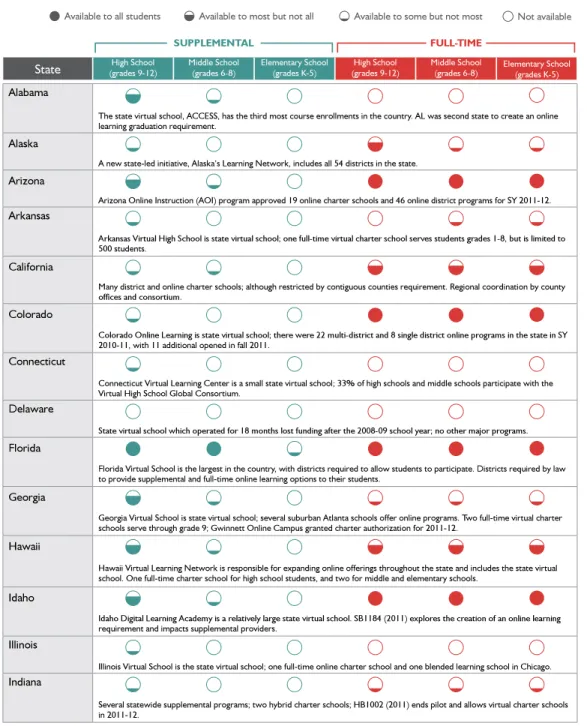
The table on the following pages presents all 50 states rated in six categories of online learning activity: full-time and supplemental online options for high school, middle school, and elementary school students. Each category was assigned one of four ratings: Available to all students across the state; available to most, but not all, students across the state; available to some, but not most, students across the state; and available to few or no students across the state
SS
CHOOL
M
M
ARKET
RR
ESEARCH
II
NSTITUTE,
INC
1721 Saybrook Road, P.O. Box 10, Haddam, CT 06438 • 800-838-3444 • FAX 860-345-3985 • www.smriinc.comTable 2: State-level snapshot of online learning activity
Ratings are based on the expected availability of online learning options to students of all grade levels in all geographic areas of the state for the 2011-12 school year. Availability is in turn based on the existence and attributes of programs, state policy and funding (including changes created in 2011 that will impact the 2011-12 school year), and the proportion of the student population taking part in online courses and schools for the 2010-11 school year.
Available to all students Available to most but not all Available to some but not most Not available
SUPPLEMENTAL FULL-TIME
State (grades 9-12)High School Middle SchoolJUDGHV Elementary School(grades K-5) (grades 9-12)High School Middle SchoolJUDGHV Elementary School(grades K-5) Alabama
The state virtual school, ACCESS, has the third most course enrollments in the country. AL was second state to create an online learning graduation requirement.
Alaska
A new state-led initiative, Alaska’s Learning Network, includes all 54 districts in the state.
Arizona
Arizona Online Instruction (AOI) program approved 19 online charter schools and 46 online district programs for SY 2011-12.
Arkansas
$UNDQVDV9LUWXDO+LJK6FKRROLVVWDWHYLUWXDOVFKRRORQHIXOOWLPHYLUWXDOFKDUWHUVFKRROVHUYHVVWXGHQWVJUDGHVEXWLVOLPLWHGWR
500 students.
California
Many district and online charter schools; although restricted by contiguous counties requirement. Regional coordination by county
RIÀFHVDQGFRQVRUWLXP Colorado
&RORUDGR2QOLQH/HDUQLQJLVVWDWHYLUWXDOVFKRROWKHUHZHUHPXOWLGLVWULFWDQGVLQJOHGLVWULFWRQOLQHSURJUDPVLQWKHVWDWHLQ6<
2010-11, with 11 additional opened in fall 2011.
Connecticut
Connecticut Virtual Learning Center is a small state virtual school; 33% of high schools and middle schools participate with the Virtual High School Global Consortium.
Delaware
6WDWHYLUWXDOVFKRROZKLFKRSHUDWHGIRUPRQWKVORVWIXQGLQJDIWHUWKHVFKRRO\HDUQRRWKHUPDMRUSURJUDPV Florida
Florida Virtual School is the largest in the country, with districts required to allow students to participate. Districts required by law to provide supplemental and full-time online learning options to their students.
Georgia
Georgia Virtual School is state virtual school; several suburban Atlanta schools offer online programs. Two full-time virtual charter schools serve through grade 9; Gwinnett Online Campus granted charter authorization for 2011-12.
Hawaii
Hawaii Virtual Learning Network is responsible for expanding online offerings throughout the state and includes the state virtual school. One full-time charter school for high school students, and two for middle and elementary schools.
Idaho
,GDKR'LJLWDO/HDUQLQJ$FDGHP\LVDUHODWLYHO\ODUJHVWDWHYLUWXDOVFKRRO6%H[SORUHVWKHFUHDWLRQRIDQRQOLQHOHDUQLQJ
requirement and impacts supplemental providers.
Illinois
Illinois Virtual School is the state virtual school; one full-time online charter school and one blended learning school in Chicago.
Indiana
Several statewide supplemental programs; two hybrid charter schools; HB1002 (2011) ends pilot and allows virtual charter schools in 2011-12. ST AT E PO LI C Y PR O FI LE S O U T LO O K PL A N N IN G F O R Q U A LI T Y PO LI C Y A N D P RA C T IC E K -1 2 O N LI N E LE A RN IN G 2 01 1 IN T RO D U C T IO N FR O N T M AT T ER 16
Ratings are based on the expected availability of online learning options to students of all grade levels in all geographic areas of the state for the 2011-12 school year. Availability is in turn based on the existence and attributes of programs, state policy and funding (including changes created in 2011 that will impact the 2011-12 school year), and the proportion of the student population taking part in online courses and schools for the 2010-11 school year.
SS
CHOOL
M
M
ARKET
RR
ESEARCH
II
NSTITUTE,
INC
1721 Saybrook Road, P.O. Box 10, Haddam, CT 06438 • 800-838-3444 • FAX 860-345-3985 • www.smriinc.comAvailable to all students Available to most but not all Available to some but not most Not available
SUPPLEMENTAL FULL-TIME
State (grades 9-12)High School Middle SchoolJUDGHV Elementary School(grades K-5) (grades 9-12)High School Middle SchoolJUDGHV Elementary School(grades K-5)
Iowa
Iowa Learning Online and Iowa Online AP Academy are the state virtual schools, regional academies that can offer online created in 2011 law.
Kansas
47 district programs and charter schools provide online courses, some of these schools serve students statewide. Kentucky
Kentucky Virtual Schools is a small state virtual school; also supports blended learning options statewide; JCPSeSchool is one of the largest district programs in the country.
Louisiana
/RXLVLDQD9LUWXDO6FKRROWKHVWDWHYLUWXDOVFKRROEHJDQFKDUJLQJFRXUVHIHHVIRUWKHÀUVWWLPHLQ6<7ZRYLUWXDOFKDUWHUV opened in SY 2011-12.
Maine
36% of middle and high schools participate in Virtual High School Global Consortium; Maine Online Learning Program approved its ÀUVWWKUHHSURYLGHUVIRU6<
Maryland
Maryland State Virtual School was defunded, a 2010 law allowing districts to create virtual school programs is being interpreted and has not yet taken effect.
Massachusetts
MassONE is a state-led initiative supporting blended learning; 60% of middle and high schools participate in Virtual High School *OREDO&RQVRUWLXP'LVWULFWVDOORZHGWRRSHQVWDWHZLGHYLUWXDOVFKRROVIRUWKHÀUVWWLPHLQZLWKVLJQLÀFDQWHQUROOPHQWOLPLWV Michigan
7KHVWDWHYLUWXDOVFKRRO0LFKLJDQ9LUWXDO6FKRROLVRQHRIWKHODUJHVWLQWKHFRXQWU\0LFKLJDQZDVWKHÀUVWVWDWHWRFUHDWHDQ ´RQOLQHOHDUQLQJH[SHULHQFHµJUDGXDWLRQUHTXLUHPHQWÀUVWWZRIXOOWLPHRQOLQHVFKRROVRSHQHGLQ6<EXWZLWKFDSV Minnesota
Many online charter school and district programs offering part- and full-time options; 24 providers authorized by the Department of Education.
Mississippi
Mississippi Virtual School is state virtual school; no other major programs. Missouri
State virtual school, Missouri Virtual Instruction Program (MoVIP), enrolls both part- and full-time students, but lost most funding in middle of SY 2009-10 and is primarily on a tuition model; there has been a 92% enrollment drop.
Montana
0RQWDQD'LJLWDO$FDGHP\WKHVWDWHYLUWXDOVFKRROVHUYHGFRXUVHHQUROOPHQWVLQ6<LWVÀUVW\HDURIRSHUDWLRQ$IHZ small district supplemental programs exist as well.
Nebraska
New state virtual school pilot, Nebraska Virtual School, started fall 2011. Omaha Public Schools and other district programs; Partnership for Innovations supports blended learning through a statewide license for open educational resources from the National Repository of Online Courses.
Nevada
DSSURYHGRQOLQHFKDUWHUVFKRROVDQGGLVWULFWSURJUDPVLQFOXGLQJ&ODUN&RXQW\6WDWH%RDUGLVUHGHÀQLQJVHDWWLPHDOWHUQDWLYHV New
Hampshire The Virtual Learning Academy Charter School provides primarily supplemental courses for grades 7-12; acts as de facto state virtual school. New Hampshire has 22 middle and high schools (20%) that are part of VHS in 2011.
New Jersey
Few online programs in the state, but 11% of high schools participate in Virtual High School Global Consortium. New Mexico
IDEAL-New Mexico is the state virtual school; some district programs exist, including Albuquerque’s eCademy. New York
A few online programs through BOCES. iLearnNYC provides online and blended options in New York City; Board of Regents eased seat-time and face-to-face requirements in 2011.
FR O N T M AT T ER IN T RO D U C T IO N K -1 2 O N LIN E LE A RN IN G 2 01 1 PO LIC Y A N D P RA C T IC E P LA N N IN G F O R Q U A LIT Y O U T LO O K ST AT E PO LIC Y PR O FIL
SS
CHOOL
M
M
ARKET
RR
ESEARCH
II
NSTITUTE,
INC
1721 Saybrook Road, P.O. Box 10, Haddam, CT 06438 • 800-838-3444 • FAX 860-345-3985 • www.smriinc.comAvailable to all students Available to most but not all Available to some but not most Not available
SUPPLEMENTAL FULL-TIME
State (grades 9-12)High School Middle SchoolJUDGHV Elementary School(grades K-5) (grades 9-12)High School Middle SchoolJUDGHV Elementary School(grades K-5) North Carolina
North Carolina Virtual Public School has the second highest number of enrollments of any state virtual school. North Dakota
North Dakota Center for Distance Education provides self-paced and scheduled courses to high school and middle school students. Districts may also use 20 online courses approved for SY 2011-12.
Ohio
27 eschools; HB153 (2011) lifts the moratorium on new eschools. ilearnOhio is a state-led initiative. Oklahoma
Two statewide full-time online schools in SY 2010-11 (one new in 2011); two university supplemental programs. Oregon
Oregon State Virtual School District, a state-led initiative, supports blended learning statewide; several district programs and statewide online charter schools; HB2301 (2011) eliminates some restrictions on virtual charter growth.
Pennsylvania
13 cyber charters (one new in 2011) and many district programs opening in response to cyber charter funding rules. Many districts partner with blendedschools.net.
Rhode Island
RIPLGGOHDQGKLJKVFKRROVSDUWLFLSDWHLQ9LUWXDO+LJK6FKRRO*OREDO&RQVRUWLXP1RUWKHUQ5KRGH,VODQG&ROODERUDWLYHRIIHUV online courses to grades 3-12; little other activity.
South Carolina
6RXWK&DUROLQD9LUWXDO6FKRROLVVWDWHYLUWXDOVFKRROÀYHIXOOWLPHFKDUWHUVFKRROVDQGVRPHGLVWULFWSURJUDPV South Dakota
South Dakota Virtual School is a consortium of course providers approved by state department of education. There is also a statewide virtual alternative school and statewide programs that focus on career and technical education and advanced courses. Tennessee
H71WKHVWDWHYLUWXDOVFKRROZDVGHIXQGHGIRU6<7KHÀUVWVWDWHZLGHRQOLQHVFKRRORSHQHGLQ6<VRPHGLVWULFW programs including Hamilton County.
Texas
Texas Virtual School Network is one of the largest state virtual schools, but lost its appropriation for SY 2011-12; TxVSN Online Schools (formerly eCP) allows for full-time schools operated both by charters and independent school districts for grades 3-11. Utah
8WDK(OHFWURQLF+LJK6FKRROZDVDPRQJWKHÀUVWVWDWHYLUWXDOVFKRROVLQWKHFRXQWU\7KHUHDUHWZRIXOOWLPHVFKRROVDQGWZR opened in 2011. SB65 (2011) expands part- and full-time options.
Vermont
State virtual school opened in 2010; 44% of high schools participate in Virtual High School Global Consortium. Virginia
9LUWXDO9LUJLQLDLVVWDWHYLUWXDOVFKRROVRPHGLVWULFWSURJUDPV7KHÀUVWPXOWLGLVWULFWSURYLGHUVDUHDSSURYHGIRU6< Washington
At least 15 district programs serving students statewide. There are at least an additional 20 single-district programs. West Virginia
West Virginia Virtual School is state virtual school utilizing third-party course providers. Schools must pay course fees, which can be quite high, after state budget allocation has been spent.
Wisconsin
Wisconsin Virtual School - Wisconsin Web Academy is the state virtual school. The Wisconsin eSchool Network , a supplemental program, is a consortium of 11 districts including some of the largest in the state. In addition there were 14 full-time online charters in SY 2010-11, and 11 more are approved for SY 2011-12.
Wyoming
Wyoming Switchboard Network coordinates distance learning for K-12 full-time and supplemental options statewide; several district programs. 7DEOH6WDWHOHYHOVQDSVKRWRIRQOLQHOHDUQLQJDFWLYLWLHV PO LI C Y PR O FI LE S O U T LO O K PL A N N IN G F O R Q U A LI T Y PO LI C Y A N D P RA C T IC E K -1 2 O N LI N E LE A RN IN G 2 01 1 IN T RO D U C T IO N FR O N T M AT T ER