The Night Sky
8.6 Star Patterns
What are constellations?
Why do we see some in winter, some in summer and some all year long?
The Milky Way
The band of light called the “Milky Way” traces the galactic plane as it appears from our location in the outskirts of the galaxy.
From: http://skyphoto.com/milky/Default.htm
The “Obvious” View
The most simplest
observation in Astronomy: Look at the night sky
About 3000 stars visible at any one time; distributed randomly but human brain tends to find patterns…
Patterns in the Sky
The
• Constellations: Recognizable patterns in the sky are called Constellations.
• There are 88 Constellations. 12 are based on the Zodiac.
– Orion, Leo, Aries, Taurus, etc.
• Asterisms: Recognizable patterns of stars that are not one of the constellations are called
Asterisms:
Our modern system of 88 constellations is based partly on constellations first
labelled in Mesopotamia, Babylon, Egypt and Greece, and partly on constellations added to fill in the southern sky (plus regions of the northern sky previously neglected
1.3 The “Obvious” View
• Are stars still present in the sky during the day time?
The following animations might help relate the zodiacal
constellations to the way the Earth orbits the Sun each year.
Viewed from Earth, the Sun is “in” Taurus: May 13 - June 21
zodiacal constellations
sightline from Earth
Why do the Stars Move?
Polaris –
the North Star
Circumpolar
Why do the Stars Move?
• The Stars don’t actually move… It is the Earth that is moving
(spinning).
• The spinning Earth gives the
perception that the stars move.
• Polaris – Earth’s northern axis points at this star so its
The Circling Sky
• Earth rotates from west to east.
• The celestial sphere appears to rotate east to west.
Constellations
• Group of stars that appear to form a pattern in the sky.
• 88 recognized by International
Circumpolar Constellations
• Can be seen all year long
• Never fully set below the horizon
• Appear to move counter clockwise around Polaris
The Dome of the Sky:
Angular Sizes
• We can measure angles in the sky• The angular size of an object like the Sun or the Moon is the angle it appears to span in your field of view.
Angular size of moon ~ ½ o
Angular distance between the “pointer stars” ~ 5o
To
• Latitude : Measures positions north or south of the equator. (Note: This is an angle)
– 0o = the equator.
– 90o N= the north pole.
– 90o S = the south pole.
• Longitude : Measures positions east or west of the Prime Meridian. (This is an angle)
• In the Northern Hemisphere, stars near the North Celestial Pole are always above the horizon. Therefore, these stars are called
Circumpolar Stars
• In the Northern Hemisphere, stars near the south celestial pole remain below the
horizon and so are never seen by a northern observer.
Counter-Clockwise Rotation Clockwise
Rotation
Northern Hemisphere Southern Hemisphere
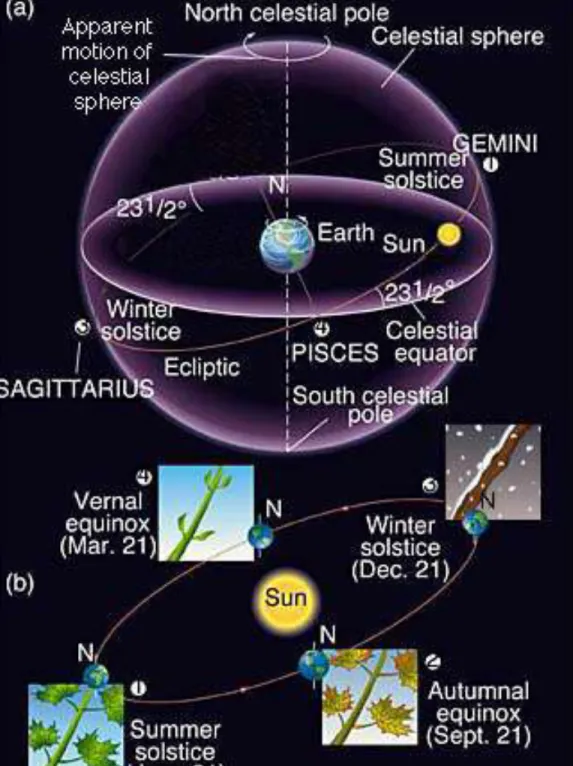
Seasonal Changes in the Sky
• The night-time constellations change with the seasons.
The Sun’s Path Through The Daytime Sky Changes With Seasons
• The sun traces out a characteristic figure 8 pattern over the course of a year at the same time of the day. This “Figure 8” is called an
analemma.
South
North Composite photograph
•Images taken always at same time of day. (8:30 am. EST)
•Pictures taken at 10 day intervals over an entire year.
Summer
Fall
Spring
Winter
Dennis di Cicco
Text 14.1
The apparent path of the Sun on the celestial
sphere, showing how the seasons arise.
Figure from Astronomy Today, 3rd ed.,
Chaisson & McMillan, Prentice-Hall, ©1999
Right Ascension and Declination
• Right Ascension (RA): Analogous to longitude, but on the celestial sphere.
– It is the east-west angle between the vernal equinox and a location on the celestial sphere.
• Declination (dec): Analogous to latitude, but on the celestial sphere.
Units of R.A.
360o = 24h
The Moon, Our Constant Companion
• As the Moon moves through the sky, both its appearance and the time at which it rises and sets change with the cycle of Lunar
Lunar Phases Demonstration
Lunar Phases
•We always see the same face of the Moon.
•The Moon rotates as it orbits the Earth.
•The rotation rate is synchronized with the orbital period.
Eclipses
• In order for an Eclipse to occur:
• The nodes of the Moon’s orbit must be nearly aligned with the Earth and the Sun.
Lunar Eclipse
Solar Eclipse
Solar Eclipse
Lunar Eclipse
The Ecliptic Plane is represented by the surface of the pond.
Geometry of a Lunar Eclipse
(Sunlight is partially blocked)
Multiple Exposure Photograph of Progression of a Solar Eclipse
Totality- lasts only a few minutes.
How often do Eclipses Occur?
• There are two periods each year when the
nodes of the Moon’s orbit are nearly aligned with the Sun.
• These are called Eclipse Seasons.
• The combined effect of the changing dates of eclipse seasons and the 29.5 day lunar cycle, makes eclipses recur about every 18 years.
Solar Eclipses from
2001 to 2022
The Ancient Mystery of the Planets Retrograde Motion
• Apparent Retrograde Motion
• A period during which a planet appears to
move westward relative to the stars is called a period of Apparent Retrograde Motion.
• Prograde (Direct) Motion
Retrograde Motion for Jupiter
East West
What Causes Retrograde
Motion?
• It is a result of Stellar Parallax.
– Parallax is the apparent shift of the position of a nearby object with respect to a more distant
background object.
– Do pen/pencil against background wall demo.
• Explanation of
apparent retrograde
motion using the
principle of
parallax.
Stellar Parallax
More distant stars are used as
the background for measuring