WHEN, WHY AND HOW DO ATTENTIONAL CONTROL SETTINGS INFLUENCE REFLEXIVE CAPTURE?
CASSIE BARASCH FORD
A dissertation submitted to the faculty at the University of North Carolina at Chapel Hill in partial fulfillment of the requirements for the degree of Doctor of Philosophy in the department of
Psychology and Neuroscience (Cognitive).
Chapel Hill 2016
Approved by: Daniel Bauer Mark Hollins
Joseph B. Hopfinger Neil Mulligan
ABSTRACT
Cassie Barasch Ford: When, why and how do attentional control settings influence reflexive capture? (Under the direction of Joseph Hopfinger)
Most models of selective attention acknowledge the role of both goal-driven and
saliency-driven factors (Itti & Koch, 2001). An important ongoing debate asks when and to what extent top-down task settings prevent distraction by salient but irrelevant stimuli. Some studies suggest that reflexive orienting of spatial attention occurs only when distractors are congruent with
ACKNOWLEDGEMENTS
TABLE OF CONTENTS
List of Tables ... viii
List of Figures ... ix
Chapter 1: Introduction ... 1
Top-down biasing of saliency-driven reflexive capture ... 3
Event-related potentials (ERPs) evidence ... 7
Development of an attentional set ... 11
Individual Differences ... 16
Chapter 2: Experiment 1 ... 20
Experiment 1a ... 24
Experiment 1b ... 28
Experiment 1c ... 30
Experiment 1d ... 33
Comparing results across experiments ... 36
General Discussion ... 37
Chapter 3: Experiment 2 ... 40
Methods ... 43
Results ... 46
Results ... 65
Discussion ... 69
Chapter 5: Discussion ... 73
Contributions to broader literature ... 77
Limitation and future directions ... 79
Conclusions ... 82
Appendix A. Cognitive Failures Questionnaire (CFQ) ... 103
Appendix B. Barratt Impulsiveness Scale (BIS-11) ... 105
Appendix C. Multilevel Model Equations ... 107
Figure 2. Additional singleton paradigm ... 85
Figure 3. Paradigm for experiments 1a-1c. ... 86
Figure 4. Paradigm for experiment 1d. ... 86
Figure 5. Experiment 1a reaction times. ... 87
Figure 6. Experiment 1a capture effect across blocks. ... 87
Figure 7. Experiment 1b reaction times. ... 88
Figure 8. Experiment 1c reaction times. ... 88
Figure 9. Experiment 1d reaction times. ... 89
Figure 10. Experiment 1d. capture effect across blocks: ... 89
Figure 11. Experiment 2 paradigm. ... 90
Figure 12. Experiments 2 and 3 mean reaction times. ... 91
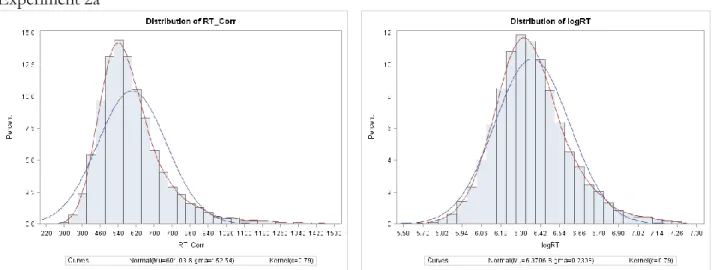
Figure 13. Histograms of raw and log-transformed RTs for experiments 2 and 3. ... 92
Figure 14. Experiment 2a individual variability in predicted RTs across time... 93
Figure 15. Experiment 2a effect of validity across all trials. ... 94
Figure 16. Experiment 2a means for rmANOVA test of validity by block effect ... 94
Figure 17. Experiment 2a validity by time effect within each block. ... 95
Figure 18. Experiment 2b individual variability in predicted RTs across time. ... 96
Figure 19. Experiment 2b effect of validity across all trials. ... 97
Figure 20. Experiment 2b means for rmANOVA test of validity by block effect. ... 97
Figure 21. Experiment 2b validity by time effect within each block. ... 98
Figure 22. Experiment 3 paradigm. ... 99
Figure 23. Experiment 3 individual variability in predicted RTs across time. ... 100
CHAPTER 1: INTRODUCTION
As we navigate the external world we are bombarded with constant sensory information, not all of which is relevant to our immediate goals. Selective attention enables both the processing of relevant items as well as the reduction of interference by irrelevant items by biasing our limited processing resources (Desimone & Duncan, 1995). Within theories of attention, the saliency of an object typically refers to its physical distinctiveness (Fecteau & Munoz, 2006; Itti & Koch, 2001). Our ability to both attend to and suppress salient items is adaptive, allowing us to quickly avert danger ("watch out for that a falling tree branch") or stay on task ("don't click that banner ad!"). The extent to which physically salient, but task irrelevant visual stimuli capture attention has been hotly debated by cognitive scholars for quite some time and remains unresolved (Eimer & Kiss, 2008; Fellrath, Manuel, & Ptak, 2014; Folk, Remington, & Johnston, 1992; Gibson & Kelsey, 1998; Theeuwes, 1991, 2004; Zehetleitner, Koch, Goschy, & Mu, 2013). Understanding when, why and how visual attention is directed to distracting objects has multiple implications for applied scientists as well, including those building models of salient object detection for artificial intelligence (Ramik, Sabourin, Moreno, & Madani, 2014), and those creating effective and specific interventions for attentional disorders in which attention is erroneously and detrimentally captured (Greenaway & Plaisted, 2005).
(Posner, 1980) or attaching a reward to such shifts (Anderson & Folk, 2010). In contrast, exogenous attentional orienting refers to involuntary or reflexive, effortless, relatively fast, and (potentially) unconscious shifts of attention that may or not be behaviorally beneficial and are associated with distraction (Hopfinger & Mangun, 1998; Posner & Cohen, 1984). Experimentally, exogenous attentional shifts are associated with orienting to distracting stimuli that may or may not share characteristics with a target, and are often taken as evidence of attentional capture, or distraction (Theeuwes, 1991).
The focus of the present study is how attention is directed reflexively, and when internal goal-related factors influence this type of orienting. There are two prominent and competing positions about when in the information processing stream goal-related factors begin to influence attentional capture. Those adopting a preattentive viewpoint take the position that top-down factors (such as internal goals) influence the earliest stages of sensory processing, resulting in reflexive attentional shifts only to behaviorally relevant items (Muller & Krummenacher, 2006). Preattentive processing refers to cognitive and sensory processes that are performed automatically, in parallel, and without attentional resources (Folk et al., 1992). The result of these processes is that some sensory information is tagged for further attentional and higher order cognitive processing while other information is ignored. In a series of studies from the 1990's which have since been replicated and extended, Folk et al. (1992) demonstrated that a distracting visual object will only capture attention when it shares critical physical features with the target. These findings along with subsequent extensions support the theory that a top-down attentional settings act at preattentive stages of sensory processing (Eimer & Kiss, 2008; Folk & Remington, 1998). The mechanism underlying this mediation is thought to involve suppression (Zehetleitner, Goschy, & Müller, 2012) in which the top-down set acts to prevent
processing of irrelevant features.
potentially behaviorally relevant, stimuli capture attention reflexively, and top-down factors impact attention post-attentively, resulting in further processing or rapid disengagement (Fellrath et al., 2014; Theeuwes, 2004, 2010; van der Stigchel et al., 2009; Zehetleitner et al., 2013). Researchers who argue in favor of the postattentive viewpoint argue that the mechanism underlying capture to only relevant items is one of disengagement from irrelevant items after some degree of processing takes place (Belopolsky, Schreij, & Theeuwes, 2010). This argument suggests that capture still takes place by salient distractors at the earliest stages of attentional processing but attention is quickly disengaged (potentially through suppression and inhibition) due to top-down attentional control settings acting at later stages of processing (Theeuwes, 2010). When and why and how top-down attentional control settings mediate capture by salient physical distractors is the focus of the present study. A series of experiments tested: (a) whether top-down settings can be disrupted by additional task demands (b) the time course and flexibility of top-down attentional settings and (c) the role of individual differences in how top-down settings both develop over time and influence involuntary capture.
Top-down biasing of saliency-driven reflexive capture
unclear at what stage of information processing top-down or feedback processes either support or suppress saliency-driven attentional capture. The following section will review a selection of the large body of research investigating the relative influence and timing of both goal-related factors and saliency-related factors on reflexive attentional capture in order to highlight the questions that still remain.
Some of the earliest modern studies of reflexive attentional capture demonstrated that a non-predictive cue (Posner & Cohen, 1984) or irrelevant distractor (Yantis & Jonides, 1984) resulted in a shift of spatial attention when there was any degree of spatial uncertainty about the target (Theeuwes, 1991). In particular, abrupt onsets or changes in luminance appeared to uniquely capture attention even under conditions in which other salient singletons did not (Yantis & Jonides, 1984). In these early studies, and many since, evidence of attentional capture comes from reaction times (RT) measured in cueing tasks (Posner, 1980). To test reflexive orienting, a spatially non-predictive, and therefore task-irrelevant, visual object is presented at one of several possible target locations (Figure 1). The target is then presented either at the same spatial location (valid target), or at one of the other locations (invalid target). The cue is non-predictive because it carries no spatial information about the upcoming target, which is equally likely to appear at any one of the preset potential target locations (e.g. if 2 possible locations, the cue precedes the target 50% of the time; if 4 possible locations, the cue precedes the target 25% of the time). Attentional capture to the cue is inferred when reaction times to targets are faster for cued-location target as compared with uncued-location targets. Based on both behavioral and electrophysiological evidence, it is believed that reflexive attentional orienting to a spatial location results in early biasing of sensory processing (Hopfinger & Mangun, 1998).
location will not help performance when the cue is non-predictive. In a two-location cueing paradigm, Lambert, Spencer, & Mohindra (1987) found that even when the target was more likely to be invalid, participants sill responded faster to valid targets, further supporting an interpretation of capture as being automatic. Importantly, this occurred only when participants were unaware that the cue was anti-predictive. When subjects were made aware of the nature of the cue's predictability, they were no longer faster at valid locations. They were not, however, faster at invalid locations, indicating that either the cue was causing reflexive orienting to its location from which people quickly disengaged, but did not reorient to the other potential target location, or that the cue did not reflexively capture attention at all.
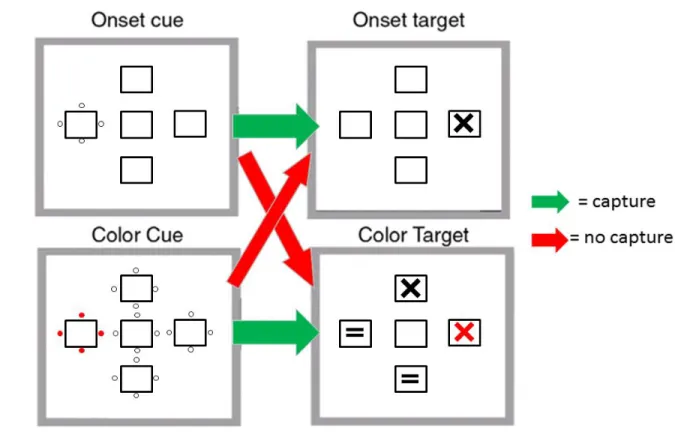
In addition to cueing paradigms, bottom-up attentional capture has been found using the additional singleton paradigm, a modified version of visual search (e.g. Theeuwes, 1991, Figure 2). In this task, participants are typically asked discriminate a target in a two-choice task (e.g. discrimination of a line: vertical or horizontal). The target is further identified by a specific feature (e.g. green circle) and is surrounded by a uniform set of distractor objects (e.g. green squares). Evidence of capture is found when responses to the target are slower in the presence of a salient but irrelevant distractor object presented simultaneously in the target array. Evidence from both behavioral and ERP studies utilizing the additional singleton paradigm have supported the post-attentive view of top-down control of attentional capture by indicating that attention is reflexively captured to the most salient visual object, but is quickly disengaged when this item is not the target (Hickey, Di Lollo, & McDonald, 2009; Hickey, McDonald, & Theeuwes, 2006).
to a stimulus that shares critical properties with the to-be-identified target and is therefore contingent upon top-down settings. Folk et al. (1992) distinguish between two distinct categories of stimulus properties: dynamic discontinuities such as abrupt onsets, and static discontinuities such as a color or shape singleton. In a series of four experiments, they demonstrated that when searching for a target belonging to one category, attention was only captured to a cue belonging to the same category.
The contingent capture work arose out of experiments that demonstrated capture always and only to dynamic changes, specifically abrupt onsets (Remington, Johnston, & Yantis, 1992). In a series of five experiments, Remington et al. (1992) found slower reaction times when a bright flash cue was presented either at an invalid location, at all 4 potential target locations, or at the center of the display (i.e. fixation). Interestingly, they did not find evidence that the flash facilitated target processing, but only that it exclusively interfered with processing when it was spatially incongruous. However, more recent studies have also found facilitation of target processing by onset cues in both behavioral and ERP measures (Cosman & Vecera, 2014; Hopfinger & Mangun, 1998; Hopfinger & Ries, 2005). The early evidence that onsets captured attention, even when participants were explicitly told that the target would not appear at the location of the flash for the entire block of trials were interpreted as
saliency-driven capture that is free from top-down control (Lambert, Spencer, & Mohindra, 1987; Remington et al., 1992). In response, Bacon & Egeth (1994) argued that any time a task involves responding to a pop-out target (i.e. a visual object that can be distinguished from its neighbors along a single feature dimension, such as shape) participants adopt a singleton search mode. The adoption of this search mode may result in capture by any singleton, such as a single onset or singleton defined along a non-target dimension (e.g. color).
Strong evidence that irrelevant distractors capture attention comes from studies that have used the additional singleton paradigm (Hickey et al., 2006; Theeuwes, 1991, 2004). When a salient
capture to the salient distractor first, followed by processing of the target following hypothesized disengagement from the cue (Hickey et al., 2009, 2006). These results are interpreted as reflecting a top-down search mode for singletons (Lamy, Carmel, Egeth, & Leber, 2006; Leber & Egeth, 2006). However, such an interpretation cannot reconcile other evidence that changes to luminance (Atchley, Kramer, & Hillstrom, 2000; Franconeri, Hollingworth, & Simons, 2005), or motion (Abrams & Christ, 2003) also cause attentional capture. These examples seem to suggest that under certain conditions top-down set is unable to mediate capture by salient distraction. Alternatively, it may be the case that attention is always capture to salient distractors, but when the items are not sufficiently salient, or do not match top-down settings, attention is quickly disengaged from the spatial location of the
distractors and therefore does not bias processing of subsequent stimuli. (Theeuwes, 2010).
Event-related potentials (ERPs) evidence of top-down and bottom-up attentional capture
At the heart of the debate about top-down versus bottom-up capture is the question of not whether top-down factors influence capture, but rather when (Fellrath et al., 2014). However, behavioral
evidence of capture to a cue or simultaneous distractor are observed anywhere from 400 to 1500ms after the capture is thought to have occurred. As a result attentional capture is inferred rather than
directly observed. Due to their high temporal resolution, a number of reliably evoked ERPs have been used to answer questions about how attention affects perception, and what factors influence
larger amplitudes (Mangun, 1995; Mangun & Hillyard, 1991). Later components such as the P300, observed at latencies longer than 300ms following a stimulus onset are primarily driven by higher order processes related to attention, such as the violation of expectancies, or memory updating (Mangun & Hillyard, 1991; Rugg & Coles, 1995). Critically, between these early effects on sensory processing and later effects on other cognitive functions, is a time window (~200-300 msec post stimulus onset) during which neural activity seems to reflect some critical process or processes related to the focusing of spatial attentional on relevant or task-related stimuli. A widely studied component, the N2pc, occurs during this time period. It is elicited following a bilateral visual array, which contains a target or target-like item as well as non-target items that require suppression. Unlike early sensory components (P1, N1) the N2pc is not simply triggered by physically salient visual events, but rather, is elicited by items that are related to the task at hand (Luck & Hillyard, 1994; Seiss, Kiss, & Eimer, 2009).
A number of studies have looked at modulations by attention on the early sensory components for evidence of attentional to tease apart top-down and bottom-up influences on attentional capture. Fellrath et al. (2014) measured early sensory ERPs (P1, N1) elicited by
non-predictive cues to determine if and when top-down factors (i.e. task relevance) and bottom-up factors (i.e. stimulus salience) resulted in attentional biasing of sensory information processing. Stimulus saliency (luminance) and task relevance (cue-target color match) were manipulated
early sensory components, with larger P1 and N1 amplitudes elicited by high relative to low saliency targets. Relevance only began to modulate the ERP at a later stage of processing, beginning around 200 - 250 ms after the targets stimulus onset, which was classified as an effect on the P2 by the authors. The differential timing of the effects of the conditions of salience and relevance on the evoked brain potentials are critical. Most studies that have tried to tease apart if and when saliency-driven capture occurs without top-down mediation look only at the N2pc (and later components such as the sustained posterior contralateral negativity, SPCN), and by design, are unable to detect effects of attention on the early sensory components, due to a visually balanced stimulus display (Ansorge, Kiss, Worschech, & Eimer, 2011; Eimer & Kiss, 2008; Hickey et al., 2009, 2006). Selective modulation of the N2pc by task-relevant cues as compared with task-irrelevant cues has been interpreted by many as strong evidence that the initial stage of visual selection is under the control of top-down settings (Ansorge et al., 2011; Eimer & Kiss, 2008; Kiss, Jolicøeur, Dell’Acqua, & Eimer, 2008; Lien, Ruthruff, & Cornett, 2010; Lien, Ruthruff, Goodin, & Remington, 2008). However, the results found by Fellrath et al (2014) suggest that attention may be captured by salient stimuli, but when irrelevant, the effects of capture are short-lived and replaced by goal-driven processes, in line with the disengagement
hypothesis (Theeuwes, 2010).
Similar to Fellrath et al. (2014), Hopfinger & Ries (2005) found no behavioral capture for an onset cue followed by a color-singleton target with only 2 locations however, they did find ERP evidence suggesting that some degree of capture took place. Specifically, they found that the
supporting the interpretation that a similar processing bias resulted from the cue. It's possible that capture for onset cues may be more sensitive to specific design features and task peculiarities than other cues given the strength of the signal generate by a single object presented without competing visual information. The contradiction between behavior and ERP evidence found by Fellrath et al. (2014) and Hopfinger & Ries (2005) may indicate why, in several studies that measured only behavior, onset cues have resulted in contradictory findings that don't definitely support a bottom-up or a top-down account of attentional capture. Onset cues followed by color-singleton targets have resulted in both a behavioral cueing effect (Cosman & Vecera, 2014; Ford & Hopfinger, 2013), and a lack of behavioral cueing effect (Eimer & Kiss, 2008; Hopfinger & Ries, 2005). Critically, ERP evidence has shown that onset cues not resulting in behavioral cueing effects may none-the-less act to bias
attentional processing.
Most of the research utilizing ERPs to determine the stage at which top-down factors influence saliency-driven capture focus on the N2pc component which occurs ~200-300 msec post stimulus onset, during which neural activity seems to reflect some critical process or processes related to the focusing of spatial attentional on relevant or task-related stimuli. It is elicited following a bilateral visual array, which contains a target or target-like item as well as non-target items that require suppression. Unlike early sensory components (P1, N1) the N2pc is not simply triggered by physically salient visual events, but rather, is elicited by items that are related to the task at hand (Luck & Hillyard, 1994; Seiss et al., 2009). Multiple studies have shown that the N2pc is selectively elicited by a
non-predictive singleton-cue only when it matches a critical feature of the to-be identified target (Ansorge et al., 2011; Eimer & Kiss, 2008; Kiss et al., 2008). However, as previously mentioned, it may be the case that even at 250 following the target, the effects of reflexive capture by a salient but irrelevant cue are no longer present (Theeuwes, 2010).
saliency-driven capture may occur pre-attentively (Ansorge et al., 2011; Eimer & Kiss, 2008; Folk & Remington, 1998; Folk et al., 1992; Gibson & Kelsey, 1998; Lien et al., 2008) but that this suppression can be disrupted by abrupt onsets (Liao & Yeh, 2013; Schreij, Owens, & Theeuwes, 2008; Yantis & Jonides, 1984), changes to saliency or luminance (Atchley et al., 2000; Franconeri et al., 2005; Theeuwes, 2004), motion (Abrams & Christ, 2003) or differing task demands (Lien, Ruthruff, & Naylor, 2014). Therefore, the first aim of the present study is to test assertions that top-down attentional control settings for features mediation attentional capture by a salient but task irrelevant distractor.
Development of an attentional set
influences on attentional capture are present at the throughout an experiment, or if they develop as a result of experience with the task and stimuli. If the presence or strength of attentional capture is the result of both task goals as well as stimulus and task experience, it would suggest a more complex interaction between top-down and bottom-up factors than has previously been discussed.
Many studies that demonstrate how top-down goals and task set can suppress or attenuate attentional capture explore the effects of an attentional set, taking for granted that the set is established as soon as task instructions are given and are relatively consistent across trials. However, there is reason to believe that this kind of attentional control takes time to develop (Zehetleitner et al., 2012); and that an attentional set can develop incidentally and without explicit instruction (Cosman & Vecera, 2014). In a study directly aimed at exploring the how an attentional set is established, Cosman and Vecera (2014) found that participants adopted an attentional set for a specific color cue without awareness through a statistical learning mechanism. Using a two-location cueing paradigm,
participants were given a lengthy training phase in which they had to indicate which of two possible target letters was present (B or H). Even though the cue was non-predictive, and was equally like to be either green or red, one of the target colors would appear 80% of the time, which induced an
detect when the effect of training ceased to impact capture during testing. In summary, this study demonstrated that once acquired, an attentional set may change as a result of implicit information gained through experience with the task.
There is also evidence to suggest that top-down mediation of reflexive capture is caused by experience with the distractor itself (Zehetleitner et al., 2012) and can be flexible on a trial-by-trial basis (Lien et al., 2010), although the evidence is mixed (Lien et al., 2014). For example, during a search task, when participants are presented with blocks in which the target's critical features change on a
trial-by-trial basis, there is a higher cost of distractor present trials leading to slower reaction times (Muller & Krummenacher, 2006; Pinto, Olivers, & Theeuwes, 2005). In a cueing study, Lien, Ruthruff & Johnston (2010) found evidence of interference when target properties switched from one trial to the next, but no evidence that top-down suppression of irrelevant singletons was disabled when participants had to switch between target colors rapidly. However, more recently, some members of the same team (Lien et al., 2014) found a breakdown of top-down suppression when people had to rapidly switch between search modes (feature versus singleton) randomly mixed within a block. These studies all looked at the development and duration of an attentional set by design, and collapsed across trial types to calculate effects by using trial type (repeat vs switch) as a factor in a repeated measures ANOVA.
top-down suppression of capture does not function in an all or nothing manner but may be stochastic in nature, as has been found with the effect of saliency on capture (Zehetleitner et al., 2013). Finding capture throughout the course of the experiment supports the more extreme contingent capture point of view (Folk et al., 1992). Additionally, modeling the development of capture over time provides a way to compare capture across various experimental conditions that goes beyond mean RTs collapsing across all blocks.
Rather than attempting to do this by choosing various levels and weighing the needs for power and sensitivity, it makes sense to try to use a statistical model that allows us to keep all of the trials or time points without having to conduct single t-tests at each one.
The second aim of the present study is to test whether attentional settings are immediately present when a task begins or if they build up over time. Specifically, I plan to include both the possibility of a trial-to-trial influence in the model, along with a predictor representing experience with the stimuli (i.e. exposure) in order to understand how selection history may result in the hypothesized attentional setting causing contingent attentional capture. Awh, Belopolsky, & Theeuwes (2012) argue that the dichotomization of attentional control into top-down and bottom-up factors fails to capture the full array of influences acting upon selection at a given moment. They argue that selection history is often subsumed by the idea of top-down factors and should be considered distinct. On a
macro-level this could mean task history in the recent or distant past. On the micro level, selection history could refer to the trial-to-trial correlations assumed to be zero by most analyses (Baayen & Milin, 2010). One of the aims of the present study is to not only include the possibility of a trial-to-trial influence but to explicitly model it in order to understand how selection history may result in the hypothesized attentional setting causing contingent attentional capture by using multilevel modeling.
Individual Differences
The third aim of the study is to determine the role of individual differences in
attentional capture. Within this goal there are two distinct questions. The first question is whether or not explicitly modeling individual variability in reaction times enhances our understanding of the effects of task manipulations on behavior. Until recently, attention researchers have typically been interested in how similar people are on measures of attention, rather than in their differences. Because of this, most studies examining attentional control settings treat individual differences in RT as random noise, including these differences only as the variance term used to calculate probability of an observed mean difference between conditions. Even studies that make use of the full distribution of reaction times, do so, for example, to examine differences in fast versus slow responses across all participants, rather than between them (Leber, Lechak, & Tower-Richardi, 2013). However, in the present study, allowing for individual differences (i.e. randomness) in the effects of task conditions on RTs will likely result in more realistic and appropriate models of behavior, and moreover, allow us to test whether person-level traits or cognitive abilities predict different trajectories across the span of the experiment. For example, a person who is particularly fast to begin with may not show any changes in RTs or effects of condition on capture as a result of experience with the stimuli as compared with someone who starts out more slowly.
clearly find within-person effects, otherwise confounded by these differences. Additionally, differences in working memory capacity have been correlated with attentional capture (Fukuda & Vogel, 2009, 2011).
Working Memory Capacity
There are several reasons to hypothesize a critical role for individual differences in WMC in attentional capture to relevant and irrelevant stimuli. Working memory has been indicated in the creation and maintenance of a top-down attentional set (Bundesen, Habekost, & Kyllingsbaek, 2005), which in turn may determine which stimuli capture attention (Downing, 2000). In fact, people with low WMC may be more distractible, possible reflecting a weaker attentional set (Kane, Bleckley, Conway, & Engle, 2001). In their study examining the relationship between individual differences in WMC and attentional control during a cueing task, Kane et al., (2001) found people with lower WMC were selectively impaired when the cue was anti-predictive (i.e. predicted that the target would appear at an alternate location). Broadly, the authors interpreted the deficits in performance as evidence that working memory capacity reflects both short-term memory storage as well as attentional control. They make no specific interpretations about the mechanisms supporting attentional control that might be specifically impacted by WMC differences, but the results of their experiments suggest a selective impairment in the ability to recovery following distraction. Indeed, this interpretation is supported by a series of more recent experiments that found that people with low working memory capacity did not show differences in voluntary attentional allocation but did show a decrement in their ability to override attentional capture after initial capture (Fukuda & Vogel, 2009, 2011).
both a search task, and a concurrent verbal task, capture to a distractor in the search task increased. In other words, when the need for working memory increased, people were more susceptible to
attentional capture, potentially indicating a shared resource underlying both visual working memory and visual attentional control (Lavie & de Fockert, 2005). Given the evidence that the ability to resist distraction by salient visual objects may contain a great deal of between-person variability, including a measure of WMC as a factor in our models of attentional capture may provide a more accurate portrait of our effects. Critically, if the effects of a given task condition differ across people due to differences in WMC, there may be opposing effects present in the data that cancel each other out, preventing us from properly modeling the within-person effects. Therefore, WMC may help explain why certain people show capture under conditions in which others do not.
Cognitive Failures Questionnaire & Barratt Impulsiveness Scale
distractibility.
CHAPTER 2: EXPERIMENT 1
CATCH TRIALS CATCH SPATIAL ATTENTION WHEN TARGET ABSENCE IS RELEVANT
The first goal of the study is to determine if top-down mediation of attentional capture can be disrupted by introducing alternative task demands without that go beyond changing the relationship between the target and distractor. Studies of contingent attentional capture have found that items trigger a reflexive orienting of spatial attention only when the cue stimuli are congruent with
task-relevant features of the target stimuli (e.g. Eimer & Kiss, 2008; Folk & Remington, 1998; Folk et al., 1992). These results have been interpreted as demonstrating a top-down suppression of capture to salient items, potentially due to a particular search mode or strategy (Lamy et al., 2006; Leber & Egeth, 2006). Alternatively, it has been shown that characteristics of the distracting stimuli may cause the capture in a manner that is unrelated to top-down attentional control settings (Franconeri et al., 2005; Liao & Yeh, 2013; Schreij et al., 2008; Theeuwes, 2004).
possible that participants adopt a strategy in which they prevent preattentive processing of all items in the distractor-containing array in the case of the latter experimental design, although this is not in line with the disengagement hypothesis (Theeuwes, 1991, 2010). Second, in additional singleton (i.e. search) paradigms, stimuli typically remain on screen until a response is made, whereas in cueing paradigms, stimuli duration is extremely brief (e.g. 50ms) and typically not dependent upon a response.
Folk and Remington (1998) interpreted the contradictory findings from cueing and search paradigms as evidence of two distinct forms of attentional capture. Specifically, they argue that capture in cueing paradigms results in spatial orienting to the cue, whereas capture in search paradigms constitutes a non-spatial filtering cost. However, studies since then have found evidence of spatial attentional capture to irrelevant distractors (Hickey et al., 2006; Theeuwes & Godijn, 2002) even under conditions in which participants had likely adopted a feature search mode (Schreij et al., 2008). Critically, in all of these cases of saliency-driven capture, which seem to contradict the contingent attentional capture hypothesis, the distracting item was presented simultaneously with a to-be
identified target. In his disengagement hypothesis, Theeuwes (2010), accounts for these differences by positing that in all cases, attention is captured by a salient distractor, but when given enough time to disengage, such capture may no longer be present in response times. He dismisses ERP evidence that points to a lack of capture to non-congruent cues by arguing that the component used to indicate capture (N2pc) does not necessarily reflect capture alone, but rather capture along with higher order processing that results due to top-down set.
(the distractor positivity, Pd). However, when the arrays were on screen for a brief and fixed amount of time, only the ERP index of suppression was elicited. Despite the assertion by the authors that these results clearly support early top-down mediation, the results do not necessarily contradict a rapid disengagement hypothesis account as it is unclear if the Pd is an index of suppression or
disengagement or both (Toffanin, de Jong, & Johnson, 2011), and many studies explicitly refer to the Pd as an index of disengagement (Sawaki & Luck, 2010).
ERP results have also differed depending on whether or not the distractor is presented simultaneously with the target (i.e. additional singleton paradigm) or is presented before or after (cueing paradigms). On the one hand, an N2pc was elicited by a salient but task-irrelevant distractor when simultaneously with the target in an additional singleton paradigm (Hickey et al., 2006). An N2pc to the target was found immediately after the component elicited to the cue, suggesting that
participants were captured by the salient distractor but quickly disengaged and reoriented to the target in order to discriminate its orientation and respond. In contradiction to Hickey et al. (2006) salient but task-irrelevant have repeatedly not elicited the N2pc component when presented before the target in cueing paradigms (Ansorge et al., 2011; Eimer & Kiss, 2008; Lien et al., 2008). For example, in a color-cue / color-target experiment, with color match between the cue and target as the critical manipulation, Lien et al. (2008) found that the color matching cue elicited a robust N2pc similar in magnitude and latency to that of the target. These results were taken as evidence supporting
These results suggest the possibility of an alternative interpretation of contingent capture evidence. Specifically, instead of interpreting spatial capture as being the result of a match between the specific cue features and those belonging to a target set, it could be that when the cue display matches the target display (as is the case with congruent cue arrays that elicit contingent attentional capture), participants attend to the entire display, as it may be relevant. Once the array is attended to, capture to the salient distractor is automatic. For congruent cues, the cue-array typically contains a similar number of items as the target array with similar configurations (e.g. Eimer & Kiss, 2008). This interpretation of contingent attentional orienting may help reconcile the seemingly contradictory results of cueing and additional singleton paradigms, because in the latter, the array containing the distractor may also contain the target and is therefore always relevant.
To test this alternative interpretation of contingent attentional capture and simultaneously demonstrate conditions under which top-down settings are disrupted, we included an additional task which made the event containing the cue behaviorally relevant. Critically, although the cue event was behaviorally relevant, the physical properties and the spatial location of the cue were not. The design of the stimuli and procedure were based on an earlier study by Eimer and Kiss (2008) which
cannot be suppressed when the event containing it is behaviorally relevant, then we would expect to find a cueing effect in this case, even if the target does not share critical features with the distractor. Additionally, the same cue-target pairing should not result in capture when the additional task goal is removed. If, however, contingent capture to distractors only occurs when their features match those contained within a target set, then we should find a validity effect only when the cue and target array both contain color singletons (1d).
Experiment 1a
In the first experiment we created a condition in which the entire cue array was behaviorally relevant as an event, but the specific features and the location of the color-singleton within the array were not. This was done within the traditional cueing paradigm framework by including a detection task for target-absent trials in addition to a discrimination task for target-present trials. Critically, the color-singleton cue never matched the features of the single onset target. If the attentional control settings underlying the contingent attentional capture effect are related to feature matches between objects, then no capture is expected. If, however, capture to a salient singleton is automatic when an entire event is (potentially) behavioral relevant, then the inclusion of these target-absent responses would result in capture to the spatial location of an irrelevant color-singleton cue.
Methods Participants
Materials and Procedure
The experimental sessions took place in an electrically shielded room with visual stimuli presented on a CRT monitor 75cm from the subject. The commercial software package, Presentation (Neurobehavioral Systems; San Francisco, CA), was used to present stimuli and record response times and accuracy levels.
Following an initial training block, in which participants became familiar with the task and with maintaining fixation throughout all trials, 8 experimental blocks, each consisting of 46 trials, were completed. A central fixation dot remained on the screen throughout the entire block, including when cue and target stimuli were on screen. Each trial sequence began with a fixation screen for
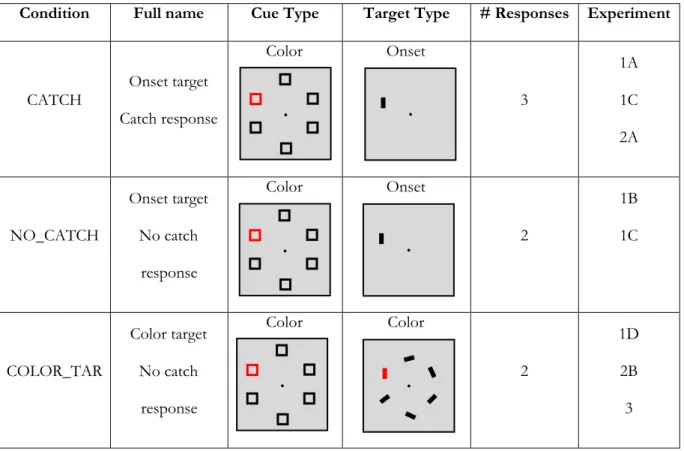
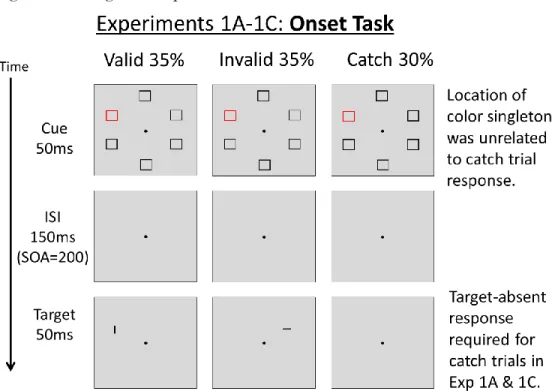
1000-1500ms, followed by a cue array for 50msec (Figure 3). The cue array consisting of six square outline boxes (each 1.3˚ x 1.3˚), five black and one red, each presented 5.2˚ from fixation at the 12, 2, 4, 6, 8, and 10 o'clock positions. The red singleton was presented in either the upper right or upper left visual field with equal likelihood, and did not predict the location of the subsequent target stimulus. On 70% of trials a target display appeared 150ms after the cue. The target, a single black rectangle (0.7˚ long) presented 5.2˚ from fixation, appeared in either the upper right or upper left visual field (i.e. same location as the two singleton cue locations) and remained on the screen for 50ms, before being replaced by the background fixation screen. The non-predictive cue resulted in two equally likely target conditions: valid (i.e. target appeared in the same location as the preceding cue), and invalid (i.e. target appeared in the location not occupied by the preceding cue), with 128 trials in each target-present condition when collapsing across visual field.
each block, the trial sequence was pseudo-randomized, such that a given trial type (e.g. right cue – right target) did not occur more than four times before a different trial type was presented (e.g. right cue – left target). This was done in an attempt to control for idiosyncratic strategies that may arise because of trial expectancies being formed due to longer sequences of a certain trials type. Trial sequence for the practice block and eight experimental blocks was consistent across participants and experiments (1a, 1b & 1d).
During 30% of all experimental trials (i.e. 112 trials per participant), the cue was not followed by a target display. These trials served as cue-only ("catch") trials, and required that participants respond by pressing a third ""target-absent" button. Catch trial responses were included in order to make the cue array event behaviorally relevant (i.e. participants had to know that a cue array had occurred in order to judge the lack of a target appearance). Critically, the location of the red singleton within the cue array was irrelevant to the target-absent response task.
Results & Discussion
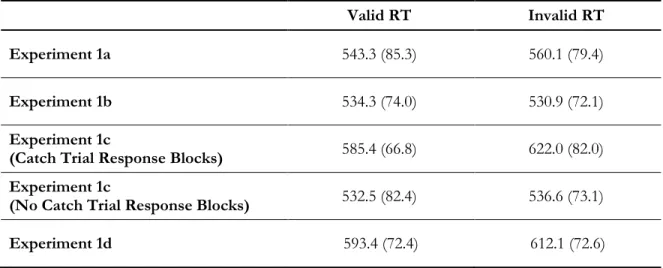
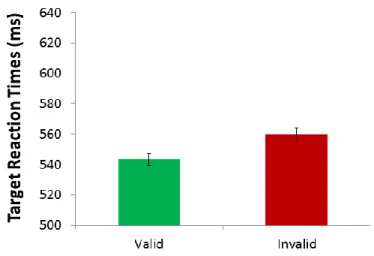
For target-present trials, a significant effect of validity was found as participants responded significantly faster to valid targets (M = 543.27 ms, SD = 85.33 ms) as compared with invalid targets (M = 560.06 ms, SD = 79.37 ms; t(7) = 2.87, p = 0.02, d = 1.05; Table 1, Figure 5). There were no significant effects on accuracy (Valid: M = 97.5%, SD = 1.7%; Invalid: M = 96.4%, SD = 3.4%; t(7) = 1.20, p = 0.27).
target-absent detection task was fast and accurate, and participants were able to judge when a target should have appeared, but did not.
One of the goals of the study is to investigate whether or not attentional capture to the cue was present throughout the experiment or rather developed as a result of experience with the stimuli (i.e. time). To answer this question, reaction times for each condition were averaged within blocks and compared using t-tests, Bonferonni corrected for multiple comparisons (Cosman & Vecera, 2014). Blocks 5, 6 and 7 were all significant at p<0.05 but none survived the Bonfernni correction criteria of 0.05/8 = .006. To increase our power to detect differences, RTs for each condition were averaged within every two blocks, resulting in only 4 time points for comparison (Figure 6). T-tests reveal a significant difference between valid and invalid RTs only at combined blocks 5 & 6 (t(7) = 4.10, p = 0.005) and blocks 7 & 8 (t(7) = 4.58, p = 003), indicating that capture only occurred in second half of the experiment.
Folk, 2010; Töllner, Müller, & Zehetleitner, 2012).
It is not clear why capture, evident when averaging across all trials, seems to only have emerged in the second half of blocks. One interpretation is that capture occurred throughout the experiment (Theeuwes, 2010), and disengagement became more difficult as participants made more and more responses to the cue-only (i.e. target absent) condition. Alternatively, participants may have adopted a strategy of attending to the red singleton within the cue array in order to make their target-absent responses after some experience with the task, as has been found with search strategies in tasks with changing search tasks (Harris, Remington, & Becker, 2013). Finally, it could be the case that
participants were not captured to the cue until the point at which such capture was evident in the behavior. Given that most cueing studies examining attentional capture to irrelevant singletons average across all trials, we do not know if such results are typical. It will therefore be useful to similarly analyze capture across time under conditions in which we expect to see contingent attentional capture (Folk et al., 1992) to determine if the present experiment's "learned" capture is specific to the present event-relevance capture, or is generalizable to other cases of attentional capture. Additionally,
something idiosyncratic about our set-up or stimuli could have caused the overall validity effect. Experiments 1b, 1c and 1d were conducted to address these possibilities.
Experiment 1b
If, however, the validity effect was an artifact of something unique to our specific experimental parameters, we might still find an effect of cue-target spatial congruency (i.e. a validity effect) not typically found in experiments of this kind (Ansorge et al., 2011; Eimer & Kiss, 2008; Folk & Remington, 1998; Folk et al., 1992; Leber & Egeth, 2006).
Methods Participants
A new group of nine undergraduate students from the University of North Carolina at Chapel Hill served as participants after giving informed consent. One participant was excluded due excessive errors, resulting in a sample of eight individual.
Materials and Procedure
Experiment 1b was identical in materials and procedure to experiment 1a (Figure 3), except that no response was required to catch trials. Catch trials still comprised 30% of all experimental trials and participants were advised that there would be cue-only trials mixed in with target trials, but were instructed to only discriminate and respond to the orientation of the target.
Results & Discussion
As predicted, when the catch trial response was no longer required, we found no evidence of capture to the color-singleton. The results indicate no difference between valid and invalid RTs (Valid: M = 534.31 ms, SD = 73.98 ms; Invalid: M = 530.91 ms, SD = 72.13 ms; t(7) = 0.73, p = 0.49; Figure
7). Additionally, there were no significant effects on accuracy (Valid: M = 97.2%, SD = 1.7%; Invalid: M = 96.9%, SD = 1.7%; t(7) = 0.57, p = 0.58). As was done in experiment 1a, capture was assessed
T-tests for each combined block set indicate a significant difference only for combined blocks 1 & 2 (t(7) = 3.81, p = 0.007). However, the significant difference was due to faster RTs for invalid relative to valid trials, which does not indicate capture but suggests an anti-cueing effect in which participants may have been actively shifting to the location not occupied by the cue. It is not clear why participants would have adopted such a strategy, and more importantly, there is no cueing effect in either direction in the aggregate.
Experiment 1b was conducted in order to establish that the validity effect observed in experiment 1a was due to the inclusion of catch trial target-absent responses, and not to a peculiarity of our stimuli, design, set-up, etc. When the same experiment was conducted, using identical timing, stimuli, and apparatus, but when no catch response was required, we no longer find evidence of spatial capture to the irrelevant color-singleton. These results replicate the findings of multiple studies demonstrating contingent attentional capture, in which, only stimuli that match target features held in an attentional set capture attention (Ansorge et al., 2011; Eimer & Kiss, 2008; Folk & Remington, 1998; Folk et al., 1992; Leber & Egeth, 2006). Although these results provide compelling evidence that capture to the cue is exclusively due to catch trial results, our conclusions up to this point were based on between subject comparisons, and could therefore be an artifact of a particular sample. Experiment 1c was conducted to address this concern.
Experiment 1c
RT faster than invalid RT) only for the blocks in which these responses were made.
Methods Participants
A new group of fourteen undergraduate students from the University of North Carolina at Chapel Hill served as participants after giving informed consent. One individual was falling asleep during the experiment and was excluded, resulting in a total of thirteen participants included in the analysis. A larger sample size was included in this experiment (as compared with the first two) due to the increased complexity of the design, which now includes a 2x2 interaction.
Materials and Procedure
All materials and procedures were identical to those used in experiment 1a (and 1b) with the following exceptions. Participants were presented with 12 full blocks, with the first and seventh treated as practice blocks for each of the two conditions. The cue-location was still not predictive of the target, with an equal number of valid-location targets and invalid-location targets in each block (80 of each condition, for each task). Catch trials still comprised 30% of trials within and across all blocks. Participants were instructed to respond to the catch trials in either the first or second half of the experiment (counter-balanced across participants) and told not to respond during the other half of blocks. The within-subject manipulation allowed us to look at the main effect of target-type (valid vs. invalid) as well as any interaction with condition (catch response vs. no catch response) on both RT and accuracy.
Results & Discussion
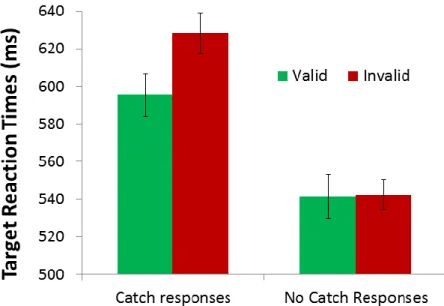
No_Catch) repeated measures ANOVA. Examining the effects on RT, we found a significant main effect of Validity [F(1,12) = 30.88, p <0.001, η2 = 0.72] with faster responses to valid versus invalid targets across both conditions; and a significant main effect of Task [F(1,12) = 22.87, p <0.001, η2 = 0.66], with faster responses during the no catch trial response blocks. Importantly, we found a significant interaction between target type and condition [F(1,12) = 9.11, p =0.011, η2 = 0.43]. As revealed by planned post-hoc comparisons, the validity effect was present for responses made in the catch response blocks [Valid: M = 585.45 ms, SD = 66.81 ms; Invalid: M = 622.03 ms, SD = 82.00 ms; t(12) = 4.58, p = 0.001, d = 1.27; Figure 8] and was not present during the no catch trial response
blocks [Valid: M = 532.46 ms, SD = 82.41 ms; Invalid: M = 536.63 ms, SD = 73.06 ms; t(12) = 0.92, p = 0.38; Figure 9].
When we include the order in which participants performed the two tasks as a between subject factor (i.e. Catch_First vs. No_Catch_First) we find a significant three-way interaction between Task, Validity and Order [F(1,12) = 4.86, p =0.05,η2 = 0.43]. Specifically, the interaction between task and validity was present for both groups, but was larger when participants saw No_Catch trial blocks first, and there may have been some carryover of the cueing effect into the No_Catch response blocks when participants saw catch response trial blocks first.
We found no significant effects on accuracy for Task [F(1,12) = 0.18, p =0.68], Validity [F(1,12) = 0.77, p =0.40], nor was there an interaction [F(1,12) = 0.24, p =0.64].
then 3, 4 & 5. Second, the order of the task presentation (Catch first vs. No_Catch first) may have interacted with or confounded the effect of stimulus experience on capture for each task. For example, although we seem to find capture for Catch blocks beginning in blocks 1 and 2, we must somehow account for the fact that for half of the sample, these occurred after seeing the cue and performing the target discrimination task for 6 previous blocks. For these reasons, the question of how time or exposure to the stimuli may have interacted with condition to impact capture will be addressed by experiments 2 and 3, both of which were designed more explicitly to answer these questions.
Overall, the pattern of results replicates those found when comparing the reaction time effects between subjects in the first two experiments. Participants responded faster when targets were presented at the same location as the preceding color-singleton cue (i.e. validly-cued targets) as compared with targets presented at the invalidly-cued location, but only during blocks in which the target-absent response was required for catch trials. These results support our hypothesis that the inclusion of the catch trial responses results in spatial attentional capture by the color-singleton cue, despite the fact that these responses do not require the use of the cue's location, but only the awareness that a cue event has occurred in order to judge when a target's presence would have been expected. Experiment 1d
of the cue array's behavioral relevance. Additionally, if capture is found when the cue and target features match and no response is required to catch trials, we can rule out the possibility that the lack of capture found in experiment 1b was the result of including trials that did not require an overt response. Based on previous studies of contingent capture (Eimer & Kiss, 2008, 2008; Hopfinger & Ries, 2005)(Folk et al, 1992; Hopfinger & Ries, 2005; Eimer & Kiss, 2008), we expected the cue to capture spatial attention without requiring catch trial responses since the target features matched those of the cue.
Methods Participants
A new group of nine undergraduate students from the University of North Carolina at Chapel Hill served as participants after giving informed consent. One participant was excluded due excessive errors, resulting in a sample of eight individual.
Materials and Procedure
1a - 1c). Again, 30% of trials were catch trials; however, no target-absent response was required.
Results & Discussion
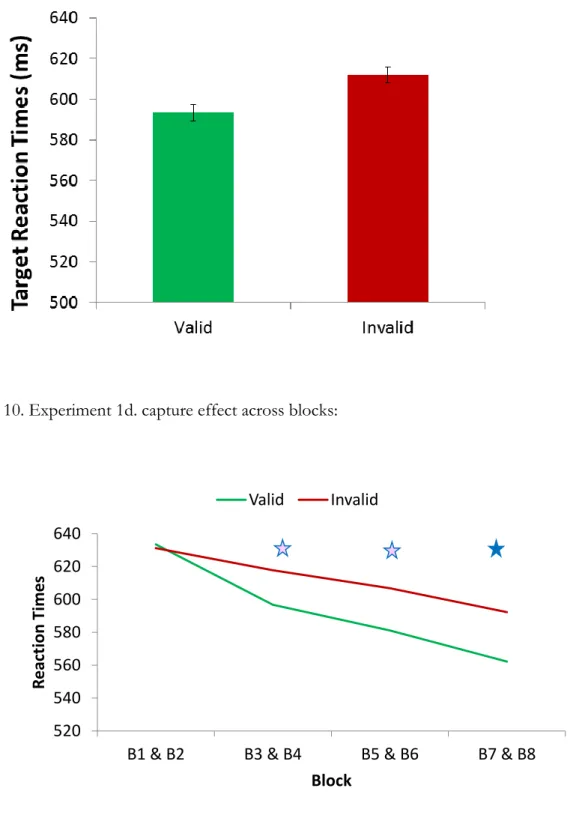
Replicating previous studies of contingent attentional capture (e.g. Eimer & Kiss, 2008), we found a significant effect of validity with faster responses to valid as compared with targets (Valid: M = 593.38 ms, SD = 72.43 ms; Invalid: M = 612.00 ms, SD = 72.59 ms; t(7) = 3.27, i = 0.01, d = 1.15; Figure 9). There were no significant effects on accuracy (Valid: M = 96.9%, SD = 3.1%; Invalid: M = 96.1%, SD = 2.6%; t(7) = 0.67, p = 0.52). T-tests for each combined block set indicate that the difference between valid and invalid RT reaches significance at the Bonferroni corrected p<0.0125 level only in combined blocks 7 & 8 [(t(7) = 3.68, p = 0.008; Figure 10] However, both combined blocks 3 & 4 [(t(7) = 3.26, p = 0.014], and blocks 5 & 6 [(t(7) = 2.92, p = 0.023] are significant at p<0.05, suggesting that capture may begin as early as block 2 or 3 in this experiment. This appears to occur sooner than it did in experiment 1a, however, such a comparison must be made cautiously, given the different samples. To directly examine the question of whether or not capture develops at the same rate in these two tasks we should use a within-subject design, and an analysis that includes more time points (see experiment 2).
target array, either because of a strategic choice by participants to attend to all multi item arrays or because of confusion about whether or not the cue array was actually target array. Previous interpretations of the contingent cueing effect interpret the selective capture by target feature matching cues as a reflection of an attentional set for features (e.g. Folk et al., 1992). The present experiment does not rule out this interpretation, although the results of experiments 1a and 1c suggest that it is not the only type of attentional control setting.
Comparing results across experiments
In experiment 1, attention was captured to an irrelevant but salient distractor when the color of the singleton distractor matched the color of the to-be-discriminated singleton target (experiment 1d) and also when the distractor did not match the target features, but instead was embedded in a
temporally relevant event (experiments 1a & 1c). Only the former type of capture has been previously found (Eimer & Kiss, 2008; Folk et al., 1992; Gibson & Kelsey, 1998). The capture observed in the latter case cannot be due to peculiarities of the stimuli used as no capture was found in experiment 1b, in which no response was required for catch trials, rendering the cue array no longer behaviorally relevant. To further investigate this novel type of capture, we can also compare the average cueing effect in each experiment (i.e. Invalid RT – Valid RT). It could be the case that although attention was captured by the cue due to event relevance in the Catch task (1a, 1c), the strength of the capture, or more specifically, hold of attention, was not as great as that found when the features of the cue matched those held in a hypothesized attentional setting containing target feature information.
interaction reflects the fact that there was a significant InvalidRT – ValidRT difference found for experiments 1a and 1d, but not 1b. Invalid - Valid RT difference scores were submitted to a univariate ANOVA and revealed a significant effect of experiment, F(2,21) = 5.86, p = 0.010. Post-hoc comparison's using Tukey's HSD indicated that the cueing effects in both experiments 1a and 1d were significantly higher than that in 1b (M1A = 24.71ms, M1B = -2.01ms, M1D = 22.13ms) but that there was no difference between the cueing effects in 1a and 1d. These results suggest that the effects found in both the classic contingency case (experiment 1d) and in our novel event-relevance condition
(experiment 1a) are equal at the level of behavior. However, these results were found across relatively small samples and represent average RTs over the entire experiment. By looking at the effect of capture on RT over time, we can determine if these processes are in fact the same.
General Discussion
The purpose of these experiments was to determine if a salient but task-irrelevant distractor would capture attention when it was presented in a behaviorally relevant array. Using cueing
paradigms, a large body of research investigating top-down mediation of capture in cueing paradigms has found that salient distractors only cause behavioral evidence of attentional capture when they share critical features with the target (e.g. Ansorge et al., 2011; Eimer & Kiss, 2008; Folk & Remington, 1998; Folk et al., 1992). In experiment 1, we made the visual array containing the distractor
behaviorally relevant while keeping the features and location of the distractor task-irrelevant, to test whether doing so would result in spatial capture to the distractor. The results of experiments 1a and 1c suggest that it does, with behavioral evidence that attention was captured to the cue, but only when the cue-array was behaviorally relevant. When it was not relevant, there was no evidence of attentional capture to the cue with identical cue-target pairs.
First, we could conclude that in experiments 1b, 1c (No_Catch blocks), and 1d, top-down set
mediated attentional capture, possibly through a mechanism of suppression, but this suppression was disabled when attention was directed to to the visual event or array containing the salient distractor. The breakdown of top-down suppression could have been the result of an increased attentional or working memory load that occurred as a result of the additional task demands in 1a and 1c (Fukuda & Vogel, 2009; Lavie & de Fockert, 2005). Alternatively, participants may have had to adopt a different strategy for the target-absent response task relative to the target discrimination task, resulting in a break-down of top-down settings (Lien et al., 2014)
Another interpretation of the results is that some degree of saliency-driven capture to the cue occurred throughout all experiments, but was only evident in the behavior when participants did not rapidly disengage from the cue's location either due to features of the cue (1d) or to its temporal relevance (1a, 1c). Such an interpretation is supported by ERP evidence of cueing effects by non-congruent cues (Fellrath et al., 2014; Hopfinger & Ries, 2005), and processing of irrelevant distractors in a search paradigm (Hickey et al., 2006).
CHAPTER 3: EXPERIMENT 2
THE MECHANISMS AND TIME COURSE OF ATTENTIONAL CAPTURE The results of experiments 1a-1d indicate that attention can be reflexively captured to an irrelevant, yet salient distractor that does not share critical features with the target, but only when the array containing the distractor was behaviorally relevant. These results are in-line with post-attentive models of top-down control that predict initial capture to the most salient stimulus in the visual environment, which is either followed by further processing for relevant information, or suppression and disengagement for irrelevant stimuli (Theeuwes, 2010; Zehetleitner et al., 2013). Additionally, a coarse examination of capture over time, revealed a changes in capture over the course of the
In most studies of attentional capture, behavior is averaged across many trials, and only the average of each condition, for each person is submitted to the repeated-measures ANOVA for analysis. They do not typically include any information about within-subject variability, or changes in the effect across time that may arise due to experience with the stimuli and tasks (cf. Fukuda & Vogel, 2009, 2011; Jaeggi, Buschkuehl, Shah, & Jonides, 2014). Of course, most experimental aims do not include understanding the effects across time or within individuals, so the analyses not necessarily inappropriate. Even in studies that do look at the effects of time or experience, researchers tend to either take averages of conditions to examine trial-by-trial effects (e.g. number of repetitions, Lamy et al., 2006), or take means of a given block or experimental session (Awh et al., 2012; Cosman & Vecera, 2014; Kim & Cave, 1999), resulting in a loss of information and inability to compare rates of change across conditions.
The goals of this experiment were to 1) use a novel analysis to test if attentional capture changes as a function of experience with the stimuli (i.e. time), 2) to compare hypothesized changes in capture over time across tasks to detect different mechanisms driving seemingly similar behavioral effects, and 3) test how individual differences in working memory capacity, self-reported daily
distractibility, and self-reported impulsivity relate to our task measures of both attentional capture. All of these goals ask why and how capture occurs in these tasks, and what role attentional control settings play in both capture by, and active suppression of, salient stimuli.
their use remains relatively rare in most other areas of cognitive psychology. For most cognitive studies using fully balanced within-subject designs, traditional repeated measures ANOVAs are appropriate, however, they limit our ability to test for effects over time, random effect in rates of change, and the inclusion of alternative error structures.
The third goal of the experiment is to determine if individual differences cognitive traits, including working memory capacity, distractibility and impulsiveness predict the effects of task, condition, and time on attentional capture. It is possible that the that no-target present response required in the Catch condition taxes working memory and increases conceptual attentional load, making people more susceptible to attentional capture. Given that people may be differentially susceptible to manipulations of load, depending on the WMC, it may be critical to control for these differences (Fukuda & Vogel, 2009; Kane et al., 2001; Lavie & de Fockert, 2005). Therefore, by including a measure of working memory capacity in our models we can test whether WMC predicts capture overall, or whether it interacts with task, potentially only predicting capture when working memory may have been more involved in the task. Additionally, we measured and tested whether individual differences in impulsiveness and distractibility may account for differential effects of condition and task on attentional capture both in the aggregate as well as over time, as both have been associated with attentional control (Landau et al., 2012; Tipper & Baylis, 1987).
Methods
Participants
Participants were recruited for experiments 2a and 2b from the pool of undergraduate research volunteers and given one hour of class credit for participation in the study. All participants were right handed, with 20/20 or corrected-to-20/20 vision, had no history of head injury or ADHD, and were not taking any psychotropic medications (e.g. antidepressants). For experiment 2a, thirty-four students were recruited and four participants were removed from the final sample due to low accuracy (more than 3 SD below the mean), extreme drowsiness (e.g. falling asleep during the task), and age
(participant was 48 years old, while all others were 17-21). The final sample for 2a consisted of thirty undergraduate students (19 female, average age = 18.76). For experiment 2b, thirty-three students were recruited and two were removed from the final sample due to low accuracy (more than 3 SD below the mean) and extreme drowsiness (e.g. falling asleep during the task). The final sample for 2b consisted of thirty-one undergraduate students (15 female, average age = 18.2).
Stimuli & Procedure
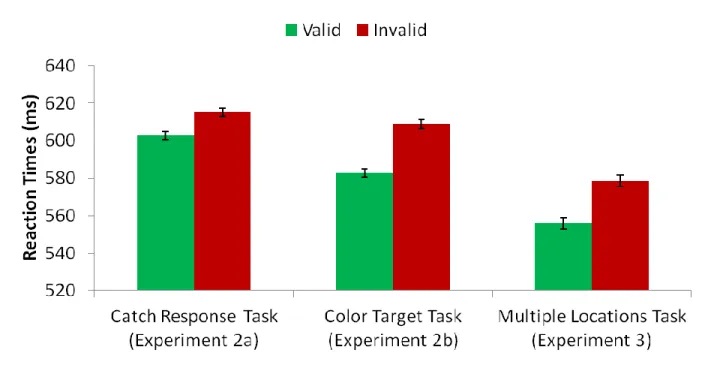
The attention tasks in experiment 2a and 2b followed the design of experiment 1a (Catch) and 1d, respectively, with identical stimuli and procedures except for the following changes. Participants completed fewer blocks (6 rather than 8) of the task, however, each block had 68 trials (versus 46 per block in experiment 1) resulting in a total of 144 validly-cued, 144 invalidly-cued and 120 catch (no-target) trials. Following a shortened block which served as practice, participants completed sets of two blocks, with timed two-minute breaks following blocks 2 and 4. This was done to maintain consistency across subjects and to facilitate trial-by-trial modeling. Other than these changes, the task stimuli and responses were the same as those in experiments 1a and 1d (See Figure 11).
CA), was used to present stimuli and record response times and accuracy levels. Participants were instructed to respond as quickly as possible without sacrificing accuracy. Within each block, the trial sequence was semi-randomized such that a given trial type (e.g. right cue –– right target) did not occur more than four times before a different trial type is presented (e.g. right cue – left target). This was done to ensure that unintentional probabilities did not arise, leading to different strategies across participants (e.g. probability of an invalidly-cued target after three or more validly-cued targets is higher than after only one validly-cued trial).
Following the six task blocks, participants were given the two surveys to complete: the Cognitive Failures Questionnaire (CFQ, Broadbent et al., 1982) and the Barratt Impulsiveness Scale (BIS-11, Patton et al., 1995). Lastly participants were given two tasks to assess their working memory span: Operations Span and Symmetry Span (Oswald, McAbee, Redick, & Hambrick, 2014). One participant in the final sample of experiment 2a was unable to complete the Symmetry Span task due to time constraints. The order of events was consistent across all participants (i.e. task, surveys, WM tasks). In particular, we did not want to ask people about attention and then conduct an experiment measuring attention in case it biased performance.
Cognitive Failures Questionnaire & Barratt Impulsiveness Scale
All participants were given two short self-report measures, the CFQ and BIS-11. The Cognitive Failures Questionnaire (CFQ, Broadbent et al., 1982) a self-reported measure of everyday absentmindedness and distractibility (e.g., memory lapses and spatial orientation difficulties),
motor impulsiveness and nonplanning impulsiveness (BIS-11, Patton et al., 1995). It consists of 30 items to be answered on a 4 point scale from (i.e., 1 = never, 4 = always), which are summed such that higher scores indicating more impulsiveness. Eleven out of 30 of the items are reverse scored
(Appendix B).
Working Memory Tasks
After completing the full cueing task and surveys, participants completed two automated complex span tasks to measure working memory capacity: Operation Span and Symmetry Span. Stimuli were presented using the E-Prime 2.0 software (Psychology Software Tools, Pittsburgh, PA). We used shortened versions of these tasks developed by Oswald et al (2014). The tasks are known as complex span tasks because they require participants to remember a list of either letters or spatial
locations presented sequentially (storage component), while performing a task (processing component. At the beginning of each task, participants are given two trials of each component separately. They first practice the storage component by observing a sequence of digits or spatial locations (both are list length of two) and are then prompted with a matrix of letters, or a matrix of squares, and are asked to recall, in order, the sequence of letters or locations that they saw. They then practice the processing component. For the processing component of the operation span task, participants view simple arithmetic problems and are asked to judge if the answer given is true or false. In the symmetry span task, participants are instructed to indicate whether or not an image is symmetric (yes/no).