HIGH SCHOOL TEACHERS’ PERCEPTIONS OF TEACHING CIVICS TO IMMIGRANT STUDENTS IN A NEW GATEWAY STATE
Jeremy Dale Hilburn
A dissertation submitted to the faculty of the University of North Carolina at Chapel Hill in partial fulfillment of the requirements for the degree of Doctor of Education in the School of Education.
Chapel Hill 2012
Approved by:
Advisor: Dr. Xue Lan Rong
Reader: Dr. Cheryl Mason Bolick
Reader: Dr. Paul G. Fitchett
Reader: Dr. Suzanne Gulledge
ii ABSTRACT
JEREMY HILBURN: High school teachers’ perceptions of teaching Civics to immigrant
students in a new gateway state (Under the direction of Dr. Xue Lan Rong)
This qualitative study examines Civics teachers’ perceptions of working with
immigrant students in a new gateway state. By analyzing collective case studies of six
teachers in central North Carolina, from different types of schools and with different
professional backgrounds, this study is positioned to make recommendations for social
studies teacher educators and Civics teachers with respect to teaching Civics to immigrant
students in areas with a relatively small but growing number of immigrant students.
Employing the additive acculturation model as a theoretical frame, and supported by a civic
education framework, this study explores the multiple contexts of teaching Civics to
immigrant students in a new gateway state, including teachers’ overall perceptions of
immigrant students and teachers’ perceptions of teaching Civics to immigrant students.
The major finding in this study is that six self-selected, reflective practitioners with
differing personal and professional backgrounds who have taught in different types of
schools all had overall positive perceptions of teaching immigrant students, strove to support
immigrant students academically and socially, and encouraged students to maintain their
heritage culture despite being obstructed from doing so by a series of contextual factors and
professional limitations, each of which was influenced by teaching in a new gateway state.
iii
teaching Civics to immigrant students in a new gateway state, support the central argument.
From these findings, I suggest a broadening of the additive acculturation framework, and
iv
ACKNOWLEDGEMENTS
This dissertation would not have been possible without the support of my family. To
my parents, Ronald and Joyce, and sister, Jill, you were nothing but encouraging throughout
this process as you have always been. I think I had the confidence to undertake a doctoral
program because of the positive support you’ve always provided. Sheila, my wife and
friend, you kept me grounded, focused, and understood my occasional surly moods. For that
and for so much else, and of course for paying the bills these last four years, I thank you.
Haley, I couldn’t have dreamed of a better daughter. I’m so proud of you. Your smiles kept
me going. To all of my in-laws, nieces, nephews, and extended family, you remained
supportive and inquisitive about my work these four years. Each “Hang in there!” was
appreciated.
I offer a most sincere thank you to my committee members. Cheryl Bolick, you
welcomed me so warmly into the “social studies club.” Paul Fitchett, I did my best to live up
to being the “New Paul;” thanks for driving the extra hundred miles. Suzanne Gulledge,
you’re the model for what a social studies teacher educator should be. Lynda Stone, my
second reader, your suggestions polished the rougher edges of this paper and your
affirmations saved me weeks of stress.
Lastly, to my advisor, mentor, and friend Xue Lan Rong, thank you from the bottom
of my heart. This dissertation is what it is because of your patience, long hours of reading
v
TABLE OF CONTENTS
LIST OF TABLES ………..……….…………...x
LIST OF FIGURES ……….…………xi
CHAPTERS I. INTRODUCTION………1
Research questions………..……….3
Exploring key terms………..………...3
Significance of the study……….……….………....4
Outline of the dissertation………..………..6
II. LITERATURE REVIEW & THEORETICAL FRAMEWORK………..7
Literature Review ………..………..7
Conceptualizing immigration to the United States………..8
Social studies purposes for immigrant students ………12
Social studies pedagogy for immigrant students ………..16
Democratic citizenship education for immigrant students ………....20
Immigration and social studies: Gender and “soft skills” ……….24
Teacher education and immigrant students ………...26
Theoretical Framework ………..…….30
Additive acculturation antecedents ………...33
vi
Limitations of theoretical framework ………...38
Democratic citizenship education ……….40
III. METHODOLOGY………..45
Qualitative inquiry ………..45
Case study research ……….46
Strengths and limitations of case study research ………...49
Research design ………..………50
Pre-study and participant selection ………..……….50
Data collection ……….……….52
Data analysis ……….54
Data reporting ………...56
Positionality statement ………57
Participants ………..61
Demographic and professional information ………..61
Portraitures ………63
Contexts of teaching immigrant students ………..68
Limitations ...…...69
vii
Teachers’ positive perception ………..………...74
“Soft skills” ……….………..74
Hardworking with thirst for knowledge ………75
Value education ………...….75
Respect authority ………..76
Immigrant students aid learning of non-immigrant students ………77
Challenges beyond linguistic domain ………...……83
Formal curriculum ………...….84
Legal status ………..87
New gateway state ………90
Refugee students ………..94
National and cultural affiliation ………98
Anti-immigration climate ……….……….…101
Limited knowledge of policies specific to immigrant students …………..………105
Conclusion .………...………..………114
V. RESEARCH QUESTION 2 ……….………….116
Philosophical alignment with three tensions ……….…………..118
Philosophical alignment ………..119
Tensions ………..……120
Gender equality vs. patriarchy ………121
Respect for authority vs. challenging authority ………..…126
viii
Local, national, global citizenship education ………...134
Prioritizing national citizenship education ………..……136
Local, national, global for immigrant students ………..….139
Duties, rights, and responsibilities ………..143
Duties, rights, responsibilities as foundation of Civics ………..143
“Rights talk” for immigrants ……..……….……...147
Contextual trends ………..….152
Conclusion ……….……….154
VI. CONCLUSION ……….156
Summary of findings ………..…157
Research question 1 summary ………..……..158
Research question 2 summary ………..……..161
Implications for teaching Civics to immigrant students ……….162
Application of findings ………...…162
Theoretical implications ………..167
Confirm ………...……168
Complicate ………..169
Broaden ………..172
Revised additive acculturation tenets ………..176
Approaches to teaching Civics to immigrant students …………....178
ix
Neutrality ………...…….179
Additive engagement ………..180
Critical advocacy ………....180
Limitations ………..182
Directions for future research ……….184
APPENDICES ………186
LIST OF TABLES
Table
1. Additive acculturation tenets ……….………40
2. Civic education prerequisites ………..………..…….………43
3. Participants’ background data……….………62
4. Participants’ teaching contexts ………..………...…..68
5. Participants’ knowledge of policies specific to immigrant students ……….106
6. Participants’ alignment with additive acculturation tenets ………...………..……..133
7. Application of findings for Civics teachers and social studies teacher educators …166 8. Revised additive acculturation tenets ……….………….………….176
xi
LIST OF FIGURES
Figure
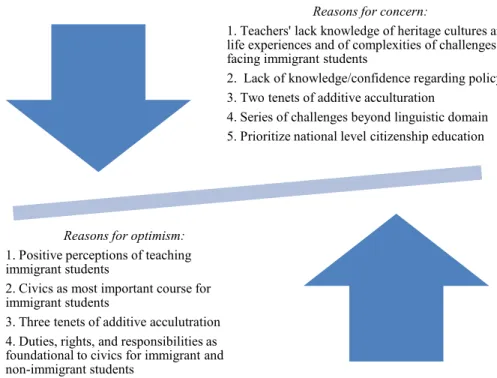
1. Concept map of dissertation findings ………...………72
2. Visual representation of participants’ alignment with additive acculturation
tenets ………134
Chapter 1
INTRODUCTION
This dissertation examines questions applicable to Civics teachers and teacher
educators in “new immigrant gateway states” by analyzing collective case studies (Merriam,
1988) of Civics teachers’ perceptions of working with immigrant students in central North
Carolina. It explores multiple contexts of teaching Civics to immigrant students in a new
gateway state, including teachers’ overall perceptions of immigrant students and teachers’
perceptions of teaching Civics to immigrant students.
My interest in this topic comes out of my own public school teaching experience.
Despite the rapid increase of immigrant student population in all parts of North Carolina, it
seemed to me that the teachers in my school were woefully prepared to teach immigrant
students. Immigrant students who struggled academically seemed to get left behind.
Immigrant students who were academically strong were not given any supports by teachers,
though often these students were socially isolated in the school and classroom. More
specifically, social studies teachers have an additional layer of complexity for educating
immigrant students. Though there is little consensus across the field, citizenship education is
a very large component of social studies (NCSS, 1994). It seemed to me that citizenship
education in United States schools might mean something different for U.S.-born citizens and
2
like for U.S. citizens compared to new citizens or non-citizens?” will be my “career
question.” I envision the work I do on this dissertation to begin to answer this question.
As a collective case study (Merriam, 1988; Stake, 2000), this study prioritizes the
voices of six Civics teachers in central North Carolina, drawing on ethnographic data
gathered from interviews and a focus group. The study also considers the “new gateway
state” (Passel & Suro, 2005; Rong & Preissle, 2009) phenomenon for teachers of immigrant
students. By exploring how these teachers perceive and teach their immigrant students, this
study is positioned to offer recommendations for social studies teachers and teacher
educators in new gateway states.
As a means of analyzing the teachers’ perceptions of and strategies for working with
immigrant students, I adopt Margaret Gibson’s (1995) additive acculturation framework.
This framework has been expanded by Angela Valenzuela (1999, 2002, 2005) and others.
Additive acculturation is a flexible theory that has been applied to Punjabi Sikh immigrants
in California communities. In the late 1970s and early 1980’s, these Sikh immigrants had no
well-established Sikh community from which to draw support. The condition of many
immigrant communities in North Carolina is similar to the Sikh immigrant community
researched by Gibson.
This study addresses a lack of research on teaching social studies to immigrant
students in new gateway states. The results from this study will fill notable research gaps in
the following topics: teacher perceptions of working with immigrant students, identifying the
3
to educating immigrant students, Civics pedagogy for immigrant students, as well as
expanding the growing literature on teaching immigrant students in new gateway states.
Research Questions
This study is guided by two research questions:
1.What are Civics teachers’ perceptions towards working with immigrant students in a new
gateway state?
2. What are teachers’ perceptions of teaching Civics relevant to immigration and immigrant
students?
Exploring Key Terms
Within these research questions, and in the context of the study, a number of terms
require definition. Those terms are defined in the following text.
Immigrant – voluntarily moved from one society to another and intends to stay in a host
country on a long term basis (Rong & Preissle, 2009, p. 3). This study will focus on teacher
perceptions of first generation and 1.5 generation immigrants. First generation immigrants
were born in another country and arrived in the host country after age five. 1.5 generation
immigrants were born in another country and arrived in the host country before age five
(Rong & Preissle, 2009).
New gateway state – state which had a small immigrant population before the 1990s and has
4
Additive acculturation – The “process of culture change and adaptation that occurs when
individuals with different cultures come into contact, the end result need not be the rejection
of old traits or their replacement. Acculturation may be an additive process or one in which
old and new traits are blended.” (Gibson, 1995, p. 90).
Significance of the Study
Although there is a proliferation of research on English Language Learners (ELLs),
there is limited research on immigrant students apart from linguistic considerations. ELLs
and immigrant students are mistakenly conflated (Goodwin, 2002). Many immigrant
students do not require ELL services, while others have been exited from language services
while they still could benefit from services (Sox, 2009). In addition, this conflated
categorization seems to deny immigrant students services in school other than English as a
Second Language (ESL) services. There exists ample literature on teachers and teacher
education with respect to ELLs. However, there is scant literature on teachers and teacher
education for immigrant students apart from linguistic considerations – Goodwin (2002) and
Sox (2009) are notable exceptions. Laurie Olson refers to the “continuing blindness to the
needs of immigrant students” (1997, p. 250), while Phelan, et.al (1998) suggest that teacher
education programs prepare teachers to do little more than teach middle-class,
English-speaking students. Furthermore, there is scarcely any research on this topic with any
specificity towards the social studies content area. Perhaps one reason why there is little
research on immigrant students apart from linguistic considerations is due to the 1982 Plyer
vs. Doe case. In this decision, the Supreme Court ruled that public schools are prohibited
from denying immigrant students access to education. As a result, schools may not inquire
5
researchers, to identify immigrant students through school records. Scholars who wish to
conduct research on immigrant students must therefore rely on students to self-identify as
immigrant students or to work exclusively with students enrolled in ELL programs.
Of special significance to this study is the fact that North Carolina, along with many
other Bible-belt states such as Georgia and inter-mountain states such as Nebraska, is a new
gateway state. There are limitations for immigrant students in new gateway states.
Immigrants in traditional gateway states use existing ethnic communities to provide social
and economic capital (Waters, 1994). New gateway states often lack such established ethnic
communities (Rong & Preissle, 2009). Traditional gateway states have better funded and
longer running programs to serve immigrant students such as English Language Learner
(ELL) programs (Rong & Preissle, 2009). Furthermore, the Pew Hispanic Center (2005)
stated that the new gateway states market themselves to businesses as low-wage,
industry-friendly locales leading to a trend in immigration whereby new arrivals tend to lack a high
school diploma, be poor, not speak English very well or not at all, and are more likely to be
undocumented than immigrants in traditional gateway states. This dynamic has been
underexplored in the literature. Thus this study has the opportunity to provide needed
recommendations to social studies teachers and teacher educators in new gateway states.
Immigrant students are not a homogenous group. Nor do all new gateway states share
similar opportunities and challenges. This study is not meant to globalize the experiences of
Civics teachers. Rather, exploring the perceptions and strategies of a group of Civics teachers
in a new immigrant gateway may lend insight into the ways in which teacher perceptions and
educational practices might meet the needs and embrace the strengths of immigrant students
6 Outline of the Dissertation
The first chapter of the dissertation will provide a background for and outline the
questions that will guide the research study. Specifically, these questions address social
studies teacher’s perceptions towards and strategies for working with immigrant students.
This chapter will also include an introduction to the context of the study, define key terms,
and outline the significance of the study.
Chapter 2 will present the relevant background literature and further explore the
theoretical framework that will guide the study. Chapter 3 will describe the methodology of
the study. Chapters 4 and 5 will present the findings that emerged from the data. Chapter 6
will conclude the dissertation by summarizing the findings to the research questions,
discussing the relevance of the findings, and re-examining the theoretical framework in light
of the data. Finally, I will discuss the implications of the findings for social studies teachers
Chapter 2
LITERATURE REVIEW & THEORETICAL FRAMEWORKS
This chapter will explore the background literature to provide a scholarly context for
the study, as well as advance the theoretical frameworks. The literature presented below
addresses influential scholarship on many of the key areas addressed in this study. First, the
literature review will conceptualize immigration to the United States. Specifically, this
portion of the literature review will historically position immigration to North Carolina and
explore the ways in which immigrants have been incorporated into American society. Next,
the literature review will shift to social studies purposes and pedagogy with respect to
immigrant students. Since this dissertation will address social studies as well as civic
education pedagogy, it is necessary to review the literature for existing social studies
pedagogy recommendations. Finally, the literature review will address teacher education with
respect to immigrant students. Teacher education literature is important because the
recommendations provided in the dissertation will be directed towards teacher education
programs. The literature in these areas, reviewed together, will provide background to the
research study and point to significant gaps in the scholarly literature. Two theoretical
frameworks support this study: the additive acculturation model drawn from Margaret
Gibson’s (1995) theorizing and supported by Angela Valenzuela’s (1999) work and a
democratic civic education framework, drawn from Billig & Root’s (2008) prerequisites of
8 Conceptualizing immigration to the United States
Martin and Midgely (2003, 2006) conceptualize American immigration into three
broad categories. The first categorical group, founders, laid the framework of the society that
later became the United States. This group settled on the Eastern seaboard of North
America. The second category is involuntary Americans, who became a part of the United
States without their consent. This group includes slaves taken from Africa, and the
incorporation of people as America's border expanded, such as the French and American
Indians as a result of the Louisiana Purchase, the Hawaiians with the annexation of Hawaii,
Mexicans as a result of the Mexican-American War, and others. The last category is
immigrants.
Martin & Midgely (2003, 2006) argue there have been four major waves of
immigration. After each of the first three waves, there was a steep decline in the number of
immigrants, until the next wave began. The first wave took place before 1820, when the
United States began keeping statistics about immigrants, and included mostly British and
Northern European immigrants. The second wave, 1820-1860, was driven by Irish and
German immigrants. The third wave, 1880-1914, saw vast numbers of immigrants from
Southern and Eastern Europe. The United States is still experiencing the fourth wave of
immigration
Fourth wave immigration is particularly significant for North Carolina and thus will
receive the greatest amount of attention in this literature review. There are multiple
characteristics of 4th wave immigration which make this wave distinct from previous
9
immigration.” Specifically, these newcomers do not fit the traditional definition of
immigrants as a large portion of newcomers are refugees, asylum seekers, and undocumented
immigrants. A second characteristic is a shift in heritage origins away from Europe and
towards Asian and Latino immigrants, with minor increases in African and Caribbean
immigrants. Third, this immigrant wave is extremely diverse in terms of countries of origin,
economic status before and after arrival, and language (Passel & Suro, 2005). Fourth, many
4th wave immigrants come to the United States with many skills that enable them to function
well in the United States economic system. These immigrants can speak English well, have
college degrees, and are given high prestige work visas specifically because of their skill-sets
(Rong & Preissle, 2009). Fifth, many fourth wave immigrants, empowered by advances in
communication and travel, maintain stronger connections with their heritage countries. In
fact, many immigrants make frequent sojourns to their heritage country in order to maintain
social networks. Many immigrants plan to return to their heritage country permanently, while
other immigrants move from country to country based on employment opportunities
(Brittain, 2002; Rong & Preissle, 2009).
Many of the characteristics which set the fourth wave apart from previous waves are
due to the 1965 Immigration Act. Whereas previous federal regulations regarding
immigration privileged specific heritage countries through the national origins quota system,
the 1965 Act privileged immigrants’ skills and family relationships with U.S. citizens. A cap
of 170,000 immigrants per heritage nation also allowed for a greater diversity of sending
nations (U.S. Immigration Legislation, 2011). Federal and state policy regarding immigration
10
The final characteristic that separates the fourth wave from prior waves is the “new
gateway state” factor (Passel & Suro, 2005). Traditional immigrant gateway states such as
California, New York, and Texas have historically been the preferred settlement locales for
immigrants. These states have experience in educating immigrant students and have
infrastructure in place to aid newcomers. New immigrant gateways, on the other hand, have
historically received few immigrants since the colonization of the United States. New
immigrant gateway states, such as North Carolina, Georgia, and Nebraska, had small
immigrant populations before the 1990s and have tripled or quadrupled their immigrant
populations in the last 15 years (Passel & Suro, 2005). North Carolina and other new
gateway states have “limited experience and infrastructure for settling newcomer families”
(Fix & Passel, 2003, p. 8). North Carolina’s position as a new gateway state will be explored
further in later chapters of the dissertation.
The United States has had a long running debate about the ways in which to
incorporate immigrants into American society. Glenn (2003) called the United States, “a
nation always comprised both of newcomers and those who worry about the impact of
newcomers on the existing society.” Two major arguments have dominated the debate:
assimilationists and pluralists. Assimilationists, often referred to as integrationists, advocate
that immigrants eliminate their ethnic affiliation and embrace American national identity. In
doing so, assimilationists argue that immigrants will experience upward social mobility and
American society will be preserved. Pluralists, on the other hand, argue that immigrants
should maintain their ethnic identities. Martin & Midgely (2003, 2006) argue that neither of
these arguments represents the realities of immigrants in the United States. The
11
fail to acknowledge that culture is not fixed and that many immigrants wish to marry and
socialize out of their ethnic communities. Other models have attempted to more accurately
represent immigrants’ socialization experience. Newman (1973), for example, argued for a
modified cultural pluralism model, which suggests that immigrant groups can and do
maintain unique cultural features, but that immigrant groups and the dominant group also
influence one another and develop common characteristics. Modified cultural pluralism is
best illustrated as A + B + C = A1 + B1 + C1, where A represents the dominant American
group, B and C represent immigrant groups, and 1 represents the characteristics of common
culture that all groups share (Newman, 1973). Fuchs (1991) describes similar sentiments
through the metaphor of a kaleidoscope, in which the entire image is altered as multiple
colors in the kaleidoscope change over time. This study adopts the modified cultural
pluralism framework as it represents a more accurate view of the contemporary immigrant
experiences (Martin & Midgely, 2006). Furthermore, Newman’s work is consistent with the
additive acculturation model, the theoretical framework of the study.
It is perhaps important to recognize immigrant student academic achievement at this
point in the literature review. Although academic achievement is not the focus of the
dissertation, the divergent outcomes presented in the literature illuminates that much more
research needs to be conducted on the education of immigrant students. The literature on
immigrant academic achievement is contentious and conflicting. Many studies argue that
immigrants are academically out-performing non-immigrants (McDonnell & Hill, 1993;
Suarez-Orozco & Suarez-Orozco, 1995; Kao & Tienda, 2005). Other studies suggest that
immigrant students are performing poorly (Natasha, 2005; Han, 2006; Harklau, 2006),
12
agreement is that first-generation immigrants have significantly higher drop-out rates
(Waggoner, 1999; US Bureau of the Census, 2003). In summary, there is no consensus in the
field about the outcomes of immigrant academic achievement. The positive picture of high
academic performance by many immigrant students is tempered with high immigrant student
drop-out rates.
This study connects the concepts of Martin & Midgely’s (2003, 2006) waves of
immigrants, the distinctive characteristics of the fourth wave, Passel & Suro’s (2005) new
gateway state phenomenon, and the modified cultural pluralism philosophy. Taken together,
this background information helps conceptualize immigration to North Carolina.
Social studies’ purposes for immigrant students
There is much disagreement over the purposes of social studies (Woyshner, 2006).
This section will trace the evolution of the purposes of social studies with respect to
educating immigrant students. The one constant factor is the centrality of citizenship in
social studies. Despite the many social studies “camps” (Evans, 2004) trying to control the
direction and purpose of the field, it is clear that camps “cannot gain leverage in the social
studies if they do not appease the mandatory requirement and mission of the social studies in
building informed and active citizens” (Maguth, 2009, p. 40). The idea of citizenship
education is certainly relevant and important to immigrant students. Walter Parker (1996)
states that social studies scholars and outsiders “have charged that citizenship education is at
once so vague and all-encompassing that it can mean anything to anybody” (p. 18), while
others have asked how the concept of patriotism fits into citizenship education and even
13
In response to the 3rd wave of American immigration, which occurred around 1900
and represented mostly Southern and Eastern Europeans, the purpose of the social studies
generally reflected “Americanization” (Mirel, 2010; Jeynes, 2007, Evans, 2004).
Americanization ironically came to fruition around the same time as the formal creation of
social studies. Several factors contributed to the Americanization movement in education:
WWI, large numbers of immigrant students, and concerns over ethnic strife in Europe. The
primary stated goals of the Americanization movement were literacy, learning democratic
values, and learning habits of health and hygiene (Jeynes, 2007). Other scholars, such as
Ellwood Cubberly, were much more direct about the assimilative aspect of Americanization -
to divest immigrant students of their heritage culture and force students to “fit into the
mythical Anglo-Saxon Protestant conception of the ‘good citizen’” (Banks, 2001, p. 6).
Despite the best intentions of 1916 committee to develop social studies which focused on
critical thinking, the purpose of school courses around 1916 was the “glory of Western
civilization and its latest triumph, the growth of the American nation” (Evans, 2004, p. 44).
This purpose is certainly not congruent with the additive acculturation model. Tyack (1967)
asserts, however, that in spite of the Americanization movement “the common school
changed the immigrant, but the immigrant altered the school, too” (p. 231). Americanization
itself was an indication that immigrant students influenced what was taught in social studies
and the very purposes of school.
Social studies during the 1920’s and 1930’s seemed to be a reaction to the
conservative Americanization movement and to the Depression. This interwar period saw
new approaches to social studies such as the rise of social reconstructionism, championed by
14
specifically to immigrant students, it is clear that a progressively-oriented Problems of
Democracy course grew in popularity and the issues-centered, transformative camps were in
the ascendency in social studies academic literature (Woyshner, 2006). Issues-centered
instruction is more consistent with the additive model than subject-centered approaches. One
1930’s survey, however, found that less than 12% of classroom teachers felt that they should
lead student discussions on reforming social issues (Tyack, et.al., 1985).
The WWII period through the 1950’s was, in turn, a conservative response to the
liberal social studies efforts, patriotism surrounding the war, and the Cold War period.
During WWII, the purpose of social studies was most clearly articulated in the NCSS report,
The Social Studies Mobilize for War, which promoted loyalty to the nation, a willingness to
face combat, and preparation to assist in the war effort (Evans, 2004). The conservative
movement continued through the 1950s, which resulted in a move away from issues-centered
to discipline-centered social studies. The purpose of the era seemed to be promoting
democracy and portraying communism as a threat to democracy. Though there seems to be
little follow-through in terms of teacher practice, Evans (2004) argues that the
issues-centered camp made great strides during this era in developing theory to support their camp.
NCSS defended the issues-centered approach with a 1955 resolution calling for support of
teachers to discuss controversial issues in their social studies classes. There is little literature
that addresses how the purposes of social studies evolved for immigrant students specifically
during WWII and the 1950s, but one can infer from the tenor of the camp debates that social
studies purposes reflected a reiteration of the assimilatory, Americanization movement. This
15
The 1960s and 1970s saw several important historic events and several changes in
the direction of social studies (Woyshner, 2006). The “New Social Studies” was a series of
projects in the 1960s, many of which were government sponsored, which attempted to
reorient social studies away from factual learning to a focus on the structure of the
disciplines, stimulating student interest in the disciplines, and the use of discovery learning.
In short, students were to be disciplinary scholars in training. The New Social Studies
movement did not last. It suffered from a series of problems, but the most damaging was that
it did not focus at all on current events or social issues. Considering that this era witnessed
the civil rights movement, the war in Vietnam, and heightened civic awareness of college
students, the New Social Studies gave way to the “newer social studies.” The newer social
studies focused on contemporary social issues, with the purpose of developing active
citizens. It was most closely associated with the social reconstuctionist camp. According to
Evans (2004), “Unfortunately, this burst of energy was short lived. . . The war in Vietnam
ended. Optimism was replaced by cynicism with Watergate . . . and the specter of nuclear
holocaust. All denied the possibility of social improvement” (p. 139). In terms of social
studies purposes and immigrant students, the lasting legacy of this period was the
multicultural education movement which ultimately opened the door for culturally responsive
and relevant pedagogy; the purpose of which was the academic improvement of minority
students.
The 1980s witnessed conservatives take control politically and in the social studies.
The nation’s conservative movement coupled with media attacks against education, notably
the A Nation at Risk (1983) report, which famously claimed a “rising tide of mediocrity in
16
and more emphasis on history than the social sciences (Saxe, 2003). The back-to-basics
movement opened the door for the contemporary standards movement. NCSS responded to
the standards movement by developing its own standards in 1994 along disciplinary lines.
Despite calls in academic literature for a reorientation of social studies to an issues-centered,
social improvement purpose, these calls remain “largely out of step with mainstream trends”
(Evans, 2004, p. 171). Most social studies instruction in practice is focused on delivering
content information to students in the social efficiency, discipline-centered vein without
regard for the cultural differences of immigrant students. The social efficiency camp, as it
disregards students’ heritage, is contrary to the additive acculturation model.
To the degree that is it possible to speak broadly about this divisive topic, it seems
that the purpose of social studies with respect to educating immigrant students has moved
from one of explicit assimilation to one that is more accommodating of immigrant students,
but whose purpose has splintered in multiple directions, with little specifically towards
immigrant students. The original purposes of social studies were directed primarily at
immigrant students and their Americanization. Later iterations of the purpose of social
studies have focused more on serving mainstream students, while neglecting the special
position that social studies should serve for immigrant students.
Social studies pedagogy for immigrant students
Social studies pedagogy has evolved with respect to teaching immigrant students by
default. Though there is little in the way of research explicitly directed towards immigrant
students, there have been several pedagogical movements to improve pedagogy for ethnic,
17
and often speak languages other than English, so other pedagogical moves encompass many
immigrant students by default. The major pedagogical changes are moves towards
differentiation, linguistic adaptations, and culturally responsive and culturally relevant
teaching (Cruz & Thornton, 2009; Gay, 2000; Ladson-Billings, 1995; Tomlinson, 2000).
Although these pedagogical evolutions have been occurring in many schools, the evolution is
by no means universal as many teachers still rely on traditional pedagogy.
Differentiation has become a major area of emphasis for all levels of public
education. Differentiation is the “systemic approach to planning curriculum and instruction
for academically diverse students” (Tomlinson, 2005, p. 6). Differentiation is particularly
applicable in the social studies for the education of immigrant students. Carol Anne
Tomlinson, one of the most influential differentiation scholars, justifies her advocacy of
differentiation on these grounds: “Students in today’s schools are become more academically
diverse. . . . there are more students for whom English is not their first language” (2008, p.
1). Furthermore, culture-related preferences make up one-third of each student’s academic
differentiation profile (Tomlinson, 2008).
Perhaps the most significant social studies pedagogical responses to the teaching of
immigrant and minority students are culturally responsive and culturally relevant teaching.
These pedagogical movements were initially developed for minority students, but
considering the context of 4th wave immigrant students, who tend to be racial minorities,
these models are applicable to immigrant students. Culturally responsive teaching (Gay,
2000) fits well within the additive acculturation model. The major tenets of culturally
responsive teaching are these: academic achievement among ethnic groups are too consistent
18
is an important factor in academic (under)achievement; and greater academic achievement
will follow if schools draw upon the cultural and linguistic strengths of its students. One of
the goals of culturally responsive pedagogy is “developing sociocivic skills for effective
membership in multicultural communities” (Gay, 2000, p. 20), which could and should be
addressed in social studies classes. Gay calls culturally responsive teaching both routine and
radical: routine because it does for minorities what traditional pedagogy does for white
students; radical because it makes culture explicit in pedagogy (p. 24-25). Rather than
immigrant students adjusting their culture to the dominant culture represented in schools,
schools encourage students to maintain heritage cultural competence while succeeding
academically. In terms of practical recommendations, Gay and others (Cruz & Thornton,
2009) suggest using ethnic literature and histories to perform academic skills. For example,
teaching students the skills of primary document analysis can just as easily be taught using
ethnic materials as they can from Euro-centric materials.
Gloria Ladson-Billings (1995, 2009) advocates for culturally relevant pedagogy.
Ladson-Billings model is similar to Gay’s culturally responsive teaching but has a few key
additions. The first is that teachers must “help students to recognize, understand, and critique
current social inequalities” (p. 476). In addition to academic success and cultural
competence, students are to be equipped with the ability to cast a critical eye upon the society
in which they live. The other key addition of Ladson-Billings’s model is the action
component of critique - students must take action within their communities to reduce
inequality for others. Finally, culturally relevant pedagogy is “committed to collective, not
merely individual, empowerment” (Ladson-Billings, 1995a, p. 160). This social action
19
considering the social improvement roots of social studies and its congruence with the
additive acculturation model.
Despite these moves towards the pedagogy advocated in the additive acculturation
framework, there are still a great many limitations in the social studies pedagogy for
immigrant students. Teachers still largely embrace the “American exceptionalism” method
of instruction (Gaudelli, 2003), which, by its very nature, does not respect or value the
heritage countries of immigrant students. Furthermore, social studies methods courses rarely
prepare teachers for how to teach immigrant students (Coady, et.al., 2003). According to
Valenzeula (1999, 2002, 2005), most teachers are subtractive, not additive, in practice.
Finally, social studies literature positions language as the only need facing immigrant
students. This can be problematic because many immigrant students do not require ELL
services. For example, students from English-speaking Jamaica are most likely not classified
as ELL learners. Because these immigrant students would not be classified as ELLs, social
studies teachers might assume that they would not need to adapt their instruction for these
immigrant students.
How has social studies pedagogy evolved with respect to teaching immigrant
students? The answer is that social studies pedagogy has evolved very little with any
specificity towards immigrant students - there is scant literature in this area. However, there
have been major changes in social studies pedagogy for minority and ELL students.
Considering the majority of 4th wave immigrants are racial minorities and speak heritage
languages other than English, these pedagogical evolutions present, by default, improved
pedagogy for immigrant students from the additive acculturation perspective. In light of the
20
students is a serious shortcoming in the field of social studies. Social studies scholarship has
conflated immigrant students with ELL students as if addressing the language issue is all that
is required when teaching social studies to immigrant students. The few studies that do
specifically address pedagogy for immigrant students are general curriculum rather than
specific to social studies (Faltis & Coulter, 2008). In this review of the literature, it appears
that between social studies curriculum, pedagogy, and purposes, pedagogy is the area in
which social studies has paid the least regard to the academic needs of immigrant students.
Thus this study has the potential to make contributions to fill this gap in the literature.
Democratic civic education for immigrant students
Sociologist, historian, and civil rights leader W.E.B. Dubois famously asked, “Am I
an American or am I a Negro? Can I be both? Or is it my duty to cease to be a Negro as soon
as possible and become an American?” (1897/2008, p. 146). His queries have been and
certainly still are applicable to immigrant families upon and after arrival in the United States.
These questions have also been pondered by civic education scholars. How should American
democratic civic education programs teach what it means to be an American to immigrant
students? Should civic education programs emphasize a unified American story, by
privileging a national “unum,” or prioritize multiple narratives and the diversity of American
society, “pluribus” (VanSledright, 2010)?
Abowitz & Harnish (2006) posit that two approaches to democratic citizenship
education have emerged in an attempt to answer this question: civic republicanism, which
prioritizes civic duty, knowledge of American history and democratic processes, and
21
critically and prioritizes social diversity, such as the contributions of immigrant groups. Civic
education scholars critique the civic republicanism approach. Ben Porath (2003), for
example, postulates that the civic republicanism approach can lead to “belligerent
citizenship” (p. 245), in which minority and immigrant groups feel alienated and resist
feelings of pride in the nation. Terrie Epstein (2000, 2009), in studies with minority youth,
finds that minority and immigrant groups do not feel that a single, unified national narrative
speaks to them, which leads to negative attitudes towards school and society. Amy Gutmann
(2004) suggests that the civic republicanism approach does little to prepare students to live in
a diverse society and proposes civic educators do more to make all student groups, including
immigrant students, civic equals. Despite these warnings from civic education scholars and a
rapidly growing immigrant student population, US schools persist in clinging to civic
republicanism as the primary approach to democratic citizenship education (Journell, 2011).
So what is the state of democratic civic engagement amongst immigrants and
democratic civic education for immigrant students in the United States? Although scholars
(Torney-Purta, Barker, & Wilkenfeld, 2006) critique the paucity of research on immigrant
civic engagement, extant literature reveals generally low civic engagement amongst
immigrants in the United States. Naturalized citizens in some immigrant groups are less
likely to vote than native-born Americans (Bass & Casper, 1999; Callahan, Muller, & Shiller,
2008) and less likely to participate in civic activities (Verba, Scholzman, & Brady, 1995).
Second and third generation Asian and Hispanic immigrants are also less likely to vote than
White and Black citizens (US Bureau of the Census, 2002). However, for more active forms
22
immigrants are just as likely to participate as native-born Americans (Baretto & Munoz,
2003).
The literature on democratic citizenship education for immigrant students presents
less than ideal outcomes. For example, Hispanic immigrant adolescents have less trust in
government and see voting as less important than their African-American and Caucasian
peers (Lopez, 2003). Furthermore, Hispanic immigrant students have lower civic knowledge
and lower positive perceptions of the United States than native-born students, including
native-born Hispanics (Torney-Purta, et al., 2006).
Perhaps most troubling, immigrant students are given fewer opportunities for civic
engagement through school-based civic activities than native-born students (Torney-Purta,
2006; Reimers, 2005). Anand Marri (2009) refers to a “civic opportunity gap,” in which
native-born, white, affluent students receive more classroom-based civic learning
opportunities than minority or immigrant students, which contributes to higher democratic
civic knowledge and civic engagement amongst privileged students. Meira Levison (2010)
warns of “a profound civic empowerment gap between poor, minority, and immigrant youth
and adults on the one hand, and middle-class or wealthy, white and native-born youth and
adults on the other,” in which the civic empowerment gap serves to “diminish the democratic
character and quality of the United States” (p. 26). This civic opportunity/empowerment gap
between immigrant and native-born students is certainly problematic and is recently gaining
more attention in the literature. In fact, editors of the book Educating democratic citizens in
troubled times (2008), Janet Bixby and Judith Pace, cite the disenfranchisement of
marginalized groups, for immigrants in particular, as one of the four most troubling
23
Despite these troubling conditions of democratic civic education for immigrant
students, civic scholars envision more robust civic education programs which value and
overtly embrace immigrant students. Joe Kinchloe (2005), for example, asserts for critical
democratic civics; in which Civics teachers facilitate student alliances across demographic
groups in order to engage in the political process. Kinchloe sees contemporary civics
education not as a struggle between citizens or between political groups, but between
organized economic interests. As such, immigrant students are invited to bring their talents,
lived experiences, and cultural diversity into the public sphere (Civics classrooms and
beyond) to articulate a better society for all. His proposed “New Political/Economic Bill of
Rights,” (p. 738-739) includes a bill to maintain one’s culture, free from political or
economic discrimination.
Walter Parker (2008) provides another vision for democratic civic education which
serves immigrant students. Parker calls for Civics courses to prepare students for enlightened
political engagement. According to Parker, the most effective means of preparing citizens for
America’s diverse society is by focusing on two key factors: embracing diversity and
identifying and solving shared problems. To achieve this goal, he calls on Civic educators to
implement three interventions. These interventions are to increase the variety and frequency
of interaction of students who are different from one another, orchestrate these interactions to
foster competent dialogue, and implement seminars and deliberations. Diversity enhances
deliberation because, as he puts this, “each participant’s knowledge of perspectives and
identities is enlarged” (p. 75). Furthermore, fostering discussions from diverse viewpoints is
more likely to lead to questioning the status quo. Parker states, “Multiple perspectives
24
and critique” (p. 76). In this vision of democratic civic education, immigrant students’
diversity and heritage cultures are invited into the classroom and valued as making
significant contributions to helping solve shared problems. In short, students are encouraged
to ask, “What can we learn from one another in order to solve our common problems?”
Rather than a civic assimilative approach which attempts to divest immigrant students of
their unique life experiences and culture in order to develop political unity, Parker’s
enlightened political engagement encourages immigrant students to maintain their cultural
identity in order to most effectively contribute to society. Immigrant students’ life
experiences and heritage cultures are viewed as a source of personal and societal strength.
Immigrant students and social studies: Gender and “soft skills”
Several factors contribute to immigrant students’ social studies experience. This
section will highlight two of these factors relevant to this study: gender and “soft skills.”
Although gender has been an understudied aspect of immigration and education until
fairly recently (Passar, 2003), immigration scholars are now focusing on gender as a key
factor in immigrant students’ acculturation in the United States. The research on immigrant
girls’ acculturation and academic performance tells a story of overcoming obstacles.
Obstacles to immigrant students’ acculturation and academic performance include immigrant
girls’ receiving mixed messages about the importance of school (Canedy, 2001; Gibson,
1998), deeply rooted traditional notions that girls’ education is not as important as boys’
education (Kwong, 2000; Qin, 2006), girls’ families refusing to support higher education
(Sarroub, 2001; Wolf, 1997), and girls’ overwhelming responsibilities at home leading to
25
outperforming immigrant boys. Immigrant girls have higher grades (Portes & Rumbaut,
2001; Olsen, 1997; Hutchinson, 1997) and more positive attitudes about school (Gibson,
1993; Qin, 2006).
Immigrant girls’ academic success and acculturation are intimately linked. Qin
(2006) cites “a gender role shift after migration” (p. 10), in which parents from traditional
communities gradually adopt gender egalitarian views after resettling in the United States, as
key to immigrant girls’ success. Other scholars note that immigrant parents are more likely to
regiment girls’ free time after school which likely contributes to girls’ academic success
(Portes & Rumbaut, 2001; Zhou & Bankston, 2001). Perhaps most significantly, studies
show that immigrant girls are more likely than boys to adopt “additive” or “hyphenated”
identities, which indicate their attempt to develop bicultural competencies in the heritage
community in the United States (Gibson, 1998; Olsen, 1997; Rumbaut, 1996; Qin, 2006). In
other words, girls are more likely to view the compatibility and advantages of striving for
gender equality in American schools while maintaining cultural ties to family and immigrant
community.
Another factor which contributes to immigrant students experience in social studies is
the array of traits and behaviors immigrant students bring to the classroom. Sociologists refer
to these behavioral traits as “soft skills,” and include personal graces, enthusiasm, optimism,
and others. Scholars (Massey, et al., 2007; Zhou & Bankston, 2001) aver that several of
these skills contribute to immigrant students’ school performance. These soft skills are
largely a result of immigrant’s cultural emphasis on education, hard work, and respect for
authority. Scholars note additional immigrant student soft skills such as authenticity,
26
honoring and respecting authority and elders (Lee, 2001a; Hutchinson, 1997; Rumbaut, 1995;
Portes & Rumbaut, 1996; Kao & Tienda, 2005; Zhou & Bankston, 1998).
Although the literature on immigrant student soft skills is generally positive, some
scholars warrant that certain soft skills are detrimental to school performance, particularly the
soft skill of respecting authority. For example, Stacy Lee (2001a) finds that rather than
confront a teacher when they do not understand course content, many immigrant students
skip class. Thorssenson (2008) postulates that Montagnard immigrant students are often
“good kids” who behave, respect the teacher, are nice to their peers, and sit quietly, but “bad
students” who do not request extra help out of deference to the teacher, even if they do not
understand the material. As a result, they receive poor grades. In Civics courses which should
include deliberation (Parker, 2008) and a critique of the status quo (Kinchloe, 2005), being
overly deferential to authority can be a detrimental soft skill.
In sum, multiple factors contribute to immigrant students’ social studies experience.
Two factors, gender and soft skills, are relevant to this study. The findings from this study
are positioned to offer contributions to the literature on teaching immigrant students with
respect to gender and soft skills.
Teacher education and immigrant students
In 2002, Lin Goodwin raised a challenge to teacher education programs when she
published Teacher preparation and the education of immigrant children. Goodwin maintains
that immigration has led to drastically different student demographics in American schools,
and that teacher education has not adequately responded to this change. She highlights key
27
teacher educators. Goodwin’s main point is that although teacher education literature
includes an abundance of resources about ethnic, racial, and linguistic diversity, “specific
attention to immigrant children appears to be lacking” (p. 159), which she refers to as “the
notable silence” (p. 160). Of the issues she raises, the most notable is perhaps the issue of
cultural disorientation. Specifically, many immigrants’ identities are perceived in established
United States racial categories. For example, an immigrant from Jamaica might perceive
herself as Jamaican, but would be pressured by peers and educators to identify herself as
black or African-American. Laurie Olson (1996) describes this process as moving “from
nation to race.”
Goodwin posits three recommendations for teacher educators. The first is
differentiating instruction. Under this banner, she suggests that Moll’s (1991) “funds of
knowledge” and Ladson-Billings’ (1994) culturally responsive pedagogy offer great promise
for immigrant students. She also suggests that teacher education program should prepare
teachers for students who enter school at different points in the year (a common occurrence
for immigrant students) and to introduce students to the “interactional and participatory
norms in US classrooms” (p. 167). Goodwin’s second recommendation is to prepare
pre-service teachers in second-language learning. Under this category, she offers that pre-pre-service
teachers should be prepared in the following five areas: language acquisition theories,
instructional strategies to scaffold ELLs, developing cooperative and community-based
learning, how to access resources and materials for ELLs, and being conscientious of the
stereotypes surrounding second language learners, such as the deficit perspective. Her final
recommendation is to encourage pre-service teachers to work more closely with families and
28
teacher education programs, but that working with immigrant families takes on particular
importance because familial relationships are often central to immigrant students’ identities
and because of language reasons. This is namely that students are often translators for
families, and because schools are understaffed with bi-lingual teachers, bi-lingual parents are
indispensible communicators to immigrant communities.
Although Goodwin’s piece is very helpful, there are limitations in the article. The
major limitation is that she disregards one of the major critiques she levels against the field of
teacher education. Specifically, she says that there is, unfortunately, a “noticeable conceptual
overlap in the literature between immigrant children and LEP children” (p. 160). I agree
with her on this point. Yet in her paper, two of her three suggestions relate to issues of
language.
The next article of focus is by Amanda Sox (2009), who researches Latino immigrant
students in southern schools. She pays particular attention to the states of North Carolina and
Georgia. Sox’s article challenges teacher education programs in southern states to improve
the ways in which they prepare pre-service teachers to teach growing numbers of Latino
students in southern schools. Sox identifies three themes in the (mis)education of immigrant
students and the implications of each of these themes for teacher preparation. The first theme
is policies related to immigrant students in southern states. She argues that existing policies
are harmful to immigrant students. She presents two extreme examples in Georgia. In the
first, teachers are told to enforce Georgia’s English-only policy even in students’ social time!
Another harmful policy is Georgia’s two-year ELL policy, which states that immigrant
students can only receive two years of ELL services, after which time students are either
29
these policies, she advises teacher education programs to include policy components in their
coursework.
Sox’s other major theme relates specifically to teacher education. Her argument is
that teacher education programs are doing a poor job of preparing teachers to work with
immigrant students. For example, she cites Ballantyne’s 2008 study in which he compared
teacher licensure standards at the state level on the topic of ELL preparation. Ballantyne
found that some states had no mention of ELL students in their standards. North Carolina
only referenced ELL students as an “example of diversity, but did not address specifics in
their diversity standards” (p. 316). Furthermore, no southern states required courses
specifically dedicated to the needs of ELL mainstreamed content area teachers. In her final
theme, Sox states that pre-service teachers need to develop knowledge in four areas in order
to be prepared to work with immigrant students: linguistics, second language acquisition
theories, cultural and linguistic diversity, and pedagogy for bilingual students. Rather than
making recommendations to improve teacher education programs, Sox suggests that teachers
should either gain her recommended knowledge through self-study, or should be conducted
as in-service training sponsored by school districts. In this section she oddly makes no
recommendations for teacher education programs.
There are limitations in Sox’s paper. Like Goodwin, she merges the needs of
immigrant students and ELL students in two of her three themes. While Goodwin notes this
problem, Sox did not do so. I appreciate that Sox was much more specific in her suggestions
than Goodwin. Naming specific policies that teacher educators should raise with their
pre-service teachers is particularly helpful. However, I would have appreciated even more
30
as one of her themes, yet not make specific suggestions for preservice teacher education
programs under this theme. Suggesting that in-service teachers use self-study to solve the
problems she identifies leaves much to be desired in my view.
A recent study by Cho & Reich (2008) makes recommendations for inservice social
studies teachers who teach ELL students. The researchers surveyed teachers in central
Virginia, which, like North Carolina, has a rapidly rising immigrant student population. Cho
& Reich’s survey results show that social studies teachers desire more and better bilingual
instructional materials and professional development specific to immigrant students. When
asked what type of professional development the social studies teachers would need or desire
to teach ELLs, the majority of teachers indicated cultural understanding and ESL
instructional strategies as the most important areas.
Cho & Reich (2008) offer helpful teaching strategies for social studies teachers, such
as using graphic organizers and introducing vocabulary at the beginning of lessons.
Unfortunately, their recommendations for inservice teacher education are limited and vague.
As their primary recommendations for inservice social studies teachers working with ELLs,
the authors offer “thinking like a linguist,” and “thinking like an outsider” (p. 239).
Although I applaud Cho & Reich for offering suggestions to improve inservice teacher
education for social studies teachers, the type of recommendations are not specific enough to
be helpful. Thus one of the goals of this dissertation is to make stronger recommendations
for social studies teacher education programs.
31
The primary theoretical lens employed in this study is the additive acculturation
model developed by Margaret Gibson (1995). The remainder of this section will describe the
additive acculturation model, its antecedents, and how it has evolved over time for its
developer. The section will also discuss how the additive acculturation model is employed to
inform the research design, data collection, data analysis, and findings and explore how other
authors have used the additive acculturation model. Since one of the limitations of the model
is that it does not account for civic engagement amongst immigrant students, the model is
supported by a democratic civic education framework developed by merging Billig & Root’s
(2008) and Kinchloe’s (2005) scholarship. The final chapter of the dissertation will elaborate
on the ways in which this study confirms, complicates, and broadens the theoretical
framework. Furthermore, the conclusion will include a revision of the additive acculturation
model which includes civic engagement.
The additive acculturation model (Gibson, 1995) suggests that schools and teachers
provide equal opportunities to immigrants and acculturate students through a bicultural
process that values their heritage culture and American culture. The additive model
promotes home-school relations and encourages students to maintain their ethnic
communities while, at the same time, learning and adopting aspects of American culture.
Teachers who follow the additive model recognize the value in heritage culture and
incorporate heritage cultures into the classroom. Furthermore, teachers frame their
instruction in ways that are meaningful and relevant to immigrant students. Teachers who
follow the additive model teach inclusively, by recognizing the high motivations for learning
among immigrant students and incorporating the knowledge and life experiences of
32
Gibson highlights a few key differences between assimilation and acculturation. She
describes assimilation as a process in which individuals of one society are absorbed into
another. She denotes a negative connotation with the term assimilation. Acculturation, on the
other hand, is a process of cultural “change and adaptation that occurs when individuals with
different cultures come into contact. The end result need not be the rejection of old traits or
their replacement. Acculturation may be an additive process or one in which old and new
traits are blended” (Gibson, 1995, p. 90).
Gibson holds that American schools have many things to offer immigrant students
such as helping them master the dominant language and culture, aiding students’ entry into
the host society, and preparing students to participate in the American workforce. She
suggests that the parents of immigrant students desire and encourage acculturation to a point,
but do not want assimilation. Specifically, she highlights parental fears of becoming too
Americanized.
Gibson argues that when schools do not practice the additive model, they may
“undermine just those qualities that enable minority children to excel in school” (p. 92).
Schools and educators that implicitly or explicitly remove, marginalize, or demean
immigrant students’ heritage culture practice subtractive acculturation. The subtractive
practice is based on a deficit model which associates immigrant children with multiple
handicaps in schooling, such as lack of English proficiency, lower potential to do well
academically, and not understanding the social and educational institutions in United States.
Subtractive practice in education emphasizes English-only instruction, rapid
Americanization, and a monocultural approach to assimilation. It recommends a corrective
33
Other scholars have reinterpreted Gibson’s subtractive acculturation and taken the
theory in slightly different directions. Most prominently, Angela Valenzuela (1999, 2002,
2005) describes subtractive schooling, which is similar to Gibson’s subtractive acculturation.
Valenzuela’s work focuses not on Indian immigrants like Gibson, but instead with Latina/o
immigrant students in Texas. Valenzuela is much more critical of schools and educators than
Gibson, and suggests that schools, by their very design, are intended to be subtractive to
immigrant students. In fact, she postulates that only by openly defying federal and state
policies are schools and teachers able to be anything but subtractive in their practice.
Whereas Gibson’s work focuses on teacher practice and local policy, Valenzuela focuses on
the structure of schools and state and federal policy. Valenzuela argues that in order for
educators to overcome subtractive school practices, they must exhibit caring, tolerance, and
understanding of immigrant students and must educate themselves on the heritage cultures
and personal backgrounds of immigrant students. Both scholars advocate for teachers to
respect immigrant students’ heritage culture, to encourage students to value their heritage
culture, and to encourage bilingualism.
Additive acculturation antecedents
Gibson (1995) developed the additive acculturation model by building on Walter
Lambert’s (1975) concept of additive and subtractive bilingualism. Lambert conducted
research on immersion language education in Canada, specifically the Canadian attempt to
ensure bilingualism in the country. Lambert’s later work concentrated on applying the
additive bilingualism model developed in Canada to the education of immigrant students in