An improved AODV routing protocol for VANET
(Vehicular Ad-hoc Network)
Neha Garg 1 Puneet Rani2
M-Tech Student1, Assit. Prof. 2 & Department of CSE & Shri Ram College of Engg. & Mgmt Palwal, Haryana, India
Abstract—Vehicular Ad Hoc Network (VANET) is a part of Mobile Ad Hoc Networks (MANET). Wireless communication among vehicles and static road side infrastructure is provided by VANET. The communication among vehicles is important for comfort, safety and for entertainment purpose as well. The communication performance depends on the routing protocols that are being employed in network. In this paper, we have improved the performance of Ad-hoc on Demand Distance Vector (AODV) routing protocol by using some parameters i.e. Active route time outs and hello interval to choose the best path for routing and compared the proposed AODV protocol performance with Normal AODV in terms of different performance metrics i.e. average throughput, average delay and average network load. We have used a simulation tool “OPNET Simulator v14.5” for performance evaluation. Results show that proposed AODV routing protocol has better performance as compared to normal AODV.
Keywords:VANET, MANET, Ad-hoc, AODV, OPNET.
I. INTRODUCTION
The growing demand of wireless devices and wireless communication tends to research on self-curing and self organizing networks without the support of any centralized management or pre-demonstrated authority/infrastructure. This kind of networks is known as Ad hoc networks.
Vehicular Ad hoc Networks (VANETs) is a kind of Mobile Ad Hoc Networks (MANETs) that has came out due to recent development in sensor network and wireless technology. Vehicular Ad hoc Networks (VANETs) are ad-hoc network’s real applications where real-time communication among vehicles and nearby roadside fixed infrastructure is provided over wireless links. It minimizes both vehicle crashes and traffic congestion which are critical problems across the whole world. The wireless communication among two or more nodes in a VANET (Vehicular Ad hoc Networks) confronts various unique challenges. This is particularly suitable for safety-critical applications i.e. pre-crash feeling, collision avoidance, lane change etc. Factors i.e. more vehicle speeds, less signal latencies, varying configuration, traffic density, total message size etc. are major challenges that builds conventional wireless protocols and technologies inapplicable for VANETs (Vehicular Ad hoc Networks). Along with performance
issues, there are various security challenges in VANET i.e. asserting the validity of data packet, certifying sender of message, providing node secrecy with non-repudiation, availability, certificate cancellation etc. All these security and performance needs coordinate to build VANET safety applications more challenging as compared to other wireless applications.
Fig. 1. Vehicular Ad hoc Network
The routing protocols in VANET are classified into three main categories:-
1. Proactive Routing Protocol-In proactive routing protocol, the mobile nodes interchange routing information and manage the network configuration information in routing table at regular interval of time. These protocols are also known as table driven routing protocol.
2. Reactive Routing Protocol- Here the mobile nodes do not interchange routing information periodically. These protocols obtain a new route when it is required. These protocols are also known as on demand routing protocol.
3. Hybrid Routing Protocol- It is the combination of both reactive and proactive routing protocols. A table driven method is employed inside the routing zone of every node while an on demand method is employed for the nodes that are beyond the routing zone [10].
II. Ad-hoc On Demand DistanceVector (AODV) Ad hoc On Demand Distance Vector (AODV) routing protocol is a reactive or on-demand routing protocol which is able of both multicasting and unicasting. Similar to all reactive routing protocols, Ad hoc On Demand Distance Vector (AODV) protocol, works on demand basis when there is requirement of sending the data by the nodes inside the network. If source node wants to send some data to destination node then firstly, it starts the route discovery process means it broadcasts Route Request (RREQ) message which is propagated by intermediary nodes until destination is arrived then a route reply (RREP) message is sent back to the source if the receiver either has a valid route to the desired address or it is the node utilizing the required address as shown is fig 2.
Fig. 2. Ad-hoc on Demand Distance Vector Routing Protocol Operations AODV decreases the size of routing table because AODV can collect only a restricted amount of routing information; route learning is restricted only to the source node.
III. Proposed Methodology
Here, we represent several flexible parameters to analyze AODV routing algorithm and explain their impacts on energy constraints. AODV routing algorithm is optimized by using the different parameters such as Hello Interval, Hello message loss and Active Route Timeout. The time taken by the sender to route the hello message to another node with the help of intermediary node is known as Hello Interval. The lifetime of the routing table is called Active Route Time out. After this interval of time the Vehicular Ad-hoc Network will not consider this path. We represent a discussion on how the parameter influences energy consumption through routing QoS for each parameter and represent an adaptation policy to minimize energy consumption by determining the suitable
value of these parameters by taking into consideration the current channel conditions.
IV. Simulation Setup
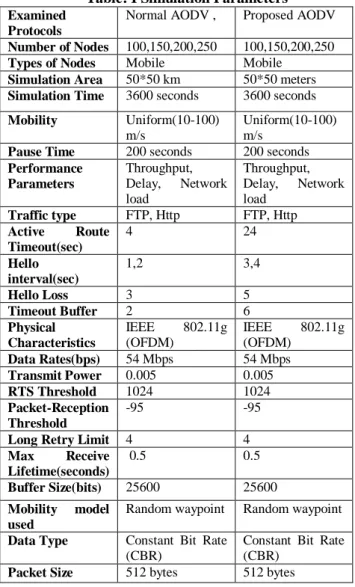
For our work we have used OPNET simulator v14.5 for simulation purpose. A network is simulated for simulation within an area of 50 m x 50 m. The all mobile nodes are distributed inside this area. Random waypoint mobility model with mobility of 100 meters is utilized, the performance of the normal AODV and proposed AODV protocol is measured by implementing various scenarios. For every mobile workstation, the buffer size of data is adjusted to 1024 Kbps at data rate of 54Mbps. The traffic flows in a random way among several Voice applications workstations located at different distances. We take the different network size with respect to the number of node as number of node is increasing in VANET; obviously there will be increment in power consumption. So by varying the value of Active Route Time, Hello Interval, and Hello loss Interval we make a scenario and compare this scenario with the normal scenario (AODV). The simulation parameter of both scenarios is shown in Table I
Table: I Simulation Parameters
Examined Protocols
Normal AODV , Proposed AODV
Number of Nodes 100,150,200,250 100,150,200,250
Types of Nodes Mobile Mobile
Simulation Area 50*50 km 50*50 meters
Simulation Time 3600 seconds 3600 seconds
Mobility Uniform(10-100)
m/s
Uniform(10-100) m/s
Pause Time 200 seconds 200 seconds
Performance Parameters Throughput, Delay, Network load Throughput, Delay, Network load Traffic type FTP, Http FTP, Http Active Route Timeout(sec) 4 24 Hello interval(sec) 1,2 3,4 Hello Loss 3 5 Timeout Buffer 2 6 Physical Characteristics IEEE 802.11g (OFDM) IEEE 802.11g (OFDM) Data Rates(bps) 54 Mbps 54 Mbps Transmit Power 0.005 0.005 RTS Threshold 1024 1024 Packet-Reception Threshold -95 -95
Long Retry Limit 4 4
Max Receive Lifetime(seconds) 0.5 0.5 Buffer Size(bits) 25600 25600 Mobility model used
Random waypoint Random waypoint
Data Type Constant Bit Rate (CBR)
Constant Bit Rate (CBR)
V. Simulation Results
To measure the performances of normal AODV and proposed AODV in various scenarios we have found the different QOS and routing parameters i.e. network load, throughput, packet delivery ratio (PDR) and End to end delay.
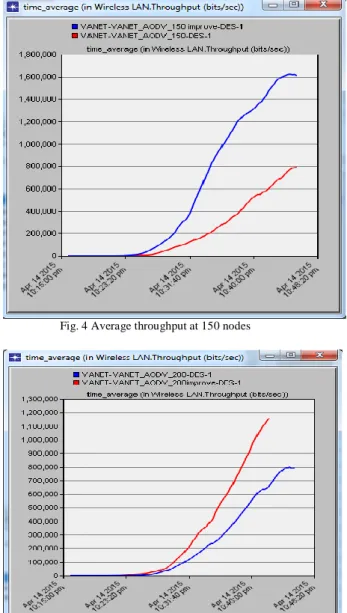
Fig 3, 4, 5, 6 shows the comparison of throughput between normal AODV and proposed AODV at various number of nodes. Proposed AODV has more throughput in comparison of AODV to discover the path.
Fig. 7, 8, 9, 10 represents the comparison of these two protocols for end to end delay. Proposed protocol performs well as compared to normal AODV at different number of nodes.
Fig 3. Average throughput at 100 nodes
Fig. 4 Average throughput at 150 nodes
Fig. 5 Average throughput at 200 nodes
Fig 8. Average delay at 150 nodes
Fig 9. Average delay at 200 nodes
Fig 10. Average delay at 250 nodes
Fig.11 Average network load at 100 nodes
Fig. 12 Average network load at 150 nodes
Fig 14. Average network load at 250 nodes
Fig 11, 12, 13, 14. shows the comparison of network load and it is concluded that proposed AODV has less load than normal AODV. The proposed AODV performs significantly for mobile and dynamic networks.
Conclusion and Future Work
The simulation of VANET network is done by using OPNET 14.5 modeler and examined for normal AODV and proposed AODV routing protocol. We employed some methodology to enhance the performance of AODV protocol by varying parameters values i.e. Active Route Timeout, Hello Interval and Hello Message loss for making proposed AODV routing protocol. We employed this proposed AODV to different numbers of nodes i.e. 100, 150, 200 and 250 and concluded that this is efficient in all the cases. After simulation, It is concluded that proposed AODV has better QoS (Quality of service) and Routing results as compared to normal AODV protocol. In future work, we will further enhance the AODV protocol at large scale environment.
REFERENCES
[1] Mehta, K.; Malik, L.G.; Bajaj, P., "VANET: Challenges, Issues and Solutions," Emerging Trends in Engineering and Technology (ICETET), 2013 6th International Conference on , vol. 4, no. 5, pp.78-86 Dec. 2013
[2] Shuai Yang; Rongxi He; Ying Wang; Sen Li; Bin Lin, "OPNET-based modeling and simulations on routing protocols in VANETs with IEEE 802.11p," Systems and Informatics (ICSAI), 2014 2nd International Conference on , vol., no., pp.536,541, 15-17 Nov. 2014
[3] Nafi, N.S.; Khan, J.Y., "A VANET based Intelligent Road Traffic Signalling System," Telecommunication
Networks and Applications Conference (ATNAC), 2012 Australasian , vol. no. 4, pp.1-9 Nov. 2012
[4] Grzybek, A.; Seredynski, M.; Danoy, G.; Bouvry, P., "Aspects and trends in realistic VANET simulations, Wireless, Mobile and Multimedia Network, 2012 IEEE International Symposium on a , vol. no. 6, pp.25-28, June 2012
[5] Sadeghi, M.; Yahya, S., "Analysis of Wormhole attack on MANETs using different MANET routing protocols," Ubiquitous and Future Networks (ICUFN), 2012 Fourth International Conference on , vol., no., pp.301,305, 4-6 July 2012
[6] Chim, T.W.; Yiu, S.M.; Hui, L.C.K.; Li, V.O.K., "VSPN: VANET-Based Secure and Privacy-Preserving Navigation," Computers, IEEE Transactions on , vol.63, no.2, pp.510-524, Feb. 2014
[7] K. Liu, J. Guo, N. Lu, F. Liu, X. Wang, and P. Wang, “RAMC: A RSU-Assisted Multi-Channel Coordination MAC Protocol for VANET,” IEICE Trans. Commun., Vol. E94-B, No. 1, pp. 203–214, January 2011.
[8] Nafi, N.S.; Khan, R.H.; Khan, J.Y.; Gregory, M., "A predictive road traffic management system based on vehicular ad-hoc network," Telecommunication Networks and Applications Conference (ATNAC), 2014 Australasian , vol., no., pp.135,140, 26-28 Nov. 2014
[9] S.R. Biradar, K. Majumder, S.K. Sarkar and Puttamadappa C, “Performance Evaluation and Comparison of AODV and AOMDV,” International Journal on Computer Science and Engineering (IJCSE), Vol. 2, No. 2, pp. 373–377, 2010 [10] Performance Comparison Of AODV and DSDV Routing Protocols in Mobile Ad Hoc Networks, Aditi Sharma,Sonal Rana, Leena Kalia, International Journal of Emerging Research in Management and Technology, ISSN:2278-9359 Volume-3, Issue-7, July 2014.
[11] Kumar, A.; Sinha, M., "Overview on vehicular ad hoc network and its security issues," Computing for Sustainable Global Development,2014 International Conference on , vol., no., pp.792,797, March 2014
[12] Bhoi, S.K.; Khilar, P.M., "A secure routing protocol for Vehicular Ad Hoc Network to provide ITS services," Communications and Signal Processing (ICCSP), 2013 International Conference on , vol., no. 7 pp.1170-1174, April 2013
[13] Ait Ali, K.; Baala, O.; Caminada, A., "Routing
Mechanisms Analysis in
Vehicular City Environment," Vehicular Technology Conference, 2011 IEEE 73rd , vol., no. 6 pp.1-18 May 2011
[14] Hamieh, A.; Ben-othman, J.; Mokdad, L., "Detection of Radio Interference Attacks in VANET," Global Telecommunications Conference, 2009. GLOBECOM 2009. IEEE , vol., no. 3, pp.1,5, Nov. 30 2009
[15] Pathre, A.; Agrawal, C.; Jain, A., "A novel defense scheme against DDOS attack in VANET," Wireless and Optical Communications Networks (WOCN), 2013 Tenth International Conference on , vol., no. 6, pp. 26-28 July 2013 [16] Lyamin, N.; Vinel, A.; Jonsson, M.; Loo, J., "Real-Time Detection of Denial-of-Service Attacks in IEEE 802.11p Vehicular Networks," Communications Letters, IEEE , vol.18, no.1, pp.110-113, January 2014
[17] Yeongkwun Kim; Injoo Kim; Shim, C.Y., "A taxonomy for DOS attacks in VANET," Communications and Information Technologies (ISCIT), 2014 14th International Symposium on , vol., no., pp.26-27 Sept. 2014
[18] Li He; Wen Tao Zhu, "Mitigating DoS attacks against signature-based authentication in VANETs," Computer Science and Automation Engineering (CSAE), 2012 IEEE International Conference on , vol.3, no. 2, pp.261-265 May 2012
[19] Verma, K.; Hasbullah, H.; Kumar, A., "An efficient defense method against UDP spoofed flooding traffic of denial of service (DoS) attacks in VANET," Advance Computing Conference (IACC), 2013 IEEE 3rd International , vol., no., pp.550-555, Feb. 2013
[20] Pooja, B.; Manohara Pai, M.M.; Pai, R.M.; Ajam, N.; Mouzna, J., "Mitigation of insider and outsider DoS attack against signature based authentication in VANETs," Computer Aided System Engineering (APCASE), 2014 Asia-Pacific Conference on , vol. 4, no 5, pp.152-157 Feb. 2014
[21] Harri, J.; Filali, F.; Bonnet, C., "Mobility Models for vehicular ad hoc networks: a survay and taxonomy," Communications Surveys & Tutorials, IEEE , vol.11, no.4, pp.19-41, Fourth Quarter 2009
[22] Yen-Wen Lin; Guo-Tang Huang, "Optimal next hop selection for VANET routing," Communications and Networking in China (CHINACOM), 2012 7th International ICST Conference on , vol., no., pp.611-615Aug. 2012
[23] Sun Xi; Xia-Miao Li, "Study of the Feasibility of VANET and its Routing Protocols," Wireless communication, Networking and Mobile Computing, 2008. WiCOM '08. 4th International Conference on , vol. no. 2, pp. 12-14 Oct. 2008