1877–0509 © 2011 Published by Elsevier Ltd.
Selection and/or peer-review under responsibility of Prof. Mitsuhisa Sato and Prof. Satoshi Matsuoka doi:10.1016/j.procs.2011.04.093
Procedia Computer Science 4 (2011) 878–887
International Conference on Computational Science, ICCS 2011
GRAPE-MP: An SIMD Accelerator Board for Multi-precision
Arithmetic
Hiroshi Daisakaa,1, Naohito Nakasatob, Junichiro Makinoc, Fukuko Yuasad, Tadashi Ishikawad aHitotsubashi University
bUniversity of Aizu
cNational Astronomical Observatory of Japan dHigh Energy Accelerator Research Organization
Abstract
We describe the design and performance of the GRAPE-MP board, an SIMD accelerator board for quadruple-precision arithmetic operations. A GRAPE-MP board houses one GRAPE-MP processor chip and an FPGA chip which handles the communication with the host computer. A GRAPE-MP chip has 6 processing elements (PE) and operates with 100MHz clock cycle. Each PE can perform one addition and one multiplication in every clock cycle. The architecture of the GRAPE-MP is similar to that of the GRAPE-DR. It is implemented using the structured ASIC chip from eASIC corp. A GRAPE-MP processor board has the theoretical peak quadruple-precision performance of 1.2 Gflops. As a preliminary result, we present the performance of the GRAPE-MP board for two target applications. The performance of the numerical integration of Feynman loop is 0.53 Gflops. The performance of aN-body simula-tion with the second order leapfrog schema is 0.505 Gflops forN=1984, which is more than 10 times faster than the performance of the host computer.
Keywords: SIMD, Quadruple-precision, GRAPE
1. Introduction
Most of numerical simulations are currently done using double-precision operations. The reason is that almost all present-day CPUs have double-precision floating-point operation units, and their accuracy is sufficient in most cases. However, there are a lot of problems which can not be solved with double-precision operations.
An example of such problems is the evaluation of the Feynman loop integrals. One of such integrals is a one-loop integral expressed as I = 1 0 dx 1−x 0 dy 1−x−y 0 dzF(x,y,z), F(x,y,z) = D(x,y,z)−2 D(x,y,z) = −xys−tz(1−x−y−z)+(x+y)λ2 1Corresponding author
+(1−x−y−z)(1−x−y)m2e
+z(1−x−y)m2f. (1)
Here,sandtare kinematic parameters,meandmf are physical constants, Andλis a fictitious photon mass. We need
to evaluate this ingegral for the limit ofλ→0. The accurate numerical evaluation of this integral is a hard problem due to its divergent nature [1]. Yuasa et al. [1] reported that the numerical evaluation is numerically unstable with double-precision operations. A solution to this difficulty is to compute the integral in higher precision. Furthermore, Yuasa et al. [1] reported that the use of an extrapolation scheme forλ[2] was necessary.
If we adopt precision operations with emulation schemes proposed in [3] and [4], one precision variable is expressed by a pair of two double-precision variables. With the scheme in [4], one precision addition and one multiplication require 20 and 23 double-precision operations, respectively. Thus, a quadruple-precision operation is at least 20 times slower than a double-quadruple-precision operation.
To overcome this difficulty, Nakasato [5] has implemented the quadruple-precision emulation scheme on many-core accelerators and reported that GPU and GRAPE-DR [6] were effective in accelerating the numerical evaluation of the Feynman loop integral. However, the performance of quadruple-precision operations on a many-core accelerators is more than 20 times slower than the performance of double-precision operations on the same processors.
In this paper, we describe an alternative approach to improve the performance of quadruple-precision operations. We have designed a special floating-point unit for quadruple-precision operations and implemented it in a structured ASCI chip. Our project, called GRAPE-MP, is a pilot study to investigate the feasibility of a hardware implementaion of a quadruple-precision floating-point unit.
In the following, we describe the design and implementation of the GRAPE-MP system and present performance numbers on selected target applications.
2. GRAPE-MP
In this section, we overview the architecture of GRAPE-MP. The GRAPE-MP is similar to that of GRAPE-DR [6] and its internal structure is simple: (1) GRAPE-MP has programmable processing elements (PE) and memory components. (2) PEs form a Single-Instruction-Multiple-Data (SIMD) processor. (3) Instructions for PEs are supplied from a separate control processor. (4) the control processor, also sends data to GRAPE-MP, receives data from GRAPE-MP, and handles the communication with a host computer.
The GRAPE-MP processor board (Figure 4) consists of one GRAPE-MP chip and one FPGA chip which imple-mentes the contorol processor. This separation of functionalities between GRAPE-MP and FPGA is a key design. In this way, we can maximize the quadruple-precision operation units on a chip. In addition, we can simplify the design of the custom chip, since complex control logic units such as PCIe interface are all in the FPGA chip. In the following, we describe each component of the GRAPE-MP board.
2.1. Numerical Format
First, we describe our numerical representation for a quadruple-precision value. Hereafter, we call our represen-tation eXtended-Double format: XD format. We use 128 bit to express a value in XD format with 1 bit for sign, 11 bits for exponents and 116 bits for mantissa. The size of the exponent in the XD format is the same as the size of the exponent in the double-precision format (IEEE 754) and is smaller than the exponent defined in the binary128 format (11 vs. 15 bits). However, the size of the mantissa in the XD format is larger (116 vs. 112 bits). A drawback of the XD format is that we have no compatibility with the binary128 format. In the current software library for GRAPE-MP, we have implemented conversion functions between the XD format and Double-Double (DD) and Quad-Double (QD) formats proposed in [7].
2.2. Processor Element
Figure 1 shows the block diagram of a PE. Each PE consists of a floating-point multiply unit, an add unit, a special functional unit (RSQ unit), two general purpose register files (GRF1 and GRF2) and an auxiliary register (Treg). The multiply and add units can operate independently and handle quadruple-precision values with the throughput of one operation per clock cycle. The RSQ unit is designed to compute an approximation of the inverse of square root in
Figure 1: Block diagram of the PE.
Figure 2: Block diagram of the chip.
roughly 24 bit. We use the output of the RSQ unit as an initial guess for the iterative improvement by the Newton-Raphson method. We can use the RSQ unit for the calculation of not only the reciprocal square root in quadruple-precision but also the division with two additional multiply operations and the square root with one additional multiply operation. The latency of these units is 4 clock cycles. In order to hide the latency, we implement virtual 4-element vector processing in a PE which behaves like 4 “logical” pipelines.
All registers (GRF1, GRF2 and Treg) are 128-bit wide to store quadruple-precision values. GRF1 and GRF2 are general purpose registers which store input/output values and intermediate results. They have one read and one write ports, and each register has 128 words. Treg also has one read and one write ports, and has 4 words. We use Treg to store the result that is used in the next operation. The PE has input and output ports for the communication and an input port for instructions (inst). These I/O ports are only connected to GRF1 so that we use it for the communication with the control processor. The control processor writes instructions through the input ports for instruction.
2.3. GRAPE-MP chip
Figure 2 shows the block diagram of the GRAPE-MP chip. It has six PEs and two memory components called broadcast memories. One broadcast memory is used to transfer data from the control processor (BMin), and the other is used to transfer the data to the control processor (BMout). Both memories are 128-bit wide and can store 128 words.
PCIeIF
config unit
Dual port ram for inst
FIFO
Dual port ram for data control unit wr adr inst rd 100MHz 125MHz wr adr inst rd host control processor GRAPE-MP
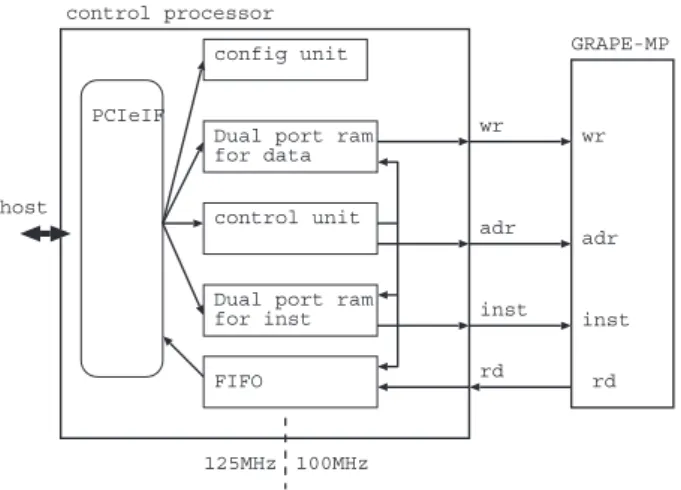
Figure 3: Block diagram of the control processor.
The control processor writes data to GRAPE-MP through the write port with 64 bit. We need two clocks to write one quadruple-precision value. We also need two clocks to read out one quadruple-precision value from BMout.
The control processor writes instructions through the inst port. Instructions are broadcasted to all PEs so that all PEs execute the same instruction. The instruction consists of two parts: (1) a control code for floating-point units in PE and (2) a control code for BMin and BMout. To write quadruple-precision values to a given PE, we first write the values to BMin, and then we instruct PEs to load the values from BMin with the mask code that specifies the given PE. To read quadruple-precision values from a given PE, we need a similar procedure such as following. First we instruct PEs to write the values to BMout with the mask code and then we read the values from BMout.
The GRAPE-MP chip is implemented on a Nextreme eASIC NX2500 chip with 90nm design rule. I/O ports on the chip are SSTL-II 100MHz. The operation frequency of the GRAPE-MP chip is also 100 MHz. Thus, the peak performance of GRAPE-MP is 2(operations)×6(PEs)×100(MHz)=1.2×10⁹floating-point operations per second. Note that it is not always possible to issue two operations (i.e., multiply and add) simultaneously.
2.4. Control processor
Figure 3 shows the block diagram of the control processor. It consists of the PCIe interface unit, the configuration unit, two dual port ram (DPRAM) blocks to store the data and the instructions from the host computer, FIFO to store data from GRAPE-MP, and the control logic for these units. Main functions of the control processor are to supply instructions and data, to receive data from GRAPE-MP, and to communicate with the host computer.
The control processor is implemented in an FPGA chip (EP1AGX60EF1152) made by Altera corporation. The logic units in the PCIe side and the GRAPE-MP chip side operate on different clocks (125MHz for the PCIe side and 100MHz for the GRAPE-MP side, the same as the clock in the GRAPE-MP chip). Thus, the transfer speed between the control processor and GRAPE-MP is 800MB/s.
Data from the host computer is first stored in DPRAM and then transferred to BM in the GRAPE-MP chip through the wr-port with the address. When data is set into a resister of a PE from BM, the corresponding instruction once stored in DPRAM is also sent to the GRAPE-MP chip. Also, DPRAMs are also used to store instructions and data required in a program execution.
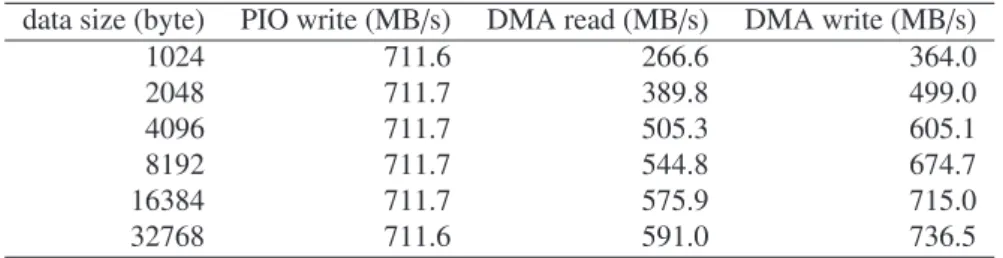
For the PCIe interface logic unit, we use the GPCIe IP core from KFCR[8]. We use PCIe x4 (theoretical peak speed is 1GB/s) though x8 is also available. The transfer speed of PIO write (with write combining), DMA read and DMA write measured by the GRAPE-MP board is listed in Table 1. It achieves more than 700MB/s for PIO write and DMA write, which is more than 70% of the theoretical speed. Since PIO write is faster than DMA read in all data size, we use PIO write and DMA write in the current implementation.
data size (byte) PIO write (MB/s) DMA read (MB/s) DMA write (MB/s) 1024 711.6 266.6 364.0 2048 711.7 389.8 499.0 4096 711.7 505.3 605.1 8192 711.7 544.8 674.7 16384 711.7 575.9 715.0 32768 711.6 591.0 736.5
Table 1: The transfer speed measured by the GRAPE-MP board with PCIe x4 link.
FPGA
GRAEP-MP chip config
unit DCDC
PCIe x8(x4)
Figure 4: Block diagram of the GRAPE-MP board.
2.5. Processor board
Figure 4 shows the block diagram of the MP board. It is a standard PCI short card onto which a GRAPE-MP chip, a control processor, the configuration unit, and DCDC units (1.2V for FPGA core, 1.3V for the GRAPE-chip core, 1.8V for IO) are integrated. The interface between the control processor and the host computer is PCI Express x 8 link. At the current implementation, we use PCIe x4 link. Figure 5 shows the picture of the GRAPE-MP board.
3. Programming the GRAPE-MP System
To program the GRAPE-MP, we extend our domain specific language (DSL) compiler developed for many-core accelerators [9]. From a program written in this DSL, our compiler generates instructions (hereafter a kernel) for GRAPE-MP. For example, with the double exponential integral scheme [10], the integral in Eq. (1) is reduced to a
LMEM x, y, cnt4; BMEM x30_1, gw30; RMEM res;
CONST tt, ramda, fme, fmf, s, one; z = x30_1*cnt4;
d = -x*y*s-tt*zz*(one-x-y-z)+(x+y)*ramda**2 +
(one-x-y-z)*(one-x-y)*fme**2+z*(one-x-y)*fmf**2; res += gw30/d**2;
Figure 6: DSL program for our compiler system to compute the integral in (1).
following summation: I= i j k G(zk) D(xi,yj,zk)2 , (2)
whereG(zk) is the double-exponential kernel variable.
In our DSL, we only define the inner-most loop for Eq. (2) as presented in Figure 6. First four lines define input/output variables and constants in the integral. For instance,resis a partial sum for the integral and gw30 represents an input variable allocated in the broadcast memory. See Nakasato [9] for detailed descriptions of our DSL.
4. Performance of the GRAPE-MP System
In this section, we present the measured performance of GRAPE-MP for two applications. First one is the numer-ical evaluation of the integral given by Eq. (1). A second problem is theN-body simulation that requires computation of forces betweenNparticles. See Figure 6 in [9] for the actual code for our DSL compiler system.
4.1. Integration of Feynman loop on the GRAPE-MP
The source code to compute Eq.(1) is written in 9 lines. The code includes definitions of variables that is denoted as LMEM, BMEM and, RMEM (Figure 6). It contains 24 add/multiply operations and 1 division operation. With the GRAPE-MP, we need 16 instructions to compute a division using a combination of the RSQ unit and the Newton-Raphson iteration. Accordingly, we need about 40 instructions to execute the code given in Figure 6. Our compiler generates the kernel with 41 instructions where we require one additional instruction to resolve a read conflict.
The integral in Eq.(1) is computed as a triple nested loop. We use the GRAPE-MP to perform the inner-most summation forzgiven byxandy. The GRAPE-MP can calculate 4×6 =24 combinations of xandyin parallel. We repeat the execution of the kernel for necessary times and we do the outer summations forxandyon the host computer using the DD emulation.
In Table 2, we present the elapsed time to evaluate the integral in Eq.(1) with different values ofNfor GRAPE-MP running at 100 MHz. The measured calculation speeds are 0.314, 0.425, 0.491, and 0.532 Gflops forN =96, 192, 384 and 768, respectively. Here, we assume the total number of QP operations is 41N3(one division is equivalent to 16 operations). For comparison, on Core2Duo E8400 running at 3.0 GHz, the calculation withN =384, it took 14.7 and 85.9 sec with the optimize option “-O2” and “-O0”, respectively. Note that this is a result with using a single core of E8400. The computing speed of the GRAPE-MP is roughly 3 times faster than the DD emulation on the CPU.
Nakasato [5] implemented the DD emulation scheme on GPU and GRAPE-DR and obtained about 15 Gflops on ATI Radeon HD 5870. Even though the effciencty for the DD emulation on GPUs is still not high, the performance of the GPU is better than the GRAPE-MP board. However, the performance per watt of the GRAPE-MP board is not so bad compaired to GPUs since the power consumpsion of the GPU is∼180 watt.
integral point(N) 96 192 384 768
elapsed time(sec) 0.115 0.683 4.723 34.9
speed (Gflops) 0.314 0.425 0.491 0.532
Table 2: The measured elapsed time and speed to compute the integral in Eq.(1) with different integration points.
4.2. N-body simulation on the GRAPE-MP
N-body simulation is widely used to study a self-gravitating particle system in astrophysical objects such as galaxy formation, globular cluster dynamics, planetary formation, and planetary ring dynamics. In theN-body simulation, the equation of motion of a particleiin a system withNgravitating particles is described as
d2xi dt2 = N j=1;ji Gmj(xi−xj) (r2 i j+2)3/2 (3)
where xiis the position of particlei,ri j is the distance between particlesiand j,mjis the mass of particle j, andG
is the gravitational constant, andis the artificial potential softening used to suppress the divergence of the force at
ri j→0. These equations are integrated with an appropriate integration scheme.
The most time consuming part of theN-body simulation is the part of force calculation which is the term on the right-hand side of Eq.(3), since the calculation cost isO(N2). Therefore, the traditional GRAPE systems have been designed to calculate the force calculation between the particles, whereas other calculations like the time integration are done by the host computer. Following the conventional way of the implementation ofN-body simulation on the GRAPE system, our implementation on the GRAPE-MP is as follows.
1. Set up the GRAPE-MP board. The instructions used for the force calculation are sent from the host and are stored in the memory on the FPGA.
2. The data (mass, position, etc) of field particles which exert gravitational forces on a particle (so-called j -particles) are sent from the host and is stored in the memory on the FPGA.
3. The data of particles which recieve the forces (so-calledi-particles) are sent from the host to the registers of the PE in the GRAPE-MP chip.
4. The registers in the PEs used for accumulation of forces are cleared by sending constant (zero) data and the instruction from the host.
5. Calculate the force fori-particles. The start signal from the host is sent. Data of a j-particle and the instructions are subsequently sent from the FPGA to the GRAPE-MP chip until all j-particles stored in the memory are sent, so that the forces of thei-particles exerted from all j-particles are calculated. The data of a j-particle are put on the BM memory, and are broadcasted to all PEs.
6. The host gets back the calculation results from the PEs.
7. (3)-(6) are repeated until the forces on alli-particles are calculated. 8. Back to (2).
With the current implementation, the GRAPE-MP board has 24 logical pipelines (6 PEs×4 logical pipelines in a PE), and the maximum number of particles stored in the memory in the FPGA is 1984 particles.
We present the measured performance of the GRAPE-MP system for the 2nd order leapfrog scheme with constant timestep. We integrated the Plummer model with equal-mass particles, and used the standard unit [11] in which
M=G=−4E=1. Here,MandEare the total mass and energy of the system. The softening parameter is constant =0.03125. We changed number of particles from 16 to 1984. We integrated the system for more than one time unit and measured the CPU time on the host, excluding the time of the initial setup (making the initial data of particles, etc). We also measured the elapsed time for key functions in order to analyze the performance. On the host calculation, variables with DD precision were used with the QD/DD emulation scheme [12]. For the host computer, we used a PC with Intel Core2 quad Q6600 CPU, nVidia nForce 780i chipset, and 8GB of DDR2-800 memory.
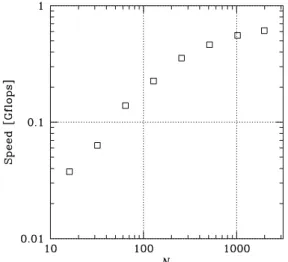
Figure 7: The measured performance of the GRAPE-MP system in Gflops.
total (sec) send jparticles send zero sendiparticles calculate and receive data
38.61 2.223 0.3422 2.4983 33.47
Table 3: Elapsed time. All communication functions include the conversion of the format used in the GRAPE-MP. “send zero” is to clear the registers of PEs used for the accumulation of the forces. Total particle-step is 524288.
Figure 7 shows the calculation speed in Gflops for the runs. The measured peak speed is 0.505 Gflops forN =
1984 when we use 33 operations for one particle interaction. This is about 42 % efficiency of the theoretical peak performance of 1.2 Gflops. The reason for the loss of the efficiency is that the current instructions for the force calculation allow only one operation per clock, although two operations can be executed at the same time. The performance can be improved if we use the appropriate instructions.
The operations used here (33 operations) are the actual operation counts executed on the GRAPE-MP, which are smaller than that usually used operation counts (38 operations [13]). The reason is that the RSQ unit in the GRAPE-MP can reduce the operations needed for the force calculation. This is more effective in GPUs which reduce down to 20 operations ([5], [14]). As for a reference, if we use these operation counts, we have the peak speeds of 0.581 Gflops (38 operations) and 0.305 Gflops (20 operations), respectively. In either case, the measured performance of the GRAPE-MP is more than 10 times faster than that of the host of which the performance with the DD emulation library is 0.021 Glops.
Table 3 lists elapsed time of each step when we integrate the system withN=1024 for one time unit. This table shows that about 10% of the total elapsed time is used for the communication between the host and the GRAPE-MP. Note that it includes the time to convert the DD format from the XD format, and the XD to the DD format. This conversion seems to consume significant time, because the time for “send zero”, which shows the pure transfer time, is about 1/10 of the time of other types of the communication.
We also construct a simple performance model of thisN-body simulation on the GRAPE-MP. Following previous studies (e.g., [15], [16]), the calculation time per one particle-step can be given as
T =thost+Ntf orce/NPE+tcomm,
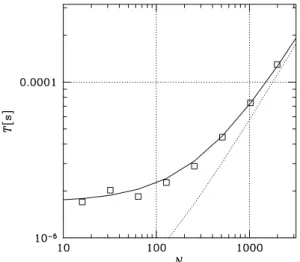
Figure 8: The measured calculation time per one particle-step and the performance model. The solid line is the performance model with the measured time oftj,ti,tf, and the dotted line is that of the ideal case.
the GRAPE-MP, and the time of the communication between the host and the GRAPE-MP, andNPE=6 is the number of PE in the GRAPE-MP chip. Since the GRAPE-MP chip operates 100MHz clock and the number of operation is 33, we can estimatetf orce =3.3×10⁻⁷(sec). This yields the time spent on the force calculation on the GRAPE-MP
astcalc =29.5(sec), and the time required to receive data from the GRAPE-MP to the host can be estimated as about
4 (sec).
tcommis given as
tcomm=tj+ti+tzero+tf,
where the first, second, third, and forth terms are estimated from the time spent on (2), (3), (4), and (6) in the procedure described before. Note that these terms include the time for data conversion. From table 3 and the time receiving data estimated above, we can settj=4.25×10⁻⁶,ti=4.75×10⁻⁶,tzero=0.65×10⁻⁶, andtf =7.6×10⁻⁶.
Also, we estimatethost=4.5×10⁻⁸, which is negligible compared to the other terms.
This performance model is plotted in Fig. 8 with the measured calculation time per one particle-step. We can see that they are in good agreement. This figure also shows that the calculation speed is limited by the speed of communication (mainly, data conversion) for smallN(N <100). We also plot the ideal case in which the time for data conversion is negligible (i.e.,tj∼ti∼tf ∼tzero). This becomes possible if data conversion is done in the FPGA,
and it improves the performance for smallN.
We also measure the power consumption of the GRAPE-MP board. To do so, we used the PCI express extender made by KFCR [17], which enables us to measure the power consumption of the board separated from that of the host. The total watt of the GRAPE-MP board is 9.64 Watt at idle, and 12.64 Watt at the calculation, which is much lower compared to GPUs.
5. Summary
Since there are a number of numerical calculations cannot be done in double-precision operations, the need for higher precision arithmetic operations is growing. We described the design and performance of the GRAPE-MP system which is an SIMD accelerator board for quadruple-precision operations. The GRAPE-MP system is a pilot study to investigate the feasibility of a hardware implementation of a quadruple-precision floating-point unit. With our
two target applications (the numerical evaluation of a Feynman loop integral andN-body simulation), the achieved performance of the GRAPE-MP is roughly 50 % of the theoritical peak performance. We show that the GRAPE-MP system is effective to speed-up the numerical evaluation of the Feynman loop integral and other problems for the first time. In future, we will extend the GRAPE-MP system in two directions: (1) implementing multi-chip or multi-board system and (2) implementing more number of PEs on one chip. Furthermore, if we implement the reduction network unit and external memory which are implemented in the GRAPE-DR board, the GRAPE-MP system will be suitable for wider range of applications such as large matrix computation. In either ways, we believe that the GRAPE-MP system will be used for a lot of problems.
[1] F. Yuasa, E. de Doncker, J. Fujimoto, N. Hamaguchi, T. Ishikawa, Y. Simizu,Precise Numerical Evaluation of the Scalar One-Loop Integrals with the Infrared Divergence, in: Proceedings of the ACAT workshop, 2007, pp. 446–449.
[2] P. Wynn,On the convergence and stability of the epsilon algorithm, SIAM Journal of Mathematical Physics 3 (1966) 91–122.
[3] D. Knuth,The Art of Computer Programming vol.2 Seminumerical Algorithms, 1st Edition, Addison Wesley, Reading, Massachusetts, 1998. [4] T. Dekker,A Floating-Point Technique for Extending the Available Precision, Numerische Mathematik 18 (1971) 224–242.
[5] N. Nakasato, Application of many-core accelerators for problems in astronomy and physics, in: 13th International Workshop on Advanced Computing Analysis Techniques in Physics Research, 2010.
[6] J. Makino,Specialized Hardware for Supercomputing, SciDAC Review (2009) 54–65.
[7] Y. Hida, X. Li, D. Bailey, Algorithms for Quad-Double Precision Floating Point Arithmetic, in: Proceedings of the 15th Symposium on Computer Arithmetic, 2001, pp. 155–162.
[8] K & F Computing Research Co.,PCI Express IP core GPCIe,http://www.kfcr.jp/gpcie.html.
[9] N. Nakasato, J. Makino,A Compiler for High Performance Computing With Many-Core Accelerators, in: IEEE International Conference on Cluster Computing and Workshops, 2009, pp. 1–9.
[10] M. Mori,Discovery of the Double Exponentioal Transformation and Its Developments, Publications of the Research Institute for Mathematical Sciences 41(4) (2005) 897–935.
[11] D. Heggie, R. D. Mathieu,Standardised units and time scales, in: The Use of Supercomputers in Steller Dynamics, 1986, pp. 233–235. [12] Y. Hida, X. S. Li, D. H. Bailey,Library for Double-Double and Quad-Double Arithmetic.
[13] M. S. Warren, J. K. Salmon, D. J. Becker, M. P. Goda, T. Sterling, G. S. Winckelmans, Pentium pro inside: I. a treecode at 430 gigaflops on asci red ii. price/performance of $50/mflops on loki and hyglac, in: Supercomputing ’97, 1997.
[14] T. Hamada, K. Nitadori, 190 tflops astrophysicaln-body simulation on cluster of gpus, in: Supercomputing ’10, 2010.
[15] J. Makino, T. Fukushige, M. Koga, K. Namura,GRAPE-6: Massively-Parallel Special-Purpose Computer for Astrophysical Particle Simula-tions, Publ. Astron. Soc. Japan 55 (2003) 1163–1187.
[16] T. Fukushige, J. Makino, A. Kawai,GRAPE-6A: A Single-Card GRAPE-6 for Parallel PC-GRAPE Cluster Systems, Publ. Astron. Soc. Japan 57 (2005) 1009–1021.