UPTEC IT 14 008
Examensarbete 30 hp
Juni 2014
A Modular Framework Approach
to Regression Testing of SQL
Teknisk- naturvetenskaplig fakultet UTH-enheten
Besöksadress: Ångströmlaboratoriet Lägerhyddsvägen 1 Hus 4, Plan 0 Postadress: Box 536 751 21 Uppsala Telefon: 018 – 471 30 03 Telefax: 018 – 471 30 00 Hemsida:
http://www.teknat.uu.se/student
Abstract
A Modular Framework Approach to Regression
Testing of SQL
Oskar Eriksson
Regression testing of SQL statements in database management systems is a time-consuming process that requires much developer effort. Adding and updating test cases is tedious and validating test case results cannot be done without considering database state. These problems can lead to fewer test cases being used, likely affecting test coverage and the quality of testing negatively. Therefore, it is important to automate and reduce the required workload for this kind of testing. This work proposes a framework for minimizing the required developer effort for managing and running SQL regression tests through a modular framework design. Modularity is achieved through well-defined interfaces and makes it possible to customize large parts of the framework functionality, such as the user interface and test execution, without affecting the rest of the system. While the extensibility is the main result of the thesis work, the default component implementations offer some alleviation of developer effort compared with other existing tools. However, more advanced component implementations should be a high priority for future users, as some usability limitations still exists.
Tryckt av: Reprocentralen ITC ISSN: 1401-5749, UPTEC IT 14 008 Examinator: Lars-Åke Nordén Ämnesgranskare: Tore Risch Handledare: Ruslan Fomkin
Acknowledgements
This master thesis is a result of a project conducted in collaboration with Starcounter AB, a company developing the Starcounter database management system at the time of this thesis work. The work has been carried out at Starcounter’s office in Stockholm, Sweden during the spring of 2014.
Special thanks to Ruslan Fomkin for supervising the work and providing crucial guidance and support throughout the entire thesis work.
I would also like to thank my reviewer Tore Risch at Uppsala University for additional feedback and help with the thesis.
Contents
1 Introduction ... 1
2 Software and Database Testing ... 3
2.1 Testing in Database Management Systems ... 4
3 Problem Statement ... 8
3.1 Goals ... 8
3.2 Use Case Scenarios... 9
4 Method ... 11
4.1 Study of Literature and Existing Tools ... 11
4.2 Development Methodology ... 12
4.3 Evaluation Methodology ... 12
5 Existing Approaches to DBMS Testing ... 13
5.1 Related Research ... 13
5.2 Existing Tools for DBMS and SQL Testing... 15
5.3 Comparison of SQL Testing Tools ... 16
5.3.1 Input and Output ... 16
5.3.2 Data Population ... 18
5.3.3 Result Handling ... 19
5.3.4 Discussion ... 20
5.4 Conclusion ... 21
6 Proposed Prototype ... 23
6.1 Requirements ... 24
6.2 Modular Framework Components ... 25
6.2.1 InputHandler ... 27
6.2.2 SQLTestCase ... 28
6.2.3 TestExecutor ... 29
6.2.4 OutputHandler ... 29
6.3 Prototype Component Implementations ... 30
6.4 The Internal Storage... 32
6.5 Using the Framework API... 32
6.5.1 Running Tests ... 32
6.5.3 Using Custom Components ... 34
6.5.4 Internal Storage API ... 35
7 Evaluation and Discussion ... 36
7.1 Architecture and Design... 36
7.2 Implementation ... 38
8 Limitations and Future Work ... 41
8.1 The Prototype Components ... 41
8.2 Core Framework Extensibility ... 42
8.3 Integration with Existing Tools ... 43
9 Conclusion ... 44
Bibliography ... 46
Appendix A ... 49
A.1 Tools Comparison Questions ... 49
Appendix B ... 50
B.1 Interfaces and Abstract Classes ... 50
B.2 Methods ... 51
1
1
Introduction
Testing of database management systems (DBMSs) is just as important as testing of any software, but regression testing SQL statement execution in a DBMS can be problematic for several reasons. For example, the database must be in the same state at the start of each test, the state of the database must be considered when verifying the correctness of test results, and test cases may need to be executed in order [1]. This can make adding and updating SQL test cases time-consuming and the process of regression testing can require a lot of developer effort. Furthermore, existing tools for regression testing does not provide optimal user interface and are lacking extensibility. This is likely to impact the number of test cases, test coverage and the quality of tests negatively, as much work must be spent on managing test cases. Minimizing the required developer effort for managing and running regression tests is therefore a high priority.
This thesis work will attempt to solve this problem by developing a framework prototype that will reduce the required workload, and attempt to automate as much of the testing process as possible. Like many other similar tools, regression testing using this framework will be carried out by executing tests and comparing results with previously validated expected results, to decide if the test failed or passed. However, this prototype framework will be an attempt at minimizing the effort required for adding, updating and running tests as much as possible, by providing an improved user interface and robust extensibility for further improvements and customization.
This will be solved using a modular framework design, providing support to switch and update framework components without affecting the rest of the framework. Simple default implementations will be included in the framework, but more advanced functionality can be implemented through the creation of new component implementations.
The rest of the thesis is organized as following:
Section 2 contains a description of the purpose and methods of software testing.
Section 3 presents a description of the problem to be solved and the goals of the project
Section 4 describes the methods used to solve the problem throughout the thesis work
Section 5 contains a description of existing tools for DBMS testing and a detailed comparison between four of these
2
Section 7 evaluates the proposed solution in regards to usability and extensibility of the design and implementation
Section 8 discusses the limitations of the solution and gives suggestions for future improvements
3
2
Software and Database Testing
Testing can be an efficient way of discovering faults and other limiting characteristics of any software, and even though testing can never prove the correctness of software, it can be an effective way to minimize errors [1]. It is also the most commonly used method for validating software [2]. Sommerville [3, p. 206] clarifies this by summarizing the goals of testing into two points; to demonstrate to both developers and users that a piece of software fulfills its requirements, and to find incorrect or undesirable behavior, i.e. software faults. Furthermore, testing during the development process can help with not only finding errors or bugs, but also to make sure that the implementation stays true to the software specification and requirements during the entire course of software development [4]. Software testing can be done in a number of different ways and at different levels in the software. A few of the different testing methods are listed below [3, pp. 42, 211-221]:
Unit testing – Verifies the functionality of specific parts of the code, usually individual functions or methods. Tests are run in isolation from the rest of the system, so faults should be easily identifiable in the component under test. Unit tests can also form a sort of executable design specification that will always be up to date if tests are run regularly. [5]
Component testing – Verifies that the interfaces of components, modules and composite components of a system behaves according to the specification. This type of testing can find faults that are not detectable in unit testing, but arises as components are combined and used together, because of incorrect interactions.
System testing – Verifies the functionality and behavior of a complete system, integrating all components. Component compatibility and interactions through interfaces are tested. System testing overlaps with component testing as both are focused at testing interfaces, but system testing exercises the entire system, not subsets of the system components. System tests should validate the functionality of system behavior emerging when all components are used together.
Acceptance testing – Verifies that a complete system meet the specifications and fulfills the requirements of the users. This type of tests may reveal problems in the requirements specification. For example, some needs of the users may have been neglected in the specification, or the performance of the software may not be acceptable. This type of testing often uses real data supplied by the customer, not simulated test data.
4
All of these testing methods can be used to perform regression testing. Regression tests are performed by running a set of test cases, for example unit tests, after a change has been made to a system. If the test cases were successfully executed before the change was made, then by passing the regression tests the developer can be confident that no functionality under test has been broken as a result of the modification. If the regression test cases cover all the functionality of a system, this will make sure that a change has not introduced new bugs, re-introduced old bugs (regressed), or changed the behavior of the software in unexpected ways [3, p. 223]. Regression testing is an important part of developing any type of software since modifications to a system or subsystem, such as updates, bug fixes, or enhancements are unavoidable [6].
There are many useful techniques and tools that can be used for regression testing. Many unit testing frameworks provide automation that helps carry out regression testing of unit tests. So called xUnit-based frameworks are often used for this, especially in the extreme programming development methodology [3, pp. 65-66]. Examples of xUnit-based frameworks include JUnit [7], a popular Java unit test framework, and the NUnit [8] framework for .NET. These are just two of many similar tools meant to simplify unit testing. They allow the developer to easily create a number of unit test cases, which can then be run as a test suite when needed, effectively serving as regression tests.
Regression testing can be performed at different levels of testing (unit, component, system, etc.) and JUnit and NUnit are just two examples of tools that can be useful, as many other tools exist for different testing levels. However, most of the testing techniques used are designed for traditional imperative or object-oriented languages [1] and are not suited for testing database management systems or applications.
A popular approach to automate testing is by running tests on a build server [9] [10]. A build server can provide a stable, isolated environment for coordinating distributed development of code (avoiding local machine differences when building solutions), as well as providing automated regression tests. As such, it helps with alleviating some of the workload of testing, by automating the execution of test runs.
2.1
Testing in Database Management Systems
Testing is important for any type of software, including database management systems [11]. Today’s DMBSs consist of many software components and layers, and they are increasingly complex. Therefore,
5
testing is increasingly important for DBMS development [12] [13]. Additionally, the increasing number of device utilizing Internet-based systems has led to increased focus on DBMSs performance, illustrating that testing must not only examine the correctness of the behavior, but also test the amount of concurrent work load that will be handled by a DBMS [14]. However, that area of testing is beyond the scope of this thesis work.
Another aspect of DBMS testing involves verifying the correctness of executed SQL statements. The SQL language provides an interface to all the DBMS functionality [15]. It can be very useful in testing, as SQL statements are relatively simple and short, providing simplicity, while still providing the functionality of complex queries and data manipulation statements. The complexity is related to the fact that a single statement not only requests the work (retrieving some results, or updating the database data), but also defines how results are structured. For example, different queries may request the same data entries, but with different properties, sorting, filters, etc. As such, SQL execution involves many different system components [16, p. 529], and since changes to a component can propagate through the system, regression testing SQL execution is especially important.
One of the difficulties in SQL testing lies in the fact that the state of the database will greatly influence the result of a test. As such, the database state must be controlled at the start of every test run. Additionally, if a test case alters the state of the database in any way, it can affect the results of all later test cases. In this case, some kind of ordering must be enforced to keep the results consistent. This is one of the reasons why the unit testing tools mentioned above do not work for regression testing of SQL statements, as they assume that test cases can be executed in any order without changes to the result. This problem is not limited to testing of DBMSs, but also applies to DBMS application testing [12] [1]. A common way of regression testing SQL functionality is to issue queries to a test database and compare the results returned by the DBMS with some expected results, often generated beforehand [17] [13]. Depending on the type of SQL statements used for testing, the state of the database may also need to be inspected to deduce test results. As an example, a successful execution of an UPDATE statement does not prove that a value was actually updated. Knowing the expected results beforehand is another non-trivial issue with DBMS testing today, but there are a few different approaches to achieve this.
One approach is to execute the queries on other vendors’ DBMSs and compare the resulting output and database states (of course the initial state of the databases must be the same). This can be very hard in practice, as only SQL functionality that exists on all DBMSs used can be tested (i.e. no new SQL features
6
or vendor-specific SQL dialect constructions) [18] [13], and there may also be difficulties with the actual comparison of the results as in Slutz [19], where character string handling and numeric type coercion proved problematic. However, the Sqllogictest (SLT) test harness [20] uses this approach and works by comparing results between different DBMSs. Although, the usefulness of SLT for SQL regression testing is limited, as discussed on the official website:
“In order to maximize the portability of scripts across database engines, it is suggested that test scripts stick to the basic CREATE TABLE syntax. Use only a few common data types such as:
INTEGER
VARCHAR(30)
REAL
Remember, the purpose of Sqllogictest is to validate the logic behind the evaluation of SQL statements, not the ability to handle extreme values. So keep content in a reasonable range: small integers, short strings, and floating point numbers that use only the most significant bits of and a 32-bit IEEE float.” [20]
Another approach, which will be used in this work, is the use of a so-called baseline tool. Such tools take as input a set of test cases, execute them in a DBMS, and then store the results. The results are then validated by manual inspection and if accepted they will be used as expected results and automatically be compared with results in coming test rounds. These results are called the baseline [17] [21, p. 120]. This is a common approach to SQL regression testing, used by many DBMS developers today [22] [23]. However, if the database is large, it can be non-trivial to validate test case results by inspection as these can be very large as well. For example, manually checking that every result row of a test query is correct when the result set has several hundred rows is time-consuming.
The expected results used in a baseline tool can be serialized and stored in a number of ways to allow for quick comparisons. One alternative used by Slutz [19] is to calculate a checksum over all values of a returned result. In this way, a regression test run will calculate a checksum from test run results and compare it to the expected checksum. The main drawback of this approach is that a checksum mismatch only proves the existence of an error, not which values of the result are incorrect [17]. Also, as checksums can only represent a finite range of values, two matching checksums cannot be guaranteed to correspond to the same results. Another option is to store the results in a way so that the contents of
7
the result set is preserved and can be used to deduce the exact values that changed, with the drawback of slower comparisons. Examples include XML-files [17] or string representations in simple text files [22]. Baseline tools can be quick and easy to use when new functionality is to be tested, but in general, baseline tool test cases require a lot of maintenance as development progresses [17]. Other drawbacks include the already mentioned fact that the database must be in exactly the same state and contain exactly the same data for every test run in order for the baseline to be valid.
Researchers have attempted to develop tools that can be used to automate the process of regression testing DBMS by automatically populate databases, generate SQL test queries, and verify results. This research is presented along with other existing tools in Section 5.
8
3
Problem Statement
A problem with testing SQL in DBMSs lies in the fact that the state of the database must be considered when deducing testing outcomes, as the state will determine the test results and may need to be controlled. Of course, almost all applications contain some kind of state, so this problem is not limited to DBMS testing. It is however especially hard to avoid state modification in SQL testing, since many SQL statements perform some kind of state modification. [12]
Regression testing also requires knowing expected results of all test cases beforehand in order to verify results. In the case of regression testing SQL statements in DBMSs, not only are expected results for every test case needed, but the data in the database must always be the same at the start of every test run, otherwise the expected results will not stay consistent. Furthermore, the results of query statements are sets and differences in result set sorting can be correct or incorrect depending on the test case statement, making the comparison with expected results even more complicated.
These considerations lead to significant developer effort being required for adding and updating test cases. This is problematic as it can lead to new test queries rarely being added, and in turn lead to some DBMS features not being thoroughly tested, which could become a serious issue. Therefore it is vital that adding and updating tests can be done efficiently and that as much of the testing process as possible is automated.
The proposed solution of this work is to reduce the workload of managing and running regression tests in DBMSs to a minimum by developing a new baseline test framework prototype. The framework must provide SQL test developers with a fast and easy user interface for adding, updating and running regression tests of SQL test cases. It should also automate the process of generating expected results as much as possible, and provide extensibility for further customization, improvements and enhancements.
3.1
Goals
In order to create a robust framework prototype for solving the problem it will be necessary to first research the current state of DBMS testing and evaluate existing tools used to regression test SQL. This will help to identify requirements and suggestions for the prototype framework solution. Several questions must also be considered for the design of the prototype:
9
How can the inspection and establishment of the expected results be simplified in practice?
How can the number of required steps for running regression tests and managing test suites be reduced?
How can test cases be simple to create and update while still robust enough to support verification of more than just SQL statement results?
In general, how can the usage of this kind of regression testing tool be simplified?
Knowledge gained from this study will then be used to design and implement the framework prototype, with goals of high usability and minimal required developer effort when adding, updating and running test cases. Finally, an evaluation of the proposed prototype with regards to extensibility and required developer effort will determine how well the problem has been solved, and identify fields of further improvements.
3.2
Use Case Scenarios
Several different use case scenarios should also be supported by the framework prototype, in order to make it a robust testing tool and simplify the process of regression testing:
Build server functionality – A build server can function as an isolated environment for building solutions, but can also provide a good testing environment. The framework should support build server specific functionality to help automate testing, by providing two different modes of execution; one for running on a local machine and another for running on a build server. The behavior of the framework should be appropriate for the type of machine on which it is run, which can be specified through a user-configurable setting. Running regression tests on build servers can help automate the testing process, and supporting it is therefore a high priority.
Adding new test cases – Adding new test cases should be simple and fast in order to minimize required developer effort. A user should be able to get generated results for new tests without having to wait for a regression test run of all existing test cases to complete. An example of a solution is to ignore already existing test cases when new test cases are run. Then only new tests will be executed and results will be generated.
Debugging mode – The framework prototype should support a mode for debugging purposes, providing additional debugging tool functionality for failed test cases, and allowing users to cancel test runs when failed tests are encountered.
10
Different result comparison methods – Test case results should be able to be verified using different comparison methods. This should be supported through an extensible design, so that the verification methods can be changed in future work. The prototype should, by default, provide comparison of results formatted as readable strings or results stored as checksums.
11
4
Method
The methods used in this thesis project were chosen to allow for efficiency and adaptability of evolving requirements and obstacles, to ensure that the outcome of the thesis work would be relevant and allow for a detailed analysis of the work.
4.1
Study of Literature and Existing Tools
To gain knowledge about the nature of DBMS testing, the first phase of the thesis work consisted of researching scientific literature on the subject, as well as examining existing tools used today. This provided a basis for the thesis work to be built upon.
The literature study consisted of mostly scientific articles from online literature databases, as no suitable books describing DBMS testing was found. SCOPUS, IEEE Xplore and Google Scholar were used as primary literature databases for finding literature. Search strings consisted mostly of combinations of “DBMS”, “SQL”, “regression”, “testing”, and “framework” and through references in relevant literature additional resources were found.
While the literature study helped establish a foundation and get a basic understanding about the state of DBMS testing in general, literature regarding the use of regression testing tools for SQL was very sparse. The study of existing tools and frameworks complemented the literature study by giving more specific hands-on details about regression testing solutions, while also providing insights on different alternatives for a solution in this work.
As a previous framework used for regression testing of SQL already existed at Starcounter, it was included in the evaluation of existing tools, as it would also give further insight of any needs and requirements of Starcounter. Three other publicly available tools were found by examining testing methods and tools used by other DBMS vendors (MySQL, SQLite, and PostgreSQL). A set of questions and design aspects was established to be used in the comparison, to illustrate similarities and different approaches for minimizing developer effort and ease of use. These questions are listed in full in Appendix A. Knowledge gained from this can later be used, in conjunction with the problem description and discussions with the supervisor, to establish a set of requirements for the prototype framework.
12
4.2
Development Methodology
The framework prototype design will be derived from the knowledge gained from the literature and tools study, as well as from discussions with the supervisor. The framework prototype will be developed in .NET using the Visual Studio 2012 IDE.
Since the development phase will be short (about 6 weeks), no specific well-established software development methodology will be used, as it is likely to result in added overhead. Instead, a kind of agile approach is going to be used, where only simple features of limited functionality are designed and implemented initially, and later these will be refactored and improved upon as the understanding of the problem grows, until they contain all the necessary functionality required. This should be a good fit for the project, as requirements are expected to evolve throughout the design and development phases. Regular meetings and discussions with the supervisor will also help with the development phase, as problems that emerge during implementation should be able to be dealt with quickly, and any uncertainties regarding usage of the prototype solution can be discussed immediately.
4.3
Evaluation Methodology
The developed framework prototype will be evaluated with regards to three main aspects; usability, extensibility and similarities or differences to other frameworks and tools. By going through the requirement specification many aspects of usability and extensibility will be examined. Furthermore, the results of the existing tools comparison should prove useful for quick and easy comparisons with the prototype.
The usability aspect will be further analyzed through ordinary usage of the framework prototype, to identify enhancements and find fields of further improvement. Questions like how the required developer effort for adding, updating, running and managing test suites has been minimized or can be further improved will be given extra focus, and also be discussed with the supervisor and future user. The modularity of components and extensibility of the framework will also be considered of extra importance, and evaluated through discussions and source code examination.
13
5
Existing Approaches to DBMS Testing
This section contains an overview of some of the existing tools supporting regression testing of SQL today, but also tools for DBMS testing in general. Proposed solutions in related research are first introduced, followed by a description of other existing tools as well as a detailed comparison of a subset of these.
5.1
Related Research
Most research done in the field of DBMS testing focus on automatic generation of test queries and automatic test database population using either randomness or more complex techniques to yield more relevant test data or queries. Very little research focusing on test result verification exists, although Khalek et al. [13] presents an example of this.
Haftmann et al. [12] have proposed a framework to execute regression testing of DBMS applications more efficiently, by running regression tests in parallel over several machines as well as ordering test cases to minimize the number of database resets needed to keep test case results consistent. This work is motivated by the huge amounts of time and resources that are spent on testing in the industry. Another approach to minimize costs of regression testing is shown by Wong et al. [6], where a technique to minimize the number of regression tests needed to find faults is presented. Here the sheer number of test cases is regarded as the main problem. This work is not related specifically to DBMS testing, but regression testing in general. Also related to this is the work by Bowman [4] where an investigation of the possibility of using mutation testing to evaluate the adequacy of DBMS test suites is made, making it possible to optimize test suites based on this evaluation.
Chays et al. [1] have created a prototype implementation for automatic data population of databases to be used for DBMS application testing, given a database schema and example values. Their focus has been automatic population of meaningful data that still conforms to the constraints posed on the database schema. This is related to the work of Lo et al. [24], where a framework including a database generator called QAGen is presented. QAGen is a “Query-Aware” database generator that takes not only the database schema, but also the test queries as input. The framework also includes tools to help automate test case construction and execution.
14
As mentioned above, research has also been made in the field of query generation. Khalek and Khurshid [2] present a framework that generates valid SQL test queries, with regard to the constraints of the schema. Queries are generated based on only the schema as input and should be easy to use to test any DBMS. Similar work has been presented by Bruno et al. [25] where queries are automatically generated using specified constraints, and by Slutz [19] where huge amounts of SQL queries are randomly generated very quickly. A database schema is the only input to the tool presented in [19], just as in [2]. However, both these tools generate no erroneous queries, which should also be used when testing a DBMS.
There are also tools that generate queries based on grammars. The MySQL Random Query Generator [26] tool is a popular framework that can generate queries based on a specified grammar. However, supplying a grammar that can generate queries with good test coverage is not trivial and a large drawback of this tool. [2]
While automatic data population and query generation are important aspects of automating testing of SQL, utilizing these tools are beyond the scope of this work, but may prove useful in complementing the proposed framework prototype in future work.
The process of automatically verifying the correctness of test results is an important and much less researched area, but still a non-trivial problem. Very few commercial or academic DBMS testing generators can automatically generate expected results of tests [13]. Slutz [19] handles this by executing all generated queries on several different vendors’ DBMSs and comparing the results. Of course, the previously mentioned drawbacks such as only being able to compare common features apply (see Section 2.2). Chordia et al. [17] describe four different approaches that were used to verify queries when testing Entity SQL. Among these is the baseline tool approach mentioned in Section 2.2 (and the chosen approach for this thesis work). Binnig et al. [18] takes a new approach to the problem of result verification by using a methodology where a query is used to generate an expected result, and then a database instance is populated with data, so that if the query is correctly executed, the expected result is returned.
Khalek et al. [13] present in their work a tool for both automatic query-aware database generation as well as automatic test oracle generator. A test oracle is a mechanism used to determine the result of a test by examining output [27, p. 468]. The data population and automatic result verification can be done
15
by only taking a database schema and an SQL query as inputs. Combined with other work in test query generation, this could provide an almost entirely automated test tool for DBMSs.
5.2
Existing Tools for DBMS and SQL Testing
Even though regression testing of DBMSs requires state management, there are plenty of xUnit-based tools like TSQLUnit [28] and PLUTO [29] that provide functionality to unit test DBMS application code. In TSQLUnit every test case is implemented as stored procedures with “test” prefixed in the name. It handles database state changes by executing every test case in a transaction. After the test case has been run the transaction is rolled back to remove any resulting side-effects from the test case execution. PLUTO functions in a similar way but also provides more options for setup and teardown phases for each test.
In the case of pure DBMS testing (not DBMS application testing), many DBMS vendors use the baseline approach previously discussed for verifying the correctness of SQL execution. A few examples of such tools are the Starcounter SQL framework, MySQL test framework [22], PostgreSQL test suite [23], and Sqllogictest [20] test harness:
The Starcounter framework is used to regression test SELECT statements in the Starcounter DBMS. It is written in .NET and uses the Starcounter DBMS .NET integration to populate a database, execute queries and verify the results. It provides the functionality of not only comparing expected and actual results, but also exceptions, execution plans, and more.
The MySQL test framework consists of a set of test cases and programs meant to verify the functionality of MySQL Server. Most of the standard test cases consist of SQL statements, but the framework supports other test language constructs as well.
The PostgreSQL regression test consists of a set of test cases and a program for running them to verify the functionality of the PostgreSQL SQL implementation. It provides the user with the ability to run the regression test both sequentially and in parallel.
The Sqllogictest (SLT) test harness is a program and a set of tests used to verify the correctness of execution of SQL statements by comparing results between different vendors’ DBMSs. SLT is used by SQLite [30], but supports a number of different DBMSs.
16
In contrast to the first three tools mentioned, SLT’s primary focus is not to reduce the required effort of regression testing, but to compare the correctness of SQL execution by comparing results of different DBMSs. As such, it may not, strictly speaking, be classified as a baseline tool. The fact that it is not meant to provide regression testing is reflected in the fact that the user of SLT is recommended to only use common data types like INT, REAL, and VARCHAR (see Section 2.2), to avoid problems with running the same test cases across different DBMSs. However, it is similar to baseline tools in many other aspects. Furthermore, it supports storing expected results for future usage. Combined with only testing a single DBMS, this makes SLT basically work exactly like a baseline framework, even though it is not its main purpose.
Another DBMS testing tool is the SQL Test Suite [31], developed by the National Institute of Standards and Technology (NIST), National Computing Centre Limited (NCCL), and Computer Logic R&D. It is used to verify that SQL implementations conform to the SQL standard specifications. It verifies the results of SQL statements on custom tables against predetermined results, similar to how the above baseline tools work.
5.3
Comparison of SQL Testing Tools
This section contains a detailed analysis and comparison of four of the tools mentioned in the previous section; the Starcounter and MySQL frameworks, the PostgreSQL test suite, and the Sqllogictest (SLT) test harness. Differences and similarities between the tools are presented and advantages and disadvantages of different approaches are discussed. The tools have been evaluated by reading documentation, examining source code, and through actual usage and execution of the tools.
5.3.1 Input and Output
All the tools take files containing SQL statements and some additional information as input. The MySQL test framework, PostgreSQL test suite and SLT test harness generate additional files containing both the test input as well as actual results of a test run as output, to be used as expected results. The reason why the same information is put into different files is because these tools use diff utilities for result comparison, more on that in Section 5.3.3. The Starcounter framework, on the other hand, uses only one file for each set of test cases, containing both test case information provided by the user and
17
expected results. New versions of the file are automatically generated as output during test runs, containing actual results of the last test run. If expected results in input files are outdated or incorrect, these generated files can be used as new input files. The MySQL test framework and PostgreSQL regression test suite also has additional options for input, such as ignoring certain tests, running scripts, etc.
A difference between the Starcounter framework and the other tools is how test files are structured. The other tools use test files containing collections of SQL statements (and SQL results). In the Starcounter framework, test files contain collections of test case declarations. Each such test case has a large set of input parameters like description, statement, literal values, etc. While this allows for clear and fine-grained control of each individual test case, it makes adding new tests harder compared to the other tools, where only a SQL statement is added.
Specifying what tests to run also differs between the Starcounter framework and the other tools. Using the Starcounter framework requires a user application to execute test runs by calling framework API methods from user source code, specifying the name of every test file to run. As such, the developer can control exactly which collection of test cases are run when executing a regression test, but on the other hand, all test files must be manually added to the code in order to run all tests. The user application should also perform the data population needed, using Starcounter’s .NET-integration before and after calling the framework to execute test runs. This approach allows for setup and teardown of data in-between the execution of two different test files. However, this makes it impossible to run a single test from command-line, since data population must be done before executing the test. This approach also requires more effort, as a regression test application must be created.
The MySQL framework, PostgreSQL test suite, and SLT harness instead use scripts to run all specified test files. As there is no need for any API calls to initiate a test run, these tools can be used from command-line, and they also support running of single test files through command-line arguments. This is possible because data population is supported within the test files (see Section 5.3.2). The initial task of setting up a regression test suite should therefore be simple.
In addition to the generated files discussed above, the Starcounter framework, MySQL framework, and PostgreSQL test suite will write any failing test cases, including the actual and expected results, to files at the end of a test run. This simplifies the process of updating outdated expected results, as the absence of correctly executed test results in these files will simplify the inspection of the actual results.
18
5.3.2 Data Population
Regression testing using baseline tools requires the database to be in the exact same state whenever a regression test run is started, as data values must be the same in order for the previously stored generated expected results to be valid. This can be particularly difficult when using the SLT harness for testing of several DBMSs, as the state of databases must be synchronized. Of course, it is still possible to regression test using a single DBMS in SLT. This essentially makes SLT a baseline tool and removes this issue.
While much effort has gone into tools for automatically database population, as mentioned in Section 5.1, the tools compared here, have no such features. As such, test developers have to manually populate the databases with meaningful data values. These tools provide two different approaches to database population.
The MySQL test framework, PostgreSQL test suite, and SLT harness support data population statements inside test files. The MySQL test framework also provides support for dedicated data population files. In these files, SQL statements are used to populate a database before, in-between, or after test cases are run. The Starcounter framework does not support data setup or teardown inside test runs, and the task of data population is put on the user application calling the framework API. However, Starcounter’s .NET-integration makes it possible to populate databases by just declaring database classes and instantiating objects of those classes, making data population very simple while also removing any need for population inside the test files. Since no data population code is in the test files, just like in the MySQL framework, this has the potential of creating more readable test files. A drawback of the Starcounter approach of data population is that setup and teardown (removing test specific data) of data can only be done before and after the execution of all tests in a test file.
The Starcounter approach for populating large databases is simpler and easier extendable than using the other tools. Instead of large collections of SQL INSERT INTO statements, small amounts of .NET for-loops instantiating database classes can be used to insert data, making population code both shorter and more easily updated. However, integration with other automatic data population tools will probably be much simpler when using the other tools, as generated population statements can simply be put in dedicated population files or in front of test cases in test files.
19
5.3.3 Result Handling
All four tools use simple text files as input, containing test cases and expected results. However, two different comparison methods are used to verify the results.
The MySQL test framework, PostgreSQL test suite, and SLT harness all uses a diff utility [32] to compare the contents of the file containing the expected results with the actual results serialized to file during a test run. The diff utility is used to compare the contents of two files and will output any differences between them [32]. As such, it can also be used to find which specific test cases failed. As described in Section 5.3.1 the file containing the expected results also contains all the test case statements from the input test file, making verification a simple matter of serializing all SQL statements and results of a test run to file, and then comparing the files using a diff utility.
SLT also supports the other approach, which is also used by the Starcounter framework. They perform comparisons of results during test result serialization, as a part of the test run. This means that failures can be handled and reported by the tool itself, in contrast to a diff utility handling this afterwards, and makes it easier to customize how the information is presented to the user.
In addition, the SLT harness supports hashing of results if the size of the results surpasses a specified hash threshold. This will avoid the necessity to compare every single value in the results by hashing all values in a result to a single value. This single value can then be compared to verify the correctness of the result. The drawback is of course the same as in [19] where Slutz use a similar approach to verify results. If the expected and actual hash values differ there is no way to get information about which values in the result set caused the mismatch.
Another aspect that must be considered when comparing the results of test queries is the sorting of the result set. If a test result has multiple rows, the sorting of the rows must be consistent with the sorting of the expected results in order to verify the result. The Starcounter SQL framework, MySQL test framework and SLT test harness all handle this by having the user either explicitly use the ORDER BY clause in test queries, or by signaling the tools to sort the results of a test case after execution. None of the tools handle this automatically. The PostgreSQL test suite seems to have a very relaxed approach to this problem. As the same queries are executed in the same data by the same DBMS, they assume that the result ordering will stay consistent across platforms without the use of ORDER BY clauses. They also argue that row ordering of results is another aspect of testing that should be verified, and that more types of query plans will be exercised when not using ORDER BY [33]. However, internal changes to the
20
DBMS can affect the ordering and execution plans in this situation, which can be a significant drawback in regression testing, as expected results will become outdated. Of course, it is still possible to test queries without using ORDER BY or other sorting to test row ordering in the other tools as well.
When testing SQL queries all of the four tools verify query results and error messages. The Starcounter framework also verifies execution plans. This is simple using the Starcounter .NET-integration, as the Starcounter DBMS returns an object containing this information when executing a query. The MySQL framework, PostgreSQL test suite, and SLT harness support this only if the DBMS under test provides statements returning this information (for example, MySQL has the EXPLAIN statement, which returns an execution plan of a given query), as these tools can only verify information that is output as statement results by the DBMS.
Execution plans can be useful for verifying that indices are used correctly and allows for more specified and detailed query execution verification, making tests more useful. But if the DBMS under test does not support any statement returning this kind of information, or if even more aspects of execution are to be verified, extending the verification functionality of either of these tools is hard. None of the tools provide any special support for customizing result verification, and implementing such changes would likely require rewriting or adding large amounts of code in the tools. The same applies to the aspect of automating the result ordering mentioned above. In the case of SELECT queries, the use of ORDER BY can be easily determined by examining the test case statement and the tools should be able to (by default) automatically sort queries without ORDER BY clauses. Again, no special extensibility is provided, and code rewriting is needed in all four tools to accomplish this. However, this issue should not require as much code rewriting as changing the verification functionality, at least in the Starcounter framework, where minor updates to the class reading input should be sufficient.
5.3.4 Discussion
All the tools in this comparison require users to manually manage text files for test input and to copy files or file contents containing generated results after inspection, to use as expected results for tests. No automated process or graphical user interface aids this task. The reason is most likely that since the most common action is simply running the test suite, launching from a command-line interface or similar is more convenient than using a GUI. For test case management however, a GUI can be helpful for grouping and formatting test cases. A problem with using simple text files as input is that the ability
21
to group test cases is limited, and files can become difficult to manage as the number of test cases grows. Additionally, checking for test coverage is hard and none of the tools provide any additional support for this.
Another interesting aspect is that some of the tools require data population to be handled inside the test files, making them larger and less structured. While the Starcounter and MySQL frameworks provide other approaches to make test files more structured and easy to inspect, the above issues of test coverage checking and grouping is still a problem.
For the actual comparison and evaluation of test run results, two different methods has been encountered and examined. Results can either be serialized to file and verified using a diff utility or verified within the tool itself during a test run. A diff utility is simple to use for this, but having the tool handle the comparison gives more control over result verification and test run reporting. This approach is more natural for a framework designed for the Starcounter DBMS as the .NET-integration will most likely be used to execute queries.
While all four tools provide the possibility to verify statement results, but also more detailed information like execution plans through special statements, none of the tools provide any good way of extending the functionality of result verification. In fact, the extensibility of many aspects of functionality is lacking in all four tools. The MySQL framework is probably the most robust of these tools and provides rich functionality with many different features, but it too is lacking in support for extending the framework functionality.
5.4
Conclusion
While several tools exist for regression testing of SQL in DBMSs today, the required developer effort is still high, making testing a time-consuming process. Furthermore, the tools used by popular DBMS vendors in the industry does not use very efficient user interfaces, especially lacking support for managing test suites and checking test coverage of test cases. The extensibility aspect is also lacking in the tools examined in this thesis.
The modular framework approach of this thesis work should alleviate these problems, by supporting custom implementation of framework components. Since the framework will focus on executing test
22
cases and not perform any automatic data population or query generation, integration of some of the tools in Section 5.1 may be a perfect fit for future work.
23
6
Proposed Prototype
The large amount of required developer effort is a big problem in the field of database testing and minimizing it is one of the goals with this work, but defining a concrete idea of what approach to user interaction is the best is difficult. As many different aspects influence the optimal user interaction method (test developer preferences, changing requirements based on different phases of testing, etc.) many different approaches needs to be considered and evaluated. A modular framework could provide the possibility to do this by supporting different kinds of user interface implementations (GUI based, text file based, etc.), and allow users to define their own implementations. It was therefore decided early in the design process to focus on a modular framework approach.
Modularity is defined as having logically related code grouped into separate independent components with low coupling. Each such component should function as a subsystem in itself and have a single, well-defined purpose. Dependencies between components should be few (components should be loosely coupled) and each components should have a well-defined interface. This leads to component implementation changes having minimal effect on other components, allowing for easy modifications of parts of a system. [34, pp. 197-199] [35, pp. 15-18]
Another reason for the focus on a modular design was that it can provide an extensible design, making it possible to add support additional types of SQL statements as test cases in the future. Additionally, changing framework requirements is to be expected, as prototype development is part of a larger iterative process.
As such, the focus of the project shifted from creating a framework that would be as simple as possible to use, to creating a modular framework that would be able to support a wide range of requirements, including great usability. This approach would allow any user to create custom components to provide different user interface implementations, customized test case execution, handling of different test cases types, and more.
This approach enabled the project to concentrate on creating a good framework core structure with only simple component implementations, while leaving more advanced component implementations to future users.
24
6.1
Requirements
The main purpose of the framework prototype is to provide an easy way for test developers to manage and run regression tests of SQL statements in a DBMS. As such, one of the most important requirements is to minimize the required effort of updating and adding new test cases, to alleviate the workload of test developers and make sure that tests are often added and always kept up to date.
In this work, a test case is defined as a single SQL statement with some additional information. Examples of additional parameters include test case descriptions, which should be supported in order to describe the purpose of each test case and keeping track of what is tested by a test case, how it is tested, etc. Test case parameters should also be used to support parameterized statements, where literal values are extracted from a statement but specified in a separate test case parameter. Test cases should also be able to be grouped, in order to simplify structuring of test cases and checking for test coverage without having to search through all test cases.
Executing a regression test run of all test cases should also be as simple as possible, to encourage frequent test runs. Additionally, the test developer should be notified of any failed test cases and investigating and debugging failed test cases should be simple and well-supported. Functionality of running test cases in parallel should also be supported as it will result in faster (and maybe more frequent) test runs, but also exercise parallel SQL execution in the DBMS.
Finally, test cases should be able to be run on different data in different kinds of scenarios to allow for testing of very specific datasets if needed, or for example, testing query execution with or without indices, etc. This could also be used to serialize query results to checksums when running on a data set that returns very large results, while serializing to readable strings when running on other data sets. The developer should also be able to verify different aspects of statement execution, not only query results. Therefore, the framework should provide the possibility of verifying, for example, errors and query execution plans.
These requirements are general for any SQL testing tool and contain all the requirements posed by Starcounter as well, so no Starcounter specific requirements were taken into account for the development of the framework prototype.
Three additional, less important, requirements was also formulated. They include functionality for running only a single test case or collection of test cases for debugging purpose, automatically launching
25
a database if none is available, and providing the option to choose between sequential or in parallel test case execution.
6.2
Modular Framework Components
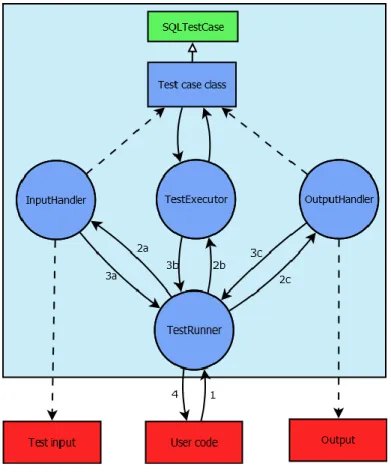
The proposed framework design uses modular components defined by three interfaces and an abstract class, available to any user to implement or extend. These components fill the roles of representing test cases in a test run, reading test cases from user input, executing test cases, and writing test run output. To execute a test run the TestRunner class is called from user source code. TestRunner acts as the core of the framework and coordinates the different components. It also provides the framework API (see Appendix B) to users. TestRunner will call the InputHandler component to read tests and instantiate objects representing test cases. Each test case object is a subclass of the SQLTestCase component and should contain all test case information read from input. The TestRunner will then invoke the TestExecutor component, which will execute test case objects and evaluate their results. As illustrated by Figure 1, the TestExecutor component calls the actual test case objects to perform class-specific execution and evaluation logic (see Section 6.2.2). Finally, the OutputHandler component will be invoked by TestRunner. It takes care of presenting test run outcome and results to the user, by examining executed test case objects.
26
Figure 1. An overview of the program flow during a test run. A call to the TestRunner class from user code starts the test run. TestRunner then invokes the modular components to read test input, execute tests and present test run output.
The framework supports several different modes of execution. For example, a debugging mode exists where additional information about test execution and assertion failures should be used to immediately identify failed test cases. A special mode is also supported for running the framework in a build server (see Section 6.5.2). Build server specific functionality should be implemented by each modular component, as a Boolean parameter indicating when running in a build server is sent as a parameter to each component during a test run.
Additional test run options are also provided by the framework. The default behavior of the system is to run test cases in parallel, but sequential execution can also be used. The design of the TestExecutor component provides this option by having two different methods for executing test cases. Furthermore, the InputHandler, TestExecutor and OutputHandler components are by default run in three different threads for concurrent reading, execution and output of test cases (as in Figure 1), but they can also be run in the same thread, which may be useful for example when debugging. This is handled by TestRunner and is configurable through a test configuration property (see Appendix B).
27
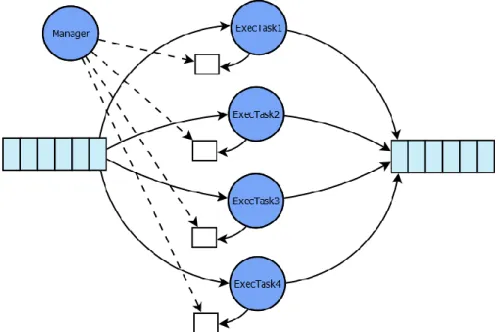
As mentioned above, the main responsibility of TestRunner is to execute regression tests by coordinating and invoking the modular component implementations. In order to transmit test case objects between components, TestRunner manages two queue data structures. References to the queues are sent to the components, and allow components to send and retrieve test case objects through the queues. As seen in Figure 2, the InputHandler component will enqueue test case objects read from input, to be dequeued by the TestExecutor. In the same way, the TestExecutor will enqueue executed test case objects, which will be dequeued by the OutputHandler. This is especially useful when components are run concurrently, as a test case can flow through all the components as soon as it is read.
Figure 2. Test case objects flow between the framework components through shared queues
6.2.1 InputHandler
The InputHandler component constitutes part of the user interface. It reads test input and instantiates concrete test case objects populated with the read information. The IInputHandler interface defines an InputHandler component as a .NET iterator [36] that streams objects created from input through iteration. The details of how test case objects are read and created are of course up to the component implementation. The IInputHandler interface also defines a method ReadTests(). The ReadTests method takes two string parameters specifying where to read user test input from. The method serves to initialize the iterator and can, for example, be used to read and instantiate all test cases before iteration or prepare to read test cases one at a time during iteration.
To simplify inspection and test coverage checking, only descriptions, statements and other optional parameters should be needed for test cases provided by users. In order to still provide expected results, two different input sources can be used. User test input is a data source handled by the user to add and manage test cases to be run, and should only contain the information mentioned above. An internal data structure (see Section 6.4) can be used to hold additional test case information generated during test runs, especially expected test results, and work as a complement to user input when reading test
28
cases. The IInputHandler interface encourages making use of such an internal data store by sending an internal storage location as a parameter to the ReadTests method.
The InputHandler component serves an important part in the usability aspect of the framework. It constitutes a large part of the user interface, as it is responsible for instantiating test case objects from input. The modular design provides users with the ability to create, and even swap between, different component implementations utilizing different input methods. However, because the component is designed to read test case information from both the internal data store and user test input, it handles both loading of internal data as well as defines the user interface. Not only does this raise the complexity of the component, it also violates the rule that each modular component should have a single, well-defined purpose. This is discussed further in Section 8.1.
6.2.2 SQLTestCase
Each type of SQL statements handled by the framework should be implemented as a separate class, in order to reduce the complexity of the implementation and make full use of the modular framework design. The abstract SQLTestCase class serves as an interface to be implemented by all the test case types. It provides properties useful for all types of SQL test cases and enforces test case class specific implementations of execution and evaluation logic. It also allows all test case objects in a test run to be handled in the same way, by providing a common interface that can be used by the other components. SQLTestCase contains many properties for representing a test case. They include description, SQL statement, expected and actual results, test outcome, execution time stamps, error messages, etc. These are general and should be useful to any type of test case, but creating subclasses of SQLTestCase allows for having additional class specific properties. SQLTestCase also defines two methods; Execute(Boolean checksumResults) for executing the SQL statement of a test case object and format results as readable strings or as checksums depending on the parameter value, and EvaluateResults() for evaluating the results held in the object to decide the outcome of the test case. These methods encapsulate the class-specific logic, allowing execution and evaluation logic to differ between test case subclasses without any changes to the framework itself. This is the main mechanism that makes it possible to add support for new types of test cases without rewriting the framework code.
29
6.2.3 TestExecutor
The TestExecutor component is responsible for the execution and evaluation of test cases objects and is defined by the ITestExecutor interface. The interface declares two methods that must be implemented by any TestExecutor component implementation in order to provide the option of sequential and parallel execution and evaluation of test case objects. Both methods take references to the two queue data structures described in Section 6 as parameters, and uses them to read and dequeue test case objects to execute and enqueue executed test objects to the OutputHandler. Parameters indicating the number of times to execute each test case, and whether results should be calculated to checksums are also included in the method signatures. The method for parallel execution also has a parameter specifying the maximum allowed execution time of each test case run in parallel.
Because of the encapsulation of execution and evaluation logic provided by SQLTestCase, a TestExecutor implementation only needs to call the test case objects’ Execute and EvaluateResults methods to perform the actual execution and evaluation. However, a TestExecutor component should also handle things like managing execution thread(s), monitoring and handling failed execution attempts, handling of statement execution timeouts, etc. It should also log execution information and provide special functionality to support debugging when the framework is run in debug mode.
6.2.4 OutputHandler
The OutputHandler component is responsible for handling results and output of test runs, but also for implementing framework API functionality for managing any internally stored test case information. The IOutputHandler interface defines the methods to be implemented by any OutputHandler implementation. The AddOutput method is called by the framework at the end of each test run, and should handle the results of a test run, given all executed test case objects. AddOutput has string parameters specifying where user input was read from and the location of the internal data store, and also a test object queue that will be populated with all test case objects that has been executed by the TestExecutor. The user input information can be useful for allowing internal data to be organized by the structure of user test input, making it simple to find matching test cases. Other methods defined in the interface are AddTests, UpdateTests, and DeleteTests, which should be used to manage implementation specific internally stored test case information. These three methods has the same parameter signatures; a collection of test case objects, the location of the internal data store, and the user input to match.