Volume Weighted Average Price Optimal Execution
Enzo Busseti
Stephen Boyd
September 28, 2015
Abstract
We study the problem of optimal execution of a trading order under Volume Weighted Average Price (VWAP) benchmark, from the point of view of a risk-averse broker. The problem consists in minimizing mean-variance of the slippage, with quadratic transaction costs. We devise multiple ways to solve it, in particular we study how to incorporate the information coming from the market during the schedule. Most related works in the literature eschew the issue of imperfect knowledge of the total market volume. We instead incorporate it in our model. We validate our method with extensive simulation of order execution on real NYSE market data. Our proposed so-lution, using a simple model for market volumes, reduces by 10% the VWAP deviation RMSE of the standard “static” solution (and can simultaneously reduce transaction costs).
1
Introduction
Most literature on optimal execution focuses on the Implementation Shortfall (IS) objective, minimizing the execution price with respect to the market price at the moment the order is submitted. The seminal papers [BL98], [AC01] and [OW05] derive the optimal schedule for various risk preferences and market impact models. However most volume on the stock markets is traded with Volume Weighted Average Price (VWAP) orders, benchmarked to the average market price during the execution horizon [Mad02]. Using this benchmark makes the problem much more compelling from a stochastic control standpoint and prompts the development of a richer model for the market dynamics. The problem of optimal trade scheduling for VWAP execution has been studied originally [Kon02] in a static optimization setting (the schedule is fixed at the start of the day). This is intuitively suboptimal, since it ignores the new information coming as the schedule progresses. Some recent papers [HJ11] [MK12] [FW13] extend the model and incorporate the new information coming to the market but rely on the crucial assumption that the total market volume is known beforehand. Other works [BDLF08] take a different route and focus on the empirical modeling of the market volumes. A recent paper [GR13] studies the stochastic control problem including a market impact term, while the work by Li [Li13] takes a different approach and studies the optimal placement of market and limit orders for a VWAP objective. Our approach matches in
complexity the most recent works in the literature ([FW13], [GR13]) with a key addition: we don’t assume that the total market volume is known and instead treat it as a random variable. We also provide extensive empirical results to validate our work.
We define the problem and all relevant variables in §2. In§3 we derive a “static” optimal trading solution. In §4 we develop a “dynamic” solution which uses the information coming from the market during the schedule in the best possible way: as our estimate of the total market volume improves we optimize our trading activity accordingly. In §5 we detail the simulations of trading we performed, on real NYSE market data, using our VWAP solution algorithms. We conclude in §6.
2
Problem formulation
We consider, from the point of view of a broker, the problem of executing a trading order issued by a client. The client decides to trade C ∈ Z+ shares of stock k over the course
of a market day. By assuming C > 0 we restrict our analysis to “buy” orders. If we were instead interested in “sell” orders we would only need to change the appropriate signs. We don’t explore the reasons for the client’s order (it could be for rebalancing her portfolio, making new investments,etc.). The broker accepts the order and performs all the trades in the market to fulfill it. The broker has freedom in implementing the order (can decide when to buy and in what amount) but is constrained to cumulatively trade the amount C over the course of the day. When the order is submitted client and broker agree on an execution
benchmark price which regulates the compensation of the broker and the sharing of risk. The broker is payed by the client an amount equal to the number of shares traded times the execution benchmark, plus fees (which we neglect). In turn, the broker pays for his trading activity in the market. Some choices of benchmark prices are:
• stock price at the start of the trading schedule. This gives rise toimplementation short-fall execution ([BL98], [AC01]), in which the client takes no risk (since the benchmark price is fixed);
• stock price at day close. This type of execution can misalign the broker and client objectives. The broker may try to profit from his executions by pushing the closing price up or down, using the market impact of his trades;
• Volume Weighted Average Price (VWAP), the average stock price throughout the day weighted by market volumes. This is the most common benchmark price. It encourages the broker to spread the execution evenly across the market day, minimizing market impact and detectability of the order. It assigns most risk associated with market price movements to the client, so that the broker can focus exclusively on optimizing execution.
2.1
Definitions
We work for simplicity in discrete time. We consider a market day for a given stock, split in T intervals of the same length. In the following T is fixed to 390, so each interval is one minute long.
Volume We use the word volume to denote an integer number of traded shares (either by the market as a whole or by a single agent). We definemt∈R+fort= 1, . . . , T, the number of shares of the stock traded by the whole market in interval t, which is non-negative. We note that in reality the market volumesmtare integer, not real numbers. This approximation is acceptable since the typical number of shares traded is much greater than 1 (if the interval length is 1 minute or more) so the integer rounding error is negligible. These market volumes are distributed according to a joint probability distribution
fm1:T(m1, . . . , mT).
In §5.2 we propose a model for this joint distribution. We also define the total daily volume
V = T
X
t=1
mt
We call ut ∈ R+ the number of shares of the stock that our broker trades in interval t, for t = 1, . . . , T. (Again we assume that the volumes are large enough so the rounding error is negligible.) By regulations these must be non-negative, so that all trades performed by the broker as part of the order have the same sign.
Price Let pt ∈R++ for t = 1, . . . , T be the average market price for the stock in interval
t. This is defined as the VWAP of all trades over interval t. (If during interval t there are
Nt > 0 trades in the market, each one with volume ωi ∈ Z++ and price πi ∈ R++, then
pt=PNi=1t ωiπi/PNi=1t ωi.) If there are no trades during intervalt then pt is undefined and in practice we set it equal to the last available period price. We model this price process as a geometric random walk with zero drift. The initial price p0 is a known constant. Then the
price increments ηt≡ pt
−pt−1
pt−1 for t = 1, . . . , T are independent and distributed as
ηt∼ N(0, σt),
where N is the Gaussian distribution. The period volatilities σt ∈ R+ for t = 1, . . . , T are
constants known from the start of the market day. We define the market VWAP price as
pVWAP =
PT
t=1mtpt
Transaction costs We model the transaction costs by introducing the effective price ˆpt, defined so that the whole cost of the trade at interval t is utpˆt. Our model captures in-stantaneous transaction costs, in particular the cost of the bid-ask spread, not the cost of long-term market impact. (For a detailed literature review on transaction costs and market impact see [BFL09].) Let st ∈ R++ be the average fractional (as ratio of the stock price)
bid-ask spread in period t. We assume the broker trades the volume ut using an optimized trading algorithm that mixes optimally market and limit orders. The cost or proceeding per share of a buy market order is on averagept(1 +st/2) while for a limit order it is on average pt(1−st/2). Let uLO and uMO be the portions of ut executed via limit orders and market orders, respectively, so that uLO+uMO =ut. We require that the algorithm uses trades of the same sign, so uLO, uMO, andut are all non-negative (consistently with the constraint we introduce in §2.3). We assume that the fraction of market orders over the traded volume is proportional to the participation rate, defined as ut/mt. So
uMO
ut = α
2
ut mt
where the proportionality factor α ∈ R+ depends on the specifics of the trading algorithm used. This is a reasonable assumption, especially in the limit of small participation rate. The whole cost or proceedings of the trade is
utpˆt=pt
uLO
1−st 2
+uMO
1 + st 2
which implies
ˆ
pt=pt
1− st
2 +α
st
2
ut mt
. (2)
We thus have a simple model for the effective price ˆpt, linear inut. This gives rise toquadratic
transaction costs, a reasonable approximation for the stock markets ([BFL09], [LFM03]).
2.2
Problem objective
Consider the cash flow for the broker, equal to the payment he receives from the client minus the cost of trading
CpVWAP−
T
X
t=1
utpˆt.
In practice there would also be fees but we neglect them. The trading industry usually defines theslippage as the negative of this cash flow. It represents the amount by which the order execution price misses the benchmark. (The choice of sign is conventional so that the optimization problem consists in minimizing it). We instead define the slippage as
S ≡
PT
t=1utpˆt−CpVWAP
CpVWAP
normalizing by the value of the order. We need this in order to compare the slippage between different orders. By substituting the expressions defined above we get
S = T
X
t=1
utpt
1− st
2 +α
st 2 ut mt −C PT
t=1mtpt
V
!,
CpVWAP =
T X t=1 pt pVWAP ut C − mt V + T X t=1
ptst 2pVWAP
α u
2
t Cmt
−ut
C
'
T−1 X
t=1
ηt+1
Pt
τ=1mτ
V −
Pt
τ=1uτ C + T X t=1 st 2 α u 2 t Cmt
−ut
C
(4) where we used the two approximations (both first order, reasonable on a trading horizon of one day)
pt−pt−1
pVWAP
' pt−pt−1
pt−1
=ηt (5)
ptst pVWAP
' st. (6)
We model the broker as a standard risk-averse agent, so that the objective function is to minimize
ES+λvar(S)
for a given risk-aversion parameter λ ≥ 0. These expectation and variance operators apply to all sources of randomness in the system, i.e., the market volumes m and market pricesp, which are independent under our model. The expected value of the slippage is
E
m,pS =EmEp S =Em
" T X t=1 st 2 α u 2 t Cmt
− ut
C
#
(7) since the price increments have zero mean. Note that we leave expressed the expectation over market volumes. The variance of the slippage is
var
m,p S =m,pE
"
S− E
m,pS 2# = E m,pS 2− E m,pS 2 = E
mEp S
2−
E
mEp S
2
−E
m(Ep S)
2
+E
m(Ep S)
2
=E
mvarp (S) +varm (Ep S). (8) The first term is
E
mvarp (S) = EmEp
T−1 X
t=1
ηt+1
Pt
τ=1mt
V −
Pt
τ=1ut C !2 = E m
"T−1 X
t=1
σt2+1
Pt
τ=1mt
V −
Pt
τ=1ut C
2#
which follows from independence of the price increment. The second term is
var
m (Ep S) = varm T
X
t=1
st 2
α u
2
t Cmt
− ut
C
!
. (10)
We drop the second term and only keep the first one, so that the resulting optimization problem is tractable. We motivate this by assuming, as in [FW13], that the second term of the variance is negligible when compared to the first. This is validated ex-post1 by our
empirical studies in §5. We thus get
E
m,pS+λvarm,p(S)' T
X
t=1 E
m
st
2
α u
2
t Cmt
− ut
C
+λσt2
Pt−1
τ=1mt
V −
Pt−1
τ=1ut
C
!2
. (11)
We note that the objective function separates in a sum of terms per each time step, a key feature we will use to apply thedynamic programming optimization techniques in §4.
2.3
Constraints
We consider the constraints that apply to the optimization problem. The optimization variables are ut for t = 1, . . . , T. We require that the executed volumes sum to the total order size C
T
X
t=1
ut=C. (12)
We then impose that all trades have positive sign (buys)
ut≥0, t= 1, . . . , T. (13)
(If we were executing a sell order, C < 0, we would have all ut ≤ 0.) This is a regulatory requirement for institutional brokers in most markets, essentially as a precaution against market manipulation. It is a standard constraint in the literature about VWAP execution.
2.4
Optimization paradigm
The price increments ηt and market volumes mt are stochastic. The volumes ut instead are chosen as the solution of an optimization problem. This problem can be cast in several different ways. We define the information set It available at time t
It≡ {(p1, m1, u1), . . . ,(pt−1, mt−1, ut−1)}. (14)
1 In the rest of the paper we derive multiple ways to solve the optimization problem of minimizing the
objective (11). For these different solution methods, the empirical value of (10) is between 1% and 5% of the value of (9), so our approximation is valid. The results are detailed in§5.6.
By causality, we know that when we choose the value ofut we can use, at most, the informa-tion contained in It. In §3 we formulate the optimization problem and provide an optimal solution for the variables ut in the case we do not access anything from the information set It when choosing ut. The ut are chosen using only information available before the trading starts. We call this a static solution (or open loop in the language of control). In §4 in-stead we develop an optimal policy which can be seen as a sequence of functions ψt of the information set available at time t
ut =ψt(It).
We develop it in the framework on dynamic programming and we call it dynamic solution (or closed loop).
3
Static solution
We consider a procedure to solve the problem described in §2 without accessing the infor-mation setsIt. We call this solution static since it is fixed at the start of the trading period. (It is computed using only information available before the trading starts.) This is the same assumption of [Kon02] and corresponds to the approach used by many practitioners. Our model is however more flexible than [Kon02], it incorporates variable bid-ask spread and a sophisticated transaction cost model. Still, it has an extremely simple numericaly solution that leverages convex optimization [BV09] theory and software.
We start by the optimization problem with objective function (11) and the two constraints (12) and (13)
minimizeu Em,pS+λvarm,p(S)
s.t. PT
t=1ut=C
ut≥0, t= 1, . . . , T.
We remove a constant term from the objective and write the problem in the equivalent form minimizeu
PT
t=1
st 2C(αu
2
tκt−ut) +λσt2
Pt−1
τ=1ut
C
2
−2Mt
Pt−1
τ=1ut
C
s.t. PT
t=1ut=C
ut≥0, t= 1, . . . , T
(15)
where Mt and κt are the constants
Mt=E m
" Pt−1
τ=1mt
V #
, κt=E m
1
mt
for t= 1, . . . , T. In this form, the problem is a standard quadratic program [BV09] and can be solved efficiently by open-source solvers such as ECOS [DCB13] using a symbolic convex optimization suite like CVX [GB14] or CVXPY [DCB14].
3.1
Constant spread
We consider the special case of constant spread, s1 = · · · = sT, which leads to a great simplification of the solution. The convex problem (15) has the form
minimizeu
PT
t=1
st 2C(αu
2
tκt−ut) +λ
PT
t=1σt2(Ut2−2MtUt/C)
≡φ(u) +λψ(u)
s.t. u∈ C
where Ut =Pt
−1
τ=1ut/C for each t = 1, . . . , T, and C is the convex feasible set. We separate
the problem into two subproblems considering each of the two terms of the objective. The first one is
minimizeu φ(u)
s.t. u∈ C
which is equivalent to (since the spread is constant and α >0) minimizeu
PT
t=1u 2
tκt
s.t. u∈ C
The optimal solution is ([BV09], Lagrange duality)
u?t =C 1/κt
PT
t=11/κt
, t= 1, . . . , T.
We approximate κt=Em[1/mt]'1/Em[mt] and thus u?t 'C Em[mt]
PT
t=1Em[mt]
'CE
m
hmt V
i
, t= 1, . . . , T.
The second problem is
minimizeu ψ(u)≡PTt=1σt2(Ut2−2MtUt/C) u∈ C
we choose the Ut such that σt2(Ut−Mt) = 0 so Ut = Mt for t = 1, . . . , T. The values of u1, . . . , uT−1 are thus fixed, and we choose the final volume uT so thatuT =C−CUT. The first order condition of the objective function is satisfied, and these values of u1, . . . , uT are feasible (since Mt is non-decreasing in t and MT ≤ 1). It follows that this is an optimal solution, it has valuesu?
t =CEm[mt/V] fort = 1, . . . , T.
Consider now the original problem. Its objective is a convex combination (apart from a constant factor) of the objectives of two convex problem above and all three have the same constraints set. Since the two subproblems share an optimal solution u?, it follows that u? is also an optimal solution for the combined problem. Thus, an the optimal solution of (15) in the case of constant spread is
u?t =CE
m
hmt V
i
This is equivalent to the solution derived in [Kon02] and is the standard in the brokerage industry. In our model this solution arises as the special case of constant spread, in gen-eral we could derive more sophisticated static solutions. We also note that we introduced the approximation κt = Em[1/mt] ' 1/Em[mt]. (In practice, estimating Em[1/mt] would require a more sophisticated model of market volumes thanEm[mt/V]). We thus expect to lose some efficiency in the optimization of the trading costs. However, with respect to the minimization of the variance of S (if λ → ∞ or s = 0), this solution is indeed optimal. In the following we compare the performances of (16) and of the dynamic solution developed in§4.
4
Dynamic solution
We develop a solution of the problem that uses all the information available at the time each decision is made, i.e., a sequence of functions ψt(It) where It is the information set available at timet(as defined in (14)). We work in the framework of Dynamic Programming (DP) [Ber95], summarized in §4.1. In particular we fit our problem in the special case of linear dynamics and quadratic costs, described in §4.2. However we can’t apply standard DP because the random shocks affecting the system at different times are not conditionally independent (the market volumes have a joint distribution). We instead use the approximate procedure of [SBZ10], summarized in§4.3. In§4.4 we finally write our optimization problem, defining the state, action and costs, and in §4.5 we derive its solution.
4.1
Dynamic programming
We summarize here the standard formalism of dynamic programming, following [Ber95]. Suppose we have a state variable xt ∈ X defined for t = 1, ..., T + 1 with x1 known. Our
decision variables areut ∈ U fort = 1, ..., T and eachutis chosen as a function of the current state, ut = µt(xt). (We use the same symbol as the volumes traded at time t since in the following they coincide.) The randomness of the system is modeled by a series of IID random variables wt ∈ W, fort = 1, ..., T. The dynamics is described by a series of functions
xt+1 =ft(xt, ut, wt), at every stage we incur the cost
gt(xt, ut, wt), and at the end of the decision process we have a final cost
gT+1(xT+1).
Our objective is to minimize
J =E " T
X
t=1
gt(xt, ut, wt) +gT+1(xT+1) #
We solve the problem bybackward induction, defining thecost-to-go functionvt at each time step t
vt(x) = min
u E[gt(x, u, wt) +vt+1(ft(x, u, wt))], t = 1, . . . , T. (17) This recursion is known as Bellman equation. The final condition is fixed by
vT+1(·) =gT+1(·).
It follows that the optimal action at timet is given by the solution
ut= argmin u
E[gt(xt, u, wt) +vt+1(ft(xt, u, wt))]. (18) In general, these equations are not solvable since the iteration that defines the functions vt requires an amount of computation exponential in the dimension of the state space, action space, and number of time steps (curse of dimensionality). However some special forms of this problem have closed form solutions. We see one in the following section.
4.2
Linear-quadratic stochastic control
Whenever the dynamics functionsft are stochastic affine and the cost functions are stochas-tic quadrastochas-tic, the problem of §4.1 has an analytic solution [BLR12]. We call this Linear-Quadratic Stochastic Control (LQSC). We define the state spaceX =Rn, the action space
U = Rm for some n, m > 0. The disturbances are independent with known distributions and belong to a general set W. For t= 1, . . . , T the system dynamics is described by
xt+1 =ft(xt, ut, wt) =At(wt)xt+Bt(wt)ut+ct(wt), t= 1, ..., T
with matrix functions At(·) : W → Rn×n, Bt(·) : W → Rn×m, and ct(·) : W → Rn. The stage costs are
gt(xt, ut, wt) = xTtQt(wt)xt+qt(wt)Txt+uTtRt(wt)ut+rt(wt)Tut
with matrix functions Qt(·) : W → Rn×n, qt(·) : W → Rn, Rt(·) : W → Rm×m, and rt(·) :W →Rm. The final cost is a quadratic function of the final state
gT+1(xT+1) = xTT+1QT+1xT+1+qTT+1xT+1.
The main result of the theory on linear-quadratic problems [Ber95] is that the optimal policy
µt(xt) is a simple affine function of the problem parameters and can be obtained analytically µt(xt) = Ktxt+lt, t= 0, ..., T −1, (19) where Kt ∈ Rm×n and lt ∈ Rm depend on the problem parameters. In addition, the cost-to-go function is a quadratic function of the state
vt(xt) =xTtDtxt+dTtxt+bt (20) where Dt ∈ Rn×n, dt ∈ Rn, and bt ∈ R for t = 1, . . . , T. We derive these results solving the Bellman equations (17) by backward induction. These are known as Riccati equations, reported in Appendix A.1.
4.3
Conditionally dependent disturbances
We now consider the case in which the disturbances are not independent, and we can’t apply the Bellman iteration of §4.1. Specifically, we assume that the disturbances have a joint distribution described by a density function
fw(·) :W × · · · × W →[0,1].
One approach to solve this problem is toaugment the statext, by including the disturbances observed up to time t. This causes the computational complexity of the solution to grow exponentially with the increased dimensionality (curse of dimensionality). Some approxi-mate dynamic programming techniques can be used to solve the augmented problem [Ber95] [Pow07]. We take instead the approximate approach developed in [SBZ10], called shrinking-horizon dynamic programming (SHDP), which performs reasonably well in practice and leads to a tractable solution. (It can be seen as an extension ofmodel predictive control, known to perform well in a variety of scenarios [Bem06] [KH06] [MWB11] [BMOW13]).
We now summarize the approach. Assume we know the density of the future disturbances
wt, . . . , wT conditioned on the observed ones
fw|t(wt, . . . , wT) :W × · · · × W →[0,1].
(If t = 1 this is the unconditional density.) We derive the marginal density of each future disturbance, by integrating over all others,
ˆ
fwt|t(wt), . . . ,fˆwT|t(wT).
We use the product of these marginals to approximate the density of the future disturbances, so they all are independent. We then compute the cost-to-go functions with backwards induction using the Bellman equations (17) and (18), where the expectations over each disturbance wτ are taken on the conditional marginal density ˆfwτ|t. The equations (17) for
the cost-to-go function become (note the subscript·|t)
vτ|t(x) = min u fˆE
wτ|t
[gτ(x, u, wτ) +vτ+1|t(fτ(x, u, wτ))], (21)
for all times τ = t, . . . , T, with the usual final condition. Similarly, the equations (18) for the optimal action become
ut = argmin u
E ˆ
fwt|t
[gt(xt, u, wt) +vt+1|t(ft(xt, u, wt))] (22)
for all times τ = t, . . . , T. We only use the solution ut at time t. In fact when we pro-ceed to the next time step t + 1 we rebuild the whole sequence of cost-to-go functions
vt+1|t+1(x), . . . , vT|t+1(x) using the updated marginal conditional densities and then solve
4.4
VWAP problem as LQSC
We now formulate the problem described in§2 in the framework of§4.2. For t= 1, . . . , T+ 1 we define the state as:
xt =
Pt−1
τ=1uτ Pt−1
τ=1mτ
, (23)
so that x1 = (0,0). The action is ut, the volume we trade during interval t, as defined in §2. The disturbance is
wt=
mt
V
(24) where the second element is the total market volumeV =PT
t=1mt. With this definition the disturbances are not conditionally independent. In §4.5 we study their joint and marginal distributions. We note that V, the second element of each wt, is not observed after time t. (The theory we developed so far does not require the disturbances wt to be observed, the Bellman equations only need expected values of functions of wt.) For t = 1, ..., T the state transition consists in
xt+1 =xt+
ut mt
.
So that the dynamics matrices are
At(wt) =
1 0 0 1
≡I, Bt(wt) =
1 0
≡e1,
ct(wt) =
0
mt
.
The objective funtion (11) can be written as Em
PT
t=1gt(xt, ut, wt) where each stage cost is given by
gt(xt, ut, wt) = st 2 α u 2 t Cmt
− ut
C
+λσt2xTt
1
C2 −
1 CV − 1 CV 1 V2 xt. The quadratic cost function terms are thus
Qt(wt) = λσ2t
1
C2 −1/CV
−1/CV 1/V2
qt(wt) = 0 Rt(wt) =
αst 2Cmt rt(wt) = −
st 2C
for t = 1, . . . , T. The constraint that the total executed volume is equal to C imposes the last action
uT =µT(xT) =C− T−1 X
t=1
with
KT = −eT1
lT = C. This in turn fixes the value function at time T
vT(xT) =EgT(xT, KTxt+lt, wt), (25) so we can treatxT as our final state and only consider the problem of choosing actions up to uT−1. We are left with the constraint ut≥0 for t = 1, . . . , T. Unfortunately this can not be enforced in the LQSC formalism. We instead take the approximate dynamic programming
approach of [KB14]. We allowutto get negative sign and then project it on the set of feasible solutions. For every t= 1, . . . , T we compute
max(ut,0)
and use it, instead of ut, for our trading schedule. This completes the formulation of our optimization problem into the linear-quadratic stochastic control framework. We now focus on its solution, using the approximate approach of§4.3.
4.5
Solution in SHDP
We provide an approximate solution of the problem defined in §4.4 using the framework of shinking-horizon dynamic programming (summarized in §4.3). Consider a fixed time
t = 1, . . . , T −1. We note that (unlike the assumption of [SBZ10]) we do not observe the sequence of disturbances w1, . . . , wt−1, because the total volume V is not known until the
end of the day. We only observe the sequence of market volumes m1, . . . , mt−1.
If fm(m1, . . . , mT) is the joint distribution of the market volumes, then the joint distri-bution of the disturbances is
fw(w1, . . . , wt) =fm(e1Tw1, . . . , eT1wT)×1{eT
2w1=V}× · · · ×1{eT2wT=V}×1{V=PTτ=1eT1wτ}
where e1 = (1,0), e2 = (0,1), and the function 1{·} has value 1 when the condition is true
and 0 otherwise. We assume that our market volumes model also provides the conditional density fm|t(mt, . . . , mT) of mt, . . . , mT given m1, . . . , mt−1. The conditional distribution of
V given m1, . . . , mt−1 is
fV|t(V) =
Z
· · ·
Z
fm|t(mt, . . . , mT)1{V=PTτ=1mτ}dmt· · ·dmT
(where the firstt−1 market volumes are constants and the others are integration variables). Let the marginal densities be
ˆ
The marginal conditional densities of the disturbances are thus ˆ
fwτ|t(·) = ˆfmτ|t(·)×fV|t(·) (26)
for τ =t, . . . , T.
We use these to apply the machinery of§4.3, solve the Bellman equations and obtain the suboptimal SHDP policy at time t. We compute the whole sequence of cost-to-go functions and policies at times τ =t, . . . , T. The cost-to-go functions are
vτ|t(xτ) =xTτDτ|txτ +dτ|txτ+bτ|t (27) forτ =t, . . . , T−1. The only difference with equation (20) is the condition|tin the subscript, because expected values are taken over the marginal conditional densities ˆfwτ|t(·). Similarly,
the policies are
µτ|t(xτ) =Kτ|txτ +lτ|t (28) for τ =t, . . . , T −1. We report the equations for this recursion in Appendix A.2. At every time step t we compute the whole sequence of cost-to-go and policies, in order to get the optimal action
u?t =µt|t(xt) = Kτ|txτ +lτ|t. (29) We then move to the next time step and repeat the whole process. If we are not interested in computing the cost-to-go vt|t(xt) the equations simplify somewhat (we disregard large part of the recursion and only compute what we need). We develop these simplified formulas in Appendix A.3.
5
Empirical results
We study the performance of the static solution of §3 versus the dynamic solution of §4 by simulating execution or stock orders, using real NYSE market price and volume data. We describe in §5.1 the dataset and how we process it. The dynamic solution requires a model for the joint distribution of market volumes, here we use a simple model, explained in§5.2. (We expect that a more sophisticated model for market volumes would improve the solution performance significantly.) In §5.3 we describe the “rolling testing” framework in which we operate. Our procedure is made up of two parts: the historical estimation of model parameters, explained in §5.4, and the actual simulation of order execution, in§5.5. Finally in§5.6 we show our aggregate results.
5.1
Data
We simulate execution on data from the NYSE stock market. Specifically, we use theK = 30 different stocks which make up the Dow Jones Industrial Average (DJIA), onN = 60 market days corresponding to the last quarter of 2012, from September 24 to December 20 (we do not consider the last days of December because the market was either closed or had reduced
trading hours). The 30 symbols in that quarter are: MMM, AXP, T, BA, CAT, CVX, CSCO, KO, DD, XOM, GE, HD, INTC, IBM, JNJ, JPM, MCD, MRK, MSFT, PFE, PG, TRV, UNH, UTX, VZ, WMT, DIS, AA, BAC, HPQ. We use raw Trade and Quotes (TAQ) data from Wharton Research Data Services (WRDS) [TAQ]. We processe the raw data to obtain daily series of market volumes mt∈Z+ and average period price p∈R++, for t= 1, . . . , T
where T = 390, so that each interval is one minute long. We clean the raw data by filtering out trades meeting any of the following conditions:
• correction code greater than 1, trade data incorrect;
• sales condition “4”, “@4”, “C4”, “N4”, “R4”, derivatively priced, i.e., the trade was executed over-the-counter (or in an external facility like a Dark Pool);
• sales condition “T” or “U”, extended hours trades (before or after the official market hours);
• sales condition “V”,stock option trades (which are also executed over-the-counter);
• sales condition “Q”, “O”, “M”, “6”, opening trades and closing trades (the opening and closing auctions).
In other words we focus exclusively on the continuous trading activity without considering market opening and closing nor any over-the-counter trade. In Figure 1 we plot an example of market volumes and prices.
5.2
Market volumes model
We have so far assumed that the distribution of market volumes
fm(m1, . . . , mT)
is known from the start of the day. In reality a broker has a parametric family of distributions and each day (or less often) selects the parameters for the distribution with some statistical procedure. For simplicity, we assume such procedure is based on historical data. We found few works in the literature concerned with intraday market volumes modeling ([BDLF08]). We thus develop our own market volume model. This is composed of a parametric family of market volume distributions and an ad hoc procedure to choose the parameters with historical data.
For each stock we model the vector of market volumes as a multivariate log-normal. If the superscript (k) refers to the stockk(i.e.,m(tk)is the market volume for stockkin interval
t), we have
fm(k)(m
(k)
1 , . . . , m (k)
T )∼lnN(µ+1b
(k),Σ) (30)
where b(k) ∈R is a constant that depends on the stock k (each stock has a different typical
0 50 100 150 200 250 300 350 time (minutes)
0 50 100 150 200
Volume (shares, x1000)
117.2 117.4 117.6 117.8 118.0 118.2 118.4
Price ($)
Stock CVX on day 2012-10-09
Figure 1: Example of a trading day. The blue bars are the market volumes traded every minute (in number of shares) and the red line is the period pricept.
Σ ∈ ST++ is a covariance matrix. The volume process thus separates into a per-stock de-terministic component, modeled by the constant b(k), and a stochastic component with the
same distribution for all stocks, modeled as a multivariate log-normal. We report in Ap-pendix B the ad hoc procedure we use to estimate the parameters of this volume model on historical data and the formulas for the conditional expectationsEt[1/V],Et[mτ],Et[1/mτ] for τ = t, . . . , T (which we need for the solution (29)). The procedure for estimating the volume model on past data requires us to provide a parameter, which we estimate with cross-validation on the initial section of the data. The details are explained in Appendix B.
5.3
Rolling testing
We organize our simulations according to a “rolling testing” or “moving window” procedure: for every day used to simulate order execution we estimate the various parameters on data from a “window” covering the precedingW >0 days. (It is commonly assumed that the most recent historical data are most relevant for model calibration since the systems underlying the observed phenomena change over time). We thus simulate execution on each day i =
W + 1, . . . , N using data from the daysi−W, . . . , i−1 for historical estimation.
In this way every time we test a VWAP solution algorithm, we use model parameters calibrated on historical data exclusively. In other words the performance of our models are estimated out-of-sample. In addition since all the order simulations use the same amount of historical data for calibration it is fair to compare them.
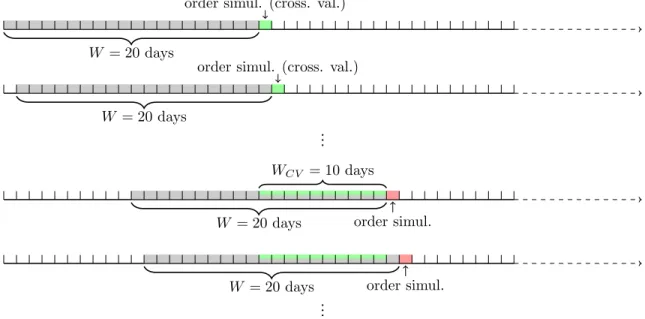
We fix the window lenght of the historical estimation to W = 20, corresponding roughly to one month. We set aside the firstWCV = 10 simulation days for cross-validating a feature of the volume model, as explained in Appendix B.2. In Figure 2 we describe the procedure. In the next two sections we explain how we perform the estimation of model parameters and simulation of orders execution.
order simul. (cross. val.)
W = 20 days
order simul. (cross. val.)
W = 20 days
.. . WCV = 10 days
order simul. W = 20 days
order simul. W = 20 days
.. .
Figure 2: Description of the rolling testing procedure. We iterate over the dataset, simulating execution on any day i= W + 1, . . . , N and estimating the model pa-rameters on the precedingW = 20 days. The firstWCV = 10 days used to simulate
orders are reserved for cross validation (as explained in Appendix B.2). The aggre-gate results from the remaining W +WCV + 1, . . . , N days (30 days in total) are
presented in§5.6.
5.4
Models estimation
We describe the estimation, on historical data, of the parameters of all relevant models for our solution algorithms. We append the superscript (i, k) to any quantity that refers to market day i and stock k. We start by the market volumes per interval as a fraction of the total daily volume (which we need for (16)). We use the sample average
Ehmt
V i
'
Pi−1
j=i−W
PK
k=1m (j,k)
t /V(j,k) W K
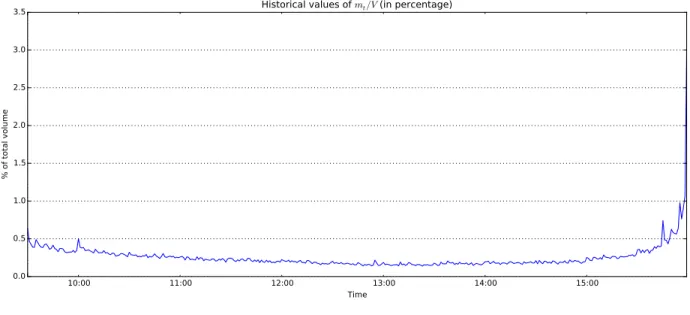
for every t = 1, . . . , T. An example of this estimation (on the first W = 20 days of the dataset) is shown in Figure 3. The dynamic solution (29) requires an estimate of the
10:00 11:00 12:00 13:00 14:00 15:00 Time
0.0 0.5 1.0 1.5 2.0 2.5 3.0 3.5
% of total volume
Historical values of mt/V (in percentage)
Figure 3: Estimated values of Emt
V
using the first W = 20 days of our dataset, shown in percentage points.
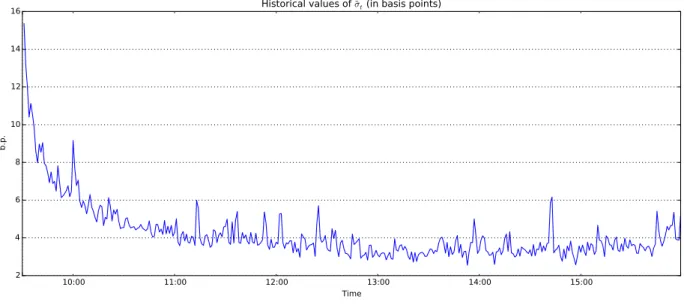
volatilites σt, we use the sample average of the squared price changes
σt2 '
Pi−1
j=i−W
PK
k=1
(p(tj,k+1)−pt(j,k))/p(tj,k)
2
W K
for every t = 1, . . . , T. In Figure 4 we show an example of this estimation (on the first W
days of the dataset). We then choose the volume distribution fm(m1, . . . , mT) among the parametric family defined in §5.2 (using the ad hoc procedure described in Appendix B.1). We estimate the expected daily volume for each stock as the sample average
E[V(i,k)]'
Pi−1
j=i−WV(j,k) W
for every k = 1, . . . , K. We use this to choose the size of the simulated orders.
Finally, we consider the parameters s1, . . . , sT, and α of the transaction cost model (2). We do not estimate them empirically since we would need additional data, market quotes for the spread and proprietary data of executed orders forα (confidential for fiduciary reasons). We instead set them to exogenous values, kept constant across all stocks and days (to simplify comparison of execution costs). We assume for simplicity that the fractional spread is constant in time and equal to 2 basis points, s1 = · · · = sT = 2 b.p. (one basis point is 0.0001). That is reasonable for liquid stocks such as the ones from the DJIA. We choose the parameter α following a rule-of-thumb of transaction costs: trading one day’s volume costs approximately on day’s volatility [KGM03]. We estimate empirically over the first 20 days
10:00 11:00 12:00 13:00 14:00 15:00 Time
2 4 6 8 10 12 14 16
b.p.
Historical values of ˜σt (in basis points)
Figure 4: Estimated values of the period volatilities, ˆσt using the first W = 20
days of our dataset. For each period of one minute these are the estimated standard deviation of the price increments, shown in basis points (one basis point is 0.0001).
of the dataset the open-to-close volatility for our stocks, equal to approximately 90 basis points, and thus from equation (2) we set α= 90.
5.5
Simulation of execution with VWAP solution algorithms
For each day i =W + 1, . . . , N and each stock k = 1, . . . , K we simulate the execution of a trading order. We fix the size of the order equal to 1% of the expected daily volume for the given stock on the given day
C(i,k) =E[V(i,k)]/100.
Such orders are small enough to have negligible impact on the price of the stock [BFL09], as we need for (2) to hold.
We repeat the simulation with different solution methods: the static solution (16) and the dynamic solution (29) with risk-aversion parameters λ = 0,1,10,100,1000,∞. We use the symbol a to index the solution methods. For each simulation we solve the appropriate set of equations, setting all historically estimated parameters to the values obtained with the procedures of §5.4. For each solution method we obtain a simulated trading schedule
u(ti,k,a), t= 1, . . . , T
by the schedule using (4)
S(i,k,a)=
PT
t=1p (i,k)
t u
(i,k,a)
t −C(i,k)p
(i,k) VWAP
C(i,k)p(i,k) VWAP
+ T
X
t=1
st
2 α
(u(ti,k,a))2
C(i,k)m(i,k)
t
−u
(i,k,a)
t C(i,k)
!
. (31)
Note that we are simulating the transaction costs. Measuring them directly would re-quire to actually execute u(ti,k,a). This test of transaction costs optimization has value as a comparison between the static solution (16) and the dynamic solution (29). Our transaction costs model (2) is similar to the ones of other works in the literature (e.g., [FW13]) but in-volves the market volumesmt. The static solution only uses the market volumes distribution known before the market opens, while the dynamic solution uses the SHDP procedure to incorporate real time information and improve modeling of market volumes. In the following we show that the dynamic solution achieves lower transaction costs than the static solution, such gains are due to the better handlng of information on market volumes.
In practice a broker would use a different model of transaction costs, perhaps more complicated than ours. We think that a good model should incorporate the market volumes
mt as a key variable [BFL09]. Our test thus suggests that also in that setting the dynamic solution would perform better than the static solution.
We show in Figure 5 the result of the simulation on a sample market day, using the static solution (16) and the dynamic solution (29) for λ = 0 and ∞. We also plot the market volumesm(ti,k).
5.6
Aggregate results
We report the aggregate results from the simulation of VWAP execution on all the days reserved for orders simulation (minus the ones used for cross-validation). For any day i =
W +WCV + 1, . . . , N, stock k = 1, . . . , K, and solution method a (either the static solution (16) or the dynamic solution (29) for various values of λ) we obtain the simulated slippage
S(i,k,a) using (31). Then, for each solution method a we define the empirical expected value
of S as
E[S(a)] =
PN
i=W+WCV+1
PK
k=1S (i,k,a)
(N −W −WCV)K and the empirical variance
var(S(a)) =
PN
i=W+WCV+1
PK
k=1(S
(i,k,a))2−E[S(a)]2
(N −W −WCV)K−1
.
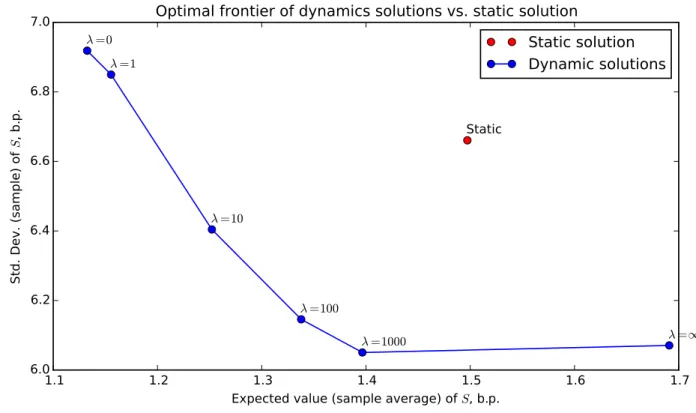
In Figure 6 we show the values of these on a risk-reward plot. (We show the square root of the variance for simplicity, so that both axes are expressed in basis points). We observe that the dynamic solution improves over the static solution on both VWAP tracking (variance of S) and transaction costs (expected value of S), and we can select between the different behaviors by choosing different values of λ.
10:00 11:00 12:00 13:00 14:00 15:00 Time
0.0 0.2 0.4 0.6 0.8 1.0
cum. fraction of total volume
Comparison of VWAP solutions and market volumes. Stock JPM on day 2012-11-27 Static solution
Dynamic solution, λ=∞
Dynamic solution, λ=0
Market volumes
Figure 5: Simulation of order execution on a sample market day. We report all volume processes as cumulative fraction of their total. At every time τ we plot
Pτ
t=1mVt for the market volumes mt and
Pτ
t=1 uCt for the various solutions ut. We
only show the dynamic solution forλ= 0 and λ=∞ since for all other values ofλ the solution falls in between.
We introduced in §2.2 the approximation that the value of (10) is negligible when com-pared to (9). The empirical results validate this. For the static solution the empirical average value of (9) is 4.45e−07 while (10) is 6.34e−09, about 1%. For the dynamic solution with
λ = ∞ the average value of (10) is 3.60e−07 and (9) is 1.92e−08, about 5%. For the dynamic solution with λ = 0 instead the average value of (10) is 4.76e − 07 and (9) is 5.50e−09, about 1%. The dynamic solutions for other values of λ sit in between. Thus the approximation is generally valid, becoming less tight for high values of λ. In fact in Figure 6 we see that the empirical variance of S for the dynamic solution with λ = ∞ is somewhat larger than the one with λ= 10000, probably because of the contribution of (9). (We can interpret this as a bias-variance tradeoff since by going from λ =∞ toλ = 10000 we effectively introduce a regularization of the solution.)
6
Conclusions
We studied the problem of optimal execution under VWAP benchmark and developed two broad families of solutions.
1.1
1.2
1.3
1.4
1.5
1.6
1.7
Expected value (sample average) of
S, b.p.
6.0
6.2
6.4
6.6
6.8
7.0
St
d.
D
ev
. (
sa
m
ple
) o
f
S
, b
.p.
Static
λ=0 λ=1
λ=10
λ=100
λ=1000 λ=∞
Optimal frontier of dynamics solutions vs. static solution
Static solution
Dynamic solutions
Figure 6: Risk-reward plot of the aggregate results of our simulations on real mar-ket data. Each dot represents one solution method, either the static solution (16) or
the dynamic solution (29) with risk-aversion parameters λ= 0,1,10,100,1000,∞.
We show the sample average of the simulated slippages, which represents the exe-cution costs, and the sample standard deviation, i.e., the root mean square error (RMSE) of tracking the VWAP. The orders have size equal to 1% of the expected daily volume. The dynamic solution improves over the static solution in both dimen-sions, we can choose the preferred behaviour by fixing the risk-aversion parameter λ.
is more flexible and can accommodate more sophisticated models (of bid-ask spread and volume) than the comparable static solutions in the literature. By formulating the problem as a quadratic program it is easy to add other convex constraints (see [MS12] for a good list) with a guaranteed straightforward fast solution [BV09].
The dynamic solution of §4 is the biggest contribution of this work. One one side, we manipulate the problem to fit it into the standard formalism of linear-quadratic stochastic control. On the other, we model the uncertainty on the total market volume (which is eschewed in all similar works we found in the literature) in a principled way, building on a recent result in optimal control [SBZ10].
The empirical tests of §5 are based on simulations with real data designed with good statistical practices (the rolling testing of §5.3 ensures that all results are obtained
out-of-sample). We compare the performance of the static solution, standard in the trading industry, to our dynamic solution. The dynamic solution is built around a model for the joint distribution of market volumes, we provide a simple one in §5.2 (along with ad hoc
procedures to use it). This is supposed to be a proof-of-concept since in practice a broker would have a more sophisticated market volume model, which would further improve per-formance of the dynamic solution. Even with our model for market volumes our dynamic solution improves the performance of the static solution significantly. The result validates all the approximations involved in the derivation of the dynamic solution and thus shows its value.
Our simulations quantify the improvements of our dynamic solution over the standard static solution. On one side we can reduce the RMSE of VWAP tracking by 10%. This is highly significant and could improve with a more sophisticated market volume model. On the other we can lower the execution costs by around 25%. In our test this corresponds to
∼ 50$ of savings for an order of a million dollars (the VWAP executions are worth billions of dollars each day).
Appendices
A
Dynamic programming equations
A.1
Riccati equations for LQSC
We derive the recursive formulas for (19) and (20). We know the final condition
vT+1(xT+1) =gT+1(xT+1),
soDT+1 =QT+1,dT+1 =dT+1, andbT+1 = 0. Now for the inductive step, assume vt+1(xt+1)
is in the form of (20) with known Dt+1,dt+1, andbt+1. Then the optimal action at time tis,
according to (18),
ut= argmin u
E[gt(xt, u, wt) +vt+1(At(wt)xt+Bt(wt)u+ct(wt))] =Ktxt+lt, with
Kt = −
E[Bt(wt)TDt+1At(wt)] (ERt(wt) +E[Bt(wt)TDt+1Bt(wt)] lt = −
Ert+ 2E[Bt(wt)TDt+1c(wt)] +dTt+1EBt(wt) 2(ERt(wt) +E[Bt(wt)TDt+1Bt(wt)]
.
It follows that the value function at time t is also in the form of (20), and it has value
vt(xt) =E[gt(xt, Ktxt+lt, wt) +vt+1(At(wt)xt+Bt(wt)(Ktxt+lt) +ct(wt))] =
xTtDtxt+dTtxt+bt with
Dt = EQt(wt) +KtT E
Rt(wt) +Bt(wt)TDt+1Bt(wt)
Kt+
E[At(wt)TDt+1At(wt)] +KtT E[Bt(wt)TDt+1At(wt)] +
E[At(wt)TDt+1Bt(wt)]Kt
dt = Eqt(wt) +KtT Ert(wt) + 2EKtTRt(wt)lt+
E[At(wt) +Bt(wt)Kt)T(dt+1+ 2Dt+1(Bt(wt)lt+Ec(wt))] bt = bt+1+ERt(wt)lt2+Ert(wt)lt+
E[(Bt(wt)lt+c(wt))TDt+1+dTt+1)(Bt(wt)lt+c(wt))].
We thus completed the induction step, and so the value function is quadratic and the policy affine at every time step t = 1, . . . , T. The recursion can be solved as long as we know the functional form of the problem parameters and the distribution of the disturbances wt.
A.2
SHDP Solution
We derive the recursive formulas for (27) and (28). These are equivalent to the Riccati equations we derived in Appendix A.1, but the expected values are taken over the marginal conditional densities ˆfwτ|t(·). We write Et to denote such expectation. In addition, these
equations are somewhat simpler since our problem hasAt(wt) =I, Bt(wt) = e1, qt = 0, and rt(wt) =rt fort = 1, . . . , T. The final conditions are fixed by (25)
DT|t = E
t QT(wT) +e1Et RT(wT)e T
1
dT|t = −rTeT1 −2CEt RT(wT)eT1,
bT|t = rTC. And the recursive equations are
Kτ|t = −
eT
1Dτ+1|t
EtRτ(wτ) +eT1Dτ+1e1
lτ|t = −
rτ +dTτ+1|te1+ 2e T
1Dτ+1|tEtc(wτ) 2(EtRτ(wτ) +eT1Dτ+1|te1)
Dτ|t = E
t Qτ(wτ) +K T τ|t
E
t[Rτ(wτ)] +e T
1Dτ+1|te1
Kτ|t+ Dτ+1|t+KτT|te
T
1Dτ+1|t+Dτ+1|te1Kτ|t=
E
t Qτ(wτ) +Dτ+1|t+K T τ|te
T
1Dτ+1|t dτ|t = KτT|trτ + 2KτT|tE
t Rτ(wτ)lτ|t+
(I+e1Kτ|t)T(dτ+1|t+ 2Dτ+1|t(e1lτ|t+E
t c(wτ))) = dτ+1|t+ 2Dτ+1|t(e1lτ|t+E
t c(wτ)) bτ|t = bτ+1|t+rτlτ|t+E
t Rτ(wτ)l
2
τ|t+Et[c(wτ)Dτ+1|tc(wτ)] + dTτ+1|t(e1lτ|t+E
t c(wτ)) +lτ|te T
1Dτ+1|t(e1lτ|t+ 2E
t c(wτ)) = bτ+1|t+E
t[c(wτ)Dτ+1|tc(wτ)] +d T τ+1|tE
t c(wτ) for τ =t, . . . , T −1.
A.3
SHDP simplied solution (without value function)
Parts of the equations derived in Appendix A.2 are superfluous in case we are not interested in the cost-to-go functionsvτ|t(xt) forτ =t, . . . , T−1. (In fact, we only want to compute the optimal action (29).) We disregard the constant term bτ|t, and we only compute the three scalar elements that we need from Dτ|t and dτ|t. For any t = 1, . . . , T and τ =t, . . . , T −1
we define
et1Dτ|te1 ≡ βτ|t et1Dτ|te2 =e2tDτ|te1 ≡ γτ|t et1dτ|t ≡ δτ|t
where e1 = (1,0) and e2 = (0,1) are the unit vectors. The final values are
βT|t = λ σ2
T C2 +
αsT
2C Et[1/mT] γT|t = −λ
σ2
T
C Et[1/V] δT|t =
sT
2C −αsT Et[1/mT]. The policy
Kτ|t = −
(βτ+1|t, γτ+1|t)
(αsτ/2C)Et[1/mτ] +βτ+1|t lτ|t = −
−sτ/(2C) +δτ+1|t+ 2γτ+1|tEtmτ 2((αsτ/2C)Et[1/mτ] +βτ+1|t)
.
We restrict the Riccati equations to these three scalars. They are independent from the rest of the recursion and we obtain
βτ|t = λ στ2 C2 −
βτ2+1|t
(αsτ/2C)Et[1/mτ] +βτ+1|t
+βτ+1|t = λσ
2
τ C2 +
(αsτ/2C)Et[1/mτ]βτ+1|t (αsτ/2C)Et[1/mτ] +βτ+1|t γτ|t = −λ
σ2τ
C Et [1/V]−
βτ+1|tγτ+1|t
(αsτ/2C)Et[1/mτ] +βτ+1|t
+γτ+1|t=
−λσ
2
τ
C Et [1/V] +
(αsτ/2C)Et[1/mτ]γτ+1|t (αsτ/2C)Et[1/mτ] +βτ+1|t δτ|t = δτ+1|t+ 2βτ+1|tlτ|t+ 2γτ+1|tE
t mt.
A.3.1 Negligible spread
We study the case where st = 0 for all t = 1, . . . , T, equivalent to the limit λ → ∞. From the equations above we get that for all t= 1, . . . , T and τ =t, . . . , T
βτ|t = λ σ2
τ C2
γτ|t = −λ στ2
C Et[1/V] δτ|t = 0.
So for every t= 1, . . . , T
µt|t(xt) = Kt|txt+lt=
−(βτ+1|t, γτ+1|t)xt−Etmtγτ+1|t βt+1|t
=
CE
t [1/V] t−1 X
τ=1
mτ +E t mt
!
−
t−1 X
τ=1
uτ.
In other words, at every point in time we look at the difference between the fraction of order volume we have executed and the fraction of daily volume the market has traded (using our most recent estimate of the total volume). We trade the expected fraction for next period
CEt[1/V]Etmt, plus this difference.
B
Volume model
We explain here the details of the volume model (30), which we use for the dynamic VWAP solution. In§B.1 we describe the ad hoc procedure we use to estimate the parameters of the model on historical data. Then in §B.2 we detail the cross-validation of a particular feature of the model. Finally in §B.3 we derive formulas for the expected values of some functions of the volume, which we need for the solution (29).
B.1
Estimation on historical data
We consider estimation of the volume model parameters b(k),µ and Σ using data from days
i−W, . . . , i−1 (we are solving the problem at day i). We append the superscript (i, k) to any quantity that refers to market day i and stockk.
Estimation of bk We first estimate the value of b(k) for each stockk, as: ˆ
b(k)=
Pi−1
j=i−W
PT
t=1logm (j,k)
t T W
We show in Table 1 the values of ˆb(k) obtained on the first W days of our dataset.
Estimation of µ Since each observation logm(j,k)−1b(j,k) is distributed as a multivariate
Gaussian we use this empirical mean as estimator ofµ:
ˆ
µt =
Pi−1
j=i−W
PK
k=1logm (j,k)
t −ˆb(k)
W K .
Stock ˆb(k) Stock ˆb(k)
AA 4.338 JPM 4.599
AXP 3.910 KO 4.312
BA 3.845 MCD 4.017
BAC 5.309 MMM 3.701
CAT 4.118 MRK 4.176
CSCO 4.693 MSFT 4.848
CVX 3.986 PFE 4.586
DD 3.990 PG 4.088
DIS 4.055 T 4.566
GE 4.784 TRV 3.546
HD 4.139 UNH 3.902
HPQ 4.577 UTX 3.782
IBM 3.788 VZ 4.225
INTC 4.860 WMT 3.992
JNJ 4.244 XOM 4.260
Table 1: Empirical estimate ˆb(k) of the per-stock component of the volume model, using data from the first W = 20 days.
Estimation of Σ We finally turn to the estimation of the covariance matrix Σ∈ST++, us-ing historical data. In general, empirical estimation of covariance matrices is a complicated problem. Typically one has not access to enough data to avoid overfitting (a covariance matrix has O(N2) degrees of freedom, where N is the dimension of a sample). Many
ap-proximate approaches have been developed in the econometrics and statistics literature. We designed an ad hoc procedure, inspired by works such as [FLM11]. We look for a matrix of the form
Σ =f fT +S,
where f ∈ RT and S ∈ ST++ is sparse. We first build the empirical covariance matrix. Let
X ∈RT×(W K) be the matrix whose columns are vectors of the form: logm(j,k)−1ˆb(k)−µˆ
for each day j = i−W, . . . , i−1 and stock k = 1, . . . , K. Then the empirical covariance matrix is
ˆ
Σ = 1
W K−1XX T.
We perform the singular value decomposition of X
10:00 11:00 12:00 13:00 14:00 15:00 Time
1.0 0.5 0.0 0.5 1.0 1.5 2.0 2.5
3.0 Historical values of µ for the log-Normal model
Figure 7: Empirical estimate ˆµof the cross-time component of the volume model, using data from the first W = 20 days.
where s ∈ RT, s1 ≥ s2 ≥ ...≥ sT ≥ 0, U ∈ RT×T, and V ∈ R(W K)×T (because in practice we have W K > T, since W = 20, K = 30, and T = 390). We have
ˆ
Σ = 1
W K−1U ·diag(s
2
1, s22, . . . , s2T)·UT.
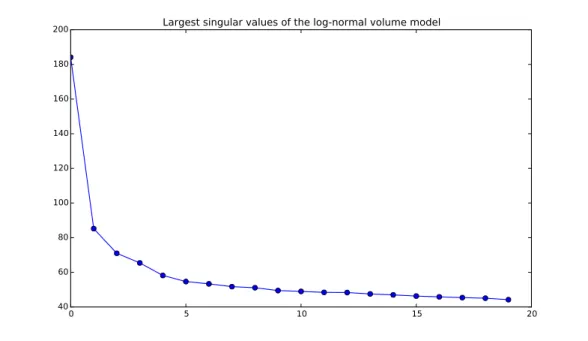
We show in Figure 8 the first singular values s1, s2, . . . , s20 computed on data from the first
W days. It is clear that the first singular value is much larger than all the others. We thus build the rank 1 approximation of the empirical covariance matrix by keeping the first singular value and first (left) singular vector
f = √s1U:,1
W K−1,
so that f fT is the best (in Frobenius norm) rank-1 approximation of ˆΣ. We now need to provide an approximation for the sparse part S of the covariance matrix. We assume that
S is abanded matrix of bandwidth b >0, which is non-zero only on the main diagonal and onb−1 diagonals above and below it (in total it has 2b−1 non-zero diagonals). The value of b is chosen by cross-validation, as explained in§B.2. The assumption that S is banded is inspired by the intuition that elements of logm(j,k)−1b(k)−µ are correlated (in time) for
short delays. We findS by simply copying the diagonal elements of the empirical covariance matrix:
·Si,j =
(
( ˆΣ−f fT)
i,j if |j−i| ≤b
0 5 10 15 20 40
60 80 100 120 140 160 180
200 Largest singular values of the log-normal volume model
Figure 8: First 20 singular values of the matrix X of observations logm(j,k)−
1ˆb(k)−µ.ˆ
We thus have built a matrix of the form Σ = f fT +S. Note that this procedure does not guarantee that Σ is positive definite. However in our empirical tests we always got positive definite Σ for any b= 1,2, . . ..
B.2
Cross validation
As explained in§B.1, we need to choose the value of the parameterb ∈N(used for empirical estimation of the covariance matrix Σ). We choose it by cross-validation, reserving the first
WCV = 10 testing days of the dataset. We show in Figure 2 the way we partition the data (so that the empirical testing is performed out-of-sample with respect to the cross-validation). We simulate trading according to the solution (29) with λ = ∞ (i.e., the special case of Appendix A.3.1), for various values of b. We then compute the empirical variance of S, and choose the value of b which minimizes it. (We are mostly interested in optimizing the variance of S, rather than the transaction costs.) In Figure 9 we show the result of this procedure (we show the standard deviations instead of variances, for simplicity), along with the result using the static solution (16), for comparison. Since the difference in performance between b= 3 and b= 5 is small (and we want to avoid overfitting), we choose b = 3.
1 2 3 4 5 6 7 8 9 b
5.7 5.8 5.9 6.0 6.1 6.2 6.3 6.4 6.5
St
d.
d
ev
. o
f
S
(p
ips
)
Cross validation of
b
Dynamic sol.
Static sol.
Figure 9: To cross validate the volume model parameter b, we compute the em-pirical standard deviation ofS for the dynamic solution (29) withλ=∞, changing the value of b in the volume model. We also show the static solution (16), which does not use the volume model, for comparison. From this result we choose b = 3 (to avoid overfitting).
B.3
Expected values of interest
We consider the problem at any fixed timet = 1, . . . , T−1, for a given stockkand dayi. (We have observed market volumes m1, . . . , mt−1.) We obtain the conditional distribution of the
unobserved volumes mt, . . . , mT and derive expressions for Etmτ, Et
h 1
mτ i
, and Et
1
V
for any τ =t, . . . , T. We need these for the numerical solution (29), as developed in Appendix A.3.1.
Conditional distribution We divide the covariance matrix in blocks: Σ =
Σ1:(t−1),1:(t−1) Σ1:(t−1),t:T Σt:T,1:(t−1) Σt:T ,t:T
.
Then we get the marginal distribution
mt:T ∼logN(ν|t,Σ|t)
by taking the Schur complement (e.g., [BV09]) of the covariance matrix
ν|t ≡ µt:T +b(k)+ ΣT1:(t−1),t:TΣ
−1
1:(t−1),1:(t−1)(logm1:(t−1)−µ1:(t−1)−b (k))
Σ|t ≡ Σt:T ,t:T −ΣT1:(t−1),t:TΣ
−1
1:(t−1),1:(t−1)Σ1:(t−1),t:T.
Note that ν|1 = µ+b(k) and Σ|1 = Σ, i.e., the unconditional distribution of the market
Volumes The expected value of the remaining volumes mτ
E
t mτ = exp
(ν|t)τ−t+1+
(Σ|t)τ−t+1,τ−t+1
2
, τ =t, . . . , T.
(Because the (τ −t+ 1)-th element ofν|t corresponds to the τ-th volume.)
Inverse volumes The expected value of the inverse of the remaining volumes mτ
E t 1 mτ = exp
−(ν|t)τ−t+1+
(Σ|t)τ−t+1,τ−t+1
2
, τ =t, . . . , T.
Total volume We have, since we already observed m1, . . . , mt−1
E
t V =
t−1 X
τ=1
mτ + T
X
τ=t
E
t mτ.
We also express its variance, which we need later
var
t (V) = vart T
X
τ=t mτ =
T
X
τ=t T
X
τ0=t
cov(mτ, mτ0) =
T
X
τ=t T
X
τ0=t E
t mτEt mτ
0(exp((Σ|t)τ−t+1,τ0−t+1)−1).
Inverse total volume We use the following approximation, derived from the Taylor ex-pansion formula. Consider a random variable z and a smooth functionφ(·), then
Eφ(z)'φ(Ez) + φ
00(Ez)
2 varz. So the inverse total volume
E t 1 V ' 1
EtV
+vart(V)
Et[V]3 .
References
[AC01] Robert Almgren and Neil Chriss. Optimal execution of portfolio transactions.
Journal of Risk, 3:5–40, 2001.
[BDLF08] Jedrzej Bia lkowski, Serge Darolles, and Ga¨elle Le Fol. Improving vwap strate-gies: A dynamic volume approach. Journal of Banking & Finance, 32(9):1709– 1722, 2008.
[Bem06] Alberto Bemporad. Model predictive control design: New trends and tools. In
Decision and Control, 2006 45th IEEE Conference on, pages 6678–6683. IEEE, 2006.
[Ber95] Dimitri P Bertsekas. Dynamic programming and optimal control, volume 1. Athena Scientific Belmont, MA, 1995.
[BFL09] J.P. Bouchaud, J.D. Farmer, and F. Lillo. How markets slowly digest changes in supply and demand, volume 4 ofHandbook of financial markets. North-Holland, San Diego, CA, 2009.
[BL98] Dimitris Bertsimas and Andrew W Lo. Optimal control of execution costs.
Journal of Financial Markets, 1(1):1–50, 1998.
[BLR12] Stephen Boyd, Sanjay Lall, and Ben Van Roy. Ee365: Stochastic control.
http://stanford.edu/class/ee365/lectures.html, 2012.
[BMOW13] Stephen Boyd, Mark Mueller, Brendan ODonoghue, and Yang Wang. Perfor-mance bounds and suboptimal policies for multi-period investment.Foundations and Trends in Optimization, 1(1):1–69, 2013.
[BV09] Stephen Boyd and Lieven Vandenberghe. Convex optimization. Cambridge university press, 2009.
[DCB13] Alexander Domahidi, Eric Chu, and Stephen Boyd. Ecos: An socp solver for embedded systems. InControl Conference (ECC), 2013 European, pages 3071– 3076. IEEE, 2013.
[DCB14] Steven Diamond, Eric Chu, and Stephen Boyd. CVXPY: A Python-embedded modeling language for convex optimization, version 0.2. http://cvxpy.org/, May 2014.
[FLM11] Jianqing Fan, Yuan Liao, and Martina Mincheva. High dimensional covariance matrix estimation in approximate factor models.Annals of statistics, 39(6):3320, 2011.
[FW13] Christoph Frei and Nicholas Westray. Optimal execution of a vwap order: a stochastic control approach. Mathematical Finance, 2013.
[GB14] Michael Grant and Stephen Boyd. CVX: Matlab software for disciplined convex programming, version 2.1. http://cvxr.com/cvx, March 2014.
[GR13] Olivier Gu´eant and Guillaume Royer. Vwap execution and guaranteed vwap.
arXiv preprint arXiv:1306.2832, 2013.
[HJ11] Mark L Humphery-Jenner. Optimal vwap trading under noisy conditions. Jour-nal of Banking & Finance, 35(9):2319–2329, 2011.
[KB14] Arezou Keshavarz and Stephen Boyd. Quadratic approximate dynamic pro-gramming for input-affine systems. International Journal of Robust and Non-linear Control, 24(3):432–449, 2014.
[KGM03] R. Kissell, M. Glantz, and R. Malamut. Optimal Trading Strategies:
Quanti-tative Approaches for Managing Market Impact and Trading Risk. AMACOM,
New York, NY, 2003.
[KH06] Wook Hyun Kwon and Soo Hee Han. Receding horizon control: model predictive control for state models. Springer Science & Business Media, 2006.
[Kon02] Hizuru Konishi. Optimal slice of a vwap trade. Journal of Financial Markets, 5(2):197–221, 2002.
[LFM03] F. Lillo, J.D. Farmer, and R.N. Mantegna. Master curve for price-impact func-tion. Nature, 421(129):176–190, 2003.
[Li13] Tianhui Michael Li. Dynamic Programming and Trade Execution. PhD thesis, PRINCETON UNIVERSITY, 2013.
[Mad02] Ananth N Madhavan. Vwap strategies. Trading, 2002(1):32–39, 2002.
[MK12] James McCulloch and Vlad Kazakov. Mean variance optimal vwap trading.
Available at SSRN 1803858, 2012.
[MS12] Ciamac C Moallemi and Mehmet Saglam. Dynamic portfolio choice with linear rebalancing rules. Available at SSRN 2011605, 2012.
[MWB11] Jacob Mattingley, Yang Wang, and Stephen Boyd. Receding horizon control.
Control Systems, IEEE, 31(3):52–65, 2011.
[OW05] Anna Obizhaeva and Jiang Wang. Optimal trading
strat-egy and supply/demand dynamics. NBER Working Papers,
http://ideas.repec.org/p/nbr/nberwo/11444.html 11444, National Bureau of Economic Research, June 2005.
[Pow07] Warren B Powell. Approximate Dynamic Programming: Solving the curses of dimensionality, volume 703. John Wiley & Sons, 2007.
[SBZ10] Jo¨elle Skaf, Stephen Boyd, and Assaf Zeevi. Shrinking-horizon dynamic pro-gramming.International Journal of Robust and Nonlinear Control, 20(17):1993– 2002, 2010.
[TAQ] Wharton Research Data Services, TAQ Dataset. https: // wrds-web. wharton. upenn. edu/ wrds/.