4 x 50W multifunction quad power amplifier
with built-in diagnostics feature
Features
■ Multipower BCD technology
■ MOSFET output power stage
■ DMOS power output
■ New high efficiency (class SB)
■ High output power capability 4x28 W/4 @ 14.4 V, 1 kHz, 10 % THD, 4x50 W max, power
■ Max. output power 4x72 W/2
■ Full I2C bus driving: – Standby
– Independent front/rear soft play/mute – Selectable gain (for low noise line output
function)
– High efficiency enable/disable
– I2C bus digital diagnostics (including AC and DC load detection)
■ Full fault protection
■ DC offset detection
■ Four independent short circuit protection
■ Clipping detector (2 %/10 %)
■ Linear thermal shutdown with multiple thermal warning
■ ESD protection
Description
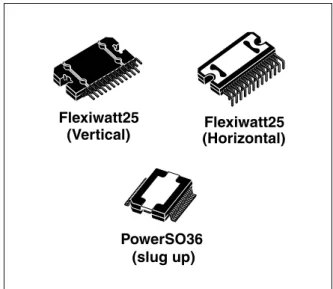
The TDA7564B is a new BCD technology quad bridge type of car radio amplifier in Flexiwatt25 /
PowerSO36 package specially intended for car radio applications.
Thanks to the DMOS output stage the TDA7564B has a very low distortion allowing a clear powerful sound. Among the features, its superior efficiency performance coming from the internal exclusive structure, makes it the most suitable device to simplify the thermal management in high power sets.
The dissipated output power under average listening condition is in fact reduced up to 50% when compared to the level provided by conventional class AB solutions. This device is equipped with a full diagnostics array that communicates the status of each speaker through the I2C bus.
Flexiwatt25
(Vertical) (Horizontal)Flexiwatt25
PowerSO36 (slug up)
Table 1. Device summary
Order code Package Packing
TDA7564B Flexiwatt25 (vertical) Tube
TDA7564BH Flexiwatt25 (horizontal) Tube
TDA7564BPD PowerSO36 Tube
Contents
1
Block diagrams and application circuit . . . 6
2
Pins description . . . 7
3
Electrical specifications . . . 8
3.1
Absolute maximum ratings . . . 8
3.2
Thermal data . . . 8
3.3
Electrical characteristics . . . 8
3.4
Electrical characteristics curves . . . 11
4
Diagnostics functional description . . . 14
4.1
Turn-on diagnostic . . . 14
4.2
Permanent diagnostics . . . 16
4.3
Output DC offset detection . . . 17
4.4
AC diagnostic . . . 17
5
Multiple faults . . . 19
5.1
Faults availability . . . 19
6
Thermal protection . . . 20
6.1
I2C programming/reading sequences . . . 20
7
Fast muting . . . 21
8
I
2C bus interface . . . 22
8.1
Data validity . . . 22
8.2
Start and stop conditions . . . 22
8.3
Byte format . . . 22
8.4
Acknowledge . . . 22
9
Software specifications . . . 24
11
Package information . . . 30
12
Revision history . . . 33
List of tables
Table 1. Device summary . . . 1
Table 2. Absolute maximum ratings . . . 8
Table 3. Thermal data. . . 8
Table 4. Electrical characteristics . . . 8
Table 5. Double fault table for turn-on diagnostic . . . 19
Table 6. IB1 . . . 24
Table 7. IB2 . . . 25
Table 8. DB1 . . . 25
Table 9. DB2 . . . 26
Table 10. DB3 . . . 27
Table 11. DB4 . . . 28
List of figures
Figure 1. Block diagram . . . 6
Figure 2. Application circuit . . . 6
Figure 3. Flexiwatt25 pins connection diagram (top of view) . . . 7
Figure 4. PowerSO36 (slug-up) pins connection diagram (top of view). . . 7
Figure 5. Quiescent current vs. supply voltage . . . 11
Figure 6. Output power vs. supply voltage (4 W) . . . 11
Figure 7. Output power vs. supply voltage (2 W) . . . 11
Figure 8. Distortion vs. output power (4 W, STD) . . . 11
Figure 9. Distortion vs. output power (4 , HI-EFF). . . 12
Figure 10. Distortion vs. output power (2 , STD) . . . 12
Figure 11. Distortion vs. frequency (4 W) . . . 12
Figure 12. Distortion vs. frequency (2 W) . . . 12
Figure 13. Crosstalk vs. frequency . . . 12
Figure 14. Supply voltage rejection vs. freq. . . . 12
Figure 15. Power dissipation and efficiency vs. output power (4 W, STD, SINE) . . . 13
Figure 16. Power dissipation and efficiency vs. output power (4 , Hi-eff, SINE) . . . 13
Figure 17. Power dissipation vs. average output power (audio program simulation, 4 W) . . . 13
Figure 18. Power dissipation vs. average output power (audio program simulation, 2 W) . . . 13
Figure 19. Turn - on diagnostic: working principle . . . 14
Figure 20. SVR and output behavior (case 1: without turn-on diagnostic). . . 14
Figure 21. SVR and output pin behavior (case 2: with turn-on diagnostic) . . . 15
Figure 22. Short circuit detection thresholds . . . 15
Figure 23. Load detection thresholds - high gain setting . . . 15
Figure 24. Load detection threshold - low gain setting . . . 15
Figure 25. Restart timing without diagnostic enable (permanent) . . . 16
Figure 26. Restart timing with diagnostic enable (permanent). . . 16
Figure 27. Current detection high: load impedance |Z| vs. output peak voltage . . . 18
Figure 28. Current detection low: load impedance |Z| vs. output peak voltage . . . 18
Figure 29. Thermal foldback diagram . . . 20
Figure 30. Data validity on the I2C bus . . . 22
Figure 31. Timing diagram on the I2C bus. . . 23
Figure 32. Acknowledge on the I2C bus . . . 23
Figure 33. Flexiwatt25 (horizontal) mechanical data and package dimensions. . . 30
Figure 34. Flexiwatt25 (vertical) mechanical data and package dimensions . . . 31
1
Block diagrams and application circuit
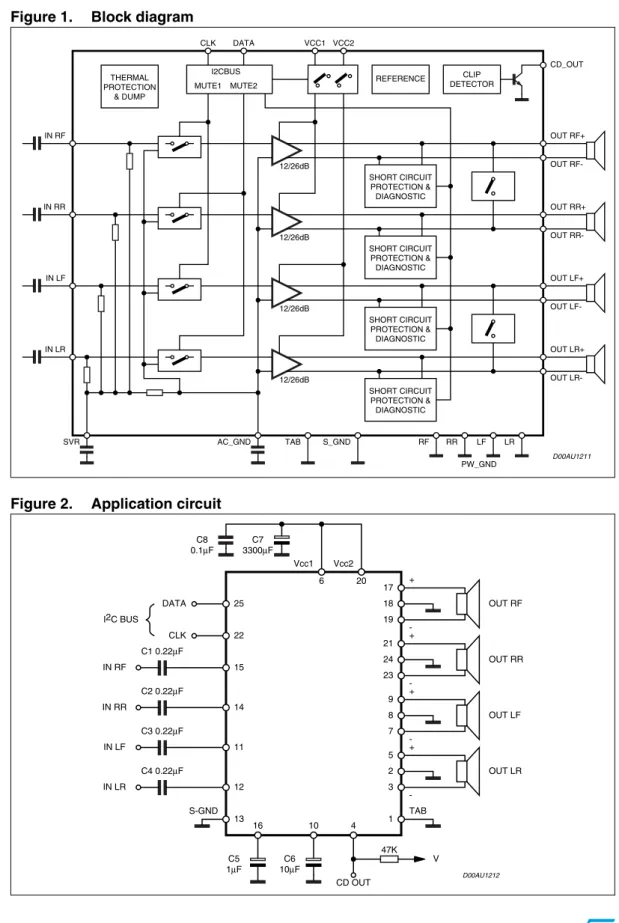
Figure 1. Block diagram
Figure 2. Application circuit
I2CBUS THERMAL PROTECTION & DUMP REFERENCE CD_OUT DATA CLK OUT RF+ SHORT CIRCUIT PROTECTION & DIAGNOSTIC CLIP DETECTOR MUTE1 MUTE2 12/26dB VCC2 VCC1 12/26dB 12/26dB 12/26dB SHORT CIRCUIT PROTECTION & DIAGNOSTIC SHORT CIRCUIT PROTECTION & DIAGNOSTIC SHORT CIRCUIT PROTECTION & DIAGNOSTIC OUT RF-OUT RR+ OUT RR-OUT LF+ OUT LF-OUT LR+ OUT
LR-AC_GND RF RR LF PW_GND LR IN LR S_GND TAB SVR IN LF IN RR IN RF D00AU1211 IN RF
C1 0.22μF
IN RR
C2 0.22μF
OUT RF
OUT RR
IN LF
C3 0.22μF
IN LR
C4 0.22μF
OUT LF
OUT LR
D00AU1212
C5 1μF
C6 10μF
TAB 47K -+ -+ -+ -+ Vcc1 Vcc2 C8 0.1μF
C7 3300μF
DATA I2C BUS CLK 12 11 14 15 22 25 13 S-GND
16 10 4
CD OUT V 6 20 17 18 19 21 24 23 9 8 7 5 2 3 1
2 Pins
description
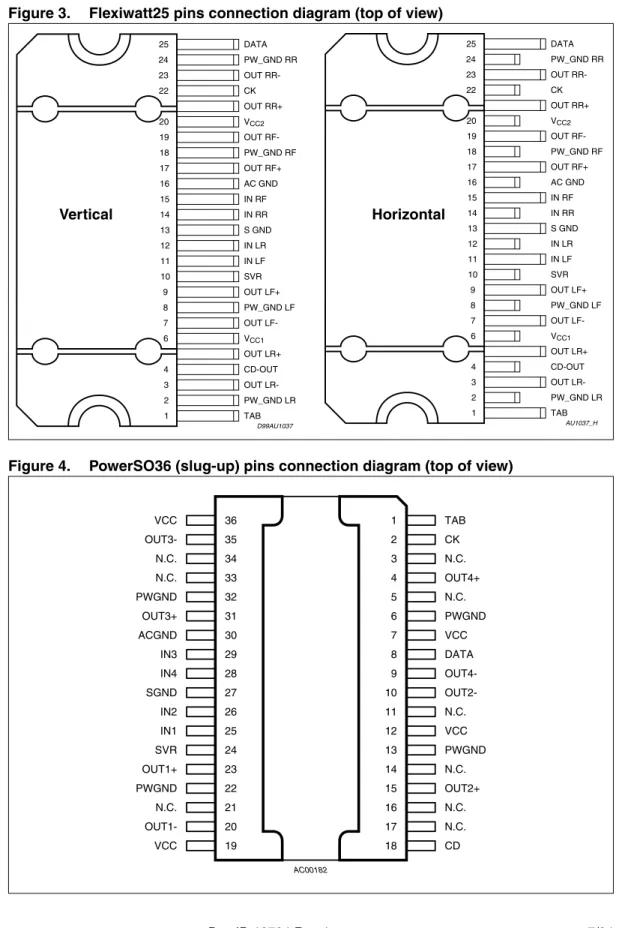
Figure 3. Flexiwatt25 pins connection diagram (top of view)
Figure 4. PowerSO36 (slug-up) pins connection diagram (top of view)
D99AU1037 TAB PW_GND LR OUT LR-CD-OUT OUT LR+ VCC1 OUT LF-PW_GND LF OUT LF+ SVR IN LF IN LR S GND IN RR IN RF AC GND OUT RF+ PW_GND RF OUT RF-VCC2 OUT RR+ CK OUT RR-PW_GND RR DATA 1 25 2 3 4 6 7 8 9 10 11 12 13 14 15 16 17 18 19 20 22 23 24 AU1037_H TAB PW_GND LR OUT LR-CD-OUT OUT LR+ VCC1 OUT LF-PW_GND LF OUT LF+ SVR IN LF IN LR S GND IN RR IN RF AC GND OUT RF+ PW_GND RF OUT RF-VCC2 OUT RR+ CK OUT RR-PW_GND RR DATA 1 25 2 3 4 6 7 8 9 10 11 12 13 14 15 16 17 18 19 20 22 23 24 Vertical Horizontal CD N.C. N.C. OUT2+ PWGND OUT4+ N.C. N.C. CK OUT3-N.C. N.C. OUT3+ PWGND PWGND N.C. OUT1-VCC 18 16 17 15 6 5 4 3 2 21 22 31 32 33 35 34 36 20 1 19 TAB VCC OUT4-VCC DATA ACGND IN4 IN3 9 8 7 28 29 30
OUT2-SGND 27 10
N.C. N.C. VCC IN2 OUT1+ IN1 14 12 11 23 25 26 PWGND
3 Electrical
specifications
3.1
Absolute maximum ratings
3.2 Thermal
data
3.3 Electrical
characteristics
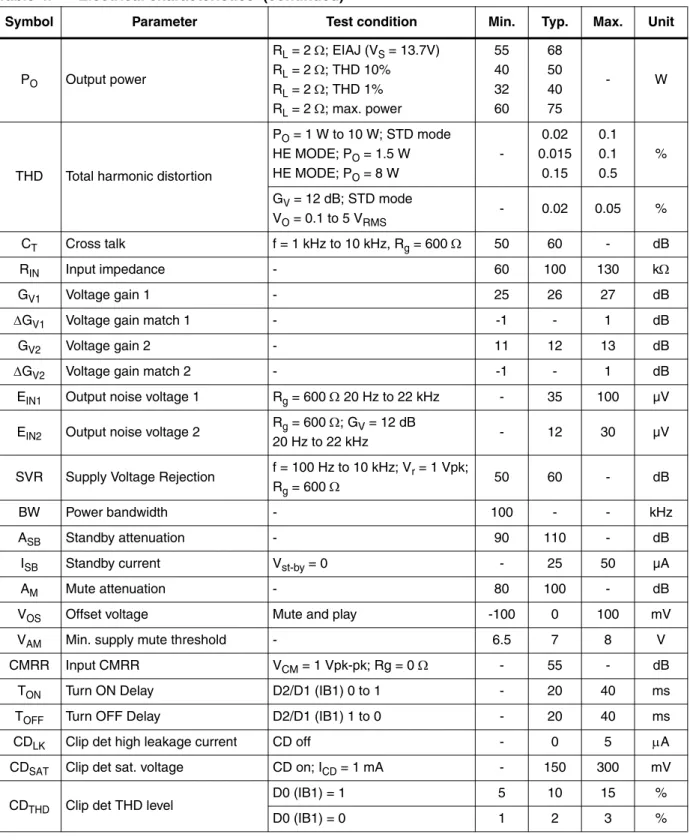
Refer to the test circuit, VS = 14.4 V; RL = 4 ; f = 1 kHz; GV = 30 dB; Tamb = 25 °C; unless otherwise specified.
Table 2. Absolute maximum ratings
Symbol Parameter Value Unit
Vop Operating supply voltage 18 V
VS DC supply voltage 28 V
Vpeak Peak supply voltage (for t = 50 ms) 50 V
VCK CK pin voltage 6 V
VDATA Data pin voltage 6 V
IO Output peak current (not repetitive t = 100 ms) 8 A
IO Output peak current (repetitive f > 10 Hz) 6 A
Ptot Power dissipation Tcase = 70 °C 85 W
Tstg, Tj Storage and junction temperature -55 to 150 °C
Table 3. Thermal data
Symbol Parameter PowerSO Flexiwatt Unit
Rth j-case Thermal resistance junction-to-case Max. 1 1 °C/W
Table 4. Electrical characteristics
Symbol Parameter Test condition Min. Typ. Max. Unit
Power amplifier
VS Supply voltage range - 8 - 18 V
Id Total quiescent drain current - - 170 300 mA
PO Output power
Max. power (VS = 15.2 V, square
wave input (2 Vrms)) - 50 - W
THD = 10 % THD = 1 %
25 20
28
PO Output power
RL = 2 ; EIAJ (VS = 13.7V) RL = 2 ; THD 10% RL = 2 ; THD 1% RL = 2 ; max. power
55 40 32 60
68 50 40 75
- W
THD Total harmonic distortion
PO = 1 W to 10 W; STD mode HE MODE; PO = 1.5 W HE MODE; PO = 8 W
-0.02 0.015
0.15 0.1 0.1 0.5
%
GV = 12 dB; STD mode
VO = 0.1 to 5 VRMS - 0.02 0.05 %
CT Cross talk f = 1 kHz to 10 kHz, Rg = 600 50 60 - dB
RIN Input impedance - 60 100 130 k
GV1 Voltage gain 1 - 25 26 27 dB
GV1 Voltage gain match 1 - -1 - 1 dB
GV2 Voltage gain 2 - 11 12 13 dB
GV2 Voltage gain match 2 - -1 - 1 dB
EIN1 Output noise voltage 1 Rg = 600 20 Hz to 22 kHz - 35 100 µV EIN2 Output noise voltage 2 Rg = 600 ; GV = 12 dB
20 Hz to 22 kHz - 12 30 µV
SVR Supply Voltage Rejection f = 100 Hz to 10 kHz; Vr = 1 Vpk;
Rg = 600 50 60 - dB
BW Power bandwidth - 100 - - kHz
ASB Standby attenuation - 90 110 - dB
ISB Standby current Vst-by = 0 - 25 50 µA
AM Mute attenuation - 80 100 - dB
VOS Offset voltage Mute and play -100 0 100 mV
VAM Min. supply mute threshold - 6.5 7 8 V
CMRR Input CMRR VCM = 1 Vpk-pk; Rg = 0 - 55 - dB
TON Turn ON Delay D2/D1 (IB1) 0 to 1 - 20 40 ms
TOFF Turn OFF Delay D2/D1 (IB1) 1 to 0 - 20 40 ms
CDLK Clip det high leakage current CD off - 0 5 A
CDSAT Clip det sat. voltage CD on; ICD = 1 mA - 150 300 mV
CDTHD Clip det THD level
D0 (IB1) = 1 5 10 15 %
D0 (IB1) = 0 1 2 3 %
Table 4. Electrical characteristics (continued)
Turn on diagnostics 1 (Power amplifier mode)
Pgnd
Short to GND det. (below this limit, the output is considered in short circuit to GND)
Power amplifier in standby
- - 1.2 V
Pvs
Short to Vs det. (above this limit, the output is considered in short circuit to VS)
Vs -1.2 - - V
Pnop
Normal operation thresholds. (Within these limits, the output is considered without faults).
1.8 - Vs -1.8 V
Lsc Shorted load det. - - 0.5
Lop Open load det. 85 - -
Lnop Normal load det. 1.5 - 45
Turn on diagnostics 2 (Line driver mode)
Pgnd
Short to GND det. (below this limit, the output is considered in short circuit to GND)
Power amplifier in standby - - 1.2 V
Pvs
Short to Vs det. (above this limit, the output is considered in short circuit to VS)
- Vs -1.2 - - V
Pnop
Normal operation thresholds. (Within these limits, the output is considered without faults).
- 1.8 - Vs -1.8 V
Lsc Shorted load det. - - - 2
Lop Open load det. - 330 - -
Lnop Normal load det. - 7 - 180
Permanent diagnostics 2 (Power amplifier mode or line driver mode)
Pgnd
Short to GND det. (below this limit, the output is considered in short circuit to GND)
Power amplifier in mute or play, one or more short circuits protection activated
- - 1.2 V
Pvs
Short to Vs det. (above this limit, the output is considered in short circuit to VS)
Vs -1.2 - - V
Pnop
Normal operation thresholds. (within these limits, the output is considered without faults).
1.8 - Vs -1.8 V
LSC Shorted load det. Pow. amp. mode - - 0.5
Line driver mode - - 2
VO Offset detection Power amplifier in play,
AC Input signals = 0 ±1.5 ±2 ±2.5 V
INLH Normal load current detection VO < (VS - 5)pk IB2 (D7) = 0 500 - - mA
Table 4. Electrical characteristics (continued)
3.4 Electrical
characteristics
curves
INLL Normal load current detection VO < (VS - 5)pk IB2 (D7) = 1 250 - mA IOLH Open load current detection VO < (VS - 5)pk IB2 (D7) = 0 - - 250 mA IOLL Open load current detection VO < (VS - 5)pk IB2 (D7) =1 - - 125 mA
I2C bus interface
SCL Clock frequency - - - 400 kHz
VIL Input low voltage - - - 1.5 V
VIH Input high voltage - 2.3 - - V
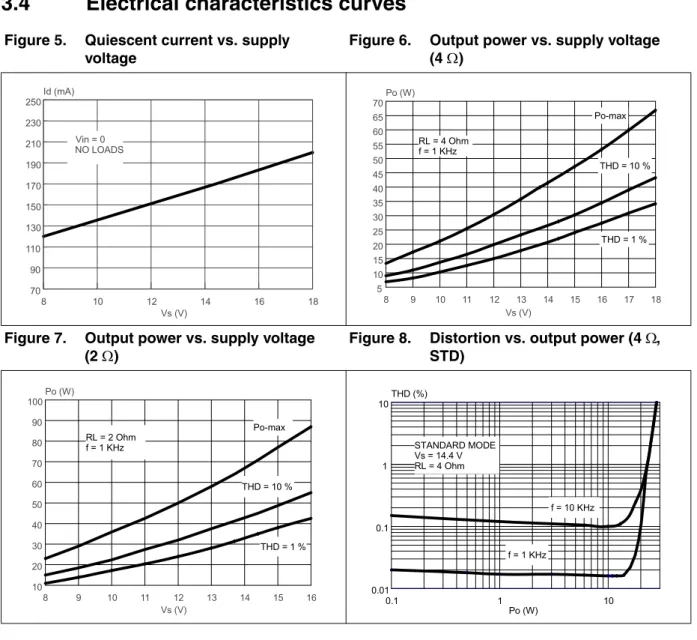
Figure 5. Quiescent current vs. supply
voltage
Figure 6. Output power vs. supply voltage
(4)
Figure 7. Output power vs. supply voltage
(2)
Figure 8. Distortion vs. output power (4 ,
STD)
Table 4. Electrical characteristics (continued)
Symbol Parameter Test condition Min. Typ. Max. Unit
8 10 12 14 16 18
Vs (V) 70 90 110 130 150 170 190 210 230 250Id (mA)
Vin = 0 NO LOADS
8 9 10 11 12 13 14 15 16 17 18 Vs (V) 5 10 15 20 25 30 35 40 45 50 55 60 65 70Po (W)
RL = 4 Ohm f = 1 KHz
THD = 10 %
THD = 1 % Po-max
8 9 10 11 12 13 14 15 16
Vs (V) 10 20 30 40 50 60 70 80 90 100Po (W)
RL = 2 Ohm f = 1 KHz
THD = 10 %
THD = 1 % Po-max
Po (W)
0.1 1 10
0.01 0.1 1 10THD (%)
f = 10 KHz
f = 1 KHz STANDARD MODE Vs = 14.4 V RL = 4 Ohm
Figure 9. Distortion vs. output power (4 , HI-EFF)
Figure 10. Distortion vs. output power (2 ,
STD)
Figure 11. Distortion vs. frequency (4 ) Figure 12. Distortion vs. frequency (2 )
Figure 13. Crosstalk vs. frequency Figure 14. Supply voltage rejection vs. freq.
0.1 1 10
Po (W) 0.001 0.01 0.1 1 10 THD (%)
f = 10 KHz
f = 1 KHz HI-EFF MODE Vs = 14.4 V RL = 4 Ohm
0.1 1 10
Po (W) 0.01
0.1 1 10THD (%)
f = 10 KHz
f = 1 KHz STANDARD MODE
Vs = 14.4 V RL = 2 Ohm
10 100 1000 10000
f (Hz) 0.01
0.1 1 10THD (%)
STANDARD MODE Vs = 14.4 V RL = 4 Ohm Po = 4 W
10 100 1000 10000
f (Hz) 0.1 1 10 THD (%) STANDARD MODE Vs = 14.4 V RL = 2 Ohm Po = 8 W
10 100 1000 10000
f (Hz) 20 30 40 50 60 70 80 90 CROSSTALK (dB) STANDARD MODE RL = 4 Ohm Po = 4 W Rg = 600 Ohm
10 100 1000 10000
f (Hz) 20 30 40 50 60 70 80 90SVR (dB)
STD & HE MODE Rg = 600 Ohm Vripple = 1 Vpk
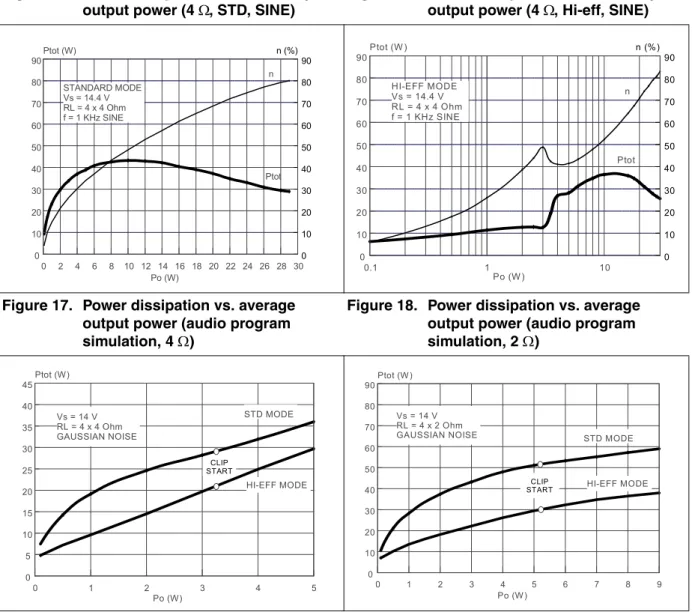
Figure 15. Power dissipation and efficiency vs.
output power (4 , STD, SINE)
Figure 16. Power dissipation and efficiency vs.
output power (4 , Hi-eff, SINE)
Figure 17. Power dissipation vs. average output power (audio program
simulation, 4 )
Figure 18. Power dissipation vs. average output power (audio program
simulation, 2 )
0 2 4 6 8 10 12 14 16 18 20 22 24 26 28 30 Po (W) 0 10 20 30 40 50 60 70 80 90Ptot (W)
0 10 20 30 40 50 60 70 80 90 n (%) Ptot STANDARD MODE
Vs = 14.4 V RL = 4 x 4 Ohm f = 1 KHz SINE
n
0.1 1 10
Po (W ) 0 10 20 30 40 50 60 70 80 90
Ptot (W )
0 10 20 30 40 50 60 70 80 90 n (%) n Ptot HI-EFF MODE
Vs = 14.4 V RL = 4 x 4 Ohm f = 1 KHz SINE
0 1 2 3 4 5
Po (W) 0 5 10 15 20 25 30 35 40 45Ptot (W)
Vs = 14 V RL = 4 x 4 Ohm GAUSSIAN NOISE
STD MODE
HI-EFF MODE CLIP
START
0 1 2 3 4 5 6 7 8 9
Po (W ) 0 10 20 30 40 50 60 70 80 90Ptot (W)
Vs = 14 V RL = 4 x 2 Ohm
GAUSSIAN NOISE STD MODE
HI-EFF MODE CLIP
4
Diagnostics functional description
4.1 Turn-on
diagnostic
It is activated at the turn-on (standby out) under I2C bus request. Detectable output faults are:
● Short to GND
● Short to Vs
● Short across the speaker
● Open speaker
To verify if any of the above misconnections are in place, a subsonic (inaudible) current pulse (Figure 19) is internally generated, sent through the speaker(s) and sunk back.The Turn-on diagnostic status is internally stored until a successive diagnostic pulse is requested (after a I2C reading).
If the "standby out" and "diag. enable" commands are both given through a single programming step, the pulse takes place first (power stage still in standby mode, low, outputs = high impedance).
Afterwards, when the amplifier is biased, the permanent diagnostic takes place. The previous turn-on state is kept until a short appears at the outputs.
Figure 19. Turn - on diagnostic: working principle
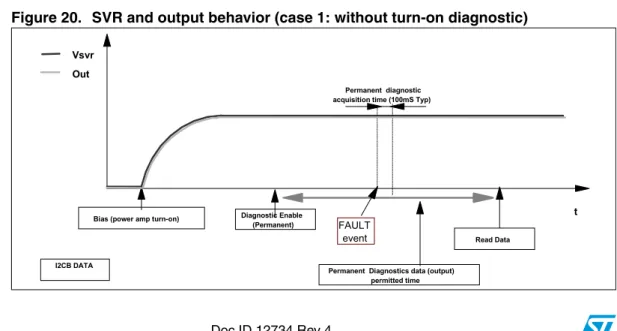
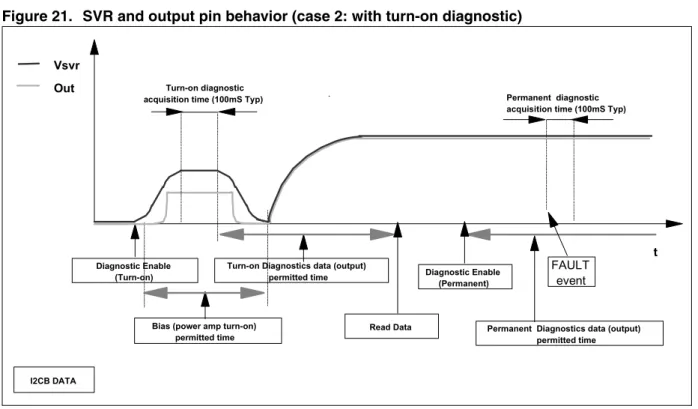
Figure 20 and 21 show SVR and output waveforms at the turn-on (standby out) with and
without turn-on diagnostic.
Figure 20. SVR and output behavior (case 1: without turn-on diagnostic)
CH-CH+ Isource
Vs~5V
Isink
t (ms) I (mA)
Isink Isource
~100mS Measure time
Bias (power amp turn-on) Diagnostic Enable t (Permanent)
Permanent diagnostic acquisition time (100mS Typ)
Permanent Diagnostics data (output) permitted time I2CB DATA
Vsvr Out
FAULT
Figure 21. SVR and output pin behavior (case 2: with turn-on diagnostic)
The information related to the outputs status is read and memorized at the end of the current pulse top. The acquisition time is 100 ms (typ.). No audible noise is generated in the process. As for short to GND / Vs the fault-detection thresholds remain unchanged from 26 dB to 12 dB gain setting. They are as follows:
Figure 22. Short circuit detection thresholds
Concerning short across the speaker / open speaker, the threshold varies from 26 dB to 12 dB gain setting, since different loads are expected (either normal speaker's impedance or high impedance). The values in case of 26 dB gain are as follows:
Figure 23. Load detection thresholds - high gain setting
If the line-driver mode (Gv= 12 dB and Line Driver Mode diagnostic = 1) is selected, the same thresholds will change as follows:
Figure 24. Load detection threshold - low gain setting
Bias (power amp turn-on) permitted time Turn-on diagnostic acquisition time (100mS Typ)
t
Read Data
Permanent diagnostic acquisition time (100mS Typ)
Permanent Diagnostics data (output) permitted time Diagnostic Enable
(Turn-on)
Turn-on Diagnostics data (output) permitted time
I2CB DATA
Vsvr Out
Diagnostic Enable (Permanent)
FAULT event
D01AU1253
S.C. to GND x S.C. to Vs
0V 1.8V VS-1.8V VS
x Normal Operation
1.2V VS-1.2V
S.C. across Load x Open Load
0V 1.5Ω 45Ω Infinite
x Normal Operation
0.5Ω 85Ω
AC00060
4.2 Permanent
diagnostics
Detectable conventional faults are:– Short to GND – Short to VS
– Short across the speaker
The following additional features are provided: – Output offset detection
The TDA7564B has 2 operating statuses:
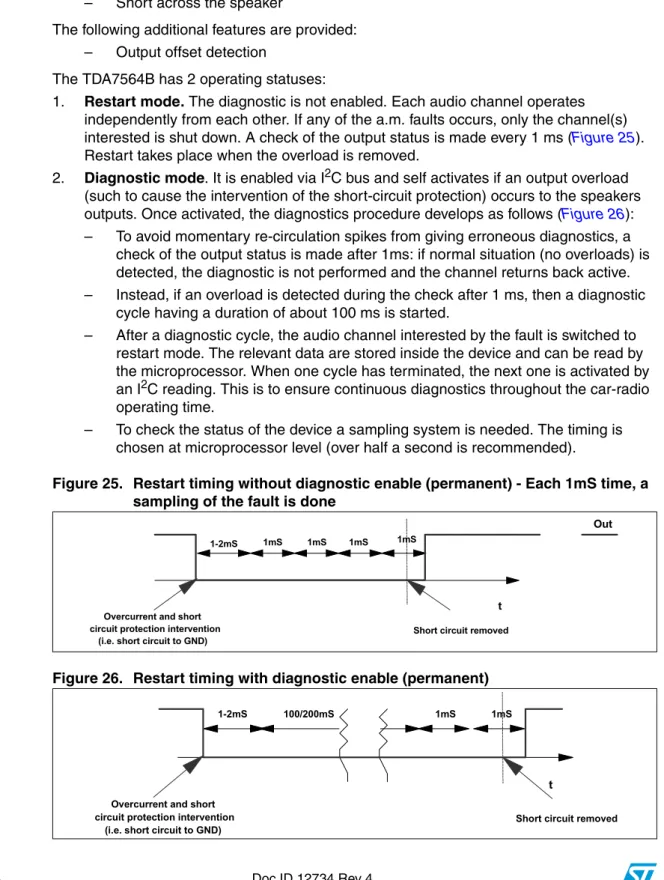
1. Restart mode. The diagnostic is not enabled. Each audio channel operates
independently from each other. If any of the a.m. faults occurs, only the channel(s) interested is shut down. A check of the output status is made every 1 ms (Figure 25). Restart takes place when the overload is removed.
2. Diagnosticmode. It is enabled via I2C bus and self activates if an output overload
(such to cause the intervention of the short-circuit protection) occurs to the speakers outputs. Once activated, the diagnostics procedure develops as follows (Figure 26): – To avoid momentary re-circulation spikes from giving erroneous diagnostics, a
check of the output status is made after 1ms: if normal situation (no overloads) is detected, the diagnostic is not performed and the channel returns back active. – Instead, if an overload is detected during the check after 1 ms, then a diagnostic
cycle having a duration of about 100 ms is started.
– After a diagnostic cycle, the audio channel interested by the fault is switched to restart mode. The relevant data are stored inside the device and can be read by the microprocessor. When one cycle has terminated, the next one is activated by an I2C reading. This is to ensure continuous diagnostics throughout the car-radio operating time.
– To check the status of the device a sampling system is needed. The timing is chosen at microprocessor level (over half a second is recommended).
Figure 25. Restart timing without diagnostic enable (permanent) - Each 1mS time, a sampling of the fault is done
Figure 26. Restart timing with diagnostic enable (permanent) t
1-2mS 1mS 1mS 1mS 1mS
Overcurrent and short circuit protection intervention
(i.e. short circuit to GND)
Short circuit removed
Out
t Overcurrent and short
circuit protection intervention (i.e. short circuit to GND)
Short circuit removed 1-2mS 100/200mS 1mS 1mS
4.3
Output DC offset detection
Any DC output offset exceeding ±2 V are signalled out. This inconvenient might occur as a consequence of initially defective or aged and worn-out input capacitors feeding a DC component to the inputs, so putting the speakers at risk of overheating.
This diagnostic has to be performed with low-level output AC signal (or Vin = 0).
The test is run with selectable time duration by microprocessor (from a "start" to a "stop" command):
– Start = Last reading operation or setting IB1 - D5 - (offset enable) to 1 – Stop = Actual reading operation
Excess offset is signalled out if persistent throughout the assigned testing time. This feature is disabled if any overloads leading to activation of the short-circuit protection occurs in the process.
4.4 AC
diagnostic
It is targeted at detecting accidental disconnection of tweeters in 2-way speaker and, more in general, presence of capacitive (AC) coupled loads.
This diagnostic is based on the notion that the overall speaker's impedance (woofer + parallel tweeter) will tend to increase towards high frequencies if the tweeter gets
disconnected, because the remaining speaker (woofer) would be out of its operating range (high impedance). The diagnostic decision is made according to peak output current thresholds, and it is enabled by setting (IB2-D2) = 1. Two different detection levels are available:
– High current threshold IB2 (D7) = 0 Iout > 500 mApk = normal status Iout < 250 mApk = open tweeter – Low current threshold IB2 (D7) = 1
Iout > 250 mApk = normal status Iout < 125 mApk = open tweeter
To correctly implement this feature, it is necessary to briefly provide a signal tone (with the amplifier in "play") whose frequency and magnitude are such to determine an output current higher than 500 mApk with IB2(D7)=0 (higher than 250mApk with IB2(D7)=1) in normal conditions and lower than 250 mApk with IB2(D7)=0 (lower than 125 mApk with IB2(D7)=1) should the parallel tweeter be missing.
The test has to last for a minimum number of 3 sine cycles starting from the activation of the AC diagnostic function IB2<D2>) up to the I2C reading of the results (measuring period). To confirm presence of tweeter, it is necessary to find at least 3 current pulses over the above threadless over all the measuring period, else an "open tweeter" message will be issued. The frequency / magnitude setting of the test tone depends on the impedance
characteristics of each specific speaker being used, with or without the tweeter connected (to be calculated case by case). High-frequency tones (> 10 kHz) or even ultrasonic signals are recommended for their negligible acoustic impact and also to maximize the impedance module's ratio between with tweeter-on and tweeter-off.
This feature is disabled if any overloads leading to activation of the short-circuit protection occurs in the process.
Figure 27. Current detection high: load impedance |Z| vs. output peak voltage
Figure 28. Current detection low: load impedance |Z| vs. output peak voltage
1 2 3 4 5 6 7 8
1 2 3 5 10 20 30 50
Vout (Peak) Load |z| (Ohm)
Iout (peak) <250mA Iout (peak) >500mA Low current detection area
(Open load) D5 = 1 of the DBx byres
High current detection area (Normal load) D5 = 0 of the DBx bytes
IB2(D7) = 0
0.5 1 1.5 2 2.5 3 3.5 4
1 2 3 5 10 20 30 50
Vout (Peak) Load |z| (Ohm)
Iout (peak) <125mA Iout (peak) >250mA
Low current detection area (Open load) D5 = 1 of the DBx byres
High current detection area (Normal load) D5 = 0 of the DBx bytes
5 Multiple
faults
When more misconnections are simultaneously in place at the audio outputs, it is guaranteed that at least one of them is initially read out. The others are notified after successive cycles of I2C reading and faults removal, provided that the diagnostic is enabled. This is true for both kinds of diagnostic (turn-on and permanent).
The table below shows all the couples of double-fault possible. It should be taken into account that a short circuit with the 4 ohm speaker unconnected is considered as double fault.
S. GND (so) / S. GND (sk) in the above table make a distinction according to which of the 2 outputs is shorted to ground (test-current source side= so, test-current sink side = sk). More precisely, in Channels LF and RR, so = CH+, sk = CH-; in Channels LR and RF, so = CH-, sk = CH+.
In permanent diagnostic the table is the same, with only a difference concerning open load (*), which is not among the recognizable faults. Should an Open Load be present during the device's normal working, it would be detected at a subsequent Turn on Diagnostic cycle (i.e. at the successive car radio turn-on).
5.1 Faults
availability
All the results coming from I2C bus, by read operations, are the consequence of
measurements inside a defined period of time. If the fault is stable throughout the whole period, it will be sent out.
To guarantee always resident functions, every kind of diagnostic cycles (turn-on, permanent, offset) will be reactivate after any I2C reading operation. So, when the micro reads the I2C, a new cycle will be able to start, but the read data will come from the previous diag. cycle (i.e. The device is in turn-on state, with a short to GND, then the short is removed and micro reads I2C. The short to GND is still present in bytes, because it is the result of the previous cycle. If another I2C reading operation occurs, the bytes do not show the short). In general to observe a change in diagnostic bytes, two I2C reading operations are necessary.
Table 5. Double fault table for turn-on diagnostic
S. GND (so) S. GND (sk) S. Vs S. Across L. Open L.
S. GND (so) S. GND S. GND S. Vs + S.
GND S. GND S. GND
S. GND (sk) / S. GND S. Vs S. GND Open L. (*)
S. Vs / / S. Vs S. Vs S. Vs
S. Across L. / / / S. Across L. N.A.
6 Thermal
protection
Thermal protection is implemented through thermal foldback (Figure 29).
Thermal foldback begins limiting the audio input to the amplifier stage as the junction temperatures rise above the normal operating range. This effectively limits the output power capability of the device thus reducing the temperature to acceptable levels without totally interrupting the operation of the device.
The output power will decrease to the point at which thermal equilibrium is reached. Thermal equilibrium will be reached when the reduction in output power reduces the dissipated power such that the die temperature falls below the thermal foldback threshold. Should the device cool, the audio level will increase until a new thermal equilibrium is reached or the amplifier reaches full power. Thermal foldback will reduce the audio output level in a linear manner.
Three thermal warning are available through the I2C bus data.
Figure 29. Thermal foldback diagram
6.1 I
2
C programming/reading sequences
A correct turn on/off sequence respectful of the diagnostic timings and producing no audible noises could be as follows (after battery connection):
Turn-on: (standby out + diag enable) --- 500 ms (min.) --- muting out Turn-off: muting in --- 20 ms --- (diag disable + standby in)
Car radio Installation: diag enable (write) --- 200 ms --- I2C read (repeat until all faults disappear).
AC test: feed h.f. tone -- AC diag enable (write) --- wait > 3 cycles --- I2C read (repeat I2C reading until tweeter-off message disappears).
Offset test: device in play (no signal) -- offset enable - 30ms - I2C reading (repeat I2C reading until high-offset message disappears).
Tj ( °C)
TH. SH. START
TH. SH. END
Vout TH. WARN. ON
Tj ( °C) Vout
Tj ( °C) SD(with same input
signal) < TSD
CD out
TH. WARN. ON
TH. WARN. ON
125° 140° 155°
7 Fast
muting
The muting time can be shortened to less than 1.5ms by setting (IB2) D5 = 1. This option can be useful in transient battery situations (i.e. during car engine cranking) to quickly turnoff the amplifier for avoiding any audible effects caused by noise/transients being injected by preamp stages. The bit must be set back to “0” shortly after the mute transition.
8 I
2
C bus interface
Data transmission from microprocessor to the TDA7564B and vice versa takes place through the 2 wires I2C bus interface, consisting of the two lines SDA and SCL (pull-up resistors to positive supply voltage must be connected).
8.1 Data
validity
As shown by Figure 30, the data on the SDA line must be stable during the high period of the clock. The high and low state of the data line can only change when the clock signal on the SCL line is LOW.
8.2
Start and stop conditions
As shown by Figure 31 a start condition is a high to low transition of the SDA line while SCL is high. The stop condition is a low to high transition of the SDA line while SCL is high.
8.3 Byte
format
Every byte transferred to the SDA line must contain 8 bits. Each byte must be followed by an acknowledge bit. The MSB is transferred first.
8.4 Acknowledge
The transmitter* puts a resistive high level on the SDA line during the acknowledge clock pulse (see Figure 32). The receiver** the acknowledges has to pull-down (low) the SDA line during the acknowledge clock pulse, so that the SDA line is stable low during this clock pulse.
* Transmitter
– master (P) when it writes an address to the TDA7564B
– slave (TDA7564B) when the P reads a data byte from TDA7564B ** Receiver
– slave (TDA7564B) when the P writes an address to the TDA7564B – master (µP) when it reads a data byte from TDA7564B
Figure 30. Data validity on the I2C bus
SDA
SCL
DATA LINE STABLE, DATA
VALID
CHANGE DATA
Figure 31. Timing diagram on the I2C bus
Figure 32. Acknowledge on the I2C bus
SCL
SDA
START
I2CBUS
STOP D99AU1032
SCL 1
MSB
2 3 7 8 9
SDA
9 Software
specifications
All the functions of the TDA7564B are activated by I2C interface.
The bit 0 of the "Address byte" defines if the next bytes are write instruction (from µP to TDA7564B) or read instruction (from TDA7564B to µP).
X = 0 Write to device X = 1 Read from device
If R/W = 0, the P sends 2 "Instruction bytes": IB1 and IB2.
D7 D0
1 1 0 1 1 0 0 X D8 Hex
Table 6. IB1
Bit Instruction decoding bit
D7 0
D6 Diagnostic enable (D6 = 1) Diagnostic defeat (D6 = 0)
D5 Offset Detection enable (D5 = 1) Offset Detection defeat (D5 = 0)
D4
Front Channel Gain = 26dB (D4 = 0) Gain = 12dB (D4 = 1)
D3
Rear Channel Gain = 26dB (D3 = 0) Gain = 12dB (D3 = 1)
D2 Mute front channels (D2 = 0) Unmute front channels (D2 = 1)
D1 Mute rear channels (D1 = 0) Unmute rear channels (D1 = 1)
D0 Clip detector 2% (D0 = 0) Clip detector 10% (D0 = 1)
If R/W = 1, the TDA7564B sends 4 "Diagnostics Bytes" to P: DB1, DB2, DB3 and DB4.
Table 7. IB2
Bit Instruction decoding bit
D7
Current detection threshold High th (D7 = 0)
Low th (D7 =1)
D6 0
D5 Normal muting time (D5 = 0) Fast muting time (D5 = 1)
D4 Standby on - Amplifier not working - (D4 = 0) Standby off - Amplifier working - (D4 = 1) D3 Power amplifier mode diagnostic (D3 = 0)
Line driver mode diagnostic (D3 = 1)
D2 Current detection diagnostic enabled (D2 = 1) Current detection diagnostic defeat (D2 = 0)
D1
Right Channels
Power amplifier working in standard mode (D1 = 0) Power amplifier working in high efficiency mode (D1 = 1)
D0
Left Channels
Power amplifier working in standard mode (D0 = 0) Power amplifier working in high efficiency mode (D0 = 1)
Table 8. DB1
Bit Instruction decoding bit
D7 Thermal warning 1 active (D7 = 1) T=155 °C
D6 Diag. cycle not activated or not terminated (D6 = 0) Diag. cycle terminated (D6 = 1)
D5
Channel LF
Current detection IB2 (D7) = 0
Output peak current < 250 mA - Open load (D5 = 1) Output peak current > 500 mA - Normal load (D5 = 0)
Channel LF
Current detection IB2 (D7) = 1
Output peak current < 125 mA - Open load (D5 = 1) Output peak current > 250 mA - Normal load (D5 = 0)
D4
Channel LF
Turn-on diagnostic (D4 = 0) Permanent diagnostic (D4 = 1)
D3
Channel LF
Normal load (D3 = 0) Short load (D3 = 1)
D2
Channel LF
Turn-on diag.: No open load (D2 = 0) Open load detection (D2 = 1)
Offset diag.: No output offset (D2 = 0) Output offset detection (D2 = 1)
D1
Channel LF
No short to Vcc (D1 = 0) Short to Vcc (D1 = 1)
D0
Channel LF
Table 9. DB2
Bit Instruction decoding bit
D7 Offset detection not activated (D7 = 0) Offset detection activated (D7 = 1)
D6 Current sensor not activated (D6 = 0) Current sensor activated (D6 = 1)
D5
Channel LR
Current detection IB2 (D7) = 0
Output peak current < 250 mA - Open load (D5 = 1) Output peak current > 500 mA - Normal load (D5 = 0)
Channel LR
Current detection IB2 (D7) = 1
Output peak current < 250 mA - Open load (D5 = 1) Output peak current > 500 mA - Normal load (D5 = 0)
D4
Channel LR
Turn-on diagnostic (D4 = 0) Permanent diagnostic (D4 = 1)
D3
Channel LR
Normal load (D3 = 0) Short load (D3 = 1)
D2
Channel LR
Turn-on diag.: No open load (D2 = 0) Open load detection (D2 = 1)
Permanent diag.: No output offset (D2 = 0) Output offset detection (D2 = 1)
D1
Channel LR
No short to Vcc (D1 = 0) Short to Vcc (D1 = 1)
D0
Channel LR
No short to GND (D1 = 0) Short to GND (D1 = 1)
Table 10. DB3
Bit Instruction decoding bit
D7 Standby status (= IB2 - D4) D6 Diagnostic status (= IB1 - D6)
D5
Channel RF
Current detection IB2 (D7) = 0
Output peak current < 250 mA - Open load (D5 = 1) Output peak current > 500 mA - Normal load (D5 = 0)
Channel RF
Current detection IB2 (D7) = 1
Output peak current < 250 mA - Open load (D5 = 1) Output peak current > 500 mA - Normal load (D5 = 0)
D4
Channel RF
Turn-on diagnostic (D4 = 0) Permanent diagnostic (D4 = 1)
D3
Channel RF
Normal load (D3 = 0) Short load (D3 = 1)
D2
Channel RF
Turn-on diag.: No open load (D2 = 0) Open load detection (D2 = 1)
Permanent diag.: No output offset (D2 = 0) Output offset detection (D2 = 1)
D1
Channel RF
No short to Vcc (D1 = 0) Short to Vcc (D1 = 1)
D0
Channel RF
No short to GND (D1 = 0) Short to GND (D1 = 1)
Table 11. DB4
Bit Instruction decoding bit
D7 Thermal warning 2 active (D7 =1) T=140°C D6 Thermal warning 3 active (D6 =1) T=125°C
D5
Channel RR
Current detection IB2 (D7) = 0
Output peak current < 250 mA - Open load (D5 = 1) Output peak current > 500 mA - Normal load (D5 = 0)
Channel RR
Current detection IB2 (D7) = 1
Output peak current < 250 mA - Open load (D5 = 1) Output peak current > 500 mA - Normal load (D5 = 0)
D4
Channel RR
Turn-on diagnostic (D4 = 0) Permanent diagnostic (D4 = 1)
D3
Channel RR
Normal load (D3 = 0) Short load (D3 = 1)
D2
Channel RR
Turn-on diag.: No open load (D2 = 0) Open load detection (D2 = 1)
Permanent diag.: No output offset (D2 = 0) Output offset detection (D2 = 1)
D1
Channel RR
No short to Vcc (D1 = 0) Short to Vcc (D1 = 1)
D0
Channel RR
No short to GND (D1 = 0) Short to GND (D1 = 1)
10
Examples of bytes sequence
1 - Turn-on diagnostic - Write operation
2 - Turn-on diagnostic - Read operation
The delay from 1 to 2 can be selected by software, starting from 1 ms
3a - Turn-on of the power amplifier with 26dB gain, mute on, diagnostic defeat, High eff. mode both channels.
.
3b - Turn-off of the power amplifier
4 - Offset detection procedure enable
5 - Offset detection procedure stop and reading operation (the results are valid only for the offset detection bits (D2 of the bytes DB1, DB2, DB3, DB4)
.
● The purpose of this test is to check if a D.C. offset (2V typ.) is present on the outputs, produced by input capacitor with anomalous leakage current or humidity between pins.
● The delay from 4 to 5 can be selected by software, starting from 1ms
6 - Current detection procedure start (the AC inputs must be with a proper signal that depends on the type of load)
Current detection reading operation (the results valid only for the current sensor detection bits - D5 of the bytes DB1, DB2, DB3, DB4)
.
● During the test, a sinus wave with a proper amplitude and frequency (depending on the loudspeaker under test) must be present. The minimum number of periods that are needed to detect a normal load is 5.
Start Address byte with D0 = 0 ACK IB1 with D6 = 1 ACK IB2 ACK STOP
Start Address byte with D0 = 1 ACK DB1 ACK DB2 ACK DB3 ACK DB4 ACK STOP
Start Address byte with D0 = 0 ACK IB1 ACK IB2 ACK STOP
X000000X XXX1X011
Start Address byte with D0 = 0 ACK IB1 ACK IB2 ACK STOP
X0XXXXXX XXX0XXXX
Start Address byte with D0 = 0 ACK IB1 ACK IB2 ACK STOP
XX1XX11X XXX1X0XX
Start Address byte with D0 = 1 ACK DB1 ACK DB2 ACK DB3 ACK DB4 ACK STOP
Start Address byte with D0 = 0 ACK IB1 ACK IB2 ACK STOP
XX01111X XXX1X1XX
11 Package
information
In order to meet environmental requirements, ST offers these devices in different grades of ECOPACK® packages, depending on their level of environmental compliance. ECOPACK® specifications, grade definitions and product status are available at: www.st.com.
ECOPACK® is an ST trademark.
Figure 33. Flexiwatt25 (horizontal) mechanical data and package dimensions
OUTLINE AND MECHANICAL DATA DIM. MIN. TYP.mm MAX. MIN. TYP.inch MAX.
A 4.45 4.50 4.65 0.175 0.177 0.183 B 1.80 1.90 2.00 0.070 0.074 0.079 C 1.40 0.055 D 2.00 0.079 E 0.37 0.39 0.42 0.014 0.015 0.016 F (1) 0.57 0.022 G 0.75 1.00 1.25 0.029 0.040 0.049 G1 23.70 24.00 24.30 0.933 0.945 0.957 H (2) 28.90 29.23 29.30 1.139 1.150 1.153
H1 17.00 0.669 H2 12.80 0.503 H3 0.80 0.031 L (2) 21.64 22.04 22.44 0.852 0.868 0.883
L1 10.15 10.5 10.85 0.40 0.413 0.427 L2 (2) 15.50 15.70 15.90 0.610 0.618 0.626 L3 7.70 7.85 7.95 0.303 0.309 0.313 L4 5 0.197 L5 5.15 5.45 5.85 0.203 0.214 0.23 L6 1.80 1.95 2.10 0.070 0.077 0.083 M 2.75 3.00 3.50 0.108 0.118 0.138 M1 4.73 0.186 M2 5.61 0.220 N 2.20 0.086 P 3.20 3.50 3.80 0.126 0.138 0.15 R 1.70 0.067 R1 0.50 0.02 R2 0.30 0.12 R3 1.25 0.049 R4 0.50 0.02
V 5 (Typ.)
V1 3 (Typ.)
V2 20 (Typ.)
V3 45 (Typ.)
Flexiwatt25 (Horizontal)
7399733 C
Figure 34. Flexiwatt25 (vertical) mechanical data and package dimensions
OUTLINE AND MECHANICAL DATA
DIM. mm inch
MIN. TYP. MAX. MIN. TYP. MAX.
A 4.45 4.50 4.65 0.175 0.177 0.183 B 1.80 1.90 2.00 0.070 0.074 0.079
C 1.40 0.055
D 0.75 0.90 1.05 0.029 0.035 0.041 E 0.37 0.39 0.42 0.014 0.015 0.016
F (1) 0.57 0.022
G 0.80 1.00 1.20 0.031 0.040 0.047 G1 23.75 24.00 24.25 0.935 0.945 0.955 H (2) 28.90 29.23 29.30 1.139 1.150 1.153
H1 17.00 0.669
H2 12.80 0.503
H3 0.80 0.031
L (2) 22.07 22.47 22.87 0.869 0.884 0.904 L1 18.57 18.97 19.37 0.731 0.747 0.762 L2 (2) 15.50 15.70 15.90 0.610 0.618 0.626 L3 7.70 7.85 7.95 0.303 0.309 0.313
L4 5 0.197
L5 3.5 0.138
M 3.70 4.00 4.30 0.145 0.157 0.169 M1 3.60 4.00 4.40 0.142 0.157 0.173
N 2.20 0.086
O 2 0.079
R 1.70 0.067
R1 0.5 0.02
R2 0.3 0.12
R3 1.25 0.049
R4 0.50 0.019
V1 3˚ (Typ.)
V 5˚ (T p.)
V2 20˚ (Typ.)
V3 45˚ (Typ.)
(2): molding protusion included (1): dam-bar protusion not included
Flexiwatt25 (vertical)
H3 R4 G V G1 L2 H1 H F M1 L FLEX25ME V3 O L3 L4 H2 R3 N V2 R R2 R2 C B L1 M R1L5 R1 R1 E D A Pin 1 V V1 V1 7034862
Figure 35. PowerSO36 (slug up) mechanical data and package dimensions OUTLINE AND MECHANICAL DATA
DIM. mm inch
MIN. TYP. MAX. MIN. TYP. MAX.
A 3.270 - 3.410 0.1287 - 0.1343 A2 3.100 - 3.180 0.1220 - 0.1252 A4 0.800 - 1.000 0.0315 - 0.0394 A5 - 0.200 - - 0.0079 -a1 0.030 - -0.040 0.0012 - -0.0016
b 0.220 - 0.380 0.0087 - 0.0150 c 0.230 - 0.320 0.0091 - 0.0126 D 15.800 - 16.000 0.6220 - 0.6299 D1 9.400 - 9.800 0.3701 - 0.3858 D2 - 1.000 - - 0.0394
-E 13.900 - 14.500 0.5472 - 0.5709 E1 10.900 - 11.100 0.4291 - 0.4370 E2 - - 2.900 - - 0.1142 E3 5.800 - 6.200 0.2283 - 0.2441 E4 2.900 - 3.200 0.1142 - 0.1260
e - 0.650 - - 0.0256 -e3 - 11.050 - - 0.4350
-G 0 - 0.075 0 - 0.0031
H 15.500 - 15.900 0.6102 - 0.6260
h - - 1.100 - - 0.0433
L 0.800 - 1.100 0.0315 - 0.0433
N - - 10˚ - - 10˚
s - - 8˚ - - 8˚
(1) “D and E1” do not include mold flash or protusions. Mold flash or protusions shall not exceed 0.15mm (0.006”). (2) No intrusion allowed inwards the leads.
PowerSO36 (SLUG UP)
12 Revision
history
Table 12. Document revision history
Date Revision Changes
14-Sep-2006 1 Initial release.
22-Jan-2007 2
Add new package and part numbers in Table 1: Device summary on page 1.
Add PowerSO36 pin connections diagram Figure 4 on page 7. Changed the max. value of the “Lonp” parameter in Table 4 on page 8.
Modified Figure 23 on page 15.
Add PowerSO36 package information Figure 35 on page 32. Changed the min. and typ. value of the VM parameter in the
Table 4.
Updated Table 3: Thermal data.
15-Dec-2009 3 Updated Figure 35: PowerSO36 (slug up) mechanical data and
package dimensions on page 32.
Please Read Carefully:
Information in this document is provided solely in connection with ST products. STMicroelectronics NV and its subsidiaries (“ST”) reserve the right to make changes, corrections, modifications or improvements, to this document, and the products and services described herein at any time, without notice.
All ST products are sold pursuant to ST’s terms and conditions of sale.
Purchasers are solely responsible for the choice, selection and use of the ST products and services described herein, and ST assumes no liability whatsoever relating to the choice, selection or use of the ST products and services described herein.
No license, express or implied, by estoppel or otherwise, to any intellectual property rights is granted under this document. If any part of this document refers to any third party products or services it shall not be deemed a license grant by ST for the use of such third party products or services, or any intellectual property contained therein or considered as a warranty covering the use in any manner whatsoever of such third party products or services or any intellectual property contained therein.
UNLESS OTHERWISE SET FORTH IN ST’S TERMS AND CONDITIONS OF SALE ST DISCLAIMS ANY EXPRESS OR IMPLIED WARRANTY WITH RESPECT TO THE USE AND/OR SALE OF ST PRODUCTS INCLUDING WITHOUT LIMITATION IMPLIED WARRANTIES OF MERCHANTABILITY, FITNESS FOR A PARTICULAR PURPOSE (AND THEIR EQUIVALENTS UNDER THE LAWS OF ANY JURISDICTION), OR INFRINGEMENT OF ANY PATENT, COPYRIGHT OR OTHER INTELLECTUAL PROPERTY RIGHT. ST PRODUCTS ARE NOT DESIGNED OR AUTHORIZED FOR USE IN: (A) SAFETY CRITICAL APPLICATIONS SUCH AS LIFE SUPPORTING, ACTIVE IMPLANTED DEVICES OR SYSTEMS WITH PRODUCT FUNCTIONAL SAFETY REQUIREMENTS; (B) AERONAUTIC APPLICATIONS; (C) AUTOMOTIVE APPLICATIONS OR ENVIRONMENTS, AND/OR (D) AEROSPACE APPLICATIONS OR ENVIRONMENTS. WHERE ST PRODUCTS ARE NOT DESIGNED FOR SUCH USE, THE PURCHASER SHALL USE PRODUCTS AT PURCHASER’S SOLE RISK, EVEN IF ST HAS BEEN INFORMED IN WRITING OF SUCH USAGE, UNLESS A PRODUCT IS
EXPRESSLY DESIGNATED BY ST AS BEING INTENDED FOR “AUTOMOTIVE, AUTOMOTIVE SAFETY OR MEDICAL” INDUSTRY DOMAINS ACCORDING TO ST PRODUCT DESIGN SPECIFICATIONS. PRODUCTS FORMALLY ESCC, QML OR JAN QUALIFIED ARE DEEMED SUITABLE FOR USE IN AEROSPACE BY THE CORRESPONDING GOVERNMENTAL AGENCY.
Resale of ST products with provisions different from the statements and/or technical features set forth in this document shall immediately void any warranty granted by ST for the ST product or service described herein and shall not create or extend in any manner whatsoever, any liability of ST.
ST and the ST logo are trademarks or registered trademarks of ST in various countries. Information in this document supersedes and replaces all information previously supplied.
The ST logo is a registered trademark of STMicroelectronics. All other names are the property of their respective owners.
© 2013 STMicroelectronics - All rights reserved
STMicroelectronics group of companies
Australia - Belgium - Brazil - Canada - China - Czech Republic - Finland - France - Germany - Hong Kong - India - Israel - Italy - Japan - Malaysia - Malta - Morocco - Philippines - Singapore - Spain - Sweden - Switzerland - United Kingdom - United States of America