praktijkrichtlijn
IT security techniques - Information
security incident management (ISO/IEC
TR 18044:2004,IDT)
november 2004 ICS 35.040
Als Nederlandse praktijkrichtlijn is aanvaard: - ISO/IEC TR 18044:2004,IDT
Normcommissie 381 027 "IT-Beveiligingstechnieken"
Apart from exceptions provided by the law, nothing from this publication may be duplicated and/or published by means of photocopy, microfilm, storage in computer files or otherwise, which also applies to full or partial processing, without the written consent of the Netherlands Standardization Institute.
The Netherlands Standardization Institute shall, with the
exclusion of any other beneficiary, collect payments owed by third parties for duplication and/or act in and out of law, where this authority is not transferred or falls by right to the Reproduction Rights Foundation.
Although the utmost care has been taken with this publication, errors and omissions cannot be entirely excluded. The Netherlands Standardization Institute and/or the members of the committees therefore accept no liability, not even for direct or indirect damage, occurring due to or in relation with the application of publications issued by the Netherlands Standardization Institute.
Auteursrecht voorbehouden. Behoudens uitzondering door de wet gesteld mag zonder schriftelijke toestemming van het Nederlands Normalisatie-instituut niets uit deze uitgave worden verveelvoudigd en/of openbaar gemaakt door middel van fotokopie, microfilm, opslag in computerbestanden of anderszins, hetgeen ook van toepassing is op gehele of gedeeltelijke bewerking.
Het Nederlands Normalisatie-instituut is met uitsluiting van ieder ander gerechtigd de door derden verschuldigde vergoedingen voor verveelvoudiging te innen en/of daartoe in en buiten rechte op te treden, voor zover deze bevoegdheid niet is overgedragen c.q. rechtens toekomt aan de Stichting Reprorecht.
Hoewel bij deze uitgave de uiterste zorg is nagestreefd, kunnen fouten en onvolledigheden niet geheel worden uitgesloten. Het Nederlands Normalisatie-instituut en/of de leden van de commissies aanvaarden derhalve geen enkele aansprakelijkheid, ook niet voor directe of indirecte schade, ontstaan door of verband houdend met toepassing van door het Nederlands Normalisatie-instituut gepubliceerde uitgaven.
©2004 Nederlands Normalisatie-instituut Postbus 5059, 2600 GB Delft
Voorbeeld
Preview
Reference number ISO/IEC TR 18044:2004(E)
TECHNICAL
REPORT
ISO/IEC
TR
18044
First edition 2004-10-15
Information technology — Security
techniques — Information security
incident management
Technologies de l'information — Techniques de sécurité — Gestion d'incidents de sécurité de l'information
Voorbeeld
PDF disclaimer
This PDF file may contain embedded typefaces. In accordance with Adobe's licensing policy, this file may be printed or viewed but shall not be edited unless the typefaces which are embedded are licensed to and installed on the computer performing the editing. In downloading this file, parties accept therein the responsibility of not infringing Adobe's licensing policy. The ISO Central Secretariat accepts no liability in this area.
Adobe is a trademark of Adobe Systems Incorporated.
Details of the software products used to create this PDF file can be found in the General Info relative to the file; the PDF-creation parameters were optimized for printing. Every care has been taken to ensure that the file is suitable for use by ISO member bodies. In the unlikely event that a problem relating to it is found, please inform the Central Secretariat at the address given below.
© ISO/IEC 2004
All rights reserved. Unless otherwise specified, no part of this publication may be reproduced or utilized in any form or by any means, electronic or mechanical, including photocopying and microfilm, without permission in writing from either ISO at the address below or ISO's member body in the country of the requester.
ISO copyright office
Case postale 56 x CH-1211 Geneva 20 Tel. + 41 22 749 01 11
Fax + 41 22 749 09 47 E-mail [email protected] Web www.iso.org Published in Switzerland
Voorbeeld
ISO/IEC TR 18044:2004(E)
Contents
PageForeword... v
Introduction... vi
1 Scope ... 1
2 Normative References... 1
3 Terms and Definitions ... 1
3.1 Business continuity planning ... 1
3.2 Information security event ... 2
3.3 Information security incident ... 2
3.4 ISIRT (Information Security Incident Response Team)... 2
3.5 Other ... 2
4 Background ... 2
4.1 Objectives... 2
4.2 Processes ... 2
5 Benefits and Key Issues ... 5
5.1 Benefits ... 5
5.2 Key Issues ... 7
6 Examples of Information Security Incidents and their Causes... 11
6.1 Denial of Service... 11
6.2 Information Gathering... 12
6.3 Unauthorized Access... 13
7 Plan and Prepare... 13
7.1 Overview... 13
7.2 Information Security Incident Management Policy ... 14
7.3 Information Security Incident Management Scheme ... 16
7.4 Information Security and Risk Management Policies ... 19
7.5 Establishment of the ISIRT ... 20
7.6 Technical and Other Support... 21
7.7 Awareness and Training... 22
8 Use ... 23
8.1 Introduction... 23
8.2 Overview of Key Processes... 24
8.3 Detection and Reporting ... 26
8.4 Event/Incident Assessment and Decision... 27
8.5 Responses... 30
9 Review ... 36
9.1 Introduction... 36
9.2 Further Forensic Analysis ... 36
9.3 Lessons Learnt ... 36
9.4 Identification of Security Improvements... 37
9.5 Identification of Scheme Improvements ... 37
10 Improve... 37
10.1 Introduction... 37
10.2 Security Risk Analysis and Management Improvement ... 37
10.3 Make Security Improvements ... 38
Voorbeeld
10.4 Make Scheme Improvements ...38
10.5 Other Improvements ...38
11 Summary ...38
Annex A (informative) Example Information Security Event and Incident Report Forms ...39
Annex B (informative) Example Outline Guidelines for Assessing Information Security Incidents ...46 Bibliography...50
Voorbeeld
ISO/IEC TR 18044:2004(E)
Foreword
ISO (the International Organization for Standardization) and IEC (the International Electrotechnical Commission) form the specialized system for worldwide standardization. National bodies that are members of ISO or IEC participate in the development of International Standards through technical committees established by the respective organization to deal with particular fields of technical activity. ISO and IEC technical committees collaborate in fields of mutual interest. Other international organizations, governmental and non-governmental, in liaison with ISO and IEC, also take part in the work. In the field of information technology, ISO and IEC have established a joint technical committee, ISO/IEC JTC 1.
International Standards are drafted in accordance with the rules given in the ISO/IEC Directives, Part 2. The main task of the joint technical committee is to prepare International Standards. Draft International Standards adopted by the joint technical committee are circulated to national bodies for voting. Publication as an International Standard requires approval by at least 75 % of the national bodies casting a vote.
In exceptional circumstances, the joint technical committee may propose the publication of a Technical Report of one of the following types:
— type 1, when the required support cannot be obtained for the publication of an International Standard, despite repeated efforts;
— type 2, when the subject is still under technical development or where for any other reason there is the future but not immediate possibility of an agreement on an International Standard;
— type 3, when the joint technical committee has collected data of a different kind from that which is normally published as an International Standard (“state of the art”, for example).
Technical Reports of types 1 and 2 are subject to review within three years of publication, to decide whether they can be transformed into International Standards. Technical Reports of type 3 do not necessarily have to be reviewed until the data they provide are considered to be no longer valid or useful.
ISO/IEC TR 18044, which is a Technical Report of type 3, was prepared by Joint Technical Committee ISO/IEC JTC 1, Information technology, Subcommittee SC 27, IT Security techniques.
Voorbeeld
Introduction
No typical information security policies or safeguards will guarantee total protection of information, information systems, services or networks. After safeguards have been implemented, residual weaknesses are likely to remain that may make information security ineffective and thus information security incidents possible, potentially with both direct and indirect adverse impacts on an organization’s business operations. Further, inevitably new previously unidentified threats will occur. Insufficient preparation by an organization to deal with such incidents will make any actual response less effective, and potentially increase the degree of potential adverse business impact. Therefore it is essential for any organization that is serious about information security to have a structured and planned approach to:
x detect, report and assess information security incidents,
x respond to information security incidents, including by the activation of appropriate safeguards for the prevention and reduction of, and recovery from, impacts (for example in the support and business continuity planning areas),
x learn from information security incidents, institute preventive safeguards, and, over time, make improvements to the overall approach to information security incident management.
Voorbeeld
TECHNICAL REPORT
ISO/IEC TR 18044:2004(E)
Information technology — Security techniques — Information
security incident management
1
Scope
This Type 3 Technical Report (TR) provides advice and guidance on information security incident management for information security managers, and information system, service and network managers.
This TR contains 11 clauses and is organized in the following manner. Clause 1 describes the scope and is followed by a list of references in Clause 2 and terms and definitions in Clause 3. Clause 4 provides some background to information security incident management, and that is followed by a summary of the benefits and key issues in Clause 5. Examples of information security incidents and their causes are then provided in Clause 6. The planning and preparation for
information security incident management, including document production, is then described in Clause 7. The
operational use of the information security incident management scheme is described in Clause 8. The review phase of information security management, including the identification of lessons learnt and improvements to security and the information security incident management scheme, is described in Clause 9. The improvement phase, i.e. making identified improvements to security and the information security incident management scheme, is described in Clause 10. Finally, the TR concludes with a short summary in Clause 11. Annex A contains example information security event and incident report forms, and Annex B contains some example outline guidelines for assessing the adverse consequences of information security incidents, for inclusion in the reporting forms. The Annexes are followed by the Bibliography.
2
Normative References
The following referenced documents are indispensable for the application of this document. For dated references, only the edition cited applies. For undated references, the latest edition of the referenced document (including any
amendments) applies.
ISO/IEC 13335-1:2004, IT security techniques — Management of information and communications technology security — Part 1: Concepts and models for information and communications technology security management
ISO/IEC 17799:2000, Information technology — Code of practice for information security management
3
Terms and Definitions
For the purposes of this document the terms and definitions given in ISO/IEC 13335-1, ISO/IEC 17799 and the following apply.
3.1
Business continuity planning
Business continuity planning is the process to ensure that recovery of operations will be assured should any unexpected or unwanted incident occur that is capable of negatively impacting the continuity of essential business functions and supporting elements. The process should also ensure that recovery is achieved in the required priorities and timescales, and subsequently all business functions and supporting elements will be recovered back to normal.
The key elements of this process need to ensure that the necessary plans and facilities are put in place, and tested, and that they encompass information, business processes, information systems and services, voice and data communications, people and physical facilities.
Voorbeeld
3.2
Information security event
An information security event is an identified occurrence of a system, service or network state indicating a possible breach of information security policy or failure of safeguards, or a previously unknown situation that may be security relevant.
3.3
Information security incident
An information security incident is indicated by a single or a series of unwanted or unexpected information security events that have a significant probability of compromising business operations and threatening information security. (Examples of information security incidents are shown in Clause 6.)
3.4
ISIRT (Information Security Incident Response Team)
An ISIRT is a team of appropriately skilled and trusted members of the organization, which will handle information security incidents during their lifecycle. At times this team may be supplemented by external experts, for example from a recognized computer incident response team or Computer Emergency Response Team (CERT).
3.5
Other
Also see the definitions in ISO/IEC JTC1 SC27 SD6, Glossary.
4
Background
4.1
Objectives
As a key part of any organization’s overall information security strategy, it is essential to have in place a structured well-planned approach to the management of information security incidents.
The objectives of this approach are to ensure that:
x information security events can be detected and dealt with efficiently, in particular in identifying whether they need to be categorized as information security incidents or not, 1
x identified information security incidents are assessed and responded to in the most appropriate and efficient manner,
x the adverse impacts of information security incidents on the organization and its business operations can be
minimized by appropriate safeguards as part of the incident response, possibly in conjunction with relevant elements from a business continuity plan or plans,
x lessons can be quickly learnt from information security incidents and their management. This is to increase the chances of preventing future information security incidents occurring, improve the implementation and use of information security safeguards, and improve the overall information security incident management scheme.
4.2
Processes
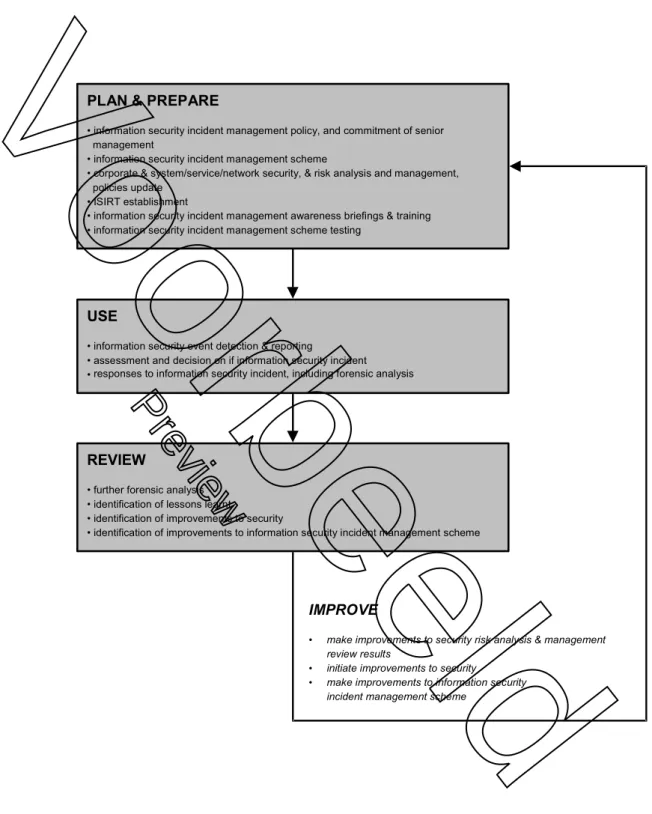
To achieve the objectives outlined in Clause 4.1, information security incident management consists of four distinct processes:
x Plan and Prepare,
x Use,
x Review,
x Improve.
1
It should be noted that information security events could be the result of accidental or intentional attempts to breach information security safeguards, but in most cases an information security event alone does not imply that an attempt has really been successful and therefore doesn't need to have any implications on confidentiality, integrity and/or availability, i.e. not all information security events will be categorized as information security incidents.
Voorbeeld
ISO/IEC TR 18044:2004(E)
(It should be noted that these processes are similar to those reflected in the “Plan, Do, Check and Act’ model in IS 9000 and IS 14000.)
A high level view of these processes is shown in Figure 1 below.
PLAN & PREPARE
• information security incident management policy, and commitment of senior management
• information security incident management scheme
• corporate & system/service/network security, & risk analysis and management, policies update
• ISIRT establishment
• information security incident management awareness briefings & training • information security incident management scheme testing
REVIEW
• further forensic analysis • identification of lessons learnt
• identification of improvements to security
• identification of improvements to information security incident management scheme
USE
• information security event detection & reporting
• assessment and decision on if information security incident • responses to information security incident, including forensic analysis
IMPROVE
• make improvements to security risk analysis & management review results
• initiate improvements to security
• make improvements to information security incident management scheme
Figure 1- Information Security Incident Management Processes
Voorbeeld
4.2.1
Plan and Prepare
Effective information security incident management requires appropriate planning and preparation. For responses to information security incidents to be effective, the following actions are necessary:
x develop and document an information security incident management policy and gain visible commitment to that policy from all key stakeholders, particularly senior management,
x develop and comprehensively document an information security incident management scheme to support the information security incident management policy. Forms, procedures and support tools, for the detection, reporting, assessment and response to information security incidents, and details of the incident severity scale2, should be encompassed within scheme documentation. (It should be noted that in some organizations, the scheme may be referred to as an information security incident response plan.),
x update information security and risk management policies at all levels, i.e. corporate-wide and for each system, service and network, with references to the information security incident management scheme,
x establish an appropriate information security incident management organizational structure, i.e. the Information Security Incident Response Team (ISIRT), with defined roles and responsibilities allocated to personnel who are available to enable an adequate response to all known types of information security incident. Within most organizations the ISIRT will be a virtual team, with a senior manager leading the team supported by groups of individuals specialized in particular topics, e.g. in the handling of malicious code attacks, who will be called upon depending on the type of incident concerned,
x make all organizational personnel aware through briefings and/or other mechanisms, of the existence of the information security incident management scheme, its benefits and how to report an information security event. Appropriate training should be provided to those personnel responsible for managing the information security incident management scheme, decision makers involved in determining whether information security events are incidents, and those individuals involved in the investigation of incidents,
x thoroughly test the information security incident management scheme. The Plan and Prepare phase is further described in Clause 7.
4.2.2
Use
The following processes are necessary to make use of an information security incident management scheme:
x detecting and reporting the occurrence of information security events (by human or automatic means),
x collecting information associated with information security events, and assessing that information to determine what events are to be categorized as information security incidents,
x making responses to information security incidents: immediately, in real-time or in near real-time,
where information security incidents are under control, conducting activities that may be required in slower time (for example, in facilitating full recovery from a disaster),
if information security incidents are not under control, instigating ‘crisis’ activities (for example, calling the fire brigade/department or activating a business continuity plan),
communicating the existence of information security incidents and any relevant details thereof to internal and external people and/or organizations. (This could include escalating for further assessments and/or decisions as required.),
2
An incident severity scale to be used to ‘grade’ incidents should be established. This scale could, for example, be ‘major’ and ‘minor’, with, in any event, the decision based on the actual or projected adverse impacts on the organization’s business operations.
Voorbeeld
ISO/IEC TR 18044:2004(E)
forensic analysis,
properly logging all activities and decisions for further analysis, closing incidents on resolution.
The Use phase is further described in Clause 8.
4.2.3
Review
After information security incidents have been resolved/closed, the following review activities are necessary:
x conducting further forensic analysis, as required,
x identifying the lessons learnt from information security incidents,
x identifying improvements to information security safeguard implementation, as result of the lessons learnt, whether from one information security incident or many,
x identifying improvements to the information security incident management scheme as a whole, as a result of lessons learnt from quality assurance reviews of the approach (for example, from review of the effectiveness of the processes, procedures, the reporting forms and/or the organizational structure).
The Review phase is further described in Clause 9.
4.2.4
Improve
It is emphasized that the information security incident management processes are iterative, with regular improvements made to a number of information security elements over time. These improvements will be proposed on the basis of reviews of the data on information security incidents and the responses to them, as well as trends over time. This will include:
x revising the organization’s existing information security risk analysis and management review results,
x making improvements to the information security incident management scheme and its documentation,
x initiating improvements to security, that may encompass the implementation of new and/or updated information security safeguards.
The Improve phase is further described in Clause 10.
5
Benefits and Key Issues
This clause provides information on the:
x benefits to be obtained from a good information security incident management scheme,
x key issues that need to be addressed to convince senior corporate management and those personnel who will report to and receive feedback from the scheme.
5.1
Benefits
Any organization using a structured approach to information security incident management may accrue significant benefits, which can be grouped under:
x improving information security,
Voorbeeld
NEN Uitgeverij
t.a.v. afdeling Marketing Antwoordnummer 10214 2600 WB Delft
Wilt u deze norm in PDF-formaat? Deze bestelt u eenvoudig via
www.nen.nl/normshop
Gratis e-mailnieuwsbrieven
Wilt u op de hoogte blijven van de laatste ontwikkelingen op het gebied van normen, normalisatie en regelgeving? Neem dan een gratis abonnement op een van onze e-mailnieuwsbrieven. www.nen.nl/nieuwsbrieven
Gegevens
Bedrijf / Instelling
T.a.v. O M O V
Klantnummer NEN
Uw ordernummer BTW nummer Postbus / Adres
Postcode Plaats Telefoon Fax Factuuradres (indien dit afwijkt van bovenstaand adres)
Postbus / Adres
Postcode Plaats
Datum Handtekening
NEN Uitgeverij
Postbus 5059 2600 GB Delft Vlinderweg 6 2623 AX Delft T (015) 2 690 390 F (015) 2 690 271 www.nen.nl/normshop
Stel uw vraag aan Klantenservice via:
@NEN_webcare
Retourneren
Fax: (015) 2 690 271 E-mail: [email protected] Post: NEN Uitgeverij, t.a.v. afdeling Marketing Antwoordnummer 10214, 2600 WB Delft (geen postzegel nodig).
Voorwaarden
• De prijzen zijn geldig tot 31 december 2015, tenzij anders aangegeven. • Alle prijzen zijn excl. btw,
verzend- en handelingskosten en onder voorbehoud bij o.m. ISO- en IEC-normen. • Bestelt u via de normshop een
pdf, dan betaalt u geen handeling en verzendkosten. • Meer informatie: telefoon
(015) 2 690 391, dagelijks van 8.30 tot 17.00 uur. • Wijzigingen en typefouten
in teksten en prijsinformatie voorbehouden.
• U kunt onze algemene voorwaarden terugvinden op: www.nen.nl/leveringsvoorwaarden.
Stuur naar:
Ja, ik bestel
€ 131.28 __ ex. NPR-ISO/IEC TR 18044:2004 en IT security techniques - Information