TCG
TCG Trusted Network Connect
IF-MAP Metadata for ICS Security
Specification Version 1.0
Revision 45
15 September 2014
Published
Contact:
[email protected]
TCG PUBLISHED
Copyright © TCG 2005-2014
Revision 45 Page ii of 68
TCG PUBLISHED
Copyright © 2014 Trusted Computing Group, Incorporated.
Disclaimers, Notices, and License Terms
THIS SPECIFICATION IS PROVIDED "AS IS" WITH NO WARRANTIES WHATSOEVER, INCLUDING ANY WARRANTY OF MERCHANTABILITY, NONINFRINGEMENT, FITNESS FOR ANY PARTICULAR PURPOSE, OR ANY WARRANTY OTHERWISE ARISING OUT OF ANY PROPOSAL, SPECIFICATION OR SAMPLE.
Without limitation, TCG disclaims all liability, including liability for infringement of any proprietary rights, relating to use of information in this specification and to the implementation of this specification, and TCG disclaims all liability for cost of procurement of substitute goods or services, lost profits, loss of use, loss of data or any incidental, consequential, direct, indirect, or special damages, whether under contract, tort, warranty or otherwise, arising in any way out of use or reliance upon this specification or any information herein.
This document is copyrighted by Trusted Computing Group (TCG), and no license, express or implied, is granted herein other than as follows: You may not copy or reproduce the document or distribute it to others without written permission from TCG, except that you may freely do so for the purposes of (a) examining or implementing TCG specifications or (b) developing, testing, or promoting information technology standards and best practices, so long as you distribute the document with these disclaimers, notices, and license terms.
Contact the Trusted Computing Group at www.trustedcomputinggroup.org for information on specification licensing through membership agreements.
Revision 45 Page iii of 68
TCG PUBLISHED
Revision 45 Page iv of 68
TCG PUBLISHED
Acknowledgements
The TCG wishes to thank all those who contributed to this specification. This document builds on considerable work done in the various working groups in the TCG.
Frédéric Guihéry Amossys
David Louin Amossys
Maxime Olivier Amossys
David Mattes (Co-Editor) Asguard Networks Padma Krishnaswamy Batelle Memorial Institute Eric Fleischman Boeing
Richard Hill Boeing
Steve Venema (Co-Editor) Boeing
John Tolbert Boeing
Steven Venema Boeing
Eric Byres (Invited Expert) Byres Security Nancy Cam-Winget Cisco Systems
Josef von Helden Fachhochschule Hannover Arne Welzel Fachhochschule Hannover Ronald Marx Fraunhofer SIT
Gerald Maunier Gemalto N.V.
Chris Daly General Dynamics C4 Systems Graeme Proudler Hewlett-Packard
Andreas Steffen
HSR University of Applied Sciences Rapperswil
James Tan Infoblox
David Vigier Infoblox
Cliff Kahn Juniper Networks
Lisa Lorenzin (Co-Editor) Juniper Networks Steve Hanna Juniper Networks Mark Labbancz Lumeta Corporation
Atul Shah Microsoft
Trevor Freeman Microsoft
Charles Schmidt MITRE
Revision 45 Page v of 68
TCG PUBLISHED
Chris Bean US Government
Julie Haney US Government
Jessica Fitzgerald-McKay US Government Gloria Serrao US Government Theresa Thomas US Government
Josef Allen Oak Ridge National Lab
Ira McDonald Samsung
Carolin Latze SwissCom
Paul Sangster Symantec
Revision 45 Page vi of 68
TCG PUBLISHED
Table of Contents
1
Introduction ... 9
1.1 Scope and Audience ... 9
1.2 Keywords ... 9
2
Background ... 10
2.1 Purpose of IF-MAP Metadata for ICS Security ... 10
2.2 Context ... 10
2.2.1 Industrial Control Systems and Overlay Networks ... 10
2.2.2 Related Standards Work ... 12
2.3 Lexicon ... 15
2.4 Supported Use Cases ... 15
2.5 Requirements ... 16
2.5.1 General Requirements ... 16
2.5.2 ICS Domain-Specific Network Security Requirements ... 16
2.6 Assumptions ... 17
3
IF-MAP Metadata for ICS Security ... 18
3.1 Authentication and Authorization ... 18
3.1.1 MAP Client Roles ... 18
3.1.2 Principal Roles ... 18
3.1.3 Identifiers and Authentication ... 19
3.1.4 Authorization Policy ... 22
3.2 Overview of Target Functionality ... 23
3.2.1 Configuration and Operational Management ... 23
3.2.2 Operational Communications Facilitation ... 23
3.2.3 Credential Management ... 24
3.2.4 MAP Server Auto-Discovery ... 24
3.3 IF-MAP Identifiers Used in This Specification ... 24
3.3.1 Use of administrative-domain Identifier Attribute ... 24
3.4 Extended Identifiers ... 25
3.4.1 backhaul-interface ... 26
3.4.2 overlay-manager-group ... 26
3.4.3 overlay-network-group ... 26
3.5 IF-MAP Metadata for ICS Security Types ... 28
3.5.1 backhaul-policy... 31 3.5.2 bhi-address ... 32 3.5.3 bhi-certificate ... 32 3.5.4 bhi-identity ... 33 3.5.5 device-characteristic ... 34 3.5.6 dn-hit ... 34 3.5.7 group-xref ... 35 3.5.8 ifmap-client-has-task ... 36 3.5.9 manager-of ... 37
Revision 45 Page vii of 68 TCG PUBLISHED 3.5.10 member-of ... 38 3.5.11 observed-by ... 39 3.5.12 overlay-policy ... 40 3.5.13 protected-by ... 41
4
MAP Client Operations ... 43
4.1 BHI Role ... 43
4.1.1 MAP Server Selection ... 43
4.1.2 Maintaining an IF-MAP Session ... 43
4.1.3 Publishing BHI Internal States ... 44
4.1.4 Subscribing to Overlay Membership and Backhaul Policy ... 45
4.1.5 Subscribing to Overlay Policy ... 45
4.1.6 Publishing Metadata Describing ICS Devices ... 45
4.1.7 Publishing Locator Metadata for Unassigned BHIs ... 46
4.1.8 Protection of Overlay Network Traffic over the Backhaul Network ... 46
4.1.9 Policy Enforcement Responsibilities ... 46
4.2 Overlay Manager Role ... 49
4.2.1 Management Model ... 49
4.2.2 Authorization Requirements ... 50
4.2.3 Example ... 51
4.3 Administrator Role ... 52
4.4 Implementation of Policy Enforcement for Roles ... 53
4.4.1 Policy Enforcement for the BHI Role ... 53
4.4.2 Policy Enforcement for the Overlay Manager Role ... 53
5
Security Considerations ... 54
5.1 Trust Model ... 54
5.1.1 Backhaul Network ... 54
5.1.2 Overlay Network ... 54
5.1.3 MAP Clients ... 54
5.1.4 Backhaul Interfaces (BHIs) ... 55
5.1.5 Factory-reset BHI ... 55
5.1.6 ICS Administrative MAP Client ... 55
5.1.7 Overlay Manager ... 55
5.1.8 Administrators ... 55
5.1.9 ICS Devices ... 56
5.1.10 Certification Authority (CA) Infrastructure ... 56
5.1.11 MAP Server ... 56
5.2 Threat Model ... 56
5.2.1 Backhaul Network and Overlay Network Attacks ... 56
5.2.2 MAP Clients ... 57
5.2.3 Backhaul Interfaces (BHIs) ... 57
5.2.4 ICS Administrative MAP Client ... 58
5.2.5 Overlay Managers ... 58
Revision 45 Page viii of 68
TCG PUBLISHED
5.2.7 ICS Devices ... 59
5.2.8 Certification Authority (CA) Infrastructure ... 60
5.2.9 Registration Authority (RA) ... 60
5.2.10 MAP Server ... 60
5.3 Countermeasures ... 60
5.3.1 Securing the MAP Server ... 60
5.3.2 Securing MAP Clients ... 60
5.3.3 Securing Backhaul Network ... 61
5.3.4 Securing Overlay Network, BHIs, and ICS Devices ... 61
5.3.5 Securing Overlay Managers and Administrators ... 61
5.3.6 Securing the CA Infrastructure and RAs ... 61
6
Privacy Considerations ... 62
7
References ... 63
Revision 45 Page 9 of 68
TCG PUBLISHED
1 Introduction
1.1 Scope and Audience
The Trusted Network Connect Working Group (TNC-WG) has defined an open solution architecture that enables security coordination between components of network-connected industrial control systems. Part of the TNC architecture is IF-MAP, a standard interface between the Metadata Access Point and other elements of the TNC architecture. This document defines and specifies IF-MAP Metadata for Industrial Control Systems (ICS) Security.
Architects, designers, developers and technologists who wish to implement, use, or understand IF-MAP in an Industrial Control Systems Security context should read this document carefully. Before reading this document any further, the reader should review and understand the TNC architecture as described in the TNC Architecture specification[1] and the TNC IF-MAP Binding for SOAP[2] and TNC IF-MAP Metadata for Network Security[3].
1.2 Keywords
The key words “MUST”, “MUST NOT”, “REQUIRED”, “SHALL”, “SHALL NOT”, “SHOULD”, “SHOULD NOT”, “RECOMMENDED”, “MAY”, and “OPTIONAL” in this document are to be interpreted as described in IETF RFC 2119[4]. This specification does not distinguish blocks of informative comments and normative requirements. Therefore, for the sake of clarity, note that lower case instances of must, should, etc. do not indicate normative requirements.
Revision 45 Page 10 of 68
TCG PUBLISHED
2 Background
2.1 Purpose of IF-MAP Metadata for ICS Security
The purpose of the IF-MAP Metadata for ICS Security specification is to facilitate secure deployment and management of large-scale industrial control systems by creating virtual OSI layer 2 and/or layer 3 overlay networks on top of standard shared IP network infrastructure - particularly (though not necessarily) TNC-compliant IP network infrastructure. This specification addresses use cases for identity-based access policy, device identity, and certificate lifecycle management; it anticipates use in retrofitting this new security functionality into existing industrial control systems as well as incorporation into new ICS products. The use cases and functionality standardized in this specification can operate independently of, but are intended to interoperate with, the existing IF-MAP Metadata for Network Security specification and broader TNC and TCG enabled capabilities for increased security and flexibility.
2.2 Context
2.2.1 Industrial Control Systems and Overlay Networks
Industrial control systems are used to operate and manage complex physical processes. They generally contain a combination of:
Sensors for measuring parameters related to physical processes (e.g., temperature, flow rate, pressure, volume, etc.).
Actuators (e.g., valves, motors, etc.) which affect physical processes.
Controllers (e.g. programmable logic controllers (PLCs)) which contain program logic that adjusts actuator controls based on sensor data and supervisory input.
Supervisory systems (e.g. Supervisory Control And Data Acquisition (SCADA) systems) that monitor and log control system data for trend analysis and as-needed diagnostics and intervention.
While some control systems are completely localized in one physical location (e.g., an automated work cell in a manufacturing plant), many of these systems have physically disjoint components that require interconnection over some kind of network infrastructure. For example, the geographically distributed physical processes in oil refineries, oil pipelines, energy transmission, etc. will typically have sensors (pressure, flow, voltage, temperature, etc.) distributed over a wide area that are not co-located with actuators (valves, switches, etc.). Moreover, the supervisory data for even single-locale control systems are typically carried to distant control centers over network infrastructure.
Communications between control system components use a variety of proprietary and standard protocols, which are often implemented on top of standard layer 2 link protocols (IEEE 802.3, IEEE 802.11, IEEE RS485, etc.). Unfortunately, many of these communications protocols were never designed for security; the trend towards operation in shared, untrusted communications media environments interconnecting physically disjoint control system components is a significant security issue for the control systems industry. Furthermore, some of the control system communications protocols do not use standard Internet Protocols (IPv4 or IPv6), making interconnection of control system components over standard IP network infrastructure difficult. The interconnection of networks not natively designed for an IP stack poses particular challenges, especially around authorization and privacy/confidentiality, when migration to an IP-based infrastructure is introduced.
Revision 45 Page 11 of 68
TCG PUBLISHED
Overlay networks provide an important layer of protection for control systems by isolating ICS components into one or more protected virtual enclaves while allowing those components to leverage the connectivity offered by increasingly ubiquitous shared, untrusted commodity IP infrastructure. This specification describes how to utilize TNC architectural components - IF-MAP in particular - to define and coordinate the operation of virtual overlay networks in order to create effectively-isolated layer 2 and layer 3/4 network enclaves that communicate securely over shared wide-area untrusted IP networks. In the control systems industry, these commodity network substrates are often called “Backhaul Networks” to denote their function of providing connectivity between ICS components over some distance. The backhaul network may be owned by the end users (e.g., an Ethernet or Wi-Fi LAN), or by a third party network provider (e.g., a satellite communications service provider). Some backhauls may be combinations of both. A backhaul network is generally a single IP routing domain, so all devices connected to a given backhaul network can talk with each other directly at layer 3.
Figure 1: Example of an ICS Overlay Network
Figure 1 shows a notional example of an ICS overlay network. Here we see three clusters of ICS devices (inner boxes), in separate physical locations, that are all part of a single overlay network (outer box). The yellow circles in the diagram denote “Backhaul Interface” (BHI) functionality that implements the necessary authentication, encryption, translation, and authorization policy enforcement capabilities to create the overlay network. This overlay network is a virtual construct whereby ICS components in different ICS device clusters communicate with one another (subject to policy controls expressed in the MAP graph) as though they were on a shared, private layer 2 or layer 3 network. Any ICS device communications that flow between BHIs over the backhaul network are protected by encryption and integrity checks so that other users of the backhaul network are unable to view or modify the ICS data. In effect, the four BHIs shown in Figure 1 form a meshed, private virtual network with MAP-coordinated authorization policies.
Simply put, BHIs communicate with each other and with the MAP Server (operated by the end user) over the backhaul network; ICS devices communicate with each other over a given overlay network, as coordinated and controlled by the BHIs. BHIs utilize two types of encrypted communication: IF-MAP communication with the IF-MAP Server over HTTPS/TLS, and VPLS tunnels from BHI to BHI over HIP. The BHI is intended to restrict which traffic is allowed onto the overlay network, and which traffic originating from its protected overlay network segment is allowed outbound to devices on the overlay that are protected by other BHIs. This specification supports the use of multiple overlay
Revision 45 Page 12 of 68
TCG PUBLISHED
networks all using the same backhaul network while requiring no configuration changes to the backhaul network. Instead, changes to the MAP graph can immediately (re)define the structure and connectivity policies of individual overlay networks and their ICS components.
In the above example, the MAP service provides the necessary operational coordination functionality for these BHIs to provide the overlay network functionality. This includes:
Coordination between the BHIs themselves (current IP addresses, identity, certificates, etc.)
Administrative policy that defines with which BHIs a given BHI can communicate
BHI overlay policies controlling which ICS devices the BHI allows to communicate across the overlay
Administration policies related to the user identities that are allowed to access and alter the configuration of the overlay network and the BHIs
In the case of control systems, device lifecycles are often measured in decades, and system downtime may not occur for as much as a year or more. During that time, configuration of the underlying IP network may well change; indeed, in the case of wireless and/or mobile control system components, much of this coordination information regarding the backhaul network interfaces may vary from one minute to the next due to roaming-triggered address changes. One advantage that the MAP service has to offer over other directory services such as LDAP is lower-latency (a few seconds), low-bandwidth, asynchronous updates of subscribed state changes in coordination data. In addition, if the metadata associated with this specification shares a MAP graph with specified metadata from other use cases (e.g., TNC IF-MAP Metadata for Network Security[3]), then new opportunities for combined use cases become possible. However, such extended uses cases are outside of the scope of this specification.
This specification anticipates that different implementations of the BHI functionality may take different forms. In general, these implementations will fall into the following three categories:
BHI functionality embedded within ICS devices.
BHI functionality embedded within the points-of-presence supplied by the backhaul network provider.
BHI functionality embedded in a security gateway device between the backhaul network and the ICS devices on the overlay network. In this situation, the gateway device is often called an “Endbox”.
These categories of implementations will generally be supplied by ICS device vendors, backhaul network providers, and third-party security appliance providers respectively. However, in order to ensure interoperability, all BHI implementations MUST comply with this specification. The intent of this specification is to support implementations that employ any combination of these categories (and perhaps some we haven’t yet considered); interoperability between different implementations is the focus of this specification.
2.2.2 Related Standards Work
From a TNC perspective, control systems components that lack a TNC Client (such as sensors, actuators, SCADA systems, controllers, etc.) are all clientless endpoints. The traditional TNC use cases have focused primarily on protecting the network against intrusion or other inappropriate client behavior or configuration. For control systems, allowed behaviors must often be defined very rigorously in order to meet operational reliability and security requirements. For example, there is generally no reason why a view-only operator station should be sending programming data to a controller. Additionally, more granular control over which kinds of commands and other data can be sent between particular components is often desirable. These needs, along with the necessity
Revision 45 Page 13 of 68
TCG PUBLISHED
to ensure integrity, authenticity, and availability in SCADA environments, drive a general requirement for a strong authentication, authorization, and accounting (AAA) environment in order to have correct policy enforcement.
While the specific implementation details of AAA applications are outside the scope of this document (except perhaps as examples), a clear definition of metadata and its use in coordinating between control system components and their network access mediators (the BHIs) is a valuable contribution to this problem domain.
It is also important to note other related public standards activities that may overlap with the scope of this specification. The following three standards activities are mentioned for reference only. It is the intent of this specification to align with - but remain independent of - these other standards activities.
2.2.2.1 International Society for Automation Work Group 15: “Wireless Backhaul”
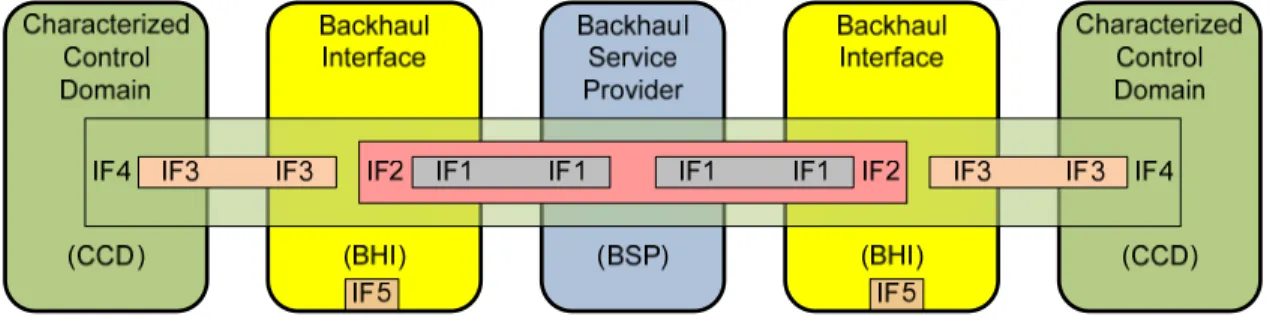
The nomenclature used in the industrial control systems community may be somewhat unfamiliar to the reader who is more familiar with other elements of the TNC standards family. Figure 2 shows the high level architecture used by the ISA100.15 WG1. The definitions for the labels used in Figure 2 are found in Table 1.
Figure 2: ISA100.15 Functional Architecture Table 1: Definitions for labels used in Figure 2
Acronym Description
BSP Backhaul Service Provider
BHI Backhaul Interface
CCD Characterized Control Domain
IF1 Interface for the specific requirements of a particular BSP technology/provider
IF2 BHI interoperability and coordination interface
IF3 Multiple layer 2 (e.g., 802.3) interfaces for control systems data links
IF4 Transparent connectivity interface between CCD’s; no interpretation of application protocols
IF5 Configuration, security and operation management interface
1
Revision 45 Page 14 of 68
TCG PUBLISHED
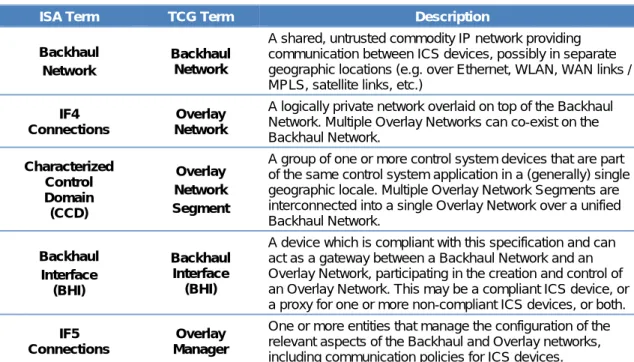
From a TNC perspective, the BHI functionality serves as a Flow Controller (see the TNC Architecture[1]) providing access control functionality that protects the ICS equipment. This functionality may be implemented within individual networked ICS devices, provided as a part of the customer site interface for a BSP, or implemented as a gateway device in front of one or more ICS devices (e.g., “Endbox”). The BHI may also include TNC client functionality in the case where the BSP uses TNC services. As a result, the BHI is required to be a MAP Client, and may also be - but is not required to be - a TNC Client. The implementation described in this specification is consistent with the above abstract architecture, but uses somewhat different terminology. It is important to relate both sets of terminology, since it would otherwise be difficult to understand the highly relevant relationships between this specification and those of the ISA (as well as the IETF and The Open Group, as described below). Table 2 describes the relationships between these terminologies.
Table 2: Equivalence of terms in ISA and TCG
ISA Term TCG Term Description
Backhaul Network
Backhaul Network
A shared, untrusted commodity IP network providing communication between ICS devices, possibly in separate geographic locations (e.g. over Ethernet, WLAN, WAN links / MPLS, satellite links, etc.)
IF4 Connections
Overlay Network
A logically private network overlaid on top of the Backhaul Network. Multiple Overlay Networks can co-exist on the Backhaul Network. Characterized Control Domain (CCD) Overlay Network Segment
A group of one or more control system devices that are part of the same control system application in a (generally) single geographic locale. Multiple Overlay Network Segments are interconnected into a single Overlay Network over a unified Backhaul Network. Backhaul Interface (BHI) Backhaul Interface (BHI)
A device which is compliant with this specification and can act as a gateway between a Backhaul Network and an Overlay Network, participating in the creation and control of an Overlay Network. This may be a compliant ICS device, or a proxy for one or more non-compliant ICS devices, or both.
IF5 Connections
Overlay Manager
One or more entities that manage the configuration of the relevant aspects of the Backhaul and Overlay networks, including communication policies for ICS devices.
2.2.2.2 IETF Host Identity Protocol (HIP), Virtual Private LAN Service (VPLS)
The Host Identity Protocol is an emerging IETF standard that provides encrypted IPsec-like tunnels between endpoints that are bound to cryptographic host identities rather than IP addresses. This work is being done in the IETF HIP workgroup; the reader is invited to review various RFCs that have been and are being developed within this workgroup.2
A Virtual Private LAN Service (VPLS) Internet Draft[6] has been defined in the HIP workgroup. The VPLS creates private overlay networks using the HIP protocol suite such that communications patterns and roles map well to the ISA functional architecture shown in Figure 2 above. An open-source implementation of this functionality has been implemented3 and is already in extensive use in at least one large company. For more details on HIP-based VPLS, see [7] and [8].
2
http://datatracker.ietf.org/wg/hip/ 3 http://www.openhip.org
Revision 45 Page 15 of 68
TCG PUBLISHED
2.2.2.3 The Open Group’s Security Forum: Secure Mobile Architecture (SMA)
The patterns defined in the ISA architecture above are not necessarily unique to the ICS use cases in this specification. Other use cases involving the transportation of trusted data between dynamic nodes over untrusted dynamic networks are common. The Open Group4 is developing a Secure Mobile Architecture document5 currently published as a reference architecture by that organization. The document includes ICS use cases similar to those in this document, but also focuses on a wider variety of use cases around meshed communications between moving transportation systems (something that is quickly appearing in automotive products today), medical systems (networks of medical devices exchanging information in, say, an operating theater), and cloud computing (networks of networks containing dynamically provisioned computing services).
The reader is invited to contact The Open Group for more information on this work and participate in its development if there is sufficient interest.
2.3 Lexicon
The following terms have specific meanings throughout the remainder of this document.
Word Definition
Entity A user, computing system, asset, application, or process Actor An entity available to perform a role
Agent An entity with delegated authority to act on behalf of another entity Principal An entity whose identity can be authenticated
Group A named collection of entities which share a particular set of attributes or roles
Role An action or functional behavior that may be performed by one or more actors
2.4 Supported Use Cases
Use cases that this version of IF-MAP Metadata for ICS Security supports:
A BHI acts as an enforcement point, enforcing both backhaul and overlay connectivity policies which can change dynamically.
BHIs use metadata published by IF-MAP Sensors (e.g., physical security sensors, IDS/IPS’s, PDP’s, etc.) to determine what ICS Authorization Policies (overlay policies and backhaul policies - see section 3.1.4) to apply in reaction to changes in the environment. A set of BHIs whose IP addresses may change dynamically can locate each other and
achieve secure communications despite address changes.
4
http://www.theopengroup.org 5
Revision 45 Page 16 of 68
TCG PUBLISHED
An overlay management function can dynamically alter the authorization policies for BHIs and the ICS devices on their overlay networks, and BHIs will quickly respond to the changes.
The contents of this document are intended to span these use cases but are not intended to be limited to these use cases.
2.5 Requirements
The following are the requirements which IF-MAP Metadata for ICS Security must meet in order to successfully play its role in the TNC architecture. These are stated as general requirements, with specific requirements called out as appropriate.
2.5.1 General Requirements
1. Extends TNC IF-MAP Metadata for Network Security
As much as makes sense, the IF-MAP Metadata for ICS Security specification will coordinate with the metadata types specified in [3]and [14]. Additional metadata types will be defined in a new namespace to preclude confusion with existing applications which are unaware of the ICS use cases and this specification.
2. Easy to use and implement
IF-MAP Metadata for ICS Security should be easy for vendors and customers to use. It should allow them to enhance existing products to support the TNC architecture and integrate with legacy functionality and products without requiring substantial changes. It should allow customers to integrate the functionality described in this specification into existing infrastructure and allow interoperation with other compliant products.
3. Unambiguous
There should be clarity and lack of ambiguity for identification of specific entities for which metadata exists and which are interacting with the MAP Server. For example, users, endpoints, and all other instances of TNC elements should be uniquely identifiable.
2.5.2 ICS Domain-Specific Network Security Requirements
4. Usable with existing ICS devices and infrastructure
ICS infrastructure has a very long lifecycle (decades), so a mix of legacy and new ICS technologies is common. To the extent possible, IF-MAP Metadata for ICS Security must support both new and legacy ICS technologies on the same network. In some cases this requirement may result in the use of proxy BHIs in front of the legacy devices.
5. Enables isolation between ICS security domains and/or individual ICS components
IF-MAP Metadata for ICS Security must enable multiple control systems to share a (potentially untrusted) backhaul network while providing isolation between control systems or subsystems as defined by the ICS administrators. The specification must include any necessary normative language to enable coordination between multiple BHIs as well as administration applications to provide for and manage this isolation capability.
6. Enables the use of cryptographically bound identities for ICS devices and PEP’s
IF-MAP Metadata for ICS Security must facilitate the interoperable use of cryptographic identities in the form of X.509 certificates. Since BHIs are often used in hazardous environments or difficult-to-reach locations, a standard model for MAP-based automated certificate management would be useful. Such a model is currently unspecified, but may be specified in a future TCG specification.
Revision 45 Page 17 of 68
TCG PUBLISHED
7. Enables the use of overlay networks
The lack of support for dynamic IP address allocation (e.g. via dynamic host configuration protocol (DHCP)) in many ICS devices, coupled with their legacy of being interconnected on isolated networks, drives the need for groups of ICS devices to be isolated in IP address space. For example, it is not uncommon for multiple sets of identical manufacturing systems in a factory to all use the same set of IP addresses. Layer 2 and layer 3 isolation techniques are commonly used to accommodate this limitation. This requirement is supported by the use of metadata for rendezvous among compliant BHIs.
8. Accommodates the creation of extended metadata definitions for deep packet inspection
The IF-MAP Metadata for ICS Security specification must not preclude the future creation of extended metadata types for particular ICS protocols (e.g., Profinet™, Fieldbus™, etc.) that allow ICS protocol-specific deep packet inspection capabilities to be implemented at BHIs or elsewhere.
2.6 Assumptions
Here are the assumptions that IF-MAP Metadata for ICS Securitymakes about other components in the TNC architecture and ICS environment.
1. Operational access control
In order to increase operational reliability and security, a MAP Server MUST support access controls to constrain the IF-MAP operations a given MAP Client may use to manipulate certain types or instances of metadata. In other words, this is not a trusted environment where all clients which have MAP Server access credentials are trusted to do any IF-MAP operation.
2. Self-Provisioning Backhaul Interfaces
A BHI is expected to be able to configure itself upon initial installation into a backhaul network: acquire a network address, locate an appropriate MAP Server, and obtain information about itself that may be pre-provisioned into the MAP Server. Methods of autoconfiguration are currently unspecified, but may be specified in a future TCG specification. This implies the availability of DHCP and DNS services provided by the backhaul network to enable the BHI to discover its IP network parameters and the IP address of DNS servers.
Revision 45 Page 18 of 68
TCG PUBLISHED
3 IF-MAP Metadata for ICS Security
This specification defines new IF-MAP extended identifiers and metadata supporting authentication, authorization, and coordination of components in an ICS environment. See section 3.4 of the TNC IF-MAP Binding for SOAP[2] for details on construction and usage of these elements.
Subsequent versions of this specification or other TNC specifications may define new XML attributes for IF-MAP elements. To anticipate this, the schema defined by this specification includes the XML element “<anyAttribute/>” within an element’s declaration. The ifmap- prefix in metadata attribute names is reserved for use by this specification and its successors. Metadata elements MUST NOT include attributes that begin with the ifmap- prefix other than attributes specified in this document or other TNC specifications. Any unrecognized attributes beginning with the ifmap- prefix MUST be ignored by MAP Clients and MAP Servers.
3.1 Authentication and Authorization
3.1.1 MAP Client Roles
There are two MAP Client roles involved in the use cases specified in this document. Authorization constraints associated with these roles are discussed separately in 3.1.4.
3.1.1.1 BHI Role
A BHI utilizes IF-MAP client functionality in order to publish, search, and subscribe to information in the MAP graph. BHIs publish information about their configuration and state, and coordinate with other BHIs in this role as well as other roles (described below). Each BHI serves as its own agent and is expected to have its own unique identity and associated certificate.
In TNC MAP Content Authorization[14], a BHI is assigned BHI Tasks, which are associated, one-to-one, with overlay networks.
3.1.1.2 ICS Administrative MAP Client Role
An ICS Administrative MAP Client is an agent that acts on behalf of the principal roles.
3.1.2 Principal Roles
Two other roles are involved in the use cases specified in this document. The principals that hold these roles are humans, applications, etc. These principals act on MAP content indirectly, by giving orders to an ICS Administrative MAP Client. Authorization constraints associated with these roles are discussed separately in 3.1.4.
3.1.2.1 Overlay Manager Role
An Overlay Manager role manages the following relationships expressed in the MAP graph for one or more overlay networks:
Overlay Membership: which BHIs are members of a given overlay network
BHI-to-BHI policy (backhaul policy): which BHI pairs may communicate for a given overlay network; see section 3.5.1
Device-to-device policy (overlay policy): which ICS devices (specified by IP address and/or MAC address) may send communications out through a given BHI for a given overlay network; see section 3.5.12
Unlike the BHIs, which serve as their own agents, IF-MAP operations related to the Overlay Manager role will be performed by an ICS Administrative MAP Client - a software agent (e.g., provisioning application) - on behalf of one or more principals (users). Multiple Overlay Manager
Revision 45 Page 19 of 68
TCG PUBLISHED
roles may be defined so that different groups of one or more overlays may be managed by different user groups. See section 4.2.2 for constraints on Overlay Managers.
3.1.2.2 Administrator Role
The Administrator role manages the following relationships expressed in the MAP graph for all overlay networks:
Overlay network coordination; creation of Overlay Manager tasks for overlay networks. Assignment of particular principals as managers of particular overlay networks.
MAP graph monitoring and repair to detect and correct unusual conditions (e.g., orphaned overlay networks)
This role is defined separately from the Overlay Manager role because overlay networks are group objects in a given MAP graph with a global namespace; in other words, the names of all of the overlay networks live in a shared namespace in the graph. This namespace is best managed separately (e.g., at an enterprise level) by an Administrator role that oversees the Overlay Manager assignments and overlay network coordination, in order to prevent Overlay Manager roles from potentially interfering with each other through namespace collisions, renaming of overlay networks, etc. For example, if an organization has a thousand overlays represented in the MAP graph, all sharing the same namespace, coordination is required to ensure that Overlay Manager A doesn’t delete an Overlay Network 1 that was created by Overlay Manager B, or vice versa.
Also, a large organization may have different users / groups of users (perhaps even using different tools) managing different overlay networks / groups of overlay networks. The Administrator role performs the function of delegation of responsibility for different overlay networks to different Overlay Managers. Coordination between different overlay manager groups is the duty of the Administrator; members of an overlay manager group are expected to coordinate among themselves.
Similar to the Overlay Manager role, IF-MAP operations related to the Administrator role will be performed by an ICS Administrative MAP Client on behalf of one or more principals (users).
3.1.2.3 Indirect Action of Overlay Managers and Administrators
Throughout this specification, any statement that an Overlay Manager or Administrator acts upon (attaches, publishes, deletes, etc.) metadata should be understood to refer to an ICS Administrative MAP Client performing the operation on behalf of the Overlay Manager or Administrator.
3.1.3 Identifiers and Authentication
Three types of authenticated communication occur in this specification’s use cases:
1. MAP Client actors and agents (BHIs and ICS Administrative MAP Clients) authenticating to the MAP Server when establishing an IF-MAP session.
2. BHI actors authenticating to each other while establishing the pairwise HIP tunnels used for carrying secured communications between BHIs across untrusted BSP(s).
3. Principal actors (Overlay Managers, Administrators) communicating with an ICS Administrative MAP Client. The protocol for this communication is out of scope of this specification, except for security considerations.
The BHI authentication MAY also facilitate additional BHI functionality that is out of scope for this specification (e.g., remote logging).
Each of the above-described roles will be associated with one or more distinct actors or agents (BHIs, Overlay Managers, and Administrators); each instance of these MUST have an identifier,
Revision 45 Page 20 of 68
TCG PUBLISHED
and BHIs MUST have an associated X.509 certificate, to facilitate authentication by and secure communications with peer actors or agents.
Implementations of IF-MAP Metadata for ICS Security MUST support the use of cryptographic identities in the form of X.509 certificates for authentication, and BHIs MUST be authenticated in this manner; for Overlay Managers and Administrators, other forms of authentication (e.g., username/password) MAY be supported in addition to certificates, but are not recommended. When using certificate-based authentication, provisioning of an explicit chain of trust is required prior to establishing secure communications; actors and agents MUST validate peer X.509 certificates and SHOULD perform out-of-band certificate validation (e.g., OCSP and/or certificate revocation lists) when validating peers. (In addition, MAP Servers are required to perform validation of MAP Client identities as specified in TNC IF-MAP Binding for SOAP[2], section 6.3.1). The MAP service may be used to distribute and share certificate validation and Customer PKI trust chains, but these scenarios are out of scope of this document.
The specific methods used by principals in Overlay Manager and Administrator roles to authenticate to an ICS Administrative MAP client are out of scope of this specification. However, it is recommended that a robust authentication method be used, since these roles are privileged and can significantly alter the functionality of overlay networks. See section 5.2.4 for additional information.
Each BHI has two or three related identifiers:
1) A unique backhaul interface identifier associated with the physical BHI device 2) Either one or two certificate identifiers used by the BHI for authentication purposes. Details on these identifiers are discussed further in each of the subsections below.
3.1.3.1 Backhaul Interface Identifier
The backhaul-interface identifier is generated based on attributes assigned by the manufacturer. It MUST be permanently associated with the BHI and MUST be globally unique. It is represented in the MAP graph by the backhaul-interface identifier type. In order to facilitate identifier uniqueness, the backhaul-interface device identifier MUST be formatted according to one of the two following patterns:
BHI@PEN#SN
BHI@PEN#MODEL-SN
where
“PEN” is replaced with the registered Private Enterprise Number of the manufacturer 6 “SN” is replaced with a string representing a manufacturer-specific unique serial number. “MODEL” is replaced with a string representing a manufacturer-specific model number When constructing the backhaul-interface identifier, any non-alphanumeric characters in the serial number and model number MUST be omitted, in order to avoid potential issues with whitespace and eliminate the possibility of collisions with the # and - delimiters.
6
Currently assigned Private Enterprise Numbers (PENs) may be found at
http://www.iana.org/assignments/enterprise-numbers . New PENs may be obtained from IANA at zero cost using the application form found at http://www.iana.org/protocols/apply/
Revision 45 Page 21 of 68
TCG PUBLISHED
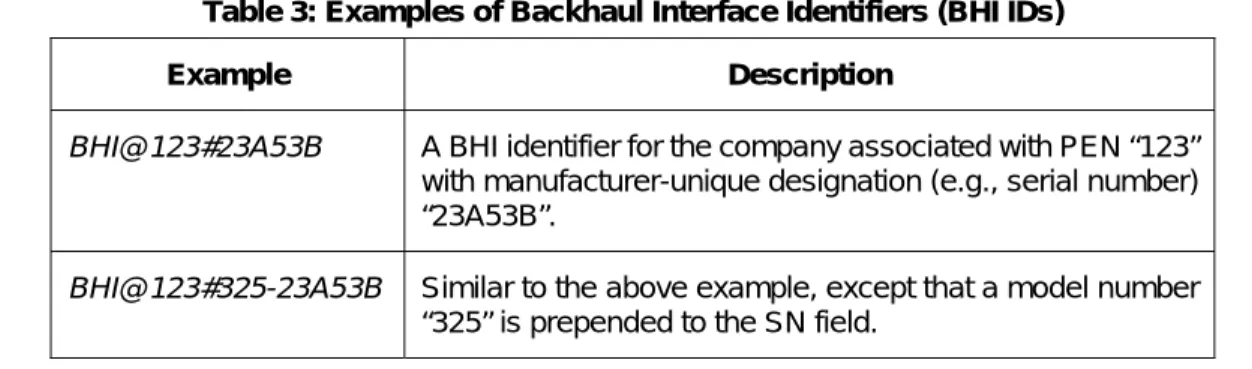
Note that standalone “SN” numbers may not be unique across the entire manufacture’s product line; the manufacturer may need to prepend a product model number if internal serial numbers are only unique to a given product or model. Examples are shown below in Table 3.
Table 3: Examples of Backhaul Interface Identifiers (BHI IDs)
Example Description
BHI@123#23A53B A BHI identifier for the company associated with PEN “123” with manufacturer-unique designation (e.g., serial number) “23A53B”.
BHI@123#325-23A53B Similar to the above example, except that a model number “325” is prepended to the SN field.
3.1.3.2 Certificate Identifiers
This specification uses the terms Initial Secure Device Identifier (IDevID) and Locally Significant Secure Device Identifier (LDevID) to describe the two possible types of certificates associated with the BHI (manufacturer-provisioned certificate and customer-provisioned certificate). This terminology was selected for its alignment with the terminology used in IEEE 802.1AR Secure Device Identity[15]. Note that IEEE 802.1AR is not incorporated as a normative reference in this version of the IF-MAP Metadata for ICS Security specification, but it may be included in a future revision.
IDevID and LDevID are each represented by a distinguished-name identifier in the MAP graph. MAP Clients MUST use the administrative domain "ifmap:client" with the IDevID and LDevID
distinguished-name identifiers; this ensures compatibility with TNC MAP Content Authorization[14]. Domain-specific information can be expressed in non-CN fields of the distinguished name.
3.1.3.2.1
BHI Factory Certificate (IDevID) Identifier
The manufacturer MUST provision the BHI with an IDevID certificate. This certificate’s “subject” field is a Distinguished Name (DN) which MUST contain a common name (CN) field that matches the associated backhaul-interface identifier name described in section 3.1.3.1. (For match criteria, see section 3.3.2.3.1 of the TNC IF-MAP Binding for SOAP[2].) The certificate subject field is expected to be unique for a given BHI due to the uniqueness constraints of the backhaul-interface identifier (see section 3.1.3.1). Other fields of the certificate subject’s DN are manufacturer-specific and are undefined by this specification.
The validity of the IDevID is recommended to be effectively infinite, which SHOULD be achieved by assigning the notAfter date to the GeneralizedTime value of 99991231235959Z, as described in RFC 5280[16]; if not, the expiration date MAY be set to any suitably large value (bearing in mind that the lifetime of ICS devices can extend to multiple decades).
The IDevID MAY be signed by a manufacturer’s intermediate CA, in order to simplify MAP Content Authorization policies. For example, different BHI models could have certificates signed by different CAs in order to simplify the specification of a MAP Content Authorization policy that allows limited rights for a particular CA chain, rather than having to set a policy for each individual BHI.
The manufacturer MAY provide a method whereby IDevIDs can be refreshed as part of a BHI certificate lifecycle management process.
Revision 45 Page 22 of 68
TCG PUBLISHED
3.1.3.2.2
BHI Customer Certificate (LDevID) Identifier
The manager / operator of the BHI MAY provision the BHI with a unique customer certificate (LDevID). The purpose of this certificate is to facilitate use of a PKI that is specific to the BHI’s deployed operating environment rather than the manufacturer’s PKI. If a valid LDevID exists, the BHI MUST use this certificate instead of the IDevID. However, the creation of an LDevID on a given BHI MUST NOT cause the IDevID to be deleted.
The specifics of the CN field in the LDevID’s distinguished name are out of scope of this specification. However, it is recommended that the CN contents also be reflected on a physically visible label on the outside of the BHI package, where practical, to help minimize potential confusion during provisioning, deployment, and maintenance operations. For example, the CN might contain a company asset number that matches an asset tag applied to the outside of the BHI package.
3.1.3.2.3
Active BHI Certificate
If a valid LDevID exists on a given BHI, that BHI MUST use the LDevID instead of the IDevID. If the LDevID is later deleted, expires, or becomes invalid for some other reason (e.g. revocation), then the BHI MUST revert to using its current IDevID. As a result, a BHI will only be associated with one DN identifier at a given time - either the LDevID if present and valid, or the IDevID if no valid LDevID is present.
The active certificate is used by the BHI to authenticate both to the MAP server and to peer BHIs; if the current certificate is changed, the BHI MUST establish new sessions with the MAP server and peer BHIs. Instances in which this is necessary might include, but are not limited to:
LDevID is provisioned, thus superseding the IDevID
LDevID expires, thus switching back to using the original IDevID LDevID is replaced or updated by a new LDevID certificate
3.1.4 Authorization Policy
There is an important distinction to be made between two types of authorization policy specified by TNC. The first type, called MAP Content Authorization Policy, defines authorization policy enforced by the MAP Server. This policy controls which MAP operations a given MAP Client may perform on particular types of instances of metadata, and is specified in TNC MAP Content Authorization[14]. In many cases, the enforcement policies will depend upon the identity of the MAP Client and/or the roles and tasks assigned to that MAP Client identity.
The MAP Server MUST implement some form of MAP content authorization policy to limit MAP Client interactions with the MAP graph as described in this document. The MAP Server SHOULD implement TNC MAP Content Authorization as specified in [14]; we expect that this requirement will become mandatory in a future version of this specification. Suggested TNC MAP Content Authorization policies for ICS Security Metadata can be found on the TCG website.7
ICS Authorization Policies are the second type of policies; they define policies which are enforced by various actors and agents defined in this specification - according to the contents and structure of specific metadata in the MAP graph. These policies as they apply to this specification’s use cases are defined below:
Backhaul Policy: Defines the set of BHIs with which a given BHI may communicate.
7
Revision 45 Page 23 of 68
TCG PUBLISHED
Overlay Policy: For the set of ICS devices being protected by a given BHI, defines which devices that BHI will allow to communicate across the overlay network.
BHI Management Policy: Specifies which BHIs each Overlay Management principal may manage.
Overlay Management Policy: Specifies which overlays each Overlay Manager principal may manage.
Additional Policies: Other policies out of scope of this specification. These might include deep packet inspection policies that enforce ICS protocol-specific authorization rules (e.g., a particular identity or role may only send “read” commands, not “write” commands, to a particular control system device).
In some cases, ICS Authorization Policies will be static; in others the policies will change over time. All MAP Clients described in this specification MUST create IF-MAP subscriptions for relevant policy metadata and maintain an active poll on these subscriptions, so that timely notification of policy changes occurs and locally enforced policies immediately reflect those changes.
For each of the roles defined in section 3.1.1, there are agents (applications and/or devices) that serve in those roles for a given implementation; those agents MUST include enforcement functionality that enforces specified policies based on the identity (and perhaps other attributes) of the agents with whom it is interacting. For example, a MAP Server must enforce MAP Content Authorization Policies that limit what a particular BHI can do to the MAP graph; the BHI must enforce ICS Authorization Policies related to what data it passes or blocks for ICS device data flows; the ICS Administrative MAP Client must enforce ICS Authorization Policies governing Overlay Managers and ICS Administrators. These policies may change over time, so the agents MUST monitor for changes in policy (using subscriptions, in the case of ICS Authorization Policies) and enforce the new policies as they become available.
3.2 Overview of Target Functionality
The metadata defined in this specification will facilitate secure coordination for the provisioning and operation of - and secure communication between - compliant BHI devices, as well as for associated configuration management functions. This will enable secure coordination in general operation.
From an architectural standpoint, four classes of client coordination activities (as described below) are present in the ICS security domain, two of which are supported by the metadata standardized in this specification. These classes of activities are described here for convenience in understanding usage, but are not actually part of the metadata and do not constrain its use.
3.2.1 Configuration and Operational Management
This specification addresses functionality for the configuration and operational management of BHIs. It is likely that additional functionality is needed for BHI diagnostics, logging, firmware upgrades, etc.; such additional functionality is outside of the scope of this specification.
3.2.2 Operational Communications Facilitation
During run-time operations, BHIs need to communicate with each other. These communications MUST support protection from man-in-the-middle attacks (message privacy and integrity). IF-MAP coordination facilitates establishment of communication, as well as policy enforcement capabilities that restrict which BHIs may send messages to other BHIs.
Revision 45 Page 24 of 68
TCG PUBLISHED
3.2.3 Credential Management
Historically, the ICS community has often had no authentication capability, or perhaps a shared credential (i.e., shared password) for authentication. However, backhaul-based interconnection drives a requirement for X.509 certificate-based credentials in order to provide traceable, cryptographically bound identities for all MAP Clients (as well as the MAP Server) described in this specification, as well as for BHI-to-BHI secure communications. This allows policies to be specified and enforced down to per-device granularity, enables non-repudiation of device-specific logging, allows device credentials to be revoked if necessary, and prevents the compromise of one device’s credentials from compromising the rest. In devices where a TPM is available, TPM-based certificate storage increases security by tying a certificate to a physical device. The provisioning and management of certificates is out of scope of this document but may be specified in a future TCG specification.
3.2.4 MAP Server Auto-Discovery
MAP Clients SHOULD attempt to use pre-configured information to locate and connect to a MAP Server. However, if that server is unavailable or if the client is unconfigured, the MAP Client MAY use an alternate method such as DNS-based Service discovery using SRV resource records as specified in IETF RFC 6335[9]. Such a method is currently unspecified, but may be specified in a future TCG specification.
3.3 IF-MAP Identifiers Used in This Specification
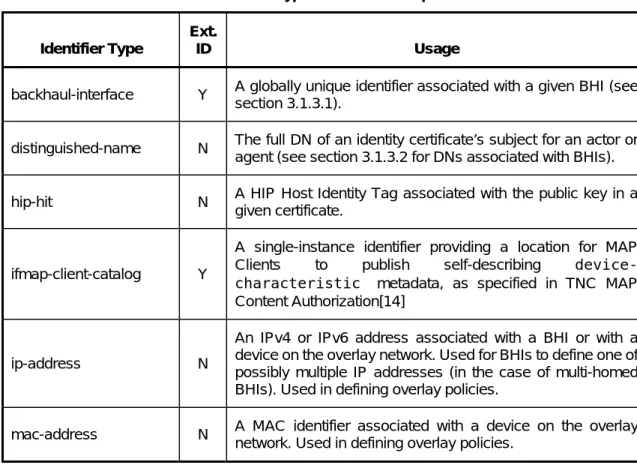
This specification uses a variety of identifiers defined in the TNC IF-MAP Binding for SOAP[2], including extended identifier types. Table 4 in section 3.4 gives a summary of these identifier types, whether they are extended identifiers, and how they are used in the ICS Security use cases.
3.3.1 Use of administrative-domain Identifier Attribute
The TNC IF-MAP Binding for SOAP[2] recommends that the administrative-domain attribute of an ip-address identifier represent the routing domain in which the IP address occurs, and the
administrative-domain attribute of an mac-address identifier represent the local network (LAN/VLAN segment) in which the MAC address occurs (see section 3.3.1.2 of [2]).
Within an ICS environment, it is beneficial to utilize the administrative-domain attribute to identify the overlay network in which the ip-address identifier or mac-address identifier occurs. In order to accomplish that goal, the following naming convention for IP routing domains and local networks in overlay networks facilitates communication of the overlay network name in the
administrative-domain attribute:
The administrative-domain attribute of an ip-address identifier referring to an ICS device on the overlay network MUST be the string concatenation of the name value of the associated overlay-network-group followed by a string that uniquely denotes the routing domain, separated by a colon.
The administrative-domain attribute of a mac-address identifier referring to an ICS device on the overlay network MUST be the string concatenation of the name value of the associated overlay-network-group followed by a string that uniquely denotes the local LAN/VLAN segment, separated by a colon.
For example, if MAC address xx:xx:xx:xx:xx:xx occurs in VLAN 100 on overlay network Overlay1, and MAC address yy:yy:yy:yy:yy:yy occurs in VLAN 200 on overlay network Overlay1, then the
mac-address identifier with name "xx:xx:xx:xx:xx:xx" could have administrative-domain
attribute "Overlay1:100" and the mac-address identifier with name "yy:yy:yy:yy:yy:yy" could have
Revision 45 Page 25 of 68
TCG PUBLISHED
For overlay networks that have a single routing domain or single LAN/VLAN segment, MAP Clients SHOULD use the same string for both the overlay network name and the IP routing domain or LAN/VLAN segment, (e.g. Overlay1:Overlay1).
As specified in section 3.1.3.2, MAP Clients are required to use the administrative domain "ifmap:client" with the IDevID and LDevID distinguished-name identifiers; this ensures compatibility with TNC MAP Content Authorization[14].
A special overlay-manager-group identifier instance with administrative-domain attribute “ tcg-reserved” and name attribute “unassigned” is used by BHIs to link to a known identifier when they are otherwise unassigned to a particular overlay-manager-group (see section 4.1.7). MAP Clients MUST NOT use the administrative domain "tcg-reserved" for any purpose other than those specified in this document.
The administrative-domain identifier attribute MUST NOT be used for any identifiers detailed in this specification except as specified in this section.
3.4 Extended
Identifiers
Details for each of the three extended identifiers listed in Table 4 are given in the subsections below. As defined in section 3.2.3 of the TNC IF-MAP Binding for SOAP[2], extended identifiers are defined as extensions of the identity type other. In future IF-MAP specifications, extended identifier types may be represented in a different manner for IF-MAP operations, but the definitions of the identifiers themselves should otherwise remain unchanged.
Table 4: Identifier Types Used in this Specification Identifier Type
Ext.
ID Usage
backhaul-interface Y A globally unique identifier associated with a given BHI (see section 3.1.3.1).
distinguished-name N The full DN of an identity certificate’s subject for an actor or agent (see section 3.1.3.2 for DNs associated with BHIs). hip-hit N A HIP Host Identity Tag associated with the public key in a
given certificate.
ifmap-client-catalog Y
A single-instance identifier providing a location for MAP Clients to publish self-describing device-characteristic metadata, as specified in TNC MAP Content Authorization[14]
ip-address N
An IPv4 or IPv6 address associated with a BHI or with a device on the overlay network. Used for BHIs to define one of possibly multiple IP addresses (in the case of multi-homed BHIs). Used in defining overlay policies.
mac-address N A MAC identifier associated with a device on the overlay network. Used in defining overlay policies.
Revision 45 Page 26 of 68
TCG PUBLISHED
overlay-manager-group Y The name of a group that can be assigned to manage one or more overlay networks and/or BHIs.
overlay-network-group Y The name of an overlay network to which various BHIs are bound.
3.4.1 backhaul-interface
The backhaul-interface extended identifier type contains a single name attribute which specifies the unique name of a given BHI; this name is based upon attributes assigned by the manufacturer, as described in section 3.1.3.1. Further context is provided by metadata attached to this identifier (see sections 3.5.1, 3.5.2, 3.5.4, 3.5.9.2, 3.5.10.1, 3.5.11, 3.5.12, and 3.5.13).
<xsd:element name="backhaul-interface"> <xsd:complexType>
<xsd:complexContent>
<xsd:extension base="base-id:IdentifierType"> <xsd:attribute name="name" type="xsd:string"
use="required"/> </xsd:extension> </xsd:complexContent> <xsd:anyAttribute/> </xsd:complexType> </xsd:element> 3.4.2 overlay-manager-group
The overlay-manager-group extended identifier type contains a single name attribute which specifies the name of a particular Overlay Manager group. Further context is provided by metadata attached to this identifier (see sections 3.5.7, 3.5.9, and 3.5.10.2).
<xsd:element name="overlay-manager-group"> <xsd:complexType>
<xsd:complexContent>
<xsd:extension base="base-id:IdentifierType"> <xsd:attribute name="name" type="xsd:string"
use="required"/> </xsd:extension> </xsd:complexContent> <xsd:anyAttribute/> </xsd:complexType> </xsd:element> 3.4.3 overlay-network-group
The overlay-network-group extended identifier type contains a single name attribute which specifies the name of the overlay network. Further context is provided by metadata attached to this identifier (see sections 3.5.1, 3.5.8, 3.5.9.1, and 3.5.10.1).
Revision 45 Page 27 of 68 TCG PUBLISHED <xsd:element name="overlay-network-group"> <xsd:complexType> <xsd:complexContent> <xsd:extension base="base-id:IdentifierType"> <xsd:attribute name="name" type="xsd:string"
use="required"/> </xsd:extension> </xsd:complexContent> <xsd:anyAttribute/> </xsd:complexType> </xsd:element>
Revision 45 Page 28 of 68
TCG PUBLISHED
3.5 IF-MAP Metadata for ICS Security Types
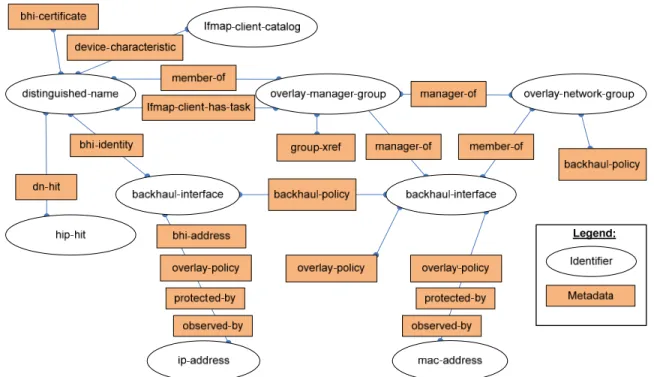
The IF-MAP Metadata for ICS Security schema contains the following metadata types, each of which is defined in detail in the subsections below. Figure 3 shows a graphical summary of these metadata types used in context with associated identifiers in the MAP graph.
Figure 3: Graphical summary of ICS security metadata types
This graphical summary of all possible ICS security metadata types is not intended to represent an actual MAP graph. Rather, it shows to what types of identifiers and links each metadata type is generally attached. For instance, a backhaul-interface identifier would never be linked to a single ip-address identifier via both bhi-address and protected-by; the bhi-address link would be to an ip-address identifier representing the IP address of the BHI itself, and the
protected-by link would be to an ip-address identifier representing the IP address of another system that the BHI has detected on the network.
Table 5 lists in alphabetical order all metadata types used in this specification; details on the usage of each of the new metadata types are given in the subsections below. The metadata types described in this section, which are defined in their own namespace that is specific to this specification, MUST NOT be used for purposes other than what is specified in this document. These metadata types MUST be attached only to prescribed kinds of identifiers or to links adjacent to prescribed kinds of identifiers, as specified in Table 5, so that match-links filters will work as intended.
Table 5: Metadata Types Used in this Specification Metadata Type Cardinality Where Attached
backhaul-policy Multi Identifier: overlay-network-group
Revision 45 Page 29 of 68
TCG PUBLISHED
bhi-address Single Link: backhaul-interface ip-address bhi-certificate Multi Identifier: distinguished-name
bhi-identity Single Link: backhaul-interface distinguished-name
device-characteristic Multi Link: distinguished-name map-client-catalog; see [14] dn-hit Single Link: distinguished-name hip-hit
group-xref Multi Identifier: overlay-manager-group
ifmap-client-has-task Single
Link: distinguished-name overlay-network-group; see [14]
manager-of Single Link: overlay-manager-group backhaul-interface Link: overlay-manager-group overlay-network-group member-of Single Link: overlay-network-group backhaul-interface
Link: overlay-manager-group distinguished-name observed-by Multi Link: backhaul-interface ip-address
Link: backhaul-interface mac-address
overlay-policy Single
Link: backhaul-interface ip-address Link: backhaul-interface mac-address Identifier: backhaul-interface
protected-by Single Link: backhaul-interface ip-address Link: backhaul-interface mac-address
Revision 45 Page 30 of 68
TCG PUBLISHED
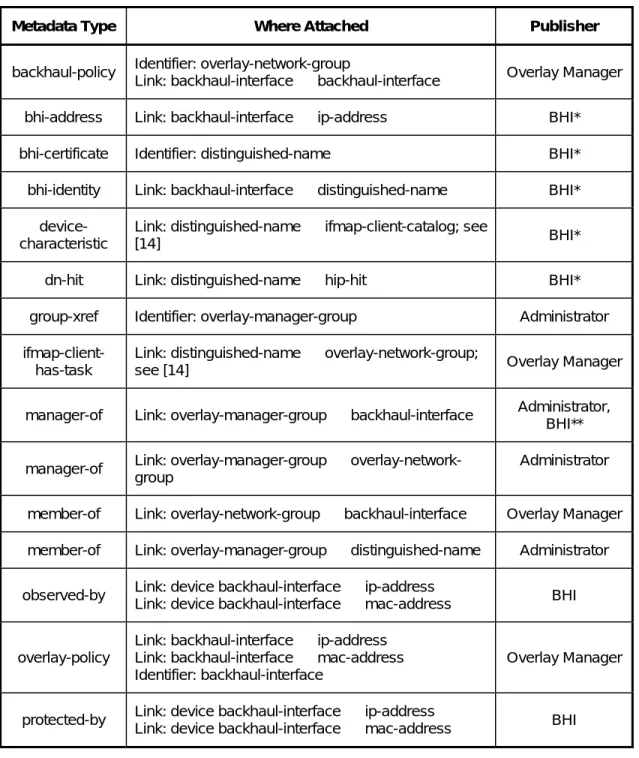
MAP Clients MUST NOT publish, modify, or delete any metadata type on a target identifier or link for which their role is not listed in the Publisher column of Table 6.
Table 6: Permitted Publishers of Metadata Types
Metadata Type Where Attached Publisher
backhaul-policy Identifier: overlay-network-group
Link: backhaul-interface backhaul-interface Overlay Manager bhi-address Link: backhaul-interface ip-address BHI* bhi-certificate Identifier: distinguished-name BHI*
bhi-identity Link: backhaul-interface distinguished-name BHI*
device-characteristic
Link: distinguished-name ifmap-client-catalog; see
[14] BHI*
dn-hit Link: distinguished-name hip-hit BHI*
group-xref Identifier: overlay-manager-group Administrator
ifmap-client-has-task
Link: distinguished-name overlay-network-group;
see [14] Overlay Manager
manager-of Link: overlay-manager-group backhaul-interface Administrator, BHI** manager-of Link: overlay-manager-group
overlay-network-group
Administrator
member-of Link: overlay-network-group backhaul-interface Overlay Manager member-of Link: overlay-manager-group distinguished-name Administrator observed-by Link: device backhaul-interface ip-address
Link: device backhaul-interface mac-address BHI
overlay-policy
Link: backhaul-interface ip-address Link: backhaul-interface mac-address Identifier: backhaul-interface
Overlay Manager
protected-by Link: device backhaul-interface ip-address
Link: device backhaul-interface mac-address BHI
* A BHI MUST publish these metadata types only on identifiers representing itself - not other BHIs. ** A BHI MUST NOT publish manager-of metadata on any identifier other than the TCG reserved
overlay-manager-group identifier instance with administrative-domain attribute “tcg-reserved”
and name attribute “unassigned”. (See section 4.1.7 for details on locator metadata for unassigned BHIs.)
Revision 45 Page 31 of 68
TCG PUBLISHED
3.5.1 backhaul-policy
Clients MUST publish this only on overlay-network-group, or between backhaul-interface and backhaul-interface
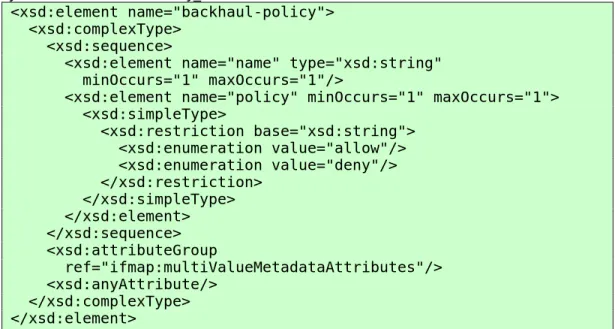
Overlay Managers use the multi-valued backhaul-policy metadata type to control whether some, all, or none of the BHIs on a given backhaul network communicate with one another over the backhaul network. For this purpose, each BHI acts as a TNC Flow Controller (see the TNC Architecture[1]). This metadata type has a name string attribute that MUST contain the name of an overlay network, as well as a policy string attribute that MUST have a value of either “allow” or
“deny”.
The backhaul-policy metadata type SHOULD only be published by the Overlay Manager role associated with affected BHIs.
3.5.1.1 Default Backhaul Policy
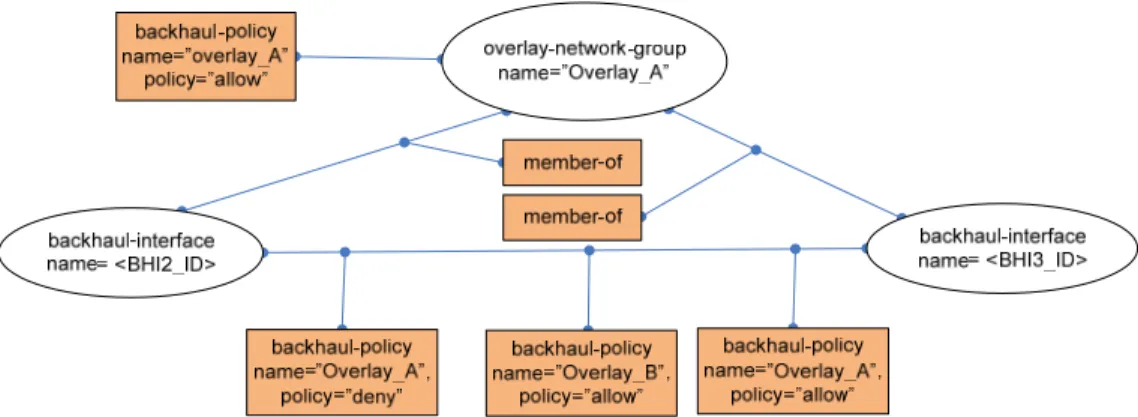
An Overlay Manager MAY attach the backhaul-policy metadata type to an overlay-network-group identifier, as shown on the left side of Figure 4, to indicate a default policy for BHIs that are members of that overlay network on a given backhaul network.
3.5.1.2 Pairwise Backhaul Policy
An Overlay Manager MAY attach the backhaul-policy metadata type to a link between the
backhaul-interface identifiers of a given pair of BHIs, as shown at the bottom of Figure 4, to indicate policy for communications between that pair of BHIs on a per-overlay network basis.
3.5.1.3 Considerations for use of Backhaul Policy
Each BHI MUST enforce policies dictated by backhaul-policy metadata in a bidirectional manner. In other words, if a backhaul policy permits traffic between two BHIs, packets may flow in either direction between those BHIs.
The use of default backhaul-policy metadata will, in some configurations, result in a more or less efficient MAP graph versus pairwise use of backhaul-policy metadata. For example, a default backhaul-policy of “allow” will result in a full-mesh configuration; once pairwise
backhaul-policy of “deny” is published on half of the possible links, the default policy becomes inefficient. In general, implementations should consider the effects of using backhaul-policy
metadata in these two different ways.
Figure 4: Example MAP graph for use of the backhaul-policy metadata type
Figure 4 shows several possible uses of backhaul-policy metadata for different scenarios as described above, but does not depict a MAP graph in an operational environment. As described