www.usa.siemens.com
White paper
Remote Security
Management Addresses
Security Challenges
Executive Summary: Facility managers want to provide an environment that is safe for occupants, whether those are tenants, patients, students, staff or visitors. Often the challenge is maintaining a high level of security within ever-tightening budgets. A growing number of facilities strike the balance between security and their budgets by turning to remote security management, or RSM. This strategy, experts say, can reduce security costs while improving the effectiveness of their overall security program.
This white paper covers the following: • RSM as a solution to funding challenges
• Using RSM to convert capital expenses to operating expenses
• Reducing onsite resources, utilizing trained professionals, and simplifying equipment and software maintenance and updates with RSM
RSM is a Solution to Funding Challenges
RSM is increasingly being used by facility managers who want comprehensive security solutions, but have limited budgets or lack the in-house expertise needed to administer, manage and monitor their systems. RSM offers compelling benefits. It allows facility managers to leverage their existing security equipment while reducing the level of IT resources needed onsite and elim-inating the need to work with multiple service providers. It re-quires minimal capital investment and can enable facilities to shift capital expenses to operating costs. RSM can also enhance facility security by allowing facility managers to cost-effectively provide 24/7/365 security.
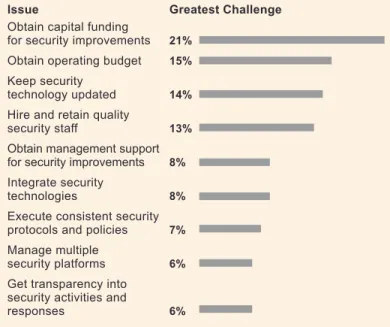
These benefits of RSM are critical given the funding challeng-es that many facility managers face. Rchalleng-esults from a recent sur-vey of more than 1,000 facility managers show that security funds are indeed tight. Respondents to the Building Operating Management/Siemens Industry, Inc. Security Management Survey ranked “capital funding for security improvements” as the greatest challenge to securing their facilities. Right behind it, cited by 15 percent of respondents, was “operating bud-get.” (See Figure 1)
Use of RSM is Growing
While most companies handle their security needs with inter-nal staff (see Figure 2 on page 3), the use of RSM is becoming more common. “As more security technology works over the Internet, remote security management becomes increasingly feasible,” says Bill Sako, chairman of Sako & Associates and se-nior vice president with The RJA Group.
In addition, the technology is continually advancing and be-coming less expensive. For instance, the software available to-day can cost-effectively bring together the audio and video re-cord of a security incident and response, providing the facility manager with a comprehensive view of the event.
A Closer Look at RSM
With an RSM solution, the provider hosts the servers and software for the facility’s video and access control systems. The facility owner or manager can keep tabs on security issues via a Web por-tal that is accessible on a 24/7/365 basis. They can also generate or review event or alarm reports and complete administrative functions, such as updating security protocols, among other ac-tivities.
RSM uses third-party security professionals to implement and execute security procedures and protocols remotely through a facility’s physical security system. RSM encompasses three categories of security solutions: video monitoring and management, access control monitoring and management, and audio services. These solutions can be provided on either a hosted or managed basis, or a combination of the two. With a hosted service, the RSM provider houses the head end servers and the management software for a facility’s video and access control systems. This minimizes much of the upfront capital costs and ongoing system expense such as electrical power for servers, cooling delivery and air handling, rack space and budgeted upgrades and maintenance.
Under a managed service, the RSM provider administers, manages and monitors a facility’s access control and video systems on a 24/7/365 basis. The provider also handles system administration, and leverages the power of its video and access control services to improve efficiencies and reduce false alarms.
Understanding RSM
Figure 1.
Obtaining funds for security
improvements is a challenge
Issue Greatest Challenge
Obtain capital funding
for security improvements 21%
Obtain operating budget 15%
Keep security
technology updated 14%
Hire and retain quality
security staff 13%
Obtain management support for security improvements 8%
Integrate security
technologies 8%
Execute consistent security protocols and policies 7%
Manage multiple
security platforms 6%
Get transparency into security activities and
responses 6%
Question:On a scale from 1 to 5 (1 = No challenge and 5 = Greatest chal-lenge) rank your ability to achieve the following items to secure your facility.
“As more security technology works
over the Internet, remote security
management becomes increasingly
feasible,” says Bill Sako, chairman of
Sako & Associates and senior vice
president with The RJA Group.
Many RSM systems can incorporate different levels of access, according to William Rhodes, market analyst with IMS Re-search. For instance, a regional manager within a restaurant chain might be able to view security recordings for the loca-tions he or she oversees, while the corporate risk manager would be able to view all locations.
Range of RSM Services
RSM can include a range of services, such as video alarm veri-fication and management, video guard tours and escorts, au-dio system administration, maintenance, and upgrades. These allow the facility’s team to focus on its core responsibilities, confident that the building is secure.
Video Alarm Verification: Using real-time video, the RSM pro-vider can check and verify alarms generated by a facility’s sen-sors, including motion, intrusion or access control alarms. This reduces the fees associated with false alarms, provides for more effective communication with authorities during a re-sponse, and allows for more efficient utilization of the securi-ty staff.
Video Guard Tours: At scheduled intervals, the RSM provider will review and record video from each security camera, quick-ly identifying any security breaches. It verifies that the system is operational, cameras are pointed in the right direction and the views are not obstructed. This is a cost-effective alterna-tive to after-hours guard tours and reduces the physical risk faced by the security staff. In addition, the video tours are available for investigative purposes.
Video Escort: The RSM provider can use the security cameras to visually escort a person or piece of equipment moving from one location to another. This offers additional security and provides video documentation of the trip.
Alarm and Event Monitoring and Management: Based on the business’ requirements and protocol, the RSM provider will re-spond to alarms and events in a consistent manner. The moni-toring and management of a facility’s alarms can be integrat-ed with its fire, environmental and other alarms.
For instance, some school districts remotely monitor closed circuit TVs, while also using two-way audio, according to Kelly Klatt, chief executive officer with the Center for Security Solu-tions, Inc., in Orlando, Fla.
Randy Johnson, facilities and environmental, health and safety manager with Microsemi Corp., a provider of semiconductor solutions, oversees three buildings in Bend, Ore. While security guards make nightly rounds throughout the buildings, a third party also monitors the burglar and fire alarms on the facilities. For instance, if a perimeter door sensor goes off after-hours, the RSM provider is alerted and can begin contacting the security guards or police, as needed. This way, even if Johnson is away on a business trip, the alarms are attended to. With this arrangement, Johnson can keep tabs on all that happens by logging in to the security provider’s website to review a log of the times at which any alarms went off, as well as other information and reports. “It’s definitely the way to go,” Johnson says.
RSM Can Supplement the
Staff on the Ground
Figure 2.
A majority of security is
managed in-house, but outsourcing is on the rise
In-house staff 69%
Outsourced company located onsite
(guard service) 39%
Outsourced company located offsite (central monitoring service) 35%
(Total exceeds 100 percent because multiple mentions were allowed.)
Question:How is your security managed?
RSM solutions provide highly trained, certified security professionals that follow consistent protocols for every incident.
“Having an outside provider monitor
the access control system also saves
time and resources while providing
us accurate, timely responses,” says
Frank LaMorte, national director of
security, Valassis.
If someone tries to break into a facility, the RSM provider can address the individual over the system, indicating that the inci-dent is being captured on camera and that he or she should leave the premises. “This can provide a valuable benefit, given the small security staffs with which most school districts work,” says Klatt.
RSM Offers Multiple Bottom-Line Benefits
RSM services are often accounted for as monthly operating ex-penses, rather than a capital investment. In many multi-tenant buildings, operating expenses can be incorporated into the tenant’s rent, while capital investments cannot.
RSM typically reduces the total cost of ownership for a security solution. This is a result of several factors. One is that it elimi-nates the upfront cost of purchasing the head end servers and software licensing required with onsite security systems. RSM also minimizes other costs associated with having an onsite head end server, such as cooling and ventilation, measures to ensure power reliability, and rack space.
Providers of RSM services can help the facility manager calcu-late the total cost of ownership of the system and compare this to the cost of hosting the security solution onsite. In addition to the initial investment, the RSM provider will take into ac-count any ongoing service charges, as well as the cost of pow-ering and managing the technology. This analysis typically cov-ers between three and 10 years.
Managing Multiple Locations
RSM providers can remotely view and manage video for nu-merous sites that are spread over a wide area, such as a chain of jewelry stores or coffee shops, according to Rhodes. The systems can also be linked to point-of-sale systems, providing management with video records of cash transactions and voids, helping to reduce shrinkage.
In addition, an RSM solution can be significantly more cost-ef-fective than an onsite system for organizations that need to secure more than one facility. Rather than install and maintain a head end server at multiple buildings, each location can sim-ply connect to the RSM provider through a secure connection. What’s more, an RSM solution can ensure that security and business protocols are applied consistently by utilizing one set of trained security professionals responsible for all locations.
Valassis, with 7,000 employees, is a leading provider of media and marketing services. It is one of the largest distributors/processors of coupons in the world. Until recently, the company operated an in-house security center with five full-time and several part-time employees that monitored access control and alarm systems for about 20 facilities. Because the plants operate on different schedules, it was necessary to staff the operations center 24/7, according to Frank LaMorte, national director of security. An analysis indicated that hiring an RSM provider to manage the center would help Valassis save costs, while still
providing appropriate security. LaMorte implemented an RSM solution for access control, including cardholder and change management, and alarm monitoring for Valassis’ locations across the country. The RSM provider also regularly updates and maintains the systems.
The RSM provider connects through a virtual private network to Valassis’ computer server, which is linked to their cameras and access control system. Valassis also maintains a separate server with backup for the access control system to provide a high level of security and prevent unauthorized access. The RSM solution provided a reduction in staff and space allocated to the security operations center, saving Valassis about $270,000 annually in salary and benefits. “Having an outside provider monitor the access control system also saves time and resources while providing us accurate, timely responses,” LaMorte says.
Valassis Saves More Than $270,000
Annually Using RSM Access Control
RSM can provide enhanced security
and information, while keeping costs
down. “It’s the wave of the future,”
says Kelly Klatt, chief executive
officer with the Center for Security
Solutions, Inc.
If someone tries to break into a facility, the RSM provider can address the individual over the loud speaker, indicat-ing that the incident is beindicat-ing captured on camera and tell-ing the person to leave the premises.
In contrast, the use of a different security staff at each loca-tion can lead to security protocol breaches and inconsisten-cies. And because turnover is often high among security per-sonnel, these differences can become even more pronounced. Reducing the Costs of Security Staffing
Gaining security services through RSM can enable facilities owners to reduce their security employee-related expenses, such as hiring and training of new security personnel. “Labor typically is the largest part of the security budget; therefore, reducing the amount of labor needed can lead to ongoing savings,” says Klatt.
The need to provide 24/7/365 monitoring was the security is-sue most frequently ranked as a top challenge by 44 percent of respondents to the Building Operating Management/Sie-mens Industry, Inc. Security Management Survey. In most implementations, RSM can provide 24/7/365 monitoring for a lower expense than having round-the-clock guards. In fact, Siemens Industry, Inc. Fire Safety and Security Solutions and Services, a provider of remote security management, has seen costs decline from 26 to 72 percent when using its To-tal Cost of Ownership calculator, which compares customers’ traditional security systems with RSM, according to Phil Atte-berry, director of managed security services.
“Of course, cost savings would be meaningless if remote secu-rity management wasn’t effective,” Atteberry says. “But, time after time, it has proven to be effective. For instance, one re-tail chain saw incidents of violence and theft drop by 42 per-cent when it implemented remote security management.” Providing Qualified Security Personnel
Another significant security concern, also mentioned by 44 percent of respondents to the Building Operating Manage-ment/Siemens Industry, Inc. Security Management Survey, was the ability to find qualified personnel.
While onsite security guards provide a visible presence to the occupants and visitors of a facility, many organizations find it difficult to afford guards who have been adequately trained. “They may hire individuals who lack proper training, hoping that they can learn on the job,” says Sako. “That can backfire if the guards are not effective. The lack of training and qualifica-tions of security personnel has come up in some lawsuits.” An RSM solution provides highly trained, certified security
Boston Properties works with an RSM provider to remotely monitor the access control systems within a Princeton, N.J., office park that covers 2 million square feet and includes 17 buildings, according to Mark Hockenjos, vice president of property management. The office park is in a suburban area, and security-related incidents are fairly minimal. Still, some level of security is prudent. So, along with having a guard cover the facility on a 24/7 basis, the office park is protected via remote monitoring after normal business hours.
In the event of an alarm, the center follows established procedures that vary based on the type of alarm. For instance, if an alarm goes off during the day, the RSM provider will notify the property management staff, which will then investigate. For alarms that sound after hours, the provider will alert the security guard or maintenance engineer to follow up.
Remote security management is common for many suburban office centers, Hockenjos says. “It’s much more costly to have physical monitoring onsite,” he says.
RSM Provides Cost-Effective
Way to Secure Office Park
RSM can supplement the security staff on the ground and provide 24/7/365 monitoring.
RSM is common for many suburban
office centers. “It‘s much more costly
to have physical monitoring onsite,”
says Mark Hockenjos, vice president
of property management for Boston
Properties.
professionals that follow consistent protocols for every inci-dent. This removes the burden and cost of ongoing training from a facility manager’s budget.
RSM Simplifies Equipment Needs and Software Management
Hosted RSM solutions eliminate the need to spend additional money for large servers that provide the platform to run the head end. Now, the RSM provider’s central alarm or monitoring stations have the ability to receive data transmitted from the facility’s system via the Internet.
Increasingly, alarms from a range of sensors, such as cameras, access control and intrusion detection devices, transmit alarm information directly over the facility’s network, therefore streamlining the process.
Not only does RSM reduce the need for additional hardware, but it improves software management as well. System administration, maintenance and upgrades are continuously managed. Security systems that aren’t well maintained will degrade and can lead to problems with false alarms, or prompt a facility manager to disable the technology. “An RSM provider can keep tabs on the status of the security equipment,” Sako says. The RSM provider will ensure that upgrades and maintenance of the security system’s head end are completed in a timely manner. This is key, given that the typical life of security technology has dropped from between 10 to 15 years to five to seven years.
Backup and Redundancy
Facility managers are understandably concerned about backup and redundancy when they consider a shift to remote security management. Many providers’ systems are fully UL listed and redundant. A robust fiber network with multiple lines con-nects the remote security center and the Internet. Multiple lines between facilities, as well as mirror technology for the alarms and monitoring systems, ensure reliability. RSM provid-ers also conduct regular testing of the connections between the system at the facility and the central monitoring station. Some take this a step further and have fully redundant moni-toring stations. If the RSM provider’s primary monimoni-toring loca-tion is impacted by a severe threat, such as a natural disaster, they have a completely redundant monitoring station located elsewhere in the country. This ensures their customers always receive service.
Security accounts for only a small percentage of the overall budget in most organizations. About two-thirds of companies spend five percent or less of their budget on securing facilities and people.
Security Spend Is a Small Part of
Corporate Budget
0 to 2% 36% 3 to 5% 25% 6 to 10% 13% 11 to 15% 5% 16 to 20% 3% 21% or more 3% Don’t know 15%Question:Approximately what percent of your organization’s corporate budget do you devote to security (including electronic systems, guard service, central monitoring service, etc.)?
“An RSM provider can keep tabs
on the status of security equipment,”
says Bill Sako of Sako & Associates
and The RJA Group.
For a majority of respondents, their funds cover a range of security functions, including access card administration, upgrading security technology, monitoring cameras and conducting guard tours. Because security often accounts for just a small portion of an organization’s budget yet must cover numerous functions, it’s critical that the funds allocated are used as efficiently and effectively as possible.
Security Staff
Responsibilities Are Numerous
Walk the property to conduct security/guard tours 75%
Card administration – add and delete
employees to access control system 71%
Check camera functionality, placement and focus 67%
Monitor security cameras 24/7/365 65%
Upgrade security technology and software 63%
Pull video footage for forensic analysis 55%
Verify alarms or alerts through the video system prior to dispatching security personnel 54%
Generate reports for scheduled maintenance
and guard tours, alarms, alerts and incidents 54%
Escort people or assets from one area to another 52%
(Total exceeds 100 percent because multiple mentions were allowed.)
Question:Please select all of the security-related tasks conducted by staff or outsourced personnel.
If the Internet connection between the facility and the RSM provider should be interrupted, the provider will immediately receive an alarm notification of the lost connection. The devic-es on the client side, such as the card readers, remain in oper-ation and the data is stored. When the connection is re-estab-lished, the data from the readers will be transmitted to the controller.
In addition, RSM providers have done a great deal of work to establish back-up systems via the cell phone system. In bank-ing and other high-security fields, this has become the norm. Enhanced Security and Information
RSM can work very well in a variety of facilities. Many build-ings have security guards onsite during the day, when they’re most needed. After work hours, the need for security guards may drop, but many facilities need some level of security. “Re-mote security monitoring can provide that, at savings of 20 to 50 percent of the cost of a security guard,” says Atteberry. Owners of vacant buildings often want to ensure that their buildings are secure, yet may determine that the buildings don’t warrant onsite security guards. Again, RSM can be an ef-fective solution. The same is true for facilities in low crime-risk areas that still need some level of surveillance and protection. The systems can also integrate non-security services, such as the ability to turn off the lights in a facility remotely.
A growing number of municipalities are requiring alarm verifi-cation prior to responding to reduce the number of false alarms transmitted to the fire and police departments. By using tech-nology to perform an initial check of an alarm event, the RSM provider can efficiently investigate the circumstances that led to the alarm. Often, alarms go off for reasons that do not volve fire or intrusion. For instance, a cleaning person may in-advertently set off an alarm.
Many companies are finding multiple ways to use information that is obtained via a security system. In retail settings, man-agement can use security videos to gather marketing informa-tion about their customers’ behavior and determine which ar-eas in a store generate the most traffic. Or a facility manager can view a security video to verify if the firm hired to do snow removal actually is completing the job in a timely manner. An-other example involves a food and beverage company utilizing security cameras to ensure FDA guidelines are being followed. They also verify that the trucks transporting the products are sealed to avoid tampering. The same can be done for compa-nies that manufacture medical products.
Remote security management can provide enhanced security and information, while keeping costs down. “It’s the wave of the future,” says Klatt. “Consolidating these services is a more efficient use of security dollars.”
Whether a building is occupied or vacant, remote monitoring is an effective solution to protect people, property and assets.
“Remote security monitoring can
provide savings of 20 to 50 percent of
the cost of a security guard,” says Phil
Atteberry of Siemens Industry, Inc.
The Building Operating Management/Siemens Industry Inc. Security Management Survey was sent via email to a random sample of 13,000 Building Operating Management subscribers on June 16, 2011. Reminders were sent to non-respondents on June 20 and June 30, 2011. A total of 644 subscribers chose to opt out of the survey or failed to respond due to an invalid email address, yielding a final sample of 12,356. The survey was closed for responses on July 7, 2011. With 1,019 qualified responses returned and with a net sample of 12,356, the rate of response for the email survey was computed to be 8.2 percent.
The overall estimated margin of error for this study is +/- 3.05 percent at the 95 percent confidence level.
Methodology
Demographics of Survey Sample
40% Commercial Office 30% Educational: K-12/Colleges/Universities 20% Health care 15% Government 12% Industrial/Manufacturing 11% Retail 5% Hospitality 6% Other
(Total exceeds 100 percent because multiple mentions were allowed.)
Question:Please indicate the types of facilities you/your firm own or manage. Responses = 1,010
42% 100,000 to 499,999 sq. ft. 20% 500,000 to 999,999 sq. ft. 23% 1 million to 4,999,999 sq. ft. 6% 5 million to 9,999,999 sq. ft. 9% 10 million or more sq. ft.
Question:Please indicate the total square feet of buildings you/your firm own or manage. Responses = 988