Asset Management and
Maintenance Audits
By Ralph Bell and Jo Harris
BG 24/2012
A BSRIA Guide
www.bsria.co.uk
ACKNOWLEDGEMENTS
This publication replaces two earlier BSRIA publications:
AG 24/97 Operation and Maintenance Audits by Rohan Nanayakkara
and Mike Smith
AG 13/2000 Toolkit for Building Operation Audits by Cary Donaldson
and John Armstrong
This update was developed with input from industry representatives. BSRIA wishes to thank the following members of the CIBSE Maintenance Task Group for their contributions.
John Armstrong Armville Consulting
Andrew Saville Armville Consulting
Stephen Gathergood G4S Integrated Services
Andy Green Faithful and Gould
Geoff Prudence UCL
Neil Ambler Watson and Sole
Paul Kee Hurley Palmer Flatt
Rob Farman Abacus FM Engineering Consultancy
Kate McCommick SPIE Matthew Hall
David Robinson Babcock
Steve Hunter Mitie TFM
Javier Carnero Mitie TFM
Special acknowledgement is given to Ashley Hemmings of Interserve FM for his work compiling the toolkit and willingness to share with the industry.
Acknowledgements from AG 13/2000 are reproduced in appendix A. This publication was designed and produced by Joanna Smith.
Every opportunity was taken to incorporate the views of the contributors, but final editorial control rested with BSRIA.
A limited number of advertising slots were offered to BSRIA member Companies and to those who sat on the steering group for this publication.
The advertisements in this publication do not necessarily reflect the views of BSRIA. BSRIA does not endorse the products and services of
ii ASSET MANAGEMENT AND MAINTENANCE AUDITS
PREFACE
The issue of effective audits was raised by John Armstrong the author of
AG 13/2000 Toolkit for Building Operation Audits in a recent CIBSE
maintenance task group meeting. We are very pleased to be able to update this guide and make the toolkit available to the industry. I’ll take this opportunity to apologise to Ashley Hemmings of Interserve FM, as he approached me over two years ago with his conversion of the original checksheet into a useful toolkit. We have been using the toolkit in earnest for two years, as has Ashley. It has been developed over the last 5 years on PFI projects within Interserve and trialled in the banking, arts and printing sectors.
Between us we have now produced this guidance and toolkit that is easy to use, streamlines the audit process and allows you to track progress and capture the results effortlessly.
The audit results can be used to benchmark performance and it is the intention of BSRIA to facilitate this benchmarking in the future to help quantify and improve the performance of building operation and maintenance.
Jo Harris July 2012
CONTENTS
Part 1 – Audit Guidance
1 INTRODUCTION 1
1.1 What is an audit? 1
1.2 Purpose of audits 2
1.3 Business success criteria 3
2 AUDITS 4
2.1 Level of audits 4
2.2 Types of audits 5
2.3 The audit plan 6
2.4 The audit process 7
2.5 The role of the auditor 7
3 MANAGEMENT APPROACH TO AUDITING 10
3.1 Justifying the audit process 10
3.2 Terms of reference 10
3.3 Overlap of audit activities 10
4 THE AUDIT FUNCTION 12
4.1 Planned arrangements 12 4.2 Performance indicators 12 4.3 Gathering information 13 4.4 Information collection 15 4.5 Information analysis 15 5 THE AUDITOR 16 5.1 General 16
5.2 Auditor training and experience 16
5.3 Selection of an auditor 17
6 REPORTING 18
6.1 Format and contents 18
6.2 Introductory section or preamble 18
6.3 Summary of non-conformities and recommendations 18
6.4 The audit summary 19
iv ASSET MANAGEMENT AND MAINTENANCE AUDITS
CONTENTS
Part 2 – Audit Toolkit
7 HOW TO USE THE TOOLKIT 24
8 TOOLKIT GUIDE 26
8.1 Maintenance organisation and resourcing 26
8.2 Planning and management of the maintenance activity 28
8.3 Environmental and energy management 33
8.4 Health and safety 34
8.5 Financial planning, management and control 38
8.6 Communication 40
8.7 Records and documentation 40
8.8 Additional work 41
8.9 Client satisfaction 44
8.10 General quality of work 45
8.11 Site survey 46
APPENDIX A: AG 13/2000 ACKNOWLEDGEMENTS 48
APPENDIX B: TRAINING AND COMPETENCE LEVELS 49
APPENDIX C: DOCUMENTS AND RECORDS 50
Figure 1 : Continuous Improvement 2
Figure 2 : Two levels of Audit 4
Table 1 : Optional audit front sheet 20
Table 2 : Property Information 21
Table 3 : Housekeeping checklist 46
Table 4 : Plant condition checklist 46
REFERENCES 51
TABLES
FIGURES
Part 1 – Audit Guidance
1
INTRODUCTION
Effective management of the operation and maintenance of any asset requires feedback. A well thought out and enacted audit will provide that feedback and allow an organisation to check their management systems, identify any deviations from those systems and make any necessary corrections. An audit does not have room for apportioning blame for problems.
The audit process and its outcome is broken down to the following key stages:
process review
correcting problems
preventing problems
dynamic improvements.
The audit process provided in this guide will support the implementation
of good practice asset management as outlined in PAS 55-1[1].
To assist this we have annotated the elements in section 8 of this guide,
highlighting the relevant section in relation to clause 4 of PAS 55-2[2].
1.1 WHAT IS AN
AUDIT? An operation and maintenance audit is a systematic examination, undertaken by those who have a knowledge and understanding of the
operation and maintenance of buildings, to assess the effectiveness of the asset management.
The main purposes of the audit are to highlight deviations from plans or expectations, to evaluate the need for improvement and to take
corrective action.
Operation and maintenance combines the availability of the building services plant and equipment with the implications of this in terms of environmental comfort, client satisfaction, business risk, disruption to the organisation, health and safety and financial management.
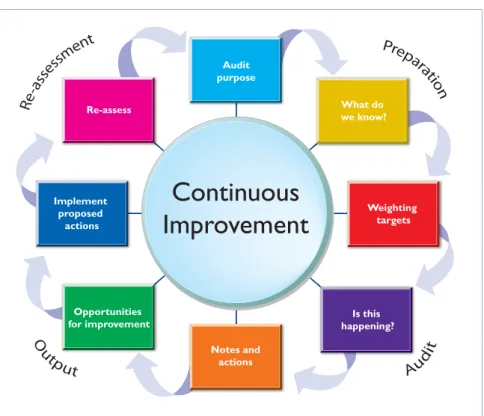
Audits are part of a process of continuous improvement, as illustrated in Figure 1. They provide a structured means of collecting information and data to allow an assessment of current performance to be made, together
INTRODUCTION
2 ASSET MANAGEMENT AND MAINTENANCE AUDITS
2
Current performance is judged against criteria such as:
acceptable downtime
financial and budgetary criteria
reliability and availability requirements of the engineering plant and
services
service level achieved
key performance indicators (KPIs)
occupant expectations.
Figure 1 : Continuous Improvement
Re-assess Implement proposed actions Opportunities for improvement Notes and actions Is this happening? Weighting targets What do we know? Audit purpose
Co
n
ti
nu
o
u
s
I
m
prove
m
e
n
t
1.2 PURPOSE OFAUDITS Operation and maintenance audits are carried out for a number of reasons including:
assessment of current position
comparison against best practice
examination of efficiency
to demonstrate that work has been carried out as specified and that
2
AUDITS
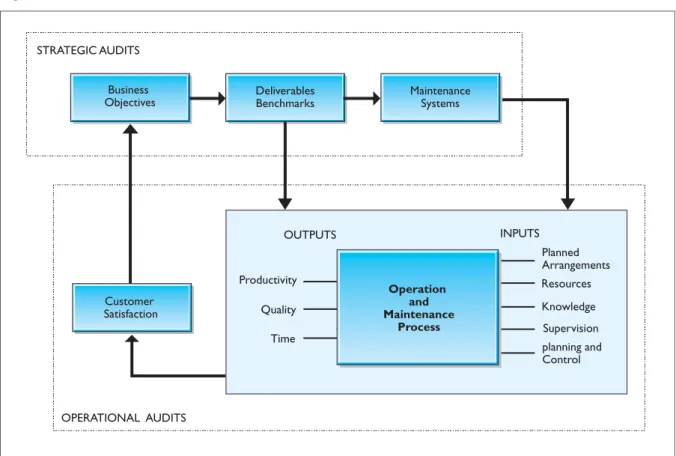
2.1 LEVEL OF AUDITS An audit can be conducted at two levels - strategic or operational as
illustrated in Figure 2.
Figure 2 : Two levels of Audit
Business Objectives Deliverables Benchmarks Productivity Maintenance Systems STRATEGIC AUDITS OPERATIONAL AUDITS Operation and Maintenance Process Customer
Satisfaction Quality
Time planning and Control Knowledge Supervision Resources Planned Arrangements OUTPUTS INPUTS Strategic audits
Strategic requirements for operation and maintenance match
organisational objectives and are determined at management level. The strategic audit examines the status and effectiveness of the organisation’s operation and maintenance system. It determines whether the overall maintenance strategy, maintenance priorities and resourcing are suitable to achieve the objectives of the organisation. The strategic audit also enables management to continually review and re-focus maintenance strategies and action plans to meet those objectives.
Strategic audits are concerned with the overall system performance to achieve the organisation’s needs.
6<Insert Name> 5<Insert Name> 4<Insert Name> 3<Insert Name> 2<Insert Name> 1<Insert Name> 1 2 3 4 5 6 < In s e rt Na m e > < In s e rt Na m e > < In s e rt Na m e > < In s e rt Na m e > < In s e rt Na m e > < In s e rt Na m e >
Ref Audit Questions 0 0 0 0 0 0
8.1 MAINTENANCE ORGANISATION AND RESOURCING h h h h h h
8.1.1 Organisational and Structure sh sh sh sh sh sh
8.1.1.a Is there an organisational chart for maintenance staff that clearly identifies their job functions, duties and responsibilities and the reporting structure?
8.1.1.b Is the structure adequate and suitable to carry out the work?
8.1.1.c Are all of the positions shown on the organisational chart fully resourced? 8.1.1.d Is the organisation over-resourced?
8.1.1.e Do individuals understand their job functions and responsibilities? 8.1.1.f Is staff conduct, appearance, attitude and behavior satisfactory?
8.1.2 Knowledge, Competence and Training sh sh sh sh sh sh
8.1.2.a Is there a procedure for assessing and ensuring that the staff are competent to do their jobs?
8.1.2.b Is this procedure adequate to satisfy legislative requirements such as the management of Health And Safety at Work Regulations and the requirements of the business?
8.1.2.c Are there adequate arrangements to refresh training on specific duties, for example, refresher training of HV authorized persons?
8.1.2.d Do staff have the necessary qualifications, training, approvals, skills and competence to carry out their specific job functions in line with the company policy for competence?
8.1.2.e Are staff kept up to date with information required to carry out their work, for example current legislation, British Standards, innovations, etc.?
8.1.2.f Do the staff fully utilize the information provided by the company?
8.1.2.g Are there sufficient management controls to ensure that staff do not use outdated information?
8.1.2.h Do the staff receive any support training (e.g. Customer awareness, First Aid, Related trade information, etc.)? 8.1.2.i Is there an ongoing training programme?
8.1.2.j Are adequate budget funds allocated for staff training and development?
8.1.3 Information Technology sh sh sh sh sh sh
8.1.3.a Is there a company policy related to computer-based information systems? 8.1.3.b Does it compare well to the industry norms?
8.1.3.c Is this policy applied to the maintenance IT system?
8.1.3.d Does the maintenance organisation use the full potential of current IT systems to optimize its processes, for example CMMS & CAFM systems?
8.1.3.e Is the maintenance IT system fully understood by its users? 8.1.3.f Are information back-up facilities provided?
8.1.3.g Is the information on the system secure?
8.1.3.h Is the information security in compliance with the Data Protection Act 1998?
8.1.4 Staff Motivation sh sh sh sh sh sh
8.1.4.a Is the company organisational policy for staff well-being satisfactory (e.g. standard of accommodation, messing facilities, etc.)?
8.1.4.b Is there a staff grievance procedure?
8.1.4.c Have all past and present grievances been resolved?
8.1.4.d Is any staff dissatisfaction apparent (e.g. grievances re: pay awards, lack of training, lack of support from senior management, harassment, etc.)?
8.1.4.e Are there any systems in place for additional staff motivation (e.g. bonuses, career structure, etc.)? 8.1.4.f Is there a high level of staff turnover?
8.2 PLANNING AND MANAGEMENT OF THE OPERATION AND MAINTENANCE PROGRAMME h h h h h h
8.2.1 OPERATION AND MAINTENANCE DOCUMENTATION sh sh sh sh sh sh
8.2.1.a Are the ‘Good Practice’ operation and maintenance documents and records available [as listed in Appendix C of the guide and worksheet tab labelled 8.2.1.a].
8.2.1.b Are these records indexed and kept for easy access for those who require them? 8.2.1.c Is there a person / satisfactory system for updating these records as changes occur? 8.2.1.d Are these documents up to date? [as listed in Appendix C]
8.2.1.e Are these documents and records held on a computer-based system? 8.2.1.f Is there an Asset Register?
8.2.1.g Are all plant and equipment included?
8.2.1.h Are plant and equipment which are no longer in use identified as such in the Asset Register?
8.2.1.i Is there a person / satisfactory system for updating the asset register as changes are made to plant and installations? 8.2.1.j Is the Asset Register accessible to all those who require the information it contains?
8.2.2 Stores Management sh sh sh sh sh sh
8.2.2.a Is there an adequate budget for maintaining essential stocks? 8.2.2.b Is there a regular review of stocks – levels, etc.?
8.2.2.c Is there a stock control and review procedure? 8.2.2.d Is there evidence of over-stocking? 8.2.2.e Are redundant stock items retained on site? 8.2.2.f Are the stock storage areas adequate?
8.2.2.g Does the method for purchasing stock comply with maintenance response times, e.g. lead time to obtain spares?
8.2.3 Issuing the Stock sh sh sh sh sh sh
8.2.3.a Is there any undue queuing while drawing stock?
8.2.3.b Is the security for stock holding areas adequate to reduce loss, damage and personal abuse, etc.? 8.2.3.c Are non-expendable items tested and checked on a regular basis?
8.2.3.d Are sufficient tools and test equipment available for completion of the maintenance tasks? 8.2.3.e Is test equipment checked and calibrated on a regular basis?
Allocated Audit Questions by Key Contact >