Journal of Language and Linguistic Studies Vol.4, No.1, April 2008
Developing an ESL Curriculum Based on Needs and Situation Analyses: A Case
Study
Hayriye Kayı
Abstract
Needs analysis is important in terms of students’ involvement in every phase of educational process. It is necessary to know about learners’ objectives, language attitudes, expectations from the course and learning habits in order to design an efficient curriculum. However, it is not only the learners who play an important role in developing a curriculum. There are other factors relevant to the design and implementation of language programs or curricula. At this point, situation analysis is needed. The purpose of this paper is, then, to explain how to conduct needs and situation analyses for developing an English as a second language (ESL) curriculum. The results of observations of ESL students, questionnaires given to the student participants, and interviews conducted with three ESL teachers indicate the variety of needs of students. Based on those results, implications are provided for faculty designing ESL curriculum in community colleges.
Key Words: Needs analysis, situation analysis, ESL curriculum development
Özet
ikinci dil olarak öğrenen ögrencileri gözlemleme, öğrenci katılımcılara verilen anketler ve İngilizceyi ikinci dil olarak öğreten öğretmenlerle yapılan röportaj sonuçları, öğrencilerin ihtiyaçlarındaki çeşitliliği göstermektedir. Bu sonuçlara dayanarak, İngilizce dersi
müfredatı düzenleyen akademisyenler için öneriler sunulmaktadır.
Anahtar Kelimeler: İhtiyaç analizi, durum analizi, İngilizce dersi müfredat geliştirme
1. INTRODUCTION
Kaur (2007) claims, if English as a second language (ESL) instructors do not know about their students and their needs, developing a curriculum gets challenging causing many problems in learning and teaching the second language. In order to prevent those problems, teachers’ attention should shift to needs analysis which is a process of collecting and analyzing information about learners in order to set goals and contents of a language curriculum based on the needs of those learners (Richards, 2001). Needs analysis is important in terms of students’ involvement in every phase of educational process. The studies indicate that it is necessary to know about learners’ needs such as their objectives, language attitudes, expectations from the course and learning habits in order to design an efficient curriculum (e.g. Brindley, 1984; Kaur, 2007; Nunan, 1988; Nunan, 1990; Xenodohidis 2002). Those studies are helpful in providing a procedure for using information about learners to inform and guide the course design, syllabus design or curriculum development.
Developing a curriculum is a complex task due to the rich variety of learners’ needs and the amount of people who play a role in decision-making process. Before explaining its complexity, it would be wise to make clear what is meant by curriculum and curriculum development which are frequently used in this paper. Curriculum means “principles and procedures for the planning, implementation, evaluation, and management of an
definition which includes many factors in it such as teacher, learner, parent factors, etc., makes curriculum development a complex and challenging task.
As seen, it is not only the learner factors which need to be taken into consideration in developing a curriculum. There are other factors directly related to the design and implementation of language programs or curricula. At this point, situation analysis, which is “an analysis of factors in the context of a planned or present curriculum that is made in order to assess their potential impact on the project” (Richards, 2001, p. 91), is needed. Although there are studies based on needs analysis in ESL settings, there is no literature on situation analysis and its application to ESL curriculum. The purpose of this study is, then, to explain how to conduct needs and situation analyses for designing an ESL curriculum. The main research question is “How does one conduct needs and situation analyses in order to design an efficient ESL curriculum?” Needs and situation analyses have never been done in the target setting for this study. The need for those analyses for a comprehensive ESL curriculum for that setting inspired my desire to conduct this study.
2. METHOD 2.1. Design
This is a case study consisting of questionnaires, interviews (Appendix A) and observations. Questionnaires were given to the adult ESL students who were also observed. Interviews were conducted with three ESL teachers. The purpose of collecting qualitative and quantitative data is to have more convincing and accurate findings and conclusions by means of multiple sources of evidence (McMillan & Schumacher, 2000).
The lens which shapes this study is a multicultural lens. One reason for selecting multicultural lens is because of the diverse student population at the community college which is the target setting of this study. In order to address those students and help them get used to the life and school system in a foreign country, it is inevitable to examine their cultural backgrounds. The other reason is that, as Pang (2001) claims, since
2.2. Participants
The participants of this study are 22 students taking classes in a western community college in the U.S, and three ESL teachers, Sonya, Janet and Diane, teaching there. The students come from different cultural and linguistic backgrounds. The Hispanic and Asian students constitute the largest portion of student population. The teacher participants have been teaching English at this college with varying years of experience. They all hold an MA degree in Teaching English to speakers of other languages (TESOL). Sonya and Janet teach 15 hours in a week and Diane, who is the administrator at the same time, teaches 6 hours in a week. Teacher participants have been assigned a pseudonym.
2.3. Setting
The community college where this study was conducted provides more than 50 degree and certificate programs. The English department in the college designs all ESL programs and almost 2000-3000 ESL students take ESL classes every year. There are more than 30 faculty members in the English department and almost 70 instructors offer ESL classes on different levels and skills. The three classes observed for this study are
Intermediate Listening taught by Janet, Intermediate Reading by Sonya, and Basic Skills in Writing by Diane. It is an Adult Basic ESL program.
2.4. Data Collection
Both qualitative and quantitative data were collected for this study. Data included interviews, observations and questionnaires. Before collecting the data, the researcher explained the purpose of the study to the participants and their role in it.
Observations: While teachers were lecturing in classes, giving explanations or engaging with various activities, the students were observed to determine what kinds of activities they liked and what kinds of language problems and linguistic difficulties they encountered. Only notes were taken during the observations. Each observation took approximately 2-3 class hours and each class was observed a maximum of four times.
study both during the observations and when the questionnaires were distributed. The questionnaires were administered only once in the Reading class and took approximately 25 minutes. The questionnaire was adapted from the Richards text (2001). The reasons for using Richard’s questionnaire is that it is the most comprehensive sample among the others and the questions are consistent with TESOL standards. The questionnaire consisted of 60 questions in six parts. The first part was on personal and demographic information of the participants while the second part focused on the importance of skills to the students and the problems that they encounter. The last part was on the skills students would like to improve.
Interviews: Lastly, the teachers were interviewed to determine what kinds of
language problems and linguistic difficulties their students encounter. They were also asked about their roles and experiences related to curriculum development. Semi-structured interviews were administered only once and audio taped. For interviews, time commitment was no more than 45 minutes. To maintain confidentiality, each participant was assigned a pseudonym. When conducting the interviews, a specific location and time appropriate for teachers and investigators were chosen.
2.5. Data Analysis
Percentages and frequency of responses to the questions on challenges or problems about listening, speaking, reading and writing skills in English were found through
analyzing the student questionnaires using MS Excel. The categories of data were
developed for interviews notes and observations and each category was further analyzed to determine major themes.
3. RESULTS
into four headings. The first three categories are the findings of needs analysis while the last one is of situation analysis.
Reasons for learning English
In the questionnaire, the students were asked why they wanted or continued to learn English. Three common answers were given:
Educational Purposes: Ten students stated that they were learning English to meet the TOEFL requirement for attending an undergraduate or graduate school. They mentioned that they were studying very hard because they wanted to start their academic program as soon as possible.
Job Requirement: Considering the fact that one of the first requirements of many job applications is to speak English fluently, twelve reported that they wanted to learn English to get a better job. Sonya stated that since most of her students did not have the opportunity to “speak” English in an English as a Foreign Language (EFL) context, to learn the language they had to come to the U.S. where English is the native language. The researcher observed that the students believe having a certificate or degree which indicates a high proficiency level of English provides a lot of opportunities in their countries.
Survival Purposes: Students also stated that they learn English because they live in an English dominant country and they have to speak English in order to survive. Their teachers stated that living in the U.S. with limited English had caused various inconveniences or challenges to the students, which affected their lives severely. For instance, they had communication problems while registering at school, shopping, renting an apartment, etc. In order to survive in this English dominant society, the students had only one option: learning English.
Students’ Social Needs and Interests
In all three classes observed, the time the students were the most active was when they could make connections between the topic covered and their own lives. In her theme based classroom, before reading the stories, Sonya always asked students to give examples from their own lives on the related theme. This was when the students got very excited to talk about their lives, cultural or educational experiences. Even the students with the lowest level of language proficiency were observed to participate. Similarly, in Diane’s classroom, the immigrant and international students enjoyed talking about their life experiences in the U.S. They were always willing to explain to their classmates about the traditional or religious holidays celebrated in their countries or the school system or the culture shock they had when they arrived in the U.S.
In Sonya’s writing class, students liked teacher-centered activities better than student- centered. Sonya explains why:
They want me to teach grammar, because it is what their teachers were doing when they were in China, or Japan or … They really seem to like formal and traditional classrooms.
Despite their favor of traditional classrooms, the researcher observed that students in Diane’s and Janet’s classes also favored communicative activities. As for the materials or resources, it was seen that the students found the textbooks and written materials more interesting and helpful than audio-programs. The researcher observed higher participation during the exercises in the textbook and less participation when the students had to listen to a tape recorder for listening activities in Janet’s class.
Questionnaire Results
The questionnaire was administered with the aim of collecting data on the personal and demographic information of the participants, the importance of skills to the students, the problems they encounter and the skills they would like to improve.
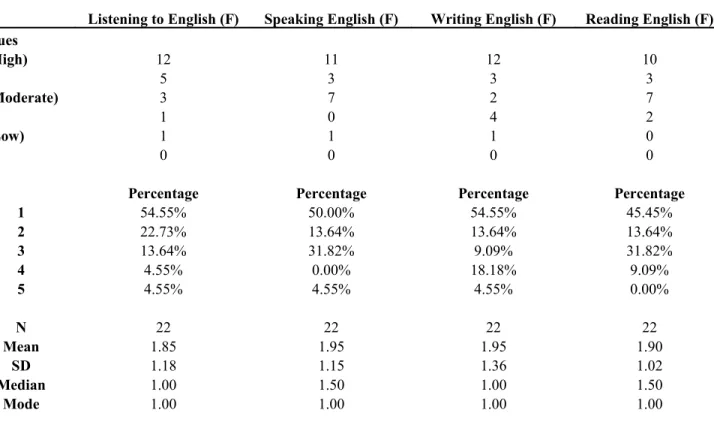
Table I: How important to success in your course of study are the following abilities?
Listening to English (F) Speaking English (F) Writing English (F) Reading English (F) Values
1 (High) 12 11 12 10
2 5 3 3 3
3 (Moderate) 3 7 2 7
4 1 0 4 2
5 (Low) 1 1 1 0
0 0 0 0
Percentage Percentage Percentage Percentage
1 54.55% 50.00% 54.55% 45.45%
2 22.73% 13.64% 13.64% 13.64%
3 13.64% 31.82% 9.09% 31.82%
4 4.55% 0.00% 18.18% 9.09%
5 4.55% 4.55% 4.55% 0.00%
N 22 22 22 22
Mean 1.85 1.95 1.95 1.90
SD 1.18 1.15 1.36 1.02
Median 1.00 1.50 1.00 1.50
Mode 1.00 1.00 1.00 1.00
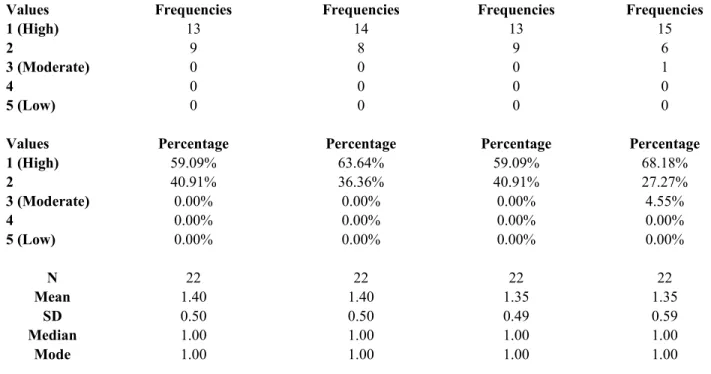
Next, the students were asked to rate the importance of the same abilities to success in their fields after graduation. Table II indicates the frequency and percentages of the responses given to this question. All the students considered the four skills highly important or important to success in their field after graduation. In all skills, the students rated reading ability as the most important one to success in their course of study. What follows reading ability is speaking ability with 63.64 % respond rate. Among the four skills, listening and writing in English were rated as the least important ones to success after graduation. However, overall, all those abilities were rated as highly important or important by all the respondents.
Values Frequencies Frequencies Frequencies Frequencies
1 (High) 13 14 13 15
2 9 8 9 6
3 (Moderate) 0 0 0 1
4 0 0 0 0
5 (Low) 0 0 0 0
Values Percentage Percentage Percentage Percentage
1 (High) 59.09% 63.64% 59.09% 68.18%
2 40.91% 36.36% 40.91% 27.27%
3 (Moderate) 0.00% 0.00% 0.00% 4.55%
4 0.00% 0.00% 0.00% 0.00%
5 (Low) 0.00% 0.00% 0.00% 0.00%
N 22 22 22 22
Mean 1.40 1.40 1.35 1.35
SD 0.50 0.50 0.49 0.59
Median 1.00 1.00 1.00 1.00
Mode 1.00 1.00 1.00 1.00
The following part of the questionnaire aimed to identify the problems students are having in the four language skills. This part was divided into four sections, each focusing on one skill. For each ability, students chose among always, often, sometimes, never, and not applicable to indicate the frequency of the difficulties experienced. Table III indicates the frequency and percentages of the responses given to the questions on speaking skills. The results showed that 77.27 % of the students sometimes have difficulty in oral presentation. Regarding the difficulty with pronunciation, 14 students, that is 63.64 %, stated that they sometimes have that problem. 54.55 % reported that they sometimes have trouble wording what they want to say quickly enough while 18.18 % often experience the same problem. 19 out of 22 students, that is 90.82 %, believe they sometimes or often do not know the best way to say something in English, which is the most problematic issue reported by the students in this section.
Table III: How often do the following happen to you? (Speaking Skills) Have difficulty
in oral presentation.
Have trouble wording what you want to say quickly enough
Worry about saying something in case you make
a mistake in
Not know how to say something in
English
Not know the best way to say
something in English
your English
Values Frequencies Frequencies Frequencies Frequencies Frequencies Frequencies
1 (Always) 0 2 2 1 1 1
2 (Often) 4 5 7 5 9 4
3 (Sometimes) 17 12 6 11 9 14
4 (Never) 0 2 5 4 1 1
5 (NA) 1 1 2 1 2 2
Values Percentage Percentage Percentage Percentage Percentage Percentage
1 (Always) 0.00% 9.09% 9.09% 4.55% 4.55% 4.55%
2 (Often) 18.18% 22.73% 31.82% 22.73% 40.91% 18.18%
3 (Sometimes) 77.27% 54.55% 27.27% 50.00% 40.91% 63.64%
4 (Never) 0.00% 9.09% 22.73% 18.18% 4.55% 4.55%
5 (NA) 4.55% 4.55% 9.09% 4.55% 9.09% 9.09%
N 22 22 22 22 22 22
Mean 2.90 2.75 2.95 2.90 2.70 2.95
SD 0.64 0.97 1.19 0.91 0.98 0.94
Median 3.00 3.00 3.00 3.00 3.00 3.00
Mode 3.00 3.00 2.00 3.00 3.00 3.00
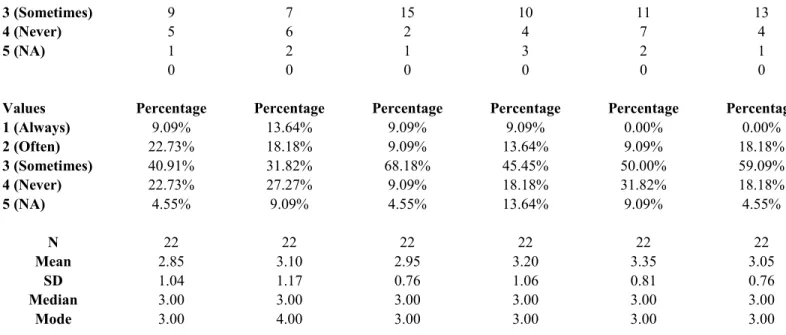
The frequency and percentages of the responses to the questions on listening skills are shown in Table IV. The results indicated 15 students, that constitute 68.18 % of the whole population, sometimes have trouble in understanding various accents of English. Half of the participants stated that they sometimes have trouble in understanding the topic of a discussion and 59.09 % sometimes has difficulty in understanding vocabulary.
Table IV: How often do the following happen to you? (Listening Skills)
Have trouble in understanding
lectures
Have trouble taking notes
Have trouble understanding various accents
of English
Have trouble understanding
informal language and
slang
Have trouble understanding
the topic of a talk
Have trouble understanding
vocabulary Values Frequencies Frequencies Frequencies Frequencies Frequencies Frequencies
1 (Always) 2 3 2 2 0 0
3 (Sometimes) 9 7 15 10 11 13
4 (Never) 5 6 2 4 7 4
5 (NA) 1 2 1 3 2 1
0 0 0 0 0 0
Values Percentage Percentage Percentage Percentage Percentage Percentage
1 (Always) 9.09% 13.64% 9.09% 9.09% 0.00% 0.00%
2 (Often) 22.73% 18.18% 9.09% 13.64% 9.09% 18.18%
3 (Sometimes) 40.91% 31.82% 68.18% 45.45% 50.00% 59.09%
4 (Never) 22.73% 27.27% 9.09% 18.18% 31.82% 18.18%
5 (NA) 4.55% 9.09% 4.55% 13.64% 9.09% 4.55%
N 22 22 22 22 22 22
Mean 2.85 3.10 2.95 3.20 3.35 3.05
SD 1.04 1.17 0.76 1.06 0.81 0.76
Median 3.00 3.00 3.00 3.00 3.00 3.00
Mode 3.00 4.00 3.00 3.00 3.00 3.00
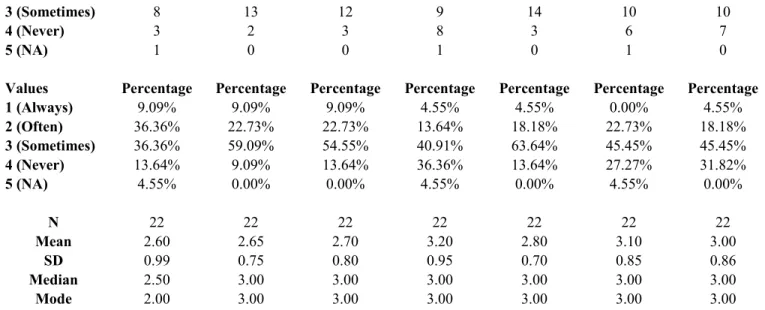
Table V indicates the frequency and percentages of the responses given to the questions on writing skills. When students were asked how often they had problems using correct punctuation and spelling, 36.36 % stated they often had problems while 36.36 % sometimes had difficulties. 13 students, that is 65 %, found structuring sentences
sometimes difficult while 22.23 % often found it difficult. For 54.55 % using appropriate vocabulary was sometimes difficult, for 25 % it was often difficult. Developing ideas was a problem 70 % sometimes have and 22.73 % face it often. 45.45 % have difficulty in addressing the topic in writing and the same percentage of students sometimes find completing written tasks within a time limit problematic.
Table V: How often you have problems with the skill? (Writing Skills)
Using correct punctuation and spelling
Structuring Sentences
Using appropriate
vocabulary
Organizing paragraphs and ideas
Developing ideas
Addressing topic
Completing written tasks within
the time given
Values Frequencies Frequencies Frequencies Frequencies Frequencies Frequencies Frequencies
1 (Always) 2 2 2 1 1 0 1
3 (Sometimes) 8 13 12 9 14 10 10
4 (Never) 3 2 3 8 3 6 7
5 (NA) 1 0 0 1 0 1 0
Values Percentage Percentage Percentage Percentage Percentage Percentage Percentage
1 (Always) 9.09% 9.09% 9.09% 4.55% 4.55% 0.00% 4.55%
2 (Often) 36.36% 22.73% 22.73% 13.64% 18.18% 22.73% 18.18% 3 (Sometimes) 36.36% 59.09% 54.55% 40.91% 63.64% 45.45% 45.45% 4 (Never) 13.64% 9.09% 13.64% 36.36% 13.64% 27.27% 31.82%
5 (NA) 4.55% 0.00% 0.00% 4.55% 0.00% 4.55% 0.00%
N 22 22 22 22 22 22 22
Mean 2.60 2.65 2.70 3.20 2.80 3.10 3.00
SD 0.99 0.75 0.80 0.95 0.70 0.85 0.86
Median 2.50 3.00 3.00 3.00 3.00 3.00 3.00
Mode 2.00 3.00 3.00 3.00 3.00 3.00 3.00
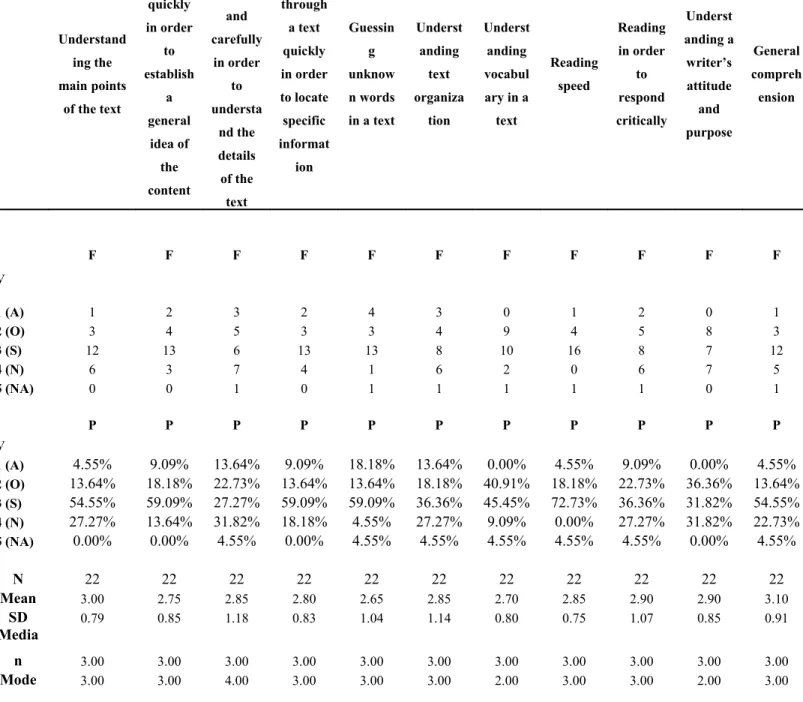
Table VI indicates how often students have difficulty with abilities related to reading skill. 54.55 % sometimes are having trouble in understanding the main points of a text. 59.09 % indicated that they sometimes have difficulty in reading a text quickly in order to establish a general idea of the content. The same percentage of the respondents also pointed out the difficulty in looking through a text quickly in order to locate specific
Table VI: Indicate how often you have difficulty with each of the following? (Reading Skill)
P: Percentage, F: Frequency
Understand ing the main points
of the text
Reading a text quickly in order to establish a general idea of the content Reading a text slowly and carefully in order to understa nd the details of the text Looking through a text quickly in order to locate specific informat ion Guessin g unknow n words in a text
Underst anding text organiza tion Underst anding vocabul ary in a
text Reading speed Reading in order to respond critically Underst anding a writer’s attitude and purpose General compreh ension
F F F F F F F F F F F
V
1 (A) 1 2 3 2 4 3 0 1 2 0 1
2 (O) 3 4 5 3 3 4 9 4 5 8 3
3 (S) 12 13 6 13 13 8 10 16 8 7 12
4 (N) 6 3 7 4 1 6 2 0 6 7 5
5 (NA) 0 0 1 0 1 1 1 1 1 0 1
P P P P P P P P P P P
V
1 (A) 4.55% 9.09% 13.64% 9.09% 18.18% 13.64% 0.00% 4.55% 9.09% 0.00% 4.55%
2 (O) 13.64% 18.18% 22.73% 13.64% 13.64% 18.18% 40.91% 18.18% 22.73% 36.36% 13.64%
3 (S) 54.55% 59.09% 27.27% 59.09% 59.09% 36.36% 45.45% 72.73% 36.36% 31.82% 54.55%
4 (N) 27.27% 13.64% 31.82% 18.18% 4.55% 27.27% 9.09% 0.00% 27.27% 31.82% 22.73%
5 (NA) 0.00% 0.00% 4.55% 0.00% 4.55% 4.55% 4.55% 4.55% 4.55% 0.00% 4.55%
N 22 22 22 22 22 22 22 22 22 22 22
Mean 3.00 2.75 2.85 2.80 2.65 2.85 2.70 2.85 2.90 2.90 3.10
SD 0.79 0.85 1.18 0.83 1.04 1.14 0.80 0.75 1.07 0.85 0.91
Media
n 3.00 3.00 3.00 3.00 3.00 3.00 3.00 3.00 3.00 3.00 3.00
The students were also asked to rate the importance of skills they would like to improve and Tables VII, VIII and IX indicate their responses. In Table VII, essay writing and listening to pronunciation, intonation and stress patterns of English were rated as always important by the half of the respondents. General listening comprehension is often important to be improved by the same number of students. 59.19 % considered lecture note taking always or often important while 72.72 % stated giving formal speeches and
presentations is always or often important.
Table VII: Skills you would like to improve
Listening to pronunciation , intonation, stress patterns of English Lecture note taking General listening comprehensio n Giving formal speeches, presentation s Participate effectively in discussions Communicatin g effectively with peers in
small group discussions, collaborative projects, or out
of class study groups
Communicatin g effectively with people out
of class
Essay writing
V F F F F F F F F
1 (A) 11 8 5 8 7 6 4 11
2 (O) 2 5 11 8 8 6 8 6
3 (S) 6 6 3 4 5 6 7 3
4 (N) 2 2 2 1 1 2 2 1
5 (NA) 1 1 1 1 1 2 1 1
V P P P P P P P P
1 (A) 50.00% 36.36% 22.73% 36.36% 31.82% 27.27% 18.18% 50.00%
2 (O) 9.09% 22.73% 50.00% 36.36% 36.36% 27.27% 36.36% 27.27%
3 (S) 27.27% 27.27% 13.64% 18.18% 22.73% 27.27% 31.82% 13.64%
4 (N) 9.09% 9.09% 9.09% 4.55% 4.55% 9.09% 9.09% 4.55%
5 (NA) 4.55% 4.55% 4.55% 4.55% 4.55% 9.09% 4.55% 4.55%
N 22 22 22 22 22 22 22 22
Mean 3.00 2.75 2.85 2.80 2.65 2.85 2.70 2.90
SD 0.79 0.85 1.18 0.83 1.04 1.14 0.80 1.07
Media
n 3.00 3.00 3.00 3.00 3.00 3.00 3.00 3.00
P: Percentage, F: Frequency
In Table VIII, it is seen that creative writing, writing introductions and conclusions, and analyzing written materials were considered always important by 45.45 %.
Table VIII: Skills you would like to improve
Creativ e Writing
Writing case studies
Describing objects and procedures
Writing introductions
and conclusions
Writing references
and quotations
Formulating coherent arguments
Summarizing factual information
Synthesizing information
from more than ones
source
Analyzing written materials
F F F F F F F F F
V
1 (A) 10 6 5 10 8 5 3 6 10
2 (O) 4 7 6 5 2 6 5 1 2
3 (S) 6 7 9 4 9 10 11 9 6
4 (N) 1 1 1 2 1 0 2 5 2
5 (NA) 1 1 1 1 2 1 1 1 2
V P P P P P P P P P
1 (A) 45.45% 27.27% 22.73% 45.45% 36.36% 22.73% 13.64% 27.27% 45.45%
2 (O) 18.18% 31.82% 27.27% 22.73% 9.09% 27.27% 22.73% 4.55% 9.09%
3 (S) 27.27% 31.82% 40.91% 18.18% 40.91% 45.45% 50.00% 40.91% 27.27%
4 (N) 4.55% 4.55% 4.55% 9.09% 4.55% 0.00% 9.09% 22.73% 9.09%
5 (NA) 4.55% 4.55% 4.55% 4.55% 9.09% 4.55% 4.55% 4.55% 9.09%
N 22 22 22 22 22 22 22 22 22
Mean 2.10 2.15 2.20 2.40 2.35 2.30 1.75 1.95 2.20
SD 1.02 1.09 1.11 1.27 1.04 1.03 1.07 1.15 1.06
Median 2.00 2.00 2.00 2.00 2.00 2.00 1.00 1.50 2.00
Mode 2.00 2.00 2.00 3.00 2.00 3.00 1.00 1.00 3.00
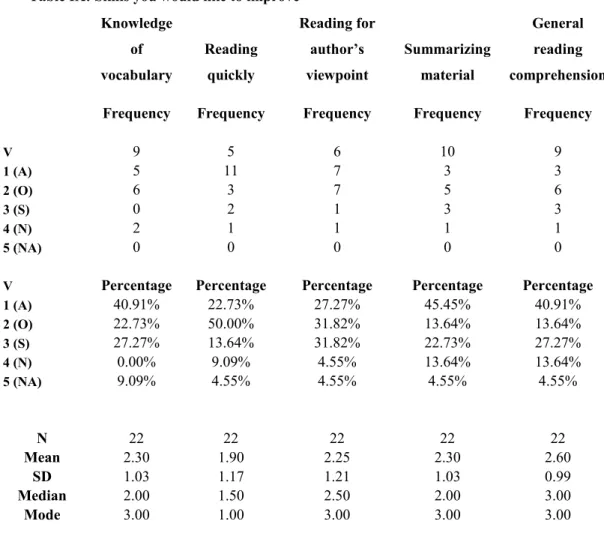
Table IX indicates that while 72.73 % believed reading quickly is always or often important.
Table IX: Skills you would like to improve
Teacher Factors: Situation Analysis
In this paper, for situation analysis, the focus was on teachers rather than other factors. The teachers were asked what difficulties their students generally had while learning the language. Their answers to the question differed. Diane stated it was mostly grammar which was problematic for her students, while Janet and Sonya found vocabulary challenging for their students. Janet also stated that cultural differences might sometimes cause difficulties for her students while learning the language. Despite the challenges their students face, all teachers declared their learning groups are easy to teach and they
mentioned various reasons for this. According to Janet, the main reason for her students’
Knowledge of vocabulary
Reading quickly
Reading for author’s viewpoint
Summarizing material
General reading comprehension Frequency Frequency Frequency Frequency Frequency
V 9 5 6 10 9
1 (A) 5 11 7 3 3
2 (O) 6 3 7 5 6
3 (S) 0 2 1 3 3
4 (N) 2 1 1 1 1
5 (NA) 0 0 0 0 0
V Percentage Percentage Percentage Percentage Percentage
1 (A) 40.91% 22.73% 27.27% 45.45% 40.91%
2 (O) 22.73% 50.00% 31.82% 13.64% 13.64%
3 (S) 27.27% 13.64% 31.82% 22.73% 27.27%
4 (N) 0.00% 9.09% 4.55% 13.64% 13.64%
5 (NA) 9.09% 4.55% 4.55% 4.55% 4.55%
N 22 22 22 22 22
Mean 2.30 1.90 2.25 2.30 2.60
SD 1.03 1.17 1.21 1.03 0.99
Median 2.00 1.50 2.50 2.00 3.00
being easy to teach is that ninety percent of her students are adults, which makes them aware of their responsibilities. She said “They are not here for fun, they are not traditional college students. They are adults and they want to be here, they are not forced to be here”. Sonya believes that their high motivation, which is actually a result of students’ immediate social needs, is another reason for learner’s being easy to teach: “They want to learn English because they are immigrants in the U.S and they need to find a job, communicate with people, find a school for their kids, so they really want to learn English and they are highly motivated”
When the teachers were asked the topics their students enjoy, they all reported that the content the students would prefer would always change and there were different factors that affect their preferences such as their age level, interests, cultural background and so on. For instance, Diane stated that the main factor in her classes is the age level of her students: “They are all adults in my class, you know, we cannot talk about Britney Spears” Although it was difficult for Janet and Sonya to determine the interests and preferences of their students, all three teachers agreed that the students would prefer the topics which were directly connected with their own lives in the U.S. as immigrants.
The teachers were also asked to give information about the resources available in the college and beneficial for their teaching. The teachers stated that there was a range of recourses available for ESL students. They said that all of the services once called the Writing Center, the Math Center, The Source, and the ESL Resource Center were now under the title Tutoring and Learning Center where students get help with any ESL homework, learn to use the resources available to help learn English such as books, CD's, videos, cassettes and practice the basic ESL skills through conversation groups or reading groups.
ask every year “What do they do in other schools”” As for the materials and textbooks which will be used, Janet says “Full time teachers do it on their own and part time teachers talk to each other for ideas” and the variety of professional resources, such as workshops or libraries, helps them in determining the materials and the textbooks. The process ends this way.
4. LIMITATIONS OF THE STUDY
This study has limitations. Due to the small number of the participants, the sample population is not truly representative. Involving other institutions with similar cohorts of students might have increased the reliability of the study. Additionally, the study looks at only teacher factors in situation analysis. The results would have been more valid if the role of other factors, such as societal, project or institutional had also been explored. The length of the questionnaire is another limitation. The questionnaire was too long to be completed, which may have resulted in discrepancy in the answers.
5. DISCUSSIONS AND IMPLICATIONS
This study has attempted to explain how to conduct needs and situation analyses for developing an ESL curriculum. Accordingly, the main research question is “How does one conduct needs and situation analyses for designing an efficient ESL curriculum?” This study is important because there is no research done on situation analysis and its application to developing an ESL curriculum before. The study is also important as it will contribute to the limited literature on needs analysis and its application to design of an ESL curriculum.
students’ reasons for learning English, a content-based curriculum including topics and themes which are directly related to students’ lives and the challenges that they have had in the US as immigrants is recommended for the instructors teaching English in community colleges.
The data from the questionnaires has been helpful in diagnosing the problems related to the four language skills and the abilities students would like to improve. It is worth mentioning that all the students considered those skills highly important or important to success in their field after graduation. Based on the findings, it is not possible to
conclude that one skill is more difficult than the others for the students, but within each skill, there are some abilities reported to be more challenging than others by the student participants. Within speaking, the students are more challenged by presentations, not knowing the best way to say something in English, while in listening they are confronted by understanding various accents of English. Within writing, using correct punctuation and spelling, structuring sentences, and developing ideas are the most problematic issues and within reading, understanding the main points of a text, skimming and scanning, and understanding vocabulary are the difficulties students have. These results are also consistent with the interview data that indicated that vocabulary and grammar were the most difficult aspects of language for learners. The results further indicated that the students wanted to improve their essay writing skills, pronunciation, general listening comprehension, oral presentations, and listening comprehension. It is clearly seen that there is a strong connection between the difficulties students face in learning the language and the skills they would like to improve. They would like to improve the skills which are challenging or problematic for them. In developing the curriculum for Reading, Writing, Listening and Speaking courses, these findings should be taken into consideration by ESL instructors and emphasis should be given to the most problematic skills for the learners in this specific setting.
REFERENCES
Brindley, G. (1984). Needs Analysis and Objective-setting in the Adult Migrant Education Program. Sydney: Adult Migrant Education Service.
Kaur, S. (2007). ESP Course Design: Matching Learner Needs to Aims. English for Specific Purposes, 6(1).
McMillan, J. H., & Schumacher, S. (2000). Research in education: A conceptual introduction (5th ed.). New York: Longman.
Nunan, D. (1988). The learner centered curriculum. Cambridge: Cambridge University Press
Nunan, D. (1990). Using learner data in curriculum development. ESP Journal, 9, 17-32. Pang, O. (2001). Multicultural Education: A Caring-centered Reflective Approach.
NY:McGraw-Hill
Richards, J. (2001). Curriculum development in language teaching. Cambridge: Cambridge University Press.
APPENDIX A: INTERVIEW QUESTIONS
1. What teaching loads do you have and what resources you make use of?
2. What are the language problems and linguistic difficulties your students encounter while learning the language?
3. Is your learning group easy to teach or difficult to teach? 4. Are your students motivated to learn English? How?
5. What type of content they prefer? What type of content they have difficulty with? 6. Are there any learning resources your students will access to?
7. Who takes part in the decision-making process in developing the curriculum 8. Who decides which textbooks and materials will be used?
9. Do you have enough professional resources available at …?
10. Have you worked as a member of a curriculum project team? If yes, could you please tell a bit about your experience(s)?
11. If teachers and learners have different expectations and beliefs about the nature of a language course, what can be done? What would you do in such a situation?
Hayriye Kayı did her undergraduate studies at the Middle East Technical University where she earned a Bachelor of Arts degree majoring in Foreign Language Education. She