Link Quality and MAC-Overhead aware Predictive
Preemptive Multipath Routing Protocol for Mobile
Ad hoc Networks
Moussa Ali cherif
1, Mohamed Kamel Feraoun
1and Sofiane Boukli Hacene
11
Computer Science Department, Sidi Bel Abbes University, Algeria [email protected], [email protected], [email protected]
Abstract: In Ad Hoc networks, route failure may occur due to less received power, mobility, congestion and node failures. Many approaches have been proposed in literature to solve this problem, where a node predicts pre-emptively the route failure that occurs with the less received power. However, these approaches encounter some difficulties, especially in scenario without mobility where route failures may arise. In this paper, we propose an improvement of AOMDV protocol called LO-PPAOMDV (Link Quality and MAC-Overhead aware Predictive Preemptive AOMDV). This protocol is based on new metric combine two routing metrics (Link Quality, MAC Overhead) between each node and one hop neighbor. Also we propose a cross-layer networking mechanism to distinguish between both situations, failures due to congestion or mobility, and consequently avoiding unnecessary route repair process. The LO-PPAOMDV was implemented using NS-2. The simulation results demonstrate the merits of our proposed LO-PPAOMDV with approximately 10-15% increase in the packet delivery ratio while average end-to-end delay is reduced by 20%, and normalized routing load is reduced about 45%, also with 7% increase in the throughput, when compared with PPAOMDV.
Keywords: Ad-Hoc networks, Multipath Routing, PPAOMDV, MAC, Cross layer.
1.
Introduction
An ad hoc network consists of mobile nodes, which communicate with each other through multi-hop routes. Nodes cooperate with their neighbors to route data packets to their final destinations. In ad hoc networks, network topology is changing continuously because of the node movement. To maintain the communication between nodes, many routing protocols have been proposed, which are classified under two categories: table-driven and on-demand routing protocols.
On-demand routing protocols discover routes only when the source needs to send packets. Therefore, there is almost no route maintenance overhead, whereas the route discovery before data transmission increases the delay. However, if the link failure happened, nodes should inform the sources to change the existing route and retransmit the packets that were lost due to link failure. Therefore, on-demand routing protocols increase delay and decrease the successful packet arrival ratio. This causes the reduction of the packet delivery ratio.
Several approaches have been proposed [3],[4],[27] to flexibly anticipate link failure by adding a function that predicts the link failure in one of the popular on-demand routing protocols which is Ad hoc On-demand Distance Vector (AODV).
Previous approaches encounter some difficulties, especially in scenario without mobility. The problem is that these approaches predict link failures based of the Received Signal Strength (RSS) information and interpret that it happened due to node mobility, where actually it was due to congestion. Therefore, the process of route repair should not be performed since it increases even more the congestion, decreasing the overall performance of the network.
Transmitting information to a neighboring node in MAC layer is preceded by the exchange of Request To Send (RTS)/Clear To Send (CTS) frames. If this communication fails, the MAC layer waits (back off time) and retries later. After several failed attempts, the MAC layer informs the routing layer using a cross layer interaction. In our approach, the cause of that unsuccessful communication is sent to the routing layer. If the last received power of the destination node indicates that it is reachable, the routing layer is informed, using the variable xmit_reason with the value XMIT_REASON_HIGH_RSS. Depending on this information a node will decide whether it performs a route repair or not.
In this paper, we propose Link Quality and MAC-Overhead aware Predictive Preemptive Ad hoc On-Demand Multipath Distance Vector (LO-PPAOMDV), it is an on-demand routing protocol based on new metric combine two routing metrics (Link Quality, MAC Overhead), that aims to create congestion-free routes by making use of information gathered from the MAC layer. Also we propose a cross-layer networking mechanism to distinguish between both situations, failures due to congestion or mobility, and consequently avoiding unnecessary route repair process, where we use a “Route Failure Prediction Technique” based on the Lagrange interpolation for estimating whether an active link is about to fail or will fail.
The rest of the paper is organized as follows. Section 2 describes related works; the proposed protocol is presented in section 3 and its performance is evaluated and compared with that of PPAOMDV in section 4. Some conclusions and future works are given in section 5.
2.
Related Works
networks.
Xiaoqin, Jones and Jayalath in [10] have proposed the Congestion Aware Routing protocol for Mobile ad hoc networks (CARM). Also they have proposed a congestion-aware routing metric which was employed data-rate, MAC overhead, and buffer queuing delay.
In [11] the authors have proposed a link availability-based QoS-aware (LABQ) routing protocol for mobile ad hoc sensor networks based on mobility prediction and link quality measurement, in addition to energy consumption estimate was proposed.
In [12] Yi and Shakkottai have developed a fair hop-by-hop congestion control algorithm with the MAC constraint was being imposed in the form of a channel access time constraint, using an optimization-based framework. They have used a Lyapunov-function-based approach.
Chen and Heinzelman [13] have proposed a QoS-aware routing protocol that were an admission control scheme and a feedback scheme to meet the QoS requirements of real-time applications was incorporated.
Chenxi and Corson [14] have developed a QoS routing protocol for ad hoc networks using TDMA. They aims to establish bandwidth guaranteed QoS routes in small networks whose topologies were changed at low to medium rate.
In [15] CRP, a congestion-adaptive routing protocol for MANETs, was proposed by Tran and Raghavendra. CRP tried to prevent congestion from occurring in the first place, rather than dealing with it reactively.
In [16] a cross-layer design among physical, medium access control and routing (network) layers, using Received Signal Strength (RSS) was proposed by Chandran and Shanmugavel. Their object was energy conservation, unidirectional link rejection and reliable route formation in mobile ad hoc networks.
Xia, Ren and Liang [17] have introduced a method for cross-layer design in mobile ad hoc networks. They have used fuzzy logic system (FLS) to coordinate physical layer, data link layer and application layer for cross-layer design. Hassan omar proposed in [18] VeMAC, a novel multichannel TDMA MAC protocol proposed specifically for a VANET scenario. The VeMAC supports efficient one-hop and multi-one-hop broadcast services on the control channel by using implicit acknowledgments and eliminating the hidden terminal problem. The protocol reduces transmission collisions due to node mobility on the control channel by assigning disjoint sets of time slots to vehicles moving in opposite directions and to road side units. But the protocol has high packet loss and does not support different class of broadcast services.
The authors in [19], have proposed a fuzzy scheduler based mechanism to ensure QOS for different class of broadcast messages along with VeMAC. which is an amelioration of the work of Hassan omar in [19]. Through simulation they have measured the packet delivery ratio and prove that their mechanism is able to increment the delivery ratio by 20% over VeMAC.
Baboo and Narasimhan [20] have proposed a hop-by-hop congestion aware routing protocol which employs a combined weight value as a routing metric, based on the data rate, queuing delay, link quality and MAC overhead. Among
the discovered routes, the route with minimum cost index is selected, which is based on the node weight of all the in-network nodes.
In [21] Bisengar, Rziza and Ouadou have proposed an improvement of AODV protocol called AMAODV (Adaptative Mobility aware AODV). This protocol is based on new metric combine more routing metrics (distance, relative velocity, queue length and hop count) between each node and one hop neighbor.
Mahdieh Ghazvini, Naser Movahedinia and Kamal Jamshidi [22] have proposed a game theory based method to adjust the user’s contention window in improving the network throughput, delay and packet drop ratio under heavy traffic load circumstances. The system performance, evaluated by simulations, shows some superiorities of the proposed method over 802.11-DCF (Distribute Coordinate Function). In [23] Sedrati, Bilami and Benmohamed propose a new variant based on the AODV which gives better results than the original AODV protocol with respect of a set of QoS parameters and under different constraints, taking into account the limited resources of mobile environments (bandwidth, energy). The proposed variant (M-AODV) suggests that the discovering operation for paths reconstruction should be done from the source. It also defines a new mechanism for determining multiple disjoint (separated) routes.
In order to reduce the number of broken routes, the authors propose [24] a novel reliable routing algorithm using fuzzy applicability to increase the reliability during the routing selection. In the proposed algorithm source chooses a stable path for nodes mobility by considering nodes position/ velocity information. Also they propose novel method for rout maintenance, in this protocol before breaking packet transmitted path a new one is established.
The Authors in [28] have presented a QoS-aware Shortest Multipath Source (Q-SMS) routing scheme that have been shown to offer significant network improvement when compared to previously proposed schemes. Q-SMS essentially modifies the previously proposed SMS scheme to explicitly provide QoS assurance. The new proposed scheme allows nodes to obtain and then use estimation of the residual capacity to make appropriate admission control decisions. Their results demonstrate the merits of the proposed scheme with a 16% increase in goodput while end-to-end delay is reduced by 37% when compared with SMS and the necessity of QoS-aware multipath routing schemes in MANETs becomes more apparent.
hand throughput increases along with the increase of transmission range for some values, then it start decreasing with increase in transmission range.
2.1. Link Failure Prediction Methods
In [3], a Predictive Preemptive AODV (PPAODV) was proposed which predicts the link failure using the Received Signal Strength (RSS) has been proposed. The prediction method uses Lagrange interpolation, which approximates the process of RSS by means of n-dimensional function with information of past RSS. PPAODV [3] discovers a new route before the active route becomes obsolete and changes the route smoothly by predicting a RSS of data packets at the Predict Time tPT from the past information of RSS. PPAODV
[3] sets Discovery Period TDP as the minimum time that a
node can exchange one data with the neighboring node. In [4], the authors have proposed a High Precision - PPAODV (HPPPAODV) which is an amelioration of PPAODV. HPPPAODV can improve the prediction accuracy ratio by 1) using the Newton interpolation, 2) adding the chance of acquisition of RSS to reduce the error margin of RSS that is affected by the influence of the thermal noise and fading and 3) predicting the value of the Discovery Period TDP by the number of hop in a route.
In [27], Authors propose The Predictive Preemptive AOMDV (PPAOMDV) , an approach that uses the “Route Failure Prediction Technique” for estimating whether an active link is about to fail or will fail . To evaluate this approach to route failure prediction, they have added it to Ad Hoc on- Demand Multipath Distance Vector Routing Protocol (AOMDV).
2.2. AOMDV Overview
AOMDV is an extension of AODV protocol where it computes multiple disjoint loop-free paths in a route discovery [26]. Authors assume that every node AOMDV shares several characteristics with AODV. It is based upon the distance vector concept and uses hop-by-hop routing approach. Moreover, AOMDV also finds routes on demand using a route discovery procedure. The main difference is in the number of routes found in each route discovery. In AOMDV, RREQ propagation from the source to the destination establishes multiple reverse paths both at intermediate nodes as well as the destination. Multiple RREPs traverse these reverse paths back to form multiple forward paths to the destination into the source and intermediate nodes routing tables.
3.
The Proposed LO-PPAOMDV
3.1.Protocol Overview
3.1.1 Link Quality Estimation
In this paper, two-ray ground model is adopted. This model [25] considers both the direct path and a ground reflection path. The model gives more accurate prediction at a long distance than the free space model. The received power is predicted by:
( )
L
d
h
h
G
G
P
d
P
t t r t rr 4
2 2
=
(1)Where Pt is the transmitted signal power; Gt and Gr are the antenna gains of the transmitter and the receiver respectively; L is the system loss; d is the distance between transmitter and receiver; ht and hr are the heights of transmit and receive antennas respectively. In this paper, we suppose that the transmit range of each node is equivalent.
So, the link quality
L
q=
P
r (2)3.1.2 Estimating MAC Overhead
We consider IEEE 802.11 MAC with the distributed coordination function (DCF). It has the packet sequence as request-to-send (RTS), clear-to-send (CTS), and data, acknowledge (ACK). The short inter frame space (SIFS) is the amount of time between the receipt of one packet and the transmission of the next. Then the channel occupation due to MAC contention can be computed as:
SIFS CTS
RTS
oc
t
t
t
C
=
+
+
3
(3)Where tRTS and tCTS are the time consumed on RTS and CTS, respectively and tSIFS is the SIFS period.
Then the MAC overhead OHMAC can be represented as:
ac oc
MAC
C
t
OH
=
+
(4)Where tac is the time taken due to access contention. The amount of MAC overhead is mainly dependent upon the medium access contention, and the number of packet collisions. That is, OHMAC is related to the congestion around a given node.
OHMAC can become relatively large if congestion is not controlled, and it can dramatically decrease the capacity of a congested link.
LO-PPAOMDV employs a combined weight metric in its cost function; the node weight metric fpd which assigns a cost to each link in the network. Weight function fpd combines the link quality Lq and MAC overhead OHMAC to select optimal paths.
The fpd for the link from node i to a particular neighboring node is calculated as:
( )
q(
MAC)
pd
L
OH
f
=
(5)LO-PPAOMDV is a reactive routing protocol; no permanent routes are stored in nodes. The source node initiates route discovery procedure by broadcasting the RREQ message similar to the AOMDV RREQ packet [26].
Multiple disjoint paths are computed during the route discovery like AOMDV protocol [26].
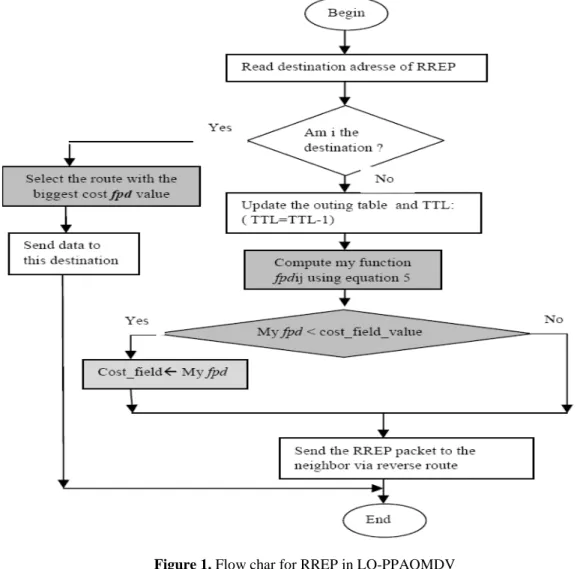
in Figure 1.
When the intermediate node receives the RREP packet, it first estimates link quality Lq and MAC overhead OHMAC as (2) and (4) respectively; and calculate the node’s fpd as (5); see (Figure 1).
Upon receiving the RREP, an intermediate node records the previous hop and relays the packet to the next hop. If a node detects a link break during route maintenance phase, it sends a Route Error (RERR) packet to the source node. Upon receiving the RERR, the source node initiates a new round of route discovery.
Table 1. RREP message in LO-PPAOMDV
TYPE U_int8_t Reserved u_int16_t HOP COUNT u_int8_t
DESTINATION IP ADDRESS nsaddr_t
DESTINATION SEQUENCE NUMBER u_int32_t
LIFE TIME Double
Cost_field
Double
3.2 The Proposed Mechanism for Congestion Control
In LO-PPAOMDV we implemented a cross layer approach that tracks the RSS of received data packet from each neighboring node in order to know when an adjacent node is near enough for a successful transmission.
We use a “Route Failure Prediction Technique” based on the Lagrange interpolation (6) for estimating whether an active link is about to fail or will fail, and it can distinguish between both situations; link error at MAC layer was due to congestion and due to mobility of nodes to avoid the unnecessary route repair process. The Predict Time (tPT) is
calculated as (7) and the Discovery Period TDP can be
calculated as (8).
( ) (
(
)(
)(
)
)
(
(
)(
)(
)
)
×
−
−
−
−
+
×
−
−
−
−
=
2 3 2 1 2 3 1 1 3 1 2 1 3 2P
t
t
t
t
t
t
t
t
P
t
t
t
t
t
t
t
t
t
P
PT PT PT PT PT
(
)(
)
(
)(
)
×
−
−
−
−
+
3 2 3 1 3 2 1P
t
t
t
t
t
t
t
t
PT PT(6)
Where P(tPT) is the value of RSS at tPT, P1−P3 and t1−t3 are 1st−3rd RSS and their received time respectively. tPT = t3 + TDP (7)
TDP = Twarning×nA-S+TRREQ × nS-D+TRREP × nS-D (8)
Where, Twarning, TRREQ and TRREP represent the transmission
time of warning packet, RREQ packet and RREP packet, respectively. Also nA−S and nS−D represent the number of
hops between node “A” to node “S” of the active route and number of hops between; node S to node D of a new route, respectively.
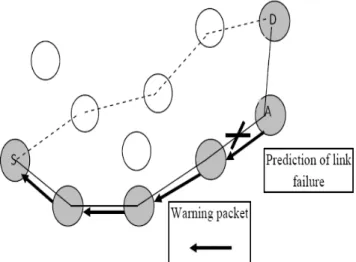
Figure 2. Node A predicts link failure
3.2.1 Extension of MAC Layer
AOMDV [26] interprets a link failure (in MAC layer) as a broken link, even when it was caused by congestion at the receiver. The sender node should know why communication was impossible. We implemented an approach that tracks the RSS of received data packet from each neighboring node in order to know when an adjacent node is near enough for a successful transmission. If lost packets were due to congestion and high traffic, AOMDV triggers route repair, and this can affect the network performance. If lost packets is due to low signal quality or misrouted packets, then route repair is needed because the receiver is not reachable. Afterward, the signal strength of neighboring nodes can be used to detect the reason for lost packets, distinguishing between congestion and broken links due to mobility, because in the last case, the receiver is unreachable and its signal strength is now available. The implementation is divided into two parts; the first part keeps the last three received signals from a node in an array, and computes RSS using Lagrange Interpolation (from the received data packets) if the signal is weak enough and the node moving away, the MAC layer sends a Request To Send (RTS) and the second part decides the kind of message (link failure, either due to errors or due to congestion using signal strength of neighboring nodes) to be sent to the upper layer, whenever the communication is impossible but the destination node is in the transmission range of the sender.
that is not the reason delivered to the routing layer, a route maintenance process is required.
3.2.2 Extension of AOMDV
When a node tries to communicate with a neighboring node and this communication failed (after several attempts, MAC layer sends an error to the routing layer). AOMDV interprets that the neighboring node is not present anymore and communication failure was due to mobility.
In a scenario without mobility communication failures may arise, but AOMDV will interpret that it was due to mobility, where actually, it was due to congestion. Therefore, the process of route repair should not be performed since it increases even more the congestion, decreasing the overall performance of the network. The proposed amelioration will make AOMDV capable to distinguish between both situations, avoiding the route repair process when the link error at MAC layer was due to congestion and not due to mobility of nodes. In our approach, when a node is not able to communicate with a neighboring node, MAC layer informs to the upper layer that there was a problem including whether the neighboring node is still reachable or not (see Figure 3). Therefore, the sender node does not perform route maintenance if it was informed that the neighboring node is still reachable.
4.
Simulation and Performance Results
We have used the implementation of AOMDV [26] in the NS simulator version 3.35 [5]. Our results are based on the simulation of 50 wireless nodes forming an ad hoc network moving about in an area of 1500 meters by 300 meters for 200 seconds of simulated time. Two Ray Ground reflection model was adopted. Nodes positions were generated randomly. The movement scenario files used for each simulation are characterized by a pause time. Each node begins the simulation by selecting a random destination in the simulation area and moving to that destination at a speed distributed uniformly between 0 and 10 meters per second. It then remains stationary for pause time seconds. This scenario is repeated for the duration of the simulation. We carry out simulations with movement patterns generated for 5 different pause times: 0, 20, 40, 80 and 200 seconds. A pause time of 0 seconds corresponds to continuous motion, and a pause time of 200 (the length of the simulation) corresponds to limited motion. Constant bit rate (CBR) sources are used in the simulations. The packet rate is 4 packets /sec when 10, 20, 30 and 40 sources are assumed. The performance metrics used to evaluate performance are:
• Packet delivery ratio: The ratio of the data packets
delivered to the destination to those generated by the CBR sources. This should be maximized.
• Average end-to-end delay of data packets: This
includes all possible delays caused by buffering during route discovery, queuing at the interface queue, retransmission delays at the MAC layer, and propagation and transfer times. This should be minimized.
• Normalized routing load: The number of routing
packets transmitted per data packet delivered to the destination. This should be minimized.
• Throughput: the overall rate of transfer (received
bytes/ Time of simulation) which should be maximized. We report the results of the simulation experiments for the Predictive Preemptive AOMDV protocol (PPAOMDV) and for LO-PPAOMDV.
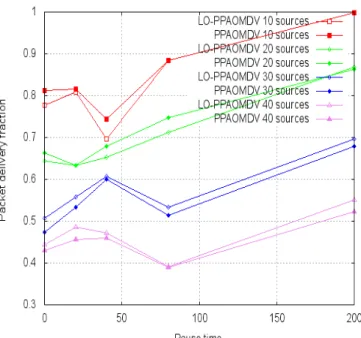
Figure 4. Packet delivery fraction
Figure 4 represents the simulation results for the delivery ratio metric. The results indicate that the packet delivery ratio decreases with the increase in the number of sources. This indicates that the number of sources has significant effect on the packet delivery ratio. The result indicates that packet delivery ratio increases with increase in pause time. For example, when the pause time increases from 80s to 200s, the packet delivery ratio increases approximately 15%. Also, it can be seen that significant performance gains between 10-15% in the delivery ratio were obtained from LO-PPAOMDV.
In Figure 5 the results obtained for the end-to-end delay metric are presented. We observe that the end-to-end delay increases significantly when the number of sources increases. The delay is affected by the route repair procedure because data packets are buffered until an alternative route is found. The results show that LO-PPAOMDV outperforms PPAOMDV significantly when the number of sources increase and the motion is low. Figure 5 shows a gain of about 20% less of LO-PPAOMDV over PPAOMDV, for 40 sources in the pause time 200s.
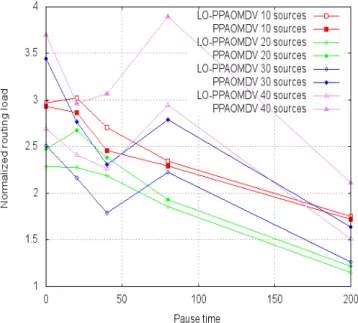
Figure 6. Normalized routing load
Figure 6 shows the normalized routing load against the pause time. The metric is an indicator of protocol efficiency and a relative measure of control packets (routing overhead). LO-PPAOMDV offers higher efficiency (lower normalized routing load) throughout the graph (when the number of sources is superior 10). An increase in the number of sources results in congestion and traffic loss starts to occur. When the maximum number of retransmissions is reached, the MAC layer notifies the routing layer that it was unable to deliver the traffic to the next hop and the routing scheme generates a RERR packet to notify the source of the connection that the path is broken. As a result, the source node searches the cache for alternative paths to route its traffic and, if none is found, a new route discovery process is instigated. PPAOMDV has alternative routing paths cached but it will interpret communication failures that it was due to mobility, where actually, it was due to congestion. Therefore, the process of route repair should not be performed since it increases even more the congestion, and triggers new route discoveries which increase the normalized routing load. On the other hand, LO-PPAOMDV has alternative QoS-aware routing paths cached and the affected traffic is switched to one of the alternative paths with highest bottleneck capacity (the biggest fpd) and LO-PPAOMDV does not perform route maintenance if it was informed that the neighboring node is still reachable. LO-PPAOMDV triggers new route discoveries only when no routing path is available in the cache of the source node or the neighboring node is not reachable resulting in lower routing overhead and,
consequently, the normalized routing load. It can be observed from Figure 6 that the biggest gains of LO-PPAOMDV over LO-PPAOMDV is of 45% and happen with 80s of pause time and 40 sources. This has a good impact on energy because the number of control packets generated is low.
Figure 7. Throughput
Figure 7 represents the influence of mobility and number of sources on throughput by varying pause time and number of sources. The result indicates that the throughput increases with increase of number of sources. Also the throughput increases as the pause time increases (low mobility) because the more collisions take place the more time is needed for a successful transmission, this reveals that when pause time decrease (high mobility), the collisions may grow up and significantly affect the throughput. For example when pause time decreases from 200s to 80s the throughput decrease by 7% for 10 sources, 15% for 20 sources and 25% for 30 and 40 sources. Also, it can be noticed from this figure that significant performance gains approximately 7% in throughput were obtained from LO-PPAOMDV (especially when the number of sources increase 30 and 40 sources).
5.
Conclusion and Future Works
Multipath routing can be used in on-demand protocols to achieve faster and efficient recovery from route failures in highly dynamic Ad-hoc networks. In this paper, we have proposed a Link Quality and MAC-Overhead aware Predictive Preemptive Multipath Ad hoc On-Demand Distance Vector (LO-PPAOMDV). There are two main contributions in this work. One is the protocol is based on new metric combine two routing metrics (Link Quality, MAC Overhead) another is the proposition of a cross-layer networking mechanism to distinguish between both situations, failures due to congestion or mobility; by the usage of the “Route Failure Prediction Technique” based on the Lagrange interpolation for estimating whether an active link is about to fail or will fail.
less route changes provokes lower routing overhead in the network. As the routing overhead is decreasing, the nodes are able to transmit more data packets; therefore, a higher throughput is obtained (up to 7% for 40 flows); also, a gain of about 20% less in average end to end delay for 40 flows and 200s of pause time. Also with approximately 10-15% increase in the packet delivery ratio while the normalized routing load is reduced about 45%.
However, in the future task, we could deepen our study to improve outcomes. In particular, the study of the QoS multilayer management (MAC network) can be enhanced to include the application layer. In this case, the application layer can adjust the flow rate according to the information provided by the lower layers. Meanwhile, an admission control mechanism would be interesting to study and would control the network load and regulate the number of traffic allowed in the ad hoc network.
Our routing protocol reduces collisions by reducing the number of retransmissions, should have a positive impact on the energy consumption of nodes. In fact, the nodes use less energy for transmitting a packet correctly.
Our approach proposed, is developed with the objective of avoiding disconnections in scenarios with objects that interfere with the communication among nodes. The main idea makes sense in mobility scenarios, for example: in
vehicular network (VANET), to ensure a reliable communication path between vehicles in a flat v-2-v architecture, this may reduce accidents and save many lives.
Finally, it should be noticed that a real system network might use more network resources than the simulations. Thus, the results tend to be lower for both LO-PPAOMDV and PPAOMDV in a real environment. Although the realization of simulations is an important step because it allows comparing the proposed routing protocols with existing protocols. It can be considered an experiment on real equipment for the evaluation of our protocol under real conditions, as a routing protocol can have undesired operation in a real scenario.
References
[1]E. Belding-Royer, C. Perkins, “Evolution and future directions of the ad hoc on-demand distance-vector routing protocol,” Ad Hoc Networks Journal, Vol. 1, No.1, pp. 125–150, 2003.
[2]C. Perkins, E. Royer, and S. Das, “Ad-hoc On-Demand Distance Vector (AODV) Routing,” Mobile Ad Hoc Networking (MANET), IETF RFC 3561, 1999. [3]S.H. Boukli, A. Lehireche, and A. Meddahi, “Predictive
Preemptive Ad Hoc On-Demand Distance Vector Routing,” Malaysian Journal of Computer Science, Vol. 19, No 2, pp.189-195, 2006.
[4]K. Hayato, M. Naoki, H.S. Bouk, and I. Sasase, “High Precision-Predictive Preemptive Ad hoc On-demand Distance Vector Routing in Ad hoc Networks,” in The 11th International Symposium on Wireless Personal Multimedia Communications (WPMC’08), 2008. [5]NS-2 Network Simulator, available at
http://www.isi.edu/nsnam/ns/, November 2011. [6]B. Tuch, “Development of WaveLAN, an ISM Band
Wireless LAN,” AT&T Technical Journal, Vol. 4 No. 72, pp. 27–33, July/August 1993.
[7]Internet Engineering Task Force (IETF), “Mobile Adhoc Networking (manet) Working Group,” http://www.ietf.org/html.charters/ manet- charter.html, 2004.
[8] J. Norman, and J.P. Joseph, “HLAODV – A Cross Layer Routing Protocol for Pervasive Heterogeneous Wireless Sensor Networks Based On Location,” IJCSI International Journal of Computer Science Issues, Vol. 7, Issue 4, No 7, pp. 28-37, July 2010.
[9]M.A. Sayid, and H. Suhaidi, “Divert Failure Route
Protocol Based on AODV,” IEEE
DOI10.1109/NETAPPS, pp. 67-71, 2010.
[10]C. Xiaoqin, M.H. Jones, and A. Jayalath, “Congestion-Aware Routing Protocol for Mobile Ad Hoc Networks,” in proceedings of IEEE conference on
Vehicular Technology, Doi.
10.1109/VETECF.2007.21., pp.21-25, 2007.
[11]Y. Ming, A. Malvankar, W. Su, and S.Y. Foo, “A link availability-based QoS-aware routing protocol for mobile ad hoc sensor networks,” Computer communications Archive, Vol.30, No.18, pp. 3823-3831, 2007.
[12]Y. Yi and S. Shakkottai, “Hop-by-Hop Congestion Control Over a Wireless Multi-Hop Network,” in IEEE/ACM on Networking, Vol.15, No.1, pp. 133-144, February 2007.
[13]L. Chen, and W.B. Heinzelman, “QoS-Aware Routing Based on Bandwidth Estimation for Mobile Ad Hoc Networks,” IEEE on Selected Areas in Communications, Vol.23, No. 3, pp. 561-572, march 2005.
[14]Z. Chenxi, and M.S. Corson, “QoS routing for mobile ad hoc networks,” in proceedings of Twenty-First IEEE Annual Joint Conference of Computer and Communications Societies, Vol.2, pp. 958-967, 2002. [15]A.D. Tran, and H. Raghavendra, “Congestion
Adaptive Routing in Mobile Ad Hoc Networks,” in IEEE Transactions on Parallel and Distributed Systems, Vol.17, No.11, pp.1294-1305, November 2006.
[16]R. Chandran, and Shanmugavel, “Received Signal Strength-based Cross-layer Designs for Mobile Ad Hoc Networks,” IETE Technical Review, Vol.25, No.4, pp.192-200, 2008.
[17]X. Xia, Q. Ren, and Q. Liang, “Cross-layer design for mobile ad hoc networks: energy, throughput and delay-aware approach,” in proceedings of the IEEE conference on Wireless Communications and Networking, Vol.2, pp. 770-775, 2006.
[18]H.A. Omar, W. Zhuang, and L. Li, “VeMAC: a novel multichannel MAC protocol for vehicular ad hoc networks,” in Proc. IEEE INFOCOM Workshop on Mobility Management in the Networks of the Future World (MobiWorld 2011), pp. 413–418, Apr. 2011. [19]R. Shruthi, and H. Harshavardhan, “Fuzzy Scheduling
For Ensuring Qos in VMAC for VANETs,” International Journal of Engineering Research and Applications (IJERA) ISSN: 2248-9622, Vol. 3, Issue 4, pp.781-784, Jul-Aug 2013.
Information Security, Vol. 3, No. 1, pp. 129-135, 2009.
[21]A. Bisengar, M. Rziza, and M. Ouadou, “Queue Length and Mobility aware Routing Protocol for Mobile Ad hoc Network,” International Journal of Communication Networks and Information Security (IJCNIS), Vol. 4, No. 3, pp. 207-211, December 2012. [22]M. Ghazvini, N. Movahedinia, and K. Jamshidi. “A
Game Theory based Contention Window Adjustment for IEEE 802.11 under Heavy Load,” International Journal of Communication Networks and Information Security (IJCNIS) Vol. 5, No. 2, pp. 93-103, August 2013.
[23]M. Sedrati, A. Bilami, and M. Benmohamed, “M-AODV: AODV variant to Improve Quality of Service in MANETs,” IJCSI International Journal of Computer Science Issues, Vol. 8, No 1, pp.429-436, January 2011.
[24]A. Dana, and M.H. Babaei, “A Fuzzy Based Stable Routing Algorithm for MANET,” IJCSI International Journal of Computer Science Issues, Vol. 8, No 1, pp. 367-371, January 2011.
[25]T. S. Rapport, Wireless communications, principles and practice: Prentice Hall, 1996.
[26]K. Marina, and R. Samir, “Ad hoc on-demand multipath distance vector routing,” Wireless Communications and Mobile Computing, vol. 6, pp. 969–988, 2006.
[27]S. Mallapur, “Predictive Preemptive Ad Hoc on-Demand Multipath Distance Vector Routing Protocol,” Int. Journal of Computer Science & Emerging Technologies (IJCSET), Vol. 1, No 2, pp.155-160, August 2010.
[28]H. Zafar, D. Harle, I. Andonovic, L. Hasan and A. Khattak, “QoS-aware Multipath Routing Scheme for Mobile Ad Hoc Networks,” International Journal of Communication Networks and Information Security (IJCNIS), Vol. 4, No. 1, pp. 1-10, April 2012.
[29]I. Mustapha, J.D. Jiya , and B.U. Musa, “Modeling and Analysis of Collision Avoidance MAC Protocol in Multi-Hop Wireless Ad-Hoc Network,” International Journal of Communication Networks and Information Security (IJCNIS) Vol. 3, No. 1, pp. 48-56, April 2011.
[30]M. Ali-cherif, M.K. Feraoun, N. Doumi, and M. Kather, “Integration of dynamic current bandwidth capacity calculation for existing AODV,” in Proceding of IEEE ICITeS 2012 Int. Conf. on Information Technology and e-Services, pp. 669-675, March 2012. [31]M. Ali-cherif, M.K. Feraoun, and S.H. Boukli,
Figure 1. Flow char for RREP in LO-PPAOMDV
Figure 3. The proposed approach that uses the Lagrange interpolation is shown here, this diagram shows also how MAC