FORMATIVE RESEARCH FOR THE DEVELOPMENT OF STRATEGIES TO INCREASE DUAL METHOD USE AMONG ADOLESCENTS AND YOUNG ADULTS
Mollie M. Williams
A dissertation submitted to the faculty at the University of North Carolina at Chapel Hill in partial fulfillment of the requirements for the degree of Doctor of Public Health in the Department of Health Policy and Management in the Gillings School of Global Public Health.
Chapel Hill 2014
Approved by:
Suzanne Havala Hobbs Dorothy Cilenti
Herbert Peterson
ii
iii ABSTRACT
Mollie M. Williams: Formative Research for the Development of Strategies to Increase Dual Method Use Among Adolescents and Young Adults
(Under the direction of Suzanne Havala Hobbs)
Unintended pregnancy and sexually transmitted infections (STIs) are significant health problems in the United States, and African American and Latino youth experience higher rates of both. The simultaneous use of birth control and condoms is a strategy that has demonstrated effectiveness in preventing both unintended pregnancy and STIs. Eight focus groups were conducted with African-American and Latino adolescents and young adults to inform strategies to increase dual method use, defined as the simultaneous use of condoms and highly effective contraceptives. Participants described dual method users as “smart,” “careful,” and “focused.” Positive emotions were also associated with dual method use, including confidence and security. Participants readily identified cost and access as environmental obstacles. Many believed dual method use was important, but others doubted that it was necessary, especially within a committed relationship. These findings, coupled with established theories of behavior change, suggest that public health professionals should emphasize the positive images and emotions associated with dual method use. They must help participants negotiate, and help reduce,
iv
TABLE OF CONTENTS
LIST OF FIGURES ... vii
LIST OF TABLES ... viii
CHAPTER 1: INTRODUCTION ... 1
Unintended Pregnancy and STIs in the United States ... 2
Strategies for Reducing Unintended Pregnancy and STIs ... 3
Prevalence of Dual Method Use ... 7
Factors Associated with Dual Method Use ... 8
CHAPTER 2: LITERATURE REVIEW ... 12
Project PROTECT ... 14
Project REACH ... 16
Clinic-based Intervention Using Video ... 17
Prime Time Pilot Study ... 19
Carrera Program ... 20
HIV Counseling Among Users of Long-term Contraceptives ... 21
Double Dutch ... 22
Condom Distribution Within a School-based Intervention ... 23
Condoms and a Written Dual Method Message ... 23
v
Summary ... 25
CHAPTER 3: METHODOLOGY ... 37
Research Questions ... 37
Definitions... 38
Conceptual Framework ... 39
Qualitative Research ... 47
Researcher’s Role ... 49
Delimitations ... 51
Data Collection Procedures ... 51
Sampling ... 56
Data Management Plan ... 56
Analysis... 57
Reliability and Validity ... 59
Ethical Considerations ... 60
CHAPTER 4: RESULTS ... 64
Familiarity with Dual Method Use ... 64
Pre-established Codes ... 65
Emergent Codes ... 74
Message testing ... 78
Message Development ... 82
CHAPTER 5: DISCUSSION ... 86
Image and Descriptive Norms ... 87
vi
Environmental Constraints... 89
Relationship Factors... 90
Limitations ... 91
Practical Implications and Further Research Needed ... 93
Digital Education Tools ... 95
Affiliate Education Programs ... 100
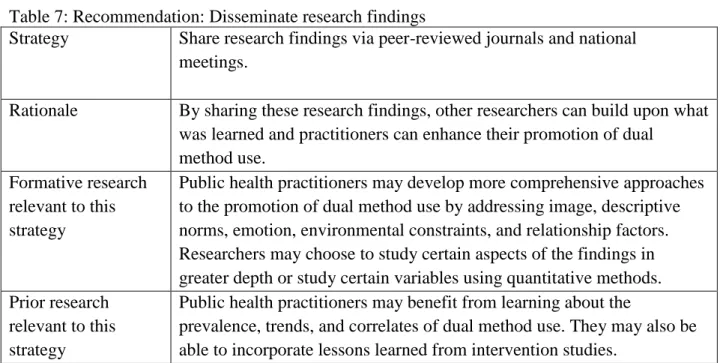
Dissemination to other Professionals ... 101
Other Opportunities ... 103
APPENDIX A: FOCUS GROUP SCREENER TELEPHONE SCRIPT ... 105
APPENDIX B: PRE-FOCUS GROUP SURVEY ... 112
APPENDIX C: FOCUS GROUP DISCUSSION GUIDE... 114
vii
LIST OF FIGURES
Figure 1: Distal Determinants ... 41
Figure 2: Proximal Determinants ... 42
Figure 3: Distal Determinants of Dual Method Use ... 44
Figure 4: Proximal Determinants of Dual Method Use ... 45
Figure 5: Condoms and Pill Pack Walking Hand-in-Hand ... 85
Figure 6: No Glove, No Love ... 85
viii
LIST OF TABLES
Table 1: Studies Conducted in the U.S. Canada, and Europe ... 29
Table 2: Studies Conducted in Africa and Mexico ... 34
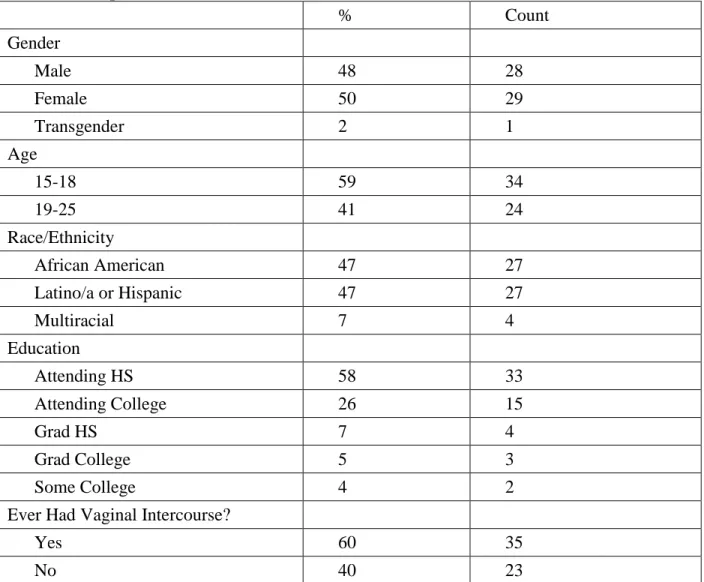
Table 3: Participant Characteristics ... 53
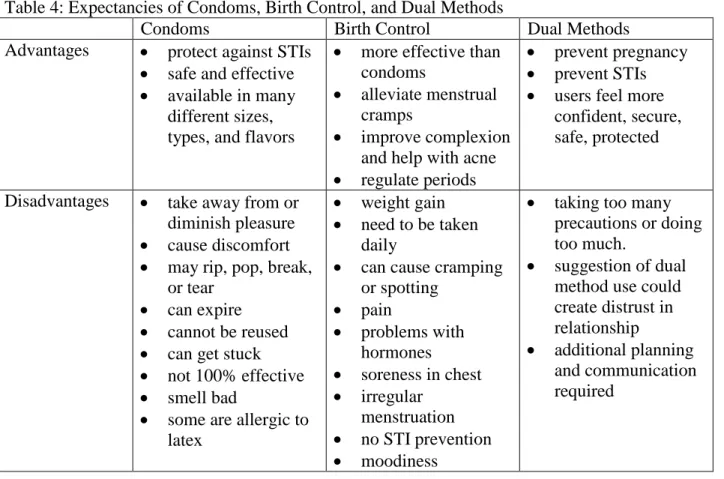
Table 4: Expectancies of Condoms, Birth Control, and Dual Methods... 66
Table 5: Recommendation: Develop comprehensive marketing strategy ... 98
Table 6: Recommendation: Facilitate webinar for Planned Parenthood health educators ... 100
1
CHAPTER 1: INTRODUCTION
Unintended pregnancies and sexually transmitted infections (STIs), including HIV, are significant public health problems in the United States. While condoms offer protection against STIs, they are not as effective at preventing pregnancy as other methods, such as hormonal contraception and intrauterine devices (IUDs)(Trussell, 2007). Therefore, it is often
recommended that sexually active adolescents and young adults use condoms and another method of contraception simultaneously. This practice is referred to as dual method use. Despite health professionals’ recommendations and the additional protection offered by dual method use, it is not widely practiced.
This dissertation describes formative research conducted to inform strategies to increase dual method use among adolescents (ages 15 to 18) and young adults (ages 19 to 24). In Chapter One, the research describes the public health problems of unintended pregnancies and STIs, explores strategies that could reduce unintended pregnancy and STIs, and presents information about the prevalence of and correlates with dual method use. Chapter Two is a literature review of interventions designed to increase dual method use. In Chapter Three, the researcher presents a conceptual framework and describes the qualitative research strategy, data collection
2 Unintended Pregnancy and STIs in the United States
In 2006, approximately 2.5 million women ages 15 to 24 became pregnant, and more than two-thirds of these pregnancies were unintended (Finer & Zolna, 2011). The unintended pregnancy rate for 15 to 19 year olds was 60 per 1,000 women. For 20 to 24 year olds, it was 107 per 1,000 women. Despite a 64 percent decline in teen pregnancy from 1991 to 2009, the rate is still 9 times higher than those of other developed countries (Centers for Disease
Control and Prevention, 2011; United Nations, 2010)
Unintended pregnancies are associated with numerous negative consequences, not only for the mothers, but also for children, families, and society. Women with unintended pregnancies delay prenatal care at higher rates and have less favorable mental health during and after pregnancy. In addition, unintended pregnancies are associated with negative
consequences for the children, including poorer physical health and psychological well being (Logan, Holcombe, Manlove, & Ryan, 2007).
The costs of unintended pregnancies are significant. In 2006, the annual cost to public insurance programs like Medicaid and the Child Health Insurance Program (CHIP) for births resulting from all unintended pregnancies in the U.S. was $11.1 billion (Sonfield, Kost, Gold, & Finer, 2011). In 2004, The National Campaign to Prevent Teen and Unplanned Pregnancy estimated that the cost of teen pregnancy to taxpayers was $9.1 billion (Hoffman, 2006).
3
Adolescents and young adults also have higher rates of STIs, including HIV, than other age groups. While 15 to 24 year olds only represent 25 percent of the population, they account for nearly half of reported STIs. In 2011, males and females ages 20 to 24 had the highest rates of chlamydia and gonorrhea as compared to other age groups (Centers for Disease Control and Prevention, 2012b). In 2011, persons ages 20 to 24 had the highest rate of new HIV infections, compared with any other age group (Center for Disease Control and Prevention, 2013).
African Americans and Latinos experience a disproportionate burden of STIs, including HIV. In 2011, African American females ages 15 to 19, were diagnosed with chlamydia and gonorrhea at approximately six and fourteen times, respectively, the rate of White females in this age group. The chlamydia and gonorrhea rates for African American women ages 20 to 24 were five and twelve times, respectively, the rates of White women in the same age group (Centers for Disease Control and Prevention, 2012b).
While the disparity is not as great as for African Americans, Latinos also have higher rates of chlamydia and gonorrhea when compared to Whites. In 2011, the chlamydia rate for 15-19 Latina females was 62% greater than it was for White females in the same age group. For Latina females 20-24 the chlamydia rate was 67% greater(Centers for Disease Control and Prevention, 2012b).
Strategies for Reducing Unintended Pregnancy and STIs
4
These problems, however, are not amenable to one, simple solution. In this following section, potential strategies are explored.
Abstinence from vaginal sex for the prevention of pregnancy and from vaginal, oral, and anal sex for the prevention of STIs is the best strategy for some adolescents and young adults. However, abstinence education has not been effective (The National Campaign to Prevent Teen and Unplanned Pregnancy, 2009). While some people choose to abstain from sex until marriage, it is not the norm in the U.S. According to the National Survey for Family Growth, 86.4 percent of women and 90.6 percent of men have sex before marriage (Centers for Disease Control and Prevention, 2012a). Like other methods of contraception, there is a perfect-use effectiveness rate and a typical-use effectiveness rate for abstinence (Dailard, 2003). Typical-use rates represent the percentage of women who successfully avoid pregnancy during the first year of use, and include women whose methods fail due to inconsistent or incorrect use. Abstinence can fail too, when practiced inconsistently or incorrectly. For example, some adolescents and young adults may abstain from vaginal sex, but not oral and anal sex, putting them at risk for STIs. Others may abstain from vaginal sex periodically, but not 100 percent of the time.
5
intercourse with someone else while in a serious dating relationship (Wiederman & Hurd, 1999).
Besides infidelity, there are many reasons that a supposedly STI-free person could infect a partner. First, it is not uncommon for people to misunderstand the meaning of medical test results. One study found that 78 percent of sexually experienced adolescent females believed that a Pap test was synonymous with an STI test (Blake, Weber, & Fletcher, 2004). Second, some people believe that STIs are always accompanied by symptoms. In a survey of adolescent patients of a primary care clinic, 64 percent believed that gonorrhea was always accompanied by a rash, pain, sores, or discharge (Biro, Rosenthal, & Stanberry, 1994). Gonorrhea, in fact, is usually asymptomatic in women (Detels et al., 2011). Third, some people receive a “clean” test for one or more STIs and assume this means they have tested negative for all possible STIs. The American College of Obstetricians and Gynecologists recommends screening asymptomatic adolescents for HIV, chlamydia, and gonorrhea, but not other STIs like syphilis and HPV (American College of Obstetricians and Gynecologists, 2011b).
Finally, people may lie to their partner about having an STI in order to avoid embarrassment, stigma, loss of the relationship, or other negative consequences. It is important to remember that these decisions about how “safe” one’s partner is can be influenced by one’s feelings of commitment toward one’s partner. In fact, greater
commitment is associated with decreased perception of one’s partner as a potential source of harm (Agnew & Dove, 2011). In summary, while using a highly effective method of
6
Condoms alone, when used correctly and consistently, provide good protection against pregnancy and excellent protection from STIs. Condoms, used alone or in combination with emergency contraception in the event of condom failure, is another possible strategy. O’Leary (2011) proposes that this strategy may be more effective than recommending dual method use because women counseled to practice dual method use may be more likely to forgo condoms than women counseled to use condoms alone. However, for many adolescents and young adults, the 15 percent typical-use failure rate for pregnancy prevention with use of male condoms (Trussell, 2007) is unacceptable. Furthermore, access to emergency contraception is not optimal. In a November 2012 statement, the American College of Obstetricians and Gynecologists wrote the following: “Access to emergency contraception remains difficult for adolescents, immigrants, non-English speaking women, survivors of sexual assault, those living in areas with few pharmacy choices, and poor women.” (ACOG Committee Opinion Number 542: Access to emergency contraception, 2012, p. 1251) As a result, many of the women who need emergency contraception the most are unable to get it.
Some sexual health experts advocate the promotion of “dual protection” which includes dual method use, as well as abstinence, using a highly effective method of
7
candidates for dual method use given their relatively rapid relationship turnover… and high rates of both unintended pregnancies and STI.”
Due to the high rates of unintended pregnancy and STIs in adolescents and young adults, many health organizations recommend dual method use. The American College of Obstetricians and Gynecologists recommends “…sexually active adolescents should be encouraged to use condoms in conjunction with a more effective method of contraception to provide effective pregnancy prevention and protection against STIs. Adolescents should also be counseled in the specific steps required for correct use of condoms.”(American College of Obstetricians and Gynecologists, 2011a) Healthy People 2020, the ten-year health agenda set by the U.S. Department of Health and Human Services, includes four objectives (FP 11.1 – FP 11.4) for increasing dual method use, including the following: “FP 11.1: Increase the proportion of sexually active females aged 15 to 19 who use a condom and hormonal or intrauterine contraception at first intercourse.” The other goals related to dual method use target men in this same age group and aim to increase dual method use at last intercourse (U.S. Department of Health and Human Services, 2012).
Prevalence of Dual Method Use
8
Despite its low prevalence, dual method use is increasing. (G. Martinez, Copen, & Abma, 2011). The 2006-2010 National Survey of Family Growth showed that 20.1 percent of 15 to 19 year olds engaged in dual method use, up from 3.3 percent in 1988.
A recent study of clients at four Planned Parenthood clinics in Northern California found that condom use declined significantly after initiation of a more effective method of contraception (Goldstein, Upadhyay, & Raine, 2012). Condom use declined from 36 percent to 27 percent in the first 3 months after starting another method. Among condom users who had stopped using a more effective method after one year, only 47 percent returned to using condoms. These findings are especially concerning given the high prevalence of STIs among the demographic groups represented in the study population—young (two-thirds were ages 15 to 19), predominantly Latina and African American females living in low-income neighborhoods.
Factors Associated with Dual Method Use
A number of studies have examined the factors associated with dual method use. A recent review of the literature (Higgins & Cooper, 2012) found that the following
characteristics were positively associated with dual method use: younger age, motivation to avoid pregnancy, concern about STIs, confidence using condoms, past condom use, higher number of partners, shorter duration of relationships, partner support of condom use, parental communication about sexual risks, and receipt of sex education or contraceptive counseling. While the evidence of an association between race/ethnicity and dual method use is
9
conflicting evidence about the association between level of education, use of user-dependent methods, and perceived STI risk.
Another recent review of the dual method use literature revealed similar correlates (O'Leary, 2011). O’Leary also reported a positive relationship between dual method use and good communication with parents, later sexual debut, and having fewer nonsexual risk behaviors. Those with newer or less committed sexual relationships were more likely to use dual methods. Women with good communication with sexual partners and those who expected their partner to be supportive if they became pregnant were more likely to be dual method users. Being strongly motivated to avoid HIV and other STIs and believing that one’s partner could have HIV or another STI was also associated with dual method use. In addition, women who were concerned about pregnancy and STIs, had a history of an STI, or perceived that condoms were effective in preventing STIs were more likely to use dual methods.
An older literature review by Bearinger and Resnick (2003) identified additional variables associated with dual method use: partners’ history of STIs, needle-sharing, female requested partner to use condoms, partner communication of risk, and frequency of parents knowing who their adolescent was with when not at home or school.
10
Higgins and Cooper (2012, p. 77) suggest this as an area for possible intervention, writing the following: “Taken cumulatively, the above results strongly support the argument that men’s method preference and contraceptive attitudes can greatly facilitate dual method use.”
A qualitative focus group study of African Americans explored the social dynamics of dual method use (Woodsong & Koo, 1999). Woodsong and Koo found that while most participants were knowledgeable about dual method use and believed it was important, participants found it difficult to practice consistently. Barriers included discomfort discussing sex and condom use, norms prohibiting a woman from asking a man to use condoms,
negative attributes of condoms, and tension and mistrust between the genders. Many women believed that asking their partner to use condoms would result in a negative reaction and potentially damage the relationship. Both men and women discussed that it was difficult to bring up condom use in an ongoing relationship and doing so might result in distrust or suspicion of infidelity.
A desire to create trust and to avoid distrust within relationships is a major barrier to the promotion of dual method use. Misovich, Fisher, and Fisher (Misovich, et al., 1997), in a review of the literature about HIV risk behaviors within close relationships, describe how people estimate partners’ HIV risk using personality theories and and incorrect AIDS prevention heuristics. These estimates then influence risk taking behavior. For example, the beliefs that a known or trusted partner is unlikely to have HIV and that monogamous
relationships are “safe” often take the place of well-reasoned, knowledge-informed decisions. In addition, motivation to engage in AIDS-preventive behaviors may diminish as a
11
they are uniquely invulnerable to HIV, compared with similar or the average person” (Misovich, et al., 1997, p. 92).
Any successful effort to increase dual method use must address the important issues of trust and distrust. Higgins and Cooper (2012, p. 78) suggest that “cultural-level resistance to condoms as a barrier to intimacy and trust may also be an important focus for future
research, development of interventions, and social messaging….Qualitative research methods could be especially helpful in identifying and addressing cultural and structural constraints.”
Most research examines the relationship between individual-level factors such as age, method of contraception, and perception of risk. Additional research is needed to understand how partners, family, community, and society-level factors influence dual method use. For example, Higgins and Cooper (2012) recommend that further research is needed to
understand provider- and service-level barriers to dual method use.
Changing behavior, especially behaviors related to sexual health, is not a
straightforward endeavor. Dual method use is a complex behavior involving two people and two components —condom use and contraceptive use—and all the concomitant barriers, facilitators, and sub-behaviors (buying condoms, using a condom correctly, obtaining contraception, adhering to the chosen method’s appropriate use, etc.). Furthermore, these behaviors are taking place within the context of relationships. For adolescents and young adults, these may be some of their first romantic relationships, so they are navigating decisions about their relationships, including decisions about sex, with little personal
12
CHAPTER 2: LITERATURE REVIEW
This research will enhance understanding of dual method use and the complex array of behaviors, facilitators, barriers, decisions, and context associated with dual method use for the purpose of developing strategies to increase dual method use among adolescents and young adults. A literature review was conducted to understand what strategies have been tried and tested to increase dual method use. In this section, the literature review is presented, including the procedures followed, descriptions of the major studies and their findings, and a summary of what was learned.
The author conducted a broad and thorough search of the peer-reviewed literature. The following indexes were searched: PubMed, Web of Science, CINAHL, and PsychInfo. The exact phrases, “dual method use”, “dual use”, and “dual protection” were queried. All citations were imported to Endnote, and once duplicates were removed, 931 citations
remained. The following inclusion criteria were applied, first to the 931 titles resulting in the exclusion of 749 obviously unrelated articles:
Intervention studies, regardless of the intervention type
All stages of intervention development, including developmental studies, proof-of-concept, pilot studies, and clinical trials
Prospective or retrospective analysis All countries, all populations
13
At least one outcome measure of dual method use or intent to practice dual method use
After this step, 182 studies remained. These abstracts were reviewed, and 18 articles qualified for inclusion. The references of these articles were reviewed for additional relevant articles. Two more articles were identified and one of the articles initially included was excluded after further review.
The literature review described here was performed before the research plan was developed. During the course of the study, the researcher was made aware of a systematic review for the Centers for Disease Control and Prevention’s Guide to Community Preventive Services of group-based interventions to prevent or reduce adolescent pregnancy, HIV, and STIs (Chin et al., 2012). According to the systematic review four of the studies included dual method use results (Aarons et al., 2000; Li, Stanton, Feigelman, & Galbraith, 2002; Philliber, Kaye, Herrling, & West, 2002; Stanton et al., 2005). However, upon reading the published articles, only one publication included the dual method use results. This study by Philliber was added to the literature review.
At completion, 20 articles were included in the literature review. A summary of the abstraction is presented in Tables 1 and 2.
Studies evaluating “dual protection” interventions were included if “dual protection” included the choice of dual method use. Several studies were excluded because neither the intervention nor the outcome measurement included dual method use. However, if the
14
The inclusion criteria were intentionally broad and did not exclude studies conducted outside the U.S., but it became clear during the review of the articles that a subset of studies was less relevant to this proposal because of the economic, cultural, and health differences between countries. Six of the studies were based in sub-Saharan African in either
HIV-positive populations or in communities with very high prevalence of HIV. Another was based in Mexico City, Mexico. These articles will be discussed briefly at the end of the literature review, but in less detail than the studies based in the U.S., Canada, and Europe because of the cultural, economic, and health care system differences.
What follows are summaries of the studies found in the literature search and their major findings. Several articles were about the same research, so there are nine studies presented from the U.S., Canada, and Europe. Then the key findings of the six studies in Mexico and Africa are presented. Finally, similarities and differences between the studies, as well as limitations of the research are discussed.
Project PROTECT
15
for STIs or unintended pregnancy. All women 13 to 24 were considered high risk, and older clients were deemed high risk if they had a history of unplanned pregnancy or an STI, used contraception inconsistently, had more than one partner in the last six months, or abused drugs or alcohol. The primary outcome of interest was dual method use, which included “1) use of hormonal contraception (e.g. oral contraceptives, estrogen–progesterone injections (Lunelle) long-acting progestin injections (Depo-Provera), etc.) plus a barrier method (e.g. male or female condoms or diaphragm); 2) male condoms plus female condoms; 3) condoms plus spermicide; or 4) intrauterine device or sterilization plus a barrier method” (Peipert, et al., 2007, p. 632).
The intervention consisted of three different sessions over a period of eighty days. It was interactive and used text, audio, and images. It was tailored to the participant’s stage of readiness to change and included the pros and cons of condom and contraceptive use, help with situations where condoms and contraception might not be used, and strategies to
facilitate the participants progress through the stages of change. At eighteen-month follow-up, the intervention group showed faster initiation and overall higher rates of dual method use (Peipert, et al., 2008). There were no differences in unintended pregnancies or STI rates between the two groups. In a subsequent article, Peipert and colleagues published the results of 24-month follow-up (Peipert, et al., 2011). They reported that while the intervention group was more likely to initiate dual method use, this difference was not sustained. They
16
an advanced stage of change (action or maintenance), and women using contraception at baseline were more likely to adhere to dual method use.
Project PROTECT demonstrated that a computer-delivered, tailored intervention can lead to short-term behavior change (Peipert, et al., 2011). Peipert et al suggest that the addition of booster sessions could extend the effect of the intervention, as well as further tailoring the intervention to address the needs of new contraceptors and those with lower levels of education.
Project REACH
Project REACH is a clinic-based, provider-delivered intervention that used
motivational interviewing and relapse prevention strategies to assist clients in selecting the best method of dual protection, including dual method use (Exner et al., 2011). Other options for dual protection were the use of male or female condoms alone or the use of effective contraception within a mutually monogamous relationship. The intervention was evaluated using a quasi-experimental, quantitative design. In addition, a separate article was published describing the development and validation of a Dual Protection Counseling Checklist to evaluate provider-client interactions in the main study (Adams-Skinner et al., 2009).
17
Counseling Checklist, were significantly associated with clients’ reduction in sexual risk behaviors (Adams-Skinner, et al., 2009).
Project REACH demonstrated that a provider-delivered counseling intervention could increase condom use (Exner, et al., 2011). They did not directly measure other types of dual protection, namely dual method use. Only quality nurse-client interactions were associated with reductions in sexual risk behaviors. Examples of quality nurse-client interactions include the nurse asking open-ended questions, giving empathetic responses, and having a non-judgmental attitude, as well as the client expressing concerns about STIs or pregnancy, volunteering relevant information, and expressing her own preferences about contraception. Use of motivational interviewing techniques and relapse prevention counseling were not associated with reduction in sexual risk behavior at 6 months follow-up.
One limitation of this study was that the intervention was delivered by one nurse who was not randomly selected (Exner, et al., 2011). Further study is required to determine if this intervention could be replicated and successfully carried out by multiple providers.
Furthermore, since only quality interactions were associated with positive outcomes and not motivational interviewing or relapse prevention counseling, the approach used during the counseling intervention should be modified and tested. Finally, given the findings for Project PROTECT related to sustained behavior change, longer-term follow-up is needed (Peipert, et al., 2011).
Clinic-based Intervention Using Video
18
American and Latina female adolescents. First, the researchers describe the development of the video using a series of studies to determine what strategies and content would be most relevant to the target audiences. They began with a quantitative study of the relationship between condom use and contraceptive use. The researchers then conducted open-ended interviews with past and current hormonal contraceptive users, followed by semi-structured interviews with sexually active men and sexually active women who had used or currently used hormonal contraceptives. Two important themes were trust and “seeing is believing.” Teens indicated that they did not use condoms if they believed they could trust their partner and that the use of condoms could indicate distrust and harm the relationship. Interviewees also suggested that teens would respond to a message from a peer who had contracted HIV. After the 21-minute video was developed, the researchers showed the video to several focus groups, obtained feedback, and made minor changes to the videos.
Roye, Silverman, and Krauss (2007) then conducted a randomized controlled trial to test the impact of counseling alone (based on Project RESPECT, an HIV-prevention
19
interventions for other outcomes including self-reported STI diagnosis, positive chlamydia tests, number of casual partners, communication with partners about sexual history, or condom use during anal intercourse.
Like other interventions, sustained behavior change was not accomplished and the question remains whether booster sessions or other reminders would improve the results. Due to the small sample size and high attrition rates, small changes would have been difficult to detect (Roye, et al., 2007). The researchers suggest that the lack of intervention effect for the video alone and counseling alone may be explained by the Extended Parallel Process Model, which proposes that appeals based on fear, if followed by self-efficacy based messages, can result in behavior change. By featuring HIV positive young women in the video, it may have elicited fear, and the subsequent counseling session could equip the clients to take action based on that fear (Roye, et al., 2007).
Prime Time Pilot Study
20
method use. In addition, there was a significant dose-response relationship for dual method use; it was more common among participants who participated in a greater number of sessions.
The Prime Time Pilot Study demonstrates that an intensive, long-term, multi-faceted, youth development intervention can improve consistency of condom and hormonal
contraceptive use, and may also increase dual method use among teens at high risk for STIs and unintended pregnancies. While limited by a small sample size (128) and its quasi-experimental design, it shows long-term effects where other interventions have failed to do so.
Carrera Program
This comprehensive youth development intervention was administered by six different social service agencies in New York City five days per week for approximately three hours each day for three years. It included the following components: a job-related intervention with stipends and employment experiences; academic assistance such as tutoring and SAT preparation; “comprehensive family life and sexuality education”; arts programs; and individual sports programs. Intervention participants also received mental health, medical, and dental care. Youth ages 13 to 15 were randomly assigned to the intervention or a control program and the primary outcomes of interest were pregnancy and childbirth.
21
The researchers did not assess the relative importance of the program components. The cost of the intervention was about $4,000 per year per teenager. While the improvements in dual method use are important, the duration, intensity, and cost of the intervention make it difficult to replicate.
Project PROTECT (Peipert, et al., 2007; Peipert, et al., 2008; Peipert, et al., 2011), Project REACH (Adams-Skinner, et al., 2009; Exner, et al., 2011), the clinic-based video and counseling intervention (Roye & Hudson, 2003; Roye, et al., 2007), the Prime Time Pilot Study (Sieving, et al., 2012), and the evaluation of the Carrera Program (Philliber, et al., 2002) employed well-designed studies that can advance public health professionals understanding of how to increase dual method use. The next four studies, while relevant, offer lessons for which the relevance is less straightforward. These studies are more limited due to research design and sample size. They do, however, suggest areas where further study is needed, including the impact of condom distribution and educational materials on dual method use.
HIV Counseling Among Users of Long-term Contraceptives
Cushman and colleagues (1998) asked clients at three urban, hospital-based family planning clinics to recall if they had been advised to use condoms with their new, long-term contraceptive method to protect against HIV. The primarily outcome of interest was
22
comparing them to participants who responded, “never.” (Cushman, et al., 1998) Other weaknesses include the reliance upon recall of receiving the message about condoms and no follow-up beyond six months. While this study suggests that women who recall receiving an educational message about condoms and HIV are more likely to use condoms at least some, it is difficult to draw other conclusions. However, it is important to understand condom use among this patient population, long-term contraceptive users, as long-acting reversible contraceptives (LARCs) become more widely used among adolescents and young adults. Additional studies are needed to learn how to effectively increase dual method use among users of long-acting contraception.
Double Dutch
The term “Double Dutch” was first used to refer to dual method use in 1992 by three family planning physicians from the Netherlands (Gregson & Kirkman, 1999). Since then, it has been adopted in several European countries, including the UK. Gregson and Kirkman published an evaluation of a group of family planning clinic’s promotion of Double Dutch to their clients in Manchester, England. An anonymous survey was conducted with women under 25 who had been prescribed oral contraceptives. Twenty two percent of respondents reported that they used condoms most of the time and 7 percent used them occasionally. The most common reason for not using condoms was being “in a long-term relationship.” These long-term relationships varied from less than two months to more than one year. Only 14 percent of the participants were aware of the term “Double Dutch.”
23
languages. Unfortunately, Gregson and Kirkman’s study lacks a comparison group or any description of how Double Dutch was promoted within the clinics. It does, however, demonstrate that despite its promotion, few clients were aware of the term and more practiced it than knew its name.
Condom Distribution Within a School-based Intervention
Also in the UK, Parkes, Henderson, and Wight (2005) evaluated the impact of free condom distribution on dual method use. Intention to use both condoms and oral
contraceptives was one of several outcome measures. However, when controlling for other factors, there was no relationship between condom distribution and intention to use two methods. There was also no association between receiving free condoms and anticipated regret if dual protection was not used. The extent to which free condom distribution was combined with any counseling or education, is unknown. Also, students were not randomized to receive free condoms or not, possibly confounding the results by unmeasured differences between students who took free condoms and those who did not. This strategy, commonly used in the U.S., is potentially important because it reduces barriers to condom use, such as cost and access. While the study does not support free condom distribution to increase dual method use, this strategy should not be eliminated based on this study alone.
Condoms and a Written Dual Method Message
Ullman and Lathrop (1996) evaluated a condom distribution intervention in Calgary, Canada, designed to promote dual method use. A family planning clinic introduced a
24
counseling and the distribution of condoms in an envelope printed with an educational message about dual method use. One hundred clients who had previously visited the clinic completed an anonymous, self-administered questionnaire. An age-matched sample from a similar clinic where such a campaign did not take place also completed questionnaires. Thirty nine percent of clients at the intervention clinic reported condom use at last intercourse as compared to 29 percent at the comparison clinic. However, this difference was not
considered statistically significant. Once again, one cannot assume that condom distribution is ineffective in promoting dual method use. This study had a number of limitations,
including that many of the clients at the comparison clinic also reported receiving free condoms. Additional research is needed to evaluate the impact of condom distribution on dual method use.
Interventions in Mexico and Africa
Finally, there were six studies set in Africa and one in Mexico. Due to the economic, cultural, and health care system differences between Africa, Mexico, and the United States, a full review of these articles was not warranted. It is worth noting, however, the various approaches used in these interventions, some of which may be relevant in the U.S. For
example, two studies took systems-based approaches, evaluating how the introduction of new tools and training affected the actions of health care providers and in turn, their clients
25
use. No U.S.-based studies examined health care provider or system-level influences on dual method use.
While most studies in the U.S., Canada, and Europe promoted condom use among new or existing contraceptors, several of the African studies took the opposite approach (Chibwesha et al., 2011; Exner et al., 2009; Feldblum et al., 2007; Mark et al., 2007). They implemented interventions to increase contraception in populations where condom use was already high, including HIV serodiscordant couples and sex workers.
While all of the U.S.-based interventions targeted females, one study in Nigeria targeted males (Exner, et al., 2009). Male partners of female family planning clients participated in two two-hour workshops and had monthly two-hour check in sessions. At three-month follow-up, participants in the intervention were four times as likely as the comparison group to report condom use at last sex. This approach, intervening with the partners of female users of contraception, could be relevant in the U.S.
Summary
This literature review was an important step in the formative research process, helping the researcher to understand what strategies have been attempted to increase dual method use and to what extent they were effective.
26
care providers (Adams-Skinner, et al., 2009; Kim, et al., 2005), teaching aids for health care providers (Kim, et al., 2005), written educational messages (Ullman & Lathrop, 1996), and free condom distribution (Parkes, et al., 2005; Ullman & Lathrop, 1996).
The interventions drew upon multiple theories including Social Cognitive Theory (Roye, et al., 2007; Sieving, et al., 2012), Resilience Paradigm (Sieving, et al., 2012), Theory of Planned Behavior (Parkes, et al., 2005), Theory of Reasoned Action, Health Belief Model (Roye, et al., 2007), Theory of Planned Behavior (Parkes, et al., 2005), and the
Transtheoretical Model (Peipert, et al., 2007; Peipert, et al., 2008; Peipert, et al., 2011). All but one intervention with multiple follow-up points found that the initial impact of their interventions diminished or disappeared over time. The youth development
intervention conducted by Sieving et al. (2012) was the exception, showing a trend towards dual method use at 18-month follow-up
One major limitation of the studies reviewed here is the inconsistency of how dual method use was defined. For example, Peipert defines dual method use as, “1) use of
hormonal contraception (e.g. oral contraceptives, estrogen–progesterone injections (Lunelle) long-acting progestin injections (Depo-Provera), etc.) plus a barrier method (e.g. male or female condoms or diaphragm); 2) male condoms plus female condoms; 3) condoms plus spermicide; or 4) intrauterine device or sterilization plus a barrier method.” (2007, p. 632). Among the studies reviewed here, Peipert’s studies are the only ones that include condom with spermicide as a dual method. Other authors only examined the use of condoms and hormonal contraceptives.
27
clients at high risk of STIs or unintended pregnancy, it may be more effective to encourage dual method use as a better alternative to other forms of dual protection (male or female condoms only or contraception within a mutually monogamous relationship).
Another limitation of this review of interventions, as well as the research examining the prevalence, trends, and correlates of dual method use, is the measurement of dual method use. Most studies ask about the methods used at last vaginal intercourse and do not assess consistent dual method use practices. Most studies do not measure consistency of condom use and none of the studies reviewed here measured consistency of contraceptive use (e.g., frequency of missed pills, late shots, etc.). Only one study reported outcomes related to condom use during anal sex (Exner, et al., 2011).
This review only includes articles published in English, likely resulting in the exclusion of research on the European “Double Dutch” programs. It also does not include efforts to increase dual method use not published in peer-reviewed journals.
The literature review demonstrates a need for further study of interventions that increase dual method use. While patient counseling, computer-delivered tailored education, and a youth development approach all show promise, the sample sizes were small and with the exception of the youth development approach, follow-up beyond 12 months was either lacking or showed no intervention effect. Other approaches, such as peer education, social marketing campaigns, and other types of electronically delivered interventions should be developed and evaluated. The emphasis should be on practical strategies that can be
28
Table 1: Studies Conducted in the U.S. Canada, and Europe Authors,
Year
Intervention Definition of dual method use Research Design Primary Measure Findings Gregson & Kirkman, 1999 Promotion of “Double Dutch” message; nature of promotion was not described
The simultaneous use of oral contraceptives and condoms
Cross-sectional Condom use 23 clients reported condom use most of the time and 7 reported occasional condom use Sieving, et al., 2012 Monthly visits with case manager, participation in peer leadership group, service learning
Hormonal method plus condoms
Phase II clinical trial pilot study
Consistency of condom use
At 12-months, no
difference; at 18 months, intervention group trended towards greater dual method use. Peipert, et al., 2007 Computer-assisted, tailored, individualized intervention based on the Transtheoretical Model
Peipert, et al., 2011 Computer-assisted, tailored, individualized intervention based on the Transtheoretical Model
Use of hormonal contraception plus a barrier method; male condoms plus female condoms; condoms plus spermicide; IUD or sterilization plus a barrier method
Randomized clinical trial
Dual method use
While intervention was associated with initiation of dual-method use, it was not sustained. Peipert, et al., 2008 Computer-assisted, tailored, individualized intervention based on the Transtheoretical Model
Use of hormonal contraception plus a barrier method; male condoms plus female condoms; condoms plus spermicide; IUD or sterilization plus a barrier method
Randomized clinical trial
Dual method use
Intervention group reported faster initiation and overall higher rates of any dual use
Adams-Skinner, et al., 2009 Clinic-based, provider-delivered intervention using motivational interviewing and relapse prevention.
Dual protection: 1) use of male or female condom alone; 2) condom and non-barrier method; 3) use of effective contraceptive within mutually monogamous relationship Quasi-experimental, quantitative design with embedded study to validate Dual Protection Counseling Checklist
Reduction in the number of male or female
condom-unprotected sex occasions
Only scores on the Quality of Nurse-Client Interaction were associated with clients’ reduction of sexual risk behavior at 6 months.
Exner, et al., 2011 Clinic-based, provider-delivered intervention using motivational interviewing and relapse prevention.
Dual protection can be 1) use of male or female condom alone; 2) condom and non-barrier method; 3) use of effective contraceptive within mutually monogamous relationship Quasi-experimental, quantitative design with interviewer-administered instrument pre and post intervention and at 6-month follow-up Reduction in the number of male or female
condom-unprotected sex occasions
The intervention group had a greater reduction in unprotected sexual encounters than the usual care group.
Parkes, et al., 2005
Visiting a service to get free
condoms
Use of condoms and oral contraceptives
Cross-sectional, exploratory
Intention to use two methods
There was no relationship between condom
distribution and intention to use two methods.
Ullman & Lathrop, 1996 Free condom distribution and promotion of condom use among pill users by nurse
counselors and distribution of “condom cards”
Use of condoms and oral contraceptives Anonymous self-administered questionnaire Use of
condoms at last intercourse
39% of intervention clients and 29% of comparison clients used condoms at last intercourse; not statistically significant
Cushman, et al., 1998 Mandatory contraceptive counseling for family planning clients
Condom use among clients receiving injectable or implanted contraceptives
Observational Frequency of condom use during reliance on the implant or injectable.
LARC users who recalled being advised to use
condoms had higher rates of dual method use.
Roye & Hudson, 2003
Video designed to improve condom use by teenage women who use hormonal contraceptives
Use of condoms and hormonal contraceptives Series of preliminary quantitative and qualitative studies for development of video Qualitative themes identified to inform video development
Developed video that emphasized that one cannot tell by looking at someone that they have HIV.
Roye, et al., 2007 Video featuring HIV positive young women; counseling by health care assistants based on Project RESPECT protocol; Video followed by counseling
Use of condoms and oral contraceptives
Randomized controlled trial
Condom use at last vaginal intercourse with main partner
Young women who received video and
counseling were 2.5 times more likely than usual care group to have used a condom at last vaginal intercourse with main partner at 3-months. No difference at 12 months. No significant difference between usual care and video only or counseling only.
Philliber, Kaye, Herrling & West, 20021
Participants received a work-related
intervention, academic assistance, comprehensive sex education, and arts and sports programs. They also received mental health, medical, and dental care.
Condom with a highly effective methods (i.e. pill, injectable, or implant)
Randomized control trial
Pregnancy and childbirth
Females who received the intervention were 2.4 times more likely to have used dual methods at last sex than those who were assigned to the control group when controlling for sex before enrollment, use of health care before enrollment, age, race/ethnicity, and the number of social barriers.
Table 2: Studies Conducted in Africa and Mexico Citation Intervention Definition of dual
method use Research Design Primary Measure Findings Adeokun, et al., 2002 Trained family planning providers, introduced dual-protection counseling protocol, provided free female condoms
Use of male or female condom alone or condoms with non-barrier method Mixed methods - observations of interactions between providers and clients, exit interviews with clients, interviews with dual protection acceptors, focus groups, service statistics Distribution of condoms
More than half of the visits in which condoms were distributed, the client also received another method
Feldblum, et al., 2007
Peer education only versus peer education plus clinic-based counseling on protected sex and STIs. Peer
educators counseled
participants on the importance of consistent condom use for the prevention of both STI and pregnancy
Condoms and the use of a highly effective contraceptive method (hormonal, IUD)
Secondary data analysis of trial conducted with sex workers to measure the effect of male and female condoms on STI outcomes
Contraceptive use
Remained steady at 15-17%
Citation Intervention Definition of dual method use Research Design Primary Measure Findings Exner, et al., 2009 Two 5-hour workshops one week apart, with two 2-hour check-in sessions
Dual Protection – use of condoms alone or condoms and another method of
contraception
Quasi-experimental
Condom use at last intercourse
Men in the intervention were four times as likely as men in the comparison group to use condoms at last intercourse.
Mark, et al., 2007
Educational session + free birth control; Ed session + free birth control + session on inheritance law and will
preparation
Condoms plus another method of contraception Randomized controlled trial Initiation of non-barrier contraception within 3 months of randomization
33% of control, 80% of intervention1, and 76% of intervention2 couples adopted method
Stephenson, et al., 2011
30 minute videos with info on contraception emphasizing IUD and implant
Use of a highly effective method of contraception with condoms Randomized controlled trial Adoption of contraception
92% of nonusers adopted a new contraceptive method
Citation Intervention Definition of dual method use Research Design Primary Measure Findings Chibwesha,
et al., 2011
Reproductive health peer counselors and family planning nurses provided education and counseling emphasizing dual methods
Use of condoms and short or long-term contraceptive use or sterilization Quasi-experimental quantitative design Women desiring contraception after counseling
9.8% of women not already using contraception desired it after counseling (71 of 737 stated intention to use dual methods)
Kim, et al., 2005
Providers received the flipchart and 2.5 day training
Consistent and correct use of male or female condoms; condoms and another method of contraception; any family planning method with an uninfected partner
Pre and post intervention observation of provider-client interaction Average length of counseling session
Increased from 6 to 10 minutes
37
CHAPTER 3: METHODOLOGY
The literature review revealed limited research about effective strategies to promote dual method use. In this chapter, a set of research questions are presented, key terms are defined, and a conceptual model is described. Finally, the researcher describes the methods she used to answer these questions employing a qualitative research design.
Research Questions
In this dissertation, the researcher set out to answer the following question: How can public health organizations and health professionals best support dual method use by adolescents and young adults?
Specifically, the following sub-questions were the focus of the research: What motivates adolescents and young adults to adopt dual method use? What motivates adolescents and young adults to maintain dual method use?
What discourages or interferes with adolescents’ and young adults’ practices of dual method use?
What messages do adolescents and young adults find most persuasive regarding dual method use?
What strategies have been attempted to increase dual method use among adolescents and young adults? Which were effective, which were not, and why?
38
How can public health organizations and health professionals use this information to advance support for dual method use?
Definitions
For the purposes of this study, dual method use is defined as the simultaneous use of male or female condoms with a highly effective contraceptive method. Highly effective methods are those with perfect-use efficacy of 99 percent or greater and include hormonal methods (combined oral contraceptives, progestin-only pill, injections, vaginal ring, patch, and implant), intrauterine contraception (copper T intrauterine device and levonorgestrel intrauterine system), and male or female sterilization (Trussell, 2007).
Adolescence, the period between childhood and adulthood, has no standard scientific start and end date. Much of the research, however, about pregnancy and contraception
categorizes respondents into the age groups, 15 to 19 and 20 to 24. Furthermore, the average age of first sexual intercourse in the U.S. is 17 (Chandra, Martinez, Mosher, Abma, & Jones, 2005; G. M. Martinez, Chandra, Abma, Jones, & Mosher, 2006). For the purposes of this research, the terms, “adolescents” refers to persons ages 15 to 19 and "young adults" to persons ages 20 to 24.
39
This study examines the “motivations” for dual method use, as well as what “discourages or interferes” with dual method use. Motivation encompasses a wide variety of mental processes and is “a driving force or forces responsible for the initiation, persistence, direction, and vigour
of goal-directed behavior” (Coleman, 2008) and for the purpose of this study, includes anything
or anyone that encourages, promotes, or otherwise supports dual method use. Factors that “discourage or interfere” are those having the opposite effect. These terms are broadly defined and open to interpretation to allow for the greatest possible understanding of factors amenable to change or important to any efforts intended to increase dual method use.
Conceptual Framework
This research builds upon a foundation of existing knowledge about dual method use, its prevalence, correlates, and predictors, as well as several intervention studies. To help organize and make sense of this existing knowledge from various sources, the researcher used a
conceptual framework.
40
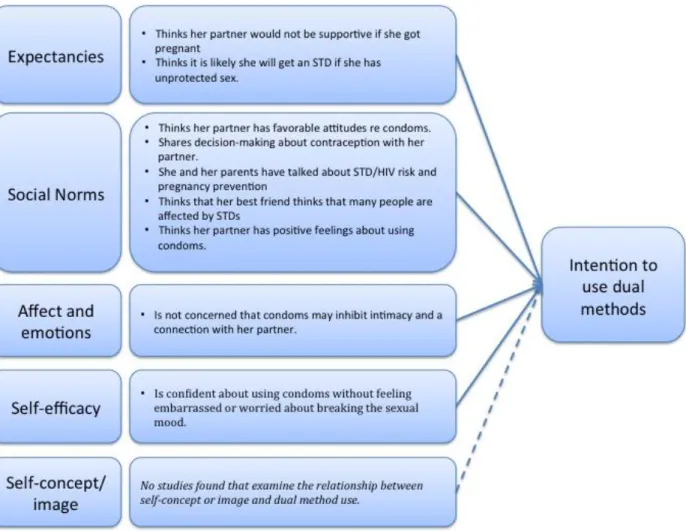
The conceptual framework for this study was derived from an existing framework for the analysis of adolescent sexual behaviors (Guilamo-Ramos, Jaccard, Dittus, Gonzalez, & Bouris, 2008; Jaccard, Dodge, & Dittus, 2002) and several recent reviews of the literature for correlates and predictors of dual method use (Higgins & Cooper, 2012).
As noted in the literature review, the research on interventions to increase dual method use has relied upon a variety of different theories, models and paradigms. No single theory was applied consistently across the interventions. Bearinger and Resnick (2003, p. 341), in their review of the literature on dual method use, suggest that the limited knowledge base on how to promote dual method use stems from the “failure of most researchers in this area to use complex, integrative frameworks characterized by the potential for moving beyond and outside the limited conceptual spheres presented by most theories of health behavior” A similar limitation has been identified by other researchers in the field of sexual reproductive health, and to address that limitation, Guilamo-Ramos, Jaccard, and other colleagues have put forth an integrated
framework of adolescent sexual behavior (Guilamo-Ramos, et al., 2008; Jaccard, et al., 2002). In 2001, the National Institute of Mental Health brought together the leading theorists in social behavior with the goal of integrating the fundamental constructs of their respective theories into a single framework. The meeting included Bandura (social learning theory), Fishbein (theory of reasoned action), Kanfer (self-regulation theories), and Triandis (theory of subjective culture). While the theorists could not agree on a single, unifying framework, a
41
interventions. Their model provides the necessary integrated framework to analyze a complex behavior like dual method use.
Figure 1: Distal Determinants Self Concept/
Image Social Norms
Expectancies
Intention or Decision
Affect and Emotions
42 Figure 2: Proximal Determinants
The five variables in Figure 2 show the model’s primary determinants for a person’s decision or intention to perform a behavior(Guilamo-Ramos, et al., 2008). Each determinant, or class of variables, is derived from one or more well developed behavior theories. Expectancies are an individual’s perceived advantages and disadvantages of performing the behavior, or in other words, the positive or negative consequences they expect to result. Social norms can be divided into two types, injunctive norms, which come from the perceived approval or
disapproval of other people, and descriptive norms, which refer to perceptions about to what extent one’s peers are performing the behavior. Norms may be experienced as social pressures. The more that someone feels social pressures, the more likely they are to behave according to the norms.
Environmental Constraints
Salience of Behavior Intention or
Decision to Perform Behavior
Knowledge and Skills for Behavioral Performance
Behavior
Habit and Automatic
43
Self-concept and self-image are important, especially to adolescents, and can influence one’s intention to perform a behavior through the desire to project a certain image. Also, an individual is more likely to intend to perform a behavior if it is congruous with the person’s self-concept (Jaccard, 2009). Affect and emotions have important roles in intention as adolescents and young adults consider how a certain behavior “feels” affectively and emotionally. It is their “gut-level” response to a behavior. Finally, self-efficacy, or the extent to which an individual believes they can successfully perform a behavior, overcoming obstacles along the way, is a primary determinant for intention (Guilamo-Ramos, et al., 2008).
While intention is an important precursor to behavioral performance, there are other predictors. Figure 3 shows that in addition to intention, one must possess knowledge and skills to perform the intended behavior. Environmental constraints limit one’s ability to translate intention into action, and environmental facilitators have the opposite effect. Behavior is also largely influenced by the salience of the behavior, or how important the individual believes that behavior to be, especially given competing alternatives(Guilamo-Ramos, et al., 2008). The concept of salience also includes “cues to action” or that people may need to be reminded of an intention before they enact the behavior (Jaccard, 2009). Finally, habit and automatic processes can either support or weaken the relationship between intention and behavior (Guilamo-Ramos, et al., 2008).
44
other articles that included comprehensive literature reviews of dual method use correlates (Bearinger & Resnick, 2003; O'Leary, 2011). In addition, when only one study was cited for a particular factor or it was unclear where a variable best fit in the integrated framework, she reviewed the original study.
45 Figure 4: Proximal Determinants of Dual Method Use
Applying past research findings to the integrated framework was not always
straightforward and it is possible that another person might place certain factors in different categories. The author also consulted with two colleagues familiar with the framework and used these different perspectives to make decisions about where to place the various correlates.
Despite the subjective nature of the placement of some variables, the conceptual model serves an organizing function and deepened the researcher’s own understanding of what is already known about dual method use.
46
about one performing a behavior) and no instances of descriptive norms were found (one’s perception of the extent to which his or her peers perform the behavior). Only one factor clearly related to self-efficacy was identified. The association between self-concept/image did not appear to have been examined as a predictor or correlate with dual method use.
Similarly to the distal determinants, the proximal determinants clustered together around a limited number of concepts – salience and knowledge and skills. Only one environmental constraint/facilitator was identified and no studies measuring the association between habit and automatic processes and dual method use were found.
Some correlates of dual method use do not fit this model, including demographic characteristics and other health risks. Dual method users are typically younger (e.g. more likely to be a teenager than an adult, and among teens, she is a younger teen)(Higgins & Cooper, 2012). Dual method users are also less likely to engage in other risk behaviors (Santelli et al., 1997), more likely to delay the onset of sex until age sixteen or older (Santelli, et al., 1997), and more likely to have had more than one sexual partner in the last six months (Cushman, et al., 1998). These more distal variables are useful for tailoring, but are generally not predictive by
themselves (Jaccard, 2009). Rather, they act through the more proximal variables included in the two conceptual models.
Relationship and partner characteristics are not explicitly included in the model. However, it is known that dual method users are less likely to be married or living with their
47
pressures from the norms of one’s sexual partners can be particularly strong. In addition to the concepts outlined in the conceptual framework, the researcher will listen for partner and relationship-related influences on dual method use.
Qualitative Research
The conceptual model demonstrates that there are many unanswered questions about why adolescents and young adults intend (or do not intend) to use dual methods, as well as why (or why not) those intentions translate into behavior. Rather than testing a hypothesis, the researcher aims to inform strategies that are grounded in the real lives of the target population. This purpose calls for a qualitative approach. Using qualitative methods offered insight into the thoughts and experiences of adolescents and young adults, including those who have tried dual method use or may be currently practicing dual method use. It also allowed the researcher to explore possible messages and strategies with both the target population and experts in the field. In this section, an overview of qualitative research and its characteristics will be presented.
Qualitative approaches explore the human elements of phenomena, including the thoughts, feelings, and interpretations of those who have experienced them (The SAGE encyclopedia of qualitative research methods, 2008). In this case, the phenomenon of interest for the proposed research is dual method use by adolescents and young adults. The researcher believes that understanding how adolescent and young adults think, feel, and interpret dual method use will enrich and strengthen the strategies designed to increase this practice.
48
Creswell (2009) synthesized many of those characteristics into a list of nine. The following three characteristics from Creswell’s list are most relevant to this study: the use of inductive analysis, multiple sources of data, and an emphasis on participants’ meanings (Creswell, 2009). In the following paragraphs, each of these characteristics is described in greater detail.
Qualitative research is inductive, in that the researcher identifies patterns and themes, moving from abstract to specific. Working iteratively, the researcher works between the data and themes until a comprehensive set of themes have been developed. In this study, a conceptual model frames the questions and will provide the researcher an initial set of themes on which to build during the analysis. While some qualitative researchers begin with no pre-conceived theories, the use of apriori theoretical frameworks is acceptable. Unlike quantitative approaches where theoretical frameworks serve to define variables and explain the relationship between them, in qualitative research, they serve as a mental model to guide the initial research design and analysis. They are meant to be flexible and should stimulate, rather than inhibit, new ideas.
In qualitative research, the researcher seeks to understand the meanings that participants give to the phenomenon. Emphasis is placed on the participants’ interpretations over the researcher’s or other author’s. The focus group interviews will be recorded and transcribed, capturing the participants’ words verbatim. The analysis process, which is described later, included the use of “in-vivo codes” which come directly from the words and phrases the participants use (Strauss & Corbin, 1990). In-vivo coding, a uniquely qualitative technique, is particularly useful when conducting research with children and adolescents as using their words “enhances and deepens an adult’s understanding of their cultures and worldviews” (Saldaña, 2009, p. 74).
49
phenomenon, using multiple sources allows for a fuller, more complex picture. It helps the researcher look for supporting, as well as disconfirming evidence, an important part of
qualitative analysis. Using multiple sources of data also exposes a variety of perspectives on the phenomenon and allows a richer, more nuanced understanding to emerge. All types of data collection have their limitations and using multiple sources helps compensate for those. It also allows the researcher to triangulate the findings, strengthening the validity of the results (Patton, 2001).
By using a qualitative approach, the results complement the existing quantitative studies about correlates and predictors of dual method use, as well as the intervention research.
Researcher’s Role
In qualitative research, it is important to be explicit about the role of the researcher. The researcher is herself an instrument in the study, as the collector and interpreter of participants’ experiences. Creswell (2008) recommends, “inquirers explicitly identify reflexively their biases, values, and personal background, such as gender, history, culture, and socioeconomic status, that may shape their interpretations formed during a study.” In this section, the researcher will reflect upon her own experiences and interpretations in an effort to be explicit regarding how her involvement influences the research.
50
phenomenon, in contrast to the positivist paradigm that seeks to explain a phenomenon. (Strauss & Corbin, 1990, p. 41) The constructivist suggests that the world is shaped by our experiences and assumptions and true objectivity does not exist. While the researcher recognizes the value of quantitative research and positivist approaches, her bias is that this kind of research often misses the nuanced reality of people’s complex thoughts, feelings, and interpretations of the world around them.
The author works for Planned Parenthood Federation of America and has worked in the field of women’s health for more than fifteen years. Early in her public health career, she volunteered as a sexual health educator and met many adolescents and young adults who were uninformed or misinformed about sex. She also volunteered for a hospice serving those with AIDS, which motivated her to continue working to prevent the spread of HIV. Most of her career has been spent working with communities that bear a disproportionate burden of poverty and disease. She has worked towards ending health disparities and views health as a human right and a matter of social justice. These experiences have predisposed the researcher to believe that women and men, including adolescents, should have access to the information and services to protect and promote their sexual and reproductive health. She believes that a person’s life experiences and
environment are just as important to their health as their knowledge, attitudes, and beliefs.