Received 20 March 2020; received in revised form 22 April 2020; accepted 25 May 2020.
To cite this article: Kumar et al. (2020). Analysis of control flow valve compensated thrust bearing considering thrust
Analysis of control flow valve compensated thrust bearing
considering thrust pad flexibility
Vivek Kumar 1*, Satish C. Sharma 2, Kuldeep Narwat 3
1 Department of Mechanical Engineering, School of Technology (SoT), Pandit Deendayal
Petroleum University (PDPU), Gandhinagar, Gujarat 382007, INDIA.
2 Department of Mechanical and Industrial Engineering, Indian Institute of Technology Roorkee,
Roorkee, 247667 Uttarakhand, INDIA.
3 School of Mechanical Engineering, Galgotias University, 247667 Greater Noida, INDIA. *Corresponding author: [email protected]
KEYWORDS ABSTRACT
Hydrostatic bearing Control flow valve Flexibility
Thrust pad Couple-stress FEM
For heavily loaded applications, film pressure within the hydrostatic thrust bearings is large enough to elastically deform the pad surface. Thus, the fluid film pressure envelope and associated performance parameters get altered. Therefore, to have an accurate prediction of bearing performance characteristics data, it becomes essential to address the elastic nature of the bearing pad while performing the numerical simulation. This paper investigates the combined influence of bearing pad flexibility and couple stress lubrication on the operation of an externally pressurized thrust bearing. Stokes couple stress theory is employed to obtain Reynolds equation to allow for the effect of the size of additives blended into the lubricant. A MATLAB based iterative source-code is developed to solve the modified Reynolds equation using FEM. It is found that the combined effect of couple stress lubricant and pad flexibility results in an overall increase of 63.79% and 10% in load-carrying capacity and film stiffness coefficient, respectively.
1.0 INTRODUCTION
Unlike Hydrodynamic bearings, fluid film pressure in the hydrostatic bearings is generated by an external source usually a pump. Relative Independence of pressure generation mechanism on the speed in hydrostatic thrust bearings ensures complete separation of bearing surfaces at low or even at zero operating speeds. In addition to higher load supporting ability, hydrostatic thrust bearings offer higher film stiffness and damping coefficients, enabling their suitability for wide range of applications as compared to hydrodynamic bearings. Therefore, numerous research efforts had been targeted to enhance the performance of these bearings. Initially, Fuller (Fuller, 1956) and Brown (Brown, 1961) have investigated the dynamic performance of hydrostatic thrust pad bearings. Bearing pad surface in above-mentioned studies is assumed to be rigid. Later, Jain et al. (Jain et al., 1986) investigated the influence of recess geometry on the performance indices of this class of bearings. Many researcher (Ghora et al., 2014, Kumar et al., 2018) have investigated the use of different restrictor and pocket geometric shape in hydrostatic thrust bearings. Experimental investigation on high-pressure axial piston pump are carried out by (Koc and Hooke, 1997) to examine the operation of hydrostatic bearing employing an orifice restrictor. The author concluded that presence of non-flatness (in small magnitude) on bearing surface enhance the performance these class of bearings. The effect of the location of circular and sectorial shape recess on the steady-state operation of hydrostatic thrust bearing was numerically and experimentally examined by (Safar et al, 1996). The authors recommended use of sectorial recessed thrust bearings for sustaining heavier external loads. Hydrodynamic thrust bearing having cycloidal and plane profile are experimentally investigated by (Pandey and Sharma, 2009). It has been found that imparting surface roughness on the stationary pad can significantly enhance the hydrodynamic action and reduce the fluid film friction coefficient.
Researchers in the past have used stokes couple stress theory to investigate the performance of different class of bearings operating with couple stress lubricants. However, majority of the study dealing with couple stress lubricant in hydrostatic lubrication regimes are uncompensated. The performance of hydrostatic bearings strongly depends on selection of the compensating element. Therefore, bearing design data obtained from uncompensated hydrostatic thrust pad bearing is comparatively unrealistic and lacks reasonable level of accuracy. Further, no study has been reported using control flow valve (CFV) as restrictor in hydrostatic thrust bearing lubricated using couple-stress fluid/lubricant. Moreover, abovementioned studies for couple-stress lubricant have assumed bearing pad surfaces as rigid, which is unrealistic assumption for hydrostatic thrust bearing employed in heavily loaded applications. This study is focussed to bridge the aforementioned gap in hydrostatic thrust bearings. The aim of the present work is to analyze and investigate the effect of size of couple-stress additives and bearing pad flexibility on steady-steady and dynamic operation of hydrostatic thrust bearings employing a CFV restrictor.
2.0 ANALYSIS
The couple-stress fluid/lubricant is supplied to pocket/recess of hydrostatic thrust bearing through control flow valve as shown in figure1. The flow of lubricant is assumed to be laminar and lubricant is iso-viscous and incompressible. In dimensional less form the Reynolds Equation for couple-stress lubricant can be expressed as (Kumar and Sharma, 2018):
𝜕 𝜕𝛼(ℎ̅
3𝑓′(ℎ̅, 𝑙̅)𝜕𝑝
𝜕𝛼) + 𝜕 𝜕𝛽(ℎ̅
3𝑓′(ℎ̅, 𝑙̅)𝜕𝑝
𝜕𝛽) = 𝜕ℎ̅
𝜕𝑡̅ (1)
Where, 𝑓′(ℎ̅, 𝑙̅) = 1 − 12(𝑙̅/ℎ̅)2+ 24(𝑙̅/ℎ̅)3tanh(ℎ̅/(2𝑙̅)) denotes couple stress function. 𝑙̅ is
defined as non-dimensional characteristics size of couple-stress polymer added to stock oil and is expressed as: ℎ1
𝑟(𝜂/𝜇)
0.5. The modified Reynolds (Eq.1) is subjected to FE weak formulation.
Top view of bearing pad
(a) (b) (c)
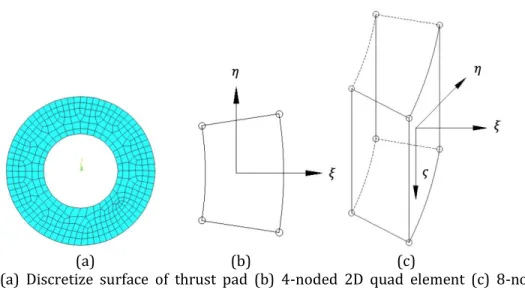
Figure 2: (a) Discretize surface of thrust pad (b) 4-noded 2D quad element (c) 8-noded 3D element.
The surface of thrust pad is divided into sub-domains using iso-para quad element (Figure 2(a,b)). The fluid film pressure within an element is approximated using:
𝑝̅ = ∑ [𝑁𝑗𝑝𝑗] 4
𝑗=1 = 𝑁1𝑝1+ 𝑁2𝑝2+ 𝑁3𝑝3+ 𝑁4𝑝4 (2)
The thrust pad material is supposed to be linear, elastic and isotropic. In order to determine the elastic deformation of thrust pad under fluid film pressure, thrust pad has been discretized using 8-noded 3D element as shown in figure 2(c). The variation of field variable (displacement) within any element is described as follows:
𝜑(𝑢, 𝑣, 𝑤) = [𝑁]𝑒𝜑𝑒 (3)
Here u, v and w are displacement with an element along x, y and z direction. These values of nodal displacement are computed by solving elasticity equation using principle of virtual work. The final generalized elasticity equation after weak formulation is expressed as follows:
[𝐾]𝑒{𝜑} = {𝐹
𝜀𝑜 }𝑒+ {𝐹𝜎𝑜 }𝑒+ {𝐹𝑏}𝑒+ {𝐹𝑇}𝑒 (4)
The elemental matric are as follows,
[𝐾]𝑒= ∬ 𝐵𝑇𝐷𝐵
V𝑒
𝑑𝑉𝑒
{𝐹𝜀𝑜 }𝑒 = ∬ 𝐵𝑇𝐷𝜀𝑜
V𝑒
{𝐹𝜀𝑜 }𝑒 = ∬ 𝐵𝑇𝜎𝑜
V𝑒
𝑑𝑉𝑒
{𝐹𝑏}𝑒= ∬ 𝑁𝑇𝐵𝑏
V𝑒
𝑑𝑉𝑒
{𝐹𝑇}𝑒 = ∬ 𝑁𝑇𝐹𝑏
V𝑒
𝑑𝑉𝑒
The constitutive relation matrix (for strain and stress relationship) can be expressed as follows:
𝐷 = 𝐸
(1 + 𝜐)(1 − 2𝜐)
[
1 − 𝜐 𝜐 𝜐 0 0 0
𝜐 1 − 𝜐 𝜐 0 0 0
𝜐 𝜐 1 − 𝜐 0 0 0
0 0 0 1/2 − 𝜐 0 0
0 0 0 0 1/2 − 𝜐 0
0 0 0 0 0 1/2 − 𝜐]
𝐵 =
[
𝑁𝑖,𝑥 0 0
0 𝑁𝑖,𝑦 0
0 0 𝑁𝑖,𝑧
0 𝑁𝑖,𝑧 𝑁𝑖,𝑦
𝑁𝑖,𝑧 0 𝑁𝑖,𝑥
𝑁𝑖,𝑦 𝑁𝑖,𝑥 0 ]
The non- dimensional fluid film thickness in an element is expressed by:
ℎ̅ = ℎ̅𝑜+ 𝑁𝑖𝑤̅|𝑖 (5)
w
being the bearing pad elastic deformation in z-direction.The modified Reynolds (Eq.1) is subjected to FE weak formulation using abovementioned approximation.
𝜕 𝜕𝛼(ℎ̅
3𝑓′(ℎ̅, 𝑙̅) 𝜕
𝜕𝛼{∑ (𝑝̅𝑗𝑁𝑗) 4
𝑗=1 }) +
𝜕 𝜕𝛽(ℎ̅
3𝑓′(ℎ̅, 𝑙̅) 𝜕
𝜕𝛽{∑ (𝑝̅𝑗𝑁𝑗) 4
𝑗=1 }) −
𝜕ℎ̅
𝜕𝑡̅ = 𝑅𝑒𝑠 (6)
∬ (𝑊𝑗∗ 𝑅𝑒𝑠)
Ω𝑒 𝑑𝛼𝑑𝛽 = ∬ (𝑁𝑗∗ 𝑅𝑒𝑠)
Ω𝑒 𝑑𝛼𝑑𝛽 = 0 (7)
After simplification equation 4 in the matrix forms can be expressed as:
𝐹̅𝑖𝑗𝑒 = ∬ [ℎ̅3𝑓′𝜕𝑁𝑖
𝜕𝛼 𝜕𝑁𝑗
𝜕𝛼 + ℎ̅
3𝑓′𝜕𝑁𝑖
𝜕𝛽 𝜕𝑁𝑗 𝜕𝛽] Ω𝑒 𝑑𝛼𝑑𝛽
𝑄̅𝑖𝑒= ∫ [(ℎ̅3𝑓′
𝜕𝑝
𝜕𝛼) 𝑛𝛼+ (ℎ̅
3𝑓′𝜕𝑝
𝜕𝛽) 𝑛𝛽]
Γ𝑒
𝑁𝑖dΓ𝑒
𝑅𝑆
̅̅̅̅𝑖𝑒= ∬ 𝑁 𝑖
Ω𝑒
𝑑𝛼𝑑𝛽
Equation 5 coupled with restrictor (CFV) flow equation is solved to obtain nodal pressures over the bearing surface. The film pressure at all the nodes located on recess boundary will be equated to recess/pocket pressure. The film pressure at all nodes lying on bearing pad outer radius is set to zero (ambient pressure).
In the present bearing system, the recess is considered to be deep enough (50 times nominal fluid film thickness) to ensure uniform fluid film pressure within the recess. The static load carrying capacityof bearing is evaluated by integrated fluid film pressure over land and recess area.
𝐹̅𝑜= 𝐹̅𝑜|𝑙𝑎𝑛𝑑𝑐𝑜𝑛𝑡𝑟𝑖𝑏𝑢𝑡𝑖𝑜𝑛+ 𝐹̅𝑜|𝑟𝑒𝑐𝑒𝑠𝑠𝑐𝑜𝑛𝑡𝑟𝑖𝑏𝑢𝑡𝑖𝑜𝑛 (9)
𝐹̅𝑜= ∑ {∫ ∫ (∑4𝑗=1𝑝̅𝑗𝑁𝑗)|𝐽̅| 𝑑𝜉 𝑑𝜂 +1
−1 +1
−1 }
𝑛𝑒
𝑒=1 + 𝐴̅𝑝𝑝̅𝑜𝑐 (10)
Fluid film stiffness coefficient of a thrust bearing is defined as derivative of fluid film reaction with respect to fluid film thickness. A bearing must possess sufficient magnitude of film stiffness for a system/machine to achieve desired level of precision, accuracy, and repeatability during its operation. The stiffness of a lubricating film in thrust bearings is computed by giving small perturbation in fluid film thickness:
𝐾̅ =𝜕𝐹̅𝑜
𝜕ℎ̅ = ∑ {∫ ∫ (∑ 𝜕𝑝̅𝑗
𝜕ℎ̅ 𝑁𝑗 4
𝑗=1 ) |𝐽̅| 𝑑𝜉 𝑑𝜂 +1
−1 +1
−1 }
𝑛𝑒
𝑒=1 + 𝐴̅𝑜𝑐
𝜕𝑝̅𝑜𝑐
𝜕ℎ̅ (11)
Fluid film damping coefficient of a thrust bearing is quite an important performance
parameter from the viewpoint dynamic state/stability of the bearing system. Fluid film damping coefficient of a thrust bearing is defined as derivative of fluid film reaction with respect to the squeeze velocity. Mathematically, lubricating film damping coefficient of thrust bearing is described as rate of change of film reaction when runner is subjected to motion along the film thickness direction.
𝐷̅ =𝜕𝐹̅
𝜕ℎ̇̅= ∑ {∫ ∫ (∑ 𝜕𝑝̅𝑖
𝜕ℎ̇̅ 𝑁𝑗 4
𝑗=1 ) |𝐽̅| 𝑑𝜉 𝑑𝜂 +1
−1 +1
−1 }
𝑛𝑒
𝑒=1 + 𝐴̅𝑜𝑐
𝜕𝑝̅𝑜𝑐
3.0 SOLUTION METHODOLOGY
An iterative program/code has been written for finite element formulation of Reynolds equation and its solution using Gauss-Siedel method. The source code has been developed to examine the effect of size of additives (𝑙̅) and thrust pad flexibility (𝐶𝑜𝑑) on operational indices of
the externally pressurized thrust bearing. The parameter 𝑙̅ describe the ratio of chain length of polymer additive to that of nominal fluid film thickness. Long chain polymer additives have been blended into the base lubricant as viscosity index improvers. The classical Newtonian theory neglects the size of additives. The lubricant exhibit Newtonian behavior as value of 𝑙̅ approaches towards zero. The values of 𝑙̅ (between 0.1 to 0.2) corresponds to chain length of polymer additives in non-Newtonian lubricant. The value of (𝑙̅) depends on material constant (ɳ) and viscosity (µ) of the lubricant. Stokes (1966) described some experimental methods to determine the numerical value of (η) and (µ). Elasticity parameter (𝐶̅𝑜𝑑) is a function of Young’s modulus
(thrust pad), lubricant supply pressure, film thickness and thickness of thrust pad. The rigid surface of thrust pad is simulated by taking 𝐶̅𝑑 as zero and elastic nature of thrust pad is
numerically treated by varying 𝐶̅𝑜𝑑 from 0.2 to 1. The bearing surface is discretized using
bi-linear iso-parametric quad elements in FEA software ANSYS. Bearing operating and geometric parameters (Table 1) have been used from available published literature (Jain et al., 1986; Lin, 1999). Mesh sensitivity test is achieved at a grid size of 511x411(Nodes x Element). Further, a convergence of order of 10-06 has been set on nodal pressure vector to terminate the iterative
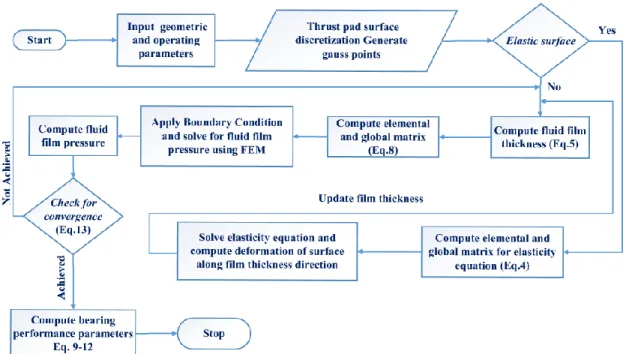
scheme. The solution scheme is depicted in figure 3 and can described as follows: (a) Input bearing operating condition (data), mesh details, initialize variables (b) Generate gauss-points and weights for elements of discretised surface of pad. (c) Establish and compute fluid film thickness using bearing surfaces to be rigid. (d) Compute elemental terms for fluidity, flow and squeeze matrix.
(e) Assemble terms in step four to obtain set of algebraic equations (Eq.8)
(f) Solve equation 8 using Gauss0-Siedel method and compute fluid film pressure values. (g) Check for pressure convergence criteria (Eq.12). Terminate iterative scheme once
convergence criteria are fulfilled. 𝑡𝑜𝑙𝑝 = 0.0001 > max ([p̅0]∆𝑘
[p̅0]𝑘) (13)
(h) Solve elasticity equation (Eq.4) to obtain nodal displacement along z-direction.
(i) Update fluid film thickness at all nodes (Eq.5) and perform Elastohydrostatic solution of equation 5 to update nodal fluid film pressure values. Terminate iterative scheme once convergence criteria are fulfilled.
Figure 3: Solution scheme for elastohydrostatic lubrication of thrust bearings.
Table 1: Reference values of bearing geometric and operating conditions.
Input parameters Reference value
Bearing Pad outer radius 178 mm Area of annular pocket 24871.94 mm2
Nominal fluid film thickness 0.0508 mm Lubricant supply pressure 20.6843 MPa Lubricant dynamic viscosity (400 C) 0.034 Pa.s
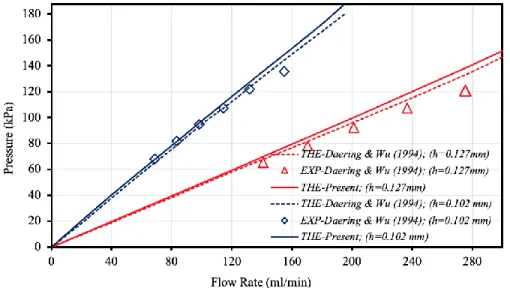
Figure 4: Pump/supply pressure vs. flow rate for graphite/ethylene glycol mixture.
It is always desirable and necessary to ascertain the adequacy of developed mathematical model, before proceeding with numerical simulation of the bearing under consideration. In view of this, the developed code has been used to reproduce the result for a study carried out by (Daering and Zhenming, 1994). The authors have performed analytical and experimental simulation for CFV compensated thrust bearing operating with a slurry of graphite powder blended in ethylene glycol. The analytical solution is obtained using power law model to describe non-Newtonian behaviour of lubricant. The developed code has been modified to take into account the power law behaviour of lubricant. Afterwards, the numerical results are generated for supply pressure vs lubricant flow rate for thrust bearing operating with CFV. Figure 4 depicts comparison between original analytical and experimental results and numerical results generated using developed model/code. A slight variation has been observed between results from numerical and experimental simulation. This could be due to settling down of slurry particulates and assumption of smooth bearing surfaces during performing numerical simulations. The results presented in figure 3 vindicate the ability of developed mathematical model/source code to numerically simulate hydrostatic thrust bearing.
4.0 RESULTS AND DISCUSSION
Performance parameters of hydrostatic thrust bearing are is evaluated as non-dimensional quantities i.e. lubricating film pressure(𝑝̅𝑜𝑐), load supporting capacity(𝐹̅𝑜), film stiffness (𝐾̅) and
damping (𝐷̅) coefficient. Performance indices of CFV compensated hydrostatic thrust bearing are illustrated in Fig.5-9, for classical Newtonian lubricant (𝑙̅ = 0) and couple-stress lubricant(𝑙̅ = 0.1,0.2). Influence of bearing pad flexibility is taken into account by a non-dimensional parameter 𝐶𝑜𝑑 i.e. elasticity parameter coefficient of bearing pad material. Result are presented for both rigid
(𝐶𝑜𝑑= 0) and flexible(𝐶𝑜𝑑= 0.1 → 1) hydrostatic thrust bearings.
bearing pads. Further, observation from Fig.5 revealed that elastic deformation of thrust pad surface tends to contract the film pressure profile. Comparatively, effect of couple-stress lubricant on fluid film pressure is highly pronounced at lower lubricant flow rate(𝑄̅𝑏= 0.6) and decreases
with increase in value of elasticity parameter (𝐶𝑜𝑑) of bearing pad.
Figure 5: 2DFluid film pressure profiles over thrust pad along diametrical line .
Figure 7 represent variation in non-dimensional load supporting capacity(𝐹𝑜) of bearing w.r.t
elasticity parameter(𝐶𝑜𝑑) . Numerical results presented in Fig.7 indicates that presence of
couple-stress enhances the load supporting capacity for both flexible and rigid thrust pad surface. Load supporting capacity of bearing reduces continuously and substantially as elastic deformation of bearing pad increases, irrespective of type of lubricant and lubricant flow rate. An overall increase of 170.45% and 63.79% in load supporting capacity is observed owing the use of couple-stress fluid/lubricant(𝑙̅ = 0.2; 𝑄̅𝑏= 1.2)vis-a-vis Newtonian lubricant (𝑙̅ = 0; 𝑄̅𝑏=
0.6)for rigid(𝐶𝑜𝑑= 0)and flexible bearing(𝐶𝑜𝑑= 1), respectively. The increase/enhancement
(a) (b)
(c) (d)
Figure 6: 3D Fluid film pressure profiles for different operating conditions
Figure 7:Film reaction force vs elasticity parameter.
[𝑄𝑏 = 0.6; 𝑙̅ = 0;
𝐶
𝑜𝑑 = 0] [𝑄𝑏 = 0.6; 𝑙̅ = 0;𝐶
𝑜𝑑 = 1]Figure 8: Film Stiffness coefficient vs elasticity parameter.
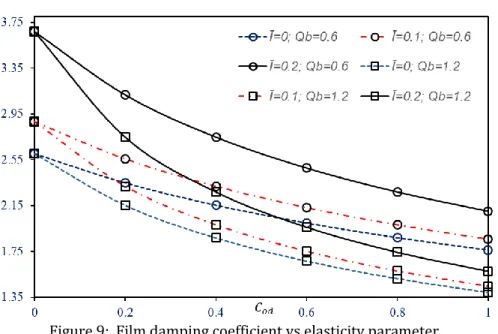
Figure 9: Film damping coefficient vs elasticity parameter.
Figure 8 Present variation in fluid film stiffness w.r.t bearing pad flexibility. It can be noticed that both couple stress additives and lubricant flow rate have significant positive influence on fluid film stiffness of bearing. Elastic deformation of bearing pad is observed to have negative influence on the film stiffness coefficient. The presence of additives (𝑙̅ = 0.2; 𝑄̅𝑏= 0.6) in
lubricant yields a net increase of 67.7% and 25.3% in film stiffness coefficient as compared to Newtonian lubricant (𝑙̅ = 0; 𝑄̅𝑏= 0.6) for rigid (𝐶𝑜𝑑= 0) and flexible bearing(𝐶𝑜𝑑= 1),
respectively.
fluid film damping coefficient. These trends are noticed to be similar for both Newtonian as well as non-Newtonian lubricant. The reduction in damping coefficient w.r.t to pad flexibility is notice be steep for higher lubricant flow rate through the bearing. Quantitatively, a maximum of 42% and 13% enhancement in film damping capabilities has been notice by use of couple stress lubricant for rigid (𝐶𝑜𝑑= 0)and flexible (𝐶𝑜𝑑= 1) thrust pad.
5.0 CONCLUSIONS
The steady-state and dynamic performance indices of hydrostatic thrust bearing differ considerably when there is elastic deformation of bearing surface subjected to extremely heavy loads. Such condition normally occurs in thrust bearings used in application such as observatory domes telescopes, producing hydrostatic oil jacking etc. Following major conclusion can be drawn from the presented work:
(a) Elastic deformation of the thrust pad significantly reduces steady-state and dynamic performance indices of bearing by changing the film pressure distribution. Therefore, in heavily loaded hydrostatic thrust bearings it is always essential and practical to perform simultaneous solution of elasticity equation along with the flow governing equations. (b) The elasticity in thrust pad tends to reduce the load carrying capacity, fluid film stiffness
and damping coefficient of the bearing. This can be attributed to reduction in magnitude of fluid film pressure and its gradient in flexible bearing surfaces.
(c) Effect of couple-stress additives in stock/base oil significantly enhances the film pressure, load supporting ability and film stiffness coefficient of hydrostatic thrust bearings. These effects are noticed to be highly pronounce at lower lubricant flow rate.
(d) The effect of presence of couple-stress on bearing performance indices is noticed to be significantly higher while considering the bearing surface to be rigid (vis-a-vis elastic surface) in the numerical simulation.
REFERENCES
Brown, G. M (1961). The dynamic characteristics of a hydrostatic thrust bearing. International Journal of Machine Tool Design and Research, 1(1), 157-171.
Eringen, A. C. (1966). Theory of micropolar fluids (No. RR-27). Purdue Univ. Lafayette In School Of Aeronautics And Astronautics,27.
Etsion I. (2005). State of the art in laser surface texturing. Journal of tribology, 127(1), 248-253. Fuller, D. (1956). Theory and Practice of lubrication for engineers. New York: Wiley and Sons,
1956.
Gohara, M., Somaya, K. & Miyatake M. (2014). Yoshimoto S. Static characteristics of a water-lubricated hydrostatic thrust bearing using a membrane restrictor. Tribology International, 75, 111-116.
Gropper, D., Wang, L. & Harvey, T. J. (2016). Hydrodynamic lubrication of textured surfaces: A review of modeling techniques and key findings. Tribology International, 94, 509-529. Kumar, V., Sharma, S., & Narwat, K. (2019). Influence of micro-groove attributes on frictional
Kumar, V., & Sharma S. C. (2019). Effect of geometric shape of micro-grooves on the performance of textured hybrid thrust pad bearing. Journal of the Brazilian Society of Mechanical Sciences and Engineering, 41(11), 508-532.
Koc, E. & Hooke C. J. (1997). Considerations in the design of partially hydrostatic slipper bearings. Tribology International, 30(11), 815-823.
Kumar, V., & Sharma S. C. (2018). Influence of dimple geometry and micro-roughness orientation on performance of textured hybrid thrust pad bearing. Meccanica, 53(14), 3579-3606. Kumar, V., & Sharma S. C. (2018). Finite element method analysis of hydrostatic thrust pad
bearings operating with electrically conducting lubricant. Proceedings of the Institution of Mechanical Engineers, Part J: Journal of Engineering Tribology, 232, 101318-133.
Kumar, V., & Sharma S. C. (2018). Dynamic characteristics of compensated hydrostatic thrust pad bearing subjected to external transverse magnetic field. Acta Mechanica, 229(3), 1251-1274. Lin, J. R. (1999). Static and dynamic characteristics of externally pressurized circular step thrust
bearings lubricated with couple stress fluids. Tribology International, 32(4), 207-216
Osman, T. A, Dorid, M., Safar, Z. S. & Mokhtar, M. O. (1996). Experimental assessment of hydrostatic thrust bearing performance. Tribology international, 29(3), 233-242.
Ram, N., (2016). Numerical analysis of capillary compensated micropolar fluid lubricated hole-entry journal bearings. Jurnal Tribologi, 9, 18-44.
Ramanaiah G., & Sarkar P. (1978). Optimum load capacity of a slider bearing lubricated by a fluid with couple stress. Wear, 49(1), 61-66.
Scott, W. &, Suntiwattana, P. (1995). Effect of oil additives on the performance of a wet friction clutch material. Wear, 181, 850-855.
Sharma, R. K. & Pandey, R. K. (2008). Thermo hydrodynamic analysis of infinitely wide cycloidal profiled pad thrust bearing with rough surface and a comparison to plane profiled pad. Lubrication Science, 20(3), 183-203.
Sinhasan, R., Jain, S. C, Sharma, S. C. (1986). Orifice-compensated flexible thrust pad bearings of different configurations. Tribology International, 19(5), 244-252.
Stokes, V. K. (1966). Couple stresses in fluids. Physics of Fluids, 9, 1709-1715.
Thakre, G. D., Sharma, S. C., Harsha, S. P., & Tyagi, M. R. (2015). A parametric investigation on the microelastohydrodynamic lubrication of power law fluid lubricated line contact. Proceedings of the Institution of Mechanical Engineers, Part J: Journal of Engineering Tribology, 229(10), 1187-1205.
Wada, S. & Hayashi, H. (1971). Hydrodynamic lubrication of journal bearings by pseudo-plastic lubricants: Part2 experimental studies, Bull.JSME, 14, 279–286.