R E S E A R C H
Open Access
Flipped learning wheel (FLW): a framework
and process design for flipped L2 writing
classes
Zhanni Luo
*, Billy O
’
Steen and Cheryl Brown
* Correspondence:zhanni.luo@pg. canterbury.ac.nz
School of Educational Studies and Leadership, University of Canterbury, Room 415, Rehua Building, Christchurch 8041, New Zealand
Abstract
It is widely recognized that feedback is important for the improvement of second language (L2) writing skills; however, teachers are facing challenges in providing sufficient and quick feedback on students’written works. This study proposes to employ the flipped classroom approach and peer feedback in L2 writing classes. Though previous studies provided sufficient theoretical frameworks and design guidelines in both fields, there is still a lack of actionable process designs specifically for L2 writing that combine flipped learning and peer feedback. To address the aforementioned gaps, this article uses a‘design thinking’approach to establish a framework named the Flipped Learning Wheel (FLW), which contains the components and principles of a typical flipped learning class. To achieve
collaborative and reflective learning, which have been rarely specified in previous flipped learning research, this study involves the jigsaw technique and process writing approach in the design. The paper presents a detailed explanation of the FLW implementation process in L2 writing classes that contains 18 steps. We also interviewed eight L2 writing teachers about their perceptions on the FLW framework’s feasibility in practice. Respondents report that the teaching process is specific, actionable and feasible for real-life teaching, which also leaves sufficient freedom for teachers to make adjustments. However, more attention should be paid to classroom management, class size and teacher competence. The FLW framework and implementation process presented in this article can be directly used, adapted or reshaped by L2 writing teachers for students with middle and upper language ability. Future studies can also implement this process design in practice and test its impact on writing ability and engagement.
Keywords:Flipped learning, Process design, Framework design, Jigsaw technique,
flipped learning wheel (FLW)
Introduction
It is widely recognized that revision based on feedback is important for the improve-ment of writing skills (Law & Baer,2017; Liu & Brown,2015). However, in the teach-ing of second-language (L2) writteach-ing, teachers are faced with challenges such as the limited time to give sufficient and quick feedback on students’ written works (Cho &
Schunn, 2007; Law & Baer, 2017; Liu & Brown, 2015). In addition, Nobles and Paganucci (2015) observe that a great deal of valuable in-class time was spent on low-order activities in Bloom’s taxonomy (Anderson & Krathwohl, 2001), such as remem-bering and understanding, requiring high-order activities such as applying, analysing, evaluating and creating to be undertaken by students outside of class time.
Under this circumstance, the adoption of flipped learning (Bergmann & Sams,2012) in L2 writing classes with the involvement of peer feedback provides a potential oppor-tunity to provide feedback through engaging in high-order learning activities. A typical flipped learning class, or flipped classroom approach, provides students with access to online learning materials (usually via reading, lecture videos and quizzes) prior to face-to-face (F2F) sessions, and then use the in-class time to deal with “harder work of as-similating that knowledge” (Brame, 2013). With the use of flipped learning, learners gain full control of their study and can access their learning materials when, where and as often as they need to, while instructors gain more time to support student-centred learning (Huang, Hew, & Lo,2019; Hung,2017; Lameras & Moumoutzis,2015; Zhama-nov & Sakhiyeva,2015).
Although flipped learning is theoretically promising, its relevance with second lan-guage acquisition (SLA) has not been established, particularly in relation to the teach-ing of L2 writteach-ing (Hung,2017). Luo, Hew, Lei, and Oh (2017) suggest that teachers still
“consider it (the implementation of flipped classroom approach) too difficult” (p. 449) since there is a lack of practical models guiding them on how to do so. We partially agree with Luo et al. (2017): we believe that there are sufficient models demonstrating how to implement the flipped classroom approach, and the problem is these models are not detailed, actionable or subject-specific enough. It is true that the flipped class-room is a generic approach that can be customized to any disciplinary area; however, for teachers who are not necessarily familiar with this pedagogical approach, a ready-to-implement process design will be much more favoured. For example, Kim, Kim, Khera, and Getman (2014) suggest that teachers “provide facilitation for building a learning community”(p. 45) without answering“how to build the learning community” or “how to facilitate the process”; Lo and Hew (2017) emphasize the importance of solving simple problems without specifying how to design the problems; Lee, Lim, and Kim (2017) propose to pay attention to “procedural organization” (p. 440) with a lack of explanation on how to achieve it in the model. When it comes to subject-specific context, the aforementioned principles are even more ambiguous so that the imple-mentation in practice is difficult. If we take L2 writing as the specific context, the exist-ing models“do not adequately explicate how and what students need to do to evaluate, revise, and edit their writing once the first draft is completed”(Law & Baer,2017, p. 3), neither specify which tool or what strategies to teach L2 writing (Wingate, Andon, & Cogo,2011). In summary, the earlier work made significant contributions to the devel-opment of the flipped classroom approach, but there is still a call for detailed and subject-specific process designs to supplement existing knowledge.
process proposed by Plattner, Meinel, and Weinberg (2009), as explained in the next section.
Methodology
This study develops a process design for a flipped L2 writing class that mainly focuses on peer feedback. The design follows the iterative design thinking process proposed by Plattner et al. (2009), which contains six steps: understand, observe, point of view, ide-ate, prototype and test.
We started by gathering insights about the existing problems, trying to understand
and observe the current needs in L2 writing education. During this process, we refer-enced academic publications for theoretical support. Afterwards, we conducted infor-mal talks with teachers to confirm their point of view on whether the problems are a valid concern for teachers’. In the following step, we read widely toideatethe concept, as well as reviewing related models to shape the finalprototype. At this stage, we estab-lished a framework named the Flipped Learning Wheel (FLW) that contains the com-ponents and principles of a typical flipped class, followed by a detailed process design description of that in L2 writing classes. Then, we tested the feasibility of the frame-work by interviewing teachers about their perceptions and suggestions based on their experiences.
One of the major difficulties of the current study is that in the step oftest, every par-ticipant gave abundant suggestions so the process design dynamically changed. For ex-ample, based on literature, we suggested that teachers check students’ online learning progress prior to the F2F sessions. If needed, lecturers could send reminders to stu-dents for guaranteed online participation. This item has been removed since several interview participants believed students should not be spoon-fed. To ensure mutual un-derstanding, we conducted three rounds of interviews. In the first round, we inter-viewed participants to collect their opinions. In the second round, we merged all of their suggestions into the improved process description and interviewed participants on whether to keep or remove the newly merged items. Then, in the third round, we kept repeating the aforementioned two processes until there were no more items to add or remove.
The test includes four main parts: whether this study identifies the right problem (lack of feedback), whether the proposed solution (peer feedback) is rational in practice, what are the benefits and of the current process design and how to upgrade the process design. All of the interview questions as shown in Table1.
candidates with knowledge, we received sufficient interview responses that support the current study.
Design process understand and observe: the call for peer feedback in L2 writing
Peer feedback is also known as peer review, peer editing, peer assessment or peer re-sponses. Peer feedback activities refer to those in which learners work in pairs or small groups to provide comments on one another’s writing work, textually and/or orally (Chen, 2016; Yu & Lee, 2016). The main benefits of peer feedback are its potential in encouraging collaborative learning, contributing to learning autonomy, developing a sense of audience awareness, fostering the ownership of texts, enhancing students writ-ing attitude and improvwrit-ing the quality of students’interactions (Chen,2016).
Peer feedback is of great significance in writing activities: as instructors “seldom have the time to give adequate commentary on students’written work” (Law & Baer, 2017, p. 3), the involvement of peer feedback significantly reduces instructors’workload and therefore facilitate the teaching of writing. However, when it comes to second language teaching, a language that has not been mastered by learners, it is a concern as to whether or not learners are able to provide useful feedback and how effective that peer feedback is in L2 writing.
A number of studies compared the effect of peer feedback and self-feedback. Diab (2010) conducted a quasi-experiment to exam students’correction of specific language errors in revised drafts. The results showed that peer feedback significantly improved English writing skills for foreign language students, with the peer-reviewing group re-duced rule-based errors (subject/verb and pronoun agreement) but not the non-rule-based errors (wrong word choice and awkward sentence structure). Namely, the use of peer feedback helps the correction of certain types of errors instead of all.
There are also studies comparing the effectiveness of peer feedback with teacher as-sessment. Topping (1998) indicates that peer feedback plays a positive role in develop-ing students’sense of achievement and attitudes, and peer feedback is “as good as or better than”teacher assessment (p. 249). Ekşi (2012) conducted a comparative study in a Turkish university on 46 English major students to investigate the effectiveness of peer feedback and the teacher feedback. The results show that even though the peer-reviewing group “made many surface-level changes” at the beginning, they “gradually
Table 1Questions involved in the current study
Category Interview question/ questionnaire questions
1. Problem identification - (Questionnaire) Do you agree that revision based on feedback (either teacher feedback or peer feedback) is important for the improvement of writing skills?
- (Questionnaire) In L2 writing, do you think teachers provide quick or sufficient feedback on student writing works?
2. Rationale of the solution - (Questionnaire) Who do you think benefits from peer feedback, students with high language proficiency, students with low language proficiency, feedback giver or feedback receiver?
3. Benefits and barriers of the FLW design
- (Interview) What are the benefits or barriers of the FLW design?
4. How to upgrade the FLW framework
- (Interview) Is there anything unclear in the FLW design? Is there anything to add or delete from the process description?
increased deep-level changes” (p. 33). Eventually, the two groups presented no signifi-cant differences as to academic performances. However, the peer-review frees up the teachers’ time for other pedagogical activities to “a great deal” (Ekşi, 2012, p. 33), so peer feedback is overall useful.
Researchers also attempted to investigate the detailed functions of the two types of reviewing. The study of Chen (2010) reported 10 graduate students’perceptions regard-ing peer feedback and feedback from writregard-ing consultants. It was found that the two types of comments serve different functions for students, as writing consultants focused on local errors only in the time-limited consultation sessions while peer comments were “able to comment on higher order issues” (p. 155). Overall, peer feedback works effectively as students shared similar English writing proficiency, disciplinary knowledge and the same level of expectation. Yu and Lee (2016) proposed that peers tend to pay more attention to macro-level mistakes such as organization and overall comments while teachers are more focused on micro-level correction (e.g., form, grammar and content). Generally speaking, L2 learners perceive both ways of feedback as important, as teacher feedback is more “useful” while the peer feedback makes “positive” and
“more meaning changes”(Yu & Lee,2016, p. 466).
Another two aspects of peer feedback research are whether L2 learners are able to or can be trained to provide valid feedback and whether the two groups (feed-back-givers and feedback-receiver) benefit from the process. Both are confirmed since Rouhi and Azizian (2013) assert that “the effect of peer review on L2 writing has already been established” (p. 1349), and a number of studies have concluded that both the feedback-givers and feedback-receivers significantly benefit from peer feedback though on different aspects (Berggren, 2014; Guasch, Espasa, Alvarez, & Kirschner, 2013; Rouhi & Azizian, 2013; Yu & Lee, 2016).
When talking about peer feedback, researchers talk about computer-mediated peer feedback which includes two modes: synchronous or asynchronous (Chen, 2016). Usually, the selection of synchronous or asynchronous peer feedback is an issue.
When peer review is mediated with computers, the selection of synchronous or asyn-chronous peer feedback is normally an issue (Chen, 2016). Though we involve com-puters in the peer feedback process, we do not dig deep into the synchronous/ asynchronous differences as we focus more on the face-to-face peer feedback process rather than the media technology.
Ideation and prototype: the flipped learning wheel (FLW) The flipped learning wheel (FLW): components and principles
We propose a framework named the Flipped Learning Wheel (FLW) which contains the components and principles involved in an effective flipped learning class. The Flipped Learning Wheel was developed based on various theories, including instruc-tional design theories, the use of technology for pedagogical uses and the Community of Inquiry model (Garrison, Anderson, & Archer,1999).
design (see Appendix). According to Merrill (2002), learning will be promoted when the new knowledge is demonstrated by the instructor and applied by the learner. At the same time, the new knowledge should have connections with the learners: it should be integrated into the learners’world and can be understood based on learners’existing knowledge. This step provides scaffolding to lead the student through the zone of prox-imal development, which indicates the zone learners can reach once they are under proper guidance, as highlighted by Vygotsky (1980). Most importantly, learners are sup-posed to be engaged in problem-solving activities. Though the model by Merrill (2002) does not address on the design of flipped learning classes, researchers revise it for flipped learning classes in later studies (Hall, 2018; Kim, Jung, de Siqueira, & Huber,
2016; Lo & Hew,2017; Lo, Lie, & Hew,2018).
One dominant framework used in the field of educational technology is TPACK. TPACK is a framework that contains three aspects of knowledge: technological knowledge, pedagogical knowledge, and content knowledge. Since TPACK lays em-phasis on technology in pedagogy use, it can be used in a technology-enhanced class design such as blended learning and flipped classroom approach (Doering, Veletsianos, Scharber, & Miller, 2009; Tai, Pan, & Lee, 2015). Later on, Ansyari (2015) analysed 22 articles about the characteristics of successful TPACK arrange-ments and formed nine considerations in designing a TPACK-based class, or, a technology-enhanced teaching class (see Appendix). Generally speaking, Ansyari (2015) indicates that in designing the overall class, designers should make sure the technological content is coherent with the curriculum needs. The materials need to provide authentic learning experiences, and the whole design can actively involve learners. During the instruction, either online or F2F, instructors need to provide guidance and feedback, together with intensive training. As to students, they are expected to collaborate with each other, reflect on what has been done, and have sufficient time to practice (Ansyari, 2015, p. 701). Different from the typical flipped models, which lay emphasis on collaboration, guidance and feedback, etc., the de-sign considerations listed by Ansyari (2015) addressed authentic learning experi-ence, intensive training and sufficient time for practice.
There are also researchers focusing on the Community of Inquiry theory (Garrison et al.,1999). Community of Inquiry describes how learning occurs for a groups of indi-vidual learners through the experience that occurs at the intersection of social, cogni-tive and teaching presence (Bektashi,2018; Garrison et al.,1999; Shea et al.,2014; Shea & Bidjerano, 2010; Swan, Matthews, Bogle, Boles, & Day, 2012). Kim et al. (2014) se-lected proposed nine design principles of flipped learning based on the Community of Inquiry theory. During out-of-class sessions, Kim et al. (2014) suggests teachers make learning materials available prior to the class, provide incentives for students to get pre-pared and assess student understanding before the class. During the class, teachers are expected to make a clear connection between the in-class and out-of-class activities, followed by well-structured guidance, and give students sufficient time to complete the given tasks. While students are doing the tasks, teachers should facilitate students building of a learning community and provide feedback accordingly. Throughout the whole process, the involved technology should be easy-to-access.
First, those can be covered due to the nature of the flipped classroom approach. For example, one feature of flipped learning is the location of learning material online, in-cluding educational videos, quizzes and reading documents, etc. The feature can be interpreted as first exposure prior to F2F sessions or the demonstration of knowledge/ skills. The principle “have curriculum coherency with the programme” mentioned by Ansyari (2015), p. 701 was established for teaching involving technological knowledge. Since the domain of a flipped class is the content and design rather than technology, a flipped learning class with curriculum coherency can be easily guaranteed.
Second, the actionable guidelines for process design. Suggestions in this group are mainly specific, such as assessing students’ understanding, connecting the out-of-class and in-class activities and providing feedback. Previous studies provided detailed expla-nations for guidelines in this category.
Third, the principles of a flipped learning class serve as principles rather than oper-ational rules. These principles significantly affect the effectiveness of a flipped learning class, but rarely with specific descriptions. For example, previous studies highlighted the importance of engagement by involving learners and providing incentives (Ansyari,
2015; Kim et al., 2014); however, little literature specifies how to involve learners and what incentives to prepare. The same situation happens to the other four principles as well (reflection, collaboration, learning community and relatedness).
Other suggestions which emerged were categorised as‘Others’, including providing inten-sive training, ensuring sufficient time to complete the assignment and making sure both teachers and learners are familiar with technologies. It is worth noticing that the acceptance of technology-enhanced learning (flipped learning included), depends on people’s perceived usefulness and perceived ease of use (Davis,1989). More and more scholars have begun to pay attention to specific technological obstacles and have emphasised the importance of providing easy access to technology (Altıner,2015; Bower, Dalgarno, Kennedy, Lee, & Ken-ney,2015). The ease of use includes whether students can easily get access to online mate-rials, whether teachers are easily able to arrange the videos/quizzes and whether teachers could easily select a satisfactory learning management system. When it comes to using of digital devices in the classroom, such as in the current case, the ease of use also involves the availability of Wi-Fi network, device chargers, etc.. We propose “accessibility” as one im-portant principle of an effective flipped learning class.
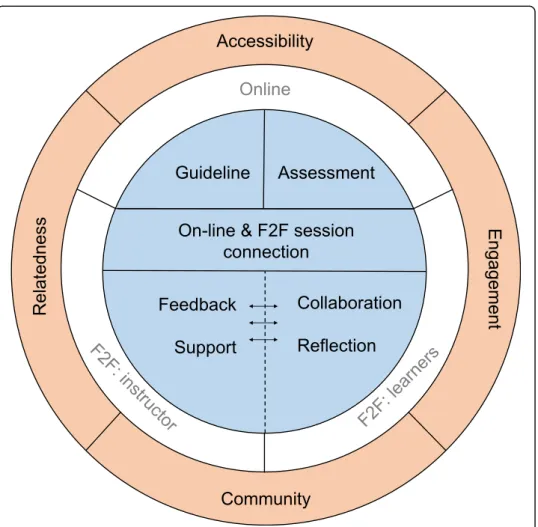
The design guidelines and suggestions are summarised into one framework named the Flipped Learning Wheel (FLW), as shown in Fig. 1. The Flipped Learning Wheel (FLW) presents the components involved in an effective flipped learning class, as well as principles that are important but rarely specified (collaboration, reflection, learning community, engagement, accessibility and relatedness).
The next section focuses on elaborating how to specify the in-class activities that are initi-ated by students. Namely, how to facilitate collaborative learning and how to lead students to take part in learning reflection (see Fig. 1). We introduce the jigsaw technique and process writing approach.
Jigsaw technique for enhanced collaboration
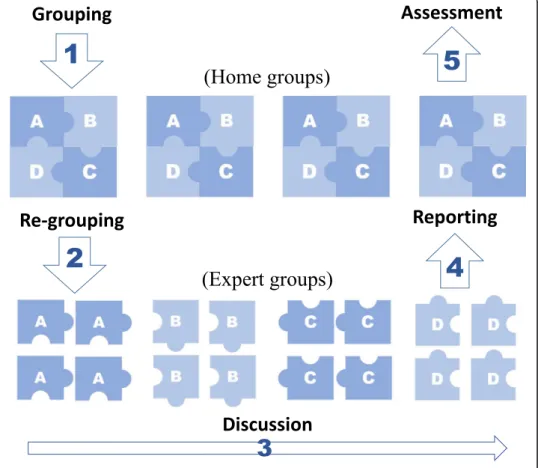
technique is one “pure” cooperative learning technique being based on“group dynamic and social interactions” (Şahin,2010, p. 778). There are two key concepts in the jigsaw techniques: home groupand expert group. In a class with jigsaw technique, as shown in Fig. 2, teacher divides students into small groups called home groups. Each member of the home group receives a different task (e.g. task A, task B, task C and task D). Then, stu-dents who are with the same learning task leave the home groups and join in an expert group (expert group for task A, task B and etc.). These two steps initiated by teachers are called Grouping and Re-grouping (see Fig.2). Each student is expected to discuss tasks in the expert group (Discussion), learn from peers, and then come back to their home groups to share what they have learnt (Reporting), followed by overall or individual assess-ments (Assessment). In the jigsaw technique, there are no fixed numbers of the two types of groups. The number of home groups depends on class size, and the number of expert groups depends on how many tasks a teacher assigns to students.
One thing that makes the jigsaw technique valuable is its empowerment on student participation. Learners in traditional classes can easily be invisible by being quiet or by refusing to volunteer, which is harder in jigsaw-learning classes (Aronson & Bridgeman,
1979). Instead, each member “has a unique and vital part of the information” like a piece in a “jigsaw puzzle” (Aronson & Bridgeman, 1979, p. 441). The learner’s task is essential for the final output, so each member is significant for the group (Qiao & Jin,
2010). The jigsaw technique, therefore, brings benefits such as facilitated knowledge construction, reduced anxiety, enhanced motivation, positive interdependence and im-proved accountability (Mattingly & VanSickle,1991; Qiao & Jin,2010; Sabbah,2016).
One challenge in implementing the jigsaw technique is to design proper tasks for stu-dents. In the original design, we planned to assign students with different roles (e.g. group leader, note-taker, facilitator, editor, etc.), as suggested by Sabbah (2016). The design provides diverse paths to group success, as students with low language proficiency are offered with roles that do not rely heavily on the language level (e.g. note-taker). However, participants in the current study criticized that the assignment of different roles is inconsiderate as to the workload and learning chances of each role. Therefore, we replaced the plan with assigning different students’ writing works. We believe that students in the expert group will learn from peers on how to give feedback even though with limited language capacity. Accordingly, we replaced the term ‘expert group’ with ‘task group’, as the word expert group indicates that members are more skilled than others, which does not apply to the revised plan. The detailed description is shown in Step 16 in Fig.3.
The process writing approach for enhanced reflection
To improve reflection in an L2 writing class, we introduce the process writing approach in the current process design. The process writing approach, also named
oriented instruction or process-oriented writing, is an approach containing a“ multiple-draft process”(Chen,2016, p. 366) including pre-writing, drafting, revising, editing and even publishing (Badger & White, 2000; Chen, 2016; Goldstein & Carr, 1996; Stahl, Pagnucco, & Suttles, 1996). Learners write more than one draft, so there could be mul-tiple rounds of revision. The mulmul-tiple-draft process increases the need for feedback and accordingly involves peer feedback during the process (Chen, 2016). The process writ-ing approach uses authentic writwrit-ing experiences. Learners in a process-oriented writwrit-ing class write for “real purposes and audiences” (Graham & Sandmel, 2011, p. 396) that has a high sense of relatedness with the writer.
Despite possible advantages, the process writing approach is not without criticisms. According to Nagin (2012), the process writing approach is not able to provide suffi-cient training on foundational skills such as handwriting, spelling, grammar, sentence structure, etc.. Therefore, the provided instruction cannot ensure the students, espe-cially those with low language proficiency, to experience satisfactory process (Graham & Harris, 1997; Graham & Sandmel, 2011). In the current study, we addressed this criticism by using the flipped-classroom approach to provide students with founda-tional skill training.
To be specific, the teaching process design in the current study designs online in-struction videos to help students understand what to consider before writing (pre-writ-ing), requires students to draft writing prior to the F2F session (drafting) and leads
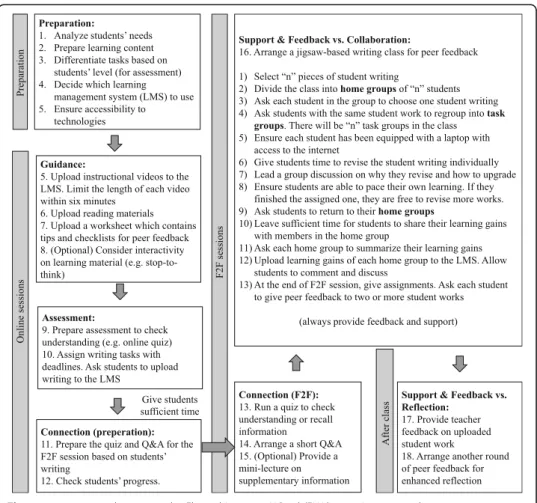
jigsaw-based peer feedback (revising). Most importantly, lectures could ask students to revise their works based on revisions or write an upgraded version of the same topic. After that, lectures could arrange another round of peer feedback to reinforce learning gains (editing). This study does not address publishing; however, students are free to upload their works online. The design based on process writing approach is simplified in the 18 steps in the FLW process description (see Fig.3).
Research findings
Prototype: the flipped learning wheel (FLW) teaching process design in L2 writing classes The previous sections introduced the FLW framework with its components and principles of a typical flipped learning class, followed by a theoretical discussion on how to make the L2 writing class collaborative and reflective (with the use of jigsaw technique and process writing approach). This section provides a detailed description of the whole process, in-cluding the preparation, online sessions, F2F sessions and the after-class activities.
Phase one: preparation In preparing for the class, the teacher needs to develop the overall course plan and material, as well as analyse students’needs. The accessibility of technology is also considered since the ease of use significantly influence the effective-ness of technology-enhanced learning (Davis,1989).
The analysis of students’ needs is important. Lungu (2013) proposed that a foreign language course should enable learners to function adequately in their specific situa-tions, hence the course designer should trace out the target situation, identify learners’ needs and determine their level of proficiency, and support students’needs before the class. Teachers could run a pilot test to gain a better understanding of students’ situ-ation via pre-survey or casual talk (Step 1). Then, teachers could start to prepare learn-ing materials. The materials could include instructional videos, online quizzes, readlearn-ing material, worksheet, quizzes in F2F sessions, Q&A content based on assignments and mini-lectures. At the material preparation stage, we suggest teachers consider designing a diverse level of tasks for assessments. To be specific, teachers could provide instruc-tional scaffolds by selecting materials that are slightly more difficult than students’ abil-ity (Krashen, 1982; Vygotsky, 1980), and then set advanced problems for students with high language proficiency and basic exercises for underperforming students (Lo & Hew,2017) (Step 1, 2 and 3).
After the learner analysis and material preparation, teachers could consider technol-ogy issues including which learning management system (LMS) to use (e.g. Moodle and TalentLMS), whether students can get access to the LMS and whether students will be equipped with devices in the F2F sessions (Step 4 and 5).
Phase two: online (out-of-class) sessions The online sessions contain three parts: guidance, assessments and perpetration for the connection of online and F2F activities.
2012; Lo & Hew,2017). We suggest keeping each video within 6 min in length, as Guo, Kim, and Rubin (2014) suggest that segmented videos within 6 min are ideal in en-gaging students. It is worth noticing that teachers are not necessarily needed to record the video themselves; instead, they can upload existing videos if there are no copyright concerns (Step 6). If the learning management system (LMS) allows, teachers could consider interactivity in the instructional videos, such as stop-think-answer, interactive graphs and optional synchronous Q&A (Lee et al.,2017, p. 433) (Step 8).
We suggest that teachers provide a worksheet for the peer feedback process that con-tains tips, assessment criteria and checklists. Peer feedback concon-tains potential problems such as too much focus on“surface concerns”(Leki,1990, p. 9), vague feedback, too sar-castic to be constructive and lack of training (Liu & Sadler,2003). Therefore, it is of great significance to provide students with specific scales for the rating (Cho & Schunn, 2007) which lays emphasis on writing styles and structures instead of grammar mistakes only. The worksheet serves as a facilitator during the F2F peer feedback process (Step 7).
In the section on Assessment, we suggest teachers prepare online quizzes to check students’understanding of the presented reading and instructional videos. Most LMSs score the quiz automatically and present the score immediately as the visualized out-puts. After that, teachers assign a writing task with deadlines, which is expected to be upload to the LMS by students (Step 9 and 10).
It worth noticing that during the online sessions, teachers are expected to prepare for the online-and-F2F connection. Teachers could review students’submitted writing and accordingly design the quiz and Q&A for F2F. Teachers could also check students’ pro-gress to have a better understanding of student online participation (Step 11 and 12).
Phase three: F2F sessions The design of F2F sessions is the key to a successful flipped learning class therefore it can be much more demanding (Lee et al., 2017; Lo et al.,
2018). The design of F2F sessions mainly focuses on connecting online and F2F activ-ities by providing quizzes, Q&A and mini lectures.
At the beginning of F2F sessions, teachers could prepare a quick multiple-choice quiz given at the beginning of the F2F session to help activate students’ prior knowledge and reduce learners’ potential anxiety (Lo & Hew, 2017). The quiz can be taken via classroom responses systems, to enable students to get immediate feedback on their performance (Talbert, 2013). Teachers could choose an audience response app that in-volves mobile phones or laptops, as there are a variety available. It is always possible that students attend the class without watching online videos or completing pre-class readings (Zhamanov & Sakhiyeva, 2015, p. 1). It is essential for lecturers to ensure that students are cognitively prepared for the F2F sessions. Therefore, teachers could pre-pare a short Q&A focusing on out-of-class assignments or a mini lecture on supple-mentary information (Step 13, 14 and 15).
work and join the task group in which every member is with the same piece of student writing work. After that, teacher tours around the class to ensure each student is equipped with a laptop with access to the internet. Google Docs is recommended here as a multi-user editing website, which could be replaced with websites with equivalent functions. Then, the teacher gives students sufficient time to revise their writing works individually and then discuss in the task group on why they revise and how to upgrade. At this stage, teachers should ensure students, especially the underperforming ones, are providing peer feedback based on the tips and checklist on the worksheet. During the discussion, mem-bers in each task group will behave differently, as they are with different language profi-ciencies and different characteristics. Therefore, teachers could encourage students to take different roles in the group discussion, such as leading underperforming students to take notes and asking introvert students to prepare for a summative speech. However, if teachers approach group work in this way, they should intentionally change students’ per-ception of their group roles (Sabbah,2016) to minimize stereotypes (e.g. S/he can only do a good job on summarizing discussions) or negative self-suggestion (e.g. I am not capable so I can only be a note-taker).
In terms of aligning the pace of learning to the class duration, teachers could ask students to review more than one student writing work. Students are also free to revise more works that are uploaded to the LMS if they finish the assigned one more quickly.
After the discussion in task groups, students return to their original group (home group) to share their learning gains. Since there are “n”pieces of student writing works and“n”students in each home group, each student will learn the peer feedback process of all the“n”pieces of writing works. Each group is expected to summarize their learn-ing gains and upload this to the LMS. At the end of the F2F sessions, teachers assign homework, such as asking each student to give peer feedback to two or more student writing works. While students are discussing in groups, teachers tour the whole class and offer suggestions or assistance when necessary.
Phase four: after class The F2F sessions are mainly about peer feedback, while after-class, teachers have more time to provide teacher feedback (Step 17). To enhance reflec-tion, as discussed around the topic process writing approach, we suggest teachers arrange another round of peer feedback based on the revised student writing works (Step 18). The importance of Step 17 and Step 18 have been confirmed by our participants.
The current process design is flexible to students’education level, class size and class duration. Since peer feedback is demanding on students’language proficiency, we sug-gest lecturers implement the current process design for students with intermediate or advanced language ability, no matter whether the students are in primary school, sec-ondary school or college. Teachers have the full freedom to re-shape the plan based on their class size and class duration.
Test: how teachers view the feasibility of the FLW process design
what the benefits and barriers are in implementing the FLW process and how to upgrade the FLW framework by conducting a survey and interviewing teachers.
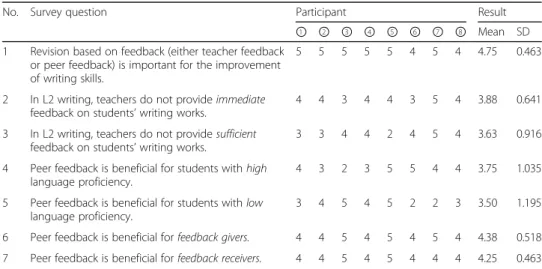
As shown in Table 3, even though the participants are reluctant to provide extreme answers, almost all of them answered“definitely yes”to the importance of feedback on the improvement of writing skills (six out of eight). This demonstrates that the inter-viewees strongly agree to the statement “revision based on feedback (either teacher feedback or peer feedback) is important for the improvement of writing skills”.
The following two questions are to investigate whether the participants think teachers provide quick or sufficient feedback on student writing works. As to the speed of teacher feedback in typical L2 writing classes, nobody views it as unbear-able as no one selected 1 (strongly disagree) or 2 (disagree) to the statement “In L2 writing, teachers do not provide immediate feedback on student writing works”. However, nobody thinks it is quick at all, as only one participant selected 5 (strongly agree). As to the amount of teacher feedback on student writing works, participants tend to believe what teachers are providing is sufficient.
According to the survey result, participants believe those who provide feedback “ feed-back givers”are the group which benefits most from peer feedback, followed by feedback receivers and students with high language proficiency, with the mean of survey answer are 4.38, 4.25 and 3.75 (out of 5). Students with low language proficiency are perceived as the group benefits least from peer review, with a mean of 3.50 for the survey answer.
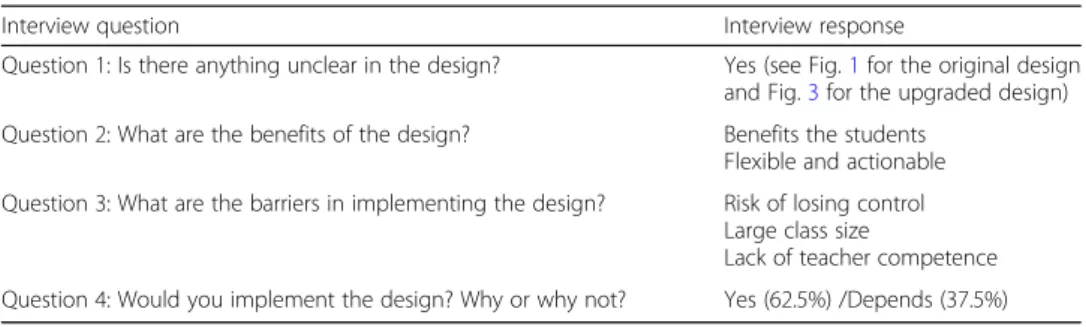
The four interview questions are mainly designed to improve the FLW framework (see Table 4). It is worth noticing that Fig. 3 and the corresponding descriptions are the results of interview question one (“Is there anything unclear in the design?”). As mentioned in the Methodology section, the process design dynamically changes as every participant gave abundant suggestions for revision. Since one main contribution of this study is to present an actionable teaching process design for practical use, we place the emphasis on presenting the final teaching process design rather than discuss-ing the process of upgraddiscuss-ing it.
When participants reached an agreement with the final teaching process design (see Fig. 3), we interviewed them to explore its benefits (see Table 4). As expected,
Table 3Survey results
No. Survey question Participant Result
① ② ③ ④ ⑤ ⑥ ⑦ ⑧ Mean SD
1 Revision based on feedback (either teacher feedback or peer feedback) is important for the improvement of writing skills.
5 5 5 5 5 4 5 4 4.75 0.463
2 In L2 writing, teachers do not provideimmediate
feedback on students’writing works.
4 4 3 4 4 3 5 4 3.88 0.641
3 In L2 writing, teachers do not providesufficient
feedback on students’writing works.
3 3 4 4 2 4 5 4 3.63 0.916
4 Peer feedback is beneficial for students withhigh
language proficiency.
4 3 2 3 5 5 4 4 3.75 1.035
5 Peer feedback is beneficial for students withlow
language proficiency.
3 4 5 4 5 2 2 3 3.50 1.195
6 Peer feedback is beneficial forfeedback givers. 4 4 5 4 5 4 5 4 4.38 0.518
7 Peer feedback is beneficial forfeedback receivers. 4 4 5 4 5 4 4 4 4.25 0.463
participants confirmed the teaching process design’s advantages in benefiting the stu-dents. They comment that the design helps make the learning engaging, explorative, collaborative, interactive and student-centred. Students might benefit exactly from the training of higher-order issues such as reflection, analysis and evaluation (compared with lower-order issues such as remembering and understanding). At the same time, students are provided with a chance to be more aware of their own needs and lacks, which therefore facilitates developing the sense of self-learning and self-regulated learn-ing. What’s more, three participants confirmed that “It will be a huge challenge at the first beginning; however, once the teachers and students got used to it, it significantly re-duces teachers’workload.”Participants also reached an agreement to the flexibility and actionability of the plan by commenting that “The plan could be both directly used in L2 writing classes and easily modified for varied conditions.”
Participants showed more concerns on the barriers in implementing the design. Their concerns are mainly on three issues: the risk of losing control, large class sizes and the lack of teacher competence.
First, the risk of losing control Since the FLW process design sets no limits to stu-dents’ age, we also interviewed a PhD candidate with primary-school teaching experi-ence. S/he asserts “if students are young, the design will be complicated for them and accordingly the classroom will be a mess”. S/he points out the key to keep young stu-dents in order is to provide easy-enough tasks while catching their attention with the use of educational facilitators (e.g. colours, cartoons, etc.). At the same time, the pre-pared worksheet should include fill-in-the-blank exercises to keep students engaged ra-ther than assessment criteria only. Anora-ther participant who has taught college students for years expressed the same concern for different reasons. S/he worries that the teachers are possible to spend more time on the quiz, Q&A and mini-lecture, or simply lose control of time on this part. If so, the time for peer feedback will be limited. S/he suggests providing teacher training on the priority of the flipped L2 writing class to avoid the aforementioned situation.
Second, large class sizes Class size is always an important concern in the implementa-tion of student-centred teaching approaches, as teachers are difficult to assist each stu-dent. Interviewees suggest that if the class size is larger than 30, there should be one more teacher to assist the class.
Table 4Interview responses summary
Interview question Interview response
Question 1: Is there anything unclear in the design? Yes (see Fig.1for the original design and Fig.3for the upgraded design) Question 2: What are the benefits of the design? Benefits the students
Flexible and actionable
Question 3: What are the barriers in implementing the design? Risk of losing control Large class size
Lack of teacher competence
Third, lack of teacher competence Teacher competence is always a challenge in implementing student-centred learning approaches, which are normally more demand-ing on teachers’overall abilities. García-Sánchez and Santos-Espino (2017) propose that in training a teacher to be competent as a flipped classroom teacher, one crucial aspect is to create“adequate video contents for the out-of-class stage”(p. 172). We do not be-lieve so. Instead, we hold the view that a qualified flipped classroom teacher is able to ensure the F2F sessions collaborative, reflective, and student-centred. At the same time, s/he is supposed to identify student needs and provide support or feedback in time.
When asked whether would like to implement the teaching process design, five par-ticipants (62.5%) are positive. They say “Yes, because it is beneficial for students” and “Yes, because it might cut down workload”. The remaining three participants (37.5%) reply“It depends”, as one comment that“My teaching environment does not fully sup-port the implementation of the plan. I would like to try it only when we get ready.”
To sum up, we completed an FLW teaching process design following the iterative design thinking process proposed by Plattner et al. (2009), which contains six steps: understand, observe, point of view, ideate, prototype and test. We understood and ob-served the existing problems in L2 writing classes, conducted a survey study and inter-views to investigate participants’ point of view, used the viewpoints and literature to help ideate and prototype the FLW teaching process design, and eventually tested the feasibility of the design in another round of survey’s and interviews. Participants con-firmed the need for peer feedback in L2 writing classes, supported the benefits of the FLW process design, and reported three main concerns in implementing the FLW process design. The interview responses help to upgrade the teaching process design, as shown in Fig. 3.
Conclusion
In this paper, we established a framework named the Flipped Learning Wheel (FLW) to demonstrate the components and principles of a typical flipped learning class. In the FLW framework, teachers provide guidance and assessments in out-of-class (online) settings, connect the out-of-class and in-class activities, and then provide feedback and support to students while students were engaged in collaborative and reflective learning activities. Throughout the whole process, lectures should ensure the accessibility of technology, the relatedness of materials, learner engagement in activities and the estab-lishment of the learning community. With regards to L2 writing, using the jigsaw tech-nique and process writing approach to enhance the collaboration and reflection in the in-class activities. The paper concludes with details of the implementation plan and feasibility of the FLW process design.
Appendix
Related frameworks
The nine design recommendation proposed by Kim et al. (2014), p. 43–46:
1) “Provide an opportunity for students to gain first exposure prior to class.” 2) “Provide an incentive for students to prepare for class.”
3) “Provide a mechanism to assess student understanding.”
4) “Provide clear connections between in-class and out-of-class activities.” 5) “Provide clearly defined and well-structured guidance.”
6) “Provide enough time for students to carry out the assignment.” 7) “Provide facilitation for building a learning community.”
8) “Provide prompt/adaptive feedback on individual or group works.” 9) “Provide technologies familiar and easy to access.”
The nine design principles proposed by Ansyari (2015), p. 701:
1) Actively involve learners in the programme. 2) Provide authentic learning experiences. 3) Promote collaboration among participants,
4) Provide guidance and support to participants when needed. 5) Have curriculum coherency with the programme.
6) Reflect on what have been done. 7) Give feedback on participants’works. 8) Provide intensive training.
9) Allocate sufficient time for students to practice.
The“First Principles of Instruction”proposed by Merrill (2002), p. 45–50:
1) Problem:“Learning is promoted when learners are engaged in solving real-world
problems.”
2) Activation:“Learning is promoted when existing knowledge is activated as a
foundation for new knowledge.”
3) Demonstration:“Learning is promoted when new knowledge is demonstrated to
the learner.”
4) Application:“Learning is promoted when new knowledge is applied by the learner.”
5) Integration:“Learning is promoted when new knowledge is integrated into the
learner’s world.”
Abbreviations
FLW:Flipped learning wheel; F2F: Face-to-face; L2: Second language
Acknowledgements Not applicable.
Authors’contributions
Zhanni Luo designed the study, conducted the data collection and drafted the manuscript. Billy O’Steen and Cheryl Brown provided supervisions on the manuscript revision. The authors read and approved the final revised manuscript.
Availability of data and materials
The datasets generated and/or analysed during the current study are not publicly available due to the ethics principles but are available from the corresponding author on reasonable request.
Competing interests
The authors declare that they have no competing interests.
Received: 5 October 2019 Accepted: 21 March 2020
References
Altıner, C. (2015). Perceptions of undergraduate students about synchronous video conference-based English courses.
Procedia-Social and Behavioral Sciences, 199, 627–633.https://doi.org/10.1016/j.sbspro.2015.07.589.
Anderson, L. W., & Krathwohl, D. (2001). A taxonomy for learning, teaching, and assessing. Abridged Edition.
Ansyari, M. F. (2015). Designing and evaluating a professional development programme for basic technology integration in English as a foreign language (EFL) classrooms.Australasian Journal of Educational Technology, 31(6).https://doi.org/10. 14742/ajet.1675.
Aronson, E. (1978).The jigsaw classroom. Sage Publications.
Aronson, E., & Bridgeman, D. (1979). Jigsaw groups and the desegregated classroom: In pursuit of common goals.Personality
and Social Psychology Bulletin, 5(4), 438–446.https://doi.org/10.1177/014616727900500405.
Badger, R., & White, G. (2000). A process genre approach to teaching writing.ELT Journal, 54(2), 153–160.https://doi.org/10. 1093/elt/54.2.153.
Bektashi, L. (2018). Community of Inquiry Framework in online learning: Use of technology. InTechnology and the Curriculum:
Summer 2018.
Berggren, J. (2014). Learning from giving feedback: A study of secondary-level students.ELT Journal, 69(1), 58–70.https://doi. org/10.1093/elt/ccu036.
Bergmann, J., & Sams, A. (2012). Flip your classroom: Reach every student in every class every day. InInternational society for
technology in education.
Bower, M., Dalgarno, B., Kennedy, G. E., Lee, M. J., & Kenney, J. (2015). Design and implementation factors in blended synchronous learning environments: Outcomes from a cross-case analysis.Computers & Education, 86, 1–17.https://doi. org/10.1016/j.compedu.2015.03.006.
Brame, C. (2013). Flipping the classroom. Retrieved 15 Nov, 2019, fromhttps://cft.vanderbilt.edu//cft/guides-sub-pages/ flipping-the-classroom/
Chen, C. W.-y. (2010). Graduate students’self-reported perspectives regarding peer feedback and feedback from writing consultants.Asia Pacific Education Review, 11(2), 151–158.https://doi.org/10.1007/s12564-010-9081-5.
Chen, T. (2016). Technology-supported peer feedback in ESL/EFL writing classes: A research synthesis.Computer Assisted
Language Learning, 29(2), 365–397.https://doi.org/10.1080/09588221.2014.960942.
Cho, K., & Schunn, C. D. (2007). Scaffolded writing and rewriting in the discipline: A web-based reciprocal peer review system.
Computers & Education, 48(3), 409–426.https://doi.org/10.1016/j.compedu.2005.02.004.
Davis, F. D. (1989). Perceived usefulness, perceived ease of use, and user acceptance of information technology.MIS Quarterly, 319–340.https://doi.org/10.2307/249008.
Diab, N. M. (2010). Effects of peer-versus self-editing on students’revision of language errors in revised drafts.System, 38(1), 85–95.https://doi.org/10.1016/j.system.2009.12.008.
Doering, A., Veletsianos, G., Scharber, C., & Miller, C. (2009). Using the technological, pedagogical, and content knowledge framework to design online learning environments and professional development.Journal of Educational Computing
Research, 41(3), 319–346.https://doi.org/10.2190/EC.41.3.d.
Educause. (2012). Things you should know about flipped classrooms. Retrieved 20 May, 2019, fromhttps://www.rit.edu/ academicaffairs/tls/sites/rit.edu.academicaffairs.tls/files/directory/ELI7081-1.pdf
Ekşi, G. Y. (2012). Peer review versus teacher feedback in process writing: How effective.International Journal of Applied
Educational Studies, 13(1), 33–48.
García-Sánchez, S., & Santos-Espino, J. M. (2017). Empowering pre-service teachers to produce ubiquitous flipped classes.Profile Issues in TeachersProfessional Development, 19(1), 169–185.https://doi.org/10.15446/profile.v19n1. 53857.
Garrison, D. R., Anderson, T., & Archer, W. (1999). Critical inquiry in a text-based environment: Computer conferencing in higher education.The Internet and Higher Education, 2(2–3), 87–105.
https://doi.org/10.1016/S1096-7516(00)00016-6.
Goldstein, A. A., & Carr, P. G. (1996). Can students benefit from process writing?NAEPfacts, 1(3), n3.https://doi.org/10.1037/ e314642005-001.
Graham, S., & Harris, K. R. (1997). Whole language and process writing: Does one approach fit all. InIssues in educating
students with disabilities(pp. 239–258).
Graham, S., & Sandmel, K. (2011). The process writing approach: A meta-analysis.The Journal of Educational Research, 104(6), 396–407.https://doi.org/10.1080/00220671.2010.488703.
Guasch, T., Espasa, A., Alvarez, I. M., & Kirschner, P. A. (2013). Effects of feedback on collaborative writing in an online learning environment.Distance Education, 34(3), 324–338.https://doi.org/10.1080/01587919.2013.835772.
Guo, P. J., Kim, J., & Rubin, R. (2014).How video production affects student engagement: An empirical study of MOOC videos. Paper presented at the Proceedings of the first ACM conference on Learning@ scale conference.https://doi.org/10.1145/ 2556325.2566239.
Huang, B., Hew, K. F., & Lo, C. K. (2019). Investigating the effects of gamification-enhanced flipped learning on undergraduate students’behavioral and cognitive engagement.Interactive Learning Environments, 27(8), 1106–1126.https://doi.org/10. 1080/10494820.2018.1495653.
Hung, H. T. (2017). Design-based research: Redesign of an English language course using a flipped classroom approach.
TESOL Quarterly, 51(1), 180–192.https://doi.org/10.1002/tesq.328.
Kim, M., Jung, E., de Siqueira, A., & Huber, L. (2016). An investigation into effective pedagogies in a flipped classroom: A case study.Journal of Distance Education (Online), 31(2), 1.
Kim, M. K., Kim, S. M., Khera, O., & Getman, J. (2014). The experience of three flipped classrooms in an urban university: An exploration of design principles.The Internet and Higher Education, 22, 37–50.https://doi.org/10. 1016/j.iheduc.2014.04.003.
Krashen, S. (1982).Principles and practice in second language acquisition.https://doi.org/10.1111/j.1467-971X.1982. tb00476.x.
Lameras, P., & Moumoutzis, N. (2015). Towards the gamification of inquiry-based flipped teaching of mathematics a conceptual analysis and framework. InPaper presented at the 2015 international conference on interactive Mobile
communication technologies and learning (IMCL).https://doi.org/10.1109/IMCTL.2015.7359616.
Law, S., & Baer, A. (2017). Using technology and structured peer reviews to enhance students’writing.Active Learning in
Higher Education, 21(1), 23–38.https://doi.org/10.1177/1469787417740994.
Lee, J., Lim, C., & Kim, H. (2017). Development of an instructional design model for flipped learning in higher education.
Educational Technology Research and Development, 65(2), 427–453.https://doi.org/10.1007/s11423-016-9502-1.
Leki, I. (1990). Coaching from the margins: Issues in written response. InSecond language writing: Research insights for the
classroom(pp. 57–68).https://doi.org/10.1017/CBO9781139524551.008.
Liu, J., & Sadler, R. W. (2003). The effect and affect of peer review in electronic versus traditional modes on L2 writing.Journal
of English for Academic Purposes, 2(3), 193–227.https://doi.org/10.1016/S1475-1585(03)00025-0.
Liu, Q., & Brown, D. (2015). Methodological synthesis of research on the effectiveness of corrective feedback in L2 writing.
Journal of Second Language Writing, 30, 66–81.https://doi.org/10.1016/j.jslw.2015.08.011.
Lo, C. K., & Hew, K. F. (2017).Using“First Principles of Instruction”to Design Mathematics Flipped Classroom for Underperforming
Students.https://doi.org/10.18178/ijlt.3.2.82-89.
Lo, C. K., Lie, C. W., & Hew, K. F. (2018). Applying“first principles of instruction”as a design theory of the flipped classroom: Findings from a collective study of four secondary school subjects.Computers & Education, 118, 150–165.https://doi.org/ 10.1016/j.compedu.2017.12.003.
Lungu, I. (2013). Designing an English course for adult non-philological students in long-life learning education.
Procedia-Social and Behavioral Sciences, 76, 456–459.https://doi.org/10.1016/j.sbspro.2013.04.145.
Luo, C., Hew, T. K., Lei, C.-U., & Oh, E. (2017).Principle-guided flipped classroom implementation framework for teaching
technological contents. Paper presented at the 2017 IEEE 6th international conference on teaching, assessment, and
learning for engineering (TALE).https://doi.org/10.1109/TALE.2017.8252377.
Mattingly, R. M., & VanSickle, R. L. (1991).Cooperative learning and achievement in social studies: Jigsaw II.
Merrill, M. D. (2002). First principles of instruction.Educational Technology Research and Development, 50(3), 43–59.https://doi. org/10.1007/BF02505024.
Nagin, C. (2012).Because writing matters: Improving student writing in our schools. John Wiley & Sons.
Nielsen, J., & Molich, R. (1990).Heuristic evaluation of user interfaces. Paper presented at the Proceedings of the SIGCHI conference on Human factors in computing systems.https://doi.org/10.1145/97243.97281.
Nobles, S., & Paganucci, L. (2015). Do digital writing tools deliver? Student perceptions of writing quality using digital tools and online writing environments.Computers and Composition, 38, 16–31.https://doi.org/10.1016/j.compcom. 2015.09.001.
Plattner, H., Meinel, C., & Weinberg, U. (2009).Design-thinking: Understand–Improve–Apply. Springer.
Qiao, M., & Jin, X. (2010). Jigsaw strategy as a cooperative learning technique: Focusing on the language learners.Chinese
Journal of Applied Linguistics (Foreign Language Teaching & Research Press), 33(4).http://www.celea.org.cn/teic/92/101206
08.pdf.
Rouhi, A., & Azizian, E. (2013). Peer review: Is giving corrective feedback better than receiving it in L2 writing?Procedia-Social
and Behavioral Sciences, 93, 1349–1354.https://doi.org/10.1016/j.sbspro.2013.10.042.
Sabbah, S. (2016). The effect of jigsaw strategy on esl students’reading achievement.Arab World English Journal (AWEJ)
Volume, 7.https://doi.org/10.24093/awej/vol7no1.27.
Şahin, A. (2010). Effects of jigsaw II technique on academic achievement and attitudes to written expression course.
Educational Research Review, 5(12), 777–787.https://doi.org/10.1007/s12564-010-9135-8.
Shea, P., & Bidjerano, T. (2010). Learning presence: Towards a theory of self-efficacy, self-regulation, and the development of a communities of inquiry in online and blended learning environments.Computers & Education, 55(4), 1721–1731.https:// doi.org/10.1016/j.compedu.2010.07.017.
Shea, P., Hayes, S., Uzuner-Smith, S., Gozza-Cohen, M., Vickers, J., & Bidjerano, T. (2014). Reconceptualizing the community of inquiry framework: An exploratory analysis.The Internet and Higher Education, 23, 9–17.https://doi.org/10.1016/j.iheduc. 2014.05.002.
Stahl, S. A., Pagnucco, J. R., & Suttles, C. W. (1996). First graders' reading and writing instruction in traditional and process-oriented classes.The Journal of Educational Research, 89(3), 131–144.https://doi.org/10.1080/00220671.1996.9941319. Swan, K., Matthews, D., Bogle, L., Boles, E., & Day, S. (2012). Linking online course design and implementation to learning
outcomes: A design experiment.The Internet and Higher Education, 15(2), 81–88.https://doi.org/10.1016/j.iheduc.2011.07. 002.
Tai, H.-C., Pan, M.-Y., & Lee, B.-O. (2015). Applying technological pedagogical and content knowledge (TPACK) model to develop an online English writing course for nursing students.Nurse Education Today, 35(6), 782–788.https://doi.org/10. 1016/j.nedt.2015.02.016.
Talbert, R. (2013). Learning MATLAB in the inverted classroom.The ASEE Computers in Education (CoED) Journal, 4(2), 89. Topping, K. (1998). Peer assessment between students in colleges and universities.Review of Educational Research, 68(3), 249–
Vygotsky, L. S. (1980).Mind in society: The development of higher psychological processes. Harvard university press.
Wingate, U., Andon, N., & Cogo, A. (2011). Embedding academic writing instruction into subject teaching: A case study.Active
Learning in Higher Education, 12(1), 69–81.https://doi.org/10.1177/1469787410387814.
Yu, S., & Lee, I. (2016). Peer feedback in second language writing (2005–2014).Language Teaching, 49(4), 461–493.https://doi. org/10.1017/S0261444816000161.
Zhamanov, A., & Sakhiyeva, Z. (2015).Implementing flipped classroom and gamification teaching methods into computer
networks subject, by using cisco networking academy. Paper presented at the 2015 twelve international conference on
electronics computer and computation (ICECCO).https://doi.org/10.1109/ICECCO.2015.7416890.
Publisher’s Note