Available online throug
ISSN 2229 – 5046
FINITE ELEMENT ANALYSIS OF DOUBLE-DIFFUSIVE HEAT TRANSFER FLOW
IN RECTANGULAR DUCT WITH THERMO-DIFFUSION AND RADIATION EFFECTS
UNDER INCLINED MAGNETIC FIELD
B. UMA DEVI*
1, Dr. R. BHUVANA VIJAYA
21
Department of Mathematics, SBIT Khammam, Telangana, India.
2
Department of Mathematics, JNTUA, Anantapuramu, (A.P.), India.
(Received On: 10-02-16; Revised & Accepted On: 13-04-16)
ABSTRACT
A
n investigation has been carried out to find the influence of the thermal radiation and thermo-diffusion on convective heat and mass transfer flow of a viscous chemically reacting and electrically fluid through a porous medium in a rectangular duct under inclined magnetic field. By using Galerkin finite element method the equations governing the flow, heat and mass transfer have been solved with three nodded triangular elements. The effects of various parameters like soret parameter Sr, chemical reaction parameter γ, radiation parameter N1, Eckert number Ec and inclination of the magnetic field the temperatureα1, concentration C, the rate of heat and mass transfer have been depicted. It is noticed that the actual temperature and concentration reduces at the vertical levels x=1/3, 2/3 and at horizontal level y=2h/3, while reduces at the horizontal level y=h/3 with increase in radiation parameter N1Keywords: Chemical reaction, Dissipation, Inclined magnetic field, Radiation effect, Rectangular Duct, Soret effect.
NOMENCLATURE
H0 Applied Magnetic Field
C Concentration of the Solute C0 Reference Concentration
Ch Concentration of the solute at hot wall
Cc Concentration of the Solute at Cold Wall
Cp Specific heat at constant pressure [J/kg K]
Cw Concentration of the solute at the plate
Dm Molecular diffusivity
Ec
Eckert Number
∆
=
T
kk
a
f
µ
4
G
Grashof number(
(
)
)
2 3
v
a
T
T
g
h−
c=
β
k Permeability of porous medium[m2]
k
f Thermal conductivity of the fluid [W/m K] Br Mean absorption coefficient2
M
Magnetic Field Parameter2 2 2 2
ν
σµ
eH
oL
=
N
Buoyancy ratio)
(
)
(
c h
c h
T
T
C
C
−
−
=
∗β
β
Nu Nusselt Number
P Prandtl Number =µCp / Kf
Corresponding Author: B. Uma Devi*
1with Thermo-Diffusion and Radiation Effects under Inclined Magnetic Field / IJMA- 7(4), April-2016.
© 2016, IJMA. All Rights Reserved 72
Q Additional heat source qr Radiative heat flux
r′ Chemical reaction constant
Sc
Scmidt parameterD
ν
=
Sh herwood Number
Ra
Rayleigh Number(
)
2
ν
β
g
T
g−
T
cka
=
Sr
Soret parameterνβ
β
•=
k
11H Step function
1
N
Radiation parameterf R
e
k
T
β
σ
3
4
• 3=
T Temperature of the fluid in the boundary [oC] Th Temperature of the field at the hot wall [oC]
Tc Temperature of the field at the cold wall[oC]
Tw Wall temperature [oC]
(u,v) Velocity components[ms-1] (x,y) Cartesian coordinates[m]
GREEK SYMBOLS
γ Chemical reaction parameter
β0 Coefficient of thermal expansion [K-1]
β* Coefficient of concentration expansion
µ viscosity of the fluid [kg m-1 s-1]
υ Kinematic Viscosity [m2s-1]
µe Magnetic permeability
σ* Stefan – Boltzman constant parameter
ρ Density of the fluid [kgm-3]
φ Non dimensional concentration
θ Non dimensional temperature
α Heat Source parameter =Qaz/kf
α1 Angle of inclination
Ψ Stream function [m2s-1]
1. INTRODUCTION
Natural convection is of great importance in many applications of industries. Convection plays an authoritative role in crystal growth in which it affects the composition of fluid-phase and temperature at the phase interface whose consequence results in a single crystal since poor crystal quality is due to turbulence. It is the base in modern electronics industry to produce pure and perfect crystals that are used to make lasers rods, transistors, infrared detectors, microwave devices, memory devices, and IC’s (integrated circuits). Natural convection harmfully affects local growth conditions and increases the overall transport rate.
studies with thermo-solutal convection in rectangular ducts were discussed by Lee et al. [6]. Lee and Hyun [7] delineated numerical solutions for transient double-diffusive convection in a rectangular duct with buoyancy forces agrees with the experimental results. Other related numerical studies marketing with double-diffusive natural convection in cavities were considered by Ranganathan and Viskanta [8], Trevisan and Bejan [9, 10], Beghein et al.
[11] and Nishimura et al. [12].
Electrically conducting fluids under the influence of a magnetic field have been broadly studied in many applications such as crystal growth. Oreper and Szekely [13] have found that the presence of a magnetic field can overcome natural convection currents and that the factors in deciding the quality of the crystal. Ozone and Maruo [14] have inspected magnetic and gravitational natural convection of melted silicon-two dimensional numerical estimations needed for the rate of heat transfer. Garandet et al. [15] and Alchaar et al. [16] have treated free convection MHD heat transfer in a rectangular duct. Rudraiah et al. [17] and Al-Najem et al. [18] have discussed the influences of a magnetic field on free convection in a rectangular fold. Mamun et al. [19] have inspected natural convection in a porous trapezoidal fold with magneto hydrodynamic effect. The dominating equations are solved by using Galerkin weighted residual method of finite element formulation. It is found that with developing Ha, the diffusive heat transfer become important even though the changed Rayleigh number increases. Rahaman et al. [20] have carried out the conjugate influence of joule heating and magneto hydrodynamic on double diffusive mixed convection in a horizontal channel with an open cavity. Homogenous flows are lay down all through the channel. The temperature, concentration, average nusselt and Sherwood number have been inspected for different values of Hartmann number, Lewis number, Joule heating, Buoyancy ratio and Richardson number. Rahman et al. [21] have inspected double diffusive natural convection in a triangular shaped solar collector. Considering the isothermal and iso-concentration boundary conditions of absorber and covers of collectors, the two dimensional equations have been solved by finite element method. The effect of buoyancy ratio and thermal Rayleigh number on local and mean heat and mass transfer rates has been examined. Ching et al. [22] have carried out numerical investigation on mixed convective heat and mass transfer in a right triangular duct. The effect of Richardson number, buoyancy ratio and the direction of the sliding wall motion on the flow, temperature, rate of heat and mass transfer has been examined. It strengthens with rise in the buoyancy ratio. The flow and temperature can be controlled by the direction of the sliding wall motion. Rahman et al. [23] have examined natural convection influences on heat and mass transfer in a bending triangular cavity using jagged shaped bottom wall by using finite element method. As Br increases, the average Nusselt number and Sherwood Number also strengthens. With increase in Le, Sherwood number strengthens and an average Nusselt number reduces. Oztop et al. [24] have studied the thermal and dynamical behavior of fluid in fold with two isothermal semi-circular heaters. The top wall and the flat surfaces of the bottom wall are adiabatic along the vertical walls that are kept at lower temperature than that with the semicircular heaters. The corresponding equations are solved by the Galerkin weighted residual finite element method. The difference between the semi-circular heaters has an effect over the heat and fluid flow fields. Hartmann number has a very bad effect on heat transfer.
Natural convection heat transfer that is induced by internal heat generation has recently received substantial attention because of various applications. Such applications even include underground disposal of radioactive waste materials, heat removal from nuclear fuel debris, exothermic chemical reactions in packed-bed reactor and storage of foodstuff (see, for instance, [25]-[29]). Acharya and Goldstein [30] studied numerically two-dimensional natural convection of air in an externally heated vertical or inclined square box with uniformly distributed internal energy sources. The results of the above showed two distinct flow pattern systems confiding on the ratio of the internal to the external Raleigh numbers. The average heat flux ratio along the cold wall increased with decreasing internal Rayleigh numbers and increasing external Rayleigh numbers. Latterly, Churbanov et al. [31] studied numerically unsteady natural convection of a heat generating fluid in a vertical rectangular fold with the walls being isothermal or adiabatic. The governing non-linear equations are solved using finite-difference scheme in the two-dimensional stream function with velocity formulation. Other related works regarding temperature-dependent heat generation influences can be found in the papers by Vajravelu and Nayfeh [32] and Chamkha [33].
A lot of useful work has been carried out to know about natural convection in porous cavity. In spite of these studies heat transfer in porous cavity, the combined influence of viscous dissipation and radiation on porous medium filled inside a square cavity has not gained proper interest. The convective heat transfer through a porous medium in a rectangular cavity with heat sources and dissipation under diverse conditions have been carried out by several researchers [34-37]. Ranga Reddy [38] has conferred when the side walls of the rectangular cavity are differentially heated using Brinkman model, natural convective heat and mass transfer flow equations are solved with the help of Galerkin finite element method. The effect of thermo-diffusion on convective heat transfer flow of a viscous fluid through a porous medium with buoyancy forces in rectangular duct has been studied by Sivaiah [39].
with Thermo-Diffusion and Radiation Effects under Inclined Magnetic Field / IJMA- 7(4), April-2016.
© 2016, IJMA. All Rights Reserved 74 2. MATHEMATICAL FORMULATION
Fig. 1: Rectangular Duct.
Fig. 2: Physical Configuration and Co-ordinate system.
We consider the mixed convective heat and mass transfer flow of a viscous incompressible fluid in a saturated porous medium confined in the rectangular duct (Fig.2) whose base length is a and height b. The base and top walls of the duct are maintained at constant heat flux. By choosing the Cartesian coordinate system O (x, y) as origin on the base of the duct and is parallel to x-axis.
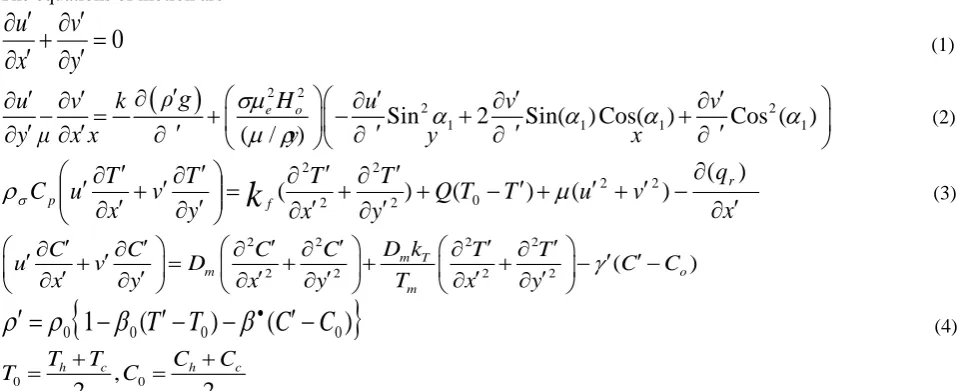
The equations of motion are
0
=
′
∂
′
∂
+
′
∂
′
∂
y
v
x
u
(1)
( )
2 22 2
1 1 1 1
Sin
2
Sin(
) Cos(
)
Cos (
)
( / )
e oρ g
H
u
v
k
u
v
v
y
μ
x
x
y
y
x
σµ
α
α
α
α
µ ρ
′
∂
′
′
′
′
′
∂
∂
∂
∂
∂
−
=
+
−
+
+
′
′
′
′
′
′
∂
∂
∂
∂
∂
∂
(2)x
q
v
u
T
T
Q
y
T
x
T
y
T
v
x
T
u
C
pk
f r′
∂
∂
−
′
+
′
+
′
−
+
′
∂
′
∂
+
′
∂
′
∂
=
′
∂
′
∂
′
+
′
∂
′
∂
′
(
2)
(
0)
(
2 2)
(
)
2 2 2
µ
ρ
σ (3)2 2 2 2
2 2 2 2
(
)
m T
m o
m
D k
C
C
C
C
T
T
u
v
D
C
C
x
y
x
y
T
x
y
γ
′
′
′
′
′
′
′
∂
+
′
∂
=
∂
+
∂
+
∂
+
∂
−
′ ′
−
∂
′
∂
′
∂
′
∂
′
∂
′
∂
′
{
1
0(
0)
(
0)
}
0
−
T
′
−
T
−
C
′
−
C
=
′
ρ
β
β
•ρ
(4)0
,
02
2
h c h c
T
T
C
C
T
=
+
C
=
+
Where u′ and v′ are Darcy velocities along θ(x, y) direction. T′, C′, p′, ρ′, and g′ are the temperature, concentration, pressure, density and acceleration due to gravity. Ho is the magnetic field strength.
(1,h)
(2/3, 2h/3)
(1,2h/3)
(1/3,h/3)
(1,h/3)
The boundary conditions are (fig. 2)
u′ = v′ = 0 on the boundary of the duct T′ = Tc, C′=Cc on the side wall to the left
T′ = Th, C′=Ch on the side wall to the right (5)
0
=
′
∂
′
∂
y
T
,
=
0
′
∂
′
∂
y
C
on the top (y = 0) and bottom
u′ = v′ = 0 walls (y = 0) which are insulated.
Following Rosseland approximation for radiation
qr =
y
T
R∂
′
∂
∗ 43
4
β
σ
Expanding
T
′
4 in Taylor’s series about Te and neglecting higher order terms4 3
4
3
4
T
eT
T
eT
′
≅
−
On introducing the dimensionless variables x′ = ax; y′ = by; c = b/a
u′ = (ν/a) u; v′ = (ν/a)v; p′ = (ν2ρ/a2)p
T′ = Tc + θ (Th – Tc); C′ = Cc + φ (Th – Tc) (6)
The equations in the dimensionless form are
2 2 2
1 1 1 1
Sin
2
Sin(
) Cos(
)
Cos (
)
u
v
u
v
v
Ra
N
M
y
x
x
x
y
y
x
θ
ϕ
α
α
α
α
∂
−
∂
=
∂
+
∂
+
−
∂
+
∂
+
∂
∂
∂
∂
∂
∂
∂
∂
(7)2 2
2 2 1
2 2
4
1
(
)
3
N
P u
v
u
v
x
y
x
y
θ
θ
θ
θ
αθ µ
∂
+
∂
= +
∂
+
∂
−
+
+
∂
∂
∂
∂
(8)γφ
θ
θ
φ
φ
φ
φ
−
∂
∂
+
∂
∂
+
∂
∂
+
∂
∂
=
∂
∂
+
∂
∂
2 2 2 2 2 2 2 2y
x
N
ScSr
y
x
y
v
x
u
Sc
(9)Following (1) we introduce the stream function ψ as
;
u
v
y
x
ψ
ψ
∂
∂
=
= −
∂
∂
(10)Using (10) the equations (7-9) reduces to
2 2 2 2 2
2 2 2
1 1 1 1
2 2
Ra
N
M
2Sin
2
Sin(
) Cos(
)
2Cos (
)
x
y
x
x
y
x y
x
ψ
ψ
θ
ϕ
ψ
α
ψ
α
α
ψ
α
∂
+
∂
= −
∂
+
∂
+
∂
+
∂
+
∂
∂
∂
∂
∂
∂
∂ ∂
∂
(11)2 2 2 2 1 2 2
4
1
3
N
P
y
x
x
y
x
y
x
y
ψ
θ
ψ
θ
θ
θ
αθ µ
ψ
ψ
∂
∂
−
∂
∂
=
+
∂
+
∂
−
+
∂
+
∂
∂
∂
∂
∂
∂
∂
∂
∂
(12)
∂
∂
+
∂
∂
+
∂
∂
+
∂
∂
=
∂
∂
∂
∂
−
∂
∂
∂
∂
2 2 2 2 2 2 2 2y
x
N
ScSr
y
x
y
x
x
y
Sc
ψ
φ
ψ
φ
φ
φ
θ
θ
(13)where 2 3
)
(
v
a
T
T
g
G
=
β
h−
c(Grashof number), P = µ Cp / kf (Prandtl number)
α = Qaz/kf (Heat source parameter),
(
)
2
ν
β
g
T
T
ka
Ra
=
g−
c (Rayleigh Number)f R e
k
T
N
β
σ
3
4
3 1 •=
(Radiation parameter),m
D
with Thermo-Diffusion and Radiation Effects under Inclined Magnetic Field / IJMA- 7(4), April-2016.
© 2016, IJMA. All Rights Reserved 76
νβ
β
•=
k
11Sr
(Soret parameter),)
(
)
(
c h c hT
T
C
C
N
−
−
=
∗β
β
(Buoyancy ratio) 2 2 2 2 2ν
σµ
H
L
M
=
e o(Magnetic parameter),
∆
=
T
kk
a
Ec
fµ
4 (Eckert number)The boundary conditions are
1
&
0
0
,
0
=
=
∂
∂
=
∂
∂
x
on
y
x
ψ
ψ
(14)0
0
0
=
=
=
φ
on
x
θ
1
1
1
=
=
=
φ
on
x
θ
(15)3. METHOD OF SOLUTION
3.1 Finite Element Method:
In this method, the domain is partitioned into a finite number of three node triangular elements (fig. 1). The element equations are derived using finite element method. The corresponding variation formulation results in a 3 x 3 matrix equations. The stiffness matrices in terms of unknown local nodal values of each element are put together in terms of global nodal values making use of inter element continuity conditions giving rise to global matrix equation.
In each case there are r distinct global nodes in the finite element domain and fp (p = 1, 2,…r) is the global nodal values
of any unknown f defined over the domain then
∑
∑
= =Φ
=
r p p if
f
1 i p 8 1,
where the first summation denotes summation over s elements and the second one represents summation over the independent global nodes and
,
i N i
p
=
N
Φ
if p is one of the local nodes say k of the element ei= 0, otherwise.
fp’ s are determined from the global matrix equation. Applying finite element analysis to the equations (11) – (13)
subjected to the conditions (14) – (15).
Assuming ψi , θi and φi to be the approximate values of ψ ,θ and φ in an element θi.
1 1 2 2 3 3
i i i i i i i
N
N
N
ψ
=
ψ
+
ψ
+
ψ
(16)1 1 2 2 3 3
i i i i i i i
N
N
N
θ
=
θ
+
θ
+
θ
(17)1 1 2 2 3 3
i i i i i i i
N
N
N
φ
=
ι
+
φ
+
φ
(18)On substituting (16) – (18) in (12) – (13), the corresponding errors are
2 2
2 2
1 2 2
1
4
1
3
i i i i i i i i
i
E
p
Ec
N
x
y
y
x
x
y
x
y
θ
θ
ψ θ
ψ θ
αθ
ψ
ψ
∂
∂
∂
∂
∂
∂
∂
∂
= +
+
−
+
−
+
+
∂
∂
∂
∂
∂
∂
∂
∂
(19)2 2 2 2
2 2 2 2 2
i i i i i i i i
i
ScSr
E
Sc
x
y
y
x
x
y
N
x
y
θ
θ
ψ θ
ψ θ
θ
θ
γφ
∂
∂
∂
∂
∂
∂
∂
∂
=
+
−
+
+
+
−
∂
∂
∂
∂
∂
∂
∂
∂
(20)By making these errors orthogonal to shape functions we get
1
0,
20,
i i
i i i i
k k
e e
E N d
Ω =
E N d
Ω =
∫
∫
2 2 2 2 2 2 14
1
0
3
ii i i i i i i i
i k e
N
p
Ec
d
N
x
y
y
x
x
y
x
y
θ
θ
ψ θ
ψ θ
αθ
ψ
ψ
+
∂
+
∂
−
∂
∂
+
∂
∂
−
+
∂
+
∂
Ω =
∂
∂
∂
∂
∂
∂
∂
∂
2 2 2 2
2 2 2 2
0
i
i i i i i i i i
e
ScSr
Sc
d
x
y
y
x
x
y
N
x
y
θ
θ
ψ θ
ψ θ
θ
θ
γφ
∂
∂
∂
∂
∂
∂
∂
∂
+
−
+
+
−
Ω =
∂
∂
∂
∂
∂
∂
∂
∂
∫
(22)Applying Green’s theorem to (21) & (22) without affecting ψ terms and obtain
2 2 1
4
1
3
ii i i i i i i i i i
i k k i
k k
e
N
N
N
PN
Ec
d
N
x
x
y
y
y
x
x
y
x
y
θ
θ
ψ θ
ψ θ
αθ
ψ
ψ
∂
∂
∂
∂
∂
∂
∂
∂
∂
∂
+
+
−
+
−
+
+
Ω
∂
∂
∂
∂
∂
∂
∂
∂
∂
∂
∫
ii i i i
i
k x y i
N
Du
n
Du
n
d
x
x
y
y
θ
φ
θ
φ
Γ
∂
∂
∂
∂
=
+
+
+
Γ
∂
∂
∂
∂
∫
(23)i
i i i i i i i i i i i i
i k k i k k i
k k
e
N
N
ScSr
N
N
N
Sc N
d
x
x
y
y
y
x
x
y
N
x
x
y
y
θ
θ
ψ θ
ψ θ
θ
θ
γφ
∂
∂
∂
∂
∂
∂
∂
∂
∂
∂
∂
∂
+
−
+
+
+
−
Ω
∂
∂
∂
∂
∂
∂
∂
∂
∂
∂
∂
∂
∫
ii i i i
i
k x y i
ScSr
ScSo
N
n
y n
d
x
N
x
y
N
x
φ
θ
φ
θ
Γ
∂
∂
∂
∂
=
+
+
+
Γ
∂
∂
∂
∂
∫
(24)where ΓI is the boundary of ei.
Putting the approximate values in (23) & (24) we get
1 1
4
1
3
i
i i i i i i i i
i
k L k L m L m L
m e
N
N
N
N
N
N
N
N
N
P
d
x
x
y
y
ψ
x
x
y
y
∂
∂
∂
∂
∂
∂
∂
∂
+
+
−
+
Ω
∂ ∂
∂
∂
∂
∂
∂
∂
∑
∫
∑
2 2 i i i i i l k e eNN
Ec
d
y
x
ψ
ψ
α θ
∂
∂
−
+
+
Ω
∂
∂
∑ ∫
∫
,
i i i i ik x y i k
N
n
n
d
Q
x
y
θ
θ
Γ
∂
∂
=
+
Γ =
∂
∂
∫
(l, m, k = 1,2,3) (25)1 1
i i
i i i i i i i i
i k k i m L m L
m
e e
N
N
N
N
N
N
Sc
d
x
x
y
y
y
x
x
y
θ
θ
φ
∂
∂
+
∂
∂
−
ψ
∂
∂
+
∂
∂
Ω
∂
∂
∂
∂
∂
∂
∂
∂
∑
∫
∑
∫
i i
i i i i
i k L k L i i i
k L e
N
N
N
N
ScSr
d
N N d
N
θ
x
x
y
y
γ
φ
Ω
∂
∂
∂
∂
+
+
Ω −
Ω
∂
∂
∂
∂
∑
∫
∑
∫
,
(
,
,
1, 2, 3
)
i
i i i i
i c
k x y i i
ScSr
ScSr
N
n
y n
d
Q
l m k
x
N
x
y
N
x
φ
θ
φ
θ
Γ
∂
∂
∂
∂
=
+
+
+
Γ =
∂
∂
∂
∂
=
∫
(26)where i k i k i k i k i
k
Q
Q
Q
Q
Q
=
1+
2+
3,
’s being the values ofQ
ki on the sides s = (1, 2, 3) of the element ei. The sign ofi k
Q
’sdepends on the direction of the outward normal w.r.to the element. Choosing different
N
ki’s as shape functions andfollowing the same procedure we obtain matrix equations for three unknowns (
Q
ip) viz.)
(
)
)(
(
Q
ipθ
pi=
Q
ki (27)where
(
Q
ip)
is a 3 x 3 matrix,(
θ
pi),
(
Q
ki)
are column matrices.with Thermo-Diffusion and Radiation Effects under Inclined Magnetic Field / IJMA- 7(4), April-2016.
© 2016, IJMA. All Rights Reserved 78
On substituting (16) – (18) in (11) the corresponding error is
2 2
3 2 2
i
E
Ra
N
x
y
x
x
ψ
ψ
θ
ϕ
∂
∂
∂
∂
=
+
+
+
∂
∂
∂
∂
2 2 2
2 2 2
1 1 1 1
2
Sin
2
Sin(
) Cos(
)
2Cos (
)
iM
d
y
x y
x
ψ
α
ψ
α
α
ψ
α
∂
∂
∂
−
+
+
Ω
∂
∂ ∂
∂
(28)and following the Variation formulation we get
0
3
Ω
=
∫
Ω
d
E
iψ
ij (29)Applying Green’s theorem to the surface integral (29) without affecting θ terms.
2 2 2 2 2
1 1 1
(1
Cos (
)
1
Sin (
)
(1
Sin( 2
))
Ra
i i i i i i
k k k
i i
i k i k
N
N
N
M
M
M
x
x
y
y
x
y
d
N
N
x
x
ψ
α
ψ
α
ψ
α
θ
ϕ
Ω
∂
∂
+
+
∂
∂
+
+
∂
∂
+
∂
∂
∂
∂
∂
∂
Ω
∂
∂
+
+
∂
∂
∫
∫
∫
ΓΓ
Γ
+
Γ
∂
∂
+
∂
∂
=
i ix i k i y i x i i
k
n
d
N
n
d
y
n
x
N
ψ
ψ
θ
(30)
Using (16) and (17) in (30) we have
2 2 2 2
1 1
2
1
i i
k k
(1
Cos (
)
(1
Sin (
))
(1
Sin( 2
))
Ra
(
N
N
i i i i
k m m k
i i
i k m
m m
i i
i L i L
L i L i
L
N
N
N
N
M
M
x
x
y
y
d
N
N
M
x
y
N
N
N
d
x
x
α
α
ψ
α
θ
ϕ
Ω Ω Ω
∂
∂
+
+
∂
∂
+
+
∂
∂
∂
∂
Ω +
+
∂
∂
+
+
∂
∂
∂
∂
+
+
Ω
∂
∂
∫
∑
∑ ∫
∫
i k i i i k i y i x i ik
n
d
N
d
y
n
x
N
Γ
+
Ω
=
Γ
∂
∂
+
∂
∂
=
∫
∫
Γ Γθ
ψ
ψ
(31)
In this problem, we partitioned the region into uniform mesh of 9 triangular elements (Fig. 3.2) with global coordinates are (0, 0), (1, 0) and (1, h). Let e1, e2…..e9 be the nine elements, let θ1, θ2, ….., θ10 be the global values of θ
,φ1,φ2,,…….,φ10 be the global values of φ,and ψ1, ψ2,……ψ10 be the global values of ψ at the ten global nodes of the
domain (Fig.2).
3.2 Shape Functions and Numerical Calculations
Range functions in ni,j; i = element, j = node.
h
y
x
n
3
3
2 ,
1
=
−
,
h
y
n
1
3
1 , 2
=
−
,
2,2
3
1
y
,
n
h
= − +
h
y
x
n
1
3
3
3 ,
2
=
−
+
x
n
2
3
1 , 3
=
−
,
h
y
x
n
1
3
3
2 ,
3
=
−
+
−
,
h
y
n
3
3 , 3=
,h
y
n
1
3
1 , 4
=
−
,
n
2
3
x
2,
4
=
−
+
,
h
y
x
n
2
3
3
3 ,
4
=
−
+
x
n
2
3
1 , 5
=
−
,
5,2
3
1 3
y
,
n
x
h
= − +
−
h
y
n
3
3 , 5=
,x
n
2
3
1 , 6
=
−
,
h
y
x
n
3
3
2 , 6
−
=
,h
y
n
1
3
3 , 6
7,1
3
2
y
,
n
h
= −
7,2
n
= − +
2 3 ,
x
h
y
x
n
1
3
3
3 ,
7
=
−
+
8,1
n
= −
3 3 ,
x
8,23
1 3
y
,
n
x
h
= − +
−
9,1
n
= −
2 3 ,
x
9,23
3
y
,
n
x
h
=
−
h
y
n
1
3
3 ,
9
=
−
+
Substituting the above shape functions in (3.78), (3.79) & (3.74) w.r.to each element and integrating over the respective triangular domain we obtain the element in the form (25). The stiffness matrices are combined by inter element continuity conditions to get a 10x10 matrix equation for the global nodes ψp,θp and φp.
The global matrix equation for temperature (θ) is
3 3 3X B
A = (32)
The global matrix equation for concentration (φ) is
4 4 4X B
A = (33)
The global matrix equation for stream function (ψ) is
5 5 5X B
A = (34)
with Thermo-Diffusion and Radiation Effects under Inclined Magnetic Field / IJMA- 7(4), April-2016.
© 2016, IJMA. All Rights Reserved 80
=
10 , 10 9 , 10 9 , 9 8 , 9 7 , 9 9 , 8 8 , 8 7 , 8 9 , 7 8 , 7 7 , 7 6 , 7 5 , 7 7 , 6 6 , 6 5 , 6 7 , 5 6 , 5 5 , 5 4 , 5 3 , 5 5 , 4 4 , 4 3 , 4 5 , 3 4 , 3 3 , 3 2 , 3 3 , 2 2 , 2 3 , 1 2 , 1 50
0
0
0
0
0
0
0
0
0
0
0
0
0
0
0
0
0
0
0
0
0
0
0
0
0
0
0
0
0
0
0
0
0
0
0
0
0
0
0
0
0
0
0
0
0
0
0
0
0
0
0
0
0
0
0
0
0
0
0
0
0
0
0
0
0
0
1
a
a
a
a
a
a
a
a
a
a
a
a
a
a
a
a
a
a
a
a
a
a
a
a
a
a
a
a
a
a
a
a
A
,
=
10 9 8 7 6 5 4 3 2 1 3θ
θ
θ
θ
θ
θ
θ
θ
θ
θ
X
=
10 9 8 7 6 5 4 3 2 1 4φ
φ
φ
φ
φ
φ
φ
φ
φ
φ
X
,
=
10 9 8 7 6 5 4 3 2 1 5ψ
ψ
ψ
ψ
ψ
ψ
ψ
ψ
ψ
ψ
X
,
=
10 9 8 7 6 5 4 3 2 1 3ar
ar
ar
ar
ar
ar
ar
ar
ar
ar
B
,
=
10 9 8 7 6 5 4 3 2 1 4br
br
br
br
br
br
br
br
br
br
B
,
=
10 9 8 7 6 5 4 3 2 1 5cr
cr
cr
cr
cr
cr
cr
cr
cr
cr
B
where ar1, ar2,…..ar10, br1, br2, …..br10, cr1, cr2, …cr10, a1,2, a1,3,…a10,10, b1,2, b1,3,…b10,10 are constants involving
parameters.
In view of the condition (14) and (15) on the boundary the specified boundary conditions as the primary variable ψ are
ψ = 0 on the boundary of the duct. Likewise the boundary conditions on the θ and C at the side wall gives
θ4 = θ5 = θ9 = θ10 = 1
C4 = C5 = C9 =C10 = 1 (35)
Initially we choose ψ as zero and solve the equations (32) and (33) we get first approximation values of θ andφ. Now
using these θi and φi in (34) we get ψi. Now in the second iteration, by putting these ψi values in (32) and (33) we get
second approximation values of θ, φ and vice versa. The matrix equations are assembled to get global matrix equation for the whole domain, which is then solved iteratively, to obtain θ, ψ and φ in porous medium. In order to get accurate
results, tolerance level of solution for θ, ψ and φ are set at 10-5, 10-5 and 10-9 respectively. Element size in domain varies. Large number of elements are located near the walls where large variations in θ, ψ and φ are expected. The mesh is symmetrical about central horizontal and vertical lines of the cavity. Sufficiently dense mesh is chosen to make the solution mesh invariant. The mesh size of 3200 elements has good accuracy in predicting the heat transfer behavior of the porous medium. The computations are carried out on high-end computer.
On the boundary wall x=1, the Nusselt number and Sherwood number are calculated using the formula.
Nu =
x
θ
∂
∂
x=1 and Sh =x
ϕ
∂
∂
x=1Nusselt Number &Sherwood Number on the side wall x=1 for different regions are given by
5 3 , 5 4 2 , 5 3 1 , 5
1
θ
θ
θ
x x x
n
n
n
Nu
+
+
=
, 5 3 , 5 4 2 , 5 3 1 , 51
φ
φ
φ
x x x
n
n
n
Sh
+
+
=
,(0
≤
y
≤
h
/
3
)
9 3 , 6 5 2 , 6 6 1 , 6
2
θ
θ
θ
x x x
n
n
n
Nu
+
+
=
, 93 , 6 5 2 , 6 6 1 , 6
2
φ
φ
φ
x x x
n
n
n
Sh
+
+
=
h
/
3
≤
y
≤
2
h
/
3
)
10 3 , 9 9 2 , 9 8 1 , 9
3
θ
θ
θ
x x x
n
n
n
Nu
+
+
=
, 103 , 9 9 2 , 9 8 1 , 9
3
φ
φ
φ
x x x
n
n
n
Sh
+
+
The suffix ‘x’ denotes differentiation of the shape functions with respect to ‘x’.
Substituting the shape functions and the boundary conditions (35) in (36) the Nusselt Number and the Sherwood Number in different regions are
Nu1=3-3θ3, Sh1=3-3φ3
(
0
≤ ≤
y
h
/ 3
)
,Nu2=3-3θ6, Sh2=3-3φ6
(
h
/ 3
≤ ≤
y
2 / 3
h
)
Nu3=3-3θ8, Sh3=3-3φ8
(
2 / 3
h
≤ ≤
y
h
)
3.3. Comparison:
Comparing the present results with the results of Shanti et al.[40] without inclined magnetic field (α1 = 0) and chemical
reaction effects (γ=0). In the absence of mass transfer and chemical reaction the results coincide with Badruddin et al.
[34].
Table-1: Values of Nusselt number and Sherwood number on the wall x=1 when α1=0andγ=0 with N and Sr.
N 1 2 -0.5 -0.8 1 1 1
Sr 0.5 0.5 0.5 0.5 1.0 1.5 2
Nu1 61.1299 52.4987 10.1099 9.8589 61.9989 64.1089 66.1399
Nu2 58.1711 51.0387 11.1266 9.8299 59.1078 60.1809 61.7899
Nu3 54.3895 50.1999 11.7678 9.8398 55.1066 56.2706 57.3798
Sh1 21.9423 20.6099 3.3549 4.1489 15.4027 13.1099 11.8897
Sh2 26.5145 21.1298 4.6935 5.1889 11.1709 19.0599 18.8099
Sh3 19.1128 29.6991 60.1087 6.2309 18.1599 17.0899 16.1289
Table-2: Results obtained by Shanti et al. [40] with N and Sr.
N 1 2 -0.5 -0.8 1 1 1
Sr 0.5 0.5 0.5 0.5 1.0 1.5 2
Nu1 61.1251 52.523 10.214 9.867 62.524 64.129 66.134
Nu2 58.161 51.135 11.165 9.856 59.126 60.196 61.896
Nu3 54.492 50.202 11.793 9.854 55.098 56.289 57.381
Sh1 21.944 20.430 3.3792 4.135 15.425 13.126 11.896
Sh2 26.516 21.116 4.6930 51.792 11.169 19.056 18.809
Sh3 19.092 29.70 6.0072 6.231 18.176 17.069 16.124
4. RESULTSAND DISCUSSIONS
The aim of this analysis is to investigate the effect of dissipation, thermo-diffusion and thermal radiation on the convective heat and mass transfer flow of a viscous chemically reacting electrical conducting fluid through a porous medium in a rectangular duct under the action of an inclined magnetic field.
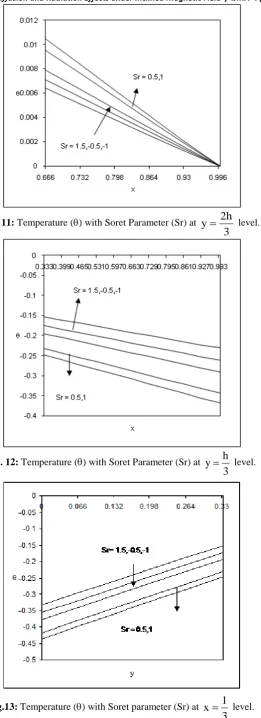
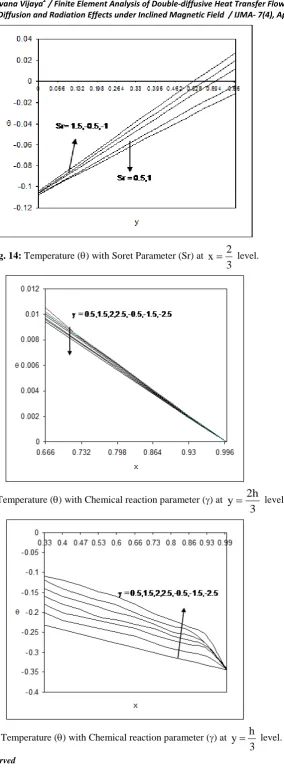
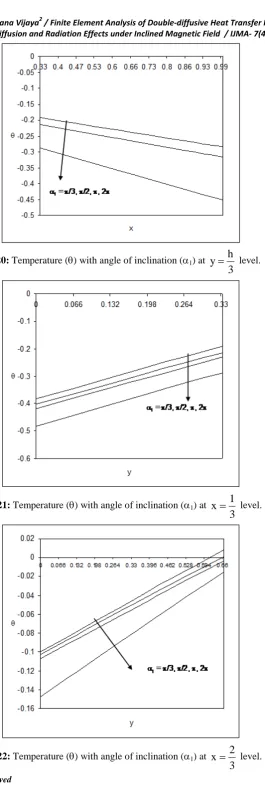
The actual temperature (θ) is exhibited in figures 3-22 for different values of Sr, Ec, N1, γ and α1 at different horizontal
and vertical levels. Figs.3-6 depicts θ with radiation parameter N1. It is observed from these figures greater the radiative
heat flux smaller the actual temperature at x=2/3 level while at y=h/3,y=2h/3 and x=1/3 levels it enhances with N1.
Figs.7-10 represent θ with Eckert number Ec. The actual temperature depreciates with increase in Ec at all levels. Figs.11-14 depict the temperature with thermo-diffusion effect (Sr). It is noticed that that the actual temperature diminishes at x=1/3 and strengthens at y = 2h/3 level and (figs.11& 13) while at x=2/3 & y=h/3, the actual temperature diminishes with rise in Sr≤1.0 and strengthens Sr>1.5 and |Sr|<0 (figs.12 & 14). The effect of chemical reaction on temperature at different levels is shown in figs.15-18. We noticed that the actual temperature increases at y=h/3 & x=1/3 levels in both degenerating and generating chemical reaction (fig 16 &17). The actual temperature reduces at x=2/3 level and y=2h/3 level (figs.15&18). The influence of inclined magnetic field on θ is shown in figs.19-22 at
different levels. Rise in the inclination α1 enhances the actual temperature at y=2h/3 level (fig.19) and depreciates at all
vertical levels and at horizontal level y=h/3(fig 20-23).
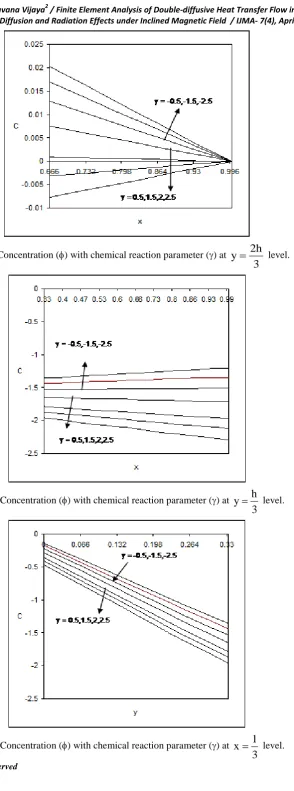
The concentration distribution (φ) is shown in figs.24-43 for different parametric values. We follow the convention that the concentration is positive or negative according as the actual concentration C is greater or lesser than Cc, the
concentration on the cold wall. Figs.24-27 represent the variation of the concentration with radiation parameter N1 .We