International Journal Advances in Social Science and Humanities
Available online at: www.ijassh.com
RESEARCH ARTICLE
A Comparative Analysis of the Performance of Real Property
Investment and Shares in Botswana
Johnson Kampamba
*, Richard Bokamoso Nnang
Land Management and Geomatics Section, Department of Civil Engineering, University of Botswana.
Abstract
Purpose: The purpose of the study was to compare the performance of investments in real property to that of shares; and to provide investors just starting in Botswana with information on which forms of investment to pursue between the two. Research design/methodology/approach: The study adopted a statistical and descriptive research approach where a survey method was used to collect data. A sample of 10 institutional investors in real property and 10 institutional investors in shares were chosen from a population of 10 investors each. Purposive sampling technique which is a non-probability sampling technique was used to choose the respondents of the study and a structured questionnaire was used to collect both qualitative and quantitative. Quantitative data was processed using statistical measures of variability such as mean, variance and standard deviation while qualitative data was analysed using content analysis. Significance: The findings of the study are relevant in the sense that they have provided potential investors just starting with information on what characteristics makes real estate or shares a better form of investment in Gaborone, Botswana. Findings: The findings of the study revealed that property offered better returns than shares even though it was considered riskier under the period of study. In addition shares required less capital to invest in, they were more liquid than real estate and they offered better availability of change positions. Meanwhile it was evident that most investors in property were more comfortable with the characteristic that real property was reliable in terms of monthly paid rent compared to dividends paid to shares quarterly or yearly. However that being discovered, shares were highly recommended to investors just starting over real property because it had high liquidity, the investment is easily started, it requires less start-up capital, there is easy access to information as well as less entry, holding and exit fees compared to investment in property. Value: The study has revealed significant information on what would be the best form of investment between property and shares to investors just starting based on various characteristics.
Keywords: Property investment, Investment in shares, Investors starting, Risks, Returns.
Introduction and Background
The research study has comparatively analysed the performance of real property investment to shares in Botswana in order to establish whether real property is a better form of investment. When comparing real estate investment with stocks, Chandra [1] observed that equity shares have low current yield, high capital appreciation, high risk, fairly high marketability, high tax shelter and high convenience while real estate investment has moderate current yield, moderate capital appreciation, negligible risk, low liquidity, high tax shelter and fair convenience.
Further, in the findings of Akinsola [2] titled “the comparative analysis of commercial
property and stock - market investments in Nigeria” it was established that stocks have the best return/risk performance than commercial property which also have diversification potentials if mixed with sectors of stock investment. It was also found out that stocks are more risky than commercial property; their standard deviation was 0.356 whilst that for commercial property was 0.044. It was then concluded that both commercial property and stocks have a hedge against inflation, but stocks seem to have inflation potentials than commercial property.
This is because real estate is a more comfortable investment for the lower and middle classes because they grew up exposed to it just as the upper class that often learned about stocks and other securities during their childhood which brings into perspective that people invest on what they are familiar with. In real estate it is more difficult to be defrauded as compared to stocks where the investor trusts the management and the auditors. Lastly, using leverage (debt) in real estate can be structured far more safely than using debt to buy stocks. Despite the preference,
Kennon [3] further explains that real estate can be costly every month if the property remains vacant, and also it requires hand-on approach as compared to shares.Although all these studies are valuable and important, there is a gap of knowledge on further evaluating real property investment
in comparison to other forms of investments such as stocks and shares in the context of Botswana which is a developing country and has a different economy. This is because other researches were carried out on large investors in established/developed economies and as compared to those in Botswana. The research therefore is aimed at filling the gap by comparatively analyzing real property investment with stocks in the context of Botswana which is a developing country with a different economy.
The conceptual framework used in this study was adapted from Lim [4] who looked at how the four independent variables; (i) access to financing; (ii) risk and return; (iii) real income of investors and (iv) interest rates affect the decision of an investor to buy an investment (dependent variable). The conceptual model is illustrated in figure 1 below:
This study tested the extent of applying this framework in Botswana context on smaller starting investors’ decision to buy an investment (independent variable) in relation to the independent variables stated above. Risk and return were the main area of focus in this study.
The main problem was that investments in real property have been growing over the past years as compared to any other forms of investment such as shares especially in Botswana. What need to be investigated are the characteristics which make real property a better form of investment as compared to other types of investments in Botswana based on risks and returns. It is observed that there is increased
To determine which characteristics makes either property or shares a better form of investment in Botswana by comparing the risk and return profile of property and shares.
To recommend what would be the best/ideal form of investment between property and shares for starting investors.
The hypothesis for objective one of this study was that investment in real property is a much better form of investment in Botswana than shares because it shows income and capital growth. The other hypothesis for the second objective was that property investment would be the best form of investment recommended for starting investors.
Review of Literature
There are several studies/debates which examined the performance of real property investment and shares from different regional perspectives. Mostly they were from a period of 1963-1979 and with the most recent being in 2009. Kuhle and Bhuyan [5] in their research paper titled “A recent comparative performance analysis of Real Estate Mutual Funds vs. Common Stock” examined the risk/return performance of real estate mutual funds compared to common stock. This was done by analysing average returns, standard deviations and risk adjusted returns for seven different mutual fund categories, including real estate mutual funds. This was done using different time horizons. These time horizons included the most recent year which was 2009, annual period, three year period, five year period and ten year periods. Kuhle and Bhuyan [5] found out that REIT mutual fund category outperformed all other categories based on the risk adjusted statistical measure determined by dividing the standard deviation by the average returns of each investment.
This study indicated that REIT mutual funds have a consistent short and long term record of performance. In fact, the REIT mutual fund category ranks either first (1 year and 10 year) among the risk adjusted performance factor, even though the average returns were not ranked first (see table 1).
However Kuhle and Bhuyan [5] concluded that it is clear from the study that REIT mutual funds have exhibited minimal volatility when measured by the standard deviation of returns. They articulated that once considered an afterthought in the financial literature, it appears that REIT mutual funds deserve a second look as a viable, stable, investment vehicle for long term capital growth.
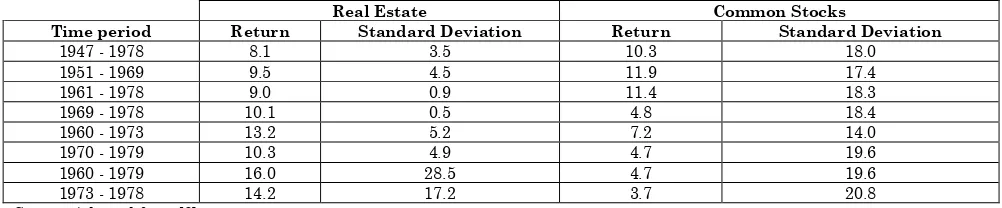
In another study on the performance of real estate assets and REITS performed by Zerbst and Cambon [6] they assessed the historical risks and returns and compared them to the performance of other assets such as stocks and bonds. They compared their returns, standard deviations of returns and coefficients of variation. Frazer [7] and Rutterford [8] agree and confirm that standard deviation calculation measures the risk of an investment. When examining the standard deviations of returns, it showed that while real estate assets, in general, appeared to have lower risk while the risk of REITS was found to be similar to common stocks. Further Zerbst and Cambon [6] noted that during the periods of inflation, real estate assets had slightly better performance results than common stocks, fixed income investments and the rate of inflation. They further stressed that if you look at the historical time periods that lie outside of the very high inflation period of the 1970s, you find that real estate returns have been somewhat lower than common stock returns [6]. These research studies are much related and important to this study, since it determined the return/mean based on a certain period of time, as well as determining the riskiness of an investment through the measure of standard deviation as shown in table 1.
Table 1: Performance of the two investments between 1947 and 1978
Real Estate Common Stocks
Time period Return Standard Deviation Return Standard Deviation
1947 - 1978 8.1 3.5 10.3 18.0
1951 - 1969 9.5 4.5 11.9 17.4
1961 - 1978 9.0 0.9 11.4 18.3
1969 - 1978 10.1 0.5 4.8 18.4
1960 - 1973 13.2 5.2 7.2 14.0
1970 - 1979 10.3 4.9 4.7 19.6
1960 - 1979 16.0 28.5 4.7 19.6
1973 - 1978 14.2 17.2 3.7 20.8
Source: Adopted from [6]
Kuhle et al [5] did a research titled “the financial performance of real estate investment trusts” with the purpose of updating REIT risk adjusted return performance versus the average performance of common stocks. These two were measured by the standard and poors 500 index which is a methodology similar to the Jensen measure for excess returns. The performance was examined over the 1973-1985 time period with the hypothesis of determining if REITS performance, on a risk adjusted basis, is significantly different from that of common stocks. To tackle the research, a measure of performance that adjusts nominal investments returns for risk was chosen. The results of the study indicated that the excess returns occurred during ten years of the thirteen-year period analysed hence concluded that REIT stocks underperformed.
Further Bello et al [9] comparatively analysed property to shares based on the point of view of being used as a security to access financing because the success of any investment activity rests heavily on the availability of adequate finance. Security is defined as backup for a loan advanced to a borrower which serves as a secondary source of loan repayment and the security must be safe, possess capability of periodic yield, and pass the test of liquidity, capital appreciation, taxation advantage with minimum management responsibility to the lender. They comparatively analysed the performance of real estate and financial assets as security for mortgage lending in Nigeria and found out that banks preferred financial assets to property as security. This is because financial assets are more liquid and this is important to lenders because of relative ease of loan realization in case of default. The other finding was that shares
certificate topped the list of security assets acceptable to financial institutions for short and medium term loans while long term loans were being secured by real estates. It is clear here that shares in Nigeria outclass property from the perspective of being preferred as security making shares attractive. Therefore in the case of Botswana, is this why preference by investors is much on property than shares? What makes property a better form of investment from this perspective?
Research Methodology
In order to determine which characteristics makes either property or shares a better form of investment in Gaborone for investors starting, their risk and return profiles were computed and compared to determine which one is riskier for a period of 6 years. The study adopted a statistical approach and used statistical measures such as variance and standard deviation to process quantitative data collected through a structured questionnaire. The results obtained were graphically presented using tables and line graphs for further analysis and interpretation on which investment would be better than the other based on their risk and return profiles. Returns for both investments were also plotted into graphs using Microsoft excel and comparatively analyzed to derive meaningful interpretations and results.
through all the responses on what characteristics makes either shares or property a better form of investment. Categories were developed based on responses and each response assigned to a category. Then patterns and trends were identified on the categories developed on characteristics and a write-up analysis was done thus drawing meaningful outcomes.
Recommendations for which investment vehicle was the best for individuals starting was derived from the findings of the research objective 2 as well as the analysis
of rating provided on the characteristics of the investment recommended to the investor starting by both investors.
Discussion of Results and Analysis
In comparing the risks of the two investment options under consideration, the expected return and standard deviation of their returns were computed using the quantitative data obtained using the structured questionnaire and findings presented as follows in table 2 below.
Table 2: The mean and standard deviation of the returns on for the two investments Shares Real Property Investment
Fleming Stanlib African alliance Time projects RDC Turnstar CBH Mean (expected returns) 11.97% 6.73% 15.01% 62.83% 107.3% 61.5% 92.67% Standard Deviation 10.29% 20.05% 2.79% 16.45% 35% 38.89% 20.05%
Source: Field survey.
Analysis from table shows that the expected returns of real property investment were higher than those of investment in shares. This interprets that property offered better returns than shares under the study period under consideration. In addition, investment in property had higher standard deviation
than investment in shares and this interprets that real property investments was riskier than shares for the study period. Hence, shares are considered to be less risky than property according to the results of the study.
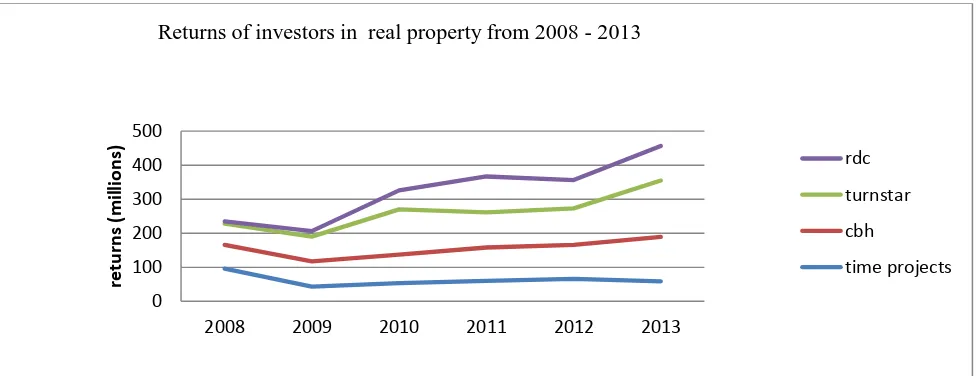
Figure 2: Performance of investors in real property from 2008 to 2013 in terms of returns Source: Field survey
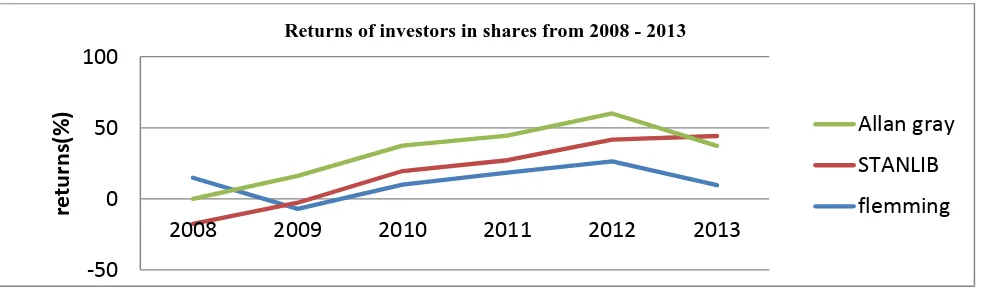
In comparing the relationship between the returns of the two investment options under consideration, graphs were drawn and presented in figure 1 and 2. It is evident from figure 1 that returns showed a consistent general upward movement for all investors in real property starting from 2009 to 2013. However between the period 2008
and 2009, there was a common downward movement in the returns. Comparative to the performance of shares between 2008 and 2009 period, it depicted a sharp declined more than that of property to an extent of negative returns (see figure 2). It should be further noted that during the 2008 and 2009 period, countries around the world including Botswana experienced recession.
0 100 200 300 400 500
2008 2009 2010 2011 2012 2013
re
tu
rn
s
(m
ill
io
n
s)
Returns of investors in real property from 2008 - 2013
rdc
turnstar
cbh
This is evidenced in figure 3 which depicts a very sharp decline in the gross domestic product (GDP) for Botswana between 2008 and 2009 period due to recession. Therefore it can be concluded from this analysis that,
during the recession period of 2008 - 2009, real property performed better than shares as evidenced from the findings in the two figures.
Figure 3: Returns of investors in shares from 2008 to 2013 Source: Field survey
Figure 4: Annual percentage change in real GDP Source:Statistics Botswana
From the data collected on the open ended section of the questionnaire, it showed that the institutions investing in shares and in property invested in the respective investments because of certain characteristics that they portray. When comparing the two investments, 80% companies/institutions investing in shares predominantly indicated in their responses that they preferred shares than real property because shares required less capital to invest in, shares are more liquid and because shares are easy to diversify than real property.
The liquidity aspect on shares was the dominant characteristic listed by investors in shares, as they articulated that shares are readily disposable at the Botswana Stock Exchange Market. It can be further said that
shares are readily available to sell between a willing buyer and seller in the stock exchange market. In addition, searches conducted on the current liquidity of shares in Botswana revealed that there is more liquidity in Choppies shares as of recent 13% (150,000,000 ordinary shares) were acquired by Standard Chartered Bank from Choppies. It was further articulated that this has improved the company's stature in the financial markets and it means there will be more shares in the public to float.
In terms of diversification, investors in shares from the study said that they believed that it is very easy to diversify a portfolio of stocks than of real property. One investor mentioned that an investor can invest in real property companies as well, through listed shares and get returns by
-50
0
50
100
2008
2009
2010
2011
2012
2013
re
tu
rn
s(%)
Returns of investors in shares from 2008 - 2013
Allan gray
STANLIB
spending less time and money running the business. This finding from the research implied that shares offer better and easier diversification ability than real property because less resources and time are spent. The job is left to professionals to manage whilst getting a return on your money.
On the other side however, it is evident that most investors in property were more comfortable with the characteristic that real property was reliable in terms of returns on monthly rental basis compared to dividends paid on shares quarterly, half a year or at the end of the year. This characteristic made them choose real property over shares. They further explained that real property is more reliable in terms of returns, which are steadily increasing upwards generally yearly as evidenced in Figure 1 from 2009 - 2013 compared to figure 2 which highlighted the sharp up and down movement on returns from 2008 - 2009. It can be concluded that there is a general upward movement on real property returns than returns on shares.
Qualitative data collected to satisfy objective two found out that 44.4% of the respondents
recommended shares to individual investors just starting, with 33.2% recommending real
property whilst the remaining
recommending both investments. In addition, it is evidenced from the table below that shares were mostly recommended over real property based on the characteristics that they considered would suit an individual just starting.
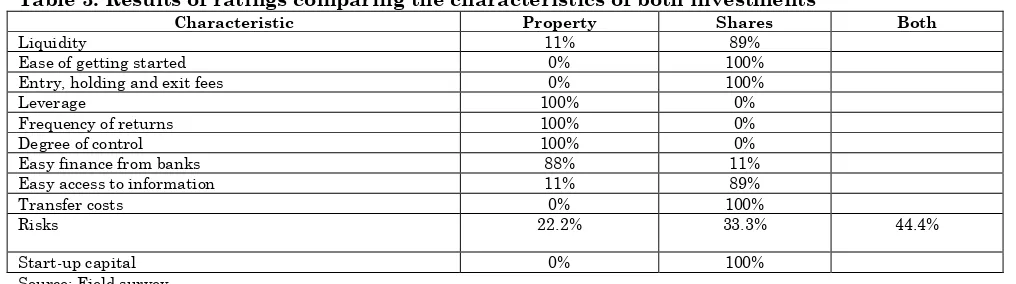
According to the findings of the study it is evident that, characteristics such as liquidity, easy of getting started, less start-up capital, easy access to information as well as less entry, holding and exit fees on shares were mostly highly rated over real property as evidenced in table 3.
Despite the shares being considered very risky, with less frequent returns since dividends are mostly paid quarterly or once a year and less preferred by banks as leverage according to the ratings in table 3 below, it can be concluded that shares are recommended to individuals starting to invest.
Table 3: Results of ratings comparing the characteristics of both investments
Characteristic Property Shares Both
Liquidity 11% 89%
Ease of getting started 0% 100%
Entry, holding and exit fees 0% 100%
Leverage 100% 0%
Frequency of returns 100% 0%
Degree of control 100% 0%
Easy finance from banks 88% 11%
Easy access to information 11% 89%
Transfer costs 0% 100%
Risks 22.2% 33.3% 44.4%
Start-up capital 0% 100%
Source: Field survey
The hypotheses were evaluated based on the two objectives stated in the problem statement section. These were:
The investment in real property is a much better form of investment in Botswana than shares because it shows income and capital growth.
The real property investment would be the best form of investment recommended for starting investors.
From the findings of the study, hypothesis one is supported and hypothesis two is not supported by the findings hence rejected. It is clear from the findings that shares would be recommended to the starting investors because it does not require huge sums of money for one to commit his resources, and that one can do it without the help of loan financing [10-15].
Conclusions and Recommendations
characteristics which made real property and shares a preferred form of investment over the other. This conclusion is drawn from the following findings of the study that, shares required less capital to invest in, they were more liquid than real estate and they offered better availability of change positions.
Meanwhile real property was preferred over shares because it was reliable, there is steady increase in income due to the quality of rental rate and lease agreements with institutional tenants mostly as well as the frequent income normally received on monthly basis. Also real property performance could have been one of the reasons why it is preferred over shares as it was evidenced from the study that real property performed better during the 2008 and 2009 recession.
Lastly, shares were highly recommended to investors just starting as the best/ideal form of investment over real property. This conclusion was drawn based on the high
ratings on shares by investors that it has high liquidity, the investment is easily started, it requires less start-up capital, there is easy access to information as well as less entry, holding and exit fees on shares compared to investment in property with low ratings on the same characteristics.
Recommendations
The research strongly recommends that individual investors/people starting should consider investing in shares since unlike real property because shares require less start-up capital and that the entry fees, holding fees and exit fees are less. For these reasons, this would be an advantage to them since they would be able to fund the buying of the shares without assistance from loans which can lead them into debts.
A further study should be undertaken to establish and focus on undiversified residential property investment only without talking it as a portfolio compared to investment in shares.
References
1. Chandra P (2008) Investment Analysis and
Portfolio Managemen. New Dehli: McGraw-Hill Publishing.
2. Akinsola N (2012) Comparative analysis of
commercial property and stock-market investments in Nigeria. International Journal of Social,
Management, Economics and Business
Engineering, 414-421.
3. Kennon J (2014) Real Estate vs. Stocks - Which Is
the Better Investment? A Comparison of Real Estate Investments vs. Stocks. Retrieved March 24,
2014, from
http://beginnersinvest.about.com/od/realestate/a/re al-estate-vs-stocks.htm
4. Lim YY (2014)
Purchase_Decision_for_Real_Estate_Properties_in_
Malaysia_A_Conceptual_Framework. Retrieved
September 5, 2014, from academia.edu websie: http://www.academia.edu/4256871/
5. Kuhle J, Bhuyan R (2009) A recent comparative perfomance analysis of real estate mutual funds vs common stocks. Journal of business and economics research, 7(8).
6. Zerbest R, Cambon B (1984) Real estate; Historical
return and risks. Journal of portfolio management.
7. Frazer WD (1984) Principles of property
investment and pricing. New York: Palgrave macmillan.
8. Rutterford J (1983) Introduction to stock exchange
investment. Hong Kong: McMillan Publishers.
9. Bello MO, Adewusi A (2009) A Comparative
analysis of the performance of real estate and financial assets as security for mortgage. Journal of the Nigerian Institution of Estate Surveyors and, 3-9.
10. Davidson D, Palmer J (1978) A comparison of
investment perfomance of common stock,home building firms and equity. Real estate appraissal and analyst, 35-40.
11. Drons W (1988) Measuring investor risk capacity with a PASS. Journal of financial planning, 88-92. 12. Fisher L (2003) Investing in shares. Australia:
Pascal Press.
13. Friedman J (2010) Keys to investing in real
estate. Florida: Barrons Educational Series. 14. Kolbe P, Greer G, Waller B (2013) Investment
analysis for real estate decisions. United States: Dearborn.
15. Koulizos P, Zacharia Z (2013) Property vs
shares,Descover your investment knockout