SYNTHESIS OF HYBRID MAGNETIC NANOMATERIAL BASED
ON POLYDIPHENYLAMINE-2-CARBOXYLIC ACID AND Fe
3O
4IN THE INTERFACIAL PROCESS
Galina Petrovna Karpacheva,
[a]*Sveta Zhiraslanovna Ozkan,
[a]Igor Sergeevich
Eremeev,
[a]Galina Nikolaevna Bondarenko,
[a]Ella Leont’evna Dzidziguri
[b]and Petr Aleksandrovich Chernavskii
[c]Keywords: interfacial polymerization in situ; core-shell; Fe3O4/polydiphenylamine-2-carboxylic acid hybrid nanoparticles; magnetic
nanomaterials; magnetic fluids
Hybrid magnetic nanomaterial with core-shell structure, where particles of Fe3O4 form the core and polydiphenylamine-2-carboxylic acid is
the shell, was obtained for the first time in the interfacial process. According to TEM data Fe3O4/polydiphenylamine-2-carboxylic acid
nanoparticles have size 2 < d < 14 nm. It was found by IR spectroscopy that the polymer shell is formed by C–C - joining into 2- and 4-positions of phenyl rings with respect to nitrogen. The obtained hybrid nanomaterial is superparamagnetic and thermally stable.
* Corresponding Authors Tel: +74959554255 E-Mail: [email protected]
[a] A.V. Topchiev Institute of Petrochemical Synthesis, Russian Academy of Sciences, 29 Leninsky prospect, Moscow 119991 Russia
[b] National University of Science and Technology “MISIS”, 4 Leninsky prospect, Moscow 119049 Russia
[c] Department of Chemistry Lomonosov Moscow State University, 1-3 Leninskie Gory, Moscow 119991 Russia
Introduction
The modern level of development of science and technologies dictates the tasks of creating new advanced materials with a complex of necessary physical-chemical properties. Among these materials a special issue is given to the hybrid polymer nanomaterials1-5 properties of which are
defined not only by the constituent polymer and inorganic components, but also by the interaction between them at the molecular level. The grown up interest for the last ten years to hybrid nanomaterials, including polymers with a system of polyconjugation is associated with the fact that they are able to show excellent electric, magnetic and electrochemical properties. It makes them promising for the use in systems of magnetic information recording, organic electronics and electrorheology, medicine, while creating electromagnetic screens, microelectromechanic systems, rechargeable batteries, sensors and biosensors, supercapacitors, electrocatalysts, solar batteries, displays and other electrochemical devices.
A special place in this class of hybrid materials is held by magnetic nanomaterials with a core-shell structure, in which the core is the magnetic nanoparticle and the polymer shell plays the role of the stabilizer, preventing their aggregation. Such hybrid nanomaterials can be used as components of magnetic liquids – unique systems, combining properties of a magnetic material and a liquid.
The combination of these properties, that cannot be found in natural materials, provides a great potential for practical use of magnetic liquids (as contrast agents in magnetic resonance tomography, in hyperthermia, for sealing the gaps between the moving parts of devices (rotating shafts, pistons), in magnetic-hydrodynamic bearings, for ore beneficiation, in printing devices, for collecting oil products on the water surface, etc.).
In the known magnetic nanomaterials with core-shell structure the role of the polymer shell with a system of polyconjugated bonds, as a rule, is performed by polyaniline, which takes a special place among the conducting polymers, due to the simplicity of its synthesis, the ease of holding processes of doping-dedoping, stability of its properties. Such nanomaterials are obtained by in situ oxidative polymerization of aniline in presence of the magnetite nanoparticles introduced into the reaction mixture.
So, the magnetic dispersed Fe3O4/polyaniline
nanomaterials with core-shell structure were obtained via aniline polymerization in an aqueous solution containing magnetic fluid, which is an aqueous suspension of Fe3O4
nanoparticles and the sodium salt of dodecylbenzenesulfonic acid with ammonium persulfate as an oxidizer.6 Fe
3O4
nanoparticles have spherical form with a diameter of 20–30 nm and aggregate easily due to magneto-dipole interaction. 70–80 % of nanoparticles have diameter from 70 to 100 nm.
The investigation of magnetic properties has shown that Fe3O4/polyaniline nanoparticles are ferromagnetic like bulk
magnetite samples. Saturation magnetization and coercive force depend on the content of Fe3O4. Ferromagnetic
nanoparticles with core-shell structure were obtained via emulsion polymerization of pyrrol in the presence of Fe3O4
It was shown that because of the aggregation of magnetite nanoparticles the polyaniline shell is able to surround a cluster of size 50 nm including several Fe3O4 nanoparticles
of size 10–15 nm.8 To prevent the aggregation of Fe 3O4
nanoparticles Lu et al. proposed to cover the Fe3O4
nanoparticles, preformed by hydrolysis of Fe(II)-Fe(III) chlorides, with a layer of molecules of the substituted aniline dimer synthesized via interaction of N-phenyl-1,4-phenylenediamine and succinic acid anhydride.9D. Chao et
al. used anthranilic acid to modify Fe3O4 nanoparticles.10
However, in both cases the authors did not manage to prevent the aggregation of nanoparticles completely due to the formation of hydrogen bonds and π-π interaction between the molecules of the modifier. Further polymerization of aniline in the presence of modified Fe3O4
nanoparticles leads to the formation of Fe3O4/polyaniline
nanoparticles with the diameter of 10–20 nm. The obtained Fe3O4/polyaniline nanoparticles have core-shell structure as
proved by TEM and XRD. These particles have superparamagnetic properties, saturation magnetization MS
= 21 emu g–1.
Promising are the nanomaterials, in which the shell is a functionalized polymer with a system of polyconjugation, providing a stronger bond between the core and the shell, that should provide a high stability of the nanomaterial. Having said that, the creation of magnetic nanomaterials with a high degree of dispersion based on functionalized polymers with a system of polyconjugation seems to be an actual problem both in scientific and practical aspects.
Earlier hybrid dispersed magnetic nanoparticles with core-shell structure based on Fe3O4 and
polydiphenylamine-2-carboxylic acid (PDPhAC) – new functionalized polymer with a system of polyconjugated bonds, the structure of which contains carboxylic groups, have been obtained homogeneously for the first time in ammonium hydroxide solution. In contrast to the papers described above where the previously obtained nanoparticles of magnetite are introduced into the medium of polyaniline synthesis, the in situ polymerization of diphenylamine-2-carboxylic acid (DPhAC) is carried out directly in the alkaline medium of Fe3O4 nanoparticles synthesis. It was shown that the
obtained nanomaterial is superparamagnetic, saturation magnetization MS = 33.5 emu g–1.11-13
In this work the method of synthesis of hybrid nanoparticles based on Fe3O4 nanoparticles and DPhAC
polymer in the interfacial process was developed. Magnetic and thermal properties of the obtained hybrid nanomaterials were studied.
Experimental
DPhAC (analytical grade), sulfuric acid (reagent grade), ammonia (reagent grade), ethyl alcohol (analytical grade), iron(II) chloride (“Acros Organics”), iron(III) chloride (high-purity grade) were used as received. Ammonium persulfate (analytical grade) was purified by recrystallization. Aqueous solutions of reagents were prepared using distilled water.
Fe3O4/PDPhAC hybrid nanomaterial was obtained as
follows. Initially, FeO nanoparticles were synthesized via
the hydrolysis of iron(II) and iron(III) chlorides mixed at the ratio 1 : 2 in ammonium hydroxide solution at 55 °C.14
FeCl2 + 2FeCl3 + 8NH3 · H2O → Fe3O4 + 8NH4Cl + 4H2O
To fix the monomer on the surface of Fe3O4 nanoparticles,
the monomer solution in chloroform of the required concentration was added to the obtained aqueous-alkaline suspension. The process was conducted at 55 °C at a permanent vigorous stirring for 0.5 h.
In order to perform an oxidative polymerization of DPhAC on the surface of Fe3O4 nanoparticles, aqueous
solution of ammonium persulfate was added dropwise to Fe3O4/DPhAC suspension preliminarily cooled down to 0 °C.
Solutions of organic and aqueous phases were mixed immediately without gradual dosing of the reagents. The volume ratio of aqueous and organic phases was 1 : 1. The ratio [monomer] : [oxidizer] was 1 : 2. The synthesis was conducted at 0 °C for 3 h at a vigorous stirring. As the reaction was complete, the mixture was precipitated into two-fold excess of 1 M H2SO4, filtered, and washed with
distilled water until the neutral reaction of the filtrate. The obtained product was dried in vacuum above KOH to a constant weight.
The magnetic fluid based on Fe3O4/PDPhAC
nanoparticles suspension in ethanol was prepared. The suspension stability was observed for 8 months.
IR spectra of Fe3O4/PDPhAC nanoparticles were recorded
on an IFS 66v FTIR spectrometer in the range 4000–400 cm–1. The samples were prepared as KBr pellets. X-ray investigations of Fe3O4/PDPhAC nanoparticles were
performed at room temperature on a Difrey X-ray diffractometer with Bragg–Brentano focusing using CrK
α-radiation. Microphotographs of Fe3O4/PDPhAC
nanoparticles were taken on a JEM-2100 transmission electron microscope at the accelerating voltage 200 kV.
The metal content in Fe3O4/PDPhAC nanoparticles was
determined quantitatively by the atom-absorption spectrometry method on an AAS 30 spectrophotometer (Carl Zeiss JENA). The accuracy of the determination of Fe was ± 1.0 %.
Magnetic characteristics of Fe3O4/PDPhAC nanoparticles
were investigated on a vibrational magnetometer at room temperature.15 The absolute magnetic moment value was
determined using a cobalt standard with a mass of 2 mg.
Thermal analysis was carried out on a TGA/DSC1 device (Mettler Toledo) in dynamic regime in the range 30– 1000 °C in air and in the flow of nitrogen. The loading of polymers was 100 mg, heating rate 10 °C min–1, and the flow of nitrogen was 10 mL min–1. Calcined alumina was used as a standard. The analysis of samples was conducted in Al2O3 crucibles.
DSC analysis was performed on a DSC823e calorimeter
Results and discussion
The peculiarity of the developed method of synthesis of Fe3O4/PDPhAC composite nanoparticles in the interfacial
process is that the in situ polymerization of DPhAC proceeds directly in the alkaline medium where Fe3O4
nanoparticles are obtained, as opposed to the case of pre-introduced magnetite nanoparticles described in the reference elsewhere. The formation of the hybrid dispersed nanomaterial Fe3O4/PDPhAC in the interfacial process
includes synthesis of Fe3O4 nanoparticles via hydrolysis of a
mixture of iron(II) and iron(III) chlorides in ratio 1:2 in the ammonium hydroxide solution,14 immobilization of the
monomer on the surface of Fe3O4 nanoparticles via the
addition of monomer solution in chloroform with further polymerization in situ in the presence of ammonium persulfate. The monomer and oxidizer are distributed in two immiscible phases (Figure 1). Polymerization of DPhAC on the surface of Fe3O4 nanoparticles proceeds at the interface
between the aqueous and the organic phases.
Figure 1. Scheme of Fe3O4/PDPhAC hybrid nanomaterial
synthesis.
The formation of composite nanoparticles based on Fe3O4
was proved by XRD. Reflection peaks of Fe3O4 are clearly
identified on the diffractogram in the range of scattering angles 2θ = 46.3°, 54.6°, 66.8°, 84.7°, 91.0°, 101.6° (Figure 2).
Figure 2. Fe3O4/PDPhAC hybrid nanomaterial diffractogram.
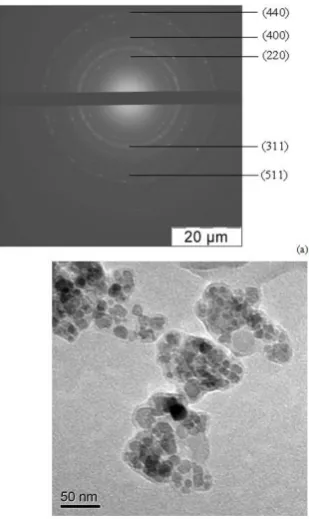
Electronic diffraction proves the crystalline nature and the phase content of nanoparticles (Figure 3a). According to TEM data Fe3O4/PDPhAC nanoparticles have size 2 < d <
14 nm (Figure 3). According to atomic adsorption spectrometry data the content of Fe is 38.5 % wt. The obtained nanomaterial entirely consists of Fe3O4/PDPhAC
hybrid nanoparticles. Fe3O4 nanoparticles without the
polymeric shell are completely deleted after precipitation into sulfuric acid.
Figure 3. Fe3O4/PDPhAC hybrid nanomaterial diffraction image
(a) and microphotograph (b).
According to the results of X-ray analysis the size distribution of coherent scattering regions (CSR) was calculated for Fe3O4/PDPhAC hybrid nanoparticles. Figure
4 depicts the volume size distribution of CSR in Fe3O4
nanoparticles. The size distribution curve of Fe3O4
crystallites is very narrow. About 90 % of crystallites have size up to 6 nm.
Figure 4. Volume distribution of crystallites by Fe3O4 size in
Fe3O4/PDPhAC hybrid nanomaterial.
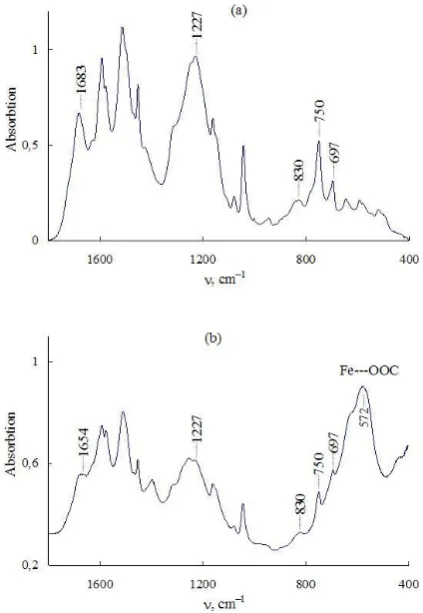
The IR spectroscopy data confirm the monomer immobilization on Fe3O4 nanoparticles via binding of the
carboxylate-ion with iron with the formation of a coordination bond Fe---OOC. Absorption band at 572 cm–1, corresponding to the stretching vibrations of νFe–O bond,
N H
O O
C H
N
C
O O
O O
C
N H
Fe3O4
4 O 3 Fe
H
N C O O
O O
C N
H
C O
O
H N
4 2 H N ( ) S O2 8
4 O 3 Fe Polymer
Figure 5. IR spectra of PDPhAC (a) and Fe3O4/PDPhAC hybrid
nanomaterial (b).
The coordination bond Fe---OOC in hybrid nanoparticles appears as a result of redistribution of electronic density after an interaction between carboxylate-anion and iron.
The positive charge appears on the polymer shell of hybrid nanoparticles due to the electronic interaction of delocalized π-electrons with free d-orbitals of iron.16 The
absorption band of valence vibrations of νС=О bond in
carboxylic group appears at 1654 cm–1 in the IR spectra of hybrid nanoparticles; it is strongly shifted to longer wavelengths in comparison with the position of this band in the polymer at 1683 cm–1. Such shift of νС=О bond
simultaneously with the appearance of an intensive band at 572 cm–1 indicates that carboxylic groups of the polymer are immobilized on Fe3O4 nanoparticles with the formation of
the polymeric shell, allowing to propose that Fe3O4/PDPhAC hybrid nanoparticles have core-shell
structure where the core is the magnetite nanoparticle and the shell is the polymer of DPhAC. It is worth mentioning that there is no absorption band at 572 cm–1 in IR spectra of the nanocomposite, in which the Fe3O4 nanoparticles are
dispersed into the polydiphenylamine matrix; the latter compound has no COOH groups in its structure.17
Absorption bands of the valence vibrations of νFe–O bond in
magnetite are in the region of 440 and 480 cm–1 (shoulder).18
The presence of absorption bands in the region of 830 and 750 cm–1 in the IR spectra of composite nanoparticles, caused by the non-planar deformation vibrations of С-Н
bonds of 1,2,4- and 1,2-substituted benzene ring, shows that the polymer shell around Fe3O4 nanoparticles is formed via
C–C - joining into 2- and 4- positions of phenyl rings with respect to nitrogen.19
Analysis of the results of spectral studies allows to present the chemical structure of Fe3O4/PDPhAC hybrid
nanomaterial as follows:
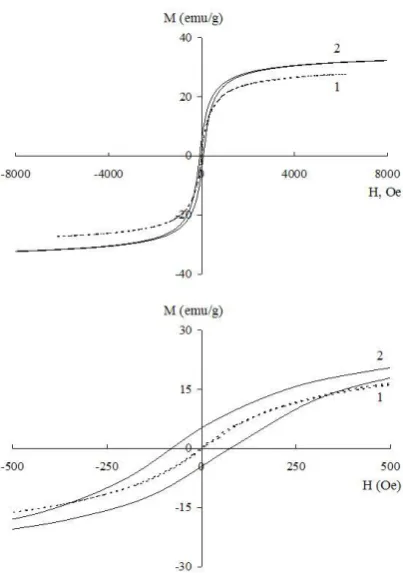
The study of the magnetic properties at room temperature showed that Fe3O4/PDPhAC hybrid nanomaterial has a
hysteresis type of magnetization reversal. Figure 6 shows the composite nanoparticles magnetization dependence on the value of the applied magnetic field.
In Table 1, the values of the main magnetic characteristics of the Fe3O4/PDPhAC hybrid nanomaterial are listed. The
magnetic characteristics of the dispersed material obtained in the ammonium hydroxide solution are given for comparison.12,13 As it can be seen from the Table, regardless
of the synthesis method, values of the squareness coefficient of the hysteresis loop kS = MR/MS indicate the
superparamagnetic behavior of the composite nanoparticles, which is characteristic of the uniaxial single-domain magnetic nanoparticles.3-5,21,22 At the same time, the hybrid
nanomaterial obtained under the conditions of the interfacial polymerization in situ is superparamagnetic with almost 100 % content of superparamagnetic nanoparticles.
4 O 3 Fe
+
-O CTable 1. Magnetic characteristics of Fe3O4/PDPhAC hybrid
nanomaterial
Synthesis method HC,a
Ое
MS,b
emu g–1
MR,c
emu g–1
MR/MS
In interfacial process In NH4OH solution
1.6 76
27.5 33.5
0.19 5.0
0.007 0.15
a – coercive force; b – saturation magnetization; c – residual magnetization.
Figure 6. Magnetization of Fe3O4/PDPhAC hybrid nanomaterial
obtained in the interfacial process (1) and in NH4OH solution (2) as
a function of the applied magnetic field at room temperature.
TGA and DSC were used to study the thermal stability of the dispersed hybrid nanomaterial Fe3O4/PDPhAC in
comparison with the polymer. The curves of weight loss have stepped nature (Figure 7). The weight loss at 168 °C in PDPhAC is caused by the removal of COOH groups.19,23-25
There is an exothermic peak in this region of temperature in the DSC image (Figure 8), it is associated with decomposition.26-28 The absence of weight loss in
Fe3O4/PDPhAC hybrid nanomaterial at this temperature is
described by the fact that the carboxylate groups of the polymer shell are immobilized on Fe3O4 nanoparticles with
the formation of the coordination bond Fe---OOC.
As it is shown in Figure 6, 50 % weight loss in air for the PDPhAC obtained in the presence of the organic solvent is achieved at 520 °C. For the Fe3O4/PDPhAC hybrid
nanomaterial obtained in the interfacial process, the residue at 520 °C is 73 %. In the inert atmosphere PDPhAC loses half of its initial weight at 660 °C. In the hybrid nanomaterial the residue at this temperature is 76 %.
Figure 7. Weight dynamics of Fe3O4/PDPhAC hybrid
nanomaterial (1, 2) and PDPhAC (3, 4) in heating to 1000 °C at heating rate 10 °C min–1 in nitrogen flow (1, 3) and in air (2, 4).
Thus, it is shown that the immobilization of the polymer on magnetite nanoparticles leads to an increase of the thermal stability.
Figure 8. DSC thermograms of PDPhAC (1) and Fe3O4/PDPhAC
hybrid nanomaterial (2, 3) in heating to 200 °C in nitrogen flow at heating rate 10 °C min–1 (1,2 – first heating, 3 – second heating).
The absence of weight loss in Fe3O4/PDPhAC hybrid
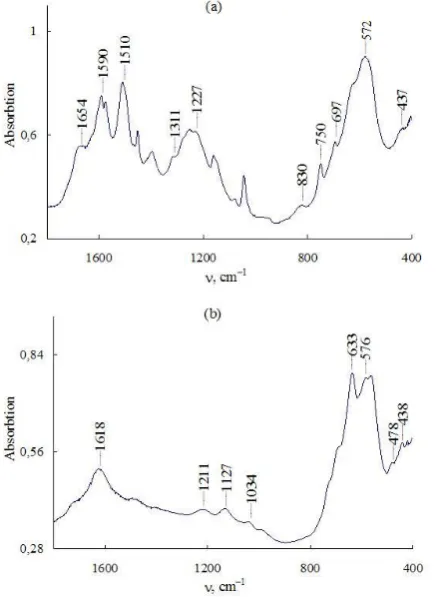
nanomaterial in air above 500 °C is associated with complete thermal oxidative destruction of the polymer shell. Figure 9 shows the IR spectra of Fe3O4/PDPhAC composite
nanoparticles before (a) and after heating in air up to 500 °C (b). In IR spectra of nanoparticles heated up to 500 °C there are no characteristic absorption bands corresponding to PDPhAC. After the completion of thermal oxidative destruction of the polymer shell, there was only magnetite left. Figure 10 shows diffraction images of Fe3O4/PDPhAC
composite nanoparticles before and after heating in air up to 500 °C. In the diffraction images of composite nanoparticles heated up to 500 °C in air, reflection bands of Fe3O4 are
clearly identified (Figure 10b). As it can be seen from Figure 7, there is a weight loss in Fe3O4/PDPhAC composite
nanoparticles at T > 800 °C in inert atmosphere. It is associated with the partial reduction of Fe3O4 to Fe and FeO.
Figure 10c shows the diffraction image of Fe3O4/PDPhAC
Figure 9. IR spectra of Fe3O4/PDPhAC hybrid nanomaterial
before (a) and after heating in air to 500 °C (b).
Reflection bands of Fe are clearly identified in diffraction images along with Fe3O4 nanoparticles in the region of
scattering angles 2θ = 68.7°, 106.1°, and with FeO in the region of scattering angles 2θ = 55.4°, 65.2°, 99.7°.
The hybrid dispersed nanomaterial Fe3O4/PDPhAC is a
black powder, completely soluble in concentrated sulfuric acid and insoluble in concentrated hydrochloric acid and organic solvents.
The massive of varied experimental data (size of hybrid nanoparticles and their superparamagnetic behavior, indicating their single-domain structure; immobilization of polymer chains on magnetite nanoparticles with the formation of core-shell structure; the presence of the positive charge in the structure of the polymer shell due to electronic interaction of delocalized π-electrons with the free
d-orbitals, defining the prevention of aggregation of nanoparticles; insolubility in aqueous and organic medium) gives a reason to suggest that the obtained hybrid dispersed nanoparticles can be used as active components of magnetic fluids, which are stable suspensions of magnetic particles in water or organic medium. To verify this assumption, aqueous and alcoholic suspensions of Fe3O4/PDPhAC
hybrid nanoparticles were obtained. It was found that suspensions of Fe3O4/PDPhAC magnetic nanoparticles in
ethanol and water are stable for at least 8 months, while Fe3O4 nanoparticles start to precipitate from the first
minutes, as can be seen from Figure 11. Thus, due to the prevention of aggregation of nanoparticles by the polymer shell of PDPhAC, the stability of magnetic suspension can be provided for a long period of time.
Figure 10. Fe3O4/PDPhAC hybrid nanomaterial diffractograms
before (a) and after heating in air to 500 °C (b) and in nitrogen flow to 800 °C (c).
Figure 11. Suspension of Fe3O4 nanoparticles (a) and
Fe3O4/PDPhAC hybrid nanomaterial (b) in ethanol. (a) – in 5
Conclusions
Hybrid dispersed nanomaterial with core-shell structure, where Fe3O4 nanoparticles form the core and PDPhAC is the
shell, were obtained for the first time in the interfacial process. The peculiarity of this method of synthesis of composite nanoparticles is the fact that polymerization in situ of DPhAC proceeds not in the presence of the magnetite nanoparticles introduced in the reaction medium, but directly in the alkaline medium of synthesis of Fe3O4
nanoparticles. The polymer shell effectively prevents the aggregation of composite nanoparticles. Size of Fe3O4/PDPhAC nanoparticles is 2 < d <14 nm. The obtained
dispersed nanomaterial is superparamagnetic, MR/MS ~
0.007. The shell (PDPhAC) is insoluble in water and organic solvents, which allows to use Fe3O4/PDPhAC hybrid
nanoparticles for preparation of magnetic fluids. High thermal stability of the hybrid nanomaterial in air and inert atmosphere provides a possibility to use the obtained dispersed material in high temperature processes.
Acknowledgements
The work has been supported by the Russian Foundation for Basic Research, project № 11-03-00560-a.
Authors thank G.A. Shandryuk (TIPS RAS) for
conducting the thermal analysis of the
Fe3O4/polydiphenylamine-2-carboxylic acid hybrid
nanomaterial.
References
1Sellinger, A., Weiss, P. M., Nguyen, A., Lu, Y., Assink, R. A.,
Gong, W., Brinker, C. J., Nature, 1998, 394, 256.
2Yamamoto, K., Sakata, Y., Nohara, Y., Takahashi, Y., Tatsumi, T.,
Science, 2003, 300, 470.
3Gerasin, V. A., Antipov, E. M., Karbushev, V. V., Kulichikhin, V.
G., Karpacheva, G. P., Talroze, R. V., Kudryavtsev, Y. V., Russ. Chem. Rev., 2013, 82, 303.
4Gubin, S. P., Magnetic nanoparticles. WILEY-VCH, Weinheim 2009, 466 p.
5Gubin, S. P., Koksharov, Yu. A., Khomutov, G. B., Yurkov, G.
Yu., Russ Chem. Rev.,2005,74, 489.
6Deng, J., He, C., Peng, Y., Wang, J., Long, X., Li, P., Chan, A.,
Synth. Met., 2003, 139, 295.
7Deng, J., Peng, Y.,He, Ch.,Long, X.,Li, P., Chan, A. S. C.,
Polym. Int., 2003, 52, 1182.
8Khan, A., Aldwayyan, A. S., Mansour Alhoshan, M., Alsalhi, M.,
Polym. Int., 2010, 59, 1690.
9Lu, X., Yu, Y., Chen, L., Mao, H., Gao, H., Wang, J., Zhang, W.,
Wey, Y., Nanotechnology, 2005, 16, 1660.
10Chao, D., Lu, X., Chen, J., Zhang, W., Wei, Y., J. Appl. Polym.
Sci., 2006, 102, 1666.
11Karpacheva, G. P., Ozkan, S. Zh. RU 2426188 "Dispersed
nanocomposite magnetic material and method of its obtaining".
12Eremeev, I. S., Ozkan, S. Zh., Karpacheva, G. P., J. Int. Sci. Publ.
Mater., Methods, Technol., 2012, 6, 222.
13Eremeev, I. S., Ozkan, S. Zh., Karpacheva, G. P., Bondarenko, G.
N., Nanotechnol. Russ., 2014, 9, 38.
14Massart, R., IEEE Trans. Magn., 1981, 17, 1247.
15Chernavskii, P. A., Khodakov, A. Y., Pankina, G. V., Girardon,
J.-S., Quinet E., Appl. Catal., 2006, 306, 108.
16Reddy, K. R., Lee, K.-P., Gopalan, A. I., J. Appl. Polym. Sci., 2007, 102, 1181.
17Ozkan, S. Zh., Karpacheva, G. P. in: Handbook of Organic
Chemistry, Biochemistry, Biotechnology and Renewable Resources. Research and Development, Ed. G. E. Zaikov, O. V. Stoyanov, E. L. Pekhtasheva, Nova Science Publishers, Inc. New York, 2013, 2, 93.
18Ivanovskaya, M. I., Tolstik, A. I., Kotikov, D. A., Pankov, V. V.,
Russ. J. Phys. Chem. A., 2009, 83, 2081.
19Ozkan, S. Zh., Eremeev, I. S., Karpacheva, G. P., Prudskova, T.
N., Veselova, E. V., Bondarenko, G. N., Shandryuk, G. A., Polym. Sci. B., 2013, 55, 107.
20Madsen K. N., J. Magn. Magn. Mater.,2002, 241, 220.
21Chernavskii, P. A., Pankina, G. V., Lunin, V. V., Russ. Chem.
Rev., 2011, 80, 579.
22Baranov, D. A., Gubin, S. P. IX International Scientific
Conference «Solid state Chemistry: Monocrystals, Nanomaterials, Nanotechnologies», Kislovodsk, 2009, p.12.
23Ogura, K., Shiigi, H., Nakayama, M., A. Ogawa, A., J. Polym.
Sci., Polym. Chem., 1999, 37, 4458.
24Ozkan, S. Zh., Bondarenko, G. N., Karpacheva, G. P., Polym. Sci.
B., 2010, 52, 263.
25Ozkan, S. Zh., Eremeev, I. S., Karpacheva, G. P., Bondarenko, G.
N., Open J. Polym. Chem., 2013, 3, 63.
26Ding, L., Wang, X., Gregory, R. V., Synth. Met., 1999, 104, 73.
27Wang, X.-H., Geng, Y.-H., Wang, L.-X., Jing, X.-B., Wang, F.-S.,
Synth. Met.,1995, 69, 265.
28Wen, T.-Ch., Chen, J.-B., Gopalan, A., Mater. Lett., 2002, 57,
280.