KINETICS AND MECHANISM OF THE OXIDATION OF
ALIPHATIC ALCOHOLS BY TETRAAMMINECOPPER(II)
BIS(PERMANGANATE)
Gifty Sharma,
[a]Jayshree Banerji,
[a]Priyanka Purohit,
[a]Pradeep K. Sharma
[a]and Kalyan K. Banerji
[b]*Keywords: tetraammincopper(II) permanganate; alcohol; oxidation; kinetics; mechanism; correlation analysis
The oxidation of aliphatic alcohols by tetraamminecopper(II) bis(permanganate) (TACP) in aqueous acetic acid leads to the formation of corresponding carbonyl compounds. The reaction is first order with respect to TACP. A Michaelis-Menten type kinetics is observed with respect to alcohols. The reaction shows a first order dependence on hydrogen ions. The oxidation of [1,1-2H
2]ethanol and [2-2 H]propan-2-ol exhibits the presence of a substantial primary kinetic isotope effect (kH/kD = 3.52 and 3.96 respectively at 298 K). The rate of disproportionation of the intermediate is susceptible to both polar and steric effects of the substituents. A suitable mechanism has been proposed.
* Corresponding Authors Fax: +912912577540
E-Mail: [email protected]
[a] Chemical Kinetics Laboratory, Department of Chemistry, J.N.V. University, Jodhpur 342005, India
[b] Faculty of Science, National Law University, Jodhpur 342304, India
Introduction
Derivatives of permanganic acid have been used as mild and selective oxidizing reagents in synthetic organic chemistry.1-5 Tetraamminecopper(II) bis(permanganate) (TACP) is also one of such compounds used for the oxidation of organic compounds.6 We have been interested in the kinetic and mechanistic aspects of the oxidation by derivatives of permanganic acid and several reports on permanganate derivatives have already reported from our laboratory.7-11
In continuation of our earlier work with Mn(VII), we report here the kinetics and mechanism of oxidation of some aliphatic alcohols by TACP in aqueous acetic acid as solvent. The mechanistic aspects are discussed. A suitable mechanism has also been proposed.
Experimental
Materials
TACP was prepared by the reported method12 and its purity was checked by an iodometric method. The procedures used for the purification of alcohols have been described earlier.13 [1,1- 2H
2]Ethanol14 and [2-2 H]propan-2-ol15 was prepared by reported methods. Their isotopic purity, as ascertained by their NMR spectra, was 962 % and 953 %. Perchloric acid (Merck) was used as a source of hydrogen ions. Acetic acid was refluxed for 3 h with acetic anhydride and chromic oxide and then distilled.
Product analysis
The product analysis was carried out under kinetic conditions. In a typical experiment, ethanol (4.60 g, 0.10 mol) and TACP (1.88 g, 0.01 mol) were made up to 50 cm3 in 1:1 acetic acid-water (v/v) and kept in dark for ca. 15 h to ensure the completion of the reaction. The solution was then treated with an excess (200 cm3) of a saturated solution of 2,4-dinitrophenylhydrazine in 2 mol L-1 HCl and kept overnight in a refrigerator. The precipitated 2,4-dinitrophenylhydrazone (DNP) was filtered off, dried, weighed, recrystallized from ethanol and weighed again. The yield of DNP before and after recrystallization was 2.02 g (91 %) and 1.79 g (79 %), respectively. The DNP was found identical (m.p. and mixed m.p.) with the DNP of acetaldehyde. Similar experiments with other alcohols led to the formation of DNP of the corresponding carbonyl compounds in yields ranging from 70 to 94%, after recrystallization.
Kinetic Measurements
The reactions were followed under pseudo-first-order conditions by keeping a large excess ( 10 or greater) of the alcohol over TACP. The temperature was kept constant to
Results
Kinetic data were obtained for all the alcohols studied. Since the results are similar, only representative data are reproduced here.
Stoichiometry
The oxidation of alcohols results in the formation of corresponding carbonyl compounds. The overall reaction may be represented as equation (1)
3 R2CHOH + 2 MnO4-
3 R2C=O + MnO2 + MnO32- + 3 H2O (1)
Rate Law
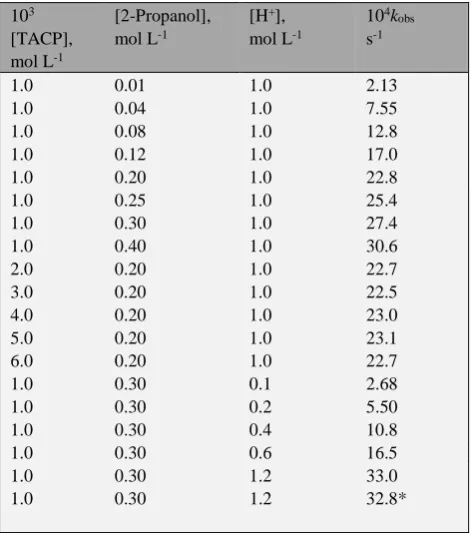
The reactions are of first order with respect to TACP. Further, the pseudo-first order rate constant, kobs is independent of the initial concentration of TACP. The reaction rate increases with increase in the concentration of the alcohols but not linearly (Table 1). A plot of 1/kobs against 1/[alcohol] is linear (r2 > 0.995) with an intercept on the rate-ordinate. Thus, Michaelis-Menten type kinetics is observed with respect to the alcohols. This leads to the postulation of following overall mechanism (2) and (3) and rate law (4). The reaction showed a first order dependence on hydrogen ions (Table 1).
Table 1. Rate constants of the oxidation of 2-propanol by TACP at 298 K
*contained 0.01 mol dm-3 acrylonitrile
(2)
(3)
(4)
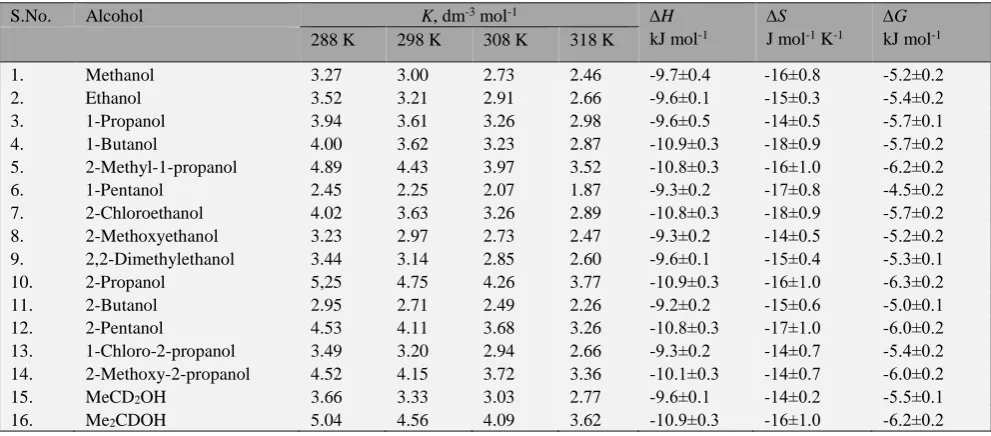
The dependence of reaction rate on the alcohol concentration was studied at different temperatures and the values of K and k2 were evaluated from the double reciprocal plots. The thermodynamic parameters of the formation of the intermediate and activation parameters of its disproportionation were calculated from the values of K and k2 respectively at different temperatures (Tables 2 and 3).
Test for free radicals
The oxidation of alcohols, in an atmosphere of nitrogen, failed to induce polymerisation of acrylonitrile. Further, the addition of acrylonitrile did not affect the rate (Table 1). This indicates that a one-electron oxidation, giving rise to free radicals, is unlikely in the present reaction. To further confirm the absence of free radicals in the reaction pathway, the reaction was carried out in the presence of 0.05 mol L-1 of 2,6-di-t-butyl-4-methylphenol (butylated hydroxytoluene or BHT). It was observed that BHT was recovered unchanged, almost quantitatively.
Kinetic Isotope Effect
To ascertain the importance of the cleavage of the -C – H bond in the rate-determining step, oxidation of [1,1-2H
2]ethanol (MeCD2OH) and [2-2H]propan-2-ol [Me2CDOH] was studied. The results (Table 3) showed that the disproportionation of the alcohol-TACP intermediate exhibited the presence of a primary kinetic isotope effect.
Effect of Solvents Composition
The oxidation of ethanol was studied in solvents containing different amounts of acetic acid and water. The rate of oxidation increases with an increase in the amount of acetic acid in the solvent (Table 4).
Discussion
A good linear correlation (r2 = 0.9894; = 0.11; sd = 5.19; slope = 43427) between the values the activation enthalpies and entropies of the oxidation of the fourteen aliphatic alcohols indicated the operation of compensation effect in this reaction.17 The reaction also exhibited an excellent isokinetic effect, as determined by Exner’s criterion.18. An Exner's plot between log k
2 at 288 K and at 318 K was linear (r2 = 0.9972; sd = 0.11; = 0.05; slope = 0.6804 0.0104). The value of isokinetic temperature is 40815 K.
103 [TACP], mol L-1
[2-Propanol], mol L-1
[H+], mol L-1
104k obs s-1
1.0 0.01 1.0 2.13
1.0 0.04 1.0 7.55
1.0 0.08 1.0 12.8
1.0 0.12 1.0 17.0
1.0 0.20 1.0 22.8
1.0 0.25 1.0 25.4
1.0 0.30 1.0 27.4
1.0 0.40 1.0 30.6
2.0 0.20 1.0 22.7
3.0 0.20 1.0 22.5
4.0 0.20 1.0 23.0
5.0 0.20 1.0 23.1
6.0 0.20 1.0 22.7
1.0 0.30 0.1 2.68
1.0 0.30 0.2 5.50
1.0 0.30 0.4 10.8
1.0 0.30 0.6 16.5
1.0 0.30 1.2 33.0
1.0 0.30 1.2 32.8*
2
2
TACP + Alcohol intermediate
intermediate Products
Alcohol TCAP Rate =
1+ Alcohol
K
k
Kk K
Table 2.Formation constants and thermodynamic parameters of alcohol-TACP intermediate
S.No. Alcohol K, dm-3 mol-1 H
kJ mol-1
S
J mol-1 K-1
G
kJ mol-1 288 K 298 K 308 K 318 K
1. Methanol 3.27 3.00 2.73 2.46 -9.7±0.4 -16±0.8 -5.2±0.2 2. Ethanol 3.52 3.21 2.91 2.66 -9.6±0.1 -15±0.3 -5.4±0.2 3. 1-Propanol 3.94 3.61 3.26 2.98 -9.6±0.5 -14±0.5 -5.7±0.1 4. 1-Butanol 4.00 3.62 3.23 2.87 -10.9±0.3 -18±0.9 -5.7±0.2 5. 2-Methyl-1-propanol 4.89 4.43 3.97 3.52 -10.8±0.3 -16±1.0 -6.2±0.2 6. 1-Pentanol 2.45 2.25 2.07 1.87 -9.3±0.2 -17±0.8 -4.5±0.2 7. 2-Chloroethanol 4.02 3.63 3.26 2.89 -10.8±0.3 -18±0.9 -5.7±0.2 8. 2-Methoxyethanol 3.23 2.97 2.73 2.47 -9.3±0.2 -14±0.5 -5.2±0.2 9. 2,2-Dimethylethanol 3.44 3.14 2.85 2.60 -9.6±0.1 -15±0.4 -5.3±0.1 10. 2-Propanol 5,25 4.75 4.26 3.77 -10.9±0.3 -16±1.0 -6.3±0.2 11. 2-Butanol 2.95 2.71 2.49 2.26 -9.2±0.2 -15±0.6 -5.0±0.1 12. 2-Pentanol 4.53 4.11 3.68 3.26 -10.8±0.3 -17±1.0 -6.0±0.2 13. 1-Chloro-2-propanol 3.49 3.20 2.94 2.66 -9.3±0.2 -14±0.7 -5.4±0.2 14. 2-Methoxy-2-propanol 4.52 4.15 3.72 3.36 -10.1±0.3 -14±0.7 -6.0±0.2 15. MeCD2OH 3.66 3.33 3.03 2.77 -9.6±0.1 -14±0.2 -5.5±0.1 16. Me2CDOH 5.04 4.56 4.09 3.62 -10.9±0.3 -16±1.0 -6.2±0.2
Table 3. Rate constants and activation parameters for the disproportionation of alcohol-TACP intermediate
aFor the identity of compounds see table 2
The linear isokinetic correlation implies that all the alcohols are oxidized by the same mechanism and the changes in rate are governed by the changes in both the enthalpy and entropy of the activation.
Table 4. Effect of solvent composition on the rate of oxidation of 2-propanol by TACP at 298 K
%AcOH (v/v) 25 40 50 60 70 104k
obs (s-1) 10.3 14.6 23.0 34.7 50.4
[2-Propanol] 0.20 mol dm-3; [TACP] 0.001 mol dm-3; [H+] 1.0 mol dm-3
Correlation Analysis of Reactivity
A perusal of the data of Tables and 2 and 3 showed that the formation constants of the alcohol-TACP intermediate do not vary much with the structure of alcohol, however, the rate of disproportionation exhibited wide variation with structure. Therefore, the rate of disproportionation was subjected to correlation analysis. The rates of disproportionation failed to yield any significant correlation separately with either Taft's19* or E
s values.
log k2 = 1.72(0.27) * 2.44 (5)
r2 = 0.7766; sd = 0.47; = 0.49; n = 14; T = 298 K
Alcohola 105k
2 (s-1) H* kJ mol-1
S* J mol-1 K-1
G* kJ mol-1 288 K 298 K 308 K 318 K
1 0.21 0.84 3.40 11.6 99.7±0.9 - 8±1 102±2
2 6.61 19.5 52.3 128 72.7±1.0 - 73±2 94.2±0.8
3 11.1 30.4 77.8 188 69.3±1.1 - 80±2 93.1±0.8
4 17.3 45.6 103 240 63.8±0.8 - 96±2 92.2±0.6
5 27.4 66.8 156 346 61.9±0.8 - 99±1 91.1±0.8
6 20.2 50.4 122 274 63.8±1.0 - 95±3 91.8±1.8
7 0.36 1.42 4.88 14.5 91.4±0.9 - 32±1 101±2
8 1.81 6.02 18.2 48.8 81.1±0.8 - 54±2 97.1±1.1
9 240 425 745 1300 40.3±0.6 - 157±2 86.5±0.7
10 260 467 830 1410 40.5±0.5 - 154±2 86.3±0.8
11 386 677 1140 1940 38.2±0.4 - 158±2 85.4±0.5
12 678 1080 1670 2700 32.3±0.7 - 175±2 84.2±0.5
13 15.7 36.0 79.2 177 58.8±0.8 - 114±2 92.6±0.5
14 71.2 143 271 537 48.5±0.7 - 137±3 89.3±0.7
15 1.82 5.54 15.3 38.4 74.9±0.5 -76±2 97.3±0.4
kH/kD 3.64 3.52 3.42 3.33
16 63.1 118 217 380 43.1±0.1 -157±1 89.7±0.8
log k2 = 0.98(0.18) Es 2.73 (6) r2 = 0.7035; sd = 0.54; = 0.57; n = 14; T = 298 K
The rates were, therefore, correlated in terms of Pavelich-Taft's20 dual substituent-parameter (DSP) equation (7).
log k2 = ** + Es + log k0 (7)
The values of substituent constants were obtained from the compilation by Wiberg.19 The correlations are excellent; the reaction constants being negative (Table 5). There is no significant collinearity (r2 = 0.2322) between * and E
s values of the fourteen substituents.
Table 5. Temperature dependence of the reaction constants
Temp., K
* R2 sd
288 -1.35±0.01 -0.75±0.01 0.9998 0.01 0.02 298 -1.22±0.02 -0.63±0.02 0.9988 0.03 0.04 308 -1.10±0.02 -0.53±0.01 0.9994 0.03 0.03 318 -0.99±0.01 -0.45±0.02 0.9996 0.02 0,02
The negative polar reaction constant indicates an electron-deficient carbon centre in the transition state of the rate-determining step. The negative steric reaction constant shows a steric acceleration of the reaction. This may be explained on the basis of high ground state energy of the sterically crowded alcohols. Since the crowding is relieved in the product carbonyl compound as well as in the transition state leading to it, the transition state energies of the crowded and uncrowded alcohols do not differ much and steric acceleration, therefore, results.
Mechanism
The presence of a substantial primary kinetic isotope effect confirms the cleavage of -C – H bond in the rate-determining step. The Michaelis-Menten kinetics indicates the formation of an intermediate in a rapid pre-equilibrium. This may well be the formation of a permanganate ester. Formation of such esters is known in several oxidation reactions.21 The observed acid-catalysis suggest that the intermediate is protonated in a fast reversible reaction, prior to the slow step. The observed solvent composition effect may be attributed to the change in the acidity of the medium with a change in the amount of acetic acid. Wiberg and Evans22 have determined the Hammett’s acidity function, H
0, for low concentration of perchloric acid in a series of acetic acid-water mixtures. They observed that the acidity increases as the concentration of acetic acid increases. The present reaction is an acid-catalyzed one and with an increase in the acidity of the solution, the rate is expected to increase. The mechanism depicted in Scheme 1 explains all the observed data.
The low negative values of the polar reaction constant support the proposed mechanism. In an oxidation reaction, the net flow of the electrons is from the reductant to the oxidant. Therefore, an electron-deficiency is created, in the transition state, in the reductant moiety. The low magnitude of the primary kinetic isotope effect is also in accord with the non-linear transition state implied in the unimolecular decomposition of the intermediate.
Acknowledgements
Thanks are due to UGC (India) for financial support for BSR, a one-time grant (to PKS) and a start-up Grant (to PP).
References
1Vimala, D. C., Nagendrappa, G., J. Saudi Chem. Soc., 2010, 14, 147.
2Dash, S, Patel, S., Mishra, B. K., Tetrahedron, 2009, 65, 707.
3Lee, D. G., Brown, K. C., J. Am. Chem. Soc., 1982, 104, 5074.
4Firouzabadi, H., Naderi, M., Saradarian, A., Vessel, V., Synth. Commun., 1983, 13, 611.
5Hajipour, A. R., Arbabian, M., Ruoho, A. E., J. Org. Chem., 2002, 67, 8622.
6Klobb, M. T., Bull. Soc. Chim. Fr., 1890, 3, 508
7Banerji, J., Kotai, L., Sharma, P. K., Banerji, K. K., Eur. Chem. Bull., 2012, 1, 1310.
8Bohra, A., Sharma, P. K., Banerji, K. K., J. Org. Chem., 1997, 62, 3562.
9Shukla, R., Sharma, P. K., Kotai, L., Banerji, K. K., Proc. Indian Acad. Sci. (Chem. Sci.), 2003, 115, 129.
10Shukla, R., Kotai, L., Sharma, P. K., Banerji, K. K., J. Chem. Res. (S), 2003, 184
11Kumar, A., Mishra, P., Kotai. L., Banerji, K. K., Indian J. Chem., 2003, 42A, 72.
R2CHOH + QMnO4 R R1
H O
Mn OH
OQ O
O
R2CO + Mn(OH)3OQ
Mn(V)
Q = [(NH3)4CuMnO4] K
R R1
H O
Mn OH
OQ O
OH H+
k2
12Kotai, L., Banerji, K. K., Sajo, I., Kristof, J., Sreedhar, B., Holly, S., Keresztury, G., Rockenbauer, A., Helv. Chem. Acta, 2002,
85, 2316.
13Grover, A., Varshney, S., Banerji, K. K., Indian J. Chem., 1996, 35A, 206.
14Kalpan, L., J. Am. Chem. Soc., 1958, 80, 2639.
15Srinivasan, N. S., Venkatasubramanian, N., Tetrahedron, 1974, 30, 419.
16Exner, O., Collect. Chem. Czech. Commun., 1966, 31, 3222.
17Liu, L., Q-X Guo, Chem. Rev., 2001, 101, 673.
18Exner, O., Collect. Chem. Czech. Commun., 1964, 29, 1094.
19Wiberg, K. B., Physical Organic Chemistry, Wiley, New York, 1963, 416.
20Pavelich, W. A., Taft, R. W., J. Am. Chem. Soc., 1957, 79, 4835.
21Rocek, J., Rudkowsky, A. E., J. Am. Chem. Soc.,1973, 95, 7123; Mukherjee, J., Banerji, K. K., J. Org. Chem., 1981, 46, 2323.
22Wiberg, K. B., Evans, R. J., J. Am. Chem. Soc., 1958, 80, 3019.