International Journal Advances in Social Science and Humanities
Available Online at: www.ijassh.com
RESEARCH ARTICLE
Bioelectricity Market: A Study within Brazilian Sugarcane Mills
Rafael Todescato Cavalheiro
*, Paulo Sérgio Vasconcelos
Agribusiness Master Program-PPGA.School of Business Administration, Accounting and Economics-FACE.Federal University of Grande Dourados-UFGD, Brazil.
*Corresponding Author: Rafael Todescato Cavalheiro
Abstract
This article analyzes the market characteristics of bioelectricity cogeneration from sugarcane biomass in Mato Grosso do Sul, Brazil. Characteristics such as product sold, crushing capacity of sugarcane per harvest, installed capacity of electricity cogeneration and energy volume consumed in the production processarediscussed.
Keywords:Electricity cogeneration, Bioenergy plants, Bioelectricity market.
Introduction
The processes of openness and economic stability initiated in the years 1990 and 1995 have radically modifiedthe business environment in Brazil. According to Hipólito and Dutra [1], the search for greater competitiveness involved technological and organizational adjustments in practically all the productive sectors of the economy. Such variations include the electricity industry and the sugarcane mills, among others.
The Brazilian sugarcane industry has been in continuous technological evolution since the 1970s. Brazilian sugarcane production jumped from 385.1 million tons in the 2005/06 crop to 669.9 million tons in the 2015/16 harvest [2].
This production is the basic input of several value-added products, including food, animal feed, biofuels, bioenergy, among others. Due to several factors, the wide range of products that use sugarcane as an input, sugar cane industries have been expanding their activities in several regions of the country, including in the Midwest [3].
For Shikida[4], the expansion of the sugarcane crop in the Midwest has been occurring mainly due to the search for food security and sustainable energy security,
saturation of traditional regions in the sector, such as the Northeast, soil conditions conducive to the development of this type of crop, favorable topography, which stimulates the use of mechanization, agricultural production in the Midwest and prospects for improvements in logistics infrastructure.
According to Biosul [5], bioelectricity production in Mato Grosso do Sul has grown from 202 GWh in the 2009/2010 harvest to 1,879 GWh in the 2014/2015 harvest. Given the importance of sugarcane crops and the huge expansion of cogenerated electricity production in Mato Grosso do Sul, it is important to identify and verify the market characteristics of this kind of energy in this state [3].
The Bioelectricity Cogeneration by
Sugarcane Mills
The Brazilian sugar and ethanol industry has been in continuous technological development since the 1970s. Currently, sugarcane is the basic input forseveral value-added products, including food, animal feed, biofuels and electricity [3].
According to CONAB [7], the cultivated area in Brazil with sugarcane for sugar-ethanol production in the 2014/15 harvest was 9,004,480 hectares, and the state of Mato Grosso do Sul was responsible by 7.4% of the national cultivated area, that is, 668,270 hectares. The total production of sugarcane for the industrywas 634,767,000 tons, where the state of Mato Grosso doSulcontributed with 42,969,800 tons.
Sugarcane produced in the 2014/15 harvest in the state of Mato Grosso do Sulachieved
approximately 2.4 million liters of ethanol, as well as approximately 1.3 million tons of sugar, representing 3.8% of the national sugar production and 8.5% of national ethanol production [7].
There are 24 mills located in the state of Mato Grosso do Sul, in 21 different municipalities. Now a daysthere are 22 mills sellingbioelectricity and 02 others that are in
the implementation phase of the
bioelectricity cogeneration project.
The bioenergy map of the 2014/2015 crop, prepared by the Association of Bioenergy Producers of Mato Grosso do Sul - Biosul [8], showed in Figure 01, presents the distribution of electricity cogeneration plants in the state.
Figure 1:Bioenergy map of the state of Mato Grosso do Sul
Bioenergy cogeneration in the state has become usual, due to the reuse of waste from the ethanol and sugar production process, providing energy self-sufficiency, as well as an alternative market and profit for these companies [3, 19].
To maintain the productive mill structure, from the harvest of sugarcane to the products manufacturing it is necessary that the internal energy demand is supported. According to the National Institute of Energy Efficiency - INEE [9], in the past these energy and heat demands were supplied by third parties, notably using wood from native forests.
Subsequently, the mills started to consume also fuel oil and to buy electricity from the electricity distribution companies. Still, according to INEE [9] during crop period mills burned the agro-industrial solid waste, also known as bagasse [3].
According to Corrêa Neto [10] sugarcane in its harvest stage in the field is composed of the stem, from which the broth, the leaves and tips are extracted. Therefore, bagasse, leaves and tipsresult as a by-product of the processing of sugarcane for generation of ethanol and sugar, also known as biomass [11].
The use of bagasse, straw, tips and vinasse has environmental advantages when used as input in electric energy generation if compared to the use of non-renewable sources [12]. Over time, the plants started to use biomass in bioelectricitycogeneration, due to the high energy potential of this by-product. According to Mello Dias et al. [13], a majorconcern with energy efficiency, both in the generation and use process, as well as the adoption of state-of-the-art technology in crop automation, eliminates the need to burn the leaves, and may increase Energy efficiency of the plant, allowing the generation of surplus energy.
Currently, sugarcane mills are designed as efficient bioenergy cogeneration units, which use high pressure boilers to burn biomass. The burning of biomass generates steam, which turns a turbine interconnected to the axis of a generator, and causes it to start
moving, generating electric energy.
Resolution No. 235 of November 14, 2006 of the National Agency of Electric Energy - ANEEL, in its article 3 conceptualizes the cogeneration of electric energy as:
Cogeneration: a process operated in a specific installation for the purpose of the combined production of the utilities heat and mechanical energy, is generally converted totally or partially into electrical energy, from the energy provided by a primary source, noting that: a) the specific installation is called cogenerationthermal power plant, whose environment is not confused with the industrial process to which it is connected; andb) the obtaining of the electromechanical utility occurs between the source and the transformation to obtain the utility heat; [14].
The fact that bio energy from sugarcane biomass is produced during harvestmakes this energy source particularly attractive and feasible [11], since it coincides with the dry season, when hydroelectric plants are with the levels of the reservoirs in its lowest level.
According to Biosul [8], as the current peak in bioenergy utilization occurs in the drought of hydroelectric reservoirs, a more
extended application of bioenergy
cogeneration can help Brazil to achieve energy security and expand the supply of energy compatible with development from the country.
In order to support the development and promote the diversification of the Brazilian Energy Matrix, the Decree No. 5.025 of March 30, 2004, created the PROINFA Alternative Energy Sources Incentive Program, which was elaborated for the purpose of alternatives to increase security in the supply of electric energy and to allow the valorization of regional and local characteristics and potentialities.
The Program provided for the
20 years by Eletrobrás (Centrais Elétricas Brasileiras S.A.).
According to Ortega Filho [15], bioelectricity cogeneration from the use of sugarcane residues presents several positive aspects, such as: meeting the national need from new sources of energy; the production of electricity with clean technology from a
renewable source, contributing to
environmental preservation; production of electricity, especially in the period of lower rainfall, which coincides with the sugar-alcohol harvest; inclusion of a new agent for the production of electricity; gaining competitiveness in the sugar and alcohol industry, among others.
Hamelinck and Faaij [16] observed when analyzing the Brazilian scenario, that emissions of greenhouse gases (GHG) can be reduced by increasing sugarcane ethanol production and increasing the use of sugarcane residues in the generation of electricity.
The benefits and feasibility of electric energy cogeneration using sugarcane biomass are evident and, in addition to the positive aspects raised by Ortega Filho, [15] the cogenerated bioenergy also makes possible the energy self-sufficiency inmills and the surplus can be marketedin the Brazilian energy market. In this context, in the next sectionisanalyzed how the electric energy is marketed in Brazil.
Brazilian Bioelectricity Market
The current model of the Brazilian electricity sector has established two environments for contracts topurchasingand sellingelectricity: the Regulated Contracting
Environment (ACR), exclusive for
generationand distribution companies, and the Free Contracting Environment (ACL), specific forgeneration, trading, importer, exporter companies and free consumers.
Decree 5.163 of July 30, 2004, in its article 1 presents the concepts of ACR and ACL for the purpose of electric energy trading in Brazil, as follows:
Regulated Contracting Environment - ACR
is the segment of the market in which
electric power purchase and sale
operations are carried out between selling agents and distribution agents, preceded by a bidding process, except for cases provided for by law, according to the rules and procedures of trading;
Free Contracting Environment - ACL is the segment of the market in which the purchase and sale of electricity is carried out, subject to bilateral contracts freely negotiated, according to specific marketing rules and procedures [17].
Tradingin both environments is done through contracts, which vary according to the contracting environment. If the negotiation happens in the ACR, the contract is regulated by ANEEL and is denominated Contract of Commercialization of Electric Energy in the Regulated Environment (CCEAR). If the transaction occurs in the ACL, the agreement is freely established between the parties and is generally referred to as the Electric Energy Purchase and Sale Agreement (CCVEE).
In the ACL contracting, the type of contract and the price of the electric energy are agreed between buyer and seller, in the ACR the type of contract, the contracting terms and the price are established in the auctions
promoted by the Chamber of
Commercialization of Electric Energy - CCEE, under the ANEEL delegation.
CCEE was created in 2004 to act as operator of the Brazilian electricity market, aimed at enabling a competitive, sustainable and secure trading environment. Currently CCEE is the responsible government entity for measuring the produced / consumed electricity per agent. Electricity purchase and sale contracts - both in the ACR and in the ACL - must be registered within CCEE, as they serve as a basis for accounting and settlement of differences in the short-term market. Differences, positive or negative, are recorded for subsequent financial settlement in the Short-Term Market and valued at the Settlement Price of Differences (PLD).
electricity (generation and consumption) verified and attributed to the respective agents are accounted for. In the Short-Term Market there are no contracts, and multilateral hiring occurs, according to the Trading Rules.
Methodology
The present research can be classified essentially as a descriptive research with a qualitative approach. Descriptive research is concerned with observing facts, recording them, analyzing them, classifying them and
interpreting them, and having as
characteristic the use of standardized techniques of data collection [18].
To identify and analyzethe profile
characteristics of bioelectricityin the state of Mato Grosso do Sul, three mills were randomly selected,they operate in both ACR and ACL.
To achieve the purpose of the research, the application of questionnaires, with closed questions, was used as data collection technique. The forms were sent by e-mail to those responsible people in each mill for the information related to the production and tradingof electricity generation, between March 15 and 18, 2016. A deadline of one
week for the return of answered
questionnaires was aligned with the participants.
Initially, questionnaires were sent to three mills, however, answers from only two of the selected mills returned. In this study the two mills are called Plant A and Plant B in the analysis of the data, as well as in the discussions and results.
The analysis of the data was carried out
following the structuring of the
questionnaire, which initially addressed the characteristics of the studied organizations and subsequently the data inherent to thetradingbioelectricity.
Data Presentation and Analysis
The data obtained refer to the answers of the questionnaire returnedby the two plants
studied. Aiming to identify the
characteristics of the organizations studied, the products sold by the plant were questioned. The data are shown in Table 1.
Table 1: Products marketed by the plants
Commercialized
product Plant A Plant B
Sugar No Yes
Ethanol Yes Yes
Cellulosic ethanol No No
Bioenergy Yes Yes
Biogas No No
Others No No
Source: Research Data
Plant A produces ethanol and
bioelectricityand Plant B produces sugar, ethanol and bioelectricity, as shown in Table 01, so none of the studied plants produce cellulosic ethanol, biogas and other products. After knowing which products are marketed by the mills, it was asked about the sugarcane crushing capacity in the respondent units. The results are shown in Table 2.
Table 2: Milling capacity of sugarcane
Plant Milling capacity
Plant A 2,0 million tons per crop
Plant B 4,5 million tons per crop
Source: Research Data
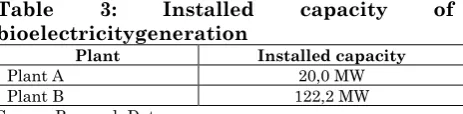
It can be observed that Plant B has a milling capacity of 2.5 million tons higher than Plant A. As discussed earlier, the processing of sugarcane generates a by-product, biomass, which is used as matter In the generation of bioelectricity. In order to identify the structure of the studied plants, the installed capacity of electric power generation of each plant was analyzed. The results are shown in Table 3.
Table 3: Installed capacity of bioelectricitygeneration
Plant Installed capacity
Plant A 20,0 MW
Plant B 122,2 MW
Source: Research Data
As shown in Table 3, the installed capacity for power generation of Plant B is six times greater than the installed capacity of Plant A.
energy generated by the plant has the guarantee of contracting with Eletrobrás for 20 years. Plant A claims not to participate in the program, that is, it does not enjoy the guarantees offered by PROINFA.
With the purpose of analyzing the tradingcharacteristics of the plants in the ACR, it was questioned about the amount of sold bioelectricity and the average selling price perMW, both in the harvest season and in the off-season. The data are presented in Table 4.
Table 4: Quantity and MW price marketed in the ACR
Plant ACR marketed quantity
Price of MW marketed ACR
Plant A 11 to 50 MW R $ 301.00 to R $ 500.00 Plant B 11 to 50 MW R $ 151.00 to R $ 300.00 Source: Research Data
According to Table 4, plants A and B commercialize the same volume of electricity in the ACR. Regarding the price of MW sold, we can observe that Plant A sold the MW of bioenergy at an average price above Plant B, which indicates that they participated in different auctions in the ACR market.
In the same sense, questions were asked regarding the tradingin the ACL market. The data are presented in Table 5.
Table 5 Quantity and MW price marketed in the ACL
Plant ACL marketed quantity marketed ACL Price of MW
Plant A 0 to 10 MW R $ 301.00 to R $
500.00
Plant B 0 to 10 MW R $ 0.00 to R $ 50.00
Source: Research Data
Analyzing Table 05, Plants A and B also tradethe same volume of electricity in the ACL market. With regard to the MW price marketed, we can observe that Plant A sold MW of bioelectricityat an average price above Plant B, both in the harvest season and in the off-season.
Final Consideration
This study was carried out with the objective of analyzing the profile of the plants and the tradingcharacteristics of bioelectricityin the state of Mato Grosso do Su, Brazil. There is evidence through the analysis of data that, Plant B has a much higher milling capacity
than Plant A, and its installed capacity for electricity generation is also bigger, yet both are self-sufficient in energy terms.
The results suggest that if Plant A, producing its total installed capacity to generate electricity (20 MW) and consuming 6 to 10 MW of energy in its production process, will generate a surplus of 10 to 14 MW, Which can be marketed in both ACR market and ACL market.
Plant B already consumes 21 to 50 MW, so it can generate a surplus of 72.2 to 101.2 MW to tradingin both markets. Analyzing the characteristics of the companies covered in the research, itcan say that because they operate in the two environments of
tradingcogenerated electricity and
havesignificant differences in their
productive capacity, they keepnecessary conditions to obtain significant results in relation to the object of this study.
After analyzing the profile, the analysis was
carried out in relation to the
bioelectricitytradingby the ACL market and ACR market. It was verified that both plants sell approximately the same volume of electric energy in the two contracting environments, which indicates that the B plant doesnot useall its potential of electricity cogeneration, allowing it to increase the benefits obtained by the bioelectricity cogeneration.
Regarding the price of MW sold, we can observe that Plant A sold the MW of cogenerated electricity at an average price above Plant B, which indicates that they participated indifferent ACR auctions, due to the sale price established in auctions promoted by CCEE. When considering the FTA negotiations, the average MW price range traded by Plant A is considerably above the value traded by plant B.
The results obtained in this study can be used by millsin the state of Mato Grosso do Sul to identify failures in the negotiations in both the ACR market and the ACL market. In these environments, the definition of marketing strategies is necessary to take advantage of the best opportunities, usually related to the dry season, where the reservoirs of hydroelectric plants are at their lowest levels.
The cogenerated bioelectricity from
sugarcane, in addition to enabling the energy self-sufficiency of the plants, can be
an environmentally correct and sustainable option for Mato Grosso doSul, which can operate with high efficiency and low operational costs in the generation of electricity. Electricity cogeneration can also be considered an important alternative to
the national electricalmatrix, mainly
because it came froma renewable source.
It is suggested that studies be carried out coveringa larger number of plants, with comparative analyzes, aiming to identify other characteristics that influence the
tradingof cogenerated sugarcane
electricityin the state of Mato Grosso do Sul.
References
1.JAM Hipólito, JS Dutra,Remuneração e
recompensas(São Paulo, SP: Atlas, 2012).
2.Unica -União da Indústria de
cana-de-açúcar,Unicadata, Available
in:<http://www.unicadata.com.br>, accessed in: May 20, 2016.
3.RT Cavalheiro, PS Vasconcelos,
Comercialização de energia elétrica cogerada: um estudo no estado de Mato Grosso do Sul, X
Congresso Brasileiro de Planejamento
Energético, Gramado, RS, 2016.
4.PFA Shikida (2013) Expansão Canavieira no
Centro-Oeste: limites e potencialidades,
Revista de Política Agrícola, 22(2):122-137.
5.Biosul - Associação dos Produtores de
Bioenergia de Mato Grosso do Sul, Série Histórica - Exportação de Bioeletricidade, 2016.
Available in:
<http://www.biosulms.com.br/resultados>, accessed in: March 9, 2016.
6.Unica-União da Indústria de cana-de-açúcar,
Bioeletricidade: a energia verde e inteligente
do Brasil, 2011. Available in:
<http://www.unica.com.br/documentos/publicac oes/bioeletricidade/>, accessed in: February 9, 2016.
7.Conab -Companhia Nacional de Abastecimento,
Séries históricas - cana-de-açúcar, 2015.
Available in:
<http://www.conab.gov.br/conteudos.php/conte udos.php?a=1111&t=>, accessed in: February 10, 2016.
8.Biosul-Associação dos Produtores de
Bioenergia de Mato Grosso do Sul, Mapa da
bioenergia, 2016. Available in:
<http://www.biosulms.com.br/bioenergia>, accessed in: March 9, 2016.
9.Inee-Instituto Nacional de Eficiência
Energética, Bioenergia – cana-de-açúcar, 2016.
Available in:
<http://www.inee.org.br/biomassa_cana.asp?Ca t=biomassa, accessed in: January 15, 2016.
10. V Corrêa Neto, Análise de viabilidade da
cogeração de energia elétrica em ciclo combinado com gaseificação de biomassa de cana-de-açúcar e gás natural, masters diss., Federal Universityof Rio de Janeiro, Rio de Janeiro, RJ, 2001.
11. RVD Broek, TVD Burg, AV Wijk, W
Turkenburg (2000) Electricity generation from eucalyptus and bagasse by sugar mills in Nicaragua: A comparison with fuel oil electricity generation on the basis of costs, macro-economic impacts and environmental emissions, Biomass & Bioenergy, 19(5):311-335.
12. PS Vasconcelos, LGT Carpio, Bagasse,
Straws, Tips and Vinasse (2017) From Sugarcane Waste to a Clean and Renewable Bioenergy Source, International Journal Advances in Social Science and Humanities, 5(3):27-37.
13. ACA Mello Dias, CL Bastian-Pinto, LET
Brandão, LL Gomes (2011) Flexibility and
uncertainty in agribusiness projects:
investing in a cogeneration plant,
RAM-Revista de Administração Mackenzie,
12(4):105-126.
14. Aneel - Agência Nacional de Energia
Elétrica, Resolução nº 235, de 14 de novembro de 2006, 2006. Available in:
<http://www.aneel.gov.br>, accessed in:
February 22, 2016.
15. S Ortega Filho, O potencial da agroindústria
canavieira do Brasil, Estudo dirigido USP, 2003.
16. CN Hamelinck, APC Faaij (2006) Outlook for
2004, (Brasília, DF: Diário Oficial da União, 2004).
18. FM Raupp, IM Beuren, Como elaborar
trabalhos monográficos em contabilidade: teoria e prática (São Paulo, SP: Atlas, 2003).
![Figure 1:Bioenergy map of the state of Mato Grosso do Sul Source: Biosul [8]](https://thumb-us.123doks.com/thumbv2/123dok_us/7830141.2089021/2.595.105.500.370.749/figure-bioenergy-state-mato-grosso-sul-source-biosul.webp)