Proceedings of the
Sixth International Workshop on
Graph Transformation and Visual Modeling Techniques
(GT-VMT 2007)
A Query Language With the Star Operator
Johan Lindqvist and Torbjörn Lundkvist and Ivan Porres
12 pages
Guest Editors: Karsten Ehrig, Holger Giese
Managing Editors: Tiziana Margaria, Julia Padberg, Gabriele Taentzer
A Query Language With the Star Operator
Johan Lindqvist and Torbjörn Lundkvist and Ivan Porres
{johan.lindqvist,torbjorn.lundkvist,ivan.porres}@abo.fi
TUCS Turku Centre for Computer Science
SoSE Graduate School on Software Systems and Engineering Department of Information Technologies, Åbo Akademi University
Joukahaisenkatu 3-5A, FIN-20520 Turku, Finland
Abstract: Model pattern matching is an important operation in model
transforma-tion and therefore in model-driven development tools. In this paper we present a pattern based approach that includes a star operator that can be used to represent re-cursive or hierarchical structures in models. We also present a matching algorithm, motivating examples and we discuss its implementation in a modeling tool.
Keywords:Visual languages, Model transformation, Graph query, Graph subgraph
matching
1 Introduction
In the context of model-driven software development, a query language is used to find parts of a model that fulfill some given constraints. A query language is a fundamental element in rule-based model transformation languages. Query languages are also used to define model constraints, where a model is invalid if it does not satisfy the query. Finally, a query language combined with different aggregation operators can be used to compute metrics.
We consider that query languages should be declarative, in the sense that they should state what to search for in a model, but not how to perform the actual search. Also, we are interested in expressive query languages that can define complex patterns in a succinct way. The Object Management Group (OMG) proposes a standard for a model transformation language called Query-View-Transform (QVT) [OMG05a], that contains a query language. The OMG Object Constraint Language [OMG03] can also be used to query models.
In this article we explore the idea of a query language based on graph matching. Our ap-proach can benefit from the fact that modeling languages and models are considered as graphs, since the application of graph theory to computer science provides a solid foundation to model-driven development tools, specially in the area of model transformations [Roz97]. Successful approaches to graph transformation in the context of software development are presented for example in [BH02,VVP02,ARS05].
con-tain hierarchical and recursive structures. Examples of these structures in UML [OMG05b] are package containment hierarchies in class diagrams or state hierarchies in statecharts. As a con-sequence, we often need to specify queries to match recursive structures where the number of elements to match is not known a priori.
In this article, we propose a new query language that supports what we call the star operator. This operator conceptually resembles the Kleene star operation over sets of strings. Used in our query language, it can match against a subgraph that appears repeatedly zero or more times in a graph representing a model. In our opinion, when we combine the star operator with the isomorphism operator that denotes isomorphic matches and the negation operator, that denotes the absence of a match, we can express complex queries by rather using short and intuitive pattern.
We proceed as follows: InSection 2we describe the basics of our query language and provide some examples of queries for the UML language.Section 3presents an overview of a matching algorithm for this query language. The next section discusses the practical implementation of the approach in an experimental modeling tool. Finally, we conclude inSection 5with a description of future work.
2 Regions in a Pattern
In this section we will describe the concept of regions in a pattern, and introduce three operators that can be applied to regions: the isomorphic, star and negation operator.
A pattern consists of a of a typed and directed graph annotated with information necessary to perform a query. The graphs in the patterns are constructed according to a metamodel. The pattern graph can be compared against a target graph. A match occurs if all nodes and edges of the pattern graph can be mapped to a subgraph of the target graph, with respect to the annotations of the pattern graph. The result is a mapping of the pattern and target graphs, which allows the nodes and edges of a pattern graph to be bound to the target graph.
In order to increase the expressiveness of a pattern based query, we have introduced the con-cept of operators and regions in a pattern. Aregion is defined over a connected subgraph of a pattern, such that a node belongs only to one region. In our approach we have defined a region as the scope of a matching operator. As a consequence, a pattern consists of several non-overlapping regions, where each region is associated with an operator. Edges can still connect nodes in sepa-rate regions. Edges that cross the boundaries of a region are calledconnection pointssince they connect two regions. These connection points can be computed from the pattern graph and are used, depending on the operator associated with the region, to validate whether the region fulfills the specific requirements of the operator associated with the region.
Next, we will describe the definition of the isomorphic, negation and star operator applied over a region.
2.1 Isomorphic Regions
isomorphic regions. However, if a pattern consists only of isomorphic regions, the regions could be merged without affecting the result of the pattern matching process.
2.2 Negative Regions
The semantics of a negative region as part of a pattern graph, is that an occurrence of all nodes and edges of a negative region in the target results in a failed match. Since the negation operator is always defined over a region in the pattern, it is possible to model complex negative conditions that involve several nodes and edges. A similar approach where the negation operator is defined over regions can be found in [HHT96].
2.3 Star Regions
In order to be able to describe patterns with recursive or hierarchical structures, we have intro-duced the concept of a star operator. The star operator in a pattern is conceptually similar to the star operator in Kleene algebra [Koz91]. A pattern with a star region can be used to generate a set of patterns where the contents of the star region is inserted an arbitrary number of times and replaced by an isomorphic region. Analogous to the Kleene star operator, the generation of patterns begins with a pattern where the subgraph is not inserted. We will discuss the constraints that apply to valid star regions later in this section.
The structure of the subgraph represented in a star region must follow some specific require-ments. This is necessary, as the patterns used for defining a query as well as new patterns that are generated by expanding the star regions into several subgraphs must preserve the structure defined by the metamodel. To ensure that the star region can be expanded, it needs to have at least two connection points to other regions. This limitation only applies to star regions. These connection points are called the ends of the star region, where one end is incoming and the other end is outgoing with respect to the nodes in the star region. The connection points define the position in the pattern graph where subgraphs generated from the star region are inserted. When the star region is expanded, the outgoing end of each generated subgraph is connected to the incoming end of the next.
Beside the two required ends, the star region may contain other connection points, which are required to connect to the same nodes inside the region as the ends do. These additional con-nection points are associated with either one of the ends and connect the last subgraph generated in the direction of the associated end with another region. If zero subgraphs are generated, all the connection points of the star region thus in effect connect the two regions on either side of the ends of the star region.The star region can contain any number of nodes and edges which are instantiated in each generated subgraph.
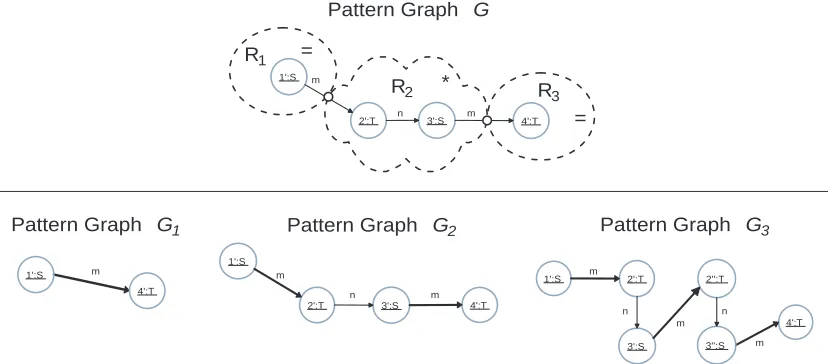
Figure 1shows the generation of patterns based on a pattern with a star region in detail. In
the top part of the figure an example patternG with two isomorphic regionsR1 andR3 and a
star regionR2is shown. R2consists of two interconnected nodes,2’and3’. There are also two
directed edges with labelm, one incoming edge from node1’inR1to2’inR2and one outgoing
edge from node3’inR2to4’inR3. The bottom part of the figure shows three different patterns
that can be generated based onG. The generation of G1 is done by applying a production that
retrieved by replacing the previously rewritten edgeminG1 with an instance of the star region
R2and the edges in the connection points are rewritten. Similarly, the patternG3is retrieved by
again replacing one of the rewritten edges with a new instance of the star region. To make the figures clearer, all rewritten edges are drawn with a wider stroke. These patterns can now be used to find a mapping to a target graph.
1':S
4':T 2':T 3':S
R2
Pattern Graph G
m
m n
R1
R3
=
= *
Pattern Graph G1
1':S
4':T m
Pattern Graph G2
1':S
4':T 2':T 3':S
m
m n
Pattern Graph G3
1':S
4':T 2':T
3':S
2'':T
3'':S m m
n m
n
Figure 1: (Top) A pattern graph formed by two isomorphic regions, R1 andR3, and one star
regionR2. (Bottom) Three possible patterns that could be generated from patternGin the top of
the figure.
Using this approach, it is possible to use a single pattern to describe recursive and hierarchical structures by generating a set of patterns that can be compared to a target graph using subgraph isomorphism.
A star region can be seen as an extension of the concept of multi-objects, or set nodes as defined in PROGRES [SWZ99]. While a multi-object can express multiple instances of a single node, the star region can express multiple instances of a subgraph. We have extended the concept of multi-objects by defining star regions in the query graph, where all connections of the nodes within or at the border of the region are explicit. This extension is also partly due to the fact that a multi-object can have an edge to another multi-object, but it is unclear whether the edge represents a single edge or multiple edges. Other related approaches are the works of graph transformations with variables presented in [MHar,HJE06,Hof05]. Karsai and Agrawal present in [KA03] an approach that allows cardinalities in individual nodes, but it is unclear whether this approach supports whole regions.
2.4 Examples
StateMachine
StateVertex Transition CompositeState
Generalizatio n Class
SimpleState target 0..1 incoming
*
parent
0..1 specializatio n *
outgoing * source 0..1 stateMachine
0..1
top 1
parent 0..1 subverte x
*
stateMachine 0..1
transitions *
child
0..1 generalization * context
0..1 behavior
*
Figure 2: A simplified fragment of the UML 1.4 metamodel.
1’:Class 2’:Generalization 5’:Class
child
parent 3’:Class parent 4’:Generalization child
=
*
=
'5 : '2 :
'1 : Class Generalizatio n '3 : Class '4 : Generalizatio n Class parent child parent child
'1 : Class '2 : Generalization '3 : Class ''2 : Generalizatio n ''3 : Class '4 : Generalization '5 : Class
parent child parent child parent child
Figure 3: (Top) An example of a query with a star region defined over a class and a generalization
and theparentrelation. (Center, Bottom) Two model fragments that matches the query defined
on the top, shown as object diagrams. The mapping is indicated with the corresponding numbers.
syntax similar to UML object diagrams, rather than the concrete syntax of the target modeling language, since the concrete syntax hides information about relations between the objects. In a tool environment, however, creating the queries using the concrete syntax of the modeling language can be beneficial.
In the examples we will use a slightly simplified version of the UML 1.4 metamodel, which is shown inFigure 2.
2.4.1 UML Generalizations
A sample query with two isomorphic regions and a star region is illustrated in the left part of
Figure 3. The star region is marked with a dashed rectangle with the ’*’ symbol, and the
iso-morphic regions with rounded rectangles and a ’=’ symbol. The connection points for the star region are marked with circles at the border of region. The star region contains a UML Gener-alization2’and a Class3’. The Generalization is linked to the superclass1’and the subclass3’
1’:StateMachine 2’:CompositeState
3’:CompositeState
4’:CompositeState 7’:CompositeState
5’:StateVertex 9’:Transition 8’:StateVertex subvertex subvertex subvertex subvertex subvertex top transitions source target
*
*
*
=
=
'2 : '9 : '8 : '5 : '1 : CompositeState Transition SimpleState SimpleState StateMachine transitions top subverte x target subverte x source '2 : '8 : '3 : '5 : '1 : ''7 : '9 : '7 : CompositeState SimpleState CompositeState SimpleState StateMachine CompositeState Transition CompositeState source target top subverte x subverte x subverte xs ubverte x transitions
s ubverte x
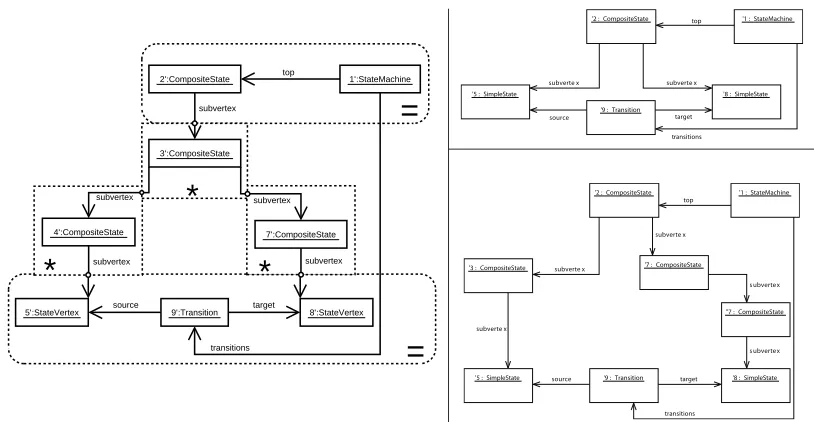
Figure 4: (Left) An example of a pattern that illustrates how transitions are connected to states and state machines. (Right) Two model fragments that matches the query.
the adjacent isomorphic regions. On the right hand side of the figure two different UML model fragments in object diagram syntax are shown that are matches of the query on the left hand side. Here, the mappings between the pattern and the target models are shown using corresponding object names, i.e.,1’in the pattern corresponds to’1in the target. The Generalization2’and the Class3’in the star region were matched once in the first model fragment, and twice in the second model fragment. The pattern can be matched to targets where the star region is mapped to the empty set. This case is not illustrated in the figure. However, that particular case would imply that Class‘1has exactly one subclass‘5.
2.4.2 UML StateMachines
The second example inFigure 4shows a pattern that can be used to query a UML model for a state machine with a transition between two states, where the states are transitively owned by any number of composite states. The state machine owns a composite state inStateMachine.top
that can transitively own other states in theCompositeState.subvertexslot. Transitions, however, are always owned by the state machine, and have associations to two states inTransition.source
andTransition.target.
states (4’and7’). It must be noted, however, that there are three connection points in the star region with composite state3’(one incoming and one outgoing edge). This is possible, since a composite state can have any number of subvertices. When this star region is expanded to two or more isomorphic regions, only one of these connection points is used to connect the next occurence, as described inSubsection 2.3.
The right side ofFigure 4 shows two model fragments that could be matched with patterns generated from the pattern on the left. Due to the fact that each star region can individually be expanded, it is possible to model all these different compositions for a state machine with a transition in one single pattern. This query can be seen as a validation that a transition has been inserted correctly in a statechart. Although the structure of state machines have changed remarkably in UML 2.0, a relatively similar pattern with a larger amount of elements are required for the UML 2.0 counterpart.
3 Matching Algorithm
In this section we will present a matching algorithm for patterns with isomorphic, star and nega-tive regions.
We have discussed an intuitive interpretation of the query language where star regions are expanded into regular graphs. In practice, the actual patterns are not expanded prior to matching since an arbitrary number of possible patterns should be generated. Instead, the star regions are expanded during pattern matching, and only as far as valid mappings against the target graph are found.
The algorithm presented below is used to match the pattern against the target graph and expand the star regions. To match individual regions, any traditional graph matching algorithm may be used; we have used an algorithm based on CSP [Tsa93] and VF2 [CFSV01, CFSV04], as presented in [Lil06].
The result of the matching algorithm is a set where each element is a mapping from the pattern graph to the target graph. In every such mapping, each node in an isomorphic region in the pattern is mapped exactly once, each node in a negative region exactly 0 times and each node in a star region 0..n times. A node in the target graph can be mapped only once in each mapping.
The algorithm is split into two functions—query and matchRegion. Query initializes the matching by selecting the region to start from, invokes the recursive matchRegion and lastly discards any results where negative regions are successfully matched. Generally, the fewer map-pings we find for the first isomorphic region matched, the faster the algorithm will work. There-fore, we generally start from the largest isomorphic region in the pattern as we are likely to find relatively few mappings for that region.
1query(pattern,target):
2 r←choose one isomorphic region inpattern
3 mappings←matchRegion (r, {},target, {}) 4 for eachnegative regioninpattern:
5 c←a connection from a non-negative region tonegative region
The function matchRegionrecursively traverses the regions in the pattern, attempting to ex-pand the mappings found until all regions have been matched. When this function is called, we either have the situation where no mappings have been passed, or where one or more neighbors of the passed region have been matched in the inputMapping. In the first case (lines 2–3), the function starts by finding all valid mappings for the passed region, in the second case (lines 5– 18), it identifies a set of candidate mappings for the partial pattern consisting of all previously matched regions and the passed region, i.e. a set of mappings where the most recently matched connection point of the passed region is satisfied (lines 5–11). The matching is done recursively for star regions, implementing the pattern generation described inSubsection 2.3(lines 12-16).
The function then checks that all other connection points to previously matched regions are satisfied, thereby ensuring that the mapping is valid, i.e. that the topology of the candidate mapping is consistent with that of the pattern (lines 17–18). At this stage we have identified all valid mappings for the partial pattern matched so far and continue with the next region in lines 19–20.
A note on connection points: In this algorithm, we assume that each connection point consists of two nodes in separate regions that are connected through an edge. A connection point is satisfied by a mapping where the two nodes are mapped to nodes in the target graph that are likewise connected. There is an implicit connection point between the two ends of a star region which is dealt with on line 13 below. The connection point between the region to match and the previously matched region is passed on tomatchRegionas a parameter in order to identify a starting node for matching.
1matchRegion(region,inputMapping,target,connection): 2 ifinputMappingis empty:
3 Mappings←all valid mappingsregion→target
4 else:
5 Mappings←{}
6 starting node←the node inregionconnected throughconnection
7 find all mappingsstarting node→target nodesatisfyingconnection
8 for eachtarget nodein these mappings:
9 start withinputMappingplus a mappingstarting node→target node
10 from there, find all valid mappingsregion→target
11 add these mappings toMappings
12 ifregionis a star region:
13 c←connection to next instance of star region to be mapped 14 for eachMappinginMappings:
15 replaceMappingwithM←matchRegion (region,Mapping,target,c) 16 addinputMappingtoMappings
17 for each matchedneighborofregion:
18 discard allMappingswhere a connection betweenregionandneighboris not satisfied 19 for each connectioncto a non-negative, unmatchedneighborofregion:
20 replace eachMappinginMappingswithM←matchRegion (neighbor,Mapping,target,c) 21 returnMappings
4 Validation and Applications
QueryElement Element Pattern
Region
+ ignoreProperty : [ * ] + isIsomorphic :
+ isNegative : + isStar : + isMaximal :
String Boolean
Boolean Boolean
Boolean
container
0..1
region
0..1 queryElement *
abstractElement 1 pattern
0..1
region *
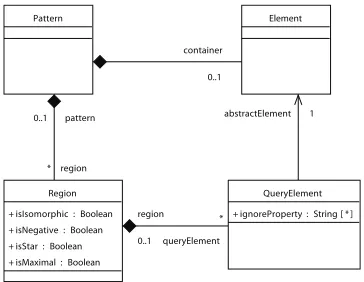
Figure 5: The CQuery Metamodel
4.1 Validation
The main idea in the design of the CQuery language is that the base of the pattern is a model in the target language. The CQuery language consists of elements that extend a modeling language to include information to control a query. That is, the pattern consists of a model fragment in the target language, annotated with query configuration in the CQuery language. Since the CQuery language itself is separated from the modeling language of the target, the target language does not have to be modified to support CQuery.
We have chosen this approach for two reasons: First, there is no need to have a separate component that verifies that the patterns are possible to construct using the target metamodel, since adherence to the metamodel is implicit. Second, we believe that the creation of patterns is easier, since a significant part can be constructed as any other model in the target modeling language. However, this approach does not prevent the queries being presented in any particular syntax, including the concrete syntax of the target modeling language or a more general object diagram syntax. A discussion on using the concrete syntax of a modeling language in model transformation rules can be found in [BW06].
The CQuery metamodel is shown inFigure 5. The metamodel is rather small, containing only 3 metaclasses, where theElementcan point to any abstract model element, and hence is not di-rectly a part of the CQuery language. The base element is Pattern, which acts as the starting point of a query. EachPatternconsists of a set ofRegionsand an abstractcontainer element which is an element in any modeling language. This element owns all model elements in the pattern which are not annotations of CQuery. A Region is either an isomorphic, a negative or a star region. This is indicated by the corresponding flags. However, only one of these flags can be set for a particular region in a pattern. ARegionconsists of an arbitrary number ofQueryElements. TheQueryElementcontains information to control which attributes and outgoing edges should be ignored when matching a single element. In a well-formed pattern, all abstract elements have a correspondingQueryElement, and allQueryElementsare owned by aRegion.
con-crete syntax, it is still possible to create queries, but without the benefit of having diagrams. The matching engine in CQuery is based on the algorithm described inSection 3 and [Lil06]. The algorithm is based on the VF2 and CSP algorithms and facilitates search planning and backtrack-ing.
All star regions can optionally set anisMaximalflag. This flag can be used to indicate whether the matching engine should attempt to expand a star region a maximal number of times, instead of attempting to match an adjacent region to a subgraph that could actually be seen as a match to the star region. This feature can be very useful since an application that uses CQuery does not need to evaluate all possible matches if the point of interest is only the maximal possible matches of the star region. It must, however, be noted that although theisMaximalflag is set, this does not rule out the possibility that a star region could match a target graph where the star region had no occurrences.
4.2 Applications
The CQuery implementation is used by a variety of components and add-ons in the Coral tool. The most straightforward application of CQuery is a model search facility. In this component it is possible to load a set of query patterns defined in the Coral tool and search for occurrences of a pattern in open modeling projects. The results of the CQuery based search are reported as a set of mappings between elements in the query pattern and the target model.
We have also implemented a constraint evaluation component based on CQuery. This compo-nent is an integral part of the Coral tool, and uses a set of CQuery patterns to detect if modeling language constraints orwell-formedness ruleshave been violated. This component is based on an approach where user models are continuously checked for errors. If an error is detected, the offending elements are reported along with an explanation, or a suggestion for correcting the problem. An example of how this constraint evaluation component has been used in a domain-specific language for System-on-Chip design called MICAS, can be found in [LLL+05].
Another application is a generic model to text transformation engine [Nym06], which uses the CQuery language as the query facility. This application can e.g. be used for generating source code or documentation based on UML models.
Perhaps the most ambitious use of CQuery is a transformation engine based on the double pushout approach [Roz97]. The transformation rules are given as a pair of a left-hand side (LHS) and a right-hand side (RHS), and an explicit mapping between the LHS and RHS. This transformation engine uses CQuery for matching the LHS to an occurrence in a model, and to specify the RHS. The transformation engine has support for negative, isomorphic regions and star regions, and provides in-place transformation of models. The transformation engine is extensively used in the Coral tool for defining the rules for editing models, e.g. inserting states or transitions in a statechart, or classes and associations in class diagrams. We have found that especially the star regions are necessary when defining model editing transformations in UML, where complex hierarchies of model elements occur frequently. Using the star region, we have been able to reduce the number of model transformation rules to define the editor.
5 Conclusions and Future Work
We have presented a query language for model-driven development applications that introduces the concept of star regions to represent hierarchical and repetitive structures. This query language has been implemented in a modeling tool and used successfully in different applications based on UML and other domain-specific modeling languages.
There are two clear future directions. First, introduce new region operators, such as cardinality or disjunction. However, the need for these new operators should arise from actual modeling tools. Also, we are studying the application of our query language to model transformations. In fact, a model transformation tool component based on CQuery has already been implemented and we plan to present these results in the near future.
Bibliography
[ARS05] C. Amelunxen, T. Rötschke, A. Schürr. Graph Transformations with MOF 2.0. In
Giese and Zündorf (eds.),Fujaba Days 2005. September 2005.
[BH02] L. Baresi, R. Heckel. Tutorial Introduction to Graph Transformation: A Software
Engineering Perspective. In Corradini et al. (eds.), Proc. Graph Transformation - First International Conf., ICGT 2002, Barcelona, Spain. LNCS 2505. Springer, 2002.
[BW06] T. Baar, J. Whittle. On the Usage of Concrete Syntax in Model Transformation
Rules. Technical report LGL-REPORT-2006-002, 2006.
[CFSV01] L. P. Cordella, P. Foggia, C. Sansone, M. Vento. An improved algorithm for
match-ing large graphs. InProceedings of the 3rd IAPR-TC-15 International Workshop on Graph-based Representations. Italy. Pp. 149–159. 2001.
[CFSV04] L. P. Cordella, P. Foggia, C. Sansone, M. Vento. A (Sub)Graph Isomorphism
Algorithm for Matching Large Graphs. IEEE Trans. Pattern Anal. Mach. Intell.
26(10):1367–1372, 2004.
[HHT96] A. Habel, R. Heckel, G. Taentzer. Graph grammars with negative application
condi-tions.Fundamenta Informaticae26(3-4):287–313, 1996.
[HJE06] B. Hoffmann, D. Janssens, N. V. Eetvelde. Cloning and Expanding Graph
Transfor-mation Rules for Refactoring.Electr. Notes Theor. Comput. Sci.152:53–67, 2006.
[Hof05] B. Hoffmann. Graph Transformation with Variables. InFormal Methods in Software
and Systems Modeling. Pp. 101–115. 2005.
[KA03] G. Karsai, A. Agrawal. Graph Transformations in OMG’s Model-Driven
[Koz91] D. Kozen. A Completeness Theorem for Kleene Algebras and the Algebra of Regu-lar Events. InLogic in Computer Science. Pp. 214–225. 1991.
[Lil06] T. Lillqvist. Subgraph Matching in Model Driven Engineering. Master’s Thesis in
Computer Science, Department of Information Technologies, Åbo Akademi Uni-versity, Turku, Finland, March 2006.
[LLL+05] J. Lilius, T. Lillqvist, T. Lundkvist, I. Oliver, I. Porres, K. Sandström, G. Sveholm,
A. Pervez Zaka. An Architecture Exploration Environment for System on Chip De-sign.Nordic Journal of Computing12(4):361–378, 2005.
[MHar] M. Minas, B. Hoffmann. An Example of Cloning Graph Transformation Rules for
Programming.Electronic Notes in Theoretical Computer Science, To appear.
[Nym06] M. Nyman. A Model-Based Approach to Text Generation from Software Models.
Master’s Thesis in Computer Science, Department of Information Technologies, Åbo Akademi University, Turku, Finland, May 2006.
[OMG03] OMG. UML 2.0 OCL Specification. October 2003. Document ptc/03-10-14,
avail-able athttp://www.omg.org/.
[OMG05a] OMG. MOF 2.0 Query / View / Transformation Final Adopted Specification.
November 2005. OMG Document ptc/05-11-01, available athttp://www.omg.org/.
[OMG05b] OMG. UML 2.0 Superstructure Specification. August 2005. Document
formal/05-07-04. Available athttp://www.omg.org/.
[Roz97] G. Rozenberg (ed.). Handbook of Graph Grammars and Computing by Graph
Transformations, Volume 1: Foundations. World Scientific, 1997.
[SWZ99] A. Schürr, A. J. Winter, A. Zündorf. The PROGRES Approach: Language and
Envi-ronment.Handbook of Graph Grammars and Computing by Graph Transformation: Vol. 2: Applications, Languages, and Tools, pp. 487–550, 1999.
[Tsa93] E. Tsang.Foundations of Constraint Satisfaction. Academic Press, London and San
Diego, 1993.
[VVP02] D. Varró, G. Varró, A. Pataricza. Designing the Automatic Transformation of Visual
Languages.Science of Computer Programming44(2):205–227, August 2002.