International Colloquium on Graph and Model
Transformation On the occasion of the 65th birthday of
Hartmut Ehrig
(GraMoT 2010)
From Graph Transformations to Differential Equations
Mayur Bapodra and Reiko Heckel
21 pages
Guest Editors: Claudia Ermel, Hartmut Ehrig, Fernando Orejas, Gabriele Taentzer Managing Editors: Tiziana Margaria, Julia Padberg, Gabriele Taentzer
From Graph Transformations to Differential Equations
Mayur Bapodra and Reiko Heckel
Department of Computer Science, University of Leicester, UK
{mb294, reiko}@le.ac.uk
Abstract:In a variety of disciplines models are used to predict, measure or explain quantitative properties. Examples include the concentration of a chemical substance produced within a given period, the growth of the size of a population of individuals, the time taken to recover from a communication breakdown in a network, etc.
The models such properties arise from are often discrete and structural in nature. Adding information on the time and/or probability of any actions performed, quan-titative models can be derived. In the first example above, commonly referred to as kinetic analysis of chemical reactions, a system of differential equations describing the evolution of concentrations is extracted from specifications of individual chem-ical reactions augmented with reaction rates.
Recently, this construction has inspired approaches based on stochastic process specification techniques aiming to extract a continuous, quantitative model of a sys-tem from a discrete, structural one. This paper describes a methodology for such an extraction based on stochastic graph transformations.
The approach is based on a variant of the construction of critical pairs and has been implemented using the AGG tool and validated for a simple reaction of unimolecular nucleophilic substitution (SN1).
Keywords: stochastic graph transformations, chemical reactions, law of mass ac-tion, ordinary differential equations
1
Introduction
In chemistry, understanding the kinetics of reactions, i.e, the evolution of concentrations of chem-ical agents over time, is essential for a variety of purposes ranging from the interpretation of ex-periments in the lab to the planning of large scale industrial systems. Analogies between chem-ical reactions and rewriting have inspired approaches like CHAM [2] where chemical reactions serve as a paradigm for concurrency, or Kappa [8] focussing on modelling biological systems. In graph rewriting the modelling of chemical reactions has been studied in [7]. The idea is to present molecules as graphs (or graph expressions) and to formalise reaction equations as graph or term rewrite rules. Such an encoding offers opportunities for cross-fertilisation, transferring concepts, problems, and ideas between chemistry and computer science.
[15], for large, complex reaction networks automation is required. We provide the formalisa-tion necessary for automating the approach and conduct a feasibility study based on a prototype implementation. More generally, we hope to contribute to bridging the gap between discrete modelling techniques focusing on change of structure and continuous ones modelling quantita-tive changes. While focussing on chemical reactions, the technique is a general one and could be applied to other systems that can be described in a similar way.
Specifically, our approach is based on stochastic graph transformations [11] which combine rules to capture the reactive behaviour of the system with a specification of rate constants govern-ing the speed at which the reactions occur. We have studied (and continue to do so) the problems of stochastic simulation and model checking of such specifications [13,16]. These analysis ap-proaches suffer from scalability issues in terms of the size of the populations considered (such as the number of starting molecules allowed in the system). Ordinary differential equations are an alternative level of abstraction less prone to this problem.
This paper is organised as follows. First, a treatment of background and related work is given. This is followed by a formal description of the derivation of ODEs from graph transformation systems. Then our case study of the SN1reaction is introduced, and the results obtained by the analysis are given, including a short discussion of tool support. Finally, the conclusion contains a discussion of required further work, and ways to evolve the current methodology.
2
Background
The derivation of ODEs from behavioural specifications is based on (variations on) the law of mass action. In chemistry, this law uses reaction rates of rules at the level of individual molecules reactions to predict the evolution of concentrations of substances in large quantities.
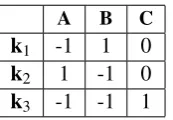
In order to state the dynamics of a chemical system in terms of ODEs, the complete set of possible reactions in the system must be known. For each reaction, we must also know how many molecules of each species are consumed and produced by that reaction. We build up what is known as a stoichiometric matrix which relates each elementary reaction to each molecular species in the system by the aggregate effect the reaction has on that species’ population. Con-sider the following 3 elementary reactions which comprise an example reaction mechanism.
A−→k1
B B−→k2 A A + B−→k3 C
The kx values are rate constants for each of these reactions. The rate law of any elementary
reaction is defined as the product of a rate constant for that reaction (e.g. k1for the first reaction) with the concentrations of any reactants needed in the initiation of that reaction (e.g. the concen-tration[A]of A for the first reaction). The rate law gives us an indication of the “speed” at which that elementary reaction goes. The rate laws for the reactions above are given respectively as
To obtain an ODE for this reaction system with respect to a particular reactant we consider how each elementary reaction affects the population of that reactant. For example, A is con-sumed once by k1, produced once by k2, and consumed once by k3. To get an ODE for A, we multiply how many net molecules of A are produced by a reaction (negative values indicate net consumption) by the rate law for that reaction, and sum over all of the rate laws. For A, this gives:
d[A]/dt = k1[A] + k2[A] - k3[A][B]
From the procedure above, it is clear that all that is needed to derive these ODE’s is an indica-tion of what effect each reacindica-tion has on each chemical species in the system. This informaindica-tion is entirely contained in the stoichiometric matrix described above. The rate laws are extracted by multiplying the rate constant for each reaction by the concentrations of every molecule needed to initiate the reaction. If we do this for every elementary reaction, we can produce a rate law vector of lengthn, wherenis the total number of elementary reactions. A multiplication of this vector and the stoichiometric matrix produces a system of ordinary differential equations:
d[X]/dt=S·R (1)
where d[X]/dt is the differential with respect to time, t, of a chemical species, X, in the system,Sis the stoichiometrix matrix, andRis the rate law vector. Thus, the derivation of ODEs is straightforward once the stoichiometric matrix is established.
A B C
k1 -1 1 0 k2 1 -1 0 k3 -1 -1 1
Table 1: Example stoichiometric matrix
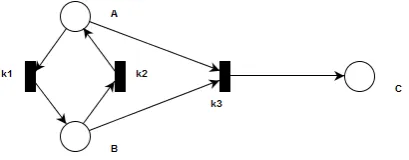
The stoichiometric matrix for our simple example reaction mechanism is given in Table 1. This can be seen as an incidence matrix for a simple net with places A,B,C and transitions
k1,k2,k3, shown in Figure1. As discussed in Section2, a Petri net whose transitions are labelled by rate constants can be translated into a system of ODEs in much the same way as a system of reaction equations [10]. In fact, starting out from the incidence matrix of the net, the ODEs can be written out immediately following the matrix equation (1) above. It therefore suffices to encode the graph transformation system into a place transition net, which is the aim throughout the rest of this section.
3
Related Work
Figure 1: Place Transition Net representing reaction mechanism of Table1
into ODEs. PEPA [14], a stochastic process algebra that incorporates rate information into com-munication activities, can express a reaction system as a set of interacting sequential components. These interactions can be expanded to a state representation of the reaction system, from which an activity matrix bearing a resemblance to the stoichiometric matrix can be extracted. The sto-ichiometric matrix describes the consumption or production of chemical species by individual reactions and is a necessary ingredient to the derivation of ODEs (see Section4).
As described in Section2, this matrix bears a close similarity to the incidence matrix of a Petri net, so it comes as no surprise that nets have been utilised to the same end. In [10] it is described how a discrete Petri net can be converted into a continuous one by allowing places to have a positive real number of tokens representing the concentration of that particular chemical species in the system. The ODEs can be deduced from the incidence matrix for such a Petri net.
Both the process algebraic methods above and the Petri net method are limited in that the specification of reactions requires the molecules involved to be defined in their entirety. For an extremely large reaction network comprising hundreds of reactions between molecules, such a specification becomes unfeasible. In contrast, we follow the work of Faeder et. al [8] and Feret et. al [9] in using a rule-based approach. Here, we model reactions at the level of functional groups rather than entire molecules. Reactions are described by local context, depicting only those elements that are directly involved in the reaction [5]. In this way, a fully defined set of concrete reactions between all reacting species is reduced to a smaller set of reaction rules that can be contextualised to fit possibly numerous specific pairs of reactants.
The BioNetGen Language (BNGL) [8] is a versatile rule-based modelling language, developed with biochemical networks in mind. The language can be used to specify rules and starting reactants as terms, which can be visualised graphically. To give a continuous numerical solution for the ODEs representing the system, the BioNetGen software constructs the entire reaction network via the systematic and exhaustive application of rules to a set of seed species, and their subsequent derivatives, until no further change occurs.
In contrast to measuring the concentration of species, [9] introduces the concept of “coarse-graining”, where so-called fragments are an alternative unit of dynamics. Fragments are sub-graphs of species and can be envisioned as the smallest units at which the system can make distinctions on the dynamics. This reduces the ODEs necessary to describe a system to a much smaller set, as one fragment encapsulates a number of species, including their reactivity. Frag-ments are constructed directly from the rules according to a number of constraints. The mod-elling language used is Kappa, which again has an algebraic and a graphical representation.
trans-formation theory to understand the relationship between the two fields and explore possible mu-tual benefits. Specifically, we attempt the derivation of ODEs via critical pair analysis of graph transformation rules. This is essentially a combination of the static analysis approach in [9] with the BNGL method in [8] which requires an enumeration of the chemical species in the system. However, where BNGL requires execution of the rules on a set of seed species (which may require numerous instances of each starting reactant), our method only requires the starting ma-terials to be defined more generally, without considering repeated instances. The adherence to a graphical representation is particularly useful in reducing the semantic gap between the model and real chemistry [3,18], since graphical representations potentially bear a conceptual similar-ity to structural formulae used in Chemistry. Atoms (or molecular species, for a higher level of abstraction) can naturally be seen as nodes in a graph, with the bonds between them represented as bi-directional edges.
We differ slightly from both the approaches in that we attempt to define a more general con-sideration of rate constants. In Chemistry, the reactivity of a site in a molecule (and therefore the rate constants for reactions involving that site) can be affected by additional context, possibly several positions away in the carbon chain. This additional context may not be a defining part of the functionality of that site, and therefore would not necessarily be included in the rule that captures that functionality. In both the coarse-grained and BNGL approaches, to account for this additional rate-altering context, a general rule must be expanded to include that context, so that a different rate constant can be assigned. This can be seen as an instantiation of the general rule so that it is applicable in a more specific instance. In both approaches, the instantiation must be done manually. In our approach, we automatically instantiate all general rules to apply to spe-cific, singular molecular context so that a distinct rate constant can be applied to each of these instantiated reactions. We make the assumption that additional context always has an effect on the rate constant. Also, this instantiation may be important in systems outside the chemical and biological realms. As our aim is to avoid restricting the application domain, we incorporate this generalisation into the methodology presented here.
4
From Graph Transformation to ODEs
As stated in Section2, the problem of deriving ODEs from a stochastic graph transformation system can be reduced to encoding the system into a suitable place-transition net. Before de-scribing this process, in this section we will first discuss the modelling of chemical molecules by graph transformation systems.
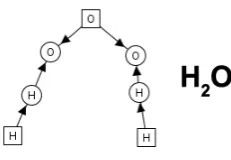
In [7], hypergraphs [6] are used to represent molecules, with hyperedges modelling atoms or molecular subgroups and nodes representing bonds. We follow a similar approach, but use bipartite graphs instead, where both atoms and bonds are represented as nodes. Bond nodes are connected to atom nodes by edges. Edges connect bond nodes with each other. Figure2
illustrates this in the case of a water molecule. This representation allows us to use tools such as AGG to analyse a system of reaction rules. Formally, we follow the double-pushout approach [6] to the transformation of typed graphs.
Figure 2: Graph representingH2O. Atoms are square nodes (with their chemical symbol given by the node label), while round nodes represent bonding capacity for that element. The square
Onode is connected to two two roundOnodes, since oxygen has a valency of 2.
span of injectiveT G-typed graph morphismsπ(p) = (L←−l K−→r R). The subset ofT G-typed graphs satisfying the constraintsCwill be denoted byGra(T G,C). The applicationG=p,⇒m Hof
pat a matchm:L→G, subject to the usual gluing conditions, is defined by a double-pushout construction. In this paper, we only consider transformations at injective matches. We assume that rule applications preserve the validity of constraints, i.e., ifG=p,⇒m H, thenG∈Gra(T G,C)
impliesH∈Gra(T G,C).
Graph transformation systems can model structural transformations of molecules. Stochastic graph transformation adds the potential of representing quantitative properties of reactions, such as the inherent speed at which they occur. In a chemical system, the reaction speed is captured by the rate constant as a measure of the reactivity of the given components. Assigning rate constants (or rates for short) to rules of a graph transformation system we obtain a stochastic graph trans-formation system. Formally a stochastic graph transformation systemS G = (T G,C,P,π,ρ) consists of a graph transformation system(T G,C,P,π)and a functionρ :P→R+ assigning to each rule name the rate of an exponential probability distribution governing the delay of appli-cation once the rule is enabled [11].
As anticipated, our approach consists in deriving from a graph transformation system the incidence matrix of a PT net. This matrix can be seen as stoichiometric matrix and, combined with the rates, gives rise to a system of ODEs. However, not all graph transformation systems can be translated into PT nets without loss of information. We first identify a class ofaccountable
systems where this translation is straightforward, then show how to map a wider class of GTS into accountable ones.
Definition 1 (accountable GTS) Given a graph M, called molecular pattern, the number of occurrences of M in a graph G, denoted #G(M), is the number of injective graph morphisms fromMtoG. For each graphG∈Gra(T G,C)this defines a multiset #G:M →N.
A graph transformation system G = (T G,C,P,π) is accountable to a set of graphs M if there exists anaccounting function acc:P×M →Zsuch that for all transformationsG=⇒p H
andM∈M,acc(p,M) =#H(M)−#G(M)is the (possibly negative) growth of the number of occurrences ofMfromGtoH.
Given a GTSG accountable toM, we can define an equivalent place-transition net with set of transitions P, set of places M and incidence matrix I given by I(p,M) =acc(p,M). The challenge is therefore to derive from an existing stochastic GTS an equivalent one that satisfies the accountability property. We will do so by replacing the rules of the given system by sets of instances, obtained from the original rules by embedding into larger context.
Formally, the relation between a rule and its instantiation is described by a DPO diagram which, for this purpose, is regarded as a vertical morphism between two rule spans.
Definition 2(DPO morphisms) Given spanss= (L←−l K−→r R)ands0= (L0 l
0
←−K0 r
0
−→R0), a
DPO morphism s−→e s0consists of a triple of graph morphismseL:L→L0,eK:K→K0,eR:R→
R0such that the two resulting squares form a double-pushout diagram. Unless stated otherwise, we will assume that all DPO morphisms are injective. Two spans are isomorphic if there exists an isomorphism between them in the category of rule spans and DPO morphisms.
The problem is to derive an accountable system while preserving the rewrite relation generated by the GTS. We will do so by step-wise refinement of the rules of the system. In a refinement, rules are replaced by sets of instances preserving the rewrite relation, i.e., every step of the original ruleG=p⇒Hcan be simulated by one of its instances. In terms of item 2 below,s−→o t
is the original step and its factorisation intos−→e s0−→d tshowss0as instance ofsas well as its application to the bottom spantof the transformation.
Definition 3(refinement) For a rulesand a set of rulesS0 over the same type graph,sCS0is a refinement if
1. for eachs0∈S0there exists a DPO morphisms−→e s0;
2. for all DPO morphisms s−→o t, there existss0∈S0 such thatofactorises overs0, that is, there are DPO morphismss−→e s0−→d tsuch thatd◦e=o;
3. there are no isomorphic copies, i.e.,s0∼=s00∈S0implies thats0=s00.
Given a graph transformation system G = (T G,C,P,π) and a refinement π(p)CS0p for each
p∈P, a refined GTSG0= (T G,C,P0,π0)is given by
• P0= S
p∈P
{p} ×S0p
• π0(hp,s0i) =s0
An accountable refinement is one whereG0is accountable.
Hence, rule names inP0 are pairshp,s0iof a rule name inPand an instances0 of the corre-sponding rule spanπ(p), with the mappingπ0 defined as projection returning s0. Note that, in particular,sC{s}is a refinement of a span by itself.
Definition 4(pattern-based refinement) Given a graph transformation systemG = (T G,C,P,π) and a set of patternsM, we define a family of rule refinements(π(p)CS0p)p∈Pto determine a
refined systemG0as described in Def.3. For all rulespsuch thatπ(p)is not an identity, consider all diagrams of the shape shown in the left (or right) of Fig.3such that
• π(p) =s= (L←K→R)andM∈M;
• the vertical arrowsL→G,K→D,R→Hform an (injective) DPO morphism;
• mis injective,mandl(ormandr, resp.) are jointly surjective;
• m(M)6⊆l(L)(orm(M)6⊆r(R), resp.);
• there is no morphismnsuch thatg◦n=m(orh◦n=m, resp.)
Then, for each p∈P, rule refinementS0pis obtained as a system of representatives for the set of spanss0= (G←D→H)derived at the bottom of either the left- or the right-hand side diagram in Fig.3. That means,S0pcontains exactly one representatives0of each isomorphism class[s0]of spans inS0p.
Otherwise, ifπ(p)is an identity, setSp0 ={π(p)}.
M m n '' (L l ~~~~ ~~~ K oo
//R)
=πi(p) =
Goo g D //H
(L
K
oo
//R)
r @ @ @ @ @ @ @ M m n ww
Goo D
h //H
Figure 3: Rule instance consuming M (left) and rule instance creating M (right)
Such a construction can be realised using critical pair analysis as implemented in the AGG system. For this purpose, the pattern graphMcan be seen as an identity ruleM←M→M. The diagram in Fig.3on the left represents a critical pair between rule pand identity rule M, i.e., the occurrence ofMis destroyed by the application of rule p. Similarly, a potential sequential dependency between rulepand identity ruleMmeans that the occurrence of the pattern is created by the rule. In the following section we will demonstrate how, in a sample chemical reaction system, the systematic critical pair and dependency analysis between reaction rules and identity rules (patterns) yields the stoichiometric matrix needed to derive ODEs.
The following proposition guarantees that in the case of graphs representing sets of molecules, the refinement is well-defined and stepwise refinement leads to an accountable system.
Proposition 1 Assume a GTSG = (T G,C,P,π)and a set of patternsM, such that graphs G
satisfy the constraints C if and only if they can be presented as coproducts over copies of patterns G=M1+· · ·+Mn for Mi∈M (not necessarily distinct). In this case, S0p as defined above is
Proof. First, we show that patten-based refinement is indeed a refinement in the sense of Def.3, i.e., that the instances generated by the diagrams in Fig. 3satisfy Def.3 (1-3). Items 1 and 3 follow directly from Def.4. For item 2, assume a DPO morphisms−→o twitht= (X←−x Y−→z
Z)andoL:L→Xthe left-hand component. By assumption,X=M1+· · ·+MnforMi∈M. Pick
oneMisuch thatMi∩oL(L)6=/0 and there is no morphismy:Mi→Y such thatx◦y=i:Mi→X
isMis coproduct injection. That means,Miis destroyed by the transformation. Such a choice for
Miexists if rulepis deleting.
LetMi+L fL
−→G−→dL Xbe the epi-mono factorisation of the unique morphism induced by the universal property of the coproductMi+Lwith respect to injectionMi→X=M1+· · ·+Mnand
matchoL:L→X. Composed withL’s injection, this leads to a factorisationL→Mi+L fL
−→
G−→dL XofoLoverG, which extends to a factorisation of the DPO morphismo:s→tover the
spans0=G←D→H.
Dually, if the rule creates at least one element, we will find anMi that is created by the
trans-formation. By the symmetry of the DPO diagram, the same arguments yield a similar decompo-sition. That means, for non-identity rules, every DPO morphism can be factorised as required. For identity rules, the factorisation is given trivially over the original rule span.
To see that a finite number of refinement steps will produce an accountable system, observe thatoL(L)only overlaps with finitely manyMis. In every instance of the construction described
on the left of Fig.3, we extendLby anMithat is not already contained inL. As an end result, all
non-identity rules will be refined into the formM1L+· · ·+MnL
L←M
K
1 +· · ·+MnKK →M
R
1+· · ·+
MnR
R and their applications will be disconnected from the context. That means, each application
will destroy exactly the occurrences of patterns that are part ofLand not inK and create those that are inRbut not inK.
In the next section we are going to apply these notions to an example from Chemistry.
5
Case Study - the SN
1reaction
In applying the methodology described in the preceding section, we start with a GTS consisting of general, generic reaction rules. We then refine the system such that it satisfies the accountabil-ity property. From the resulting system we derive the incidence matrix of a PT net which, at the same time, provides a representation of the stoichiometric matrix for the reaction system from which we can derive the ODEs directly.
5.1 The Graph Transformation System
Figure4shows the type graph used for modelling this simple reaction. The type graph captures the necessary conditions to restrict the bonding of atoms, their valencies (the total number of bonds a particular atom is allowed to have) and any other idiosyncrasies of molecular chemistry. In Figure 4, atoms are represented as square nodes, each distinct species of reactive interest having its own node type. The round nodes are atom-specific bonding nodes. A bond between atoms is represented by an edge (arrows with filled arrowheads) between two of these bonding nodes. Each bonding node is connected to only one atom node. Each atom node has an exact number of bond nodes it can connect to, which is established using cardinalities between the two types of nodes (the numbers alongside the edges). For example, an O atom can only have two bonds. In this way, the valency of each species is established.
Figure 4: Type graph for SN1reaction, produced in AGG
The type graph also exhibits inheritance (arrows with unfilled arrow heads). All bonding nodes are subtypes of the generic BondNodetype. This enables us to more easily specify the allowed edges between each pair of bonding node types. Inheritance is only used in the type graph and constraints, while rules are only given over types that are leaves in the hierarchy. Type graph and constraints are mechanisms to check the validity of a start graph, or a derived graph before committing the applied transformation, in much the same way that database constraints are evaluated in a transaction.
Note that C and C+, for example, have the same bonding node type (C) associated with them. If a reaction rule changes the charge of an atom, the atom node must first be deleted, and then a new charged one introduced in its place, so no mapping can exist between the neutral and charged atom on the left-hand side and RHS of the rule respectively. By maintaining that both node types can be connected to the same bonding node, the mapping for the bonding node of the changing atom can remain constant. This allows us to indirectly track the identity of atoms even if their charge changes throughout a reaction.
constructs an overlap between the graphs on the left-hand side and RHS of rules, a lower number of nodes in these graphs results in a lower number of overall overlappings, and a smaller number of nodes and edges in each overlapping. This in turn results in a quicker and more efficient analysis. A single CH3node, if expressed in terms of C atom nodes, H atom nodes, C bonding nodes, H bonding nodes and the edges between them, would constitute a total of 10 nodes. This abstraction of atomic structure into groups is carried out in Chemistry also, in the drawing of structural formulae, and is valid if and only if no reaction rules can be applied to the full atomic representation of the abstracted group. This can be statically checked using the analysis technique described in the previous section, i.e., creating a molecular identity rule from the full atomic representation and analysing whether there are any critical overlappings with any of the reaction rules. If there are, any abstraction of this group which affects the presence of the critical pairs is invalid.
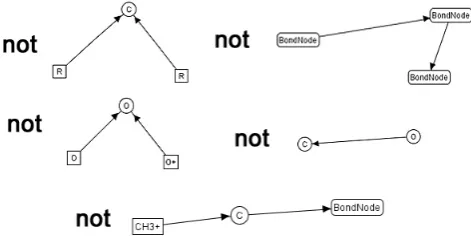
In addition to the type graph, constraints may be used to specify conditions on graphs (and rules) within the system. As edges are directional, a convention is needed to ensure that edges between a specified pair of atoms are always facing the same direction. To this end, it was de-cided that edges would go from the less electronegative atom to the more electronegative one e.g. for a bond between C and O, the edge would always go from the C bonding node to the O bonding node. A further constraint was necessary to prevent multiple incoming edges to the carbon/hydrocarbon and oxygen round bond nodes. So that all of the carbon/hydrocarbon bond-ing possibilities need not be enumerated for the constraint, the type graph utilises inheritance to create an R supertype for all carbon/hydrocarbon node types. The constraint then only requires a single combination, between 2 R nodes. Finally, a constraint was needed to prevent CH3+ from being able to bond to anything. Figure5 shows all five of these constraints, with “not” representing the fact that graphs containing these structures should be considered invalid.
Figure 5: Additional graph constraints
configuration of nodes and edges somewhere in the graph. If violated in the minimal union, it may still be fulfilled once the union is embedded into a larger graph. Positive constraints are therefore avoided in our graph representation (or if they were present, would not impact on the analysis).
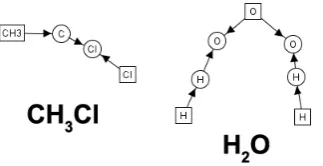
An example of a graph typed over the type graph in Figure4is given in Figure6. These are the starting materials for the SN1reaction, namely water and chloromethane.
Figure 6: Graph depicting starting materials for SN1reaction, produced in AGG. Left: CH3+, Right: H2O
The first step in our methodology is to capture all possible general rules for a reaction system. This involves the definition of reactions at the level of functional groups only, i.e., local molec-ular context. Figure 7depicts the general rules governing the reactivity for this small reaction mechanism. The top rule dictates that if a chloromethane molecule is found in a graph, it can be broken to form charged carbocation (CH3+) and Cl− ions. The middle rule captures the attack of the positively charged carbocation by a lone pair of electrons on the O of an OH group. In the lower rule, the positively charged O+accepts electrons from the O+-H bond in the presence of the Cl−created in the the very first step of the reaction. This yields hydrochloric acid (HCl), and an alcohol product, containing an OH group. The reverse of each of these three rules were also added as potential reactions (by simply reversing the left-hand side and RHS of the rule). These reverse reactions may be unlikely but this will eventually be designated by a negligible rate constant for that particular reaction. For generality and a complete specification of possible activity, it is important to include them.
We formulate the two known starting materials in Figure 6 as two molecular identity rules, where the left-hand side and RHS are the same and contain only the graph of a particular molecule. The first step towards making our GTS into an accountable one is to generate the full set of places (i.e. molecular species) that would appear in the PT net translated from our accountable GTS. To discover unknown intermediates and products in the reaction, a critical pair analysis is conducted between each general reaction rule and each molecular identity rule. This is an iterative process as described in Section4, which eventually gives the set of graphs
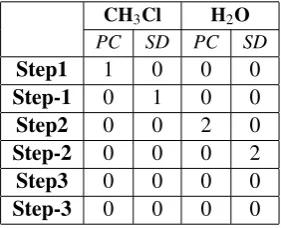
M, to which our GTS must be accountable. The results of the first iteration are given in Table
2. Each entry signifies how many of the overlappings were critical for each pair, remembering that critical pair analysis checks all possible unions ofLandMfor parallel conflict analysis, and
RandMfor sequential dependence analysis.
over-Figure 7: Steps 1 (top), 2 (middle) and 3 (bottom) of SN1reaction, general reaction rules
CH3Cl H2O
PC SD PC SD
Step1 1 0 0 0 Step-1 0 1 0 0 Step2 0 0 2 0 Step-2 0 0 0 2 Step3 0 0 0 0 Step-3 0 0 0 0
Table 2: Results of first pass critical analysis - parallel conflicts (PC) and sequential dependencies (SD)
one reactive site per instantiated reaction, therefore in all cases these overlappings were reduced to 1. If there were two asymmetric reactive sites in a molecule for an elementary reaction step, there would be 2 chemically distinct overlappings, since application of the reaction rule would lead to alternative products. In this case, we would have discovered two possible instantiations of the same general reaction rule.
Figure 8: One critical overlapping between general reaction rule Step2, and H2O (critical graph elements are contained within the shaded area)
New intermediates in the system can be discovered by the systematic application of the general rule to the molecules it has an impact on. Where a parallel conflict is apparent, the application of the general rule to that molecule at the match given by the critical overlapping gives us a chemical species that is produced by this reaction. Similarly, for sequential dependencies, the application of the reverse of the general rule to the molecule, gives us the species that undergoes this general reaction to give the molecule in the pattern graph in question. For example, new molecules arising from the critical overlappings in Table2are Cl−and CH3+. We add these new molecules as molecular identity rules and repeat the critical pair analysis as these new interme-diates may produce further intermeinterme-diates under the rule-defined behaviour of the system. After five iterations of the critical pair analysis, the total set of chemical species for this case study can be derived as molecular identity rules. The graphs representing these intermediates are given in Figure9, along with their chemical formulae. The complete set of these is then the setM to which our graph transformation system must be accountable, as described in Section4. The result of the last iteration, of the critical pair analysis is given in Table3.
CH3Cl H2O CH3+ Cl− CH3O+H2 HCl CH3OH CH3O+HCH3 CH3OCH3
PC SD PC SD PC SD PC SD PC SD PC SD PC SD PC SD PC SD
Step1 1 0 0 0 0 1 0 1 0 0 0 0 0 0 0 0 0 0 Step-1 0 1 0 0 1 0 1 0 0 0 0 0 0 0 0 0 0 0 Step2 0 0 2 0 1 0 0 0 0 2 0 0 1 0 0 2 0 0 Step-2 0 0 0 2 0 1 0 0 2 0 0 0 0 1 2 0 0 0 Step3 0 0 0 0 0 0 1 0 2 0 0 1 0 1 2 0 0 2 Step-3 0 0 0 0 0 0 0 1 0 2 1 0 1 0 0 2 2 0
Figure 9: Complete set of chemical species for SN1reaction, derived through iterations of critical pair analysis
5.2 From Graph Transformation System to Place Transition net
To achieve the accountability condition necessary to translate our GTS to a PT net, we need to instantiate the general rules using the results of Table3. The reduction of chemically equivalent overlappings explained above becomes important at this stage of the refinement. Two instantia-tions of a general rule based on two chemically equivalent overlappings would be span isomor-phic. As such, we only need to add one of the two instantiations from this equivalence class to the refined graph transformation system as per the formalism in Section4. Reducing the values in Table3to chemically differentiable critical overlappings using the analysis described above aids in simplifying the identification of these equivalence classes.
An interesting general reaction in our case study is that ofStep2. There are entries in the par-allel conflicts part of the table for H2O, CH3+and CH3OH. Closer manual examination reveals that this encapsulates two reactions; the reaction of H2O with CH3+, and a secondary reaction of the methanol product, CH3OH, with CH3+. This general rule can therefore be instantiated twice, as per Figure10. This analysis can be carried out methodically for an even larger number of instantiation candidates than just the three we have here. Essentially, the overlap ofM1withL in Figure3forms a graph into which a second overlap with another molecular pattern graph,M2, can take place directly. The order in which the overlaps are constructed is inconsequential. This is possible since the type graph cardinalities ensure that molecules are always defined in their entirety. As such, there is no possible intersection of graph elements between the two separate molecules in the combined overlap, unless the two molecules are identical (in which case the overlap is meaningless and discarded).
ex-Figure 10: Instantiation of step2 for reaction with water (top) and methanol (bottom)
amine the construction in Figure11. M1 forms a union withL to giveG1, while M2 forms a union withLto give G2. G1 andG2 can be combined to give a final overlap, which is used to instantiate the rule fully. Sincel1andl2 identify the two different reactivity sites needed for the reaction, for a valid combination ofG1andG2, their intersection should be empty. Formally, this condition is represented as:
l1−1(m1(M1))∩l2−1(m2(M2)) =φ
M1 m1 !! B B B B B B B B L l1 ~~~~~~~~
~~ l2
@ @ @ @ @ @ @
@ M2
m2 ~~|||||| || G1 A A A A A A
A G2
~~~~~~~~
~~
G
Figure 11: Combination of critical overlappings for instantiation of general rules
For each unique, valid set of instantiation species, we instantiate the general rule to include the full molecules in its context. All instantiated reaction rules are then named with rate constants, specific to the reaction they refer to. For this case study, step3 can also be instantiated twice to mark the deprotonation of CH3O+H2, and of CH3O+HCH3. Finally then,k1 refers to the first step of the reaction (the Cl−leaving the chloromethane molecule),k2ais the attack of water on the
resulting carbocation,k2bthe attack of methanol on the same carbocation,k3athe deprotonation
of the result of the water attack, andk3bthe deprotonation of the result of the methanol attack.
The reverse reactions are represented byk−xfor each of these forward reactions.
analysis. With the complete set of instantiated rules and their impact on each molecular pattern graph, we can build the incidence/stoichiometric matrix for the PT net for this reaction (see Table4) by subtracting the total parallel conflict critical overlappings (how many molecules are consumed) from the total sequential dependence critical overlappings (how many molecules are produced) for a particular instantiated reaction molecular pattern graph pair. This then gives us the impact each elementary reaction has on each chemical species. To reiterate, the reactions that the entries in the stoichiometric matrix refer to are given below:
k1: CH3ClCH3++ Cl−: k−1 k2a: CH3++ H2OCH3O+H2: k−2a
k2b: CH3++ CH3OHCH3O+HCH3: k−2b
k3a: CH3O+H2+ Cl−CH3OH + HCl : k−3a
k3b: CH3O+HCH3+ Cl−CH3OCH3+ HCl : k−3b
CH3Cl H2O CH3+ HCl Cl− CH3O+H2 CH3OH CH3O+HCH3 CH3OCH3
k1 -1 0 1 0 1 0 0 0 0
k−1 1 0 -1 0 -1 0 0 0 0
k2a 0 -1 -1 0 0 1 0 0 0
k−2a 0 1 1 0 0 -1 0 0 0
k2b 0 0 -1 0 0 0 -1 1 0
k−2b 0 0 1 0 0 0 1 -1 0
k3a 0 0 0 1 -1 -1 1 0 0
k−3a 0 0 0 -1 1 1 -1 0 0
k3b 0 0 0 1 -1 0 0 -1 1
k−3b 0 0 0 -1 1 0 0 1 -1
Table 4: Stoichiometric matrix resulting from final pass critical pair analysis and chemical equiv-alence analysis
5.3 ODEs from the PT net
ODE extraction from the results in Figure4, following the procedure outlined at the beginning of Section4led to the ODEs shown in Figure12. These results agree with ODEs derived manually for this simple system using the law of mass action.
5.4 Tool support
d[CH3+]/dt = -k-1[CH3+][Cl-] +k-2a[CH3O+H2] +k-2b[CH3O+HCH3] +k1[CH3Cl] -k2a[CH3+][H20] -k2b[CH3+][CH3OH]
d[CH3Cl]/dt = +k-1[CH3+][Cl-] -k1[CH3Cl]
d[CH3O+H2]/dt = -k-2a[CH3O+H2] +k-3a[CH3OH][HCl] +k2a[CH3+][H20] -k3a[CH3O+H2][Cl-]
d[CH3O+HCH3]/dt = -k-2b[CH3O+HCH3] +k-3b[CH3OCH3][HCl] +k2b[CH3+][CH3OH] -k3b[CH3O+HCH3][Cl-]
d[CH3OCH3]/dt = -k-3b[CH3OCH3][HCl] +k3b[CH3O+HCH3][Cl-]
d[CH3OH]/dt = +k-2b[CH3O+HCH3] -k-3a[CH3OH][HCl] -k2b[CH3+][CH3OH] +k3a[CH3O+H2][Cl-]
d[Cl-]/dt = -k-1[CH3+][Cl-] +k-3a[CH3OH][HCl] +k-3b[CH3OCH3][HCl] +k1[CH3Cl] -k3a[CH3O+H2][Cl-] -k3b[CH3O+HCH3][Cl-]
d[H20]/dt = +k-2a[CH3O+H2] -k2a[CH3+][H20]
d[HCl]/dt = -k-3a[CH3OH][HCl] -k-3b[CH3OCH3][HCl] +k3a[CH3O+H2][Cl-] +k3b[CH3O+HCH3][Cl-]
Figure 12: Result of ODE extraction for SN1reaction
AGG is open source and is implemented in Java with its own API. Adaptation of the standard implementation allowed us to schedule only relevant pairs for critical pair computation. Standard analysis would analyse every rule with every other rule. Since we only need to examine criti-cal overlappings between reaction rules and identity rules this was a first step towards a more efficient implementation. Methods and classes from the API were also used for the Java com-ponent that performed the chemical equivalence reduction described in Section5. CPA saves results in an XML file that can be reloaded using API methods. The ODE extraction module was also implemented with the aid of these methods. Finally, a script was created which piped the results of the CPA through the chemical equivalence program and ODE extraction program in turn. Currently, the overall program produces the ODEs as a text file, but the output could easily be changed to LaTex syntax, or a format recognized by a math solver for example. Figure13
shows the basic architecture of the tool chain used.
It is worth noting that the abstraction of the CH3group to a single node, described in Section
Figure 13: Basic tool chain architecture (arrow labels show input and output file extensions)
case, this number was reduced to just over 11,000 for any pair and the instantiation round of the critical pair analysis along with critical overlapping structural equivalence testing and ODE extraction took less than 8 minutes (assigning 1.0GB to the Java Virtual Machine). While a more general model with a lower level of detail would have been an interesting representation to consider, it was equally important to use valid abstraction techniques to ensure a workable implementation.
6
Conclusion
This paper has presented a graph transformation approach to defining molecular reactions that retains much of the visual notation adopted by Chemists themselves. Using a variant of critical pair analysis, a system of reaction rules presented in this form can be refined into one that can be expressed by a place-transition net. A set of ODEs describing the overall reaction dynamics can be extracted from the incidence matrix of that PT net. The approach was demonstrated by means of a simple SN1 reaction. The methodology and implementation are based on existing theory and tools for graph transformation systems, predominantly that of constraints, critical pairs, and isomorphism of graphs and rules.
Bibliography
[1] Bapodra, M., (2009): Chemical Reaction Rate Analysis Using Graph Transformations.BSc Computer Science with Management Project, Final Report Available athttp://www.cs.le.ac. uk/people/mb294/docs/BScFinalReport.pdf.
[2] Berry, G., Boudol, G., (1989): The Chemical Abstract Machine. Proceedings of the 17th ACM SIGPLAN-SIGACT symposium on Principles of programming languagespp. 81–94 Available athttp://portal.acm.org/citation.cfm?id=96717.
[3] Benko, G., Flamm, C., Stadler, P.F., (2003): A Graph-Based Toy Model of Chemistry. Journal of Chemical Information and Computer Sciences43, pp. 1085–1093. Available at
http://pubs.acs.org/doi/abs/10.1021/ci0200570.
[4] Cardelli, L., (2008): From Processes to ODEs by Chemistry. IFIP International Federation for Information Processing 273, pp. 261–281. Available at http://www.springerlink.com/ content/8g12ph2857372xm2/.
[5] Danos, V., Feret, J., Fontana, W., Harmer, R., Krivine, J., (2007): Rule-based modelling of cellular signalling.18th International Conference on Concurrency Theory, Lisbon, Portugal, September, 2007, Lecture Notes in Computer Science 4703, pp. 17-41. Available athttp: //www.pps.jussieu.fr/∼danos/.
[6] Ehrig, H., Ehrig, K., Prange, U., Taentzer, G., (2006): Fundamentals of Algebraic Graph Transformation. EATCS Monographs, Springer
[7] Ehrig, K., Heckel, R., Lajios, G., (2006): Molecular Analysis of Metabolic Pathways with Graph Transformation. International Conference on Graph Transformations 2006, Lecture Notes in Computer Science4178, pp. 107–121. Available athttp://www.springerlink.com/ content/6r637jx517320v02/.
[8] Faeder, J.R., Blinov, M.L., Hlavacek, W.S., (2009): Rule-Based modelling of Biochemical Systems with BioNetGen. Methods in Molecular Biology, Systems Biology500, pp. 113– 167. Available athttp://www.springerlink.com/content/nn1v343vw2kmj00w/.
[9] Feret, J., Danos, V., Krivine, J., Harmer, R., Fontana, W., (2009): Internal coarse-graining of molecular systems.Proceedings of the National Academy of Sciences of the United States of America106(16), pp. 6453–6458. Available athttp://www.pnas.org/content/106/16/6453.
[10] Gilbert, D., Heiner, M., (2006): From Petri Nets to Differential Equations - An Inte-grative Approach for Biochemical Network Analysis. ICATPN 2006, Lecture Notes in Computer Science 4024, pp. 181–200. Available athttp://www.springerlink.com/content/ l85l6147038t012j/.
[12] Heckel, R., (2006): Graph Transformation in a Nutshell. Electronic Notes in Theoretical Computer Science148, pp. 187–198.
[13] Heckel, R., (2005): Stochastic Analysis of Graph Transformation Systems: A Case Study in P2P Networks. International Colloquium on Theoretical Aspects of Computing 2005, Lecture Notes in Computer Science3722, pp. 53–69. Available athttp://www.springerlink. com/content/u54h1w273875u67r/.
[14] Hillston, J., (2005):Fluid Flow Approximation of PEPA models.Proceedings of the Second International Conference on the Quantitative Evaluation of Systems, IEEE Computer Society Presspp. 33–43. Available athttp://www.dcs.ed.ac.uk/pepa/features/.
[15] Keeler, J., Wothers, P., (2008): Chemical Structure and Reactivity, An Integrated Approach, Oxford: Oxford University Press.
[16] Khan, A., Torrini, P., Heckel, R., (2008): Model-based Simulation of VoIP Network Reconfigurations using Graph Transformation Systems, ECEASST 16, Available at
http://eceasst.cs.tu-berlin.de/index.php/eceasst/article/view/251.
[17] Palacz, W., (2008): Practical Aspects of Graph Transformation Meta-Rules. Intelli-gent Computing in Engineeringpp. 70–77. Available at http://www.eg-ice.org/Workshops/ ICE08/papers%20pdf/P002V03.pdf.
[18] Rossello, F., Valiente, G., (2005): Graph Transformation in Molecular Biology. Formal Methods (Ehrig Festschrift), Lecture Notes in Computer Science3393, pp. 116–133. Avail-able athttp://iospress.metapress.com/content/c7ha18g96nbm7g2e/.