Developing Communicative Competence for the
Globalized Workplace
in
English for
Occupational Purposes
Course in China
Qing Xie
School of Foreign Studies, Jiangnan University, Wuxi, China
Abstract—This article reports an investigative case study of an English for occupational purposes course in the Chinese university context which aims to help students attain a level of communicative competence suitable for the globalized workplace. Methods of document analysis, semi-structured student focus group interview and survey with 21 participants, participant observation and teacher reflectionare used to examine the possible outcomes of communicative competence development and the influencing factors. The results are analyzed based on a synthesized course analysis framework which record positive learning outcomes and success factors including helpful training methods and activities, learning materials tailoring, teacher’s relevant background and experience, learners’ strong motivations and clear learning objectives. Constraint factors include limitations in course time and length, learning environment, English co-curricular activities and learners’ lack of practical experiences. Pathway to enhance teaching effectiveness is proposed to promote English teaching reform inboth China and the world.
Index Terms—communicative competence, globalized workplace, English for occupational purposes course, Chinese University, case study, success and constraint factors
I. INTRODUCTION
In today’s globalized economy, many Chinese businesses, including foreign invested companies, require their employees to possess English communication skills. According to Global English (2016), 67% of the chief executive officers who participated in an IBM survey considered communicative competence to be the key success factor in the globalized workplace. Communicative competence is also essential for job applicants.
Economic globalization and the increasing demand for talent have directly influenced the development of university English teaching and research. Cai (2010, p. 29) indicated that to meet the demands of a globalized economy, university students must possess not only general English skills but communicative competence in English for specific business sectors or industries. The results of a recent study by Wolff (2009) also indicated that China’s universities are under huge pressure to update their curriculum to meet market demand, as Chinese graduates’ English communication skills currently cannot satisfy employer needs.
The aim of this article is to investigate English for occupational purposes (EOP) teaching in the university context, and its contribution to the development of communicative competence for the globalized workplace. The focus of the article is “wide-angled” EOP courses (Basturkmen, 2006, p. 25). The objective of such courses is to enable students to “master the industrial knowledge and the ability to work in English in the related job posts”. The course should center on developing the competence to use English effectively in the workplace (Cai & Liao, 2010, p. 48). The key issues explored in this article are as follows: whether the university EOP course design, course materials, teaching methodology, self-access learning platform meet student learning needs and objectives (Chen 2014); how EOP courses help students to develop sufficient communicative competence to meet the requirements of the globalized workplace; which factors improve the development of communicative competence for the globalized workplace; and which factors constrain such development.
II. THEORETICAL FRAMEWORK
A. Interpreting Communicative Competence for the Globalized Workplace from Different Perspectives
relation management, strategic thinking and teamwork” are also required.
For the context of China, Guo & Zhang (2013) indicated business communicative competence should cover language ability, business knowledge and comprehensive competence. Wang et al. (2015) argued that China’s business English curriculum standards should cover the competencies of language use, cross-cultural communication, business practice, critical thinking, creativity and autonomous learning. Yuan (2012, p. 7) indicated that the competencies required by the globalized workplace are fluent business English, problem-solving skills, broad perspective and cross-cultural awareness.
This article also complies with the conventions of EOP, in the context of English as a second/foreign language, which aims at developing learners’ competence to use English in the target situation (Parltridge, 2012, p. 179), i.e. the globalized workplace.
B. Challenge in EOP Teaching: How to Develop Communicative Competence for the Globalized Workplace?
In the field of English for occupational purposes (EOP), relevant research has indicated the challenge to develop communicative competence for the globalized workplace through classroom-based teaching and learning.
In Hong Kong, Bremner (2010) indicated that one of the key challenges facing EOP teachers is to bridge the gap between classroom and workplace. One study based on eight business communication textbooks has shown that there are few collaborative writing tasks which often happen in the workplace. More authentic activities should be provided in business English textbooks to narrow the gap between the classroom and the workplace. Flowerdew (2010) also raised in the context of Hong Kong that in present situation analysis, there will be some constraints to course implementation, including students’ lack of motivation, disparate student proficiency levels and the difficulties of obtaining authentic materials from the real life situations in the example of business proposal module. Course developers need to take some balance measures.
In Egypt, Ghany & Latif (2012) examined the language preparation programme for hospitality and tourism undergraduates and the perceptions of teachers and students on its effectiveness of developing adequate communicative competence for the future workplaces using semi-structured interviews with two sets of questions. The English language preparation programme was found to have several shortcomings, such as a lack of pre-course assessment, inappropriate teaching and examination methods and inadequate teaching materials. Suggestions were given to the English teaching professionals to improve the language programmes such as encouraging the use of technology in class. Other relevant studies have shown that innovative teaching activities can narrow the gap between classroom and workplace. In Ukraine, Tarnopolsky (2012) has indicated that workplace communicative competence can be developed by experiential learning. In the English courses for non-English major programs of economics, business, technology and psychology, students simulated English workplace communication activities, improved English communicative competence for the workplace, and prepared for the future career development. In Hong Kong, Evan (2013) in his study showed by empirical investigation that business English courses can adopt task-based language teaching methods to simulate the authentic workplace communication activities in order to bridge the workplace/classroom divide.
In Morocco, Bouzidi (2009, p. 10) indicated that many of their institutions are updating the EOP courses, in line with employers’ requirements. The reform is based on the recognition that students’ classroom learning should be closely connected with their future career needs. The main objective is to ensure that EOP courses provide the key business communication skills which are the most helpful to the graduates. This Morocco context study is based on the workplace needs survey with employers and employees, on the uses of English in the workplace, with reference to skills, context, topics and relevant language functions (p. 11). The results of the workplace survey were used by EOP
programme directors to more closely tailor course content to future job needs. In Spain, Ruiz-Garrido (2006, p. 75) designed the business English course and assessment based on company and student needs. The course includes the aspects related to telephoning, socializing, presentation, meeting and negotiation etc.
C. EOP Teaching in China: How to Enhance Effectiveness?
EOP courses, as the extension from English for general purposes (EGP) should concentrate on English communicative competence for the workplace on the basis of general language knowledge and skills, in order to meet the talent needs of economic globalization (Zhang, 2006, p. 105).
However, previous research has shown that in the China context, business English courses have many problems related to communicative competence development. They include no fixed course books, students’ lack of practical experiences and the class size which does not meet the course objective (Wang, 2015, p. 67). Other researchers have suggested solutions. Ho & Lu (2011) indicated that business English teaching should be directed towards the cultivation of cross-cultural communicative competence. Teachers should change the existing teaching methods, and guide the students to read the western literature. More co-curricular teaching activities should be conducted. Yuan (2012, p. 145) observed that business English courses in China’s professional training organization could develop the competencies of socializing, negotiation, leadership and management step by step.
Nevertheless, few studies empirically investigate the EOP course from the perspective of meeting future workplace requirements by systematic course analysis (Basturkmen, 2010, p. 9), especially in the China context.
For systematic EOP course analysis, previous literature has highlighted the key variables. Dudley-Evans & St John (1998) indicated that the main variables of business English courses include “number of students, course time, material, class location, course length, age of learners, teaching facilities, assessment, pre-course information, quality and style of instruction, teacher’s appearance and dress” (p. 65) etc. Ellis & Johnson (2002) indicated that business English course variables should also include learner needs and course content (telephoning, meeting, correspondence, socializing), teaching activities and teaching materials.
As China’s EOP teaching belongs to the English as a Foreign Language (EFL) field, it is also important to consider factors related to EFL teaching, such as course objectives, syllabus (Nunan, 1988) and communicative teaching methods. Cheng (2011) indicated that EOP courses, as a branch of English for specific purposes courses should consider the factors of “social group, learning objectives, input materials and output tasks, teaching methods and how to evaluate the learning progress” (p. 45).
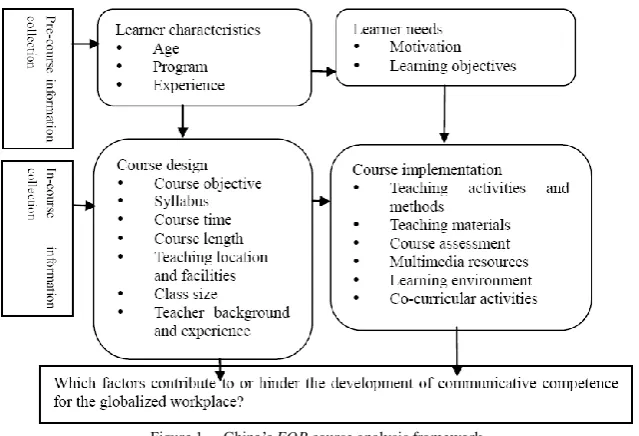
The main factors of EOP courses suited to the China context are thereby synthesized in Figure 1 China’s EOP course analysis framework.
Figure 1. China’s EOP course analysis framework.
How can China’s university EOP courses improve efficiency and develop communicative competence for the globalized workplace through effective course design, course content selection and innovation in teaching etc.? This is the central issue this article is to explore to address the gap in the literature.
III. RESEARCH QUESTIONS
Based on the theoretical framework, this article aims to analyze China’s university English for occupational purposes
(EOP) courses, so that factors which contribute to or hinder the development of communicative competence for the workplace can be identified. The pathway which improves the teaching effectiveness is to be found to enable students to be better equipped with the English communication skills required for jobs in different business sectors. The three main research questions addressed in the study are detailed below:
1. What are the learning outcomes of EOP course in the Chinese university context in developing English communicative competence for the globalized workplace?
2. Which factors in China’s university EOP course contribute to the development of communicative competence for the globalized workplace?
3. Which factors in China’s university EOP course hinder the development of communicative competence for the globalized workplace?
IV. THE STUDY
School of Internet of Things. This was the first business English reading and writing course for non-English major students provided by the university, introduced during the second round of the university’s four-year tertiary English curriculum reform. Therefore, the outcomes of the course may have important consequences for the content of courses offered in subsequent semesters, and for course development in other learning contexts.
The learning materials used in the course were drawn from three course books on professional communication, namely Market Leader Intermediate Business English Coursebook (Market Leader) (Cotton, Falvey & Kent, 2011),
CollinsEnglish for Business: Writing (Collins Writing) (Brieger, 2013) and Success with BEC– Student’s Book Vantage
(Hughes, 2010), according to the students’ attainment levels. The teaching process follows text-based instruction and analysis, student group project presentation on a company case study, student oral discussion and writing guidance based on authentic writing tasks. In addition, some authentic materials were drawn from public media resources.
According to the syllabus description, the course was designed to enhance students’ competence in business English reading and writing to prepare them for employment in the globalized workplace after graduation. The course ended with a written assessment, following Business English Certificate (BEC) Vantage criteria. The average score was 70.6/100, with a 92% pass rate. The aim of the case study is to examine whether the course can truly prepare students to meet the future workplace requirements, and to identify the success strategies and the constraint factors.
A. Case Research Process
The data collection methods for the case study include document analysis (textbooks, syllabus and student assignments), semi-structured student focus-group interviews, student surveys, participant observation and teacher self-reflection, which are adapted from the case study guidelines in Kim (2008) in the Korean context. The rationale of data collection methods for the case study also complies with the principles summarized by Yin (2009) to solicit information through multiple sources.
Document analysis: Initially, a comprehensive document analysis was conducted by the researcher to study the course books in terms of the gap with the actual workplace requirements, the syllabus mainly on the aspects of course design and student assignments to identify the strength and weakness in their workplace document preparation.
Semi-structured student focus group interview and student survey: The researcher conducted semi-structured interviews with 21 participants in May 2015. Each interview involved one or two students. The participants were eager to communicate both in and outside class. To ensure that the participants’ identities remain confidential, they are referenced here using alphabets (A – U). The students’ demographic information was gathered using written surveys, and their profiles are provided in Table 1 below.
TABLE 1.
STUDENT PARTICIPANT PROFILE
Gender Age Study program Years of English learning Self-assessment of English
communicative competence on a 4-point scale, representing the levels from beginner, lower intermediate, upper intermediate to advanced
F 19 Communication engineering 11-13 years 2
F 19 Communication engineering 14-16 years 2
F 19 Communication engineering 7-10 years 3
F 18 Communication engineering 7-10 years 3
F 21 Automation 7-10 years 2
F 20 Automation 7-10 years 2
F 19 Computer science and technology 14-16 years 3
F 19 Computer science and technology 11-13 years 3
F 20 Automation 7-10 years 2
M 18 Microelectronics 11-13 years 3
M 20 Computer science and technology 4-6 years 3
M 19 Computer science and technology 7-10 years 3
M 19 Internet of things 10 years 2
M 19 Electric engineering and automation 7-10 years 2
M 19 Automation 4-6 years 2
M 17 Microelectronics 11-13 years 2
M 20 Communication engineering 7-10 years 2
M 19 Communication engineering 7-10 years 3
M 20 Communication engineering 7-10 years 3
M 19 Microelectronics 7-10 years 2
M 19 Computer science and technology 7-10 years 3
Nine of the participants were female and twelve were male. Their average age was 19.14. They were enrolled in a range of academic programmes in the fields of computer science, electronics and communication technology. Most of the participants had studied English for 7 to 10 years, and some for more than 10 years. Their average score for self-assessed English communicative competence was 2.476 out of 4 (intermediate level).
future job, factors of successful/effective EOP class, evaluation of training methods, activities and materials, and the learning outcome in relation to the development of communicative competence for the globalized workplace. Each of the focus-group interviews lasted for approximately 20 minutes. Sample interview questions are listed in Table 2.
TABLE 2.
SAMPLE INTERVIEW QUESTIONS. How important is EOP to your academic study and future career?
Which factors are related to an effective/successful EOP class? To what extent? Which classroom activity do you think is most relevant to the workplace task? Why?
Do you prefer to use textbooks, handouts, PowerPoint presentations, or other materials in the EOP course?
Do you think the EOP course can help you effectively develop global communicative competence for the globalized workplace? Are your business email writing and oral communication better than before?
Do you participate in activities related to EOP learning, such as English science lectures or English competition?
Due to participants’ inadequate English speaking competence, ten of the interviews were conducted in Chinese while one group used English as the interview language. The researcher later transcribed all of the interviews verbatim. The interview transcripts in Chinese were translated into English by the researcher. The transcripts were then analyzed using the theoretical framework and research questions detailed above. Key information, such as critical points raised by the participants, was categorised into themes to address each of the research questions. The 21 participants who completed the written survey also described other learner characteristics such as learning motivation and needs.
Participant observation and teacher reflection: Researcher and also the teacher of the EOP course observed the changes in the students’ attitudes and performance during the course, and reflected on the course delivery process. Room for further improvement is identified to bridge the gap between classroom and the workplace and to enhance the development of communicative competence for the globalized workplace. Different sources of information are summarized in Table 3.
TABLE 3.
SUMMARY OF CASE STUDY RESEARCH PROCESS
Pre-course information collection
Learner characteristics (Age/Program/Experience) Student surveys
Learner needs (Motivation/Learning objectives) Semi-structured student focus group interview
In-course information collection
Course objective/Syllabus/Teaching material Document analysis Course time/Course length/ Location and teaching facilities/ Class size /Teaching
activities and methods/Course assessment/Multimedia resources/Learning environment/Co-curricular activities
Semi-structured student focus group interview/Teacher reflection/Participant observation
Teacher background and experience Teacher reflection
B. Data Analysis
The information gathered by different data collection methods was extracted by themes (Brown, 2014), following the analytical framework in Figure 1 and the frequency of the themes was also calculated. Results generated by different instruments in the case research process were analyzed systematically (Guest, MacQueen & Namey, 2012) to ensure comprehensive and verifiable findings. The researcher, also an insider of the case study, ensures adequate insights and full understanding about the overall course implementation process and students’ communicative competence development outcome.
V. RESULTS AND DISCUSSION
Following Figure 1 and to answer the three research questions, the three main themes are as follows: learning outcomes related to English communicative competence development for the globalized workplace, success factors contributing to the development of communicative competence for the globalized workplace and constraint factors hindering the development of communicative competence for the globalized workplace.
A. Learning Outcomes Related to English Communicative Competence Development for the Globalized Workplace
For the learning outcomes of the EOP case study, in addition to a high passing rate in the BEC Vantage level written assessment in business English reading and writing immediately after the course which means the majority of the participants have reached the required level of English communicative competence, participants have especially emphasized the usefulness and additional benefits of the course to help prepare for their future career and workplace communication skills development.
Career development
Positive outcomes were reported in relation to promoting the workplace communicative competence when 14% of the participants could foresee to work in a foreign company requiring excellent English business communication skills such as in the following statement by participant S.
Two participants anticipated working in Chinese companies, which also require their employees to possess workplace English skills. Participant U especially mentioned the prospect of working in China.
I think even in some domestic companies, there are still comparatively high demands on English. Many companies are facing the world. When they recruit new employees, they still have certain requirements on English. Therefore, it is necessary for us to study workplace English. (Participant U)
Two participants had concrete visions of their desired job in a company or even developed his own business as shown in the following two comments.
In the future, I think I want to do my job as marketing. Probably I will meet some foreigners and I will be good at communication. (Participant R)
I may set up my own business and will have some foreign companies as my customer. (Participant T)
Workplace communication skills development
33% of the participants reported that their email and memoranda (memo) writing, formatting and use of professional terms had improved. The improvements were described by Participant F and R.
There are even feedback on the format. I used to ignore the format and punctuation. I even did not know how to use the professional words. (Participant F)
I have learnt some professional words, especially those used in business communication. We have learned the formal business language. (Participant R)
Analysis of assignments produced at different stages of the course revealed significant improvements in the students’ language use, formatting and punctuation. They had learned how to write memos, emails, faxes, business letters and reports in line with the relevant business conventions, which will prove useful in their future careers.
However, a few participants reported that the connection between the course and their computer science major was weak. Participant B’s comment is quite typical.
Our academic program has little connection with business English. There is no English for computer science in our course we need. (Participant B)
Scholars have shown that the focus of EOP differs from that of English for science and technology. The former concerns “professional/occupational authenticity, oral and written communication, and workplace needs” (Master, 2005, p. 105), whereas the latter concerns “scientific/technical reading and writing” (Master, 2005, p. 104). Nevertheless, it is typical of these learners as Harding (2007, p. 11) summarized them as “studying English at the same time as studying their subject”, which might not be “language related”.
Learning transfer
When discussing their learning outcomes, 23.8% of the participants emphasized the importance of learning transfer, i.e. the need to put their knowledge to practical use in the globalized workplace. Participant U had this detailed explanation.
Learning transfer is more important. If English reading and writing are very good, but it may be difficult to put it into actual use, such as making resume. It is important to use English in future career planning. (Participant U)
However, participant O indicated that English learning is still examination-oriented rather than directed towards the actual use of English. This statement is consistent with the findings of Stanley’s (2011) study of tertiary English language teaching (ELT) in China. The College English Test (CET) was found to have a dominant backwash effect on classroom teaching. Teachers prioritize content relevant to the CET over communication skills development, limiting students’ practical use of English. The implementation of communicative language teaching (CLT) has also met with resistance in the classroom. Therefore, the context of China’s tertiary ELT may constrain students’ communicative competence development, despite the demand for communication skills in today’s globalized workplace.
B. Success Factors Contributing to the Development of Communicative Competence for the Globalized Workplace
Teaching methods and activities
The teaching method and activities implemented in the course were considered helpful. For example, participants B, M and R highlighted the writing task as an effective means of improving their business correspondence skills. For example, participant B praised the writing task in the following comment.
Writing task is the most helpful, especially the email and letter writing. (Participant B)
38% of the participants reported that working in groups on a case study had enhanced their communicative competence, and the teacher confirmed that the students had approached this activity with enthusiasm. As observed by the researcher, most of the case study groups carefully prepared their materials for presentation in class after several rounds of active discussion. The case study group performance was subject to both teacher evaluation and peer assessment. Participant H’s experience explained the benefit of case studies.
Case studies are important. We not only learn how to cooperate with others, but also we learn the culture of other countries more efficiently. (Participant H)
Two participants indicated that the case study group work had improved their presentation skills. For example, participant O elaborated on the presentation in the following statement.
Presentation can force me to speak English in public. It is more active than question and answer. I can prepare for the presentation by reading the case story. (Participant O)
innovative teaching methods such as experiential learning and simulation should be implemented in EOP classes to narrow the gap between classroom and workplace.
Teaching materials
English language teaching literature indicated evidence that “what teachers and students do in the classroom is largely determined by the course book” (Tomlinson, 2005, p. 143). However, the development of communicative competence for the globalized workplace also requires authentic material input. Careful document analysis revealed that most of the materials in the course books under study were drawn from authentic media resources, such as Financial Times and Guardian in Market Leader, with typical business topics ranging from “brand, travel, employment, trade, change, organization” to “culture, money, quality, leadership and ethics” (Cotton, Falvey & Kent, 2011). The design of case-based writing and role play tasks has enabled the learners to experience authentic workplace communication activities. Most of the materials provided in Collins Writing were drawn from the Collins corpus, with a focus on the development of writing skills required in globalized workplace settings such as multinational companies. This guaranteed the authenticity of the materials in the textbook.
As a resource provider, the teacher supplemented the innovative content above with additional authentic materials collected from various sources, such as a template for writing business memos and videos of advertisements made by famous companies in various historical periods recorded in a movie.
Participants expressed preferences to the learning materials, especially the writing guidance on Collins Writing, and the business knowledge and vocabulary on Market Leader. Participant F expressed his willingness to learn about the business background knowledge.
I have learned about the company’s marketing. I also got to learn more about the company’s operation with examples and methods. (Participant F)
14% of the participants indicated that the tailored learning materials met their academic needs such as the views by participant T.
Tailoring materials is relatively important. The university class should meet the future development needs and broaden the students’ horizon with more exposure to the western culture. (Participant T)
Multimedia resources
Moreover, participants especially suggested more input of multimedia resources as some of them enjoyed watching English films in their spare time. Participant G had a good summary of his learning experience.
I think we need to use multimedia, because learning English is a process of writing, listening and speaking. If we have the class in multimedia, we may have progress in many ways in order to increase our English level. (Participant G)
Teacher background and experience
Participants indicated that the teacher played an important role in facilitating their communicative competence development. Studies of EOP (Hutchinson & Waters, 1987, p. 158) have shown that the teacher provides resources, guides the learning process and solves various learning problems. Participant R especially indicated the important role played by the teacher.
I feel the most important factor is teacher. It is not just the book knowledge, but also the communication between people, including the varied workplace language. Communication with teacher can change my own language. (Participant R)
The teacher under study had the educational background and professional experience required to teach the course effectively. When reflecting on the course, the teacher reported enjoying communicating productively with the students in class and providing feedback on various speaking and writing tasks. Therefore, the teacher played the role of both instructor and facilitator in this context. The teacher also evaluated the students’ performance, and kept an accurate assessment record. Participant Q also emphasized the importance of class-based evaluation.
The evaluation in the teaching process is important. If the teacher can find out problems in students’ learning, there can be better solutions. (Participant Q)
Learner motivation
The participants’ motivation to learn EOP varied. Some were enthusiastic about learning English such as participant F.
I am very enthusiastic about English since young. I like English. Basically, I need to pass CET-4/6. If will go abroad to study, I also need to pass TOEFL. (Participant F)
Around 28.6% of the participants believed that learning English can help with their academic study in communication engineering or microelectronics in the aspect of western literature reading or overseas technological study. Participant G mentioned the needs of international technical communication.
We may have communication with other foreign engineers, in America, Japan or other western countries. If I learn something about business English, it’s important to promote our mutual communication, with engineers from other countries. (Participant G)
Learners’ learning objectives
In general, participants’ learning objectives were related to communicative competence development and the cultivation of cross-cultural communication skills such as those mentioned by participant R and S.
I hope to acquire the ability to have fluent communication with foreigners, such as greeting. I can watch English movies. (Participant S)
Angelelli & Degueldre (2002, p. 77) stated that a person has different purposes of learning language. It could be using the language to read the academic literature, traveling with more cultural experiences, getting more business opportunities or workplace communication, of which the fundamental aim is to enhance communicative competence. In this case, participants’ motivation for developing language competence for computer science and technology industry and pro-communication learning objectives are also contributing factors in communicative competence development for the globalized workplace.
C. Constraint Factors Hindering the Development of Communicative Competence for the Globalized Workplace
Course time and length
Participants complained that the one-session-per-week EOP class was limited in improving their English learning. The teacher reflected that teaching efficiency should be improved within the limited class time while students should be aware of the importance of autonomy in their after-class self-study. Participant F and G explained their situations of English learning after class.
We have also one session per week class. Most of English learning happens before final term exam. (Participant F) I think it is not sufficient. Learning English is long-time. One-time class is not sufficient. (Participant G)
Learning environment
Participants also indicated that their school leaders did not put much emphasis on English learning and there was little English use environment in their program study. Participant A had this very detailed description.
I used to be enthusiastic about English learning. But I was not encouraged by the school leaders to learn English well. They claimed that English was only a tool. (Participant A)
Co-curricular activities
Teacher reflected that to enhance communicative competence development, students should pay attention to English co-curricular activities. However, the participants were taking courses run by School of Internet of Things, and thus had limited access to such activities, unlike students from School of Foreign Studies. These were found by participant Q and U.
We don’t have chances to participate in [English corner or competition]. (Participant Q) We don’t have many English activities in our school time. (Participant U)
The above two hindering factors have illustrated the lack of a pro-English environment for the students. Niu & Wolff (2009, p. 271) in their recent study explained the poor “English-speaking environment” (ESE) in China’s universities, especially for English majors. As daily communication and sometimes classroom communication is in Putonghua, English learners are not ‘compelled to speak English in an environment where English is the dominant language’ (p. 272), typical of ESE. This finding is consistent with the results of the current case study. Though most of the classroom teaching is in English, learners may still lack adequate exposure to English in their daily living and the motive to use English, except when they happen to meet foreign friends on campus.
Learners’ experience
In addition, the participants also claimed that they did not have adequate practical experience to understand the business context of the EOP course such as participant O.
We did not get in touch with business, such as what we should talk in meeting or with subordinates. We need to first experience the business meeting. (Participant O)
This is not unusual in the EOP literature. As adult students, these participants are categorized as the group of learners prior to embarking on the journey of work, in contrast with experienced learners in the companies. Therefore, the teacher should in future impart more business knowledge in the classroom to better prepare the learners for their future jobs.
VI. CONCLUSION AND IMPLICATIONS
Based on the analysis framework in Figure 1 which is synthesized for the first time, this article has systematically analyzed EOP teaching in the university context to develop communicative competence for the globalized workplace, the success factors and the hindering factors through a case study. It is intended that the pathway to enhance teaching effectiveness can be identified.
The results of the study show that the EOP course has improved the writing skills and the professional language use. The course can also better prepare the students for their future career. Though the subject of the course seems not to be closely linked to students’ academic program in the School of Internet of Things, the case study participants reported positive learning outcomes while the teacher also observed significant improvement in the participants’ workplace communication skills development. Though learning transfer, i.e. to put the class knowledge into practical use is widely recognized as a key factor, the focus on examinations in China’s ELT today may decelerate the skills development process. The orientation of the university’s English enhancement programme should be shifted towards the practical use of English and communicative competence development.
include helpful training methods and activities, tailoring learning materials, teacher’s relevant background and experience, use of multimedia resources, strong learner motivation and clear learning objectives. The writing task, case study group and presentation were found to be particularly effective in enhancing learners’ practical workplace communication skills and boosting their confidence. More innovative methods are encouraged for classroom practice. Most of the course materials were creatively adapted for classroom use, especially the materials used in the writing task and the multimedia resources. The provision of authentic materials drawn directly from the workplace setting is highly recommended. In this case context, the teacher not only taught the course but facilitated the skills development process, with embedded classroom evaluation. The learners were strongly motivated to learn English, whether due to personal interest or to supplement their academic/technological study. They were also clear about the communicative competence development objectives. All of these factors contributed to the effective communicative competence development.
The factors found to hinder the development of communicative competence for the globalized workplace include limited course time and length, unsupportive English learning environment, limited access to English co-curricular activities and learners’ lack of practical experiences. To overcome these drawbacks and to enhance teaching effectiveness, it is suggested to increase learners’ out-of-class learning activities by developing a specially designed self-access learning platform so that they will be able to learn English whenever wherever they need. As discussed in relation to EOP teaching in Hong Kong (Chan, 2014), more co-curricular activities such as workplace task simulation, mock interviews and workplace communication skills workshops should be introduced. Learners should also be prepared to undertake internships or part-time work to gain a practical understanding and experience of the workplace before formally entering the world of work.
This article has both theoretical and practical value. The theoretical framework, course analysis diagram and case research process can be replicated or applied in future research. In addition, the reported study can facilitate China’s
EOP teaching reform, to link teaching content with students’ career requirements. To improve communicative competence for the workplace is also for students to make full preparation for future career development. Though this article only provides one case study results which may not be generalizable, it has highlighted some key issues which are worth exploration in the future research endeavor to enhance the quality and efficiency of EOP teaching both in China and worldwide. From the policy perspective, it is also recommended to stress real communicative competence development in the course implementation process by transforming the English language teaching focus in the current globalized environment.
ACKNOWLEDGEMENT
The author would like to express heartfelt thanks to the case study participants of the study. The author also thanks the expert comments from the editors and the reviewers for revising the article. This work was supported by “the Fundamental Research Funds for the Central Universities” (China) [2015ZX19].
REFERENCES
[1] Angelelli, C. & C. Degueldre. (2002). 4 Bridging the gap between language for general purposes and language for work: An
intensive superior-level language/skill course for teachers, translators and interpreters. In. L. Leaver & B. Shekhtman (Eds.),
Developing Professional-Level Language Proficiency. Cambridge: Cambridge University Press, 77 - 95.
[2] Basturkmen, H. (2006). Issues in Course Design. Chap. 3 in Ideas and Options in English for Specific Purposes. London:
Lawrence Erlbaum Associates, 15 - 34.
[3] Basturkmen, H. (2010). Introduction. Chap. 1 in Developing Courses in English for Specific Purposes. London: Palgrave
Macmillan, 1-12.
[4] Bouzidi, H. (2009). Between the ESP Classroom and the Workplace: Bridging the Gap. English Teaching Forum 47 (3):10-19.
http://files.eric.ed.gov/fulltext/EJ923455.pdf (accessed 1/12/2015).
[5] Bremner, S. (2010). Collaborative writing: Bridging the gap between the textbook and the workplace. English for Specific
Purposes, 29, 121-132.
[6] Brieger, N. (2013). Collins English for Business: Writing. Beijing: The Commercial Press.
[7] Brown, J.D. (2014). Mixed Methods Research for TESOL. Edinburgh: Edinburgh University Press.
[8] Chan, M. (2014). Communicative Needs in the Workplace and Curriculum Development of Business English Courses in Hong
Kong. Business and Professional Communication Quarterly, Vol. 77 (4) 376 - 408.
[9] Chen, J. H. (2014). ESP Teaching Status Quo and Improvement Strategies [ESP Jiao Xue de Xian Zhuang yu Ti Sheng Ce Lue
Yan Jiu]. Exploring Languages [Yu Yan Wen Zi Tan Suo], Contemporary Literature [Shi Dai Wen Xue], 4, Bi-monthly,
130-131.
[10] Cai, J. G. (2010). Teaching ESP in Taiwan China and the implication to College English Teaching reform in mainland China
[Zhong Guo Taiwan Di Qu Da Xue ESP Jiao Xue dui Da Lu Da Xue Ying Yu Jiao Xue Gai Ge de Qi Shi]. Foreign Languages
and their Teaching, 6, 255, 26 - 30.
[11] Cai, J. G. & L. C. Liao. (2010). English for Academic Purposes or English for Specific Purposes: The Reflection of China’s
ESP Teaching. Foreign Language Education, Vo. 31 No. 6, 47 - 50.
[12] Cheng, A. (2011). ESP Classroom Research: Basic Considerations and Future Research Questions. In D. Belcher, A. M. Johns
& B. Paltridge(Eds.). New directions in English for specific purposes research. Ann Arbor, Mich.: University of Michigan
[13] Cotton, D., D. Falvey & S. Kent. (2011). Market Leader Intermediate Business English Course Book. Beijing: Higher Education Press.
[14] Dudley-Evans, T. & M. J. St John. (1998). Developments in English for Specific Purposes. Cambridge: Cambridge University
Press.
[15] Ellis, M. & C. Johnson. (2002). Teaching Business English. Oxford: Oxford University Press.
[16] Evans, S. (2013). Designing tasks for the Business English classroom. ELT Journal, Volume 67 (3), 281-293.
[17] Flowerdew, L. (2010). Devising and implementing a business proposal module: Constraints and compromises. English for
Specific Purposes, 29 (2), 108 - 120.
[18] Ghany, S. Y. A. & M. M. A. Latif. (2012). English language preparation of tourism and hospitality undergraduates in Egypt:
Does it meet their future workplace requirements? Journal of Hospitality, Leisure, Sport & Tourism Education, 11 (2), 93 - 100.
[19] Global English. (2016). Communicate, Collaborate, Operate: How Technology is Changing the Way We Talk, Work and Deliver.
Pearson English. http://pages.globalenglish.com/rs/globalenglish1/images/Report.pdf (accessed 1/5/2016).
[20] Guest, G., K. M. MacQueen & E. E. Namey. (2012). Applied Thematic Analysis. Thousand Oaks, Calif.: Sage Publications.
[21] Guo, Y.Q. & L. J. Zhang. (2013). On the cultivation of business communicative competence of business English majors [Lun
Shang Wu Ying Yu Zhuan Ye Xue Sheng Shang Wu Gou Tong Neng Li de Pei Yang]. Journal of Zhengzhou Institute of
Aeronautical Industry Management, Vol. 32, No. 4, 172 - 174.
[22] Harding, K. (2007). English for specific purposes. Oxford: Oxford University Press.
[23] Ho, J. & S.S. Lu. (2011). The Combination of Cultivating the Ability of Cross-cultural Business Communication and Business
English Teaching. The Guide of Science & Education, 2011 (10), 109 - 110.
[24] Hughes, J. (2010). Success with BEC Student’s Book Vantage. Beijing: Economic Science Press and Cengage Learning.
[25] Hutchinson, T. & A. Waters. (1987). English for Specific Purposes: A Learning Centered Approach. Cambridge: Cambridge
University Press.
[26] Kankaanranta, A. & B. Planken. (2010). BELF Competence as Business Knowledge of Internationally Operating Business
Professionals. Journal of Business Communication, Volume 47, Number 4, 380 - 407.
[27] Kim, D. (2008). English for Occupational Purposes: One Language? London: Continuum.
[28] Louhiala-Salminen, L. & A. Kankaanranta. (2011). Professional Communication in a Global Business Context: The Notion of
Global Communicative Competence. IEEE Transactions on Professional Communication, Vol. 54, No. 3, 244 - 262.
[29] Mackay, R. & M. Bosquet. (1981). LSP Curriculum Development - From Policy to Practice. Chap. 1 in R. Mackay & J. D.
Palmer (Eds.), Languages for Specific Purposes: Program Design and Evaluation. Rowley Massachusetts: Newbury House
Publishers, Inc., 3 - 4.
[30] Martínez, R. M. & A. C. Gutiérrez. (2013). Developing Communicative Competence in English as a Second Language by
Integrating Business Competencies. Business Education & Accreditation, Volume 5, Number 2, 65 - 77.
[31] Master, P. (2005). Research in English for Specific Purposes. Chap. 6 in E. Hinkel (Ed.), Handbook of Research in Second
Language Teaching and Learning. London: Lawrence Erlbaum Associates, 99 - 111.
[32] Nickerson, C. (2015). The death of the non-native speaker? English as a lingua franca in business communication: A research
agenda. Lang. Teach., 48 (3), 390 - 404.
[33] Niu, Q. & M. Wolff. (2009). Why Chinese Universities Do not Provide an English-Speaking Environment. Chap. 17 in M.
Wolff (Ed.), China EFL Curriculum Reform. New York: Nova Science Publishers, Inc, 271.
[34] Nunan, D. (1988). The Learner-Centred Curriculum: A Study in Second Language Teaching (Cambridge Applied Linguistics).
Cambridge: Cambridge University Press.
[35] Paltridge, B. (2012). Teaching English for Specific Purposes. In A. Burns & J. Richards (Eds.), The Cambridge Guide to
Pedagogy and Practice in Second Language Teaching. Cambridge: Cambridge University Press, 179 - 185.
[36] Ruiz-Garrido, M. F. (2006). Teaching and Learning English for Business Communication: A Case in Spain. Business
Communication Quarterly, 70 (1), 74-79.
[37] Savignon, S. J. (1983). Communicative Competence: Theory and Classroom Practice, Texts and Contexts in Second Language
Learning. Reading, Massachusetts: Addison-Wesley Publishing Company.
[38] Stanley, P. (2011). Meeting in the Middle? Intercultural Adaption in Tertiary Oral English in China. Chap. 4 in L.X. Jin &
Cortazzi M. (Eds.), Researching Chinese Learners: Skills, Perceptions and Intercultural adaptations. New York: Palgrave
Macmillan, 93 - 118.
[39] Tarnopolsky, O. (2012). Experiential Learning of EFL for Professional Communication at Tertiary Educational Institutions.
Journal of Research in Innovative Teaching, Vol. 5 Issue 1, 125-138.
[40] Tomlinson, B. (2005). English as a foreign language: Matching procedures to the context of learning. Chap. 8 in E. Hinkel
(Ed.), Handbook of Research in Second Language Teaching and Learning. London: Lawrence Erlbaum Associates, 137 - 151.
[41] Wang, L.F., X.G. Ye, M. Yan, Q.L. Peng, & D.J. Xu. (2015). Business English Program Teaching Quality National Standard
Interpretation [Shang Wu Ying Yu Zhuan Ye Ben Ke Jiao Xue Zhi Liang Guo Jia Biao Zhun Yao Dian Jie Du], Foreign
Language Teaching and Research (bimonthly) Volume 47, Issue 2, 297 - 302.
[42] Wang, Y. (2015). The Cultivation of Interpersonal Communicative Competence of Business English Major Students [Shang
Wu Ying Yu Zhuan Ye Ren Ji Gou Tong Neng Li de Pei Yang]. Journal of Chuangchun Education Institute, Vol. 31, No. 9, 67
- 68.
[43] Wolff, M. (2009). Incompatibility of corporate training and holistic English. Chap.14 in M. Wolff (Ed.), China EFL
Curriculum Reform. New York: Nova Science Publishers, Inc., 256.
[44] Yin, R. K. (2009). Case Study Research: Design and Methods (4th ed.). Thousand Oaks, Calif.: Sage Publications.
[45] Yuan, L. (2012). On Business English Curriculum System: A Perspective of Global Talents Training. Hangzhou: Zhejiang
Gongshang University Press.
[46] Zhang, L. (2006). College English and ESP for Non-English Majors. Journal of Xiamen University of Technology, Vol 14 No. 3,