Research Article
July
2017
Computer Science and Software Engineering
ISSN: 2277-128X (Volume-7, Issue-7)
Investigation of Different Constraints in Cybercrime &
Digital Forensics
Shallu Kotwal, Dr. Jatinder Manhas
Department of Computer Science & IT, Jammu University, Bhaderwah Campus, Jammu and Kashmir, India
DOI: 10.23956/ijarcsse/V7I7/0209
Abstract- With rapid changes in technology and its increased use in different organizations, the cybercrime and digital forensics methods are also making advancement in new ways to tackle the latest trends in cyber crime. Cybercrime refers to any crime that involves a computer network or any public or private system. Cyber crime is emerging as a serious threat worldwide. The government organizations, police departments and various intelligence units of different countries have started to act accordingly. To control and investigate cybercrime, the investigators use various Digital forensics methods and mechanisms. Digital forensics is the procedure of investigating computer crimes in cyber world. Many researchers have been done a lot in this area to help forensic investigators to resolve the existing challenges with different methodologies designed by them. Experts provided with different tools and technologies to resolve the threats related to cyber crime in a more efficient and speedy manner with minimum loss to the victim. Still the desired technologies and tools are not that much efficient that they can control the occurrence of different types of cyber crime activities. This paper reviews the complete details regarding the growth of cybercrime and its various modes of occurrence at different level. Authors in this paper tries to bring few facts and figures which would be an eye-opener for computer and internet users. Therefore, the current manuscript provides the understanding of various types of cyber crimes and its impact on different section of the society.
Keywords- Cybercrime, Digital Forensics, Internet, IC3 Data, Law Enforcement
I. INTRODUCTION OF CYBERCRIME
Cybercrime is a technological trap, a criminal activity committed on the internet. Crime against an organization or an individual in which computer is involved. The computer may be used in the crime or may be target of the crime. First recorded cybercrime took place in the year 1820. This can be true with the fact that, computer did exist since 3500BC in India, China and Japan. The modem computer began with the analytical engine of Charles Babbage.
Offences that are committed against individual or groups of individuals with a criminal motive to intentionally harm the reputation of the victim or cause physical or mental harm to the victim directly or indirectly using modern telecommunication network such as the internet(chat, emails, notice boards, viruses) and mobile phones(SMS, MMS, Calls). Cybercrime can contain criminal activity against data, copyright, fraud, unauthorized access, child pornography, cyber stalking, hijacking, hacking, phishing scams, computer/mobile viruses, cyber terrorism, credit card theft, bank account number. There are two main types that define cybercrime:
1) Target computer network or devices such as viruses, malware, or denial of service attacks.
2) Crime that are facilitated by computer network or device like cyber-stalking, fraud, identity theft, phishing, extortion etc.
There is a relationship between computer and crime. When a criminal do crime they use the direct usage of a computer is the one way of relationship. Another way of relationship can be indirect; the criminal cannot only use a computer to commit the crime but can also use someone to make changes in a computer system, by manipulating a key computer user. In these days cybercrime is expanded to include international borders activities and now be considered a global epidemic. Cybercrime covers such a broad scope of criminal enterprise. “The modern thief can steal more with a computer than with a gun. Tomorrow‟s terrorist may be able to do more damage with a keyboard then with a bomb”. Advancements in modern technology have helped countries to develop and expand their communication network, enabling faster and easier network and information exchange. There is no doubt about computer technology and the internet that enhances the capabilities of human interaction. But somewhere the growth of global connectivity is inherent to cybercrime.
Precrime Scenario in cybercrime: You don‟t know how and when your personal information can be accessed by someone sitting miles away from you and checking your account just by cracking few codes though programming. “The first spam email took place in 1978 when it was sent over the Arpanet”.
“The first virus was installed on an apple computer in 1982”.
ISSN(E): 2277-128X, ISSN(P): 2277-6451, DOI: 10.23956/ijarcsse/V7I7/0209, pp. 222-227
II. INTRODUCTION OF DIGITAL FORENSICS
Today Digital Forensics is an important tool for solving crimes committed with computers, as well as for solving crimes against people where evidence may reside on a computer. Digital Forensics is the science of identifying, extracting, analyzing and presenting the digital evidence that has been stored in the digital devices. The collection and analysis of data from computers and other digital devices in the interest of obtaining evidence. Evidence obtained in a computer forensic investigation can be useful in criminal, civil, or corporate investigations, but different legal rules may apply.
Why it is important:According to some estimates, almost 95% of criminals leave evidence which could be captured and analyzed through proper computer forensic procedure.
- Computer forensics is also concerned with handling sensitive data responsibly and confidentially. - Taking precautions to not nullify finding by corrupting data.
- Taking precautions to ensure the integrity of the data. - Staying within the law and rules of evidence.
TABLE I: FORENSICS PROCESS
Collection Examination Analysis Reporting
Collect the data and physical evidence related to the incident being investigated.
Identify and extract the relevant information from the collected data, using appropriate forensic tools and techniques, while continuing to maintain integrity of the evidence.
Case is typically solved in this phase.
Action that were
performed.
III. CYBERCRIME IN SOCIAL MEDIA
A social networking site focuses on building online communities of people who share interests and/or activities, or who are interested in exploring the interests and activities of others. Most social network services are web based and provide a variety of ways for users to interact, such as e-mail, Whatsapp, Instagram, Facebook and instant messaging services on mobile phones.
Email:E-mail has fastest form of communication in the world. Billions of the mails traverse over the globe daily. Now email is misused by criminal elements. In emails there are some major crimes like: email spoofing, sending threatening emails, email frauds, sending malicious codes through email, email bombing etc. Email spoofing can also cause monetary damage. A spoofed email is that which originate from one source and send by another source. Email is a useful tool for technology criminals to threatening via email. It becomes very easy for anyone who knows basic knowledge of computer to become a blackmailer by threatening people via email.
Mobile Phones:Technology is constantly bringing advancement in our mobile phones and they provide us portability and flexibility. Rapid growth in the use of internet enabled mobile phones allow us to use manage our banking transaction, official and institutional transaction and many more. Every person using an internet, Bluetooth or an infra red enabled cell phone is can be fished in the web of cyber criminals. Mobile phone has common cyber crime associations like blue bugging, vishing, malware and smishing.
Whatsapp: Whatsapp is a major social media where cybercrimes are happens like hacking banking accounts through urgent messages/clips, malwares through fake messages, spreading viruses through fake video clips, popular messaging app gives a link for users to open, claiming that it would offer users access to an exclusive form of the app. Whatsapp is connected with ICloud and we can find all our data over ICloud.
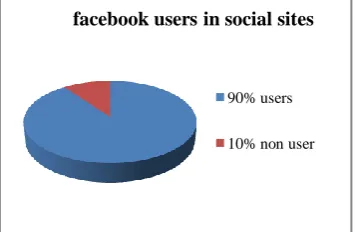
Facebook:A total 153(90%) users out of 170 were to be found Facebook user and 10% users were not having account on Facebook. Means Facebook is quite popular among people.
Fig1:- Pie chart of Facebook users in social networking sites
There‟s no doubt that Facebook has completely revolutionized the way people interact. But there‟s a dark side to the world‟s love affair with social media. Criminals are finding new ways to utilize Facebook to commit new and disturbing crimes that authorities don‟t necessarily know how to police. Here are the most common Facebook crimes and they are scams, cyber bullying, stalking, robbery, identify theft, harassment etc.
facebook users in social sites
90% users
ISSN(E): 2277-128X, ISSN(P): 2277-6451, DOI: 10.23956/ijarcsse/V7I7/0209, pp. 222-227
IV. LOCALIZATION OF DIFFERENT SERVICES PROVIDERS WITH RESPECT TO INDIAN STATES
Cyber crimes are a new class of crimes which are increasing day by day due to extensive use of internet these days. To combat the crimes related to internet The Information Technology Act, 2000 was enacted with prime objective to create an enabling environment for commercial use of I.T. The IT Act specifies the acts which have been made punishable. The Indian Penal Code, 1860 has also been amended to take into its purview cyber.
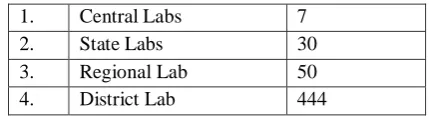
Cyber Forensics labs:The numbers of cyber forensics labs are established in India and they are:
TABLE II: NUMBER OF CYBER FORENSICS LABS 1. Central Labs 7
2. State Labs 30 3. Regional Lab 50 4. District Lab 444
Some institutes are:
National Institute of criminology and forensic Science (NICFS) New Delhi: -Standing Operating Procedure for Cyber Crime Investigation.
-Holds combined cyber training for police/prosecution/Judiciary.
Bureau of Police Research & Development (BPR&D):
- Collaboration with IITs/IIMs/Institutes of excellence NPTDC at IIT Delhi, NCETIS,IIT Mumbai. - National standing task force of Technology in policing at BPRD.
V. TRAINING TO JUDICIARY, POLICE LAW ENFORCEMENT AGENCIES
Training is imparted to Police Officers and Judicial officers in the Training Labs established by the Government. To meet this challenge, it is vital that SLTT law enforcement leaders ensure that appropriate agency personnel receive cybercrime training. Below we list examples of free cybercrime training designed to help SLTT law enforcement better understand computer technology and cybercrime issues.
FBI Cyber Shield Alliance – Virtual Academy Cyber Certification Program: The Virtual Academy contains an Introductory Class Suite (recommended below) as well as Hardware and Software Suite, a Networking Suite, a Security Suite, and an Enhanced Security Suite, which may prove useful to FLOs depending on their specific area of responsibility (AOR) roles and responsibilities.
National White Collar Crime Center (NW3C): NW3C delivers training in computer forensics, cyber and financial crime investigations, and intelligence analysis; offers investigative support to agencies investigating white collar and related crimes; conducts original research on all facets of white collar crime; and partners with the Internet Crime Complaint Center (IC3) to support the reporting of cybercrime incidents to law enforcement. NW3C currently provides several cost-free federally funded courses in the fields of cyber investigations, forensics and cybercrime, network intrusions, mobile forensics, and wireless network investigations
US Secret Service – National Computer Forensics Institute (NCFI):The National Computer Forensics Institute‟s (NCFI) innovative facility and strategic partnership serve to substantially enhance law enforcement efforts to suppress the continually evolving and increasing number of electronic crime cases affecting communities nationwide, as well as improve and strengthen the prosecution and adjudication of those cases. NCFI training courses are offered to state and local law enforcement, prosecutors and judges through funding from the federal government.
SEARCH, The National Consortium for Justice Information and Statistics: SEARCH, The National Consortium for Justice Information and Statistics, provides several computer-related online training courses for law enforcement personnel investigating crimes with a possible cyber link, such as gangs, homicide, vice, property crimes, narcotics, or high-tech crime.
These are the law enforcement agencies which gives trainings to judiciary and police officers to solve cyber crimes. Like these agencies there are several more agencies which give trainings and these institutes are Defense Cyber Crime Center (DC3), The Department of Justice, Computer Crime and Intellectual Property Section (CCIPS), Federal Law enforcement training centers (FLETC) etc.
VI. CYBERCRIME AND DIGITAL FORENSICS STATUS IN INDIA
To punish the cyber criminal government developed IT Act 2000. Some Cases registered under IT Act and IPC in India:
The case registered under IT Act includes:
Tampering computer source documents (Section 65 IT Act)
Loss /damage to computer resource/utility (Section 66 (1) IT Act)
Hacking (Section 66 (2) IT Act)
Obscene publication/transmission in electronic form (Section 67 IT Act)
Failure of compliance/orders of Certifying Authority (Section 68 I T Act)
ISSN(E): 2277-128X, ISSN(P): 2277-6451, DOI: 10.23956/ijarcsse/V7I7/0209, pp. 222-227 Publishing false Digital Signature Certificate (Section 73 IT Act)
Fraud Digital Signature Certificate (Section 74 IT Act)
Breach of confidentiality/privacy (Section 72 IT Act)
Cases registered under IPC:
Offences by/against Public Servant (Section 167, 172, 173, 175 IPC)
False electronic evidence (Section 193 IPC)
Destruction of electronic evidence (Section 204, 477 IPC)
Forgery (Section 463, 465, 466, 468, 469, 471, 474, 476, 477A IPC)
Criminal Breach of Trust (Section 405, 406, 408, 409 IPC)
Counterfeiting Property Mark (Section 482, 183, 483, 484, 485 IPC)
Tampering (Section 489 IPC)
Counterfeiting Currency / Stamps (Section 489A to 489E IPC)
Cases registered under special Acts:
Online sale of drugs under Narcotic Drugs and Psychotropic Substances Act.
Online sale of Arms Act
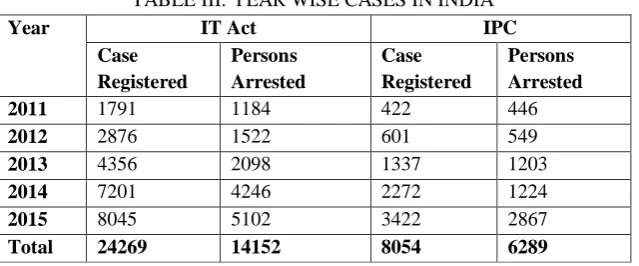
TABLE III: YEAR WISE CASES IN INDIA
Year IT Act IPC
Case Registered
Persons Arrested
Case Registered
Persons Arrested
2011 1791 1184 422 446
2012 2876 1522 601 549
2013 4356 2098 1337 1203
2014 7201 4246 2272 1224
2015 8045 5102 3422 2867
Total 24269 14152 8054 6289
As many as 39,730 cases are registered related to cybercrime in year 2016 and only 60% of cases are solved. In 2016 highest numbers of cyber crime cases are held in India in the last five years.
VII. CYBERCRIME AND DIGITAL FORENSICS SCENARIO AROUND GLOBE (DATA FROM IC3)
In May 2000, the IC3 was established as a center to receive complaints of Internet crime. There have been 3,762,348 complaints reported to the IC3 since its inception. Over the last five years, the IC3 received an average more than 280,000 complaints per year. The complaints address a wide array of Internet scams affecting victims across the globe. The IC3 is well positioned to be the central point for Internet crime victims to report and to alert the appropriate agencies of suspected criminal Internet activity. The IC3 reviews and analyzes data submitted through its website, and produces intelligence products to highlight emerging threats and new trends. The IC3 aggregates related complaints to build referrals, which are forwarded to local, state, federal, and international law enforcement agencies for potential investigation. If law enforcement conducts an investigation and determines a crime has been committed, legal action may be brought against the perpetrator. Each and every step is necessary to assist law enforcement in stopping Internet crime.
TABLE IV: YEAR WISE COMPLAINTS AND LOSS OF MONEY ON INTERNET SCAMS RECORD BY IC3
Year Complaints Money losses
2012 289,874 $525.4 Million
2013 262,813 $781.8 Million
2014 269,422 $800.5Million
2015 288,012 $1,070.7 Million
2016 298,728 $1,450.7 Million
Total 1,408,849 $4.63 Billion
2016 crime types:
TABLE V: CRIME TYPES AND VICTIM COUNT IN YEAR 2016 BY IC3
By victim count
Crime types Victims Crime types Victims
ISSN(E): 2277-128X, ISSN(P): 2277-6451, DOI: 10.23956/ijarcsse/V7I7/0209, pp. 222-227
Phishing/smishing/vishing/pharming 19,465 IPR/Copyright and counterfeit 2,572
Extortion 17,146 Re-shipping 893
Harassment/threats of violence 16,385 Terrorism 295 Credit card fraud 15,895 Investment 2,197 Tech support 10,850 Health care Related 369 Confidence fraud/ romance 14,546 Crimes against children 1,230 Social media 18,712 Virtual Currency 1,904
VIII. TOOLS AND TECHNOLOGIES CONSTRAINTS IN INDIA:
For better research and investigation, developers have created many computer forensics tools. Police departments and investigation agencies select the tools based on various factors including budget and available experts on the team. These computer forensics tools can also be classified into various categories:
Digital Forensics Framework
Open Computer Forensics Architectures
Computer Aided Investigative Environment(CAINE)
X-ways Forensics
Oxygen Software
LANTERN
Mobile edit Forensics
SIM tools
BitPim
ATHENA
CellDEK
Secure View2 etc.
IX. CYBER CRIME AND DIGITAL FORENSICS ON MULTIPLE PLATFORMS
There are multiple platforms where cyber crime and Digital forensics are used.
Mobile Device Forensics Originated in Europe and focused on the GSM SIM card. In mobiles there are many operating systems where cyber security is used and these are Android, Windows, Blackberry, IOS apple, Intel, BADA, Palm OS, Open web OS, Maemo, Verdict etc. Mobile Operating System is different from Computer System Operating System. In computer system there is also some Operating System like Windows, MS-DOS, Linux, Unix, Unicox, IBM etc.
1) Android Operating System:Android is the open source and „free to use‟ operating system for mobile devices
developed by Google. However, this open-development feature also poses challenges to securing sensitive user
data and protecting users from malicious attacks, such as phishing applications that are usually sent to users to trick them into providing their financial information and credentials while accessing malicious websites that look the same as the legitimate banking sites. Like these phishing so many malwares are also attack our android OS. In android so many apps notification come to install so we have to avoid those aids because they are accessing our data.
2) Blackberry OS: Blackberry operating system which was not explored by anyone because of security person. Blackberry was not safe so it will be banned.
3) Windows OS: 21st century is the century of revolution and change. The transformation of the analog world into a digital world has raised new challenges and opportunities for technology lovers. New forensic challenges arise with the introduction of newly released and latest operating systems. While on one hand, these newly released versions of Windows are aimed at making things easier for users, many of the functions (such as auto play, file indexing) performed by your operating system for your convenience can actually be used against you. Most of the cybercrimes are happen on windows operating system.
4) Linux OS: Linux is one of the fastest growing operating systems. Odds of a Cyber Crime Investigator encountering a Linux system are becoming greater. The Internet is made up of a majority of Linux systems. Learning the basic Linux system will help the investigator understand concepts in order to effectively investigate Cyber Crime. A majority hackers and hard core cyber-criminals don‟t use Windows based Systems. Learning the basic Linux concepts will help the Investigator effectively interview witnesses and suspects? Learning the Linux system will assist the Investigator in Crime Scene response if a Linux system is encountered. There is a common belief that Linux servers are more secure and less vulnerable than Windows servers.
X. CONCLUSION
ISSN(E): 2277-128X, ISSN(P): 2277-6451, DOI: 10.23956/ijarcsse/V7I7/0209, pp. 222-227
presented in the court of law. We have also discussed the different platforms which are much secure for the cyber users so that can‟t be an easy target of the different cyber criminals. In this paper we have also discussed an overview of IT Act 2000 which is a need of the hour to punish the different cyber criminals. In the end we have also recommended the provision of providing training to various agencies related with the cyber crime like Judiciary, Police, etc.
REFERENCES
[1] Shrivastav et al., International Journal of Advanced Research in Computer Science and Software Engineering 3(7),July - 2013, pp. 414-4192013
[2] Cyber Crime Research Presentation by the Australian Institute of Criminology Dr Russell G Smith Principal Criminologist
[3] Rajib Singla. 2013. “Cyber crimes against India: Increasing in leaps and bounds”. 21 November.http://blogs.quickheal.com/wp/cyber-crimes-against-india-increasing-in-leaps-and-bounds
[4] Federal Bureau of Investigation (FBI) for cybercrime information Cybercrimes www.fbi.gov/about-us/investigate/cyber/cyber
[5] Federal Bureau of Investigation(FBI) for tips to avoid Internet fraud www.fbi.gov/scams-safety/fraud/Internet fraud.
[6] IJCSNS International Journal of Computer Science and Network Security, 84 VOL.12 No.2, February 2012 [7] Hemraj Saini, Yerra Shankar Rao, T.C.Panda / International Journal of Engineering Research and Applications
(IJERA) ISSN: 2248-9622 www.ijera.com Vol. 2, Issue 2,Mar-Apr 2012, pp.202-209 [8] An Introduction To Cyber-Crime Cyber Law.html
[9] International Journal of Cyber Criminology (IJCC) – Publisher & Editor-in-Chief – K. Jaishankar ISSN: 0973-5089 - January – June 2015. Vol. 9 (1): 55–119. DOI: 10.5281/zenodo.22387
[10] International Journal of Cyber-Security and Digital Forensics (IJCSDF) 2(2): 48-76 The Society of Digital Information and Wireless Communications, 2013 (ISSN: 2305-0012)
[11] Computer Intrusion Forensics Research Paper Nathan Balon Ronald Stovall Thomas Scaria CIS 544
[12] Issues and Challenges of Cyber Security for Social Networking Sites (Facebook) Roshan Jabee Department of Computer Science and Engineering, Jamia Hamdrad New Delhi, India M. Afshar Alam Department of Computer Science and Engineering, Jamia Hamdrad New Delhi, India
[13] http://www.ijcaonline.org/archives/volume144/number3/jabee-2016-ijca-910174.pdf [14] http://pib.nic.in/newsite/PrintRelease.aspx?relid=132545
[15] https://factly.in/cyber-crimes-in-india-which-state-tops-the-chart/
[16] http://www.iacpcybercenter.org/topics/training-2/free-training-for-law-enforcement/ [17] http://kashmirreader.com/2017/01/19/india-reports-39730-cybercrime-cases-jan-oct-2016 [18] www.ic3.gov
[19] www.shoutmeloud.com/top-mobile-os-overview.html
[20] http://tech.firstpost.com/news-analysis/android-malware-increasing-tips-protect-phone-218395.html [21] articles.forensicfocus.com/2014/04/14/windows-forensics-and-security/