Research Article
a
April
2018
Computer Science and Software Engineering
ISSN: 2277-128X (Volume-8, Issue-4)
A Novel Algorithm based on UBTMF for Colour Pictures
Er. Himanshu Rehani
M.Tech Scholar, CSE Deptt., SIET, Aliyaspur Ambala, Haryana, India
Er. Anuradha Saini
A.P., CSE Deptt., SIET, Aliyaspur Ambala, Haryana, India
Abstract— The issue of picture denoising is one of the most established in the field, is as yet getting extensive focus from the exploration zone due to consistently expanding interest for sensibly valued great media and in additament its part as a pre-preparing venture for picture division, pressure, and so on, because of high spatial being without a vocation of mundane pictures, nearby averaging of the pixels impressively abate the commotion while bulwark the first structure of the picture. To enhance the execution of the essential channels, more compelling sifting calculations including the exchanging vector channels and the amalgamation vector. In spite of the fact that there are different sifting calculations to cull, the more preponderant part of them is not outfit predicated. Multifarious Median Filter (AMF) performs well at low commotion densities. Be that as it may, at high filter densities the window measure must be expanded which may prompt obscuring the picture. In exchanging middle channel the cull depends on Re-characterized limit esteem. The paramount downside of this technique is that characterizing a vigorous cull is onerous. Supplementally these channels won't consider the nearby highlights because of which points of interest and edges may not be recouped severely, concretely when the filter level is high. To vanquish the above downside, Decision Predicated Algorithm (DBA) is proposed. In this, the picture is denoised by utilizing a 3x3 window. On the off chance that the preparing pixel esteem is 0 or 255 it is handled or else it is left unaltered. At high commotion thickness the middle esteem will be 0 or 255 which is boisterous. The goal of disuniting is to expel the driving forces so the commotion free picture is planarity recouped with least flag bending. Filter (Clamor) expulsion can be accomplished by utilizing sundry subsisting direct dissevering procedures which are main stream as a result of their numerical straightforwardness and the presence of the assembling direct framework hypothesis. In spite of the fact that middle channels expel motivation clamor without harming the edges, the prodigious majority of them work consistently over the picture and in this way have a propensity to alter both commotion and clamor free pixels. Preferably, the disuniting ought to be connected just to debased pixels while leaving uncorrupted pixels in place. We propose a novel calculation for clamor diminishment in light of UBTMF for Colour pictures.
Keywords— Image processing, Noise, Filter, UBTMF, PSNR, IEF, MSE
I. INTRODUCTION
ISSN(E): 2277-128X, ISSN(P): 2277-6451, pp. 84-91
recently proposed algorithms renovate noise pixels by a median filter or its variants and without taking into account local features such as the promising presence of edges. Hence, details and edges are not recuperated satisfactorily, especially when the noise level is high. An intuitive conception to solve this quandary is proposed that enables switching between applying a pixel filter or not – depending on whether noise is detected or not. This approach preserves the noise-free structures of the image. Linear filtering method has drawback i.e. if the noise is non-additive, it can’t abstract the impulse noise prosperously. These disadvantages can be reduced with the avail of non-linear filters like Median filters, standard median filters, adaptive median filter, Tolerance predicated selective arithmetic mean filter, Decision predicated algorithm, DBAUTMF etc.
II. RELATED LITERATURE SURVEY
ISSN(E): 2277-128X, ISSN(P): 2277-6451, pp. 84-91
decomposition predicated on the line feature of local distribution. The experiment demonstrated that their proposed method prosperously achieved competitive performance compared to other puissant denoising methods. However, the incrimination in noise power and the number of channels processed affects the involution of achieving more precise spectral line vector estimation [15]. Mehdi Teimouri proposed an algorithm for colour image denoising designed between these two extremes, benefiting from the lower sensitivity of the human visual system to colour spatial variations. By comparison to a leading wavelet-predicated colour denoising method in computational cost as well as perceptual denoising performance, their method achieves the same performance standard at a much lower computational cost [16]. Stefan Schulte proposed an incipient impulse noise reduction method for colour images. This method withal illustrates that colour images should be treated differently than grayscale images in order to increment the visual performance.[17]. Lukasz Malinski proposed a family of switching filters designed for the impulsive noise abstraction in colour images is analysed. The salutary feature of the FASTAMF is its low computational involution, which makes the filter fascinating for the authentic-time colour image denoising [20]. Umesh Ghanekar proposed a two-stage image filtering scheme. It has been shown that their algorithm can abstract noise efficiently especially when the noise density is high. Simulation results show that the performance of PA is better than the other algorithms for both grayscale and colour images with different features and textures [22]. Sukadev Meher proposed a multi-channel circular spatial filter (MCSF) in YCbCr-colour space which was developed for YCbCr-colour image denoising. Bhoi and Meher proposed and demonstrated that circular spatial filter performed very well for efficient suppression of additive white Gaussian noise (AWGN) from gray images [23]. A novel adaptive filtering method was proposed for colour image sharpening and denoising. Experimental results have shown that this method performs great amelioration in engendering edges with natural sharpness and suppressing noises in the background around sharpen edges [24]. R. H. Laskar proposed a paper that utilizes the characteristics of the Human Visual System (HVS) for obtaining better results in denoising colour images corrupted by Gaussian noise [25]. Aleksey Rubel analysed textures or high-detailed structures contain information that can be exploited in pattern apperception and relegation [26]. Bor-Shing Lin proposed image retrieval and computer vision rely heavily on noise abstraction and image aperture padding to ascertain the precise rendering of images from depth cameras [27]. Deepthi Mary John proposed Colour Filter Arrays (CFA) utilized by single sensor cameras captures single colour information at each pixel location. The process of estimating the missing colour samples to reconstruct a full colour image was called colour filter array interpolation or demosaicing [28]. Dubok Park proposed a novel framework for enhancing submerged images captured by digital camera embedded into submerged diving mask [29]. Fang Li proposed a novel algorithm for colour image denoising. Their algorithm was predicated on Chromaticity- Effulgence (CB) colour model which disuniting the colour image into two components: chromaticity and effulgence [30]. Gitam Shikkenawis proposed sparse representations utilizing transform-domain techniques which are widely utilized for better interpretation of the raw data [31]. Igor Djurovi´c analysed that there was a paramount recent advance in filtering of the salt-and-pepper noise for digital images [32]. K.Priya discussed a novel colour image denoising approach by utilizing incipient decision predicated morpho filter for salt and pepper noise corrupted digital colour images [33]. Ngai Li proposed an image denoising algorithm for 3D DE mosaicked images [34]. Oleksii S. Rubel, Ruslan O. Kozhemiakin proposed a method to prognosticate denoising efficiency of filters predicated on discrete cosine transform (DCT) for multichannel images was proposed [35]. Raja S proposed colour image processing is the field magnetizes more on the researchers in recent decades because it challenges with number of unsolvable quandaries [36]. S. Esakkirajan proposed a modified decision predicated unsymmetrical trimmed median filter algorithm for the recuperation of grayscale, and colour images that are highly corrupted by salt and pepper noise [37]. Sergey Krivenko paper's describes a simple and expeditious way to prognosticate efficiency of DCT-predicated filtering of images corrupted by signal-dependent noise as this often transpires for hyper spectral and radar remote sensing [38]. Xin Zhang proposed a depth image denoising and enhancement framework utilizing a light convolution network [39]. Xin Sun has presented Colour Image Denoising Predicated on Guided Filter and Adaptive Wavelet Threshold [40].
III. PROPOSED WORK
ISSN(E): 2277-128X, ISSN(P): 2277-6451, pp. 84-91
Algorithmic Design:
MATLAB
The MATLAB is a high-performance language for technical computing. It integrates computation, visualization, and programming in a facile-to-use environment where quandaries and solutions are expressed in familiar mathematical notation. If you have an active Internet connection, you can withal watch the working in the Development Environment video demo, and the inditement a MATLAB Program video demo and additionally the other auxiliary demos for the major functionality. Typical uses include the following: Math and computation, Algorithm development, Data acquisition, Modelling, simulation, and prototyping, Data analysis, exploration, and visualization, Scientific and engineering graphics and Application development, including graphical utiliser interface building.
Simulation Results and Analysis
The Original Colour Image uses Salt & Pepper noise and De-noised image using a Median filter, Trimmed filter, UBTMF Filter comparisons among them. With image matrices like PSNR, IEF and MSE.
Step1: Load the original colour image
Step 2: Separate the three plane of the color of the color image i.e. red-green-blue plane.
Step3: Load the Distorted grayscale image of a cameraman at the nose density level 0.9, we may include this density level 0.1 to 0.9. In this work we use the maximum density level of noise, through which we can easily check the performance of our filters, and also calculate the image matrices like, PSNR, IEF, and MSE.
Step 4: filtered image by Median Filter Step 5: filtered image by Trimmed Filter Step 6: filtered image by Purposed Filter
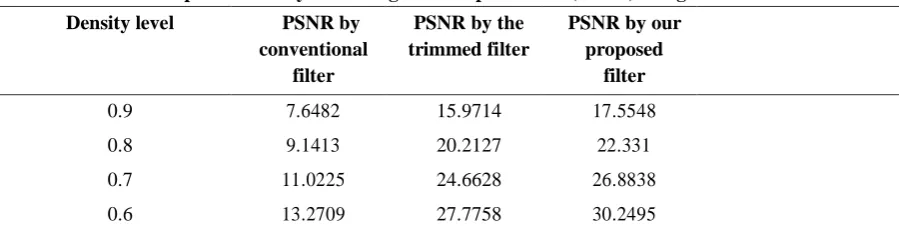
Table 1. Comparative analysis of Image Metric parameter (PSNR) using a different filter Density level PSNR by
conventional filter
PSNR by the trimmed filter
PSNR by our proposed
filter
0.9 7.6482 15.9714 17.5548
0.8 9.1413 20.2127 22.331
0.7 11.0225 24.6628 26.8838
0.6 13.2709 27.7758 30.2495
Read colour noise image.
Disunite the three plane of the color of the color image i.e. red-green-blue plane.
Cull either of the planes(R/G/B).
Cull 2-D window of size 3×3. Surmise that the pixel being processed is Pij.
If the processing pixel has values either more preponderant than 0 and less than 255 i.e. 0<Pij<255 then Pij
is an uncorrupted pixel and its value is left unchanged.
If Pij=0 or Pij=255 then it is a corrupted pixel and the further proceeding is predicated on following conditions Case i): If the culled window contains all the elements as 0’s and 255’s. Then supersede with the mean of the element of the window.
Case ii): If the culled window contains not all elements as 0’s and 255’s. Then eliminate 255 and 0’s and find the median value of the remaining elements. Supersede with the median value.
Reiterate steps 4 to 6 until all the pixels in the entire plane are processed. Go to step 3 and Cull next plane.
ISSN(E): 2277-128X, ISSN(P): 2277-6451, pp. 84-91
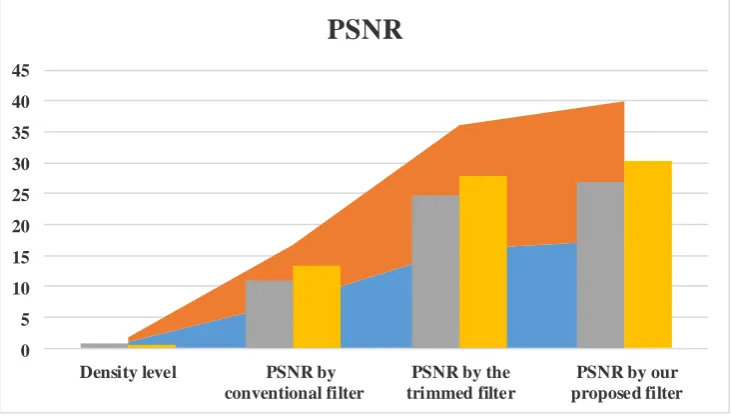
0 5 10 15 20 25 30 35 40 45
Density level PSNR by conventional filter
PSNR by the trimmed filter
PSNR by our proposed filter
PSNR
As shown in Table, PSNR value of different algorithms is compared with the proposed algorithm as a function of noise density. The table shows that the proposed algorithm (UBTMF) outperforms the existing algorithms for noise densities from 0.6 to 0.9.
Table 2 Comparative analysis of Image Metric parameter (IEF) using a different filter
Density level IEF by conventional
filter
IEF by the trimmed filter
IEF by our proposed
filter
0.9 1.4984 10.0868 14.5030
0.8 1.8704 23.9377 38.9864
0.7 2.5268 58.4271 97.4340
0.6 3.642 129.5202 181.8449
ISSN(E): 2277-128X, ISSN(P): 2277-6451, pp. 84-91
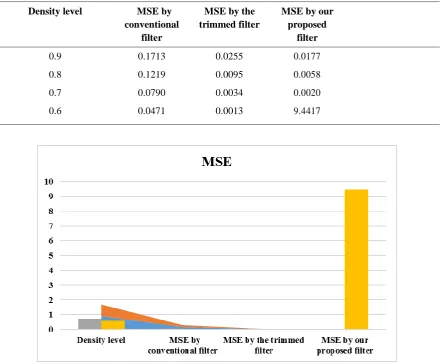
Table 3 Comparative analysis of Image Metric parameter (MSE) using a different filter
Density level MSE by conventional
filter
MSE by the trimmed filter
MSE by our proposed
filter
0.9 0.1713 0.0255 0.0177
0.8 0.1219 0.0095 0.0058
0.7 0.0790 0.0034 0.0020
0.6 0.0471 0.0013 9.4417
Table 3 shows the mean square error comparison of different algorithms as a function of noise density. Here as the noise density varied from 0.6 to 0.9 i.e. even at high noise density the proposed algorithm shows minimum MSE values in comparison with the existing algorithms, showing the effectiveness of the proposed algorithm
IV. CONCLUSIONS
In this dissertation work, I have proposed an incipient algorithm for the abstraction of impulse noise from the grayscale images. This incipient algorithm is designated as Unsymmetric Predicated Trimmed Mean Bilateral Filter (UBTMF). The proposed filter is capable of abstracting very high-density impulse noise from images and it additionally preserves the consequential details of the image during denoising. However the time required executing this algorithm is a bit more than the subsisting algorithms.The performance of the algorithm is tested against color images at low, medium and high densities, exhibiting the efficacy how impulse noise is abstracted through the color images. It yields better results than subsisting methods even at very high noise densities of 0.8 and 0.9. Both visual and quantitative results are withal demonstrated. Hence the purposed filter surmounts the circumscriptions of both these subsisting techniques. The resulting analysis shows that the purposed filter is very efficient for the impulse noise abstraction and gives better quantitative and qualitative results than the subsisting methods of impulse noise abstraction. In future, this filter can be further amended by integrating more impulse noise detection schemes to it. By utilizing efficient noise detection technique the thin lines and texture can withal be relegated differently along with edges in image hence the information contained by thin lines and texture can withal be preserved as edges are preserved in this method. All these modifications can make the purposed UBTMF filter more efficient for impulse noise abstraction. There are a couple of areas which we would relish to amend on. One area is in amending the de-noising along the edges as the method we used did not perform so well along the edges. The future work of research would be to implement Wiener Filter in Wavelet Domain.
REFERENCES
[1] Memoona Malik, Faraz Ahsan and Sajjad Mohsin, 2014. Adaptive image denoising using cuckoo algorithm,
ISSN(E): 2277-128X, ISSN(P): 2277-6451, pp. 84-91
[2] Pranay Yadav, 2015. Color Image Noise Removal by Modified Adaptive Threshold Median Filter for RVIN,
pp.175.
[3] Mayank Tiwari and Bhupendra Gupta, 2015. Image Denoising using Spatial Gradient Based Bilateral Filter and
Minimum Mean Square Error Filtering, pp.638
[4] Isma Irum, Muhammad Sharif, Mudassar Raza and Sajjad Mohsin, 2015. A Nonlinear Hybrid Filter for Salt &
Pepper Noise Removal from Color Images, pp.79
[5] Atluri Srikrishna, B. Eswara Reddy and Manasani Pompapathi, 2015. Pixon Based Image Denoising Scheme by
Preserving Exact Edge Locations
[6] Sinem Özdemir and Bekir Dizdaroğlu, 2015. PDEs-Based Gaussian Noise Removal from Color Images, pp.246
[7] Bogdan Smolka, Krystyna Malik and Dariusz Malik, 2015. Adaptive rank weighted switching filter for
impulsive noise removal in color images pp.289
[8] Kehan Shi, Zhichang Guo, Gang Dong, Jiebao Sun, Dazhi Zhang and Boying Wu, 2015. Salt-and-Pepper Noise
Removal via Local Hölder Seminorm and Nonlocal Operator for Natural and Texture Image, pp.400
[9] Bernardino Roig and Vicente D. Estruch, 2016. Localised rank-ordered differences vector filter for suppression
of high-density impulse noise in colour images, pp.246
[10] Santosh M .Tondare and Niteen S. Tekale, 2015. An Efficient Algorithm for Removal of Impulse Noise in Color
Image Through Efficient Modified Decision Based Unsymmetric Trimmed Median Filter, pp.476
[11] Bora Jin, Su Jeong You and Nam Ik Cho, 2015. Bilateral image denoising in the Laplacian subbands, pp.1
[12] S.Muthukumar, P.Pasupathi, S.Deepa and Dr. N Krishnan, 2015. An efficient Color Image Denoising method
for Gaussian and Impulsive Noises with blur removal
[13] Sara Behjat-Jamal, Recep Demirci and Taymaz Rahkar-Farshi, 2015. Hybrid Bilateral Filter.
[14] Xue Han, Xiaobo Lu, Xuehui Wu and Chunxue Liu, 2015. An Edge Detection Based Anisotropic Denoising
Method for Mobile Phone Images, pp.876
[15] Mia Rizkinia and Keiichiro Shirai, 2015. Local Spectral Component Decomposition for Multi-Channel Image
Denoising, pp.3208
[16] Mehdi Teimouri, Ehsan Vahedi, Alireza Nasiri Avanaki and Zabihollah Hasan Shahi, 2015.
[17] Stefan Schulte, Samuel Morillas, Valentín Gregori, and Etienne E. Kerre, 2015. A New Fuzzy Color Correlated
Impulse Noise Reduction Method, pp.2565
[18] M. Szczepanskia, B. Smolkaa, K.N. Plataniotisb and A.N. Venetsanopoulosb, 2004. On the distance function
approach to color image enhancement, pp. 283
[19] Isma Irum, Muhammad Sharif, Mudassar Raza and Sajjad Mohsin, 2015. A Nonlinear Hybrid Filter for Salt &
Pepper Noise Removal from Color Images, pp.79
[20] Lukasz Malinski1 and Bogdan Smolka2, 2015. Fast adaptive switching technique of impulsive noise removal in
color images
[21] Umesh Ghanekar and Rajoo Pandey, 2015. Random valued Impulse Noise Removal Using Adaptive Neuro –
fuzzy Impulse Detector
[22] Yanyan Wei, Shi Yan, Ling Yang and Yanping Fu, 2014. An Improved Median Filter for Removing Extensive
Salt and Pepper Noise, pp. 897
[23] Sukadev Meher, 2010, Color Image Denoising with Multi-channel Circular Spatial Filtering, pp.284
[24] Takahiko Horiuchi, Kunio Watanabe and Shoji Tominaga, 2015. Adaptive Filtering for Color Image Sharpening
and Denoising
[25] R. H. Laskar, S. Baishya, Saurav K. Kar, Rajib Sharma, N. Medhi and R. D. Purkayastha, 2015. Color Image
Denoising In Wavelet Domain Using Adaptive Thresholding Incorporating the Human Visual System Model, pp.498
[26] Aleksey Rubel, Vladimir Lukin, and Oleksiy Pogrebnyak, 2014. Efficiency of DCT-Based Denoising
Techniques Applied to Texture Images, pp. 270
[27] Bor-Shing Lin, Wei-Ren Chou, Chu Yu, Po-Hsun Cheng and Po-Jui Tseng, Sao-Jie Chen, 2015. An Effective
Spatial-Temporal Denoising Approach for Depth Images, pp. 647
[28] Deepthi Mary John and Abraham Thomas, 2015. Combined Denoising and Demosaicing of CFA Images, pp.
978
[29] Dubok Park, David K. Han and and Hanseok Ko1, 2016. Enhancing Underwater Color Images of Diving Mask
Mounted Digital Camera via Non-local Means Denoising, pp. 441
[30] Fang Li, 2015. A Novel Algorithm for Color Image Denoising Based on the CB Color Model.
[31] Gitam Shikkenawis, Student Member, IEEE, and Suman K. Mitra, 2016. 2D Orthogonal Locality Preserving
ISSN(E): 2277-128X, ISSN(P): 2277-6451, pp. 84-91
[32] Igor Djurovi´c, 2016. BM3D filter in salt-and-pepper noise removal
[33] [IEEE Papers:IEEE Xplore 11] K.Priya and Dr.D.Pugazhenthi, 2015. Noval Image Restoration Approach For
Colour Images Corrupted With Impulsive Noise, pp. 448
[34] Ngai Li, Jim S. Jimmy Li and Sharmil Randhawa, 2015. 3D Image Denoising Using Stereo Correspondences,
pp.978
[35] Oleksii S. Rubel, Ruslan O. Kozhemiakin, Sergey S. Krivenko and Vladimir V. Lukin, 2015. A Method for
Predicting Denoising Efficiency for Color Images, pp.304
[36] Raja S, 2015. An investigation on switching filters for impulse noise removal in color images, pp. 978
[37] S. Esakkirajan, T. Veerakumar, Adabala N. Subramanyam, and C. H. PremChand, 2011. Removal of High
Density Salt and Pepper Noise Through Modified Decision Based Unsymmetric Trimmed Median Filter, pp.287
[38] Sergey Krivenko, Vladimir Lukin and Benoit Vozel, Kacem Chehdi, 2014. Prediction of DCT-based Denoising
Efficiency for Images Corrupted by Signal-Dependent Noise, pp. 254
[39] Xin Zhang and Ruiyuan Wu, 2016. Fast Depth Image Denoising And Enhancement Using A Deep
Convolutional Network, pp. 2499
[40] Xin Sun,Ning He,Yu-Qing Zhang,Xue-Yan Zhen,Ke Lu, 2017. Color Image Denoising Based on Guided Filter