Proceedings of the
Workshop on OCL and Textual Modelling
(OCL 2010)
A Feature Model for an IDE4OCL
Joanna Chimiak–Opoka, Birgit Demuth
15 pages
Guest Editors: Jordi Cabot, Tony Clark, Manuel Clavel, Martin Gogolla Managing Editors: Tiziana Margaria, Julia Padberg, Gabriele Taentzer
A Feature Model for an IDE4OCL
Joanna Chimiak–Opoka1, Birgit Demuth2
1University of Innsbruck, Austria,[email protected] 2Technische Universit¨at Dresden, Germany,[email protected]
Abstract: An Integrated OCL Development Environment (IDE4OCL) can signif-icantly improve the pragmatics and practice of OCL. Therefore we started a com-prehensive requirement analysis with the long term vision of a multisite IDE4OCL project. In this paper we present a feature model for the IDE4OCL vision based on this analysis. In an earlier work we identified domain concepts, tool–level interac-tions with IDE4OCL, and use cases for OCL developers including a set predefined features. In the second step, we asked the OCL community members for their feed-back on our proposal. Around 100 researchers, tool developers and practitioners who gained experience with OCL have voted in an online–survey. The results gave us a valuable insight in the needs of OCL usage both in usual and advanced OCL ap-plications. One of the important results is a collection of features that have been pro-posed additionally to our predefined features. We analysed all the comments of the participants of the survey and consolidated them into an extended set of IDE4OCL features and eventually into a feature model.
Keywords: OCL, modeling, feature model, integrated development environment
1
Introduction
Thirteen years ago, the first version of the Object Constraint Language (OCL) was published as a part of the Unified Modeling Language (UML) standard. Since the publication of the OMG OCL standard many academic and commercial OCL tools have been developed such as Dresden OCL1, USE2 and MDT OCL3. In recent years OCL support is also implemented in modeling tools as in Magic Draw UML4, Borland Together5 and ECO for Visual Studio6. An overview of further OCL tools can be found in the OCL Portal7. This seems to affirm the following rule of thumb [Rid84]: It is commonly thought that 10 years is needed for technology to pass from its initial conception into wide–spread use. Below we will focus on two aspects important for a wide–spread use; namely maturity and usability of OCL, related to standards and tools.
The question of thematurityof modeling, in particular modeling with UML, was discussed during a MODELS 2009 keynote [Mel09]. Obviously OCL is less mature than UML, but the
1http://dresden-ocl.sourceforge.net/
2http://www.db.informatik.uni-bremen.de/projects/USE/
3http://wiki.eclipse.org/MDT-OCL/
4http://www.magicdraw.com/
5http://www.borland.com/us/products/together/
6http://www.capableobjects.com/ProductsServices ECO.aspx
maturity of OCL has been improved in the recent years. Considering the amount of research work related to OCL and the number of academic and industrial OCL tools [CGG08], one can see a huge potential for OCL to be in wide–spread use in the future. However, changes and imperfections of OCL specification constitute a crucial obstacle in achieving full maturity of the language.
Another important issue related to the adoption of a technology is its usability. As indi-cated in [Con09] software users and their usability issues seem to be commonly neglected in literature and practice. The availability of multiple OCL tools has caused the growth of the OCL community in the academic and industrial context. However, the OCL community has not agreed, until now, what functionality is important for OCL users. The topic of the last OCL Workshop [CCG+09] was therefore pragmatics of OCL. The question of usability of an OCL tool was already discussed in [CPP08], where it was mentioned thattools’ constituents (editors, compilers, browsers) must implement the functionalities established by integrated development environments(IDEs).
We went one step further and published a systematic requirements analysis for such an inte-grated development environment for OCL(IDE4OCL) [CDSR]. We identified domain con-cepts, tool–level interactions with IDE4OCL, and use cases for OCL developers including a set of 21 predefined features. To identify use cases and features we analysed our personal experi-ence with academic and industrial users of OCL and lessons learned from the well–established domain of IDEs for programming languages. A comprehensive description of the identified use cases and features, discussion of architectural decisions and technical feasibility can be found in our prior paper.
To validate our ideas, in the second step, we asked members of OCL community for their feedback. In this paper we presentqualitative8results of our on–line survey, in which around 100 researchers, tool developers and practitioners, who gained experience with OCL, expressed their opinions. The results gave us a valuable insight in the needs of OCL usage both in usual and advanced OCL applications. One of the important results is a collection of features that have been proposed in addition to features predefined by us. We analysed all comments of the participants of the survey and consolidated them into an extended set of IDE4OCL features eventually presented as a feature model.
The feedback from the OCL community is very important to us, as our long term goal is a community driven development of an IDE4OCL with partners from the academic and in-dustrial context. Moreover, we aim to network OCL users9. According to our knowledge, our research is the first attempt at questioning the global OCL community to systematically gather requirements to develop an IDE for OCL. Our goal is to gain a common understanding of the important functionality for OCL–driven modeling and development.
The rest of the paper is structured as follows: in Section2we outline the idea of an IDE4OCL. In Section3we shortly describe our survey–based research and give respondents characteristics. The collections of features proposed by us and by respondents of our survey are included in Sec-tion4. Based on both collections, features are summarised in Section5and presented as a feature model for an IDE4OCL. Finally, in Section6, we summarize our results and indicate future work.
8The quantitative evaluation of the results is a topic of a future paper.
2
IDE4OCL Overview
In this section we summarize the idea of IDE4OCL presenting its context, use cases and features. In recent years, many OCL based tools and tool–chains have been developed for multiple purposes. Currently, the OCL landscape is rich and heterogeneous. For the purpose of the context specification of IDE4OCL we propose a simplified view of anOCL tool landscapewith tools directly interacting with IDE4OCL (Fig.1). The view is based on possible usage scenarios of OCL discussed in [DW09]. The landscape specification also shows what IDE4OCL is not intended to be (components that are other ones than in the diagram) and at the same time points out, which functionality is considered to be outsourced (realisations in the other components in the diagram).
Thearchitectural styleof IDE4OCL can be considered as a toolset [HDF02] or a collection of plug–ins. We assume the possibility of OCL expression exchange between tools with full preservation of their semantics.
Transform OCL into Tests
<<Realizations>>
Testing Tool Design Models and Model Instances
Analyse Model Instance with OCL
Verify Model Instances with OCL
<<Realizations>>
Modeling Tool
Evaluate Statement
Specify Statement Verify Statement
<<Realizations>>
Manage Project IDE4OCL
Reason on/ Check Project
<<Realizations>>
Formal Verification Tool
Store and manage models/projects
<<Realizations>>
Repository
Use OCL for Model Transformations Transform OCL into Code
<<Realizations>>
MDE Tool
Project Evaluation Results Project Project Package,
OCL Expression
Model
Model, Model Instance,
Project
Project
Evaluation Results
Package, Model Instance
Figure 1: The OCL tools landscape: relations between tools (from [CDSR]).
From thefunctional point of view, we distinguished four main use cases to be realised by the IDE4OCL component (Fig.1), namely specification, evaluation and verification of statements and project management.
Specify Statement is the basic use case of an IDE4OCL, where an OCL developer specifies an OCL statement10. Note that the OCL statement can be specified both on the metamodel and the model layer. We consider here the creation of a new statement or a package from scratch or the modification of an existing one.
10 The termOCL statementwas introduced in [CDSR] for pragmatic reasons to denote a single artefact of an OCL
Evaluate Statement is a use case where statements are parsed by an OCL parser that creates an abstract syntax model that is evaluated by an OCL interpreter. This executes the state-ments defined on the model for the model instance. This use case can be performed on request from an OCL developer or from another tool in the OCL tool landscape (Fig.1). As mentioned in [CDSR], we consider the evaluation in the form of code generation as outsourced functionality.
Verify Statement use case covers both formal and empirical approaches to verification and val-idation of an OCL specification. Due to the complexity of formal verification, we consider it to be outsourced. As a form of empirical validation of statement, IDE4OCL should support testing of OCL statements (OCLUnit, [CO09]).
Manage Project use case is required for efficient support of OCL development. In the case of large projects it is important to have efficient management of all artefacts and configura-tion features of the IDE4OCL itself. This use case covers all management issues within IDE4OCL and related communication with other tools.
From the implementation point of view, the Specify and Evaluate Statement use cases may be hardly distinguishable. Modules to edit, to parse and to interpret OCL statements are crucial parts of IDE4OCL. For high usability, a user–friendly editor is indispensable and must fulfill the typical features of the Specify Statement use case. Nowadays, modern parsers go beyond pure parsing and are powerful tools offering advanced editing support. An OCL parser has also to semantically check OCL statements against the underlying model. A parser and editor is often shortly referred as anOCL editor.
For the Specify Statement use case we identified 21 features (among others Auto–completion, Basic Editing, Debugging and Syntax Highlighting), which were used in the on–line survey described in the next section. The features themselves are described in Section4.2.
3
Survey–Based Research
In this section we describe the design of the survey (Section3.1), data collection issues (Sec-tion3.2), and respondents characteristics (Sections3.3). Features proposed by respondents are described in Section4.2.
3.1 Survey Design and Structure
The first step in our empirical research [BW84] was the design of the survey. Thegoal of the surveywas to evaluate the appropriateness and completeness of the set of predefined features. The survey consists of four parts: personal data, appropriateness of features, completeness of the features and feedback. As the goal of this paper is to provide analysis of the qualitative survey results, we focus mostly on feedback related to achieve completeness of the futures.
Personal data part was designed to collect information about respondents. The results are pre-sented in Section3.3.
Completeness of the features part was to ask the respondents on their opinion about the com-pleteness of the set of the predefined features and to propose extensions for each use case. All but the first question in this part were open text questions, thus the respondents were free to write any information there. The summary of this part is given in Section4.2and Section5.
Feedback part consisted of the inquiry of respondents’ feedback in form of free text comments. These so–calledopen questionsare spread over survey sections according to their content.
3.2 Data Collection
The second step of our research, data collection, was a difficult task, as there is no easy way to identify OCL users. To collect data we used different channels: personal and electronic. We used hard copies and an on–line survey engine11.
Initially, data was collected throughpersonal contact with respondents. Our first opportu-nity to encounter the OCL commuopportu-nity was at the MODELS 2009 conference, especially at the OCL Workshop. We distributed our survey after the presentation and discussion of the idea of IDE4OCL [CDSR]. The second opportunity to meet people related to OCL was the 10th an-niversary of Dresden OCL12where we distributed our survey to the participants. Additionally, we contacted our co–workers and students in Dresden and Innsbruck.
After the phase with direct contacts, we started to use theelectronic channels: mailing lists, portals, e–mails and invitations via the survey engine with pre–generated tokens. We identified and directly contacted over 200 people using OCL in the academic and industrial context13and collected data over a period of 12 months14.
3.3 Respondents Characteristics
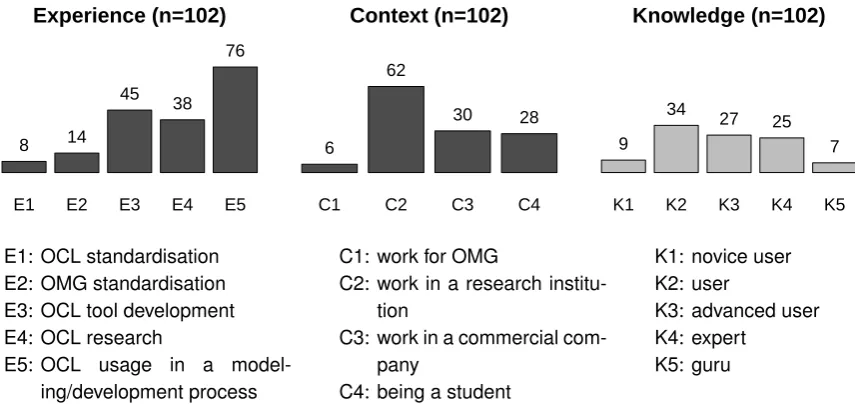
In the personal data part of the survey we asked respondents to provide information on their experience with OCL and the context in which they are using it. Additionally we asked for self– estimation of their OCL knowledge. Below we shortly describe these dimensions and present corresponding diagrams (Fig.2).
Thedistribution of experiencebased on 5 multiple choice kinds of experience is shown on the left side of Fig.2. The largest group consists of users (E5), the next groups of tool developers (E3) and researchers (E4). Several respondents were involved in standardisation processes (E1,E2).
The distribution of contextsbased on 4 multiple choice options of occupation is shown in the middle of Fig. 2. The largest group of respondents came from research institutions (C2), the next groups are employees of companies (C3) and students (C4). Only several respondents are working for standardisation organisations (C1). The greater amount of respondents from
11http://www.limesurvey.org/
12http://dresden-ocl.sourceforge.net/10years.html
13 This number is based on the number of invitations from the survey engine and excludes people contacted indirectly
by broadcasting (via portals, mailing lists and e–mails). Considering the direct contact only, the response rate was 48%.
14 The survey is still open and available athttp://squam.info/ide4ocl/.
E1 E2 E3 E4 E5
Experience (n=102)
8 14 45
38 76
C1 C2 C3 C4
Context (n=102)
6
62
30 28
K1 K2 K3 K4 K5
Knowledge (n=102)
9 34
27 25 7
E1:OCL standardisation
E2:OMG standardisation
E3:OCL tool development
E4:OCL research
E5:OCL usage in a
model-ing/development process
C1:work for OMG
C2:work in a research
institu-tion
C3:work in a commercial
com-pany
C4:being a student
K1:novice user
K2:user
K3:advanced user
K4:expert
K5:guru
Figure 2: Distribution of different experience, context (multiple choice options, in dark grey) and knowledge types (single choice options, in light grey).
research institutions compared to companies may be interpreted as a sign of wider usage of OCL in the academic rather than the industrial context.
This observation and its interpretation can be caused by the academic bias, which makes gen-eralisation vulnerable. It is easier to contact respondents from the academic context, i.e. students and researchers, because research on OCL is published. In contrast, information on usage of OCL in the commercial context is harder to find. Furthermore, the authors in social networks are predominantly settled in the academic context.
Thedistribution of knowledgebased on 5 disjoint self–estimation levels is presented on the right side of Fig.2. Central groups (K2–K4) are more dominant than peripheral ones (K1,K5).
4
Collection of Features
In this section we present features, which covers features defined in a solid requirements analysis by the authors of the survey (Section4.1) and further features proposed by the respondents of the survey (Section4.2).
4.1 Predefined Features
In the following, we present shortened definitions of 21 predefined features. For complete defi-nitions we refer to [CDSR] or to the web15.
Association End Navigability should be supported independently of the navigability of the un-derlying association in the model.
Auto–completion enables predicting a word or phrase that the user wants to type in without the user actually typing it in completely. Not only the OCL grammar but also the underlying model (model context, attributes, operations, ...) has to be included in the auto–completion mechanism.
Auto–indentation helps to better convey the structure of code to human readers (e.g. to show the relationship between OCL nested structures).
Basic Editing is a set of features related to editing any kind of text documents, which can be useful when editing OCL statements, e.g. spell checking or regular expression based find and replace.
Code Folding enables the user to selectively hide and display sections of an edited file.
Collaborative Editing allows several people to edit a file using different computers and pro-vides a possibility of team/pair work to enable knowledge transfer (e.g. teacher and stu-dent, geographically distributed developers).
Debugging should support developers in understanding the nature of bugs and typically offers functions such as running an expression step by step, conditional breakpoints in an expres-sion to examine the current state, tracking and changing the values of variables. Addition-ally, logging of and test generation based on debugging activities may be supported.
Document Interface is a set of features supporting editing of multiple documents. It covers support of multiple instances, single and multiple document window splitting, multiple document overlappable windows and a tabbed document interface. While working with hybrid models, it enables traceing relationships between textual and graphical notations.
Hybrid OCL/MOF View should provide an abstract syntax model and additionally highlight the context of any OCL expression in the metamodel.
Macro Mechanism enables short sequences of keystrokes and mouse actions to be transformed into other, usually more time–consuming, sequences.
Name Resolution for model elements in the form of simple or package–qualified names is re-quired.
Profiler enables performance analysis based on OCL statement/package evaluation time. It can be used to determine which OCL statements are most frequently evaluated and focuses on their optimization.
Refactoring Support is useful for renaming and restructuring entities whilst preserving their original semantics. For full support, dependencies between statements must be analysed to perform a series of renaming activities. Also, extracting a definition or a template from a statement should be supported to avoid code duplications.
Reuse Support can be realized at different levels. At the same abstraction level, OCL code can be reused by the composition of statements, template and library import mechanisms. A specification from the higher abstraction level can be reused during development of a specification at a lower level to ensure the correctness of metamodel instantiation.
Statement Element Browser provides facilities to browse, navigate, or visualize (e.g. as an outline) the structure of an OCL project, including OCL statements, elements and element instances.
Statement Coverage is used to measure, based on coverage criteria, the degree to which an OCL specification has been tested.
state-ment/specification and allows implicit typing or displaying size and complexity metrics.
Symbol Database enables quick and easy location of statements, elements, element instances and so on based on indexing.
Syntax Highlighting enables the display of OCL code in different colors and fonts according to the category of terminal symbols. Additionally highlighting for an underlying metamodel, errors and brace matching should be considered.
Template Support enables the definition, usage and management of templates. It is related to refactoring and reuse features.
Visibility and Lexical Scoping MOF provides the context–sensitive interpretation of a pack-age during the name resolution of OCL constraints in the context of a packpack-age with two distinct interpretations (depending on its role as a source or as a target of a package merge or import relationship).
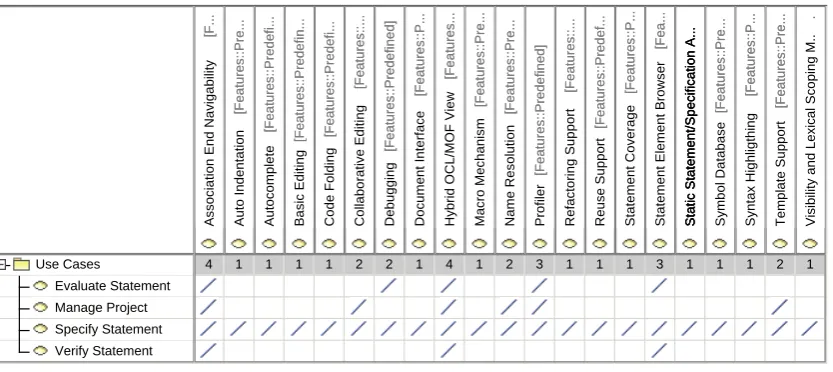
The features were intended for the Specify Statement use case, but they partially cover other use cases. In Fig.3we presentcoverage of use casesby the set of predefined features.
Association End Navigability
[F... [F... Auto Indentation [Features::Pre... [Features::Pre... Autocomplete [Features::Predefi... [Features::Predefi... Basic Editing [Features::Predefin... [Features::Predefin... Code Folding [Features::Predefi... [Features::Predefi... Collaborative Editing [Features::... [Features::... Debugging [Features::Predefined] [Features::Predefined] Document Interface [Features::P... [Features::P...
Hybrid OCL/MOF View
[Features... [Features... Macro Mechanism [Features::Pre... [Features::Pre... Name Resolution [Features::Pre... [Features::Pre... Profiler [Features::Predefined] [Features::Predefined] Refactoring Support [Features::... [Features::... Reuse Support [Features::Predef... [Features::Predef... Statement Coverage [Features::P... [Features::P...
Statement Element Browser
[Fea... [Fea...
Static Statement/Specification A...Static Statement/Specification A...Static Statement/Specification A... Symbol Database
[Features::Pre... [Features::Pre...
Syntax Highligthing
[Features::P... [Features::P...
Template Support
[Features::Pre... [Features::Pre...
Visibility and Lexical Scoping M..
.. Use Cases Evaluate Statement Manage Project Specify Statement Verify Statement
4 1 1 1 1 2 2 1 4 1 2 3 1 1 1 3 1 1 1 2 1
Figure 3: Use cases and their related predefined features
4.2 Proposed Features
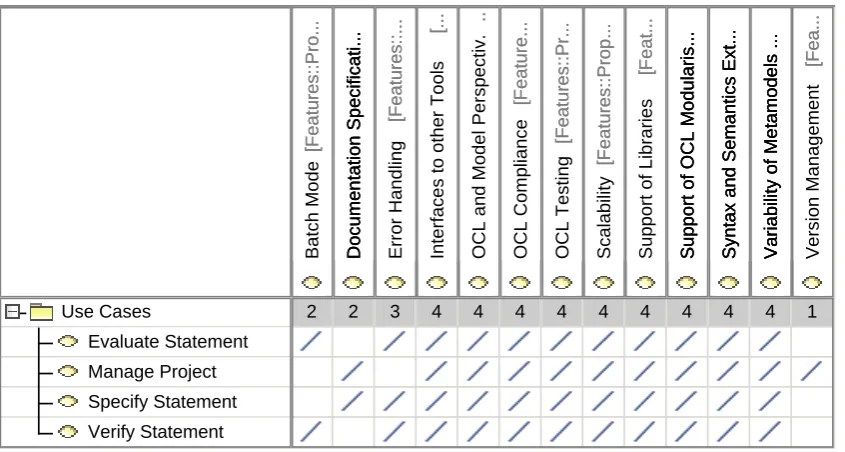
In the question on completeness on predefined features for the Specify Statement use case 68% of respondents answered positively. 59 respondents left their qualitative feedback and among them 46 answered questions on proposed features for the specify (23), evaluate (31), verify statement (27) and manage project (27) use case. We analysed and grouped their proposals and selected 13 most frequently mentioned features. Below we provide definitions of the proposed features and next we show their relation to the use cases (Fig.4).
can be considered depending on the user interaction required. Input for the batch mode can be provided from a command line, scripting mechanism or via configuration files. An example usage scenario is the evaluation of model metrics defined in OCL and passing their values to another tool or storage. Another example can be the verification of an OCL project by testing all OCL expressions (running OCLUnit tests [CO09]) before committing an OCL project into a version control system.
Documentation Specification and Generation provides an in–code documentation mechanism that is popular for many programing languages, e.g. Javadoc16. This mechanism enables keeping documentation together with code and generate documents based on the current state of the development [HT99]. We proposed adaptation of this practice to the OCL context [CO09].
Error Handling is generally the detection and resolution of errors and warnings at different levels. In the OCL context error handling refers both to the static and the dynamic seman-tics of OCL expressions. The user’s requirements for an efficient development of OCL statements include instant error/warnings detection while editing OCL, detection of all er-rors/warnings in an OCL package at a time (i.e. error reporting should not stop after the first error). as well as immediate, helpful and all in all user adequate visualization of er-rors/warnings respectively messages. Beyond error detection, developers wish support for quick fixes in OCL specification and evaluation.
Interfaces to Other Tools enable cooperation between IDE4OCL and other tools in the OCL landscape. We decided to outsource some issues to avoid extensive complexity and het-erogeneity. The interfaces should enable passing selected OCL statements to these tools to link the outsourced functionality. If appropriate, they should display feedback from them in the IDE4OCL. To integrate particular tools, adaptors have to be created.
OCL and Model Perspective provides two perspectives: one with OCL as main artifact and one with models in focus. In some cases, especially in the specify statement use case, it is easier to work within the OCL perspective. For example, when refactoring, reusing or optimising OCL expressions. In other cases, especially in the evaluate statement use case, it is more comfortable to work within the model perspective. For example, when evaluating OCL expressions results may be visualised in a corresponding model/diagram. Model elements can be enriched with annotations based on OCL evaluations results. It increases comprehensiveness of models and gives better insight into their violations of OCL–specified quality restrictions.
OCL Compliance is a prerequisite for realizing interoperability with other tools, which is one of the important architectural issues of an IDE4OCL. The OCL specification17 distin-guishes in its Chapter 2 three kinds of OCL compliance: syntax, XMI and evaluation compliance. OCL 2.0 was developed in parallel with UML 2.0 and MOF 2.0 that share a common core, thus the OCL standard requires that each OCL tool has to declare what com-pliance points against UML 2.0 and MOF 2.0 are fulfilled. To the best of our knowledge we know no OCL tool that describes its compliance. In many cases OCL tool support
16http://java.sun.com/j2se/javadoc/—a tool for generating API documentation in HTML format from doc comments
in Java source code.
is restricted to class diagrams, but in practical applications support of other diagrams is important, e.g. of state machines, like in ECO for Visual Studio.
OCL Testing is a supportive mechanism for OCL developers. It enables to check if a defined OCL statement evaluation provides expected results based on a test model. However,
testing shows the presence, not the absence of bugs[DBR69], it is the best practice to increase the quality of code. We proposed and discussed unit testing of OCL in [CO09].
Scalability is an often required feature enabling evaluation on large models, large collections of objects, or large OCL packages, but it has not yet been investigated to a sufficient extent. Support of configurations or incremental approaches can be used as a realisation approach of this feature. In the support for configurations, constraints in particular invariants should be evaluated in relevant situations to reduce the effort for useless or costly evaluations such as in the case of the OCL22Java generator18. In incremental integrity checking, only the subset of the system state that has been changed is considered [CT09].
Support of Libraries enables to increase modularisation and reuse of OCL statement as it pro-vides import mechanism. It can be used to provide libraries of typical statements for the OCL standard library either as a learning material or for reuse purposes. Additionally, for user convenience, on–fly libraries could created, e.g. for all OCL statements relating to a particular context to be editable together. Moreover, it should be possible to bind libraries in another formats or in another storage, e.g. as jar files or from databases. An example scenario: A UML profile comes with the constraints defined. These constraints could be compiled into the library, and then the tool, using this profile can just access/run constraint implementations from the (jar) library.
Support of OCL Modularisation can be interpreted from various perspectives. One is a tech-nique for the support of user–defined modularisation of the language itself. This is useful to extend, adapt or embed OCL expressions for different usage19 as well as to reduce the complexity of OCL [AZH08], [WTZ10]. Another OCL modularisation feature is the modularisation of OCL packages. For example, this could be useful for reuse of OCL expressions in the case of collaboration of partners who share the same model but not all constraints. A technique that we recommend for it is the usage of libraries.
Syntax and Semantics Extensions can increase acceptance of OCL by modifications of its syn-tax that resembles a formal language. Therefore the support for creation of an alternative concrete syntax is required. Another idea is to introduce notational beautifiers that means a printer that exports OCL programs using a math–inspired short–hand notation [Sue06]. Extending the semantics of OCL besides the syntax is much more difficult but also desired. Examples are the introduction of regular expressions or ad–hoc polymorphism. It should be indicated that OCL language modularization is a technique implementing syntax and semantics extensions.
Variability of Metamodels and Technical Spaces is required to support the original intention of OCL, i.e. to specify constraints on UML models and well–formedness rules in meta-modeling. Along the model–driven software development and domain specification
lan-18 http://dresden-ocl.svn.sourceforge.net/viewvc/dresden-ocl/trunk/ocl20forEclipse/doc/pdf/manual.pdf
19 see presentation of Christian Wende et al at the Workshop Dresden OCL - Quo Vadis at
guages hype, OCL is very often used on various metamodels. Consequently, parsers and interpreters are needed that support variability of metamodels. Regarding interpreters, the used metamodel is not the only issue. In practice, OCL interpreters are implemented in a specific technical space such as Java, EMF or a proprietary model repository. To be generic against models in variable technical spaces, an IDE4OCL should provide a framework to evaluate OCL expressions on objects in different technical spaces [WTW10].
Version Management is desired to have version control for both OCL expressions and models. It should provide support for change management and change tracking. Versioning can help to integrate OCL statements into the software life cycle. A minimalistic solution is an integration with subversion or CVS. However, a target solution should be more mature and dedicated for versioning of OCL and models at statement and model element level.
Batch Mode
[Features::Pro... [Features::Pro...
Documentation Specificati...Documentation Specificati...Documentation Specificati... Error Handling
[Features::... [Features::...
Interfaces to other Tools
[... [...
OCL and Model Perspectiv.
....
OCL Compliance
[Feature... [Feature...
OCL Testing
[Features::Pr... [Features::Pr...
Scalability
[Features::Prop... [Features::Prop...
Support of Libraries
[Feat... [Feat...
Support of OCL Modularis...Support of OCL Modularis...Support of OCL Modularis... Syntax and Semantics Ext...Syntax and Semantics Ext...Syntax and Semantics Ext... Variability of Metamodels ...Variability of Metamodels ...Variability of Metamodels ... Version Management
[Fea... [Fea...
Use Cases
Evaluate Statement
Manage Project
Specify Statement
Verify Statement
2 2 3 4 4 4 4 4 4 4 4 4 1
Figure 4: Use cases and their related proposed features
5
An IDE4OCL Feature Model
In the previous section we presented sets of predefined (Section4.1) and proposed features (Sec-tion4.2) without any prioritisation of them. In this section we structure features into a compre-hensive IDE4OCL feature model, where we distinguish between mandatory and optional features and group them into more general categories.
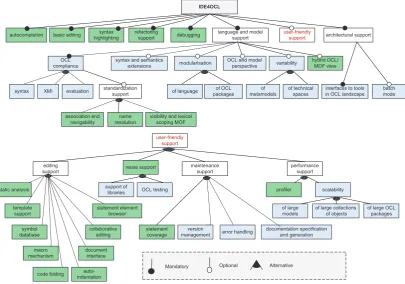
For the predefined features we used quantitative evaluation of the survey (as described below) and due to the lack of such evaluation for proposed features we based our classification on per-sonal experience with OCL and IDEs. Below we describe our strategy of feature classification in the feature model depicted in Figure5.
• The predefined features with the statistically highest importance and at the same time high-est urgency ranking in the survey20are declared asmandatory features: Auto–completion, Basic Editing, Syntax Highlighting, Debugging and Refactoring Support. The first three features can be corresponding to the state-of-the-art considered as basic mandatory fea-tures. Debugging and Refactoring Support are in contrast features that are not yet imple-mented in OCL tools. Therefore these both features are a challenge for OCL tool devel-opers in the near future. All other predefined features are considered as optional features regardless of their importance and urgency ranking.
• From the architectural point of view the IDE4OCL must provide interfaces to the tools in the OCL tools landscape (Fig.1). Therefore the feature Interfaces to tools in the OCL landscape is also mandatory. An optional feature is Batch Mode.
All other predefined and proposed features we classify into features forlanguage and model supportand features foruser-friendly support.
• Language and model support is declared as mandatory because one subfeature is OCL compliance that should be mandatory to achieve a high exchangeability with other tools. According to the OCL specification, at least one of the compliance points (syntax, XMI, evaluation) should be fulfilled. The predefined features (Association End Navigability, Name Resolution and Visibility and Lexical Scoping MOF) are aggregated into a com-pound feature for standardization support. Syntax and Semantics Extensions, Modularisa-tion, OCL and Model Perspective, Variability as well as Syntax Highlighting are optional features for language and model support.
• The rest of the features we classify as user-friendly support that are all optional. To or-der them we distinguish feature for editing, reuse, maintenance and performance sup-port. Editing support include typical editor features that are nice to have but not manda-tory (Static Statement/Specification Analysis, Template Support, Symbol Database, Macro Mechanism, Code folding, Statement Element Browser, Collaborative Editing, Document Interface and Auto–indentation). Reuse Support was extended by two proposed features: Support of libraries and OCL testing. Statement Coverage, Version management, Error handling, and Documentation Specification and Generation are features that support main-tenance of OCL packages. Besides a Profiler, OCL users wish Scalability of large models, large collections of objects and/or large OCL packages to improve the performance of OCL evaluation.
We want to explicitly note that the presented feature model is a first consolidated proposal that should be the subject of further discussions in the OCL community.
20 The statistical evaluation of the appropriateness of the predefined features will be published in a paper on
language and model
support architectural support
IDE4OCL
syntax highlighting
basic editing debugging
autocompletion user-friendlysupport
modularisation variability syntax and semantics
extensions of metamodels of OCL packages of technical spaces of language association end navigability hybrid OCL/ MOF view name resolution
visibility and lexical scoping MOF
OCL and model perspective standardization support syntax OCL compliance evaluation XMI statement coverage maintenance support user-friendly support performance support profiler scalability
of large collections of objects of large
models
error handling documentation specification and generation version management reuse support OCL testing support of libraries editing support static analysis macro mechanism collaborative editing auto-indentation document interface code folding statement element browser symbol database template support Alternative Mandatory Optional refactoring support batch mode interfaces to tools in OCL landscape
of large OCL packages
Figure 5: The IDE4OCL feature model with mandatory, alternative and optional features taken from predefined (in green) and proposed (in blue) features.
6
Conclusions and Future Work
Our long–term goal is the development of an OCL tool that can be part of a comprehensive model–driven software development environment. Additionally, we want to improve the usabil-ity of OCL usage for the software developer by efficient tool support. A requirements analysis is an important success factor in achieving this goal. Therefore we started with a solid require-ments investigation for an IDE4OCL by questioning members of the OCL community both in academia and industry. We collected and analysed data, opinions and comments from around 100 respondents. Hence we may say that our results reflect the needs of a significant group of the OCL users.
In our future work we are looking for academic and industrial partners who are willing to col-laborate in the further development, decomposition and implementation of our IDE4OCL vision within an open source project.
AcknowledgementThe research herein is partially conducted within the competence network Softnet Austria (www.soft-net.at) and funded by the Austrian Federal Ministry of Economics (bm:wa), the province of Styria, the Steirische Wirtschaftsfoerderungsgesellschaft mbH. (SFG), and the city of Vienna in terms of the center for innovation and technology (ZIT). Our gratitude goes toall respondents of our survey, especially to those who proposed additional features and gave us constructive feedback. Additionally, we want to thankparticipants of the last OCL workshop,
Manuel ClavelandTricia Balfefor interesting discussions. We would like to thankDarius SilingasandNicolas F. Rouquettefor co–operation in the initial phase of the project andKevin ChurchandHannes M¨oslfor their reviews during finalisation of the paper. Last but not least, our gratitude goes toour student–developersat universities of Innsbruck and Dresden for all discussions and their readiness to make our visions real.
Bibliography
[AZH08] D. Akehurst, S. Zschaler, G. Howells. OCL: Modularising the Language. InOcl4All: Workshop at MoDELS 2007, Electronic Communications of the EASST. Volume 9. 2008.
[BW84] V. R. Basili, D. M. Weiss. A Methodology for Collecting Valid Software Engineering Data.IEEE Trans. Software Eng.10(6):728–738, 1984.
[CCG+09] J. Cabot, J. Chimiak-Opoka, M. Gogolla, F. Jouault, A. Knapp. Ninth International Workshop on the Pragmatics of OCL and Other Textual Specification Languages. In Ghosh (ed.), MoDELS Workshops. Lecture Notes in Computer Science 6002, pp. 256–260. Springer, 2009.
[CDSR] J. Chimiak-Opoka, B. Demuth, D. Silingas, N. F. Rouquette. Requirements Analysis for an Integrated OCL Development Environment.ECEASST 24.
[CGG08] J. Cabot, M. Gogolla, P. V. Gorp. Eighth International Workshop on OCL Concepts and Tools. In Chaudron (ed.),MoDELS Workshops. Lecture Notes in Computer Sci-ence 5421, pp. 257–262. Springer, 2008.
[CO09] J. Chimiak-Opoka. OCLLib, OCLUnit, OCLDoc: Pragmatic Extensions for the Ob-ject Constraint Language. Pp. 665–669 in [SS09].
[Con09] L. L. Constantine. Interaction Design and Model–Driven Development. P. 377 in [SS09].
[CPP08] D. I. Chiorean, V. Petrascu, D. Petrascu. How My Favorite Tool Supporting OCL Must Look Like.ECEASST 15, 2008.
[CT09] J. Cabot, E. Teniente. Incremental integrity checking of UML/OCL conceptual schemas.J. Syst. Softw.82(9):1459–1478, 2009.
[DBR69] E. W. Dijkstra, J. N. Buxton, B. Randell (eds.). Software Engineering Techniques. 1969.
[DW09] B. Demuth, C. Wilke. Model and Object Verification by Using Dresden OCL. In
Proc. of the Russian-German Workshop Innovation Information Technologies: The-ory and Practice. 2009.
[HDF02] H. Hußmann, B. Demuth, F. Finger. Modular architecture for a toolset supporting OCL.Sci. Comput. Program.44(1):51–69, 2002.
[HT99] A. Hunt, D. Thomas. The pragmatic programmer: from journeyman to master. Addison-Wesley Longman Publishing Co., Inc., Boston, MA, USA, 1999.
[Mel09] S. J. Mellor. Models. Models. Models. So What? P. 1 in [SS09].
[Rid84] W. E. Riddle. The magic number eighteen plus or minus three: a study of software technology maturation.SIGSOFT Softw. Eng. Notes9(2):21–37, 1984.
doi:http://doi.acm.org/10.1145/1010925.1010927
[SS09] A. Sch¨urr, B. Selic (eds.).Model Driven Engineering Languages and Systems, 12th International Conference, MODELS 2009, Denver, CO, USA, October 4-9, 2009. Proceedings. Lecture Notes in Computer Science 5795. Springer, 2009.
[Sue06] J. G. Suess. Sugar for OCL. Proceedings of the Sixth OCL Workshop OCL for (Meta-)Models in Multiple Application Domains (OCLApps 2006), November 2006. In: Dan Chiorean and Birgit Demuth and Martin Gogolla and Jos Warmer (Eds.): Proceedings of the Sixth OCL Workshop OCL for (Meta-)Models in Multi-ple Application Domains (OCLApps 2006).
[WTW10] C. Wilke, M. Thiele, C. Wende. Extending Variability for OCL Interpretation. ac-cepted for MoDELS 2010, 2010.
![Figure 1: The OCL tools landscape: relations between tools (from [CDSR]).](https://thumb-us.123doks.com/thumbv2/123dok_us/7809228.2085704/4.595.92.504.356.555/figure-ocl-tools-landscape-relations-tools-cdsr.webp)