Volume 41 (2011)
Proceedings of the
Tenth International Workshop on
Graph Transformation and
Visual Modeling Techniques
(GTVMT 2011)
Propagation of Constraints along
Model Transformations Based on
Triple Graph Grammars
Hartmut Ehrig , Frank Hermann , Hanna Sch¨olzel , and Christoph Brandt
14 pages
Guest Editors: Fabio Gadducci, Leonardo Mariani
Managing Editors: Tiziana Margaria, Julia Padberg, Gabriele Taentzer
Propagation of Constraints along
Model Transformations Based on
Triple Graph Grammars
Hartmut Ehrig1, Frank Hermann1, Hanna Sch¨olzel1, and Christoph Brandt2
1Institut f¨ur Softwaretechnik und Theoretische Informatik, Technische Universit¨at Berlin,
[ehrig,frank,hannas]@cs.tu-berlin.de
2SECAN-Lab, Universit´e du Luxembourg,
Abstract: Model transformations based on triple graph grammars (TGGs) have been applied in several practical case studies and they convince by their intuitive and descriptive way of specifying bidirectional model transformations. Moreover, fundamental properties have been extensively studied including syntactical correct-ness, completecorrect-ness, termination and functional behaviour. But up to now, it is an open problem how domain specific properties that are valid for a source model can be preserved along model transformations such that the transformed properties are valid for the derived target model. In this paper, we analyse in the framework of TGGs how to propagate constraints from a source model to an integrated and tar-get model such that, whenever the source model satisfies the source constraint also the integrated and target model satisfy the corresponding integrated and target con-straint. In our main new results we show under which conditions this is possible. The case study shows how this result is successfully applied for the propagation of security constraints in enterprise modelling between business and IT models.
Keywords: model transformation, graph constraints, security requirements, triple graph grammars
1
Introduction
Model integration and transformation between models as well as the compliance of such models with concrete security requirements have already been studied in different application domains, especially in the context of enterprise modelling [2]. In detail, it was possible to present how triple graph grammars (TGGs) in the sense of Sch¨urr [14] can be used to realize the integration and transformation of those models. In addition to that, graph constraints [4] were utilized to verify that business and IT models comply with given security requirements.
:E/D
CS PS
1:public
:E/D
Source Constraint publicIsEncrypted2for IT-models
:Filter
1:public 1:public
CT PT
Target Constraint publicIsFiltered2for business models
aT
aS 1:public
Filter E/D
public
E/D
public
NW4:LAN
NW7:LAN
private
private
Private_Banking:Department
Investment_Banking:Department
private
public private
private
private public
p q
IT Model and IT Security Requirement Business Model and Business Security Requirement
p q
GS GT
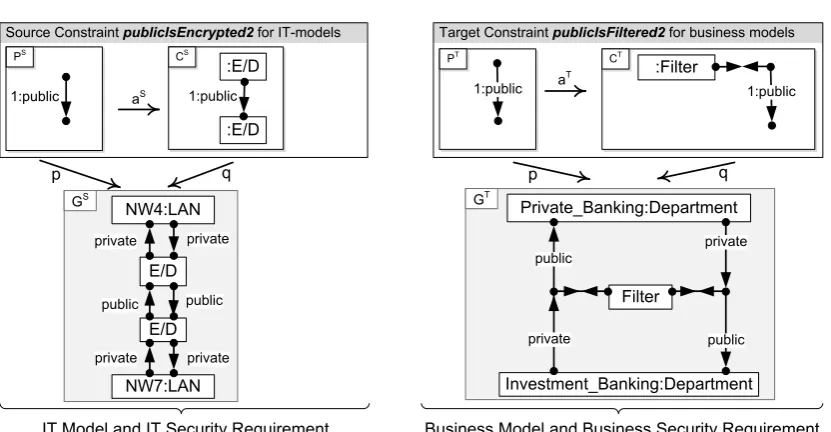
Figure 1: IT and business models with security requirements
to be understood from the point of view of the corresponding business models in order to ensure that the different persons responsible for the business models, IT models and security require-ments will be able to integrate, transform and verify these models successfully. While this paper presents the case study in concrete syntax the presented techniques are based on the underlying typed attributed abstract syntax graphs [4].
Furthermore, if an IT model satisfies the source constraint the corresponding business model should satisfy the target constraint. In general, given a requirement for a source model specified by a graph constraint we would like to construct a corresponding requirement for the correspond-ing target model with the followcorrespond-ing satisfaction property:Whenever a source model satisfies the given source graph constraint then the target model, defined by the model transformation, sat-isfies the corresponding target graph constraint. In Fig. 1 the source model GS satisfies the source graph constraintPC(aS:PS→−CS), because for each match p:PS→GS (occurrence of the premise graph) there is morphism q:CS→GS (occurrence of the conclusion graph) with
q◦aS=p.
In this paper we show under which conditions we are able to define a propagation from source graph to target graph constraints such that this satisfaction property is valid. First of all it makes sense to require strong functional behaviour of the model transformation, which implies that we have for each source model a unique target model. Moreover this allows for each source graph constraintPC(aS :PS→−CS) with premise PS, conclusionCS and embedding morphism aS to obtain a unique target graph constraintPC(aT:PT→−CT)by applying the model transformation toPS andCSleading toPT andCT. For this construction we require thatPS andCSare source models, i.e. PS,CS∈VLS, whereVLSis the source language of the model transformationMT:
VLSVVLT. In this case the source graph constraintPC(aS:PS→−CS)is called MT-consistent
and leads to a MT-consistent target graph constraint PC(aT :PT→−CT). In Sec. 2 we review model transformation based on triple graph grammars [5, 14, 15] and prepare our case study based on a model transformation from business to IT-models.
propaga-tion of security constraints is valid forMT-consistent source and target constraints. In Sec.4we discuss how to extend the theory to the case of partially MT-consistent constraints where premise or conclusion consist only of model fragments, s.t. model transformations are not directly appli-cable. Our constructions and results are illustrated by a case study of security constraints in enterprise modelling. For the main results we only give proof ideas. For detailed proofs see [6,13].
2
Model Transformation between Business and IT Models
Triple graph grammars (TGGs) [14] are a well known approach for bidirectional model trans-formations and we apply TGGs to define the model transformation of our case study between business and IT models. For this purpose we review main constructions and results of model transformations based on triple graph grammars [15,5] in this section.
Integrated models are defined as pairs of source and target graphs, which are connected via a correspondence graph together with relating morphisms between these graphs. More precisely, a triple graphG=(GS←−s−G GC−−t→G GT)consists of three graphsGS,GC, andGT, called source,
correspondence, and target graphs, together with two graph morphismssG:GC→GSandtG:
GC→GT.
(GS
mS
G oo sG GC
mC tG //
GT)
mT
(HS H
m
HC
sH
oo
tH
//HT)
A triple graph morphismm:G→Hwithm= (mS,mC,mT)
consists of three graph morphismsmS:GS→HS,mC:GC→
HC andmT :GT →HT such thatmS◦sG=sH◦mC andmT◦
tG=tH◦mC. A typed triple graph G is typed over a triple
graphTGby a triple graph morphismtypeG:G→TGand a typed triple graph morphism m:
(G,typeG)→(H,typeH)preserves the typing, i.e. typeH◦m=typeG. Triple graphs may also
contain attributed nodes and edges according to [5] and they form an M-adhesive as well as weak adhesive HLR category for which several important formal results have been shown in [4].
(LS
trS
L oo sL LC
trC tL //
LT)
trT
(RS R
tr
RC
sR
oo
tR
//RT)
L
m
tr //
R
n
(PO) G t //H
Triple rules synchronously build up source and target graphs as well as their correspondence graphs, i.e. they are non-deleting. A triple rule
tr is an injective triple graph morphism tr = (trS,trC,trT):L→Rand w.l.o.g. we assumetr
to be an inclusion. Given an (almost) injective triple graph morphismm:L→G, a triple graph transformation (TGT) stepG===tr,m⇒H fromGto a triple graphHis given by a pushout of triple graphs with comatchn:R→H and transformation inclusiont:G,→H. Given a sequence of TGT-steps G0====tr1,m⇒1 G1...=trk,mk
===⇒ Gk its trace is given bytrace=tk◦. . .t2◦t1. A grammar
TGG= (TG,S,TR)consists of a triple type graphTG, a triple start graphSand a setTRof triple rules.
PublicToP-ublic generates pPublicToP-ublic edges with gluing nodes in both domains simultaneously. The encryp-tion/decryption nodes (E/D) are created in front and at the end of a public Reo connector (de-picted as black arrows) in the rule EDToFilter, where in the Business model a Filter is attached to the corresponding public Reo connector.
:Department :LAN ++ ++ ++ ++ ++ :A ++ ++ ++ ++ ++ ++ ++ ++ ++ public ++ ++ public ++ :P :P :Filter :E/D :E/D ++ ++ ++ ++ ++ ++ :public ++ :public ++ ++ ++ :A :A :P :P
Triple Rule EDToFilter Triple Rule LANToDepartment
Triple Rule PublicToPublic
Figure 2: Some triple rules of the model transformation
(LS
trS ∅ oo //∅)
(RSoo ∅ //∅)
source ruletrS
(∅
∅
oo
//LT)
trT
(∅oo ∅ //RT)
target ruletrT
(RS
id
LC
trS◦sL
oo
trC
tL //
LT)
trT
(RS oo sR RC tR //RT)
forward ruletrF
The operational rules for model transformations based on TGGs are automatically derived from the set of triple rules TR [5]. From each triple rule tr we derive a forward rule trF for
forward transformation sequences and a source rule trS for the construction resp. parsing of a
model of the source language. ByTRSandTRF we denote the sets of all source and forward rules
derived fromTR. The sets of backward rulesTRBand target rulesTRT are derived analogously
as presented in [2].
:Filter :E/D :E/D ++ ++ ++ ++ :public ++ :public ++ ++ ++ :A :A :P :P
Forward Rule EDToFilter Figure 3: A derived forward rule
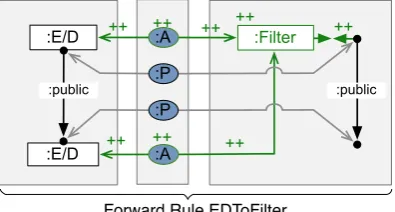
Example 2 (Forward Rule) The rule in Fig. 3 is the derived forward rule of the triple rule “EDToFilter” shown in Fig.2. No new elements are added in the source graph by this rule. The “E/D” elements that are added by the triple rule have already to be present in a model to make this rule applica-ble. Whereas the corresponding and target graphs and the morphisms remain the same as in the triple rule.
A set of triple rulesTRand the start graph∅typed over a triple graphT Ggenerate a visual
languageVLof integrated models, i.e. models with elements in the source, target and correspon-dence component. The source languageV LSand target languageVLTare derived by projection to
the triple components, i.e.V LS=pro jS(V L)andV LT=pro jT(V L). For theS-componentT GS
and target models typed overT GSandT GT respectively. This means we haveVLS⊆VL(T GS)
andV LT ⊆V L(T GT).
As presented in [5] the derived operational rules provide the basis to define model transforma-tions based on source consistent forward transformatransforma-tionsG0⇒=∗Gn via(tr1,F, . . . ,trn,F), short
G0=
tr∗F
=⇒Gn. A forward sequenceG0=
tr∗F
=⇒Gnis source consistent, if there is a source sequence
∅=tr
∗ S
=⇒G0such that the sequence∅=tr
∗ S
=⇒G0=
tr∗F
=⇒Gnis match consistent, i.e. theS-component
of each matchmi,F oftri,F(i=1. . .n)is uniquely determined by the comatchni,Softri,S, where
tri,Sandtri,F are source and forward rules of the same triple rulestri. Thus, source consistency
is a control condition for the construction of the forward sequence.
Definition 1 (Model Transformation Based on Forward Rules) A model transformation se-quenceis given by a tuple(GS,G0=
tr∗F
=⇒Gn,GT)consisting of a source graphGS, an integrated
graph G=Gn, and a target graph GT, and a source consistent forward sequence G0=
tr∗F
=⇒Gn
with GS=GS0 andGT =GTn. A model transformation MT :VL(T GS)VVL(T GT) based on
forward rules is given by a set of model transformation sequences (GS,G0=
trF∗
=⇒Gn,GT) with
GS∈VL(T GS)andGT ∈VL(T GT).
Model transformations based on forward rules using the control condition “source consis-tency” are syntactically correct and complete as shown in [5,11]. Correctness means that for each source modelGS that is transformed into a target modelGT there is an integrated model
G= (GS←GC→GT)in the language of integrated modelsVLgenerated by the TGG. Complete-nessensures that for each valid source model there is always a forward transformation sequence that transforms it into a valid target model, and if the source model is not inVLS then there is
no source consistent forward transformation sequence. Therefore, we can apply the on-the-fly construction presented in [5] to any given source model and ensure that we derive a correct corre-sponding target model and if all source rules are creating then we can always ensure termination.
Example 3(Model Transformation) The model transformation from IT to business models via the forward rules of the triple rules in Ex.1transforms the source model GSin Fig.1into the target model GTin Fig.1as presented in [2]. Using backward and target rules we obtain a model transformation from business to IT models and all together we obtain a bidirectional model transformation, where both directions are useful in different phases of enterprise modelling. Especially a propagation of constraints from IT to business models will be considered in Sec.3.
3
Propagation of MT-consistent Constraints
suitable conditions the propagation preserves the validity of constraints. An (atomic) constraint
PC(a:P→C) for a triple graph is given by a premiseP and a conclusionCconnected by a morphisma:P→C. A graphGsatisfiesPC(a:P→C), if for each injectivep:P→Gthere is an injectiveq:C→Gwithq◦a=p. Atomic constraints can be combined to general constraints as usual by boolean operators.
The first important property for ensuring the creation of propagated constraints for a given source constraint isMT-consistency meaning that the constraint has to be compatible with the model transformation MT. We take into account a domain specific source languageLS which
should be a sublanguage ofVLS, i.e.LS⊆VLS.
Definition 2(MT-consistent Constraints) Given a model transformationMT:VLSVVLT, then
a constraint isMT-consistent, if the corresponding condition below is satisfied.
constraint kind typed over condition
source constraint PC(aS:PS→CS) TGS PS,CS∈ LS⊆VLS
integrated constraint PC(a:P→C) TG P,C∈V L target constraint PC(aT :PT→CT) TGT PT,CT∈V LT
Moreover, the sound propagation of constraints is based on the notion of propagation consis-tency, which requires strong functional behaviour of the model transformation and one further technical condition.
Definition 3(Propagation Consistency and Strong Functional Behaviour of Model Transforma-tions) A model transformationMTispropagation consistent, if:
• The model transformationMT hasstrong functional behaviour with respect toLS. This
means that matches are injective and for each source graphGS∈ LS⊆VLSthe execution
ofMTterminates resulting in a model transformation sequence(GS,G0=
tr∗F
=⇒Gn,GT), and
moreover, any two source consistent forward sequencesG0=
tr∗F
=⇒GnandG0=
tr∗F
=⇒Gm
con-structed viaMTthat cannot be extended by any further step viaMTare switch-equivalent up to isomorphism, i.e. the rules of tr∗F are a permutation of those in tr∗F, n=m and
Gn∼=Gm.
• Furthermore, each triple graphG= (GS←−s−G GC−−t→G GT)∈VLhas to be left-linear, i.e. we
have thatsGis injective.
Remark 1 (Checking Propagation Consistency) Concerning the first condition (strong
func-tional behaviour), we have presented in [11] how model transformations based on forward rules
are checked for strong functional behaviour using the tool AGG for critical pair analysis. For the second condition (left linearity) it suffices to show that no rule is capable to transform a triple graphG= (GS←s−−G GC−−t→G GT)into a triple graphH= (HS←−s−H HC−−t→H HT)with non-injective
sH. This condition is ensured if there is no triple rule which simultaneously creates a
correspon-dence elementcand relates it to an existing source elements∈LS, i.e. we require for all rules
that[c∈RC\LC∧sR(c) =s] ⇒ [s∈/LS]. Both conditions have been verified for our case study.
inte-:E/D
CS PS
1:public :E/D
Source constraint publicIsEncryptedfor IT-models
:Filter
2:public 2:public
CT PT
Target constraint publicIsFilteredfor business models
Propagation
1:public
aT
aS
and
Integrated constraint publicIsSecuredfor integrated models
P
1:public 2:public
C
:Filter :E/D
:E/D
:A
:A
2:public
4:P 3:P
1:public
4:P 3:P
a
Figure 4: Source constraint as well as propagated integrated and target constraints
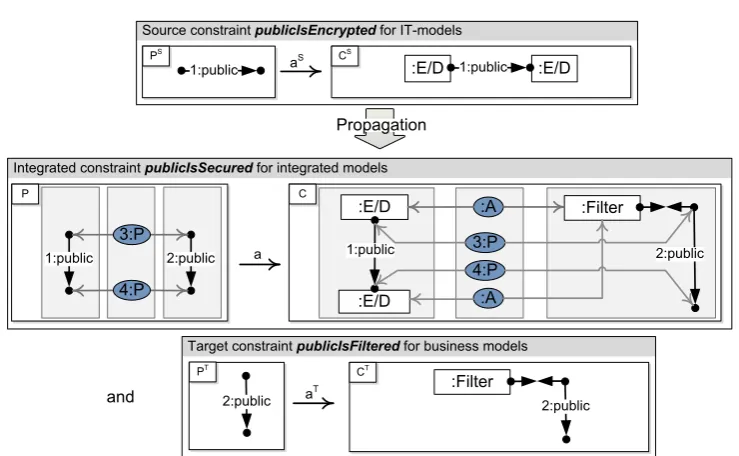
grated and a target constraint as shown by the example in Fig4which happens to be exactly the ruleEDToFilter. Note that in general those graphs are not necessarily the same. Intuitively, the transformation steps of the premise graphP, which is contained in the conclusion graphC, are transferred to the transformation steps forC and the transformation ofC is completed for the remaining parts inC.
Theorem 1(Propagation and Restriction of Constraints) Given a TGG model transformation MT with strong functional behaviour, then
1. an MT-consistent source constraint PC(aS) generates an MT-consistent integrated con-straint PC(a), calledpropagated integrated constraint, where aS is the source component of a and diagrams(1)and(2)below commute using the trace morphisms of the transformation sequences.
(PS← /0→ /0) =P0 tr
∗
F +3
(aS,/0,/0)
traceP
44
(1)
Pl =P
al
a
!!
C C C C C C C C C C C C
(CS← /0→ /0) =C0
tr∗F +3
traceC1
44Cl
tr0∗F +3
(2)
traceC2
66Cn =C
2. an MT-consistent integrated constraint PC(a) can be restricted to and an MT-consistent target constraint PC(aT:PT→CT).
Proof Idea. 1. Given an MT-consistentPC(aS:PS→−CS)we havePS,CS∈ LS⊆VLS. Now
the completeness of model transformations shown in [5,11] impliesP0=tr
∗ F
=⇒Pl =Pwith
P0= (PS← /0→−/0) and P∈VL. This model transformation sequence can be extended
firstly along(aS,/0,/0):P0→−C0leading toC0=
trF∗
by strong functional behaviour of MT toC0=
tr∗F
=⇒Cl =
tr0∗F
=⇒Cn with Cn =C∈VL. This
implies thata:P→−Cdefined by triangle (2) is MT-consistent, i.e.P,C∈VL.
2. Given an MT-consistent integrated constraintPC(a:P→−C)we haveP,C∈VL. By defini-tion ofVLT =pro jT(VL)we havePT,CT ∈VLT and hence the required MT-consistency
of the target constraints.
Integrated constraint publicIsSecuredfor integrated models
Filter E/D
public
E/D NW4:LAN
NW7:LAN
private
private
Private_Banking:Department
Investment_Banking:Department
private
public
Machine centric IT Service Model Machine centric Business Service Model p=(pS,pC,pT) q=(qS,qC,qT)
:A
:P :P :P :P :A
:A
:A
P
1:public 2:public
C
:Filter :E/D
:E/D
:A
:A
S1:public
:P :P
T1:public
:P :P
a
G’
=
G’S G’C G’T
Figure 5: Propagated Integrated Constraint
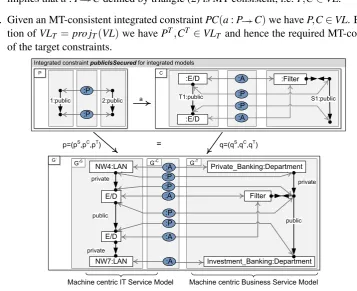
Example 4(Propagation) According to Rem.1the model transformation of our case study is propagation consistent. Furthermore, the source constraint is MT-consistent, such that we can apply Thm.1and derive the propagated integrated and target constraints in Fig.5. For better visibility we take a subgraph G0⊆G of the integrated model G in Ex. 3, such that the source model G0S is similarly transformed into the target model G0T. Now, the integrated model G0 satisfies the propagated integrated constraint, i.e. for any injective occurrence p:P→G0 of the integrated premise P in G0 there is an injective occurrence q:C→G0 compatible with the constraint morphism a, i.e. p=q◦a.
In order to generally ensure the validity of propagated constraints we provide a suitable static condition on constraints by Def.4below that can be checked automatically (see Remark2). Es-sentially, the condition requires that whenever the premise graphPof a constraint is found in an integrated model, then its occurrence is already fully determined by the source and correspon-dence component. This condition is not very restrictive, because it must only hold for premise graphs of constraints and not for all integrated graphs inVL.
Definition 4 (Admissable Premise) Given a TGG with triple language VL. The premise P
of an integrated constraintPC(a:P→C)is calledadmissable, if for any injective morphisms
Remark2 (Checking Admissability) It suffices to show that the internal morphismtP:PC→−PT
of the premise graphPis surjective on nodes, and furthermore, for each edge type occurring in
the target componentPT ofPwe have that there are no parallel edges in any triple graphG∈VL
of this type. The latter can be verified - especially in our case study - by checking that the triple rules do not create edges of those types separately, but always together with an adjacent node.
The premise graph of a propagated target constraint may occur with a target model at places that do not correspond to occurrences of the premise graph of the source constraint in the source model, because differently typed source elements may be transformed into target elements of the same type. From the application point of view, it is clear that the preservation of properties of the source model can be ensured only at corresponding occurrences in the target model. Theorem2
below shows that the validity of source constraints is preserved at those places using the notion of weak satisfaction. More precisely, given an integrated constraintPC(a:P→C), then a target model GT weakly satisfies a target constraint – written (GT |=wPC(aT)) – if for all injective
pT :PT→GT which can be extended to an injective integrated morphismp:P→Gthere exists an injectiveqT :CT→GT withqT◦aT =pT. Furthermore, the theorem shows that the validity is completely preserved for the propagated integrated constraint. It is formulated for (atomic) constraintsPC(aS:PS→−CS)but can be extended to general constraints.
Theorem 2(Validity of Propagation for MT-Consistent Constraints) Given a propagation con-sistent model transformation MT acc. to Def.3, and given an MT-consistent source graph con-straint PC(aS:PS→CS)with an MT-consistent propagated integrated constraint PC(a:P→C)
and a propagated target constraint PC(aT :PT →CT) according to Thm.1, such that P is ad-missable, then we have for all GS∈ LSwith model transformation sequence(GS,G0=
tr∗F
=⇒G,GT): GS|=PC(aS)⇒ G|=PC(a) ∧ GT|=wPC(aT).
This means that given the source graph satisfies the source constraint, then the integrated graph satisfies the propagated integrated constraint and the target graph weakly satisfies the propagated target constraint.
Proof Idea. The main idea is to show thatGS|=PC(aS:PS→CS)impliesG|=PC(a:P→C)
where both are related by diagrams (1) and (2) of Thm.1. Similar to the proof of Thm 1we are firstly able to extendC0=
trF∗
=⇒Cl =
tr0∗F
=⇒Cn=Calong(qS,/0,/0):C0→G0 withG0= (GS←
/0→ /0)toG0=
tr∗F
=⇒Gl=
trF0∗
=⇒Gnwithqn:Cn→Gnand secondly by strong functional behaviour to
G0=
tr∗F
=⇒Gl=
tr0∗F
=⇒Gn=
trF00∗
==⇒Gm=GwithG∈VL. Usingq=traceG◦qn:C→GwheretraceG=
trace(Gn= tr00∗F
==⇒Gm)we can deduceq◦a=pusing left linearity (see Def.3) and admissability
of premiseP(see Def.4).
to occurrences of the source constraint in the source model.
4
Propagation of Partially MT-consistent Constraints
In this section we discuss how to generalize constructions and results of Sec.3 to the case of partially MT-consistent constraints, i.e. for the source constraintPC(aS:PS→−CS)we may have
PS∈ L/ S⊆V LS orCS∈ L/ Sas shown in Fig.6a. Note that in Fig.6a black bullets are missing
s.t.PSis a model fragment in contrast toPSin Fig.4. Moreover,PSin concrete syntax in Fig.6a corresponds to a single node in abstract syntax in Fig. 6b. IfPS∈ L/ S orCS∈ L/ S they can be
considered as model fragments and we show now how to handle this important more general case. The main idea is to use an extended model transformation approach for model fragments introduced in [13] based on the general framework of graph transformation with borrowed con-text (BC) [8]. Intuitively, BC-transformations allow for partial matching of the forward rules in the S-component. The missing context that is required by the left hand sideLF of the forward
rule is borrowed and the instance graph is extended by this context. More precisely each BC-forward transformation step consists of two POs (1) and (2), where in PO (1) the partial match is completed and in PO (2) we have a forward transformation step with total match.
Verteilung
:E/D
CS
PS
1:public 1:public :E/D
Source Constraint publicIsEncrypted2for IT-models
aS
name = "public"
1 : Reo
PS
(a) (b)
Figure 6: Partially MT-consistent source constraint (a) and abstract syntax ofPS(b)
Definition 5(BC-Forward and BC-Model Transformation) Given triple rulesT Rwith corre-sponding forward rulesT RF then
1. A BC-forward transformation Gb0=
tr∗F
=⇒BCGbn via T RF is given by BC-forward
transfor-mation steps Gbi−1=
tri,F,mbi,F,di
======⇒ Gbi for i=1, ...,n consisting of POs (1) and (2) where in
PO (1) the partial matchm0:Li,F *Gbi−1 – given by injective morphismsmbi,F anddi –
is extended to a total injective matchm+i,F :Li,F→−Gb+i−1 and in PO(2) we have a forward
transformation step with total injective match as in Sec.2. Moreover we require that the
C- andT-componentsdCi anddiT ofdiare identities. Note that theS-componenttriS,F is the
identity ofRSi by construction ofTRF, i.e.trSi,F =idRS
i.
Di di //
b mi,F
Li,F
m0
y
tttttt
b
Gi−1
Di
b mi,F
di //
(1) Li,F
m+i,F
tri,F //
(2) Ri,F
ni,F
b
Gi−1 h
i
//Gb+i−1
h+i
//Gb
i
2. A BC-model transformation sequence(GS,Gb0=
tr∗F
=⇒BCGbn,GT)consists of a source
con-sistent BC-forward transformationGb0=
tr∗F
=⇒BCGbnviaT RFwith source modelGS=GbSnand
con-sists of BC-model transformation sequences(GS,Gb0=
trF∗
=⇒BCGbn,GT)withGS∈V L(T GS)
andGT ∈V L(T GT).
Remark 3 Source consistency of BC-forward transformations is based on partial BC-match
consistency [13], where both notions are defined in analogy to source and match consistency in
the standard case without BC [5].
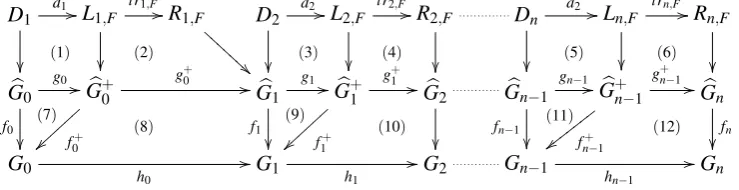
BC-forward and BC-model transformations can be extended by Fact1(with proof in [13]) to forward and model transformations in the sense of Sec.2.
Fact 1(Extension of BC-Forward and BC-Model Transformations) Given a BC-forward trans-formation sequenceGb0=
tr∗F
=⇒BCGbn withGb0= (GbS0← /0→ /0)there is an extension to a forward
transformation sequence G0=
tr∗F
=⇒Gnwith G0= (GbSn← /0→ /0)and Gn=Gbn.
Moreover, each BC-model transformation sequence (GS,Gb0 =
trF∗
=⇒BC Gbn,GT) with GS =GbSn,
GT =GbTn can be extended to a model transformation sequence (GS,G0=
tr∗F
=⇒ Gn,GT) with the
same GS, GT satisfying GS=GS0, GT =GTn and Gn=Gbn.
D1
d1 //
(1) L1,F
tr1,F//
(2) R1,F
B B B B B B
B D2
d2 //
(3) L2,F
tr2,F//
(4) R2,F
Dn
d2 //
(5) Ln,F
trn,F //
(6) Rn,F
b
G0
g0 //
f0
(7)
b
G+0
g+0
//
f0+
~~
||||
|| (8)
b
G1
f1
g1 //
(9)
b
G+1
f1+
~~
|||| ||
g+1
//
(10)
b
G2
b
Gn−1
fn−1
gn−1//
(11)
b
G+n−1
fn+−1
{{
xxxxxx x
g+n−1
//
(12)
b
Gn fn
G0 h
0
//G1
h1
//G2 Gn−1
hn−1
//Gn
Figure 7: Extension of a BC-forward Transformation Sequence
Now correctness of model transformation shown in [5,11] can be extended by Fact 2(with proof in [13]) to BC-model transformation.
Fact 2(Correctness of BC-Model Transformations) Each BC-model transformation is correct, i.e. for all BC-model transformation sequences(GS,Gb0=
trF∗
=⇒BCGbn,GT)we haveGbn∈V L with
b
GS0⊆GbSn=GS∈V LSandGbTn =GT ∈V LT.
Finally we show how to propagate a partially MT-consistent source constraint (see Fig.6) to MT-consistent target constraint as shown already in Fig.4using the BC-model transformations in Def.6. Intuitively a partially MT-consistent source constraintPC(aS:PS→−CS) is a source constraint such that we have a BC-model transformation sequence from (PS← /0 → /0) to Pb
and from (CS ← /0→ /0) toCbleading to a propagated integrated constraintPC(ab:Pb→−Cb)
to-gether with a corresponding propagated source constraintPC(abS:PbS→−CbS)and target constraint
PC(baT:PbT→−CbT)
Definition 6 (Partially MT-Consistent Source Constraint) A source constraint PC(aS) with
b
P0=tr
∗ F
=⇒BCPbl,Cb0=
tr∗F
=⇒BCCbl= tr∗F
=⇒BCCbnas shown below leading to a morphismba=trace(tr
0∗
F)◦bal,
such that the diagram below commutes and we havePbS,CbS∈ LS:
(PS← /0→ /0) =Pb0
tr∗F
BC+3
(aS,/0,/0)
Pl =Pb
b al b a !! C C C C C C C C C C C C
(CS← /0→/0) =Cb0
tr∗F
BC+3 Cbl tr0∗F
BC
+3
b
Cn =Cb
Moreover,PC(ab:Pb→Cb)is calledpropagated integratedconstraint,PC(abS:PbS→CbS)
propa-gated sourceconstraint, andPC(ab
T :
b
PT →CbT)propagated targetconstraint, whereabS andabT
are the source and target components ofba.
This allows us to present our second main result – the validity of propagation of partially MT-consistent source constraints – as a generalisation of Thm.2.
Theorem 3(Propagation of PartiallyMT-consistent Source Constraints) Given a propagation consistent model transformation MT and a partially MT-consistent source constraint PC(aS:
PS→−CS), then we have MT-consistent propagated constraints PC(ba:Pb→−Cb)with PC(abS)and
PC(ba
T). If
b
P is admissable, then we have for all GS∈ LSwith model transformation sequence
(GS,G0=
tr∗F
=⇒G,GT):
GS|=PC(ab
S
)⇒ G|=PC(ba) ∧ G
T|
=wPC(ab
T
).
Proof Idea. MT-consistency of PC(ab), PC(ab
S), and PC(
b
aT) follows from correctness of BC-model transformations (see Fact 2) and PbS,CbS ∈ LS by assumption. This allows us to apply
Thm.2.
Constraint publicIsEncrypted2
P C :E/D :E/D 1:public a 1:public
Extended Constraint publicIsEncrypted2+
P C :E/D :E/D 1:public a D 1:public
Forward Rule PublicToPublic
L 1:public R 1:public 2:public 4:P 3:P m + + + m+ d hP hC
Partially translated Constraint publicIsEncrypted2'
C' :E/D :E/D 1:public a' 1:public tr
hP+
hC+
n P' 1:public 2:public 4:P 3:P 2:public 4:P 3:P m
-Figure 8: Source constraint and propagated constraint
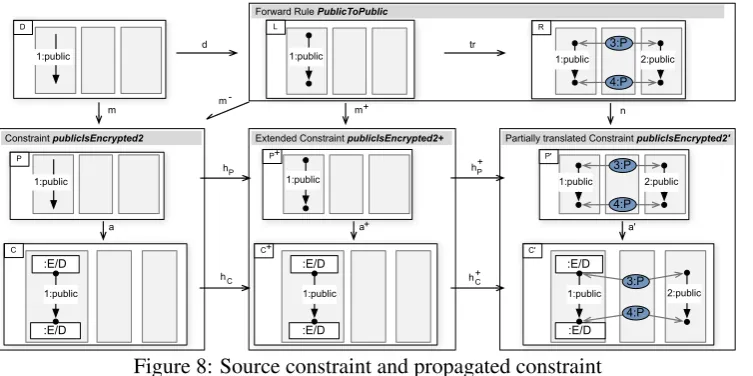
span(L←d D−→m G)with D being the domain of m−. With a pushout over D the black bullet nodes are “borrowed” from L and a standard triple graph transformation over the rule can be performed. After this step the premise graph is already completely translated and the conclusion graph can be translated as seen in Fig.4.
5
Related Work and Conclusion
Model transformation is an important concept in order to establish a consistent relationship be-tween source and target models, like business and IT models in enterprise modelling [2]. Security constraints can be defined separately for source and/or target models, but up to now, it is an open problem how to establish a consistent relationship between source and target constraints.
Triple graph grammars have been successfully applied in several case studies for bidirectional model transformations, integrations and synchronizations [15,12,16,10], and there are a variety of formal results concerning correctness, completeness and termination [5], functional behaviour and optimization with respect to the efficiency of their execution [11].
Previous studies on the relationship between model transformations and constraints focussed on general properties, e.g. in order to provide techniques for the verification and validation of model transformations [9,1,3] in order to detect underspecified parts or mismatches to the requirements of the domain. They perform semi-automated reasoning using e.g. the theorem prover Isabelle/HOL [9], Prolog [1] or they use OCL validation tools [3]. In contrast to them, this paper has its main focus on a constructive approach for the translation of domain and model specific source into target constraints, i.e. those properties of a source model which are usually not valid for all models of the source language.
Given a model transformationMT based on triple graph grammars, we have defined in this paper MT-consistent constraints and shown how to propagate source constraints to integrated and target constraints. In our first main result, we prove that under suitable conditions this propagation is consistent in the sense that validity of the source constraint for the source model implies validity of the integrated and target constraint for the integrated resp. target model. Since constraints are often incomplete models we study in Sec.4also the propagation of partialMT -consistent source constraints leading to our second main result. For this purpose we provide a new concept of model transformations with borrowed context, which allows to transform also model fragments. Transformations of model fragments along total matches are considered for the case of plain graph transformations already in [7] for the refactoring of rules. Based on the new theory of model transformations with borrowed context we will also propagate other kinds of model fragments in future work, e.g. rules of the operational semantics from source to target models in order to prove semantical correctness of model transformations.
Bibliography
[2] Brandt, C., Hermann, F.: How Far Can Enterprise Modeling for Banking Be Supported by Graph Transformation? In: Proc. ICGT’10. LNCS, vol. 6372, pp. 3–26. Springer (2010) [3] Cabot, J., Claris´o, R., Guerra, E., de Lara, J.: Verification and validation of declarative
model-to-model transformations through invariants. J. Syst. Softw. 83, 283–302 (2010) [4] Ehrig, H., Ehrig, K., Prange, U., Taentzer, G.: Fundamentals of Algebraic Graph
Transfor-mation. EATCS Monographs in Theor. Comp. Science, Springer (2006)
[5] Ehrig, H., Ermel, C., Hermann, F., Prange, U.: On-the-Fly Construction, Correctness and Completeness of Model Transformationsbased on Triple Graph Grammars. In: Proc. MOD-ELS’09. LNCS, vol. 5795, pp. 241–255. Springer (2009)
[6] Ehrig, H., Hermann, F., Sch¨olzel, H., Brandt, C.: Propagation of Constraints along Model Transformations Based on Triple Graph Grammars. Tech. rep., TU Berlin (2011), to appear [7] Ehrig, H., Ermel, C., Ehrig, K.: Refactoring of Model Transformations. ECEASST 18
(2009)
[8] Ehrig, H., K¨onig, B.: Deriving Bisimulation Congruences in the DPO Approach to Graph Rewriting with Borrowed Contexts. Mathematical Structures in Computer Science 16(6), 1133–1163 (2006)
[9] Giese, H., Glesner, S., Leitner, J., Sch¨afer, W., Wagner, R.: Towards verified model trans-formations. In: Proc. Workshop on Model Development, Validation and Verification (MoD-eVa 2006). pp. 78–93 (2006)
[10] Giese, H., Wagner, R.: From model transformation to incremental bidirectional model syn-chronization. Software and Systems Modeling 8(1), 21–43 (2009)
[11] Hermann, F., Ehrig, H., Golas, U., Orejas, F.: Efficient Analysis and Execution of Correct and Complete Model Transformations Based on Triple Graph Grammars. In: Proc. MDI’10 (2010)
[12] Kindler, E., Wagner, R.: Triple graph grammars: Concepts, extensions, implementations, and application scenarios. Tech. Rep. TR-ri-07-284, Department of Computer Science, University of Paderborn, Germany (2007)
[13] Sch¨olzel, H.: Model Transformation of Model Fragments Using Borrowed Context: Ex-tended Version. Tech. rep., TU Berlin, Fak. IV (2010), to appear, online available at http://tfs.cs.tu-berlin.de/publikationen/Papers10/Sch10.pdf
[14] Sch¨urr, A.: Specification of Graph Translators with Triple Graph Grammars. In: Proc. WG’94. LNCS, vol. 903, pp. 151–163. Springer Verlag, Heidelberg (1994)
[15] Sch¨urr, A., Klar, F.: 15 years of triple graph grammars. In: Proc. ICGT’08. LNCS, vol. 5214, pp. 411–425 (2008)