Proceedings of the
Workshop on OCL and Textual Modelling
(OCL 2011)
Using an OCL Impact Analysis Algorithm
for View-Based Textual Modelling
Axel Uhl, Thomas Goldschmidt and Manuel Holzleitner
20 pages
Guest Editors: Jordi Cabot, Robert Clariso, Martin Gogolla, Burkhart Wolff Managing Editors: Tiziana Margaria, Julia Padberg, Gabriele Taentzer
Using an OCL Impact Analysis Algorithm
for View-Based Textual Modelling
Axel Uhl1, Thomas Goldschmidt2and Manuel Holzleitner3
SAP AG Walldorf, Germany
Industrial Software Systems, ABB Corporate Research,
Ladenburg, Germany
Abstract: The Object Constraint Language (OCL) has become a vital part of many frameworks, tools and languages within model-driven engineering. One such appli-cation of OCL is the use for describing rules in concrete syntax definitions. Within the textual modeling framework FURCAS, OCL is extensively used for the definition of lookup and attribution rules. Based on these rules the model which is described by such a textual representation is created and updated accordingly. Changes on models over which such an expression is specified require the expression to be re-evaluated to keep the constructed model up-to-date. However, the effort for re-evaluating OCL expressions over a set of model elements grows with the number of elements, the complexity of the expressions, and the number of model changes. Thus, having large models and/or complex expressions places considerable performance costs on OCL evaluation. Techniques to reduce this effort have been presented in previous work but do not cover the full range of OCL expressions, in particular calls to oper-ations defined in OCL, including recursive operoper-ations. In this paper, we present an approach that is applicable to the full range of OCL expressions. We validated our approach based on a large set of models and complex expressions to evaluate the performance impact of our newly introduced techniques.
Keywords:OCL, Impact Analysis, Change Propagation, Incremental Re-Evaluation
1
Introduction
context Department : : allSubDepartments() body:
self .subDepartments−>iterate (dep; subDeps = Set{self} |
subDeps−>union(dep. allSubDepartments() ) )
Listing 1: The definition of theallSubDepartments()operation.
For example, it uses parameterized OCL queries to express lookup rules that resolve references expressed by textual identifiers.
However, modifications to the model require such expressions to be evaluated as their re-sults may have changed. Re-evaluating a large set of OCL expressions on a potentially large model can be very time consuming and therefore hinders the usability of such modelling tools significantly. A solution required here needs to find out if an expressions needs to be re-evaluated given a certain change of the model. Based on this information, the textual modeling framework can update models according to the attribution and lookup rules.
This problem has been investigated before in [CT05,CT09,AHK06]. However, the solutions presented there are incomplete especially with regard to recursive operation calls as well as loops and iterations.
The contribution of this paper is an algorithm for reliable and efficient impact analysis of OCL expressions. First, we introduce a general approach for computing the impacted context elements of an OCL expression after model changes. We show by induction that all kinds of expressions can be handled by this approach. We validate our approach using a non-trivial metamodel and a set of corresponding textual syntax definitions which include complex OCL expressions and show that the effort of computing these paths amortizes reasonably.
The remainder of this paper is structured as follows. To clarify the problem statement, we give a small motivating example in Section2. Section3discusses related work. We provide an analysis on how change events affect expression values in Section4. Our approach for tracing back to possibly affected context elements is introduced in Sections5and6. Section7presents the results of the validation which we conducted. Finally, Section8concludes and outlines future work.
2
Motivating Example
In this section we will introduce a motivating example that clarifies the problem of OCL impact analysis within textual modeling. This example will serve as running example throughout the rest of the paper and will be referred to from the sections that introduce our approach.
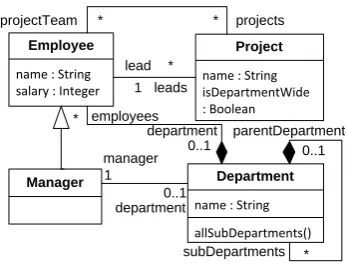
Our running example is based on a metamodel that defines classes forDepartment,
Per-son, ManagerandProject. Figure1depicts this example metamodel. ADepartment
may have several sub-departments, oneManagerand severalEmployees.Employeeswork
inProjects. TheDepartmentclass defines an operationallSubDepartments(),
im-plemented in OCL as shown in Listing1, which returns the set of all Departments which are transitively contained in thesubDepartmentscontainment association. Listings2and3
show two textual syntax definitions for this metamodel, one for the creation ofDepartments
allSubDepartments() name : String
Department Manager
name : String salary : Integer
Employee
name : String isDepartmentWide : Boolean
Project
* * projects
projectTeam 1 department 0..1 manager * department 0..1 employees 1 leads * lead * parentDepartment 0..1 subDepartments
Figure 1: The department metamodel. allSubDepartments()
name : String Department
Development : Department
salary = 5000 John : Manager
Manager name : String salary : Integer
Employee
name : String isDepartmentWide : Boolean
Project
* * projects
projectTeam 1 department 0..1 manager * department 0..1 employees 1 leads * lead
salary = 4700 Jane : Manager
salary = 3800 Judy : Employee
Administration : Department
salary = 5100 Anne : Manager
salary = 4700 Amber : Employee
salary = 4300 Arthur : Employee
* manager * manager
isDepartment Wide = false
NewProduct : Project lead
projectTeam isDepartmentWi de = true
CommonCosts : Project lead * parentDepartment 0..1 subDepartments subDepartment
Figure 2: An example instance of the depart-ment metamodel.
FURCASallows for the definition of multiple syntaxes as views on a single underlying model (called view types in FURCAS[GBU09b]). Therefore, it is possible to edit the same model using different views on it. We use theDepartmentsview type use in this running example for the definition of departments and their managers and employees. This view type includes an example usage of the lookup functionality for which FURCASuses OCL expressions parameterized with a question marks. In this case the expression is used to select an employee of the department by name and assign him/her as the Manager of the Department. The second view type
Projectsis responsible for providing a syntax for creating Projects and assign project
leaders as well as Employees working in that project. There are two different notions of projects distinguished by its propertyisDepartmentWide. These notions are also reflected in the two different alternatives of theProjecttemplate. If isDepartmentWide is true, that means that all employees of the project leader’sdepartmentare automatically assigned to that project (alternative 1). The second alternative lets modelers assign employees to projects by their name.
Figure2shows an example model which is modified through two views as shown in Listings
4and5. TheDepartment view shows twoDepartments“Development” and “Adminis-tration” both having 3 employees. TheProjectsview shows two projects “NewProduct” and “CommonCosts” which is a department wide project. According to the first alternative of the
Projectstemplate, all employees of the “Development”Departmentare assigned to the
“CommonCosts”Project.
1 viewtypeDepartments{ 2 templateDepartment{ 3 ‘ ‘department’ ’ name
4 ‘ ‘managed’ ’ ‘ ‘by’ ’ ‘ ‘: ’ ’ manager{
5 query= self.employees−>select(e | e . oclIsTypeOf(Manager)ande .name = ?)} 6 ‘‘{‘‘ employees{separator= ‘ ‘; ’ ’}‘‘}’ ’
7 }
8 templateEmployee{
9 ‘ ‘employee’ ’ name ‘ ‘: ’ ’ salary
10 }
11 templateManager{
12 ‘ ‘manager’ ’ name ‘ ‘: ’ ’ salary
13 } 14 }
Listing 2: Concrete syntax definition for the department metamodel.
1 viewtypeProjects { 2 template Project{ 3 ‘ ‘ project ’ ’ name ‘ ‘lead ’ ’
4 ‘ ‘by’ ’ lead{query= Employee. allInstances()−>select(e | e .name = ?)} 5 [[−−alternative 1
6 {{isDepartmentWide =true}} 7 ‘ ‘departmentWide’ ’
8 {{projectTeam = self. lead . department . allSubDepartments ( ) .employees}} 9 |−−alternative 2
10 {{isDepartmentWide =false}}
11 ‘‘{‘‘ employees{query= self. lead . department .employees−>select(e | e .name = ? ) ,
12 separator= ‘ ‘; ’ ’}
13 ‘‘}’ ’
14 ]]
15 } 16 }
Listing 3: Concrete syntax definition for the department metamodel.
will show that we can reduce the set expressions and context elements that has to be re-evaluated to a minimum.
3
Related Work
The problem which is tackled in this paper is related to the problem of incremental attribute grammar evaluation to which a solution is presented in [RTD83]. Interesting programming envi-ronments can be based on such approaches such as the Cornell Program Synthesizer [TR81]. The approach presented here handles attribute definitions expressed in OCL which includes recursive operations. Such expressions are used by the FURCASlanguage workbench [GBU09a,Gol10] to update features of a model that represents the program’s abstract syntax tree.
1 departmentDevelopmentmanaged byJohn{
2 managerJohn : 5000;managerJane : 4700; employee Judy : 3800
3 }
4 departmentAdministrationmanaged byAnne{
5 managerAnne : 5100; employee Amber : 4200; employee Arthur : 4300
6 }
Listing 4: View on the example model using theDepartmentview type.
1 project NewProductlead byJane {Judy} 2 projectCommonCostslead byJohn departmentWide
Listing 5: View on the example model using theProjectsview type.
This part is mostly implemented in a host language such as Java. Therefore, these approaches also do not include an incremental attribute computation based on specified dependencies. See [GBU08] for an complete overview on textual modeling approaches including a classification of their capabilities.
The re-evaluation problem specific to OCL expression has already been investigated in [CT05,
CT09,AHK06]. Those existing approaches distinguish between a so-calledclass-scope analysis
and an instance-scope analysis. The class scope analysis deals with the registration of event handlers to specific types of events so that for example an OCL expression involving only a certain association only gets re-evaluated when links of that specific association are added or removed. Theinstance-scope analysisis then responsible for efficient reduction of the number of context elements for which the expression has to be re-evaluated. However, the solutions presented there are incomplete, particularly with regard to operation calls, recursive operation calls and complex iterations and loops.
EMF-INCQUERY [BHRV10] is another approach for incrementally executing queries over large scale EMF models. The approach is based on the graph pattern formalism with which a de-veloper can formulate the queries. EMF-INCQUERYuses a caching infrastructure to store results of executed queries. The cache implementation of EMF-INCQUERYuses the so called RETE al-gorithm [For82] to storepartial matchesof the graph patterns which are used in the query. The cache recognizes modifications to the underlying model by utilizing the event mechanism pro-vided by EMF. Using this approach allows for a significant improvement in query performance. However, as EMF-INCQUERY strongly relies on its internal cache to produce the performance gains, the downside of this approach is the memory overhead produced by the cache. For exam-ple, for a model size of 25k model elements the cache size is around 14 MB.
strategies for OCL expressions after model changes.
4
How Change Events Affect Expression Values
Our goal is to find out for which context elements o a given OCL expression evaluates to a different value due to a given change event. We relax our goal by assuming that the overall expression may change its value when one of its subexpressions changes its value. Later, we will add specific rules to detect cases where a particular change of a subexpression’s value can be proven to have no impact on the overall expression’s value.
For some (sub-)expression types we understand that their value is influenced by a model change, but not always does this lead us to theselfobject based on which to re-evaluate them. In particular, anallInstances()call, influenced only by deletions and creations of objects of the class on whichallInstances()is called, are not evaluated on individual objects. In-stead, if anallInstances() call’s value changes, it changes for all elements of the overall expression’s context type.
For all other (sub-)expression types, it is not the existence of an object that decides about an expression’s value but the values of an object’s properties through which an object is connected to other objects on behalf of references. Change event notifications that signal the modification of a property’s value have an impact on the value of property call expressions. Based on this, we have to identify the navigation paths along properties that may have led from the overall expression’sselfobject to the source of the property call expression.
5
Computing
self
from Change Notifications
Let us assume we received a change event notification for a property change with the single source objectswhich is always an element of a class type because objects of non-class types are immutable values, so no change event notifications can be emitted for those.
For each property call expression pin the parse tree of the overall expressioneunder analysis we desire to find a computable functionselfp,e(s) that for the change event source objectscan
compute the set of context objectsoon which the overall expressionemay evaluate to a result different from the result obtained before the change. In those cases where the overall expression
eis obvious,selfp(s)is a shorthand forselfp,e(s).
For example, self is the source expression of the property call expression self.a. If we receive a change notification for propertyaon objects, the function for the (sub-)expression
selfis defined asselfself.a(s):=s. It computes those context objects for whichselfevaluates tosand hence for which the overall expression may have changed its value due to the change indicated by the notification.
For a property change event, we can determine allPropertyCallExpexpressions pin the tree that navigate that property. For all of those, we computeselfp(s). The union of all these
results over all applicable expressions p is the set of context objects for which the expression may have changed its value.
We now declare a function
for class-typed objectssthat we will use in our definition ofselfp(s).
Definition 1(traceback) tracebackn,e(s,t)computes a set of context elementsosuch that when
the overall expressioneis evaluated forothen the objects or values to which the subexpression
nof the overall expressioneevaluates contains
(
the single class-typed objects ift->isEmpty()
a tuple with s in tuple part identified byt->first() ift->notEmpty()
Typically, the overall expression to which the subexpressionnbelongs is obvious. Therefore,
tracebackn(s,t)is short fortracebackn,e(s,t). Likeselfn(s), we definetracebackn,e(s,t)only for
single objectss.
With thetracebackfunction we can now define theselfp,e(s)function withpbeing a property
call expression that hasnas its source expression, as follows:
selfp,e(s):=tracebackn,e(s, Sequence{})
In other words,selfp,e(s)is the set of context elementsosuch that wheneis evaluated foro, the property call expression’s source expressionnmay evaluate to the source elementson which the change occurred. This, in turn, implies the possibility for a change of thensubexpression in caseeis re-evaluated ono, and this was the definition ofselfp,e(s).
6
Implementing the
traceback
n,e(
s
,
t
)
Function
We will now inductively implement thetracebackn,e(s,t)function for all types of OCL
expres-sions. The implementation in most cases is recursive for those expressions that have a source or argument expressions. We definetracebackn,e(s,t)using OCL.
In the implementation oftracebackit is sometimes necessary to construct an expression based on the structure of the expression nodenfor which thetracebackfunction is being implemented. For example, if we want to navigate from an objectxacross a property to the opposite end of an property call expressionnwe write
x. ‘n. referredProperty . getOpposite() ‘
meaning that the expression between backquotes, which results in a property to be navigated, is first evaluated and then placed into the expression in which it is used. You may compare this with the backquote expansion performed by a Unix command line shell. In fact, the OCL expression constructed for the implementation of thetracebackfunction will just hold the name of the element resulting from the expression in backquotes, replacing the backquoted part.
6.1 PropertyCallExp
There are two flavors of a property call depending on the type of the source object from which the property value is to be retrieved. If the source object’s type is a class, thetraceback func-tion has to determine all objects of the source expression’s class whose property value for the
object’s type is a tuple type, the attribute access fetches a tuple component whose value is defined by thevalueexpression of aTupleLiteralPartowned by aTupleLiteralExp.
For a property call expressionnthetracebackfunction is therefore defined as follows:
tracebackn(s,t):=
let t0: Sequence(Property) =
i f n. source . type . oclIsKindOf(TupleType) then
t−>prepend(n. referredAttribute ) else
t
endif in
let sourceObjects :Set(Element) =
i f n. source . type . oclIsKindOf(TupleType) then Set{s}
else
‘n. source . type ‘ . allInstances ()−>select ( ‘n. referredProperty ‘ = s)
endif in
sourceObjects−>collect (so | tracebackn.source(so,t0)) )
Note, thatsourceObjectis always a single element because a class-typed element at any point in time can be an attribute value of at most one other element; for the tuple case,sis passed through unchanged, so the invariant thatsrepresents a single element is maintained trivially.
The reverse navigation here is specified using a general, yet complexity-wise expensive and scope-wise not precisely definedall- Instances()expression. However, an implementa-tion can apply three major improvements:
• For containment properties, including EMF attributes, typical repository implementations – including EMF – provide efficient navigation to an element’s container.
• For non-containment, non-elementary properties, a repository may provide query capabil-ities that can evaluate the reverse navigation more efficiently than actually evaluating an
allInstances()expression.
• An OCL environment may allow its users to define scope and visibility rules obeyed when reverse-navigating references.
Some modeling environments allow its users to declare derived properties, e.g., by specifying an OCL expression as the derivation rule. Such a derived property declaration is equivalent to a parameterless OCL-specified operation whose handling bytracebackis explained in Section
6.10. We therefore do not treat OCL-specified derived properties here because it does not restrict the general applicability of the approach.
6.2 IfExp
may contain its own property call expressions that trace back to self but since it does not evaluate to theIfExp’s result it plays no role in the definition of thetracebackfunction for the
IfExpitself. We therefore define:
tracebackn(s,t):=tracebackn.thenExpression(s,t)−>union(
tracebackn.elseExpression(s,t))
6.3 TypeExp, PrimitiveLiteralExp, EnumLiteralExp, NullLiteralExp,
InvalidLit-eralExp
These classes of expressions don’t have subexpressions, are themselves not aselfexpression and evaluate to a constant valuec. Remember that they occur somewhere in the tree of the overall expressione which is defined for the context element classC. By definition,scan only be of a class type and therefore never assume the value obtained from evaluating any of the expression types discussed here. Consequently, for all three expression types, we can define:
tracebackn(s,t):= Set{}
6.4 CollectionLiteralExp
Recall that thetracebackn(s,t) function is defined only fors being asingle element that has a
class as its type. Therefore, for a context elementoto be part of thetracebackn(s,t)result and
with nbeing a CollectionLiteralExp, scan not be the whole collection but may only occur in any of the literal’s parts when evaluated for a contexto. In particular, we don’t have to considerCollectionRangeparts because their elements are of typeIntegerwhich is not a class.
Thetraceback function for aCollectionLiteralExpexpressionnis hence defined as follows:
tracebackn(s,t):=n. parts−>select (p |
p. oclIsKindOf(CollectionItem) )−>collect (p |
tracebackp.item(s,t))
6.5 TupleLiteralExp
By definition,scan only be of class type. Therefore, if fortracebackn(s,t)the list of tuple parts
tto extract is empty,ncannot evaluate to a tuple for any context, so the empty set results. Iftcontains aPropertyidentifying a tuple literal part by its name, thetracebackfunction needs to compute the context objects for which the identified tuple literal part’svalue expres-sion can evaluated tos, with the first element oftremoved. Therefore:
tracebackn(s,t):=
i f t=Sequence{} then Set{}
else
tracebackn.part->select(attribute.name=t->first().name).value(s,
6.6 IteratorExp
Expressions of this type subsume predefined iterator expressions such ascollect, select,
reject,exists,forAll,isUnique,sortedBy,collectNested,oneorany. They
all define a single implicit, a single explicit or multiple explicit iterator variables and operate on the evaluation result of a source expression. This behavior causes a special propagation through thetracebackfunction forVariableExpexpressions in case the variable referred by
theVariableExpis an iterator variable of anIteratorExpexpression (see Section6.9.1).
Some iterators, such asexistsandisUniqueresult in a value of typeBoolean. By def-inition, those iterators can never producesas their result becausesis always class-typed. Other iterators, such asselectorrejectcompute a sub-collection of the source collection. The
collectand collectNestediterators are special in that they map each combination of
iterator variables over the source collection to some other object computed by the body expres-sion.
We definetracebackn(s,t)forIteratorExpexpressionsnas follows:
tracebackn(s,t):= i f n.name = ’ select ’ or n.name = ’ reject ’
or n.name = ’sortedBy’ or n.name = ’any’ then
tracebackn.source(s,t)
else
i f n.name = ’ collect ’ or n.name = ’collectNested ’ then
tracebackn.body(s,t)
else
-- iterator with Boolean result Set{}
endif endif
6.7 IterateExp
The result of an iterate expression is computed by its body expression. Therefore, the
tracebackdefinition foriterateapplies itself to the body as follows:
tracebackn(s,t):=tracebackn.body(s,t)
The more difficult part about theiterateconstruct is evaluating thetracebackfunction for the “result” variable that keeps the result of the previous iteration or an initialization value (see Section6.9.2).
6.8 LetExp
The value of thelet-expression is defined by itsin-expression. Therefore,
tracebackn(s,t):=tracebackn.in(s,t)
6.9 VariableExp
each of them separately. It should be sufficiently obvious how to combine them into a single definition of thetracebackfunction.
6.9.1 Iterator Variables
Iterator variables are those defined by iterator expressions such asselectorcollect. The values that the iterator variable can assume are taken from the values of the collection over which the iterator expression loops. This collection is computed by then.sourceexpression. Therefore,
tracebackn(s,t):=tracebackn.referredVariable.loopExp.source(s,t)
6.9.2 Iterate Result Variable
The result variable of aniterateexpression can be initialized by an expression. In this case, it may be referred in theiterate’s body expression. In any case, at the end of each iteration, the result of evaluating the body expression is assigned to the result variable.
For the result variable to assume the values it either has to have been initialized tos by its initialization expression, or theiterateexpression’s body has at some point evaluated tos. We can therefore define:
tracebackn(s,t):=
tracebackn.referredVariable.initExpression(s,t)−>union(
tracebackn.referredVariable.baseExp.body(s,t))
6.9.3 Operation Parameters
To understand the possible values an operation parameter can assume, we have to look at the expressions calling the operation to which the formal parameter belongs. We can limit the set of operation calls considered to those reachable from the root expression There is no direct link between the expression used as actual parameter and the called operation’s formal parameter. Instead, the binding happens through two indirections.
First, the variable declaration referred by the variable expression is linked to the operation’s formal parameter only by name equality. Second, the formal parameter is linked to the actual parameter only by the position in the parameter list. With this, we can define thetraceback func-tion for variable expressions referring to variable declarafunc-tions representing a formal parameter of an operationopwhose body expression containsn:
tracebackn(s,t):=
let params:Sequence(Parameter) = op. parameters in
let fp :Parameter = params−>select (name = n. referredVariable .name) in let pos:Integer = params−>indexOf(fp) in
let actualParamExprs:Collection(OclExpression) = op. referringExp−>collect ( arguments−>at (pos) ) in
actualParamExprs−>collect (ape | tracebackape(s,t))−>flatten ()
call expressions callingopused for the formal parameter bound top. For each of those actual parameter expressions, thetracebackfunction is used to determine the context objects for which the value passed as the parameter under consideration could have beens. The resulting collection of collections of context elements is finally flattened.
6.9.4 self
Theselfexpression can occur in two shapes: inside or outside of an operation body definition. If it occurs outside of operations, it evaluates tosif and only if it is evaluated withsas context object.
If it occurs inside an operation body, similar to the operation parameters discussed in 6.9.3, thesourceexpressions of all operation calls to the respective operation that are reachable from the root expression analyzed need to be considered.
Let’s assume, the operation containing the occurrence of theselfexpression is bound toop
which is empty in case the occurrence ofselfis outside of an operation. Then we can define:
tracebackn(s,t):=
i f op−>isEmpty() then
s
else
op. referringExp . source−>collect (selfSource | tracebackselfSource(s,t))−>flatten () endif
6.9.5 Let Expression Variables
Theletvariable’s value is defined by theLetExpexpression’s variable declaration and its re-spectiveinitExpression. Therefore, for variable expressions accessing alet-expression’s variable, we define
tracebackn(s,t):=tracebackn.referredVariable.initExpression(s,t)
6.10 OperationCallExp
The operation call’s value is determined by its body. The parameter variable values and the value for theselfvariable will be traced back to the argument expressions1We define:
tracebackn(s,t):=tracebackn.referredOperation.body(s,t)
It may be noted that this leads to a recursive definition for recursive operations.
6.10.1 oclAsType()
Ifn is anOperationCallExpwhere the operation called is oclAsType(), traceback is defined as follows:
1The way our implementation handles this, all matching argument expressions ofallcalls to the operation will be
tracebackn(s,t):= i f s . oclIsKindOf( ‘n. arguments−>at (1) ‘) then
tracebackn.source(s,t)
else Set{}
endif
Ifsis not of the type requested by theoclAsType()cast operation, for no context element
ocan the cast expression evaluate tos. In all other cases, the cast expression may evaluate tosif the cast’ssourceexpression may evaluate tos.
6.10.2 Calls to Standard Library Operations
The standard library defines many operations on collections, such asincluding,excluding
andisEmpty. The OCL specification [The10] defines them again in terms of OCL expressions. In most cases, the result expression for the operation’s return value is provided as an OCL ex-pression.
However, in some cases the result is not defined using the = operator and a direct OCL expression but rather by a set of OCL-specified predicates that span the operation result, the value of self as well as the argument values. Examples of such operations areunion and
intersection.
Theunionoperation can be specified directly in OCL as
context Set(T) : : union(s :Set(T) ) :Set(T) body:
s−>iterate ( i ; acc :Set(T)=self | acc−>including( i ) )
The example illustrates that just because the OCL specification chooses a different way to specify some of the standard library operations on collections, this does not exclude the possi-bility to provide a closed specification as an OCL expression for them. It is left as an exercise to the reader to prove this for the remaining standard library operations as well.
6.11 Putting it All Together
Becausetraceback is defined for each specialization ofOclExpression, it is complete for the entire OCL language specification. The standard library operations map down to standard OCL constructs that are covered bytraceback.
We need to assemble the entiretracebackfunction from the fragments provided in the sections on each of the OCL constructs. Thetracebackn,e(s,t) function is defined as a case distinction
over the type of the nodenas follows:
tracebackn,e(s,t):=
i f n. oclIsKindOf(IfExp) then
tracebackn.thenExpression(s,t)−>union(tracebackn.elseExpression(s,t))
else
i f n. oclIsKindOf(TypeExp) or n. oclIsKindOf(PrimitiveLiteralExp) or
n. oclIsKindOf(EnumLiteralExp) or n. oclIsKindOf(NullLiteralExp) or
else . . . endif endif
6.12 Application to the Motivating Example
We can now apply the traceback function to the motivating example. We will show the com-putation of the context element for the following change event: Removing the “Administration” department from the sub-departments of the “Development” department alters the
Depart-ment.subDepartments feature which is used by the self.subDepartments
subex-pression of theDepartment::allSubDepartments() operation’s body expression (see Listing 1) which in turn is called by the FURCAS property initialization expression for the
projectTeamproperty in the first alternative of templateProject, as shown in Listing3. Intuitively, this change would require the employees of “Administration” to be removed from the
projectTeamproperty of the “CommonCosts” Project. Starting from this change event
thetracebackcomputation works as follows:
selfself.subDepartments, self.lead.department.allSubDepartments().employees(Development) = -- applying the definition of self:
tracebackself, self.lead.department.allSubDepartments().employees(
Development, Sequence{})=
-- applying rule for VariableExp (see Section 6.9) for the self case -- for occurrences inside operation bodies. op.referringExp.source leads -- to the self.lead.department expression.
self . lead . department−>collect (selfSource | tracebackselfSource(
Development, Sequence{}))−>flatten () =
tracebackself.lead.department(Development, Sequence{}))−>flatten () =
-- applying the PropertyCallExp rule for the non-Tuple case, -- see Section6.1; n.source.type is Employee:
Employee. allInstances ()−>select (department=Development)
−>collect (so | tracebackself.lead(so , Sequence{}))−>flatten ()
-- Evaluating the Employee.allInstances()->select combination and applying the -- PropertyCallExp rule for the non-Tuple case, this time for self.lead:
Set{John, Jane , Judy}−>collect (so |
Project . allInstances ()−>select (lead=so)−>collect (so2 |
tracebackself(so2, Sequence{})) )−>flatten () =
-- Now, self does not occur inside an operation body. We expand -- Project.allInstances() and tracebackaccordingly:
Set{John, Jane , Judy}−>collect (so | Set{CommonCosts, NewProduct} −>select (lead=so)−>collect (so2 | so2) )−>flatten () =
-- evaluate collect/select combination and flatten; note that NewProduct is -- part of the result because Jane from the Development department leads it: Bag{CommonCosts, NewProduct}
The result contains both, “CommonCosts” and “NewProduct” which is correct from atrace
-backpoint of view because for both projects the expression
Set{ John, Jane, Judy, Anne, Amber, Arthur} before the change and Set {
John, Jane, Judy}after the change. However, the “NewProduct” project did not have its
projectTeam property initialized by the
self.lead.department.allSubDepart-ments(). employeesexpression because itsisDepartmentWideproperty isfalse. It
can be removed from the context elements by the FURCASruntime before re-evaluation starts.
6.13 Further Performance Improvement Attempts
We evaluated four more approaches particularly aiming at more precise results with fewer ele-ments in thetraceback results for which the evaluation result has not actually changed. Due to space limitations we outline them only briefly.
6.13.1 Partial Evaluation
Change notifications identify the element changed, as well as the old and new value for the feature that changed. This information can be used to evaluate the subexpression immediately affected by the change for the model state before and after the change. If the subexpression happens to be the source of another expression then in some cases it is possible to evaluate that other expression, again for the state before and after the model change. For example, if a change notification describes the change of an element’s name attribute, and there is an expression
self.name = ’abc’, then this expression can be evaluated for the old and new model state.
If thenameattribute changed from a value not equal to’abc’to another value not either equal to’abc’then the overall expression remainsfalse.
This principle can be recursively extended along the expression tree. Partial evaluation may fail in case the values for variables are not known. However, our benchmarks show that in many cases partial evaluation results in significant performance gains.
Partial evaluation can also be applied toIteratorExpexpressions that use Boolean pred-icates to select or reject elements. Such an expression can only produce a certain element if it passed the respective predicate. If partial evaluation can prove that the element at hand cannot have passed the predicate, the currenttracebackpath can be pruned at that point.
6.13.2 Delta Propagation
Partial evaluation can only continue as long as the subexpression whose old and new value are known is used as the source expression of another expression. However, if the old and new value of acollectiterator’s body expression are known then due to the flattening that happens for
collect we can infer how the change propagates to the collect expression’s value. In
particular, if elements are added to the body’s value, thecollectvalue at least contains these elements, too.
We found a class of expressions that propagate such changes monotonically, including the
collectexpression. For example, theselectiterator is monotonic in its source expression. When elements are added to aselect’s source then the result can at most change by adding these elements.
that the changes can not imply any changes to this overall expression.
Our benchmarks have shown the additional efforts for delta propagation to pay off significantly based on the reduction in elements for which re-evaluation needs to be triggered.
6.13.3 Operation Call Selection
In Section 6.9 we have specified how to trace back VariableExp expressions referring to operation parameters and an operation’sself variable. Recall how we determinedall possi-ble calls to the operation to find all possipossi-ble substitute expressions for the parameter or source expression, respectively.
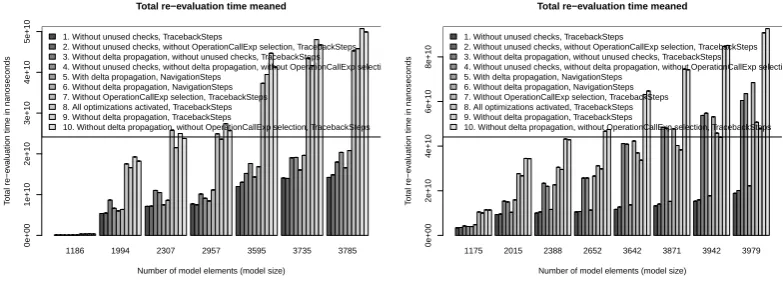
This procedure can be sharpened further, particularly for the case where an operation body is traced because a singleOperationCallExpreferring to the operation is being traced back. In this case we know exactly which call to use to substitute the parameter andselfvariables. Our benchmarks show that this improvement results only in minor gains only in some cases which came as a surprise (see Figures4aand4b).
6.13.4 Unused Checks
We found out that in some special cases, based on the information delivered by the change notification, it is possible to prove that a subexpression is not used during the overall expression’s evaluation. For example, if the change immediately affected an expression within a IfExp’s
thenexpression and sufficient information was delivered to evaluate theIfExp’s condition to
false, we know that thethenexpression does not contribute to theIfExp’s value. Therefore, thethenexpression’s change has no effect on the overall expression.
Based on this idea we defined and implemented anunusedfunction which we can evaluate for any change and any subexpression. It also carries forward the values of variables inferred so far which increases the share of successful partial evaluations, such as for the IfExp’s condition expression.
Our benchmarks, however, have shown that the vast amount of partial evaluations necessary for trying to prove that a subexpression does not contribute to the overall expression’s value on average does not pay off (see again Figures4aand4b). It may be possible that clever caching of partial evaluation results may change this, but we haven’t investigated this any closer yet.
7
Validation
The most important questions we hoped to get answers for by our experiments were these:
• Would the impact analysis still provide benefits for changes that have far-reaching effects, or would it be better for those cases to just re-evaluate the expressions affected on all their context elements?
• How well would which variant of the impact analysis algorithm perform for which sce-nario?
(a) Central change. (b) Large peripheral change.
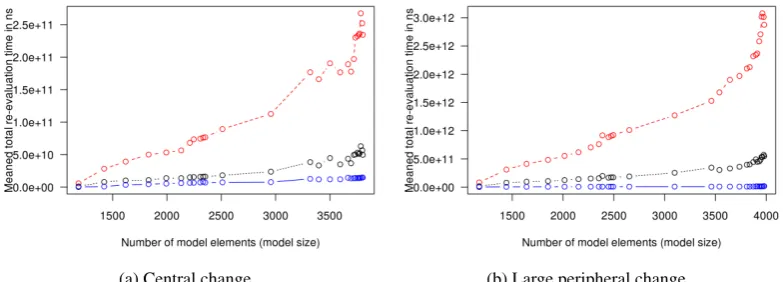
Figure 3: Re-evaluation times for a central change affecting most parts of the model (Fig. 3a) and for many changes in the rims of the larger model (Fig. 3b). The upper red dashed line shows re-evaluation of all OCL expressions on all applicable contexts. The middle dotted black line shows re-evaluation of those OCL expressions whose filter condition matches the respective change notification, on all applicable contexts. The lower solid blue line shows re-evaluation of those OCL expressions whose filter condition matches the respective change notification, restricted to those context elements identified by the instance scope analysis.
• How do the different algorithm variants such asunusedchecks, partial evaluation and delta propagation influence overall performance?
• Can the impact analysis make global OCL re-evaluation scale to large model sizes?
We performed two large benchmarks [Hol10] with EMF models of approximately 4,000 ele-ments and 10,000 references, using 380 OCL expressions and two different change logs that we re-played. Using the technique described in [Hol10], we chop off parts of this model to obtain a series of realistic models of varying sizes. The first change log describes 150 changes in core parts of the model, causing major ripple effects during re-evaluation and therefore to be consid-ered a “worst-case” scenario. The second change log has 1,700 changes mostly in the peripheral areas of the model where we don’t expect major ripples.
We were able to compare various algorithm variants, as shown in Figure4. Presented below are the results of the best-performing one. Figure3afor the central changes shows the improve-ments using the impact analyzer as compared to only using event filtering applied by the class-scope analysis described in [CT05,CT09,AHK06], compared to the most na¨ıve approach where all expressions on all their context objects are re-evaluated after each change. Re-evaluation with event filtering only takes approximately 2.4 times longer than when using the impact analyzer. The complete re-evaluation takes about twelve times longer.
Figure3bshows the results for the large, peripheral change log. There, relative savings are, as expected, even greater and scalability is even better as fewer ripples occur duringtraceback
1186 1994 2307 2957 3595 3735 3785 0e+00 1e+10 2e+10 3e+10 4e+10
5e+10 1. Without unused checks, TracebackSteps
2. Without unused checks, without OperationCallExp selection, TracebackSteps 3. Without delta propagation, without unused checks, TracebackSteps
4. Without unused checks, without delta propagation, without OperationCallExp selection, TracebackSteps 5. With delta propagation, NavigationSteps
6. Without delta propagation, NavigationSteps 7. Without OperationCallExp selection, TracebackSteps 8. All optimizations activated, TracebackSteps 9. Without delta propagation, TracebackSteps
10. Without delta propagation, without OperationCallExp selection, TracebackSteps
Total re−evaluation time meaned
Number of model elements (model size)
T
otal re−e
v
aluation time in nanoseconds
(a) Central change.
1175 2015 2388 2652 3642 3871 3942 3979
0e+00
2e+10
4e+10
6e+10
8e+10
1. Without unused checks, TracebackSteps
2. Without unused checks, without OperationCallExp selection, TracebackSteps 3. Without delta propagation, without unused checks, TracebackSteps
4. Without unused checks, without delta propagation, without OperationCallExp selection, TracebackSteps 5. With delta propagation, NavigationSteps
6. Without delta propagation, NavigationSteps 7. Without OperationCallExp selection, TracebackSteps 8. All optimizations activated, TracebackSteps 9. Without delta propagation, TracebackSteps
10. Without delta propagation, without OperationCallExp selection, TracebackSteps
Total re−evaluation time meaned
Number of model elements (model size)
T
otal re−e
v
aluation time in nanoseconds
(b) Large peripheral change.
Figure 4: Re-evaluation times for a central change affecting most parts of the model (Fig. 4a) and for many changes in the rims of the larger model (Fig. 4b), comparing the effects of the different performance improvements discussed in Section6.13.
to take approximately 20 times longer. Full re-evaluation takes about 120 times longer2. Note, that given the good scalability these ratios will increase even further for growing models.
More detailed analyses have shown that the use of theallInstances()operation affects the scalability properties. At least with a simple implementation of this operation, re-evaluation times for those expressions increase with growing model size which the impact analyzer cannot avoid. For expressions not using allInstances() we were able to show that there is no measurable increase in re-evaluation time for growing models when the changes are peripheral and therefore do not cause major ripple effects.
Figures 4a and4b show the impact of the further improvements discussed in Section6.13, again benchmarked for the two different change sets.
Regarding the algorithm’s reliability, our various tests have not shown a single case where context elements for which an expression changed its value were missing from the analysis re-sults. While lacking formal proof, this indicates that the conservative construction of the context element set is correct.
8
Conclusions and Outlook
We have presented an algorithm that for an OCL 2.2 expression and a model change event re-liably and efficiently determines a set of context elements for which the expression may have changed its value due to the change signaled by the event. The algorithm has asymptotically optimal complexity and handles operation calls, including recursive operation calls, correctly.
Based on our implementation, we have conducted measurements with a non-trivial meta-model, many different OCL expressions of different complexities, and a number of sample
models. We used the Eclipse EMF MDT/OCL 3.1.0 evaluator and based our impact analysis implementations on it. Partial evaluation, delta propagation and selective operation call trace-back improved performance significantly. With this, even for worst-case scenarios with central changes causing ripples throughout the model, using the impact analyzer pays off on average, leading to a reduction in re-evaluation efforts by a factor of twelve compared to the most na¨ıve approach, and still a factor of 2.4 compared to the event filtering-only approach. For average cases with moderate ripple effects these factors improve to 120 and 20, respectively.
Our benchmarks show that the impact analyzer makes incremental OCL re-evaluation scalable and hence practical for applications such as model validation, notification synthesis for OCL-specified derived properties as well as OCL-based attribute grammars.
Further research should be devoted to more intelligent variable value inference during com-puting thetraceback function. Regarding the unused function, caching techniques should be considered for the many partial evaluations it requires. Last but not least, special rules for stan-dard library operations with known semantics can be applied duringunusedevaluation.
We have made the impact analyzer described here available as part of the Eclipse MDT/OCL distribution, starting with Eclipse Indigo, in theOCL Editors and Examplesfeature in the Mod-elingcategory.
Bibliography
[AHK06] M. Altenhofen, T. Hettel, S. Kusterer. OCL Support in an Industrial Environment. In
MoDELS Workshops. Pp. 169–178. 2006.
[BHRV10] Incremental Evaluation of Model Queries over EMF Models. 2010. Accepted.
[CT05] J. Cabot, E. Teniente. Computing the Relevant Instances That May Violate an OCL Constraint. InCAiSE. Pp. 48–62. 2005.
[CT09] J. Cabot, E. Teniente. Incremental integrity checking of UML/OCL conceptual schemas.J. Syst. Softw.82(9):1459–1478, 2009.
[CW02] T. Clark, J. Warmer (eds.).Object Modeling with the OCL, The Rationale behind the Object Constraint Language. Lecture Notes in Computer Science 2263. Springer, 2002.
[For82] C. L. Forgy. Rete: A fast algorithm for the many pattern/many object pattern match problem.Artificial Intelligence19(1):17 – 37, 1982.
[Fou10] E. Foundation. Eclipse XText Website.http://www.eclipse.org/Xtext/, 2010. Last re-trieved 2010-07-06.
[GBU09a] T. Goldschmidt, S. Becker, A. Uhl. FURCAS: Framework for UUID-Retaining Con-crete to Abstract Syntax Mappings. InProceedings of the 5th European Confer-ence on Model Driven Architecture - Foundations and Applications (ECMDA 2009) - Tools and Consultancy Track. CTIT, 2009.
http://www.furcas.org
[GBU09b] T. Goldschmidt, S. Becker, A. Uhl. Textual Views in Model Driven Engineering. InProceedings of the 35th EUROMICRO Conference on Software Engineering and Advanced Applications (SEAA). IEEE, 2009.
[GM08] M. Garcia, R. M¨oller. Incremental evaluation of OCL invariants in the Essential MOF object model. InModellierung 2008. GI-Edition Lecture Notes in Informatics, pp. 11–26. 2008.
[Gol10] T. Goldschmidt.View-Based Textual Modelling. PhD thesis, Karlsruhe Institute of Technology (KIT), 2010.
[HJK+09] F. Heidenreich, J. Johannes, S. Karol, M. Seifert, C. Wende. Derivation and Re-finement of Textual Syntax for Models. InProc. of the 5th European Conference on Model-Driven Architecture Foundations and Applications (ECMDA-FA 2009). Pp. 114–129. Springer, 2009.
[Hol10] M. Holzleitner. Performance Analysis of an OCL Evaluation Infrastructure. 08 2010.
[RG99] M. Richters, M. Gogolla. On the Need for a Precise OCL Semantics. In France et al. (eds.), Proc. OOPSLA Workshop “Rigorous Modeling and Analysis with the UML: Challenges and Limitations”. Colorado State University, Fort Collins, Col-orado, 1999.
[RTD83] T. Reps, T. Teitelbaum, A. Demers. Incremental Context-Dependent Analysis for Language-Based Editors.ACM Trans. Program. Lang. Syst.5(3):449–477, 1983.
[SB07] A. Shankar, R. Bod´ık. DITTO: automatic incrementalization of data structure invari-ant checks (in Java).SIGPLAN Not.42(6):310–319, 2007.
[SS08] M. Seifert, R. Samlaus. Static Source Code Analysis using OCL. In Cabot and Van Gorp (eds.),OCL’08. 2008.
[The05] The Object Management Group (OMG). MOF QVT Final Adopted Specification. Nov. 2005.
www.omg.org/docs/ptc/05-11-01.pdf
[The10] The Object Management Group (OMG). Object Constraint Language, Version 2.2. May 2010.
http://www.omg.org/spec/OCL/2.2/PDF