Research Article
a
July
2018
Computer Science and Software Engineering
ISSN: 2277-128X (Volume-8, Issue-7)
Performance Analysis of Solar based Induction Motor for
Water Pumping System
Sanjay Tiwari*
PG Scholar Dept. of EXTC, PRMIT&R, Badnera, Amravati,
Maharashtra, India
Girish Patil
Dept. of EXTC, PRMIT&R, Badnera, Amravati,
Maharashtra, India
Dr. S. M. Deshmukh
Head, Dept. of EXTC, PRMIT&R, Badnera, Amravati,
Maharashtra, India
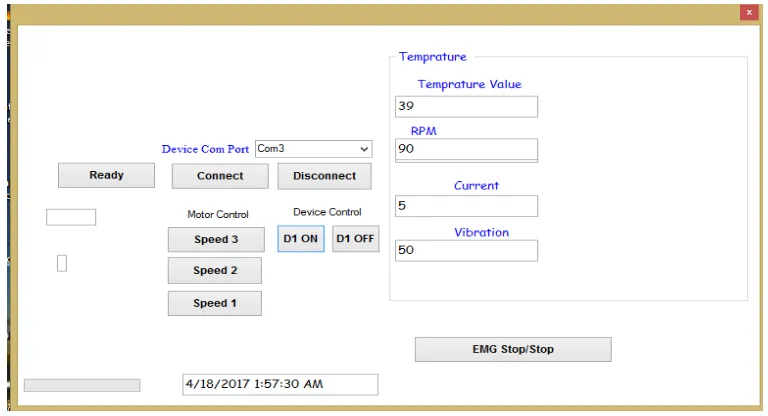
Abstract— Performance analysis of solar photovoltaic array fed single phase induction motor (IM) drive for water pumping system. In the proposed method, the output DC power of the solar PV array is stored in battery and the stored DC energy is directly fed as input to the inverter and output of the inverter is fed to the single phase induction motor for water pumping system. A centrifugal pump connected with the single phase indication motor for water pumping system. The size of PV array and motor rating selected such that the water can also be pumped during the varying in temperature and irradiation level. This study evaluates the performance parameters namely current, speed, temperature and vibrations. The GUI is developed to control the action of motor and monitor the above mentioned parameters values through appropriate sensors and microcontroller. The speed control through microcontroller by varying the pulse ON duration is studied a well as the effect of speed on vibrations is also observed.
The critical experimentation is carried out to analyze the above said parameters and examines the effectiveness the single phase induction motor for solar PV based water pumping system.
Keywords— Solar, Induction motor, microcontroller, vibration sensor, irrigation, temperature, speed, GUI,etc.
I. INTRODUCTION
Solar energy is the lowest cost, competition free, universal source of energy as sun shines throughout. This energy can be converted into useful electrical energy using photovoltaic technology. The steady state reduction of price per peak watt and simplicity with which the installed power can be increased by adding panels are attractive features of PV technology. Among the many applications of PV energy, pumping is the most promising. In a PV pump storage system, solar energy is stored, when sunlight is available as potential energy in water reservoir and consumed according to demand. There are advantages in avoiding the use of large banks of lead acid batteries, which are heavy and expensive and have one fifth of the lifetime of a PV panel. A number of experimental DC motor driven PV pumps are already in use in several parts of the world, but they suffer from maintenance problems due to the presence of the commutator and brushes. Hence a pumping system based on an induction motor can be an attractive proposal where reliability and maintenance-free operations with less cost are important. The effective operation of Induction motor is based on the choice of suitable converter-inverter system that is fed to Induction Motor. Converters like Buck, Boost and Buck-Boost converters are popularly used for photovoltaic systems. But these converters are limited to low power applications. For PV applications like pumping these converters could do a good job as pumping is carried out at high power. Thus a new push pull converter which is two switch topology can do justice by giving a high power throughout. The Induction Motors are the AC motors and hence from converter, an inverter system is also required to obtain an AC voltage. This inverter is chosen based on its advantages and it is fed to induction motor. Photovoltaic technology is one of the most promising for distributed low-power electrical generation. The steady reduction of price per peak watt over recent years and the simplicity with which the installed power can be increased by adding panels are some of its attractive features. Among the many applications of photovoltaic energy, pumping is one of the most promising. In a photovoltaic pump-storage system, solar energy is stored, Water pumping is one of the simplest and most appropriate uses for photovoltaic.
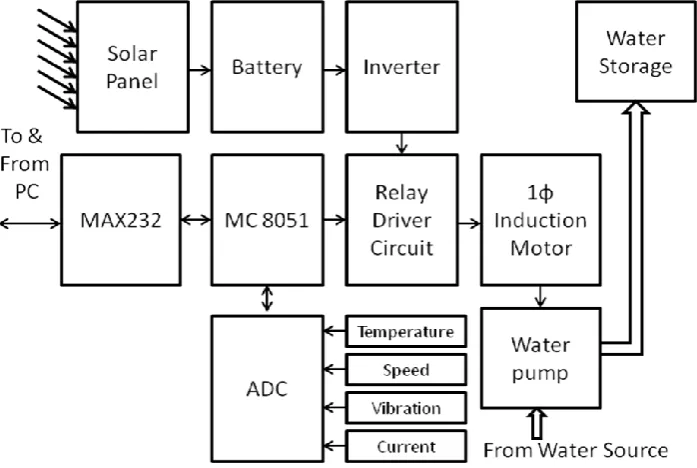
communication between microcontroller and PC is done through proper signaling by serial interface IC MAX232 which is a logic level converter IC. As per the main task of the proposed work, to monitor the performance of the IM four sensors are used for this purpose namely temperature, speed, vibration and the current. All this sensors are fitted along the body of IM at appropriate places to collect the proper readings of the required parameter. This sensors are interfaced to microcontroller though Analog to digital converter IC which converts the incoming analog quantity to proportional digital quantity to be fed to the microcontroller. All the readings of the said parameters are taken with respect to time and corresponding values are stored in the log file in PC. All this values are used for the analysis of the system.
Fig. 1 Block Diagram of complete system with all units.
This Project proposed to design the solar powered drive for induction motor based water pumping system and analyze three parameters namely temperature, speed and vibrations. The VFD which drives the motor which is controlled via microcontroller 8051, checking health of the motor considering various parameters which is communicated to RS232 channel with the monitoring i.e. the supervision software. The existing VFD’s uses the PWM techniques for the load control and thus causes the harmonics and noise in switching angle. The VFD communicates with the switching mechanism which is communicated to the logical unit of MC8051 which sends signal at different switching angles via communication protocol in supervision software. The supervision software proposed is embedded C and MS .net for GUI. The given program to microcontroller executes the hardware architecture for the flow of data for control and monitoring parameters.
III. EXPERIMENTAL RESULTS
ISSN(E): 2277-128X, ISSN(P): 2277-6451, pp. 20-28
Fig. 2 Main GUI form of Application Software
Fig. 3 Parameters at speed 1 on application software
Various experimentation is done to analyze the performance of the IM powered by solar energy through inverter and triggering circuit. The main focus of experimentation is to test following parameters of IM based water pump namely Vibration, temperature, speed and current with respect to time without and with load.
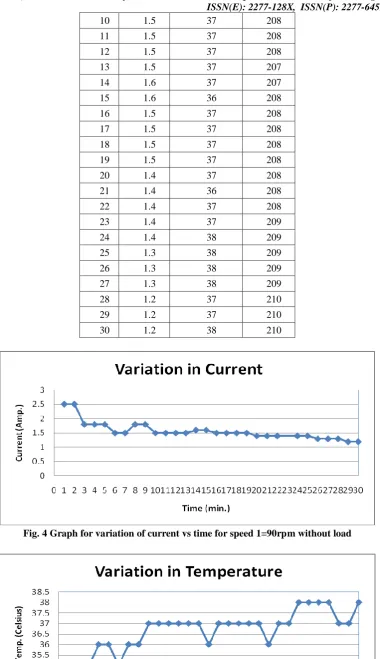
Here, first the tests are performed for speed 1 = 90rpm without load. For this speed the readings from current, temperature and vibration sensors are taken and plotted to analyze the performance.
Table 1 Variation of current vs time for speed 1=90rpm without load Time
(min)
Current (Amp.)
Temperature (Celsius)
Vibration (Hz)
1 2.5 35 200
2 2.5 35 200
3 1.8 35 201
4 1.8 36 205
5 1.8 36 205
6 1.5 35 206
7 1.5 36 206
8 1.8 36 207
20 1.4 37 208
21 1.4 36 208
22 1.4 37 208
23 1.4 37 209
24 1.4 38 209
25 1.3 38 209
26 1.3 38 209
27 1.3 38 209
28 1.2 37 210
29 1.2 37 210
30 1.2 38 210
Fig. 4 Graph for variation of current vs time for speed 1=90rpm without load
ISSN(E): 2277-128X, ISSN(P): 2277-6451, pp. 20-28
Fig. 6 Graph for variation of vibration vs time for speed 1=90rpm without load
The same experimentation is carried out for two more speeds i.e. speed 2 = 125rpm and speed 3 = 150rpm without load.
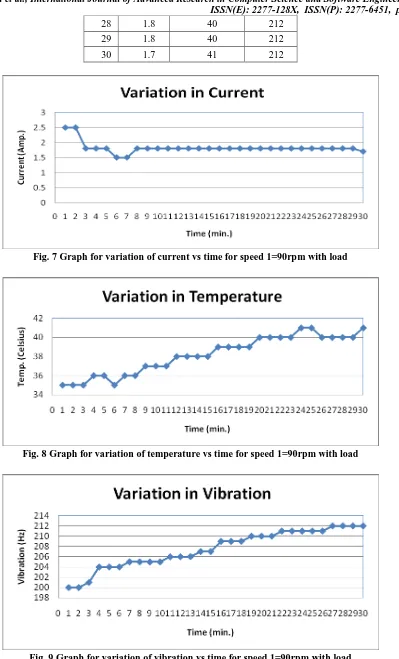
Now, the tests are performed for speed 1 = 90rpm with load. For this speed the readings from current, temperature and vibration sensors are taken and plotted to analyze the performance.
Table 2 Variation of current vs time for speed 1=90rpm with load Time
(min)
Current (Amp.)
Temperature (Celsius)
Vibration (Hz)
1 2.5 35 200
2 2.5 35 200
3 1.8 35 201
4 1.8 36 204
5 1.8 36 204
6 1.5 35 204
7 1.5 36 205
8 1.8 36 205
9 1.8 37 205
10 1.8 37 205
11 1.8 37 206
12 1.8 38 206
13 1.8 38 206
14 1.8 38 207
15 1.8 38 207
16 1.8 39 209
17 1.8 39 209
18 1.8 39 209
19 1.8 39 210
20 1.8 40 210
21 1.8 40 210
22 1.8 40 211
23 1.8 40 211
24 1.8 41 211
25 1.8 41 211
26 1.8 40 211
Fig. 7 Graph for variation of current vs time for speed 1=90rpm with load
Fig. 8 Graph for variation of temperature vs time for speed 1=90rpm with load
Fig. 9 Graph for variation of vibration vs time for speed 1=90rpm with load
The same experimentation is carried out for two more speeds i.e. speed 2 = 125rpm and speed 3 = 150rpm with load.
ISSN(E): 2277-128X, ISSN(P): 2277-6451, pp. 20-28
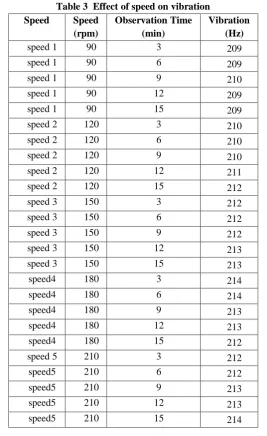
Table 3 Effect of speed on vibration
Speed Speed
(rpm)
Observation Time (min)
Vibration (Hz)
speed 1 90 3 209
speed 1 90 6 209
speed 1 90 9 210
speed 1 90 12 209
speed 1 90 15 209
speed 2 120 3 210
speed 2 120 6 210
speed 2 120 9 210
speed 2 120 12 211
speed 2 120 15 212
speed 3 150 3 212
speed 3 150 6 212
speed 3 150 9 212
speed 3 150 12 213
speed 3 150 15 213
speed4 180 3 214
speed4 180 6 214
speed4 180 9 213
speed4 180 12 213
speed4 180 15 212
speed 5 210 3 212
speed5 210 6 212
speed5 210 9 213
speed5 210 12 213
speed5 210 15 214
After analyzing the above table and fig,. it can be concluded that the vibration of motor increases as the speed of motor increases.
Fig. 10 Effect of speed on vibration
IV. CONCLUSIONS
same. The difference was found in the magnitude of parameters. In case of with load condition, the current drawn was higher than that of without load condition while the temperature and the vibrations are reduced to the considerable level as compared to the without load condition. In all, the current taken by the motor is increased whereas the temperature and vibrations are decreased, when the IM is run with load.
The experimentation is done to observe the effect of speed on vibrations by taking readings from vibration sensor for different speeds over the fixed interval of time. It is concluded that as the speed increases, the vibrations also increases. There is linear relationship between the speed and vibrations.
REFERENCES
[1] S.S. Chandel a, N. M. Nagaraju Naik a, Rahul Chandel,Review of solar photovoltaic water pumping system technology for irrigation and community drinking water supplies, www.elsevier.com/locate/rser, Renewable and Sustainable Energy Reviews 49 (2015) 1084–1099
[2] Foster R, Majid G, Cota A. A test book of solar energy. Renew Energy Environ 2014
[3] Nabil M, Allam SM, Rashad EM. Performance improvement of a photovoltaic pumping system using a synchronous reluctance motor. Electr Power Compon Syst 2013;41(4):447–64.
[4] Eker B. Solar powered water pumping systems. Trakia J Sci 2005;3:7–11.
[5] A solar choice for pumping water in New Mexico for livestock and agriculture. New Mexico State University's (NMSU) Department of Engineering Technology. 〈www.engr.nmsu.edu〉; 2014 [accessed 07.08.14].
[6] Gad HE. Performance prediction of a proposed photovoltaic water pumping system at South Sinai, Egypt climate conditions. In: Proceedings of the thirteenth international water technology conference. Hurghada, Egypt; 2009. p. 739–52.
[7] Katan RE, Agelidis VG, Nayar CV. Performance analysis of a solar water pumping system. In: Proceedings of the 1996 IEEE international conference on power electronics, drives, and energy systems for industrial growth (PEDES); 1996. p. 81–7.
[8] Loxsom F, Veroj PD. Estimating the performance of a photovoltaic water pumping system. Sol Energy 1994;52:215–9.
[9] Khan MTA, Ahmed MR, Ahmed SI, Khan SI. Design and Performance analysis of water pumping using solar PV. In: Proceedings of the international conference of developments in renewable energy technology (ICDRET); 2012.
[10] Mokeddem A, Midoun A, Kadri D, Said H, Iftikhar RA. Performance of a directly-coupled PV water pumping system. Energy Convers Manag 2011;52:3089–95.
[11] Velvizhi J, Subramanian DP. Performance enhancement of PV based water pumping system. Int J Innov Technol Explor Eng 2014;3(10):2278–3075.
[12] Kou Q, Klein SA, Beckman WA. A method for estimating the long-termperformance of direct-coupled PV pumping systems. Sol Energy1988;64:33–40.
[13] Hadj Arab A, Chenlo F, Mukadam K, Balenzategui JL. Performance of PV waterpumping systems. Renew Energy 1991;18:191–204.
[14] Pande PC, Singh AK, Ansari S, Vyas SK, Dave BK. Design development andtesting of a solar PV pump based drip system for orchards. Renew Energy2003;28:385–96.
[15] Mohanlal K, Joshi JC, Kothari DP. Performance analysis of a directly coupledphotovoltaic water-pumping system. IEEE Trans Energy Convers 2004;19:3.
ISSN(E): 2277-128X, ISSN(P): 2277-6451, pp. 20-28 [17] Atlam O, Kolhe M. Performance evaluation of directly photovoltaic powered DC PM (direct current permanent
magnet) motor – propeller thrust system. Energy 2013;57:692–8.
[18] Setiawan A, Purwanto DH, Pamuji DS, Nurul Huda N. Development of a solar water pumping system in Karsts Rural Area Tepus, Gunungkidul through student community services. Energy Procedia 2014;47:7–14.
[19] Reddy PKR, Reddy JN. Photovoltaic energy conversion system for water pumping application. Int J Emerg Trends Electr Electron 2014;10 (2):2320–69.
[20] Bhave AG. Potential of solar water pumping in India. Appl Energy 1994;48:197–200.
[21] Eyad S, Al-Soud S. Potential of solar energy development for water pumping in Jordan. Renew Energy 2004;29:1393–9.
[22] Alawaji S, Mohammed S, Rafique S. PV powered water pumping and desalination plant for remote areas in Saudi Arabia. Appl Energy 1995;52:283–9.
[23] Kaka MS, Gregoire MS. Photovoltaic water pumping system in Niger, application of solar energy, Chapter-7; p. 184–94. 〈http://dx.doi.org/ 10.5772/54790〉.
[24] Padmavathi K, Daniel A. Studies on installing solar water pumps in domestic urban sector. Sustain Cities Soc 2011;2:135–41.
[25] Badari Mahayana P, Sanjeeva Reddy BR, Prasad M, Sanjay D. Design & simulation of solar DC pump in Simulink. IEEE Trans 2013;978 (1):4673–6150.
[26] Ould-Amrouche S, Rekioua D, Hamidat A. Modelling photovoltaic water pumping systems and evaluation o f their CO2 emissions mitigation potential. Appl Energy 2010;87:3451–9.
[27] Maurya VN, Diwinder Kaur A, Maurya AK, Gautam RA. Numerical simulation and design parameters in solar photovoltaic water pumping systems. Am J Eng Technol 2013;1:01–9.
[28] Biji G. Modelling and simulation of PV based pumping system for maximum efficiency. IEEE Trans 2012. [29] Abouda S, Nollet F, Chaari A, Essounbouli N, Koubaa Y. Direct torque control –DTC of induction motor used
for piloting a centrifugal pump supplied by aphotovoltaic generator. Int J Electr Robot Electron Commun Eng 2013;7(8):619–24.
[30] Chandrasekaran N, Thyagarajah K. Modeling and performance study of singlephase induction motor in PV fed pumping system using MATLAB. Int J ElectrEng 2012;5(3):305–16.