SELF ASSEMBLING MONOLAYERS OF GLYCINE ON
CARBON STEEL
S. Gowri
[a]*, J. Sathiyabama
[a]S. Rajendran
[a,b]and J. Angelin Thangakani
[c]Keywords: Self–assembled monolayers, carbon steel surface, AFM, FTIR, corrosion, deposition method; Glycine
Well-ordered self assembling monolayer’s (SAMs) using glycine were formed on the carbon steel surface by immersion method. This leads to ordered, robust monolayers bound to the surface in a bi dentate manner. Monolayer formation takes place when carbon steel is immersed in an aqueous solution containing 60ppm of Cl– and 50 ppm of glycine for 5 minutes, and rinsing the physisorbed molecules in distilled water and heating in a hot air oven. The glycine monolayers on iron oxide steel carbon can withstand rinsing with water, concentrated acid and base exposure. Additionally, these monolayers are stable over the course of one week. The formations of monolayers were confirmed by AFM study and FTIR spectra. The results of this study show that glycine monolayers adsorbed on metal surface can reduce electrochemical activity on the surface, often the first step in corrosion.
*Corresponding Authors
*E-mail: [email protected], [email protected] [a] PG and Research Department of Chemistry, Corrosion
Research Centre, GTN Arts College, Dindigul-624 005, India. [b] Department of Chemistry, RVS School of Engineering and
Technology, Dindigul, India. Email: [email protected]. [c] CEOA Matriculation Higher Secondary School, A
Kosakulam, Madurai, India.
Introduction
Nanometer-sized particles are attracting considerable attention because of their unique properties, including optical, electrical, electrochemical, photo-electrochemical and magnetic properties1-3. Noble metals, such as gold and silver, are hot spots of the research because they can be easily prepared and exist steadily. Moreover, we can manipulate these nano-particles according to our will. Much effort has been done in exploring self-assembled (SA) nanoparticles into ordered structures 4. Specific structures can provide controlled fabrication of nanometer-sized building blocks with distinctive and useful properties 5. Polymer-stabilized nanoparticles are usually self-assembled into two-dimensional arrays on the substrate6. Yiwei Tan et al. 7 had reported the self-organization of wire-pattern arrays of Ag nanoparticles. Byeong-Hyeok Sohn 5 had demonstrated a directed self-assembly of two different kinds of nanoparticles on a block copolymer micellar template. These two particles are gold and iron oxide. The self-assembling process has been investigated to improve corrosion inhibition of metals because self-assembled substances are able to react spontaneously on the metal surface and form compact and stable films [8]. These films can protect metal from corrosion successfully. Iron is a widely used metal with extensive industrial application and the study of its corrosion inhibition has attracted much attention 9, 10.
The first work to use self-assembled films on iron for corrosion protection was self-assembling alkanethiols 11. But the application of thiol-compounds is limited due to their toxicity 12. Ilona Felhosi et al. [12] studied the formation of self-assembled films of alkane monophosphonic acids on iron surface and explained it mechanism of corrosion protection.
Organic acids such as phosphonic,13,14-18 carboxylic,19,20-23 hydroxamic,24 and sulfuric16 acids are capable for forming SAMs by chemisorption on stainless steel,25,19,26 aluminium,20-22,27 titanium13,14,17,18 and copper oxide28 surfaces.
In the present work, SAMs of glycine were formed on carbon steel surface by immersion coating (immersing metal surface in an aqueous solution containing 60 ppm of Cl-, in the absence and presence of 50 ppm of glycine). The modified samples were characterized by FTIR, and atomic force microscopy (AFM). The formation, uniformity, ordering and bonding of the monolayers accomplished by immersion method have been evaluated.
Experimental Section
Material
Very pure glycine of analytical reagent grade was used in the present study.
Preparation of the substrates
Carbon steel substrates (Composition : wt % : 0.026% S, 0.06% P, 0.4% Mn, 0.1% C and the rest Fe) of dimensions 1 x 1 x 0.2 cm were polished to a mirror finish and degreased with trichloroethylene and stored in oven at 100 oC for 1 h or more.
Formation of monolayers
Immersion deposition monolayers
Characterization of the monolayers
FTIR
The substrates were studied using a Perkin Elmer 1600 FTIR spectrophotomer. FTIR spectrophotometer was used to analyze the nature of interaction between the molecules of glycine and the substrate and the alkyl chain ordering the
CH2 peaks as the reference. The film was removed carefully, mixed with KBr and made into pellets. FTIR spectra were recorded.
Atomic force microscopy
The carbon steel specimen immersed in blank and in the inhibitor solution for a period of 5 mts was removed, rinsed with double distilled water, dried and subjected to the surface examination. Atomic force microscopy (Veeco innova model) was used to observe the samples’ surface in tapping mode, using cantilever with linear tips. The scanning area in the images was 5 m x 5 m and the scan rate was 0.6 HZ / second.
Weight-loss method
Carbon steel specimens in triplicate were immersed in 100 mL aqueous solution containing 60 ppm of Cl- various concentrations for one day. The weight of the specimens before and after immersion was determined using a Shimadzu balance, model AY62. The corrosion products were cleansed with Clarke’s solution. The inhibition efficiency (IE) was then calculated using the equation:
IE = 100 [1- (W2 / W1)] %
Where W1 = corrosion rate in the absence of the inhibitor.
W2 = corrosion rate in the presence of the inhibitor.
Results
Immersion depositon method
FTIR Spectra
A simple procedure of immersing mild steel into an aqueous solution containing 60 ppm of Cl– and 50 ppm of glycine for 5 minutes led to spontaneous film formation on the carbon steel surface. There is also possibility of formation of iron-glycine film, in the absence of iron oxide, if there is less corrosion or no corrosion of carbon steel. The samples were characterized by FTIR spectra to determine alkyl chain conformation and head group-substrate bonding 25, 17. Position of the CH
2 stretching in the infrared spectrum can be used to determine the ordering of the alkyl chain within a film 22, 29-31.
For disordered chains, the frequency of the CH2 stretching is close to that of a liquid alkane ( CH2 asym ~ 2924 cm–1) due to the presence of a gauche conformation in the alkyl chains 30, 32. For well-ordered alkyl chains the frequency is shifted to lower wave numbers and is close to that of a crystalline alkyl ( CH2 asym ~ 2914 – 2918 cm-1) which is considered to have a high degree of order, with all-trans
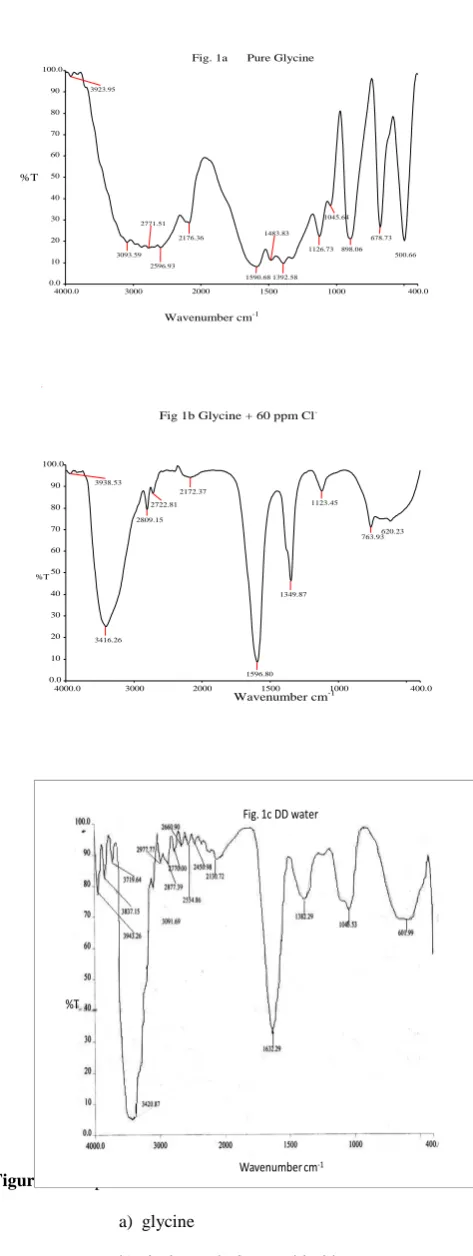
conformation throughout the alkyl chain. The FTIR spectrum of pure glycine is shown in Fig 1a. The peaks due to CH2 sym appear at 2771 cm–1. The FTIR spectrum of iron oxide film formed on metal surface after immersion in 60ppm Cl– is shown in Fig 1b. The peaks due to iron oxide appear at FeOOH = 1045, 1590 cm-1; FeOOH = 678 cm-1. The peaks due to Fe
3O4 are absent. The position of the peaks corresponding to CH2 asym and CH2sym after immersion in an aqueous solution containing 60ppm of Cl– and 50 ppm of glycine for 5 minutes and after rinsing in distilled water to remove any physisorbed material or multilayer’s, were 2809 cm–1 and 2722 cm–1, respectively (Fig 1c). This indicates that the film is stable, well ordered and strongly bound to the surface.
The IR spectra further indicate that the organic molecules are bound to the surface in a bidentate manner as determined from the shifting of C = O and – OH stretching of the one carboxyl groups of glycine specifically the C = O has shifted from 1590 to 1596 cm–1 and OH has shifted from 3093 to 3416 cm–1. Similar bidentate interaction has been reported for alkyl phosphonic acid on nickel oxide surface 33 and other organic molecules on other oxides 25, 19, and 17.
While FTIR spectroscopy can be used to characterize alkyl chain ordering and binding of the molecules to the surface, it cannot determine film thickness and integrity. Therefore, AFM imaging was used to examine the monolayer at nanometer resolution and to verify that the deposition method produces uniform monolayers.
AFM imaging
The comparison of the root mean square (rms) roughness of the unmodified substrate to the modified samples is an indicator of the film uniformity. The rms roughness parameter is a measure of the deviations in the surface from the mean plane within the sampling area 34.
Modified surfaces with an rms roughness similar to the control surface are considered to be films of monolayer thickness that follow the contour of the surface, while modified surfaces that have much larger rms roughness than the control are multilayer or non-uniform films 35, 36.
The iron oxide control samples had an average rms roughness of 12.06 nm (Fig 2a). The control sample of iron oxide is rough in comparison to model surfaces such as gold and silicon 37, 38. Modified samples formed by the immersion method (immersed in 60 ppm of Cl- and glycine had an rms roughness of 4.3806 nm (Fig 2b). The rms roughness of the substrate did not change very much after the adsorption of glycine molecules suggests uniform deposition of the organic molecules on the surface without aggregate or micelle formation. Therefore it is concluded that within the scope of the analysis, the film formed is a single layer of molecules that follows the contour of the underlying substrate.
The IR spectra of the formed films can be seen on Fig.1.
Figure 1. IR spectra of the formed films from
a) glycine
b) glycine and 60 ppm chloride
c) DD water
Table 1. The rms roughness values of the films (SAMs) formed on metal surface immersed in various test solutions.
Test solution rms roughness of the films (SAMs), nm
Cl- 60ppm
Cl- 60ppm + Glycine 50ppm
12.0558 4.38
The rms value of pure glycine molecule is very low (4.38nm) when compared with the rms value of iron oxide formed in the absence of glycine (12.06 nm). This indicates that glycine molecules are adsorbed on the metal surface before the formation of iron oxide on the metal surface. Suppose glycine molecules adsorbed on iron oxide surface then the rms value will be greater than 12.06. But it is not so. Hence it is concluded that glycine is adsorbed on carbon steel surface and not on iron oxide surface.
Stability of monolayer films
The monolayers formed by deposition method were analyzed for stability. After rinsing in water, the samples were left under atmospheric conditions for one day and analyzed. The monolayers remained ordered and bound to the surface as indicated by the lack of change in the FTIR spectra over one day. Stability to acid and base exposure was tested by rinsing modified substrates 1 M HCl or 1 M NaOH. FTIR spectra taken after these treatments remained unchanged.
Film stability and chain ordering can be dependent on alkyl chain length. In general, stability and order increase as the chain length increases 39, 40-43. Therefore, a long chain length (> 11 carbons) is commonly used in the formation of SAMs. Substantial disorder is generally found in films formed by short chain molecules, although ordered monolayers of short chain phosphonic acids have been formed on nitinol, titanium and stainless steel oxide 25, 17, and 44. In the present study there are only3 carbons in the chain
(H2N- CH2- COOH). However, the monolayer is found to be stable. Further research in this line will confirm the proposed concepts.
These conclusions are confirmed by visual observations also. In the blank experiment (60ppm Cl- only) brown film was observed on the metal. In the presence of 50 ppm of glycine brown film was absent and thin interference films (VIBGYOR colour) were noticed.
Analysis of Weight loss Study
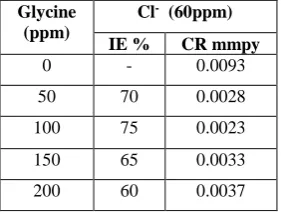
The corrosion inhibition efficiencies of glycine in controlling corrosion of carbon steel in aqueous solution containing 60 ppm of Cl- are given in Table 2. It is observed that the inhibition efficiency increases as the concentration of glycine increases upto 100 ppm. However further increases of concentration of glycine leads to a decrease in IE. This is due to the fact that as the concentration of glycine increases, the iron glycine complex formed on the metal surface goes into solution. Hence IE decreases as the concentration of the glycine increases.
Fig. 1a Pure Glycine
4000.0 3000 2000 1500 1000 400.0
0.0 10 20 30 40 50 60 70 80 90 100.0
Wavenumber cm-1 %T
3923.95
3093.59 2771.51
2596.93 2176.36
1590.68 1483.83
1392.58 1126.73
1045.64
898.06 678.73
500.66
Fig 1b Glycine + 60 ppm Cl
4000.0 3000 2000 1500 1000 400.0
0.0 10 20 30 40 50 60 70 80 90 100.0
Wavenumber cm-1 %T
3938.53
3416.26 2809.15
2722.81 2172.37
1596.80 1349.87
1123.45
763.93620.23
Fig. 1c DD water
Wavenumber cm-1
%T
Figure 2. AFM topography images of films formed on carbon steel surface after immerse on in various test solution. Cl- 60ppm; Cl- 60ppm + glycine 50ppm
Discussion
Ordered, complete monolayers of glycine were formed on carbon steel surface. These monolayers were formed using an immersion deposition process. To accomplish monolayer by immersion, a counteraction of 50 ppm of glycine, solution exposure time of 5 minutes and setting temperature of keeping the metal specimens in the oven at 100oC for 1 hr.
Table 2. Inhibition efficiencies of glycine in controlling corrosion of carbon steel in aqueous solution containing 60 ppm of Cl-
The process of monolayer formation using immersion coating has been described as a sequential process of nucleation, growth and coalescence of densely packed two-dimensional islands, finally covering the entire substrate surface or a large fraction of it 45, 46-49.
The average surface coverage for glycine films on iron surface is found to increase monotonically with solution concentration, consistent with a quarter surface density of glycine molecules. It is proposed that the initial islands are nucleated through the adsorption of individual glycine mole from solution 45, 46, 47. Therefore a higher concentration of the monomer (100 ppm) in solution leads to more collisions between monomers and subsequent island nucleation becomes more probable leading to a large number of islands on the surface 46, 50. For the immersed substrates, increasing the solution concentration leads to the formation of a complete monolayer. When the substrates were heated the bidentate increased, the molecules become thermally mobile and therefore more available for nucleation and / or growth51.
The molecules in the monolayers formed by immersion method were bound to the carbon steel surface in a bidentate manner. This bonding motif was persistent from deposition through solvent, acid and base rinsing and exposure to atmosphere for one day. A bidentate or monodentate bonding motif is seen between phosphonic acids and various metal oxides such as stainless steel 316L and Zircorium 25, 17, 44, 52-55. In the present case, glycine is bonded to carbon steel
surface in bidentate manner; since glcine is a monocarboxylic acid and coordination can take place through oxygen atoms of carboxyl groups.
The cause of the differences in bonding motifs has not been determined but may be a function of several factors including oxygen-metal-oxygen distance on the surface, hydroxyl content of the native oxide surface and the coordination sites available on the adsorbate molecules.
Summary
Well-ordered SAMs using glycine were formed on the oxide of iron carbon steel surface by immersion method. This leads to ordered, robust monolayers bound to the surface in bi dentate manner. Monolayer formation takes place when carbon steel is immersed in an aqueous solution containing 60ppm of Cl– and 50 ppm of glycine for 5 minutes, and rinsing the physisorbed molecules in distilled water and heating in a hot air oven. The glycine monolayers on carbon steel can withstand rinsing with water, concentrated acid and base exposure. Additionally, these monolayers are stable over the course of one week.
The formations of monolayers were confirmed by AFM study and FTIR spectra. The results of this study show that glycine monolayers adsorbed on metal surface can reduce electrochemical activity on the surface, often the first step in corrosion. Monolayer formation on the carbon steel surface is a significant advance in surface modification of iron oxide and can be used as a building block for future applications in corrosion barriers and electronics.
Scope of the future study
The adsorption of glycine molecule on the carbon steel surface, through the oxygen atoms of the carboxyl group can be represented as follows.
Glycine (ppm)
Cl- (60ppm)
IE % CR mmpy
0 - 0.0093
50 70 0.0028
100 75 0.0023
150 65 0.0033
On the nitrogen atom a lone pair of electron is available. On these nitrogen atoms of silver or gold nano particles can be attached if these nanoparticles are generated in –situ by suitable methods 56. Such SAMs containing nano silver or
gold may find applications in biosensors.
.
- (Nanometals- Gold or Silver)References
1Liu, Y.; Juang, L.; Langmuir2004, 20, 6591.
2Li, X.; Zhang J.; Xu, W.; Jia, H.; Langmuir, 2003, 19, 4285.
3Jana, N. R.; Gearheart, L.; Murphy C. J.; J. Phys. Chem. B, 2001, 105, 4065.
4Sun, S.; Murray, C. B.; Weller, D.; Folks, L.; Moser, A.; science 2000, 287, 1989.
5Sohn, B. H.; Choi, J. M.; Yoo, S.; Yun, S. H.; J. Am. Chem. Soc. 2003, 125, 6368.
6Teranishi, T.; Haga, M.; Shiozawa, Y.; Miyake, M.; J. Am. Chem. Soc. 2000, 122, 4237.
7Tan, Y.; Jiang, L.; Li, Y.; Zhu, D.; J. Phys. Chem.B, 2002, 106, 3131.
8Wang, C.; Chen, S.; Ma, H.; Qi, C. S.; J. App. Electrochem. 2003, 33, 179.
9Lendvay-Gyorik, G.; Meszaros, L.; Meszaros, G.; Lengyel, B.; Corros. Sci , 2000. 42, 79.
10Khaled, K. F.; Hackerman, N.; Electrochim. Acta, 2003, 48, 2715.
11Nozawa, K.; Nishihara, H.; Aramaki, K.; Corros. Sci. 1997, 39, 1625.
12Felhosi, I.; Teleddi J., Palinkas G., Kalman E., Electrochim. Acta, 2002, 47, 2335.
13Gawalt, E. S.; Lu, G.; Bernasek, S. L.; Schwartz J., Langmuir, 1999, 15, 8929.
14Adden, N.; Gamble, L.J.; Castner, D. G.; Hoffmann, A.; Gross, G.; Menzel, H.; Langmuir, 2006, 22, 8197.
15Fiurasek, P.; Reven, L.; Langmuir, 2007, 23, 2857.
16Yee, C.; Kataby, G.; Ulman, A.; Prozorov, T.; White, H.; King, A.;
Rafaiovich, M.; Sokolov, J.; Gedanken, A.; Langmuir 1999, 15, 7111.
17Gawalt, E. S.; Avaltroni, M. J.; Koch, N.; Schwartz, J.; Langmuir 2001, 17, 5736.
18Zwahlen, M.; Tosatti, S.; Textor, M.; Hahner, G.; Langmuir 2002, 18, 3957.
19Raman, A.; Gawalt, E.S.; Languir 2007, 23, 2284.
20Vanden Brand, J.; Blajiev, O.; Beentjes, P. C. J.; Terryn, H.; De Wit, J. H. W.; Langmuir 2004, 20, 6308.
21Lim, M. S.; Feng, K.; Chen, X.; Wu, N.; Raman, A.; Nightingale, J.; Gawalt, E. S.; Korakakis, D.; Hornak, L. A.; Timperman, A.T.; Langmuir 2007, 23, 2444.
22Allara, D. L.; Nuzzo, R. G.; Langmuir, 1985, 1, 45.
23 Hustak ,G.; Domb A. J.; Mandler, D.; Langmuir, 2004, 20, 7499.
24Folkers, J. P.; Gorman, C. B.; Laibinis, P. E.; Buchholz, S.; Whitersides, G. M.; Nuzzo, R. G.; Langmuir, 1995, 11, 813.
25Raman, A.; Dubey, M.; Gouzman, I.; Gawalt, E.S.; Langmuir, 2006, 22, 6469.
26Shustak, G.; Domb, A. J.; Mandler, D.; Langmuir 2004, 20, 7499.
27Brukman, M. J.; Marco, G. O.; Dunbar, T. D.; Boarman, L. D.; Carpick, R. W.; Langmuir,2006, 22, 3988.
28Sung, M. M.; Sung, K.; Kim, C.G.; Lee, S. S.; Kim, Y.; J. Phys., Chem., B.2000, 104, 2273.
29Snyder, R. G.; Struss, H. L.,; Elliger, C. A.; J. Phys. Chem,1982, 86, 5145.
30Helmy, R.; Fadeev, A. Y.; Langmuir, 2002, 18, 8924.
31Strauss, R. G. S. H.; J. Phys. Chem. 1982, 86, 5146.
32Nuzzo, R. G.,; Dubois, LH.; llara, D. L.; J. Am. Chem. Soc.1990, 112, 558.
33Rosalynn Quinones, Aparna Raman and Ellen, S.; Gawalt, Thin Solid Films,2008, 516, 8774.
34Jerome Workman, J.; Koch, M.; Veltkamp, D.J.; Anal. Chem. 2003,75, 2859.
35Quinones, R.; Raman, A.; Gawalt, E.S.; Surf. Interface Anal. 2007, 39, 593.
36Faucheux, A.; Gouget-Laemmet, A. C.; Villenevue, C.H.d.;
Boukherroub, R.; Ozanam, F.; Allongue, P.; Chazalviel, J.- N.; Langmuir 2006, 22, 153.
37Ederth, T.; Claesson, P.; Liedberg, B.; Langmuir 1998, 14, 4782.
38Ishizaki, T.; Saito, N.; SunHyng, L.; Ishida, K.; Takal, O.; Langmuir, 2006, 22, 9962.
39Bain, C. D.; Whitesides, G. M.; Science, 1987, 40, 62.
40Xiao, X.; Hu, J.; Charych, D. H.; Salmeron, M.; Langmuir, 1996, 12, 235.
41Touwslager, F. J.; Sondag, A. H. M.; Langmuir 1994, 10, 1026.
42Wolf, K.V.; Cole, D.A.; Bernasek, S.L.; Anal, Chem. 2002, 74, 5009.
43Voue, M.; Rioboo, R.; Adao, M. H.; Conti, J.; Bondar, A. I.; Ivanov, D. A.; Blake, T. D.; DeConinck, J.; Langmuir, 2007, 23, 4695.
44Quinones, R.; Gawalt, E. S.; Langmuir, 2007, 23, 10123.
45Neves, B. R. A.; Salmon, M. E.; Russell, P.E.; Troughton, J. E. P.; Langmuir 2001, 17, 8193.
46Doudevski, I.; Heyes, W. A.; Schwartz, D. K.; Phys. Rev. Lett. 1998, 81, 4927.
47Schwartz D. K., Annu, Rev, 2001. 52, 107.
48Woodward, J. T.; Ulman, A.; Schwartz, D. K.; Langmuir, 1996, 12, 3626.
49Woodward, J. T.; Doudevski, L.; Sikes, H. D.; Schwartz, D. K.; J. Phys. Chem., B1997, 101 7535.
51Neves, B. R. A.; Salmon, M. E.; Rusell, P.E.; Troughton, J. E. B.; Langmuir,2000, 16, 2409.
52Snyder, R. G.; Struss, H. I.; Elliger, C. A.; J. Phys. Chem1982, 86, 5145.
53Pawsey, S.; McCormick, M.; De Paul, S.; Graf, R.; Lee, Y.S.; Reven, L.; Spiess, H. W.; Am, J.; Chem. Soc.2003, 125, 4174.
54Schwartz, J.; Avaltroni, M. J.; Danahy, M. P.; Silverman, B. M.; Hanson, E. I.; Schwarzbauer, J. E.; Midwood, K. S.; Gawalt, E. S.; Mater. Sci. Eng.,2003,23, 395.
55Gao, W.; Dickinson, L.; Grozinger, C.; Morin, F.G.; Reven, I.; Langmuir, 1996, 12, 6429.
56Brindha, G.; Suganthi, A.; Rajendran, S.; Satyabama, P. and Robert Kennedy, Z.; Elixir Nano Tech., 2012, 50, 10585.