ISSN-L: 2501 - 1235 Available on-line at: www.oapub.org/edu
doi: 10.5281/zenodo.1466141 Volume 4 │ Issue 12 │ 2018
COMPARISON OF SOME PERFORMANCE PARAMETERS
OF PHYSICALLY ACTIVE MENTALLY RETARDED AND
INACTIVE MENTALLY RETARDED INDIVIDUALS
Evrim Çakmakçi1, Ali Tatlici2, Buse Yirmibeş2
1Faculty of Sport Sciences,
Selçuk University, Konya, Turkey
2Department of Physical Education and Sports,
Selçuk University, Konya, Turkey
Abstract:
The aim of this study is to compare the some performance parameters of 12-14 aged physically active mentally retarded and inactive mentally retarded individuals. 6 male sedentary mentally disables as a control group (age 13,33±0,21 year, weight 42,33±5,21 kg, height 149,66±6,44 cm) and 6 male physically active mentally disables (age 13,16±0,16 year, weight 39,66±2,37 kg, height 154,00±3,96 cm) were participated to the study. First of all height and weight measurement were taken, then they began warming up. Vertical jump was applied to control group and experimental group respectively. Immediately before and after the 50 meters speed test, heartbeats were taken with polar. The times of 50 meters speed test were taken by using chronometer. Spss 22 package program was used for evaluating the data. Result of the study, there were no significant differences in terms of age, height and weight of the groups. In addition that, the parameters of vertical jump, 50 meters speed test, anaerobic power and heart beat (fatigue) of the subjects were significantly different in favor of the experimental group. As a result, doing exercise for the mentally disables can improve health levels and quality of life.
Keywords: exercise, mentally retarded, mental retardation
1. Introduction
drinking, liking, being loved, being accepted and being successful like normal people they prefer to follow and mimic others rather than being leaders during group activities, because they have little confidence in themselves (Koç, 2012).
Various definitions have been made about mental retardation. This field has been examined by different disciplines and many definitions were made. Psychologists and educators also looked at the field from different perspectives and offered more educational definitions (Diken, 2013). In 1973, the American Mental Retardation Association (AMGB) defined the mental disability as, the mental disability, under-development of general intelligence functions under normal, the disorder in learning and social adaptive behaviors disorder. As a result of the evaluations made with intelligence tests, the determination of 70 points or less of the individual's score is explained as mental functions are below normal. Children with mild mental retardation are called "Educable Mentally Retarded Children" according to educational classification and account for about 85% of all mentally retarded children (Özer, 2013). Children with moderate mental retardation are classified as trainable mentally retarded children (Baykoç, 2011).
In mentally retarded individuals, physical development lags behind normal individuals due to metabolic and hormonal disorders or genetic causes. This situation slows down the development of rough and fine motor skills of mentally retarded individuals. Weak muscles and non-fixed joints of mentally disabled individuals start from childhood and cause motor development stages to be late (Connoly and Michael, 1986). Weakness in major muscle groups of mentally disabled individuals, lack of vision, weakness in hand-eye coordination, weakness in complex movements, visual attention and difficulty in mimicking movements limit their physical capacity (Varol, 2004). In addition, it is reported that the greatest difference occurs in physical development, motor skills and body coordination when mentally disabled individuals are compared with their normal age (Bruininks, 1974).
Physical activity is associated with good physiological and psychological health (Melekoğlu et al., 2018). Exercising alters muscle structure, central nervous system’s ability to control muscle co-ordination and therefore the effectiveness of the movement (Soslu et al., 2018). It is possible to observe all and even more of the positive effects of physical education and sport on individuals who have mental retardation development. Every sports event is a social experience for the disabled. In addition, sports affect all individuals in the natural environment in different ways and support all developmental dimensions. The basic philosophy of physical education and sports for the disabled is to create a positive sense of self in individuals (İlhan, 2010).
Children with mental disabilities have lower eligibility levels than those with non-disabled peers, resulting in fewer physical activity models (Pitetti et al., 2009). Disabled children are also at risk for health due to their sedentary lifestyle (Ayvazoğlu et al., 2004).
agility, coordination skills were better in favor of groups doing sport. Few studies support that sport did not change mentally retarded individuals’ abilities. Therefore, in this study, we will compare the some performance parameters of 11-12 aged physically active mentally disables and inactive mentally disables.
2. Materials and Methods
2.1 Subjects
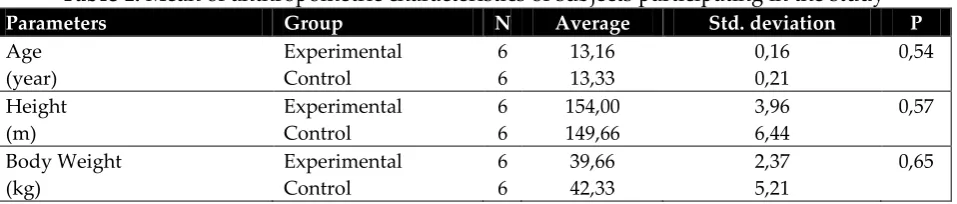
In this study, 12 mentally retarded children, studying in Selçuk teacher Fatma Menekse Education Application School and Business Training Center, was participated. 12 children were divided into 2 groups. Experimental group composed of 6 physically active children. Control group composed of 6 inactive children. Before the study, teachers and families were informed about the test procedure.
Table 1: Mean of anthropometric characteristics of subjects participating in the study
Parameters Group N Average Std. deviation P
Age (year)
Experimental Control
6 6
13,16 13,33
0,16 0,21
0,54
Height (m)
Experimental Control
6 6
154,00 149,66
3,96 6,44
0,57
Body Weight (kg)
Experimental Control
6 6
39,66 42,33
2,37 5,21
0,65
2.2 Study Design
First day both groups came to Selçuk University laboratory. Weight and height measurement were done then control group were taken to gym for warming up. Vertical jump measurement was applied to control group after that experimental group’s vertical jump scores were taken. 1 week later both group came to gym again to do 50 meter sprint test. Before and right, after the 50 meter sprint test heart rate was taken for measuring the resting and fatigue heart beat level.
Vertical jump: The subject marks the wall with his fingertip by extending his hands up on the wall. Then they touch the wall by jumping up without taking steps. The result was determined as the bounce distance of that subject in centimeters. The test was performed three times and the best score was accepted. The anaerobic forces of the subjects were calculated using the subjects ' vertical jump values and body weight with
Lewis formula. 50 meters sprint test were measured by using chronometer. Hearth rate: Heart rate values were measured with polar RS 800 (made in Finland) device in Selçuk University faculty of sports sciences performance laboratory.
2.3 Statistical analyze
All data were provided as the mean (M) and standard deviation (SD). All statistical tests were performed using the software package SPSS version 22.0 (SPSS Inc, Chicago, IL). Statistical significance level was set at p < 0.05.
3. Results
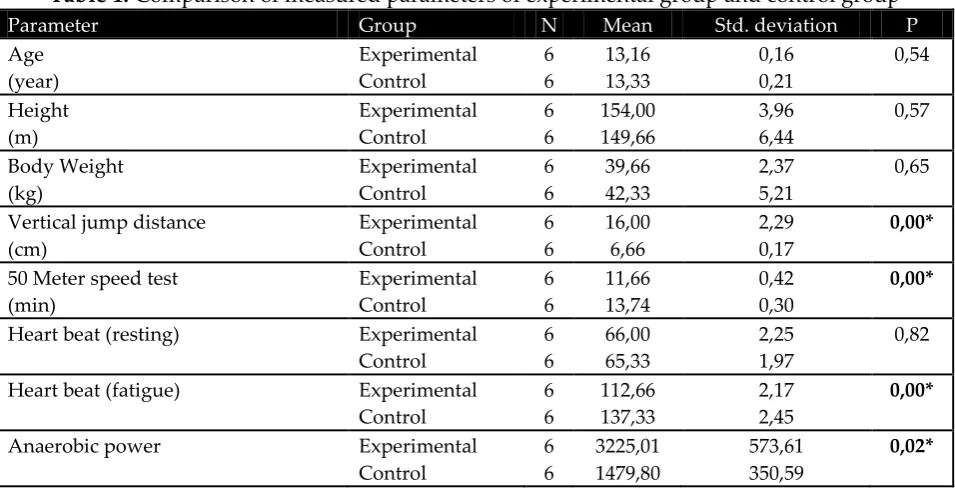
Table 1: Comparison of measured parameters of experimental group and control group
Parameter Group N Mean Std. deviation P
Age (year) Experimental Control 6 6 13,16 13,33 0,16 0,21 0,54 Height (m) Experimental Control 6 6 154,00 149,66 3,96 6,44 0,57 Body Weight (kg) Experimental Control 6 6 39,66 42,33 2,37 5,21 0,65
Vertical jump distance (cm) Experimental Control 6 6 16,00 6,66 2,29 0,17 0,00*
50 Meter speed test (min) Experimental Control 6 6 11,66 13,74 0,42 0,30 0,00*
Heart beat (resting) Experimental Control 6 6 66,00 65,33 2,25 1,97 0,82
Heart beat (fatigue) Experimental Control 6 6 112,66 137,33 2,17 2,45 0,00*
Anaerobic power Experimental Control 6 6 3225,01 1479,80 573,61 350,59 0,02*
Control: Inactive mentally retarded, experimental: physically active mentally retarded,
* significant differences (p<0,05).
As seen in the table, there are no significant differences between control and experimental groups’ heights and weights. Vertical jump distance score of groups were significantly different each other and the differences were in favor of experimental group (p<0,00). While there was no significant differences in terms of resting heart rate, fatigue heart rates of experimental group and control group were significantly (p<0,00) different. The significant differences were in experimental group favor. It was determined that anaerobic powers of groups significantly higher in experimental group (p<0,02).
4. Discussion
mentally retarded individuals’ speed, anaerobic power, anaerobic power were better than inactive mentally retarded individuals.
examined 20.9% of the experimental group, in the control group a decrease of 7.4% was observed. Lewis and Fragala-Pinkham (2005) trained a 10.5-year-old girl with Down syndrome at home. After exercise period, Improvements in submaximal heart and respiration rates, aerobic performance, muscle strength and endurance, gross motor skills, and anaerobic power were observed for this subject. Calders et al. (2011) Compared to no training, combined exercise training has significant positive effects on total cholesterol levels, aerobic capacity, muscle strength and resting systolic blood pressure, while endurance exercise training has significant effects on aerobic capacity. Guidetti et al. (2010) reported that in his study showing that athletes’ explosive leg power performances are higher than non-athletic people's performances. Rimmer ve Kelly (1991) found that resistant training significantly increased upper and lower body strength of individuals with mental retardation. Croce (1990) and Beasley (1982) found exercise increased cardio vascular fitness in mentally retarded children and adults. In contrast to our findings, Ciftci (2016) examined 32 children, 16 of them were training group and the other 16 were control group. Training group was trained for 8 week. After the training period, both group 25 meters speed performance were significantly the same. Aygün and Dinçer (2006) found that 20 meter speed test data were the same before and after training period. These contrasts can be caused by differences in subject groups and tests.
As a result, it can be said that the measured performance parameters of physically active mentally retardates are better than mentally disabled inactive individuals and this can reflect positively on mental development and quality of life.
References
Aygün, Ö., & Dinçer, A.C. (2006). Zihinsel engelli çocukların egzersiz öncesi ve sonrası motorik performanslarının karşılaştırılması. 8. SPK Poster Presentations, Muğla, 45-55.
Ayvazoğlu, N.R., Ratliffe, T., Kozub, F.M. (2004). Encouraging lifetime physical fitness.
Teaching Exceptional Children, 37(2), 16-20.
Baykoç, N. (2011). Özel Gereksinimli Çocuklar ve Özel Eğitim. Ankara: Ertem Press.. s.161-163, 165, 179-180.
Beasley, C.R., (1982). Effects of a jogging program on cardiovascular fitness and work performance of mentally retarded adults. American Journal of Mental Deficiency. Bruininks R.H. (1974) Physical and motor development of retarded persons.
International Review of Research in Mental Retardation, 7;209–61.
Connoly B., Michael B. Performance of retarded children with and without down syndrome on the bruininks oseretsky test of motor proficiency. Physical Therapy, 1986:12; 344-48.
Croce, R.V. (1990). Effects of exercise and diet on body composition and cardiovascular fitness in adults with severe mental retardation. Education and Training in Mental Retardation, 176-187.
Çiftçi, A. (2016) Denge ve kuvvet antrenmanlarının zihinsel engellilerde kuvvet ve denge gelişimine etkileri. (Master's thesis, Dokuz Eylül University, Institute of Health Sciences, İzmir)
Diken, İ.H. (2017). Özel eğitime gereksinimi olan öğrenciler ve özel eğitim. Pegem Citation Index, 1-582.
Guidetti, L., Franciosi, E., Gallotta, M. C., Emerenziani, G. P., & Baldari, C. (2010). Could sport specialization influence fitness and health of adults with mental retardation?. Research in developmental disabilities, 31(5), 1070-1075.
Isık, A., Unlu, G., Gozubuyuk, O. B., Aslanyurek, T., & Bereceli, C. (2018). The relationship between previous lower extremity injury, body weight and bilateral eccentric hamstring strength imbalance in young soccer players. Montenegrin Journal of Sports Science and Medicine, 7(2), Ahead-of.
İlhan E., Suvuren S. Engelliler için alternatif bir açılım(bocce), 11. International Sports Sciences Congress, Antalya 2010.
Koç, B. (2012). Eğitilebilir zihinsel engelli bireylerde basketbol antrenmanının teknik fiziksel ve biyomotorik gelişimleri üzerine etkilerinin araştırılması (Doctoral dissertation, SDÜ Medicine School. Isparta).
Lewis, C.L., & Fragala-Pinkham, M. A. (2005). Effects of aerobic conditioning and strength training on a child with Down syndrome: a case study. Pediatric Physical Therapy, 17(1), 30-36.
Melekoğlu, T., Ünlü, G., & Işın, A. (2018). The Effects of Training on Respiratory System of Adolescents Aged 13-14. Ulusal Spor Bilimleri Dergisi, 2(1), 1-7.
Özer, D. (2005). Engelliler İçin Beden Eğitimi ve Spor. Ankara: Nobel Publication Distribution. s.12, 15, 24-29, 31-34.
Özer, Ö., & Kılınç, F. (2012). Elite athletes in individual and team strength, speed and flexibility to compare their performance. Journal of Human Sciences, 9(1), 360-371. Pitetti, K.H., Beets, M.W., Combs, C. (2009). Physical activity levels of children with
intellectual disabilities during school. Medicine and Science in Sports and Exercise, 41(8), 1580-1586.
Rımmer J., Heler T., Wang E, Valerıo I. ( 2004 ) Improvements in physical fitness in adults with Down Syndrome. Am J Ment Retard., Mar;109(2), Abst.: 165-74.
Rimmer, J.H., & Kelly, L.E. (1991). Effects of a resistance training program on adults with mental retardation. Adapted Physical Activity Quarterly, 8(2), 146-153.
University, Health Sciences Institute, Department of Physical Education and Sports, İstanbul).
Soslu, R., Özer, Ö., & Çuvalcioğlu, İ.C. (2018). The Effects of Core Training on Basketball Athletes’ Antioxidant Capacity. Journal of Education and Training Studies, 6(11), 128-134.
Şahin, M. (2011) Zihinsel engelli çocuklarda sekiz haftalık kayak eğitiminin, fiziksel uygunluk düzeyleri üzerine etkisi. (Master Thesis. Istanbul University Health Sciences Institute, Istanbul)
Tümer, E. (2007). Polimetrik ve direnç egzersizlerinin, zihinsel engelli çocukların (10-15 yaş) kol ve bacak güç-kuvvet gelişimlerine etkisinin incelenmesi. (Kırıkkale University / Institute of Health Sciences /Department of Physical Education and Sports, Kırıkkale)
Varol N. Özbakım Becerilerinin Öğretimi. Ankara, Kök Publishing, 2004; 16-75.
Creative Commons licensing terms