Research Article
a
September
2018
Computer Science and Software Engineering
ISSN: 2277-128X (Volume-8, Issue-9)
Societal Adoption Problems of Internet of Things (IoT)-
A Study
Rotimi-Williams Bello
Department of Mathematical Sciences, University of Africa, Toru-Orua, Bayelsa State, Nigeria E-mail- [email protected]
Abstract- As reiterated by many authors, Internet of Things (IoT) is the network of physical devices, vehicles, home appliances, and other items embedded with electronics, software, sensors, actuators, and connectivity which enables these things to connect and exchange data, creating opportunities for more direct integration of the physical world into computer-based systems, resulting in efficiency improvements, economic benefits, and reduced human exertions. This is made possible by the communications models with the enabling technologies which make communications possible among IoT connected devices, although, with drawbacks. These drawbacks are the major reasons for adoption problems of IoT services by the society. This paper carried out an investigative study on previous works on the societal applications and adoption problems of IoT; IoT communications models, pros and cons of IoT. Through the study, it was revealed that for IoT devices and services to be widely adopted with no or minimal problems, future IoT technology will not only address the known drawbacks but will require hardware and software components that are highly interoperable, dependable, reconfigurable, and in many applications, certifiable.
Keyword- Internet of Things; Communications models; IoT devices; Societal applications; Technology
I. INTRODUCTION
The term IoT generally refers to scenarios where network connectivity and computing capability extends to objects, sensors and everyday items not normally considered computers, allowing these devices to generate, exchange and consume data with minimal human interventions. There is, however, no single, universal definition. The concept of combining computers, sensors, and networks to monitor and control devices has existed for decades. IoT can be compared to cyber-physical system; a new generation of systems with integrated computational and physical capabilities that can interact with humans through many new modalities. The ability to have a networked of physical devices embedded with electronics, software, sensors, actuators and connectivity which enables the physical devices to connect and exchange data, creating opportunities for more direct integration of the physical world into computer-based systems, resulting in efficiency improvements, economic benefits, and reduced human exertions is a key technological debate. The recent confluence of several technology market trends, however, is bringing the IoT closer to widespread reality. These include ubiquitous connectivity, widespread adoption of IP-based networking, computing economics, miniaturization, advances in data analytics, and the rise of cloud computing. IoT implementations use different technical communications models (device-to-device, device-to-cloud, device-to-gateway, and back-end data-sharing). These models highlight the flexibility in the ways that IoT devices can connect and provide value to the user, each with its own characteristics. Despite a shared belief in the potential of IoT, industry leaders and consumers are facing barriers to adopt IoT technology more widely. Among the barriers is the desire to have IoT hardware and software components that are highly interoperable, dependable, reconfigurable, and in many applications, certifiable. It is on this note that an investigative study on previous works on the societal applications and adoption problems of IoT services was carried out in this paper. Not only did this paper address IoT problems, it proffered a validation and verification need for a better IoT.
II. RELATED WORKS
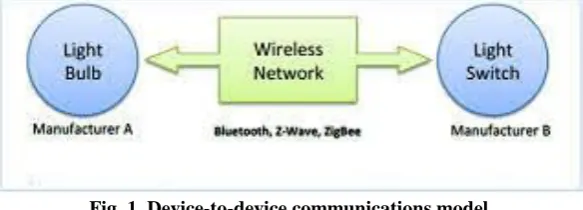
ISSN(E): 2277-128X, ISSN(P): 2277-6451, pp. 5-11 momentum when Bill Joy envisioned Device-to-Device (D2D) communication as part of his "Six Webs" framework, presented at the World Economic Forum at Davos in 1999 [4]. The term "Internet of Things" was likely coined by Kevin Ashton of Procter & Gamble, later MIT's Auto-ID Center, in 1999 [5], though he prefers the phrase "Internet for things". At that point, he viewed Radio-frequency identification (RFID) as essential to the Internet of Things [6], which would allow computers to manage all individual things [7], [8], [9]. A research article mentioning the Internet of Things was submitted to the conference for Nordic Researchers in Logistics, Norway, in June 2002 [10], which was preceded by an article published in Finnish in January 2002 [11]. The implementation described there was developed by Kary Främling and his team at Helsinki University of Technology and more closely matches the modern one, i.e. an information system infrastructure for implementing smart, connected objects [12]. Defining the Internet of Things as "simply the point in time when more 'things or objects' were connected to the Internet than people", Cisco Systems estimated that IoT was "born" between 2008 and 2009, with the things/people ratio growing from 0.08 in 2003 to 1.84 in 2010 [13]. The basic communications models of IoT demonstrate the underlying design strategies used to allow IoT devices to communicate. Aside from some technical considerations, the use of these models is largely influenced by the open versus proprietary nature of the IoT devices being networked. And in the case of the device-to-gateway model, its primary feature is its ability to overcome proprietary device restrictions in connecting IoT devices. This means that device interoperability and open standards are key considerations in the design and development of internetworked IoT systems. From a general user perspective, these communication models help illustrate the ability of networked devices to add value to the end user. By enabling the user to achieve better access to an IoT device and its data, the overall value of the device is amplified. Often, however these devices use protocols like Bluetooth, Z-Wave, or ZigBee to establish direct device-to-device communications, as shown in Fig. 1. These device-to-device networks allow devices that adhere to a particular communication protocol to communicate and exchange messages to achieve their function. This communication model is commonly used in applications like home automation systems, which typically use small data packets of information to communicate between devices with relatively low data rate requirements. Residential IoT devices like light bulbs, light switches, thermostats, and door locks normally send small amounts of information to each other in a home automation scenario. This device-to-device communication approach illustrates many of the interoperability challenges. These devices often have a direct relationship, they usually have built-in security and trust mechanisms, but they also use device-specific data models that require redundant development efforts by device manufacturers [14]. This means that the device manufacturers need to invest in development efforts to implement device-specific data formats rather than open approaches that enable use of standard data formats.
Fig. 1. Device-to-device communications model
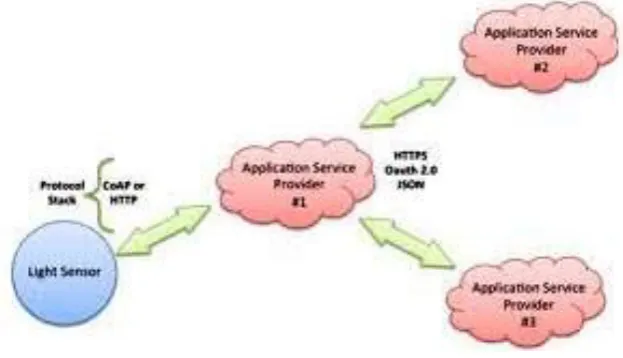
In a device-to-cloud communication model (Fig.2), the IoT device connects directly to an Internet cloud service like an application service provider to exchange data and control message traffic. This approach frequently takes advantage of existing communications mechanisms like traditional wired Ethernet or Wi-Fi connections to establish a connection between the device and the IP network, which ultimately connects to the cloud service. This communication model is employed by some popular consumer IoT devices like the Nest Labs Learning Thermostat and the Samsung SmartTV. In the case of the Nest Learning Thermostat, the device transmits data to a cloud database where the data can be used to analyze home energy consumption.
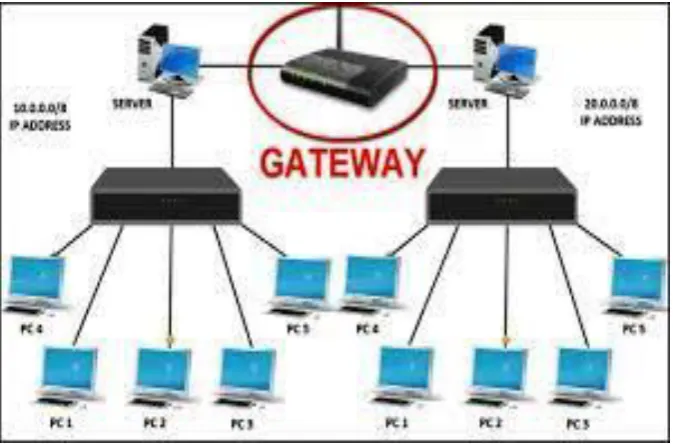
ISSN(E): 2277-128X, ISSN(P): 2277-6451, pp. 5-11 The device-to-cloud model adds value to the end user by extending the capabilities of the device beyond its native features. However, interoperability challenges can arise when attempting to integrate devices made by different manufacturers. Frequently, the device and cloud service are from the same vendor. If proprietary data protocols are used between the device and the cloud service, the device owner or user may be tied to a specific cloud service, limiting or preventing the use of alternative service providers. This is commonly referred to as ―vendor lock-in’’, a term that encompasses other facets of the relationship with the provider such as ownership of and access to the data. At the same time, users can generally have confidence that devices designed for the specific platform can be integrated. In the device-to-gateway model, or more typically, the device-to application-layer gateway (ALG) model, the IoT device connects through an ALG service as a conduit to reach a cloud service. In simpler terms, this means that there is application software operating on a local gateway device, which acts as an intermediary between the device and the cloud service and provides security and other functionality such as data or protocol translation. The model is shown in Fig 3. Several forms of this model are found in consumer devices. In many cases, the local gateway device is a smart phone running an app to communicate with a device and relay data to a cloud service. This is often the model employed with popular consumer items like personal fitness trackers. These devices do not have the native ability to connect directly to a cloud service, so they frequently rely on smart phone app software to serve as an intermediary gateway to connect the fitness device to the cloud. The other form of this device-to-gateway model is the emergence of ―hub‖ devices in home automation applications. These are devices that serve as a local gateway between individual IoT devices and a cloud service, but they can also bridge the interoperability gap between devices themselves. For example, the Smart Things hub is a stand-alone gateway device that has Z-Wave and Zigbee transceivers installed to communicate with both families of devices. It then connects to the Smart Things cloud service, allowing the user to gain access to the devices using a smart phone app and an Internet connection. This communication model is used in situations where the smart objects require interoperability with non-IP (Internet Protocol) devices. Sometimes this approach is taken for integrating IPv6-only devices, which means a gateway is necessary for legacy IPv4-only devices and services. In other words, this communications model is frequently used to integrate new smart devices into a legacy system with devices that are not natively interoperable with them. A downside of this approach is that the necessary development of the application-layer gateway software and system adds complexity and cost to the overall system.
Fig. 3. Device-to-gateway communications model
ISSN(E): 2277-128X, ISSN(P): 2277-6451, pp. 5-11 data silos because common information models are needed between the vendors.‖ In other words, this communication model is only as effective as the underlying IoT system designs. Back-end data sharing architectures cannot fully overcome closed system designs.
Fig. 4. Back-end data-sharing communications model
II.I Communication Models Enabling Technologies
ISSN(E): 2277-128X, ISSN(P): 2277-6451, pp. 5-11
III. APPLICATIONS AND ADOPTION PROBLEMS OF INTERNET OF THINGS
ISSN(E): 2277-128X, ISSN(P): 2277-6451, pp. 5-11 technology and the development of the Internet. However, the existing science and engineering base do not support routine, efficient, robust, modular design and development of IoT. Standardized abstractions and architectures are urgently needed to fully support integration and interoperability and spur similar innovations in IoT [26].
IV. CONCLUSION
This paper through literatures review studied IoT, communications models, communications models enabling technologies and the applicability of IoT in the society. The societal adoption problems of IoT were also reviewed in the course of the study. Since one of the key drivers of the IoT is data, this means that the success of the idea of connecting devices to make them more efficient is dependent upon access to and storage and processing of data. For this purpose, companies working on IoT collect data from multiple sources and store it in their cloud network for further processing just the way automobile manufacturers collect components from multiple vendors. This leaves the door wide open for interoperability problem, privacy and security dangers and single point vulnerability of multiple systems. After considering IoT in detail and subject to analysis, it was discovered that the hardware and software components, middleware, and operating systems of IoT devices need to be developed that go beyond existing technologies. The hardware and software must be highly dependable, reconfigurable, and, where required, certifiable, from components to fully integrated systems. Such complex systems must possess a trustworthiness that is lacking in many of today’s IoT infrastructures
REFERENCES
[1] Mattern, Friedemann and Floerkemeier, Christian. "From the Internet of Computer to the Internet of Things", Informatik-Spektrum. 33 (2): 107–121, 2010.
[2] Weiser, Mark. "The Computer for the 21st Century", Scientific American. 265 (3): 94–104, 1991.
Bibcode:1991.
[3] Raji, RS. "Smart networks for control", IEEE Spectrum, 1994.
[4] Pontin, Jason. "ETC: Bill Joy's Six Webs", MIT Technology Review, 2013. [5] Ashton, K. "That 'Internet of Things' Thing", 2009.
[6] Magrassi, P. "Why a Universal RFID Infrastructure Would Be a Good Thing", Gartner research report G00106518, 2002.
[7] Magrassi, P. and Berg, T. "A World of Smart Objects". Gartner research report R-17-2243, 2002.
[8] Commission of the European Communities, "Internet of Things—An action plan for Europe", COM, 278 final,
2009.
[9] Wood, Alex. "The internet of things is revolutionizing our lives, but standards are a must", The Guardian, 2015.
[10] HUVIO, Eero, GRÖNVALL, John, and FRÄMLING, Kary. Tracking and tracing parcels using a distributed
computing approach. In: SOLEM, Olav (ed.) Proceedings of the 14th Annual Conference for Nordic Researchers in Logistics (NOFOMA'2002), Trondheim, Norway, 12–14, pp. 29-43, 2002.
[11] FRÄMLING, Kary. Tracking of material flow by an Internet-based product data management system (in
Finnish: Tavaravirran seuranta osana Internet-pohjaista tuotetiedon hallintaa). Tieke EDISTY magazine, No. 1, 2002, Publication of Tieke (Finnish Information Society Development Centre), Finland, pp. 24-25, 2002.
[12] FRÄMLING, Kary, HOLMSTRÖM, Jan, ALA-RISKU, Timo, and KÄRKKAINEN, Mikko. Product agents for
handling information about physical objects , Report of Laboratory of Information Processing Science series B, TKO-B 153/03, Helsinki University of Technology, 20 p. 2003.
[13] Dave Evans. "The Internet of Things: How the Next Evolution of the Internet Is Changing Everything", CISCO white paper, 2011.
[14] Duffy Marsan, Carolyn. ―IAB Releases Guidelines for Internet-of-Things Developers.‖ Internet Engineering Task Force, IETF Journal 11.1: 6-8, 2015.
[15] Hassan, Q.F. Internet of Things A to Z: Technologies and Applications. John Wiley & Sons. pp. 27–8, 2018.
[16] Sheng, M.; Qun, Y.; Yao, L. and Benatallah, B. Managing the Web of Things: Linking the Real World to the
Web. Morgan Kaufmann. pp. 256–8, 2017.
[17] Waldner, Jean-Baptiste. Nano computers and Swarm Intelligence, London: ISTE. pp. 227–231, 2008.
[18] Kushalnagar, N.; Montenegro, G. and Schumacher, C. IPv6 over Low-Power Wireless Personal Area Networks
(6LoWPANs): Overview, Assumptions, Problem Statement, and Goals. IETF, RFC 4919, 2007. [19] Sun, Charles C. "Stop using Internet Protocol Version 4!", Computerworld, 2014.
ISSN(E): 2277-128X, ISSN(P): 2277-6451, pp. 5-11 [21] Perera, C.; Liu, C. H. and Jayawardena, S. "The Emerging Internet of Things Marketplace from an Industrial
Perspective: A Survey". IEEE Transactions on Emerging Topics in Computing. 3 (4):585–598,2015.
[22] Kang, Won Min; Moon, Seo Yeon and Park, Jong Hyuk. "An enhanced security framework for home appliances
in smart home", Human-centric Computing and Information Sciences. 7 (6), 2017.
[23] Gubbi, Jayavardhana; Buyya, Rajkumar; Marusic, Slaven and Palaniswami, Marimuthu. "Internet of Things
(IoT): A vision, architectural elements, and future directions", Future Generation Computer
Systems. 29 (7):1645–1660, 2013.
[24] Ersue, M.; Romascanu, D.; Schoenwaelder, J. and Sehgal, A. "Management of Networks with Constrained Devices: Use Cases", IETF Internet Draft, 2014.
[25] Chui, Michael; Löffler, Markus and Roberts, Roger. "The Internet of Things", McKinsey Quarterly, McKinsey and Company, 2014.
[26] S. Graham, G. Baliga, and P.R. Kumar, ―Abstractions, Architecture, Mechanism, and Middleware for