INFLUENCES OF LIFELONG LEARNING
ON ADULTS' EXPECTATIONS AND EXPERIENCES
OF RETURNING TO FORMAL LEARNING CONTEXTS
SUSAN WARNER WElL
Thesis submitted for the degree of Doctor of Philosophy
Institute of Education University of London
AB.STRAC
This multi-site qualitative study focused on mature students' meanings for and experiences of learning inside and outside formal education. Its purpose was to ascertain how influences of lifelong learning shape adults' expectations and experiences of returning to a formal learning situation after a gap of at least three years. Eight cycles of inquiry were guided by continual data analysis. Sources for data collection and analysis during cycles 1-7, involving 48 participants, included life story interviews with 3S; group interviews with 21, 11 of whom were also seen individually or in pairs; conversations with students; written material; reflexive field notes. Two cycles involved follow ups of participants who had moved to another formal learning situation. Additional groups of adult learners were used in Cycle 8 to check meaningfulness and credibility of the final data analysis. In Cycles 1-7, adults spoke from the vantage points of 55 different formal learning situations, 48 of which were in higher education. The majority of participants are identified as 'non-traditional' in the higher education literature.
ACKNOWLEDGEMENTS
Without the contributions and support of many people, this thesis could not have come to be, and indeed would have been diminished in its integrity and value. I especially want to thank:
the adults who shared their stories with me, and opened my eyes to meanings for learning and dimensions of experience that have changed me irrevocably.
All those who during the final stages of this thesis spoke so personally in response to what had emerged, affirming its meaningfulness and value; A particular thanks to Danny. With you, through our dialogue, came a very special kind of validation. Everyone at the Institute of Education library, for your endless skills, support and patience over six years.
My colleagues, and especially John, Cheryl, Linda and Marigold who supported the end in so many different ways.
Ian for our creative counterpoint during our book diversion from our theses, and helping me to learn that immense projects can end!
The participants and facilitators at the Bath conferences who helped me to know 'deep down' that I was indeed not alone, and who pushed the boundaries of my knowing beyond anything I could have imagined at the beginning of this study.
Eileen and my sister Sheila for your continual proclamations of faith in me, and the quality of our love in spite of the distance. Andy and Odile for always understanding why I was busy, and for your encouragement and support throughout.
Ginny, for sharing the struggles, and also enabling me to see things to which I had previously been blind.
John for helping me to experience a frame and a new way of being. Carlis, Elizabeth and Sheila: Your sensitivity and challenging within the context of our friendships have signficantly enhanced my own learning over the course of this thesis. May our dialogues continue!
Jocelyn: Ours is a very special friendship. Without our gentle counterbalancings of each others' differences and commonalities; without the interweavings of our ebbs and flows of energy; without our continual learning together through the struggles entailed in doing and writing up this kind of research, I wonder if I would have made it to the end. Thanks for being there, always. I look forward to sharing our continuing journeys. And thank you, Jenny and Isschara, for continually backing us up!
Phil: the integrity and clarity of your personal stance - your total way of being in relation to me - has generated a quality of learning that I have never before experienced in a formal learning situation. Thank you for never stinting in your support and commitment to pushing my boundaries. You bring a whole new meaning to the phrase, 'quality of supervision.' I will do my best to ensure that my own students gain from so much significant learning.
Tim: it is with you that this thesis began, well before the actual work was undertaken. Your love, your support, your gentle and never wavering encouragement, and belief in me. . .These have been fundamental to my own sense of enhanced integration and thus my capacity to manage disjunction along the way. You gave me the courage to find and express my own voice. I'm glad we were together when I realised that I had indeed jumped the hurdle and could come to rest. More, please...
24-67 24 27
44 47
54 58 64 65
TABLE OF CONTENTS
Thstract
Acknowledgements Table of contents Figures and tables Appendices
Introductory notes on stylistic conventions used in this thesis
PART I: UNDERPINNINGS
Chapter 1:
Literature and experience contributing to the formulation of the research quest ions
1. Introduction
2. A web of connectedness
2.1. Professional involvement in
innovation and change in higher education 2.2. From within to outside the educational
system: a detour?
2.3. working as an adult educator
2.4. Expectations and experiences: becoming a mature student
2.5. Making sense of my experience: Knowles and Koib as dominant influences at the time 3. The wider context for this study:
a new emphasis on access and continuing education in British higher education 4. Adults learning outside formal education 5. Learner experience studies within higher
education institutions 6. Mature students
7. Four strands of literature: Taking Stock 8. Methodological enigmas
2 3 5 13 14
Chapter 2:
An Evolving Epistemology
67-88
1. The emerging question: a qualitative
approach?
67
2. From questions of methodology to
questions of epistemology
68
3. Stages in my epistemological journey
69
3.1. Introduction
3.2. Qualitative approaches: a review of
the literature
3.3. Getting started: my discovery of
grounded theory
3.4. Post-positivism: a framework for
making sense of epistenological
and methodological questions
3.5. Finding and sustaining a voice:
a continuing journey
4. Research for discovery or maintenance
of the status quo?
81
5. From questions of epistemology back
to questions of methodology
84
Chapter 3
The conduct of a cyclical inquiry
89-137
1. Introduction
89
2. The notion of research cycles
90
3. Overviews of the 8 research cycles
91
3.1. Diagrammatic overview
3.2. Descriptive overview, with tables of
key participants and methods of
data collection
4. An emergent design in practice: the process
of the cycles
97
4.1. Cityside as a foundation
4.2. After Cityside
(Chapter 3, continued)
5. Methods of data collection and recording 107 5.1. Accessing meaning: life story interviews
5.2. Group interviews 5.3. Written material
5.4. Participant observation, generating talk
5.5. Fieldnotes: reflexivity in practice 5.6. Recording data
6. Meeting and talking with adults in
different learning situations 111
6.1. Getting started: role and values of letters of introduction
6.2. Meeting students: cycles 1-6 6.3. Following up students
6.4. Talking with students
7. Continual and final data analysis 122 7.1. Analysis of Cityside data
7.2. After Cityside
7.3. Final analysis: returning to the data with re-vision
8. Connecting knowledge 'in here' with knowledge 'out there': focusing the analysis around
a particular emergent issue 128
8.1. 'Disjunction' and 'Integration' as a means of making sense of key themes in the data
8.2. 'Disjunction' and 'integration': operational meanings grounded in the analysis of data
PART II: EXPLORATIONS
138Chapter 4
Dominant themes and concerns in adults'
recollections of learning during their school
years 139-170
1. Introduction 139
2. Learning and being a learner inside as
compared to outside school 140
2.1. Meanings and expectations of learning: the same or different?
2.2. Home-school intersections and the experience of reading
3. Relationships with teachers 147
3.1. Teachers as negative influences 3.2. Teachers as positive influences 3.3. Relationships with teachers in the
context of school
3.4. Relationships during times of transition 3.5. Reflections
4. Learning about oneself in relation to the 157 social context
4.1. The context for exploring these dimensions of learner identity
4.2. Social differences and the experience of disjunction
4.3. Experiencing social differences from a position of strength
5. Learners' responses to their situations 166 5.1. Pragmatism
5.2. Taking responsibility
6. Reflections 169
Chapter 5
Adults' experiences and meanings for learning
outside education 171-208
2. Learning outside education as leading to discovery 173 2.1. Introduction
2.2. Discovery out of pain and struggle
2.3. Discovery out of fortuitous circumstances 3. Learning outside as another dimension to
lifelong learning 192
4. Learning outside as loss of identity and
confidence 197
5. Learning outside as 'second best' 202
6. Reflections 205
Chapter 6
Becoming a mature student: making
and anticipating the change 208-240
1. Introduction 208
2. Some orientations and patterns associated
with returning 208
2.1. Orientations
2.2. Patterns of returning to higher education
3. Returning: how and why? 211
3.1. Further education as a route back to formal education
3.2. Other course springboards 33. Direct entry
3.4. Reflections on these three patterns of re-entry
3.5. The professionals: 'in and out' 3.6. Multiple needs in interaction
with particular conditions 3.7. Reflections on contrasting
patterns and orientations for returning
4. Anticipating: a collage of word images 238 Chapter 7
Dominant themes and concerns in adults'
(chapter 7, continued)
1. Introduction 241
2. First encounters: making sense of a new world 241 2.2. A sense of integration upon entry
2.3. Transition across different formal learning contexts
2.4. Prior learning and the experience and anticipation of disjunction upon arrival 2.5. Reflections
3. Constructive and unconstructive jarrings in
the teaching and learning situation 251 3.1. Development out of disjunction
3.2. Jarrings towards (more) disjunction in formal education
3.3. The decision to leave 3.4. Reflections
4. Issues of power and role 260
4.1. A complex social arena 4.2. Age
4.3. Age and gender 4.4. Age and class
4.5. Multiple dimensions of social identity being placed at issue
4.6. Reflections
5. On knowing and knowledge 272
5.1. Emergent thes
5.2. On legitimate and illegitimate knowledge
5.3. Exploring and expressing knowledge and knowing 5.4. Reflections
6. Mediating quality 283
6.1. Conditions conducive to integration
(Chapter 7, continued)
7. changes 287
7.1. Introduction
7.2. An increasing sense of integration
7.3. An increased capacity to aanage disjunction 7.4. 'Learning to learn'
8. Advice to tutors 291
8.1. Introduction 8.2. Eiiergent themes
9. A rich mosaic? 297
Chapter 8
Cycle 8: checking for credibility
and meaningfulness of the final analysis 298-3 10
1. Review of purposes 298
2. Some examples of outcomes from Cycle 8 299 2.1. With study participants
2.2. With other adult learners
3. Gains from cycle 8 309
PART III:
5Ur'P1ARYAND CONCLUSIONS
311
1. Introduction 312
1.1. Review
1.2. Overview of Part III
2. Summary of key themes 313
2.1. An emergent formulation: disjunction and integration involving questions of identity.
2.2. Learning during the school years.
2.3. Adults' expectations and meanings of learning outside formal education.
2.4. Becoming a mature student: making and anticipating the change.
(Part III, continued)
2.6. Cycle 8: Checking for credibility and meaningfulness of the final analysis.
3. Constraints and Caveats 334
4. The study in context: Access issues
in Britain six years on 339
5. Widening Access and supporting the transition to higher education: more and the same or more and
different students? 346
5.1. The challenge from those who do not identify with higher education 5.2. A re-assessment of access strategies
in light of these outcomes.
5.3. Access courses: advantages and disadvantages 6. Access to a responsive and enabling
higher education experience 350
6.1. Transitions that promote integration rather than disjunction
6.2. The experience of learning in higher education: questions of quality
6.3. Learning-in-relation: a quality concern for women 7. Challenges to dominant conceptions
of truth and knowledge 360
7.1. Making the implicit explicit
7.2. 'Legitimation crisis' in higher education
8. Coming to rest 368
8.1. Introduction
8.2. From then till now: a process of learning and re-structuring
8.3. On finding a voice
8.4. A final 'knot of connectedness'
I GUIE S M 'riii S
F I g
LiFigure 1:
Kolb's experiential Figure 2:
The eight research cycles
TABLES
learning cycle (1975) 38
91
Table 1:
Summary of cycle 1 ('Cityside') participants and methods, including those followed up in
Cycle 8 93
Table 2:
Summary of cycle 2 (London University,
College 1) participants and methods, including
those followed up in Cycle 8 94
Table 3:
Summary of cycle 3 ('Countryshire') female
participants and methods 94
Table 4:
Summary of cycle 4 participant's details and method
including indication of follow up, cycle 8 95 Table 5:
Summary of cycle 5 (Hillcroft la) key participants and methods,
and follow-ups in cycles 7 and 8 95
Table 6:
Summary of cycle 6 (Hillcroft 2)
female participants and methods 96
Table 7:
Errn i CPS Chapter 3
Appendix 1:
Details of participants and methods, cycles 1-6 394 Appendix 2:
Details of follow -up contacts, cycles 7 and 8
(not including checks with non-study participants) 395 Appendix 3:
Summary of details relating to the educational backgrounds and some key transition points for the
33 individuals involved in lifestory interviews 398 Appendix 4:
Emergent design in practice (Cityside): examples
of continuing data analysis 401
Appendix 5:
Example of field record 402
Appendix 6:
Letter of Introduction, Cityside 403
Appendix 7:
Letter of Introduction, Cycles 2-6 404
Appendix 8:
Meeting Students: The letter of introduction
as a starting point 405
Appendix 9:
Cycle 7/Following up students:
Letter sent via Hil]croft administrator 406 Appendix 10:
Cycle 8/Checks for credibility and
meaningfulness with draft summary of final
data analysis (8ii) 407
Appendix 11:
Cycle 8/Checks with non-study participants:
Materials used in seminar 1 (8iii) 428
Appendix 12:
Cycle 8/Checks with non-study participants:
Response from 'D' (8v) 431
Appendix 13:
Talking with students: Becoming more open 434 Appendix 14:
Talking with students:
chapter 4 Appendix 15:
Learning at school/learning through living
disjunctions 436
Appendix 16:
A sense of integration between home and school 437 Appendix 17:
Home-school intersections and the
experience of reading 438
Appendix 18:
Different teachers, different expectations 440 Appendix 19:
Girls and maths: relationships with
particular teachers 441
Appendix 20:
Teachers as positive influences 442
Appendix 21:
Being 'at school': overall memories 444
Appendix 22:
The influence of teachers at times of transition 446 Appendix 23:
Social differences and the experience of disjunction
in relation to learning during the school years 448 Appendix 24:
Learning about differences from a position of strength 450 Appendix 25:
Managing disjunction 452
Appendix 26:
Taking responsibility 453
Appendix 27: Chapter 5 Appendix 27:
Discovery out of pain and struggle 454
Appendix 28:
Discovery out of fortuitous circumstances 457 Appendix 29:
Learning outside education as another dimensions
Appendix 30:
Learning outside as 'dead end', entailing
loss of confidence and identity
464Appendix 31:
Learning outside as second best
468
(chapter 6
Appendix 32:
Further education as the route back
469
Appendix 33:
Short courses as a route back
476
Appendix 34:
34a: Direct entry to higher education
478
34b: Via Hillcroft
Appendix 35:
The professionals: moving towards and in and out
482
Appendix 36:
Multiple emphases in 'why's' for returning
484
Appendix 37:
Anticipating: same words, different meanings?
486
Chapter 7
Appendix 38:
First encounters: making sense of a new world
487
Appendix 39:
A sense of integration upon entry
489
Appendix 40:
Transitions across different formal learning
contexts: second first encounters
491
Appendix 41:
Prior learning and the experience or anticipation
of disjunction upon arrival
493
Appendix 42:
Construcive j arrings
495
Appendix 43:
43a: Unconstructive jarrings: meanings for learning
497
43b: Unconstructive jarrings: conflicting meanings
499
for quality and standards
43c: Unconstructive jarrings: the decision to leave
501
Appendix 44:
44a: Issues of power and role: disjunction in
relation to age
503
44b: Issues of power and role: disjunction in
44c: Issues of power and role: disjunction in
relation to class and age 508
44d: Issues of power and role: disjunction in relation to multiple dimensions of social
identity 511
Appendix 45:
On legitimate and illegitimate forms of knowledge 516 Appendix 46:
Exploring and expressing knowledge and knowing 521 Appendix 47:
When 'talk' gives rise to a sense of integration 524
Appendix 48:
Comparative experiences of influences that mediate
disjunction 526
Appendix 49:
Managing disjunction: compensating relationships 528 Appendix 50:
50a: Changes: an increased sense of integration 531 50b: Changes: an increased capacity to
manage disjunction 534
50c: Changes: becoming a lifelong learner 538 Appendix 51:
Advice to tutors 541
Chapter 8 Appendix 52:
Cycle 8 checks: Sally 546
Appendix 53:
Cycle 8 checks: Karen 548
Appendix 54:
Cycle 8 checks: Peter 549
Appendix 55:
Cycle 8 checks: Jane 550
Appendix 56:
Cycle 8 checks: Connie 551
Appendix 57:
Cycle 8 checks: Ethel 557
Appendix 58:
r nt cc1L1c
t nic t cmtyl i t i cczwiit i c1
ini tIii.
Voice 1:
Epistemological underpinnings
This study has been carried out within a framework of assumptions and values that I initially associated with a qualitative research approach. I now, however, associate them with with new paradigm research, or post-positivism (Reason and Rowan, 1981;
Lincoln
and Guba, 1985) and current thinking on feminist research (Harding, 1987; Stanley and Wise/9 Roberts,1981; Marshall, 1986; Wilkinson, 1986) In keeping with both paradigms, the beliefs and behaviours of the researcher are subject to critical reflection, and are part of the data supporting orcontraindicating
research outcomes.In
this thesis, I have adopted two voicesin
order to keep my objective subjectivity visible for the reader, while also allowing the 'story of the research' to unfold.Voice 1
The main body of the text is in this type face, signalling 'voice one.' Through this, I develop the argument, and trace the chronological story of the research. In most respects, I follow the usual conventions of 'writing up', especially with regard to a study which has used a qualitative research methodology.
Voice 2:
and ta1k5
Voice 2 is indented, in single spaceI and is always signalled as,
This voice serves as a kind of counterpoint to the chronological story of the thesis provided through the main text, or Voice One, and as such, has a number of functions. Through it, I foreshadow developments in my own thinking, arising from critical reflection on my own experience and themes emerging from continual data analysis. I indicate, for example, how something that was not clear at one stage became clearer at another. I also use the second voice to show how my initial explicit assumptions were challenged, changed, elaborated or undermined as a result of my engagements in the study. Through it, I highlight for the reader those times in the research when tacit rather than conscious knowing was determining directions, or blinkers were operating with respect to themes in the data. I also discuss struggles and breakthroughs related to achieving a "realised level of consciousness" (Rowan, 1981) Finally, I reflect on aspects of my own story as a learner, considering points of consonance and dissonance with themes that emerged from the final analysis illuminating complexities and contradictions.
Through the second voice, therefore, I seek to make who I am, as 'the human instrument' (Lincoln and Guba, 1985) who was involved in the collection and analysis of data, visible. In such ways, I try to address some of the key 'validity' concerns that are seen to be apropriate for disciplined inquiry carried out within these paradigms
(discussed in Chapter 3 of the thesis).
The use of the first person
for establishing trustworthiness (Lincoln and Guba, 1985). As Salmon argues, the use of the first person,
"allows - in fact, demands - that what is said reflects the particular situation, experience, understandings and dilemmas of the speaker. It is ultimately those which govern the meaning, or lack of meaning, that any academic material will have." (Salmon, 1983, p. 89)
I shall address the broader epistemological issues inherent in this stance in the thesis itself (chapter 2) with reference to arguments in a now substantive literature on this topic.
Voices one and two
Voice two is used in Parts I and II of the thesis. Part III is written in one voice.
The interweavings of voice one and two are intended to convey how subjective involvement can be risked, in order to gain, "new theoretical understanding." (Callaway, 1981, p. 470)
The use of appendices
Citations of the field record:
The use of data in this study is signalled with the notation, Field record. Capital letters are used to indicate my questions and contributions during an interview; regular typeface indicates participants responses. Commentary and descriptive comment is provided in italics.
Although the thinking behind my use of this notation is offered in the text (Chapter 3), I address the conventions that I use here, for the purposes of clarity and ease of reference:
-The following kind of notation in most cases appears after an excerpt from the field record in the main body of the text or in a longer excerpt provided in the supporting appendix: e.g. I, 6: 271/14.
Roman numeral: 1-Vill, indicates the cycle of the research during which data was collected.
Arabic numeral: 6, 7, 8, or 9 indicates the structural heading under which the data was analysed at the end of the study: 6= school years, 7= learning as an adult outside the system, 8= transition, and 9= the experience of returning. These numberings correspond to earlier chapter nuinberings, which are now offered as Chapters 4-7.
Arabic numbers after colon: These refer to the card number on which that excerpt had been recorded. A '0' in front of this number indicates that the person identified themselves as middle class. No 0 indicates that the person identified themselves as working class. (See Chapter 3 for
explanation
and further detail)Number after 'I': This refers to the page number of the transcript from which the card excerpt was taken.
Conclusion
The cumulative effect of these stylistic conventions enable me to work more effectively within a paradigm which begins with an acknowledgement of simultaneously shaping 'multiple realities.' Together, they help me to communicate to the reader some critical dimensions to the 'surplus reality' (Moreno, 1945) that are at issue when human beings give meaning to their interactions within complex social systems.
It is my hope that the relevance of these conventions to the epistemological stance which I have adopted, and to the essence of this undertaking, will become clearer through the experience of actively engaging with the parts and the whole of this dissertation.
'ir i
TJ1IXERIINI1GS
-CHAPTER ONE
LI -tv-tij
rd
,cpv
I
ccwi-tyI bLat I rig -t
-th
-Fc,ymi..i 1 -t I
ric,-F -th
vych g i..i
-t I
1. Introduction
This study is concerned with influences of lifelong learning, inside and outside formal education, on how adults anticipate and subsequently experience, formal learning contexts, and themselves as learners in such situations. The study focuses in particular on students who are often referred to as 'non-traditional' in the literature:
"Adult returners, [who] by virtue of their previous educational qualifications, life and work experience, as well as their class, gender, and/or race, have been traditionally under-represented in institutions of higher education in Britain." (Weil, 1988)
I adopted this research focus at a time in Britain when the elitism of its higher education system, and the bias towards such students, were being addressed by policy and planning bodies and influential figures in higher education. (e.g. Fulton, 1981; Warren Piper, 1981; Williams and Blackstone, 1983; Neave, 1976; Trow, 1981; Squires, 1981; Flather, 1983). A number of forces (demographic, technological, social and economic) were combining to make access to higher education by such students a critically important issue. In particular, questions were being raised about the capacity of traditional higher education institutions and academic staff to respond effectively and flexibly to the needs of a more diversified and age-comprehensive student population who had the "ability to benefit from higher education" (UGC, 1984).
countries, encountered numerous structural and attitudinal barriers making my own return to study in Britain impossible at that time; as an adult educator who worked outside formal education with all sorts of adult learners on whom access concerns were now focussed; and finally, as a mature student myself, in 1982, prior to beginning this research.
Such experiences had deepened my understanding of the relevance of particular kinds of policy, structural and practice changes advocated in major documents of the time (e.g. UGC, 1984; NAB, 1984a,b; ACACE, 1982; Fulton, 1981). The questions and issues arising from my own life and work experience had also fuelled my commitment to engage in disciplined inquiry that might illuminate some of the complexities entailed in making formal learning contexts more responsive to adults as learners.
This thesis represents an attempt to document the journey of the research on different levels, as well as its outcomes. My engagements in data collection and analysis, and my interactions with different people along the way (through reading and direct encounter) have generated both struggles and breakthroughs in my own thinking and understanding. The research process has given rise to many new questions: particularly, about what it means to learn and to be a learner in different contexts over time and about how research aims and methods, and taken for granted woridviews, or paradigms, influence our research assumptions and outcomes. In many ways, who I am today feels a very different person from the one who began this research in 1984.
perspectives altogether?
I begin to tackle these challenges in Chapters 1 and 2, the main purpose of which is to communicate 'where I was' in 1984. I shall reflect on how certain aspects of my personal and professional experience gave rise to particular questions and concerns at the beginning of the study. I shall also map some of the reading which, through what it said and what it also did not say, focused particular strands of my life and work experience and my starting assumptions in this enquiry. Throughout I shall approach the literature,
"... actively and personally.. .from the viewpoint of one's own contexts, one's own questions, one's own lived and known experience - (in order both to] enrich and develop one's own personal understandings and to create a structure of meaning within which (this research] can be viewed." (Salmon,1983, p.91 ) Throughout, as indicated in my introductory notes to this thesis, I shall use a second voice to document what Rowan (drawing on Hegel) refers to as a, "realised level of consciousness." Rowan distinguishes this from a 'primary level' which he identifies as one-sidedly subjective, or a social level, one-one-sidedly objective. A realised level brings primary subjective experience up through a social level, and uses the resulting changes in both intuitive and conscious ways to maintain an 'objective subjectivity: "enabling us continually to see the wood as well as the trees." (Rowan, 1981, p. 116.) Through this voice, I shall anticipate some of the issues that became clearer, and the core assumptions that were challenged, as a direct result of the research process and outcomes. Issues related to epistemology and post-positivism will also begin to be seen as central strand in this study, since a different set of assumptions and research practices might have led to very different research outcomes.
(This latter strand is introduced towards the end of this chapter and developed further in Chapters 2 and 3.)
2. A web of connectedness
Gregory Bateson refers to a story as a, "little knot or complex of that species of connectedness which we call relevance" (Bateson,1979, p. 22, original emphasis). The purpose of this section is to begin to spin a web of connectedness between this thesis and aspects of my own story.
2.1. Professional involvement in innovation ax change in higher education
In the U.S., beginning in 1972, I worked for a Consortium of colleges and universities each with a different set of traditions focusing on particular target groups. One was a Black university; one was a community college, with students of all ages largely from blue collar families; one was a large Catholic University, comprised of largely 18-21 year old white middle class students; one was a women's liberal arts college catering largely for young students from wealthy family backgrounds. I worked for the Consortium office itself, which specialised in setting up cross-institutional innovative pilot programmes, with government funding. I developed an interdisciplinary studies programme for students specializing in human science/service areas, such as psychology, social work, and special education. The programme involved structured experiential learning, learning contracts, reflection on learning processes, experiential group work and reading that was relevant to individual needs and
wo
the case. This experience deepened my commitment to working in education, and in 1974, I made plans to go back to Boston and do a PhD in Education. Family circumstances brought me to England instead, where I felt I had no choice but to stay and see a particular situation through.
If I had been interviewed at this time, prior to changing countries, I probably would have referred to my good fortune in the number of opportunities that had enabled me to develop my ideas, and the post graduate study choices that were now open to me as a result of a small but growing reputation. I would have spoken about my commitments to challenging social injustice through education, and widening educational opportunity for adults. I would have perceived higher education as an unequivocal good.
2.2. From within to outside the educational system: a detour?
When I changed countries, I expected to be able to pursue my plans to study. Instead, I directly confronted many of the attitudinal and structural barriers that only relatively recently have become the focus for debate and action within British higher education: for example, entry requirements that fail to recognise experiential learning, rather than merely formal qualifications as a basis for entry or changing disciplines at post-graduate level (Evans, 1984,
1988); a lack of part time, evening, and modular study (including credit transfer) opportunities(Tight, 1982, 1987; Percy, 1985; CNAA,
1988); the unavaibility of student loans to support study not financed by grants (e.g. Woodhall, 1989); subject, staff and sector boundaries (e.g. Schuller, Tight and Weil, 1988; Percy, 1988); and the organisation of study (Burgess, 1985).
These barriers channelled me outside the formal education system -both as a professional and a learner. There I continued to develop my ideas about innovative teaching and learning processes. I also had to consider them in very new arenas: in service organisations, in community education, and through setting up and running professional development programmes outside higher education institutions. For a very long time, I felt detoured from my 'mainstream' career directions and interests.
There was, however, much learning from this detour that I neither valued nor understood at the beginning of this study. As indicated above, the second voice in this thesis will continue to illustrate some ways in which various dimensions of the so-called detour, and earlier experiential learning, were surfaced, and given new meaning, through the various cycles of the research. But now I shall focus on the period prior to beginning this research, since it was in these engagements with adult learners that my initial preoccupations, germane to the study, were shaped.
2.3. Working as an adult educator
In 1979, I was fully resident, and free to pursue employment choices. I was attracted by, and eventually offered, a new position as Head of a new three year Development Project in Education and Training for a national voluntary association in an area where no previous professional development work had been done: foster care practice.
The purpose of the project was to 'train trainers' in Social Services Departments throughout the country to work with groups of foster parents and social workers. The professional development approach was
that butt
Often the foster parents had few, if any, educational qualifications, and many were working class women. The social workers tended to come from a wide range of social class backgrounds and most had done their professional training in higher education. The aim of the national trainer training programme was to empower pairs of staff developers to return to their local communities and departments and set up and run courses based on these training packages with mixed groups working in adolescent and child care.
My energies in designing the trainer training programmes focused on course design, methods and processes that I hoped would facilitate collaborative learning, active involvement, and the development of insights and skills as professionals and future trainers, relevant to working with adults as learners. I developed activities designed to engage participants in reflecting on their own experiences -as people, as learners, as foster parents and social workers, as 'former children and adolescents'. These reflections became the basis for considering the implications of working with other adults as learners on such issues. Drawing on the theories of Koib (1975) and Knowles (1973) about adult and experiential learning, (discussed below) my aim was to help 'trainer training' participants to build their own 'theories' of action for working with mixed groups of adults - from different social, educational and occupational backgrounds. Activities and group work (involving planning and running sessions from the training package) enabled participants to test out in action the 'working hypotheses' generated by the various reflections and analyses arising from their re-examination of their own experience. Practice with constructive feedback, and the overall climate of the course, were intended to support risk taking and creativity, as well as 'personal sense making' with regard to the learning taking place.
gone. My bedroom was several times located adjacent to the public phone, and I would cringe as I listened through the too thin walls to participants panicking on the phone to partners on the first night, as
they recounted their perceptions of what they had 'let themselves in for'.
I gradually realised that many of these adults and particularly the foster parents, came with the expectation that this course would be
'like school' and therefore little different from their previous experience in formal education. Sadly, for many of these working class women, this experience had been very negative. The maority had been
in no formal learning situation for many years.
From their perspective, these courses were formal because they took place in a group with a 'teacher'; they lasted for a week, and for many this meant being away from their families for the first time; and at the end, you were 'allowed' to do something different that you were unable to do before - in particular, a job that had status and that recognised your experience and skills in working with children and young people in the community.
From the first trainer training course, the active exploration of previous experiences of education and anxieties about being a participant on this course was central, and many painful stories emerged about what they had expected and why. We also considered if and how this course felt different in relation to previous experiences of school, employment training or higher education.
also what I interpreted as cultural differences.In the U.S., greater educational opportunity was available for adults from different social backgrounds, and education was perceived as a means of 'social mobility'. I had never before heard people speak about education in this way, with so many negative perceptions predominating. Moreover, a surprising number of social workers were critical of their professional training, although they would often acknowledge that the qualification had given them access to opportunities that were important.
I believe that the contrast between this course and the participants' previous experiences of formal education , coupled with the intensity and quality of relationships that were often developed over five days in a residential setting, gave me access to many dimensions of experience that I had never before considered. It was both rewarding and disturbing to have so many affirm that this course enabled them to experience something different as learners. I would often hear people saying to others that this was because we used an 'adult learning approach' - something that was discussed explicitly on the course using the ideas of various writers in the field. They would describe this using phrases like: "really talking"; , "really valuing people's experience'; "having a chance to teach social workers something"; "learning that foster parents had something to teach us".
Each course represented an immense responsibility. I often felt that I was at risk of intruding inappropriately into these adults' lives. How could I gently urge them towards new domains for learning and be neither arrogant nor disrespectful? This question never became easier; if anything, with each course, I became increasingly aware of the difficulties and implications of this question, in relation to these adults' lives. I would return home from each course both exhilarated and exhausted and I tended to dwell morbidly on those few whom I personally felt I had failed in some way. I came to regard each subsequent course as providing an opportunity to build on what I had learnt in the previous one.
professional development. Equally, social workers were regarded as largely complacent about their practice, and had been stereotyped as incapable of learning alongside foster parents. I believe we successfully ovecaine many of these perceptions.The sheer numbers who came on this programme and subsequently attended local programmes (2000+ between 1979 and 1983 in the majority of local authority social services departments in Britain) (Weil, 1983) created ripples of change within social services foster care services, particularly with regard to the ways training and professional development oppurtunities were conceived and implemented.
Voice 2: I realise now, at the end of this particular research journey, that despite the many 'successes' and 'highs' of these courses, I was using very narrow frameworks for making sense of adults' stories about their prior experiences of education. I can see that I was unable to attend to the real complexity of what we were experiencing and what I was hearing. I was convinced that 'methods' and 'progressive educational approaches' were the key to unlocking adults' potential and enthusiasm.
Admittedly, for many of these adults my attitudes and approaches afforded a qualitatively different learning experience from any that
they had encountered previously. Nonetheless, I realise now the extent to which, despite my stated commitments about 'valuing experience', only particular aspects of their and my own experience were at issue in that environment. For example, diversity was a key feature of the groups - in terms of professional status, previous educational backgrounds, class, gender, political awareness and individual and social commitments. Few Black people attended this programme. I saw my responsibility as one of helping to create an environment in which the experiences arising from differences would be respected and treated as central to the learning and development process in which we were all involved. But, there was a great deal of experience which I did not 'hear' and tacitly, discouraged, as focal points for active exploration in that learning environment. I believe at the time I shut down all sorts of opportunities for learning - my own and others. I would have been threatened by too overt an expression of differences.
For example, I know now from my own experience how often it may not be until after an event that I will become aware of how the delicate nuances of my own different 'readings' of what was happening have been trampled upon and re-interpreted within otherse' interpretative frameworks of meaning or against male norms. I bel$'e that there was a great deal of experience in these groups that I shut out altogether. I also believe that there was a great deal of experience that I assumed, and re-interpreted in my own conceptual framework. Because of my power as course facilitator, my framework could all too easily become the dominant framework. I also realise now that such power does not operate in a vacuum - for example, I am a white facilitator, and therefore can 'trade off' a great deal of existing power in the culture.
But this learning resulted only from subjecting these issues to disciplined inquiry, and adopting
an
epistemology and methodology that required me to subject also my own experience and preconceptions to disciplined inquiry, as I shall discuss in subsequent chapters . When I began the study, certain experiences in my professional and personal life, and issues arising from certain kinds of reading, dominated my perceptions of what was at issue in adult learning. I was preoccupied with methods, course designs, course climates. I was caught up in assumptions influenced by my cultural, class, and educational background. But, as will be discussed below, my own experience as a mature student further convinced me that new methods and progressive approaches were the solution to making higher education genuinely responsive to the needs of more diverse and particularly non-traditional students.2.4 Expectations and experiences: becoming a mature student
It was to be eight years before my work, and my personal and financial circumstances, enabled me to become a mature student. I was in the fourth year of my work on the national trainer training programme. My relationship with my second husband whom I had met two years previously supported me in taking what I then saw as a considerable risk. I had come to devalue my experience, and regretted my failure to do post-graduate study.
of the issues and questions of concern to me together with other educationalists.
It was agreed that I could do a one year qualifying taught course, after which I could progress to an N.A. in the psychology of education. I had always been a 'good student', and I readily fell back into habits and disciplines that had previously held me in good stead. But my expectations and my experiences seemed to be at odds with each other.
On my own, when I was reading and studying, I was fine. As ever, I was a motivated and independent learner, and would actively relate what I was reading to my own thinking and experience. My reading and private study, however, confronted me with the boundaries of the discipline of psychology which I had not ever before considered. I wanted to learn more about what I saw at the time as the 'psychology of adult learning'. In my own work, I thought I had begun this, by relating existing adult learning theory to actually working with adult learners. I had been developing my own 'theory in use' (Argyris and Schon, 1974) over many years. Many of the adults whom I had encountered during my 'detour' had made a conscious decision never to re-enter the formal educational system again because of their prior experiences. These were the preoccupations which were uppermost in my mind.
any relevance to my own lived experience, as a learner and as an educator.
Whenever I would try to bring these questions, or dimensions from my work into the seminars, I would feel myself hitting unstated but powerfully felt norms. Such explorations seemed taboo. Opportunities to make connections across disciplines, between the discipline and life/work experience, and across conflicting perspectives within the discipline seemed to be discouraged. Research within formal education (primary and secondary), or experimental work in laboratories (largely with animals) determined the boundaries for discussions of learning.
In seminars, lectures and other engagements with tutors and students, I kept experiencing a great deal of frustration, isolation, and disorientation. These feelings baffled me, since they were not feelings I had ever associated with formal study.
2.5. Making sense of my experience: Knowles and Koib as domi nnt influences at that tiae
I did however struggle to make sense of what was happening by considering what I was experiencing in terms of the theorists with whom I had become familiar through my work in trainer training: in particular, Malcolm Knowles (1973, 1978) and David Kolb (1975). These two writers deserve mention for three reasons. First, they had had a fundamental impact on my thinking as an adult educator. Secondly, they provided the conceptual frameworks through which I could interpret my experience as a mature student at the time, and account for my difficulties in 'rational terms'. Finally, my conceptualisation of 'the problem' in terms of their ideas, and the work of other 'educational reformers' with whom I had been familiar in the past, underpinnned my initial engagements in this study.
Malcolm Knowles, and David Kolb had had a significant influence on my own approach since their ideas were embedded in the 'curriculum packages' with which I was working, and which had come originally from America. (CWLA, 1976, 1978) I felt convinced by the positive impact of the different approaches that they advocated for working with adult learners over and over again. My experience 'told me' that adult learning programmes that reflected their ideas arid values could change many adults' orientations, and previous resistance to, education or training of any kind. This experience chimed with my own previous work in the States.
Knowles' ideas derived from humanistic psychology and human resource development in organisations, and at the time, represented a challenge to the limitations of behaviourism and theories of learning based on animal experiments. The core of his thinking centres, however, on distinguishing a 'theory of adult teaching and learning from a 'theory of teaching children'. He characterises the two approaches as 'andragogy and pedagogy', each of which he regards as being based on different assumptions about learning and learners, and having different implications for the role of the teacher, and for the design of the learning programme. The term 'andragogy', meaning 'the art and science of helping adults learn' (Knowles, 1980, p 31) has been popularised by Knowles, and his andragogy-pedagogy formulation has immense popular appeal. Long argues that it gave adult trainers and educators a professional identity in relation to work which was often marginalised from mainstream educational concerns
(Long, 1987). Knowles' work was published at a time in America when the numbers of adults seeking a return to study were growing, and adults as learners were recognised as a force to be reckoned with. The book built on the influence of humanistic psychology generally in the U.S. and offered a rationale for an alternative approach to teaching and learning. Speaking more personally, the ideas of Knowles enabled me to connect my work as an adult educator with the ideas of other educational reformers who had influenced my earlier professional
Knowles' book was written in a 'folksy' style, and was aimed directly at people working largely outside formal education systems, and particularly trainers working in organisations - the group with whom I had come to identify. His ideas found their way into a large number of continuing professional development initiatives in the U.S.A. and the assumptions of andragogy became associated with normative practice for working with mature students, and indeed adult learners in any educational and training initiative. (e.g. Knowles, 1984)
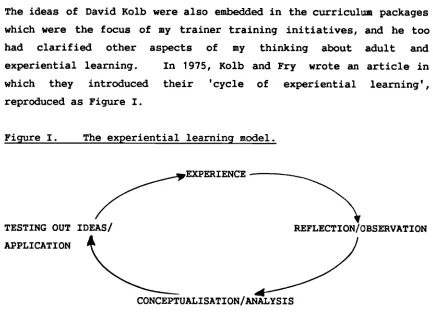
The ideas of David Kolb were also embedded in the curriculum packages which were the focus of my trainer training initiatives, and he too had clarified other aspects of my thinking about adult and experiential learning. In 1975, Kolb and Fry wrote an article in which they introduced their 'cycle of experiential learning', reproduced as Figure I.
Figure I. The experiential learning model.
,,,,EXPERIENCE
TESTING OUT IDEAS/ REFLECTION/OBSERVATION
APPLICATION
47/I
CONCEPTUALISATION/ANALYSIS
Kolb and Fry, 1975
reflections on their own experience as learners, and in turn, their considerations of what they were doing when they planned and facilitated courses, or used experiential learning approaches. For example, Kolb's model provided a way of thinking about what I and many others saw at the time as less desirable educational and therapeutic imports from America, such as encounter groups. We spoke about groups that 'got stuck' on experience and reflection, at the expense of any wider analysis or testing out new ideas and insights. Kolb's ideas for me conveyed the importance of 'balance' and the need to integrate different kinds of learning - something which had been at the heart of the new professional education programmes I had been involved with in the States. At experiential and intuitive levels, his ideas 'made sense' to me, and to many with whom I had worked.
So, as a mature student, one of the ways in which I made sense of what I was experiencing was to attribute my difficulties to the imbalanced emphasis placed only on certain ways of learning at the expense of others in that environment. For example, experience, other than through reading what was on the syllabus was not highly valued; intellectual analysis, not reflection on values and feelings , was stressed; application was not at issue on this course. The abstract and the symbolic were valued most of all. This was in direct contrast to the kinds of learning environments I had tried to create in my work, where I had sought to integrate the various dimensions of Koib's model into a series of recurring cycles, each building on the outcomes of previous ones.
Kolb and Knowles together seemed to build logically on my previous preoccupations about teaching and learning, and helped me to feel confident in the validity of the theoretical rationale that underpinned my earlier work in the U.S. and later with adult learners in this country.
and discontent, however, in various ways. For example, we had different fields of practice. Tutors and colleagues were essentially concerned with and had experience of, working with primary and secondary age children, or in the area of formal psychology. The Department's leanings were behaviouristic. My concerns were with adult learners and my leanings were more humanistic. I was caught up in a paradox that seemed particular to me and my situation: in my work environment, I was getting people to think about their own experiences as learners in terms of Knowles' 'andragogy principles'. Here was I, in a situation where pedagogy ( as Knowles defined it ) predominated.
Fortunately, however, several tutors offered relationships which provided the space and support I needed to regard my work outside formal education as valid and valuable; the pressure seemed to be on me to do otherwise. They helped me to treat the course more instrumentally: to see it as a passport to further opportunities. I therefore focused my attention on what I might do in future, should I do well in the exams.
One of the tutors who helped me to make some sense of what I was experiencing became my supervisor on this thesis; the other was the person who persuaded me to come back to study, and later helped me to overcome bureaucratic obstacles so that I could register directly for an M. Phil. He had been intensely interested in what I had been doing outside the formal system. Both of these people advocated on my behalf, and also 'heard' and understood my difficulties in trying to reconcile my experience as a person and a professional 'out there' and my experience as a student 'in here'.
also concerned with methods in learning, and Knowles was not just known to them but of concern in their approaches to course design and process. This was immensely exciting to me, since I still was concerned to become better acquainted with relevant academic literature that could inform and enrich my own understandings of adult learning.
In 1982, I had been a mature student at London University. By 1983 I was staff and working on developments in higher education -something that for eight years I had dismissed as an impossibility. My position enabled me to become involved once again in the kind of debates to which I had been so committed in my work with the Consortium, and which I had originally planned to address through post-graduate study in Boston. For the very same concerns were very much at issue in British higher education ten years later: access, continuing education, student and adult learning, the purposes of higher education in a changing society and in relation to a more diversified age comprehensive student population . I gradually came to realise the value of what I had previously undervalued as an unwanted
'career detour' and the extent to which my experiential learning and work in these areas outside the system was relevant to current developments in British higher education.
Voice 2: I realise now how at the beginning of the study a number of forces converged to focus my attention on 'progressive' versus 'traditional' educational philosophies. My experience as a mature student, alongside my experience of addressing issues of working with others on 'adult learning' led me to conclude that 'traditional approaches' to teaching were inappropriate for adult learners. From the outset, I therefore framed the 'problem' as one of teaching methods and curriculum approaches.
It is highly relevant to this study that at the time, I tended to see my 'problem' as largely (but not entirely) an inthvidual one, particular to that educational situation, that time in my life, and my own background. It did however raise wider questLons for me about the responsiveness of higher education institions to adults with a range of expectations and prior learning experiences. Nonetheless, I was still convinced by the many positive accounts
these terms, and strongly believed that this could be and was the case in most learning situations in higher education.
I rationalised that 'that course' had been wrong for me. I saw myself as 'out of practice' as a student, and in an unusual state of heightened consciousness, because of the kind of work in which I had been involved. I concluded that I was over-reacting and expecting too much of a diploma level course designed largely for teachers as a different professional group from that with which I identified (trainers, facilitators). They were working in the system; I saw myself as working outside it. (This view also was to be fundamentally challenged by this study!) They were preoccupied with children and young people at school. I was preoccupied with adults who had left school, often with largely negative images of themselves as learners and of the formal education system.
These things may have been so, but only through the research would I be confronted with the extent to which I had fallen back all too easily on the overly simplistic frameworks provided by Kolb and Knowles to make sense of my experience, and diminish its wider implications. But then, my interpretation of my situation as a mature student was simply, ( in terms of Knowles:) 'I am problem centred, as an adult learner, not subject-centred. ' The solution, as I saw it at the beginning of this study, was to provide me with more choice in the design of my programme, allowing for greater in terdi
sd
plinari ty.It would be some time before I would come across the critiques of Knowles' basic assumptions - in particular that self-direction is somehow 'natural' (Terinant, 1988) and that all adult learners have the same needs. In this, again, I realise now the extent to which I was still heavily influenced by 'common sense' assumptions to which humanistic psychology appealed. I thought I was progressive in that I saw learning as a process, involving the 'whole person', rather than as merely stimuli and responses leading to specific and observable outcomes (Skinner, 1953). I would have stressed the social aspects of groups. But I had no conceptual framework for absorbing Jarvis' meaning that learning is both a psychological and social process (1987a). What I would have missed is his essential point that 'social' means far more than social interaction and groups. The paradox for me now is that I knew these things from other aspects of my personal and professional experience - my work with Black people during the period of my work permit; my own change of countries - but I did not know that I knew these things. Why was this so?
later would I begin to question, whose sense is common sense? Is their sense sense? I would also come to know more about the extent to which dominant norms and assumptions about learning and knowledge, were sitting uneasily with my own experiences of myself as a woman in relation to the world - the meanings and implications of which I had never thought about until cycles 5-7 of the inquiry, when I was engaged with women 's stories about learning in different kinds of formal contexts and which I shall chart during the course of the thesis.
These issues, which were part of my tacit knowledge at the beginning of the study, came to
be
at the heart of my concerns, as I made sense of the data across the 8 cycles of the research. But in1983, my preoccupation was thus: if adults were to come into higher education, there would need to be some radical changes in teaching and learning methods and approaches. What about adults who , like those who had been on my courses, had had negative experiences at school, and then had the opportunity to experience alternative approaches to learning on courses where the principles of people like Rogers, Knowles or Koib were in operation? Such courses seemed to be on the increase, and afforded a contrast to much academic learning. How would such experiences affect them, should they be attracted back into formal education?
Preoccupations based on my experience guided my reading around the following four themes:
a) A new emphasis on access and continuing education in British higher education.
b) Adults as learners outside formal education.
C) Learner experience studies within higher education institutions.
d) Mature students.
3. The wider context for this study: a new emphasis on access and continuing education in British
higher
educationAs indicated previously, when I started the study, there was a growing emphasis on access and continuing education in higher education. I considered it important to familiarise myself with the literature relevant to that sea-change, and to examine the extent to which issues of teaching and learning were at issue here.
Preoccupations with access and continuing education were fueled by economic and social changes, and more urgently, by the projected decline in the number of 18 year olds in the 1990's. In addition, there were indications from government that a higher participation rate in higher education was to be encouraged, and that new groups would need to be sought out to meet this target. (This was to be borne out later : DES, 1987, 1989) Access became a major policy concern for national and planning bodies (e.g. DES, 1978; UGC, 1984; NAB, 1984)
These kinds of developments stimulated the Leverhulme Programme of Study into Higher Education to make access an important feature of its inquiry. (e.g. Fulton, 1981; Williams and Blackstone, 1983). The failure of the Post-Robbins expansion of higher education to increase participation from under-represented social groups was an evident pre-occupation throughout the literature of higher education (e.g. Warren Piper, 1981; Farrant, 1981; Spender, 1981; Little and Robbins, 1981; Williamson, 1981; Woodley, 1981) and, increasingly, the implications of moving from an elitist to more of a mass system of higher education were being debated (e.g. Fulton, 1981; Trow, 1981)
In 1984, the University Grants Committee (UGC) and the National Advisory Body on Public Sector Higher Education (NAB) working parties on continuing education published the outcomes of comprehensive reviews of their respective sectors. Continuing education was defined by these groups as all structured learning undertaken by adults after a gap following completion of their initial education. (UGC, 1984).
research. They elaborated the economic, social, professional development and leisure needs that justified such a development. Whereas the Robbin g Report (Robbins, 1963) had emphasised the need for higher education courses to be, "available for all those who are qualified by ability and
attainment
to pursue them and who wish to do so," the UGC and NAB working parties changed this to those who have the "ability to benefit." (NAB, 1984; UGC, 1984) With this shift of emphasis, the potential for more adults to enter higher education without conventional A and 0 levels was established.I also reviewed the different meanings and debates surrounding the concept of 'lifelong education', which now had a new relevance to institutions of higher education. As Knapper and Cropley (1985) pointed out, debates about lifelong education raise questions about the goals of education, the procedures for meeting these goals and the values operating within institutions to determine which goals and which procedures were to be given priority. (p. 17):
"Lifelong education
thus defines a set of organisational, administrative, methodological and procedural measures which accept the importance of promoting lifelong learning." (Knapper and Cropley, 1985, p. 18)What excited me at the time, as I reviewed the different strands of the literature relating to access within the context of broader debates about continuing and lifelong education, was the emphasis throughout on the need for formal learning contexts to become more responsive to lifelong learners. Adult learners were regarded as a client group with diverse needs, who would differ from traditional age students, and therefore make new demands. Throughout this literature there was an emphasis on the need for changes at all levels, if the system was to attract and keep as students adults who
'had the ability to benefit' from higher education, but who, by virtue of their age,as well as their life and work experience, their gender, race, and/or class, had remained previously been under-represented in the system.
changing society. Herein he, and a number of writers, report on the various strands of research and theorising that had become relevant to these new directions in higher education, given the challenges posed by a more heterogeneous and outspoken body of students. Chickering and his associates plead eloquently and forcefully for,
". . .institutions (to] devise alternatives to meet the needs of diverse students. This means that each teacher, administrator, and student personnel professional will have to give much more thought to the persons being educated than in the past. We wil thus need an increased working knowledge about human characteristics that influence learning. Such knowledge can help us better understand the kinds of heterogeneity that will maximize learning through peer interaction in our classes and our campuses. It also will help us tailor curriculums and educational practices to particular individual needs." (1981, p. 7)
Knowles also speaks of the challenges likely to be posed by growing number of adults in higher education institutions:
"... people who have been working in the education of adults. . .have known for a long time that they had to violate some of the assumptions and concepts of pedagogy if they were to help -and keep- their students. But they have felt guilty because it meant departing from accepted academic standards. In the last decade, however, their guilt feelings have begun to disappear, largely because there has been emerging a new coherent, comprehensive, body of theory and technology based on assumptions about adults as learners. Thus, they are getting a respectable rationale for doing what they have known all along would result in better learning. " (Knowles, 1978, p. 54)
The values of more progressive approaches to education were also the concerns of people such as Tony Becher (1975), David Warren Piper
(1981) Jean Ruddock (1978) and Donald Bligh (1971, 1982) , who now, in a sense, were my colleagues - as co- staff developers. I discovered that they too, for a very long time, had been concerned with a shift from,