Research Article
March
2019
Computer Science and Software Engineering
ISSN: 2277-128X (Volume-9, Issue-3)
A Genetic Type – 2 Fuzzy Logic System for Human
Identification in Craniofacial Superimposition
M. Chitra Devi
Dept. of Computer Science, Mother Teresa Women’s University,
Kodaikanal, India
Dr. M. Pushpa Rani
Dept. of Computer Science, Mother Teresa Women’s University,
Kodaikanal, India
Abstract— One of the most research areas in forensic science is human identification, because now a day’s identification of missing person is a very challenging issue. For that reason we introduce the Craniofacial superimposition is a forensic identification technique which identify the person from the photographs or video shots are compared with the skull for accurate identification of person. Our proposed work identifies the person by the craniofacial superimposition technique. Here we implement the skull - face over lay process for human identification. Our proposed work performs the skull - face over lay process by the Enhanced-Robust 3D Point Matching [ER-3DPM] algorithm which identify the person by the matching the points in skull with the photograph of person. For accurate identification of person our proposed method performs the validation process by the genetic algorithm and type 2 fuzzy set. Finally our proposed work analyses the performance with the parameters of accuracy and execution time.
Keywords—Human Identification, Skull-Face over lay, Validation , Type 2 fuzzy sets.
I. INTRODUCTION
The methods used to identify the missing person from the skull information have been under continuous investigation in forensic medicine field. Cranioface super imposition is the one of the approach for identify the cranioface. Cranio facial superimposition which performs the super imposes the skull on to the image and analyses the morphological features. Several craniofacial superimposition methods have been proposed [1, 4, and 5]. Paper [1] was proposed the craniofacial superimposition method which solves the many global optimization problems and which have more interesting properties for faster reconstruction. This approach performs the skull overlay process for human identification. In paper [4] introduce the two new variant for automatic skull face overlay process for craniofacial superimposition method. here we have modeled the imprecision associated with facial soft tissues depth in cranial and facial landmarks by using these landmark points identify the person. Computer aided craniofacial superimposition method which identifies the human by using the computer aided technique. Here craniofacial superimposition involves the two fold process, such as landmark setting and skull-face overlay process. In computer aided technique landmarks setting and overlay process of skull and face both are done by automatically. Here skull overlay process is repeated until process the all photographs in dataset which is adjust the size and orientation of skull physically [5]. Real code genetic algorithm introduces the fast automatic super imposition method. This approach considers the time consuming of overlay process of 3D skull to 2D photographs. Here synthetic data are used for validate the method. for fast super imposition process we implement enhancing of three methods such as improvement of registration transformation, use of real code scheme and design the better GA components [2]. Soft computing means combination of emerging problem solving technology which includes the fuzzy logic, probabilistic reasoning, neural networks and genetic algorithm. These soft computing technologies were used for the cranio face super imposition method. Here fuzzy controls the genetic algorithm and neural networks for this we identify the missing human [3].
1. Our proposed work provides the craniofacial superimposition method which has two step of process for human identification.
2. We first implement the skull overlay process by using the Enhanced- Robust 3D Pointing Matching [ER- 3DPM] algorithm which overlay the 3Dskull to 2D photographs
3. Second our proposed work implement the validation process by using the genetic algorithm and type 2 fuzzy sets
4. Finally our proposed work analyses the accuracy and execution time of craniofacial superimposition method.
In the following section we discuss about section 2 related work, section 3 gives the problem formulation section 4 illustrates the proposed method, section 5 explains the experimental results, and finally in section 6 we conclude the our proposed work.
II. RELATED WORK
In recent years several craniofacial superimposition techniques are introduced, in this section we discuss about the previous work related to the craniofacial superimposition method. Morpho-analytical approach was an arthroscopic method which evaluating the shape correlation between the skull and photographs. Here when applied the conjoint of skull we implement the super imposition which increase the reliability [10]. In [9] author was proposed three methods for super imposition such as basic landmark matching, morphological matching and combining of both approaches. By these methods identify the human. David garrido et al [16] was proposed the two human identification methods that is developed by the skull template. This approach achieves accuracy only 80%. Advanced 3D computer based cranio super imposition method consists of three consecutive steps for identification of human, they are face enhancement and skull modeling, and skull face overlay process and decision making. We implement the face enhancement and skull modeling by the acquisition and processing of anti-mortem of photographs which together the landmark points of skull and face. Second this method develops the skull-face overlay process by using the adjustment of size and orientation of skull. This process focuses to identify the single ante-mortem missing person. Finally we implement the decision making process which finds the degree of similarity in skull and photographs. This phase shows the identified person missing person or not [4]. Author [5] was proposed the computer aid craniofacial superimposition method. here craniofacial superimposition method comprise the three fold, first digital model of skull and enhance the face by using the computer vision technology which model the skull and enhance the image automatically. Second automatic skull-face overlay method which finds the optimum super imposition between the 3D model of skull and 2D face photographs by using computer programs. Finally we take the decision of resulting image whether its correct person or not. LSSVR is the novel frame work which develops the statistical model for skin and skull. This model involves the cross validation process for each parameter selection. Here statistical model designed by PCA [Principal Component Analysis]. In PCA process we evaluate the variation of minor and major modes of shape in skin and skull images. Finally LSSVR achieves the 99% accuracy but here the error rate and time consuming of identification of person is too high. Here deviation between the reconstructed image and original image also high [19].
Oscar ibanez et al [7] was proposed the new approach for craniofacial superimposition method. Here we identify the human by using the fuzzy location of cephalometric landmarks. Author focuses the some significant features between the different nationalities. craniofacial superimposition method uses the two land mark points such as cephalometric and craniometric because it tackles the inherent matching of uncertainty problems, fuzzy sets are improves the performance of skull overlay process by 20 sec. This process not performs the any validation process [9]. Image registration is the one of the process of skull face overlay process [6] here image registered by the four step of process. First we detect the feature by using the distinctive the salient features of object such as closed-boundary regions, edges, contours, line intersections and then we matching the feature in this step matching the feature detection image to reference image, third we implement the transform model estimation, here we align the image correspondence to the reference image. Finally we develop the resampling and transformation which compute the non-integer values by using some interpolation techniques by using these four step of process we detect the missing person.
III. PROBLEM FORMULATION
ISSN(E): 2277-128X, ISSN(P): 2277-6451, pp. 24-33
The above equation shows the distance between the fuzzy land mark points, which is find during the skull overlay process for matching the skull image. it leads the high execution time. In [2] authors have introduced the soft computing techniques which includes the genetic algorithm and neural networks for craniofacial superimposition method. Here author uses the two set of landmark points such as cranial and facial from these points construct the transformation model and matching the image. The equation shows the final results of the system
In this process two sets of landmark sets and transformation model was used for superimposition method which leads the high calculation time more than 12 sec. to overcome the above problems we have to proposed the novel algorithms for craniofacial superimposition method
IV. PROPOSED WORK
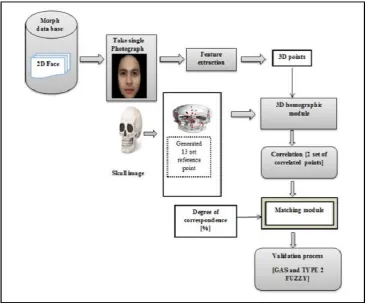
3D craniofacial superimposition is the forensic process in which photograph a missing person is identify by using the comparison with the skull found. Our proposed work identifies the human from the skull and 2D photographs. Here we identify the number of reference points in both skull and 2D face. Our method uses the various components for human identification process; the components are shown in below figure 1. Here we required the 3D target skull image, 2D unknown photographs and 13 set of reference points in skull image which are stored in morph database. It is craniofacial longitudinal Morphological Face Database which is presently comprises 55,134 images of 13,000 individuals.
Fig. 1 Overall architecture for craniofacial superimposition
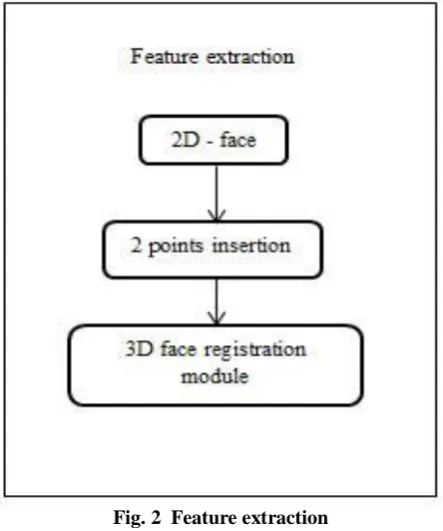
Our proposed work has the various stages for craniofacial superimposition method such as 3D homographic module, matching module, and feature extraction and validation process. In our proposed work inserts the 13 reference points in skull manually and 2D photograph we insert the 13 reference points by using the feature extraction. By using the feature extraction we apply the 2D- 3D registration because here the photograph is 2D and the skull is 3D. For that reason we apply the 2D-3D registration here the reference image taken from the morph database. Our proposed work performs the 2D-3D registration by the following three steps,
1. We get the input 2D image from MORPH database. 2. Inserts the points on 2D image
Fig. 2 Feature extraction
Figure 2 illustrates the stages of feature extraction We detect the points from 2D face to 3D skull image the figure shows the 13 reference points of the 2D photographs.
Fig. 3 13 reference points in 3D skull image
The location of the face features such as eyes, nose, lips and forehead points. Here we shows the areas of where the eyes and nose are located is used to estimate the position of the 13 points. For example, landmark A is calculated by taking the middle point between A1 and A2. Point B is calculated by taking the B3 and B7. Point C is the midpoint between C5, C6, C12 and C8, D is calculated by taking the mid pints of the D9, D10 and D11and D13, and finally E is considered by taking the E4 and C5.
A. 3D Homographic Module
Our proposed work has the first stage homographic module which estimating the points of the skull and photograph. The estimation of points on skull and photograph is necessary because the calculation of correlation between them. If face of the photograph is not a correct position correlate the 3D points of the skull with the 3D points of the human face. The homographic module performs the correlation between the skull and skin with 13 reference points.
Let 3D points of cranial land marks is defined as the C={C1,C2,C3…….Cn}and 3D points of 2D photograph face is defined as Fh={F1,F2,F3…….Fn}. from that points we constructed the homographic module [HM]and correlate the points on 3D skull and face.
ISSN(E): 2277-128X, ISSN(P): 2277-6451, pp. 24-33
The above equation illustrates the 3D skin image here m(F) represents the mean values of the image and s(F) is the variance of the image.
The mean equation are shown below,
The above equation shows the mean cranial points for the skull image, similarly we calculate the mean value for face image.
Equation 6 and 7 shows the variance of the cranial skull image. Similarly we calculate the variance in skin image points.
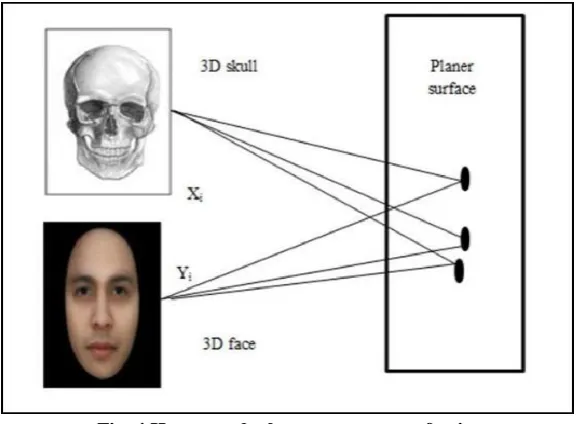
Fig. 4 Homography between two sets of points
Figure 4 shows the correlation of 3D cranial and skin points in homographic module which correlate the face and skull.
B. Matching Module
Our proposed method deals the matching problem in different way. Here we solve the problem of matching in two point’s sets in surface. Matching process is use the common algorithm for solving this problem we provides the solution of 3D point matching. Our proposed work matching module calculates the degree of correspondence which means how similarity between the 3d skull and face points. The degree of correspondence calculated by using the points of homographic module.
Algorithm 1 for Enhanced Robust 3D Point
Algorithm 1 shows the Enhanced robust- 3D point matching [ER-3DPM], here we detect the matching degree of the 3D skull and facial points in photographs. Our proposed work matching the points by using the skull overlay process which uses the ER-3D algorithm.
C. Validation Process of Skull and Face
Our proposed work performs the validation process by using the genetic algorithm with type 2 fuzzy sets. Here we implement the global population based optimizers by using the genetic algorithm. After initializing the genes present in chromosomes Genetic algorithm has the four step of process. Estimating the fitness level for each membership function which is calculated for all chromosomes. Here select the best fuzzy output which means select the best chromosomes based on best fitness function. Perform the crossover and mutation function for select for the selected chromosomes. Finally we select the best chromosomes
The purpose of this work is to utilize the high capability of T2FISs which is achieved by the combination of genetic algorithm with the type 2 fuzzy sets. This algorithm provides solution for low accuracy and uncertainty error issues. Because our proposed work combines the two soft computing techniques includes as the fuzzy and genetic algorithm. The figure shows the architecture of type 2 fuzzy sets.
ISSN(E): 2277-128X, ISSN(P): 2277-6451, pp. 24-33
From this foot print value we evaluate the upper and lower membership function of type 2 fuzzy sets as given below
The type 2 fuzzy sets Mamdani IF-Then rule is shown below Rule Ri: If X1 is Ai1 and Xn is Ain then Y is Bi
Here Ri represent the fuzzy rules for each points in n dimensional, Ai1…..Ain are the ascending fuzzy sets. In type 2 fuzzy sets are compares the size of each output, which estimate the smaller medium and larger these linguistic terms are presented in type 2 fuzzy set rules. Here we predict the fuzzy set from chromosomes which is estimated by the genetic algorithm.
Fig. 6 Type 2 fuzzy systems
Figure 6 shows the typical fuzzy set systems which contains the basic components of fuzzy. Here we reduce the fuzzy set by using fuzzy type reducer which reduce the fuzzy set and gives to the defuzzier which produce the output set of fuzzy.
Membership Membership Membership function Function ………. function
input Input input
parameter 1 parameter 2 parameter n
Fig. 7 Chromosome structure
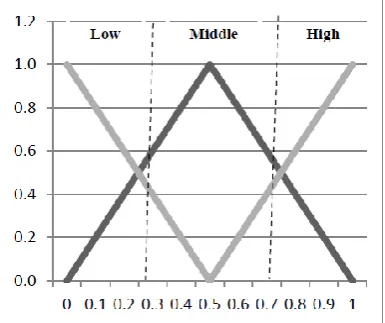
Figure 7 illustrates the chromosome structure of fuzzy set which is take the input from the fuzzy set. The below graph shows the membership ascending order values.
Fig. 9 Structure of Type-2 fuzzy systems for Mamdani Rule
Figure 9 shows the structure for type 2 fuzzy set which is used the mamdani rule, our prosed work use the mamdani rule for validation process.
V. EXPERIMENTALRESULTS
Our proposed method implemented by using the mat lab software, this paper proposes the cranio face super imposition technique for human identification from 3D skull to 2D face. In following sections we discuss about our proposed work evaluation results.
A. Craniofacial Superimposition
Our proposed work evaluate the accuracy and execution time of the validation process which proves our proposed work efficient than the other methods.
B. Experimental Setup
Our proposed work use the MORPH data base which consists of numerous image that means which contains the meta data for each person such as age, gender, height, race, eye coordinates etc., MORPH data base which contains the 55,134 images of 13,000 individuals.
C. Evaluation Results
Table 1 Analysis result for accuracy in cranio facial super imposition
Above table 1 shows the accuracy results for our proposed work. Here we compare the accuracy results of our proposed work with the previous work.
ISSN(E): 2277-128X, ISSN(P): 2277-6451, pp. 24-33
The figure 10 illustrates the accuracy comparison results; our proposed work provides the better accuracy [97] compared with the other methods.
Table 2: Analysis results for the execution time
Methods Execution Time [sec]
Fuzzy Logic [7] 2-4 minutes
Genetic Algorithm [7] 20-40 seconds
CMA-ES [14] 15-17 seconds
Proposed method 8-10 seconds
Table 2 shows the analysis results for the execution time, our proposed work provide the 8-10 seconds for identify the human by using the craniofacial superimposition method.
Fig. 11 3 Comparative results for execution time
Figure 11 explains the execution time analysis, here our proposed work provides the minimum execution time for human identification compared than the previous works.
Table 3: Results of our proposed work
Method Accuracy Execution time Matched Not Matched Not
Craniofacial Accuracy Matched Matched
Superimposition Accuracy
97 47 8 10
Above table shows the overall results of the our proposed work which shows the accuracy and execution time for matched and not matched process
VI. CONCLUSION
The main focus in forensic anthropology is the identify the human from skull information. Craniofacial superimposition is the one of the approach for identify the cranioface which identify the human by using the superimposition of a skull compares on a number of ante mortem images of a missing person morphological correspondence. Our proposed work identifies the human by using the skull - face overlay process. Here we super imposition the skull over the face by using the Enhanced Robust 3D Point Matching algorithm [ER-3DPM] which correlates the morphological points in 3D skull with 2D face.
REFERENCES
[1] A.Oscar Ibáñez, et al., “An advanced scatter search design for skull-face overlay in craniofacial
superimposition”, ELSEVIER, Department of Computer Science, 2012, pp 1459 -1473.
[2] Lucia Ballerini, et al., “Craniofacial Superimposition in Forensic Identification using Genetic Algorithms” IEEE
Third International Symposium on Information Assurance and Security, 2007, pp 429 - 434 .
[3] Piero P. Bonissone, “Soft computing: the convergence of emerging reasoning technologies”, Springer, pp
6- 18.
[4] B. Rosario Campomanes-Álvarez, et al., “Modeling Facial Soft Tissue Thickness for Automatic Skull-Face Overlay”, IEEE transactions on information forensics and security, Vol. 10, 2015, pp 2057-2070.
[5] Sergio damas et al., “Forensic Identification by Computer-Aided Craniofacial Superimposition: A Survey”
ACM Computing Surveys, Vol. 43, 2011, pp 27:1-27:28.
[6] Barbara Zitova, Jan Flusser, “Image registration methods: a survey”, Image and Vision Computing 21, 2003,
977–1000.
[7] Oscar Ibanez, et al., “A new approach to fuzzy location of cephalometric landmarks in craniofacial
superimposition”, IFSA-EUSFLAT,2009.
[8] Maria Isabel Huete, et al., “Past, present, and future of craniofacial superimposition: Literature and international surveys”, Legal Medicine, 2015.
[9] Oscar Ibanez, et al., “Modeling the skull-face overlay Uncertainity using Fuzzy sets” IEEE transactions on fuzzy
systems, vol. 19, no. 5, october 2011.
[10] P.T. Jayaprakasha et al., “Craniofacial morphanalysis: a new method for enhancing reliability while identifying skulls by photo superimposition”, Forensic Science International 117, 121-143, 2001.
[11] Alessio Ricci et al., “A New Experimental Approach to Computer-Aided Face/Skull Identification in Forensic Anthropology”, 27, 2006, pp: 46–49.
[12] K.S, Narayan Reddy, “Identification of Dismembered Parts: The Medicolegal aspects of the Nagaraju case”, Forensic Science, 2, 1973, 351-374.
[13] .O. Ibanez et al., “Ground truth data generation for skull–face overlay, international journal of legal medicine”, 2014.
[14] Jose Santamaria et al., “3D-2D Image Registration for Craniofacial Superimposition in Forensic Medicine using Covariance Matrix Adaptation Evolution Strategy”, Proceedings of the 9th International Conference on Information Technology and Applications in Biomedicine, 2009.
[15] Maryna STeyn, “An investigation into the accuracy and reliability of skull-photo superimposition in a south African sample”, Article in forensic science international, 2012
[16] David Garrido et al., “A computer application for 3D Cranio Facial Reconstruction and Automatic Skull- Photo Identification”, Vol.9, No.3, 2012, pp.108-127.
[17] Fuqing Duan, Yanchao Yang et al., “Skull Identification via Correlation Measure Between Skull and Face
Shape”, IEEE Transactions On Information Forensics and Security, VOL. 9, NO. 8, 2014.
[18] Daniela Sánchez and Patricia Melin, “Hierarchical Genetic Algorithms for Type-2 Fuzzy System
Optimization Applied to Pattern Recognition and Fuzzy Control” pp 19-35.
[19] Yan Li et al., “Craniofacial Reconstruction based on Least Square Support Vector Regression”, IEEE
International Conference on Systems, October 2014.