ISSN-L: 2501 - 1235 Available on-line at: www.oapub.org/edu
DOI: 10.46827/ejpe.v6i6.3258 Volume 6 │ Issue 6 │ 2020
INFLUENCE OF RECREATIONAL GAMES
ON NEUROPSYCHOLOGICAL ABILITIES OF
ELDERLY ADULT TRIBAL WOMEN
Manoj Kumar Murmu1i,
Gopal Chandra Saha2
1Asst. Professor,
Post Graduate Govt. Institute for Physical Education, Banipur, North 24 PGS, West Bengal,
India
2Professor, Department of Physical Education,
Jadavpur University, Kolkata, West Bengal, India
Abstract:
Introduction and Purpose: The purpose of this study was to investigate the effects of 16 Week recreational games training on Hand Eye Co-ordination and Gross movement in elderly adult tribal women. Method: The sample consists of total 20 elderly adult tribal women between the ages of 51 to 55 years selected by random method. Participants were given various recreational games training for 3 days and 45 minutes a week. Participants' Hand Eye Co-ordination and Gross movement were measured before, mid and after the recreational games training. The obtained data were evaluated statistically at (p<0.05) level. Results: There were significant differences in Hand Eye Co-ordination and Gross movement of elderly adult tribal women participating in the study compared to different phases of training (p<0.05). Conclusions: As a result, regular practice of recreational games had positive effect on Hand Eye Co-ordination and Gross movement in elderly adult tribal women aged 51 -55 years. From the above findings it can be said that such regular recreational games are necessary for a healthy life as well as a sense of relaxation and stress reduction is experienced.
Keywords: recreational games, tribal, hand eye co-ordination, gross movement
1. Introduction
Recreation is an essential part of human life and finds many different forms which are shaped naturally by individual interests but also by the surrounding social construction. Recreational activities can be communal or solitary, active or passive, outdoors or indoors, healthy or harmful, and useful for society or detrimental. The utility of free time and leisure time in a constructive way and to make a person more physically active in order to allow this growth and development to take place proportionately, active recreation activities, other than passive ones are a must (Singh, 2004). A significant section of recreational activities is designated as hobbies which are activities done for pleasure on a regular basis. A list of typical activities could be almost endless including most human activities. Recreational games promote outstanding health to the tribal women, and it is organized purposely to upscale the quality of life. Recreational activities are often done for enjoyment, amusement, or pleasure and are considered to be "fun" (McLean & Rogers, 2005). Recreational programs can be seen as a preprogram that require action in achieving the health promotion among women to solve their difficulties and challenges. Taking part in recreational activities, especially outdoors, can greatly improve physical health, maintain lower body fat percentages, and have lower blood pressure and cholesterol levels. The organized development of recreation programs to meet a variety of physical, psychological, and social needs has led to recreation playing a role as a social instrument for well-being and, in some cases, changes (Hurd & Anderson, 2010). Participating in recreational activities improve their overall health and improve their overall lives. It’s well known that outdoor recreation lends itself to both physical and mental health benefits.
outcomes and sequences of these patterns to obtain a much more relevant picture of what exactly happens in the game. In addition, some studies suggest that differences in gross motor coordination may exist, although far less empirical research has focused on these types of skills (Haslum, 1989; Merriman & Barnett, 1995). Very few researches have been done on recreational games and its effect, hence the researcher finds it fruitful to work on the title entitled “Influence of Recreational Games on Neuropsychological Abilities of elderly adult tribal women”.
2. Materials and Methods
2.1. Sample
The participants were informed for the study’s aim and general requirements. In addition, all the subjects were asked to continue their daily habits without any alterations through the 16-week period. The entire subject fulfilled the required conditions. More specifically, the participants had to be healthy, not undergoing any medication or any form of diets, as well as not participating in any physical activity or exercise individually or in group for the past six months. A written informed consent for the participation in the research was obtained from each subject. All the subjects had to agree that they will not participate in any other group or individual exercise, physical activity or any other programme for the duration of the experiment, i.e. 16-week period. For the purpose of the study 20 elderly adult tribal women in the age group of 51 to 55 years belonging to Bankura district of West Bengal state in India were selected randomly as subjects for the present study.
2.2. Procedure of Data Acquisition
Hand Eye Co-ordination and Gross movement of hands, finger and arms were taken as the variables of physical characteristics. Hand Eye Co-ordination of the subjects was taken by Mirror drawing test and the time was recorded to the nearest 1/10th of a second. To measure the Gross movement of hands, finger and arms of the subjects was taken by Finger Dexterity Test with pins and it was recorded to the nearest seconds.
2.3 Statistical Technique
2.4. Recreational Game Training Program
The experimental design (pre, mid & post-test design) and simple random sampling technique was used in this study. Various types of recreational games training was given for a period of 16 weeks, 3 days per week, 30 minutes according to the progressive training method. Subjects were given a 5 min warm-up exercise before starting the game, and a 5 min cool down exercise at the end of the game. At the beginning of the study (i.e. pre-test), during the training (i.e. mid-test after 8th weeks) and as well as at the end of the
treatment period (i.e. post-test after 16th weeks) the measurements were recorded.
3. Results
Table 1: Repeated measures analysis of variance computed for elderly
adult tribal women on hand eye co-ordination and gross movement of hands, finger and arms
Variables Sources of
Variation Sum of squares Degrees of Freedom Mean sum of squares F-Value Hand Eye Co-ordination
Between Groups 47.34 2 23.67 *37.22
Error 24.17 38 0.64
Gross movement
of hands, finger and arms
Between Groups 865.73 2 432.87
*54.78
Error 300.27 38 7.90
*Significant at 0.05 level table value 3.20.
From the above table it is clear that there was significant difference in the different training phases means of the elderly adult tribal women in the variables i.e. hand eye co-ordination and gross movement of hands, finger and arms since the obtained F value 37.22 and 54.78 respectively were greater than the table value 3.20 with 2 and 38 degree of freedom at 0.05 level of confidence. Further LSD post hoc test was applied to find out the effectiveness of the Recreational games training in different phases. It is understood from the result that there was a significant improvement in the hand eye co-ordination and gross movement of hands, finger and arms of the elderly adult tribal women due to the recreational games training.
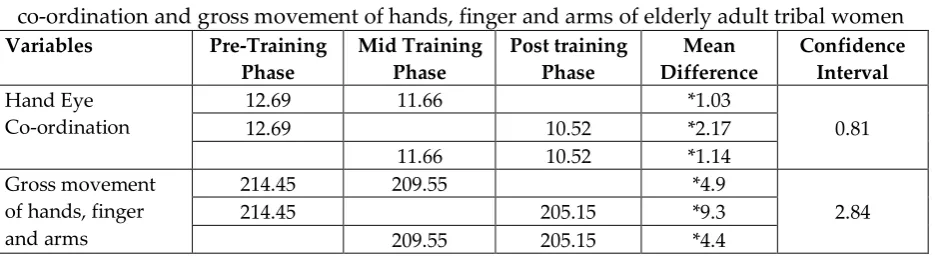
Table 2: Post Hoc (LSD) Mean comparison of Variance of hand eye
co-ordination and gross movement of hands, finger and arms of elderly adult tribal women
Variables Pre-Training
Phase Mid Training Phase Post training Phase Mean Difference Confidence Interval Hand Eye Co-ordination
12.69 11.66 *1.03
0.81
12.69 10.52 *2.17
11.66 10.52 *1.14
Gross movement of hands, finger and arms
214.45 209.55 *4.9
2.84
214.45 205.15 *9.3
The above table proved that there were significant differences existed between the different phases as the confidence interval required to be significant at 0.05 level was 0.81 and 2.84 respectively and the obtained values were greater than the required value. It was understood from the result that experimental treatments of different recreational games training significantly improved hand eye co-ordination and gross movement of hands, finger and arms of elderly adult tribal women in a progressive way from pre, mid to post phases.
Figure 1: Comparison of Means and SD in hand eye co-ordination after sixteen weeks of recreation games training in elderly adult tribal women
Figure 2: Comparison of Means and SD in gross movement of hands, finger and arms after sixteen weeks of recreation games training in elderly adult tribal women
0 2 4 6 8 10 12 14
Pre During Post
S
ec
on
d
s
Female
Hand Eye Co-ordination
Mean
SD
0 50 100 150 200 250
Pre During Post
S
ec
on
d
s
Gross movement of hands, finger and arms
Mean
4. Discussion
The findings of the undergone research support the hypothesis by evidently showing that the elderly adult tribal women, after their participation in the Recreational games training, unveiled significant influence on hand eye coordination and Gross movement. Paul et al. (2011) expressed that significant improvement was found on hand eye co-ordination after recreational games training. These findings are consistent with the literature reviewed by Cohen (1988). Akarsu et al. (2009) explained that sport activities are beneficial to both eye-hand reaction time and visuospatial intelligence.
This helps participate in recreational activities for a longer period and more often, making them create a positive atmosphere and enhancing healthy lifestyle can minimize worries, tension and obstacles under any stressful event circumstance. The findings mentioned above are partially consistent with those of Cohen and Wills (1985) showing that humor styles attract more people, and help them maintain fellowship, and develop social networks, leading to psychological and physical benefits. Thus, the findings of the present study support the position that leading an active lifestyle, here assessed by engagement in leisure activities, is a universal and culture-independent means contributing to successful aging, invariant across different countries and cultures. The benefits of physical activity on cognitive function can be attributed to an ameliorated overall health condition (e.g., brain oxygenation and stimulation of neurogenesis) (Kempermann et al., 2010). Therefore, it is considered that to make women have a habit of participating in recreational games on a regular basis is very crucial for quality of life which makes it possible for to be fruitful and successful in life. Recreation is allowed to be used as a tool of therapy. Recreation can be effective if it is used appropriately in accordance with different ages and abilities. Group activities in recreation programs improve interpersonal skills, independence, and positive self-esteem which can bring about a lot of benefits in the psychological aspect. Like this, a wide range of activities which can promote physical, psychological, social, and emotional function and improve the quality of personal life. In particular, there is a recreational activity accompanying joy called physical activity-based recreation (Koo & Lee, 2015). Participation in the physical activity-based recreation helps participants recover from the deteriorated physical strength, caused by the lack of exercise, and develops the latent ability to achieve self-realization. Accordingly, recreation games can help physical and emotional development and cultivate optimism are being operated.
5. Conclusion
Acknowledgment
The support of all the participants for their time and effort in this research is gratefully acknowledged. We also thank the Department of Physical Education, Jadavpur University for their assistance in completing this study.
About the Authors
Prof. Gopal Chandra Saha is a specialized educational teaching staff, Department of Physical Education at Jadavpur University. He has Master Degree and is Doctorate in Physical Education. He is an AFC ‘A’ License Football Coach passed from Bangladesh, Bronze medal in all India Inter University Football Championship. He is specialized in Football, Sports Training, Coaching & Fitness and Sports Management. He has eighteen years of research and teaching experience. He is Editorial board member of various National and International journal in India and abroad.
Manoj Murmu is an Assistant Professor at Post Graduate Govt. Institute for Physical Education, Banipur, India. He has a Bachelor Degree in Science, Master Degree in Education, Bachelor Degree and Master Degree in Physical Education and Pursuing Doctorate Degree from Jadavpur University, India under Prof, Gopal Chandra Saha. He is also a position holder state level athlete.
References
Akarsu Sedi, Caliskan Erkan, Dane Senol, 2009. Athletes have faster eye-hand visual reaction times and higher scores on visuospatial intelligence than nonathletes. Turkish Journal Medical Science, 39 (6): 871-874, doi:10.3906/sag-0809-44.
Cohen J, 1988. Statistical power analysis for the behaviour science. 2nd ed. New York, NY: Lawrence Erlbaum Associated.
Cohen S, Wills T A. Stress, social support, and the buffering hypothesis. Psychological Bulletin, 1985;98(2):310–357. [PubMed] [Google
Scholar]
Fleishman E A, Quaintance M K, Broedling L A, 1984. Taxonomies of Human Performance: The description of human tasks. Orlando, FL: Academic Press, Inc. Hughes Mike, Meyers Robert, 2005. Movement Patterns in elite men’s singles tennis.
Psychology- International Journal of Performance Analysis in Sports, DOI: 10. 1080/24748668.2005.11868331, Corpus ID: 147019466
Haslum Mary N, 1989. Predictors of dyslexia? The Irish journal of Psychology, 10, 622-630.
Hartmann C, Minow H J, Senf G, 2002. Exercise and training swissenschaftliche basics, In: Frobose, 1. et aL (eds): Exercise and Training. Principles and methodology for physical and Sport therapeu Ten. Munchen, :pp. 1-187.
Kempermann G, Fabel K, Ehninger D, Babu H, Leal-Galicia P, Garthe A, Wolf S A, 2010. Why and how physical activity promotes experience-induced brain plasticity. Frontiers in Neuroscience, 4:189. doi:10.3389/fnins.2010.00189
Koo Jae-Eun, Lee Gwang-Uk, 2015. An effect of physical activity-based recreation programs on children’s optimism, humor styles, and school life adjustment. Journal of Exercise Rehabilitation. 11(3): 169–174. doi: 10.12965/jer.150210
Merriman W J, Barnett B E, 1995. A preliminary investigation of the relationship between language and gross motor skills in preschool children. Perceptual Motor Skill, 81, 1211-1216.
McLean Daniel D, Hurd Amy R, Rogers Nancy Brattian, 2005. Kraus' Recreation & Leisure in Modern Society, 7th Edition. Jones and Bartlett. p. 1. ISBN-10:0763707562.
Paul M, Biswas S K, & Sandhu J S, 2011. Role of Sports Vision and Eye Hand Coordination Training in Performance of Table Tennis Players. Brazilian Journal of Biomotricity, 5 (2) pp. 106-116.
Singh H, 1991. Science of Sports Training, (New Delhi: DVS Publication), p.163 & 165. Singh Ajmer, Bains Jagdish, Gill Jagtar Singh, Brar Rachhpal Singh, Rathee Nirmaljit
Creative Commons licensing terms