www.ijemst.com
Sample Course Material for Biodiversity
and Sustainable Education
Sinan Erten
Hacettepe University
To cite this article:
Erten, S. (2015). Sample course material for biodiversity and sustainable education.
International Journal of Education in Mathematics, Science and Technology
,
3
(2), 155-161.
This article may be used for research, teaching, and private study purposes.
Any substantial or systematic reproduction, redistribution, reselling, loan, sub-licensing,
systematic supply, or distribution in any form to anyone is expressly forbidden.
Authors alone are responsible for the contents of their articles. The journal owns the
copyright of the articles.
Volume 3, Number 2, April 2015, Page 155-161
ISSN: 2147-611X
Sample Course Material for Biodiversity and Sustainable Education
Sinan Erten*
Hacettepe University
Abstract
This study was done in a period when there are attempts to develop a framework for the sustainable development and sustainable education in order to emphasize the universal significance of biodiversity, sustainable development, and sustainable education. The research reported here is a case study carried out in the spring semester of 2012-2013 academic year. The participants of the study were student teachers enrolled in a general biology course in a preservice science teacher education program at a major research university in central Turkey. The study was designed as a qualitative study and the data of the study were collected through semi-structured interviews and observation forms. The aim of the study was to develop teaching materials about the sustainable education and the sustainability of biodiversity. In parallel to this aim, an experiment of frog breeding was designed and the experiment was carried out by the participants under the supervision of the author. More specifically, the participants were involved in feeding the frogs and cleaning the aquarium. They recorded their observations together with the author. The whole process was shared in the biology course. In short, the participants observed how larvas come out from frog spawn that were put in the aquarium and how larvas became adult frogs. Adult frogs were transferred to the nearest creek after the completion of the observations. At the end of the process the attitudes of the participants towards living beings changed positively as their reports indicated.
Key words: Sustainability, Sustainable education, Biodiversity, Loss of biodiversity, Agenda 21
Introduction
Biodiversity covers all living beings from unicellular plants to other plants, animals and human beings. It is a characteristic of nature. The concept of biodiversity has become significant in the contexts of biology, economy and politics (Erten, 2004). In the Rio agreement, instead of the term of protection of biodiversity and sustainability the term of protection of biodiversity began to be employed. It is suggested in the agreement that biodiversity should be supported by governments, business, research, and educational institutions as much as possible (Bundesministerium Für Umwelt, Natur und Reaktorsicherheit, 1997, 1999; Turkish ministry of environment).
The reason for the significance of biodiversity in the fields of science, politics and economy is the huge loss of animal and plant species. As a result of such losses, the sustaniable use of living beings has become a requirement. This requirement is expressed in Agenda 21, a non-binding, voluntarily implemented action plan of the United Nations with regard to sustainable development. The agenda was produced at the UN Conference on Environment and Development held in Rio, Brazil, in 1992. Upon this, many countries including the US and European countries began to use it for research (Primack, 1995; Mayer, 1995, Mayer, 1996).
Mayer (1996) states that of the 10.000-50.000 plant species only 150 or 200 are used as a food source. Of the plants used as a food source 60% are cereals such as corn, wheat, rice, rye and barley. Such genetical uniformity leads to increase in pests and decrease in the adaptation opportunities of populations to changing environmental conditions. According to the figures of the World Health Organization (WHO), since 1900, genetic diversity of the agricultural plants has decreased by 75% (Mayer, 1996). It is reported that the protection of genetic diversity is an indispensible part of the attempts to protect nature (Schmid & Matthies, 1994; Klein & Ssymank, 1995). Reoccurrence of any extinct species is not possible. Loss of significant genetic characteristics in species leads to not only extinction of specific species but also extinction of the whole population.
*
156 Erten
The data reported by the Turkish Nature Protection association (T.T.K.D, 2001) showed that there are nearly 12,000 different types of plants and 33% of them are endemic plant species in Turkey. In addition, there are nearly 80.000 types of animals. For instance, there are 1787 types living beings in the sea and of those 300-400 are fish, 18 species are amphibians, seven of which are salamanders and eleven of which are frogs (In the world a total of 3,000 species was identified). Up to now 124 reptiles, 454 birds and 160 mammals (1 whale species, 3 dolphin species and 1 seal species) were identified and recorded.
Loss of Biodiversity
Biological diversity is not given enough emphasis in ecological research and protection of the environment. Media and environmental protection organisations have focused on water, soil, and air pollution in 70s and 80s and worked to develop policies for the environment. Great losses in animal and plant species on the one hand and the idea of unlimited use of living things directly or indirectly on the other, increased the importance of biological diversity and research on the sustainability of species in science, politics, and economy. As the subjects of biodiversity started to be included in biology, studies in this area around the world has increased. This subject was considered in the1992 Earth Summit in Rio de Janeiro as part of the Agenda 21 and the following statement was made: “Decrease in biodiversity is mainly due to human activities and it is a serious threat for human development” (Agenda 21). Heywood (1995) argues that since 17th century, at least 480 animal species and 654 plant species have become extinct. Note that these figures cover only those species identified Wilson, 1992, 1995). The data reported by the Turkish Nature Protection association (TTKD, 2001) in Turkey the animal species became extinct include: Asian elephant, aurochs, onager, lion, and cheetah. In addition, in the second half of the 20th century tiger also became extinct in Turkey.
Biodiversity and Education
Due to the significance of biodiversity and the ongoing damage of it biodiversity should be used in a sustainable manner and it should be included in educational programs. According to the World Nature Protection institution (Unesco, 1994) educational materials should be developed in regard to biodiversity, an awareness about biodiversity should be developed., Information base and skills of children, young people and adults in relation to biodiversity should be improved and individual and social behaviour for the sustainable use of biodiversity should be developed. However, it is also stated that all these goals can be achieved only through the student motivation.
What is Sustainability?
The concept of sustainability was defined as a welfare approach in the Earth Summit held in Rio in 1992.
Sustainability refers to the productive use of the surface and underground resources needed by all people in order to save necessary sources for future generations and threfore it also refers to the protection of these sources. Biodiversity is also one of such natural resource.
Three pillars of sustainability are ecology, economy and social interests and these three pillars are integrated.
The concept of sustainability handles simultanously the economic development, environmental sustainability and social justice (Bundesministerium Für Umwelt, Natur und Reaktorsicherheit, 1997, 1999; Turkish Ministry of Environment).
The central point in sustainable development, sustainable use of energy, biodiversity and water is how sustainable environmental education should be. This is also the focal point in the present discussions about the protection of environment. In short, sustainability is very nicely defined by the expression “nature is not an inheritance from our ancestors but a loan taken from our grandchildren.” One of the goals of Agenda 21 is to take necessary steps to protect those speicies under threat in both natural and unnatural conditions and to provide sustainable education for this end. In Agenda 21 it was emphasized that people should be aware of and informed about biodiversity and that biodiversity should be covered in educational programs. Here the basic goal is to motivate young people and adults to use biodiversity in a sustainable manner and to acquire necessary information and skills for this end, as well as protective behaviours (Bundesministerium Für Umwelt, Natur und Reaktorsicherheit, 1997; Turkish Ministry of Environment).
information. Such materials may be based on living organisms and natural objects. Secondary teaching materials may be movies, models, textbooks, study guides, worksheets, dias and other similar materials. Integrating living plants and animals into the courses is the basic activity for science and biology courses. However, it is not always possible to observe the developmental process of living beings in their natural environment. On the other hand, some of such obervations may be done in school environment. Through caring for and feeding them their developmental process can be observed. In this study, developmental process of frogs in a classroom environment is discussed. It can be noted that other animals can also be studied in this manner.
This study was done in a period when there are attempts to develop a framework for sustainable development and sustainable education in order to emphasize the universal significance of both biodiversity and sustainablity. This study may provide an example about how and why this topic should be delivered in schools. In other words, the aim of the study is to develop teaching materials towards the sustainable education and the sustainability of biodiversity. In parallel to this aim the study tries to answer the following research questions:
1. Is it possible to feed frogs in classroom environment or in laboratories? Do all natural development steps including metamorphosis occur in classroom environment or in laboratories?
2. Is it possible to develop course materials in classroom environments which would conribute to sustainable education and the sustainability of biodiversity?
3. Do such experiences lead to changes in the student teachers attitudes towards living beings?
Methods
Design
The research reported here is a case study carried out in the spring semester of 2012-2013 academic year. In parallel to the aim stated above, an experiment of frog breeding was designed and the experiment was carried out by the participants under the supervision of the author. More specifically, the participants sometimes involved in feeding and cleaning the aquarium. Some of them recorded their observations together with the author.
Participants
The participants of the study were student teachers attending to the Science Education program at the Faculty of Education at a major university in central Turkey. They all took a General Biology course in which this study was conducted. Participants recorded their observations. The whole experimental process was shared in the biology course. The student teachers were asked to share their observations as well. All participants observed the process at least once per week during the study period. Three males and three females were chosen from the participants to take part in semi-structured interviews.
Data Collection Tools
The data of the study were collected through observation sheets and semi-structured interviews.
Procedures
First the necessary acquarium was made. The bottom of it was covered with 2-4 cm sand and small stones.
Hydrophyte was added to the acquarium to provide a shelter for frogs since it makes it possible to have a clean acquarium through photosynthesis.
The acquarium was put in a room with necessary lighting. An air cleaning tool with thermostat was put into it and provided about 20C temperature.
Frog spawn was put into the acquarium.
Any feed was not given to tadpoles since they had their own natural feed. They also fed themselves with mud in the aquarium.
The amount of water in the aquarium was determined in a way that there should be five tadpoles in one liter water.
Later they were fed through fish fed. In addition, lettuce and algae may also be used for this purpose.
Water in the aquarium was refreshed in ten days or in a week based on its pollution.
158 Erten
Semi-structured interviews were carried out with six students.
Findings
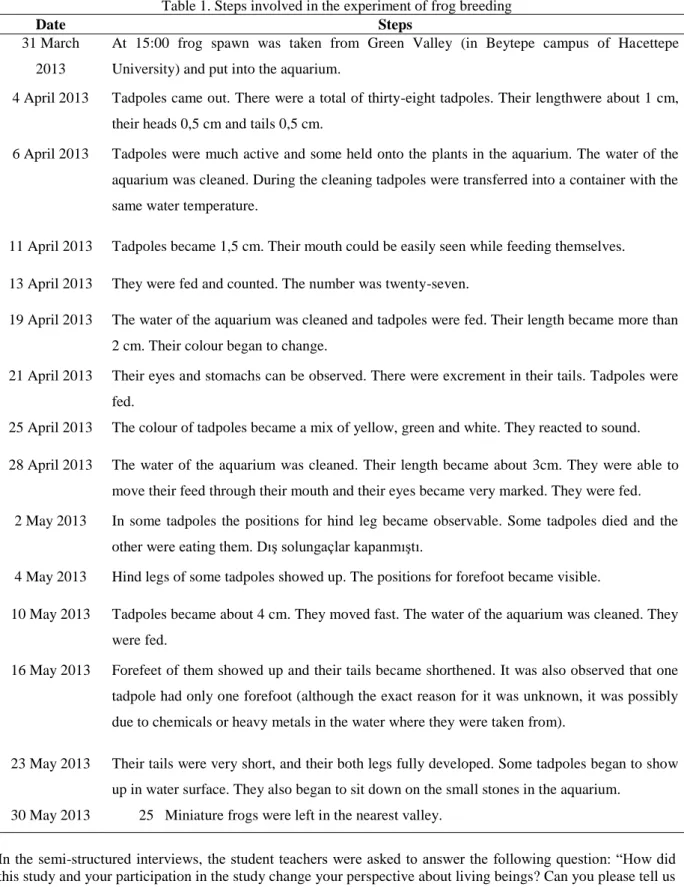
In the study student teachers had first-hand observation of the developmental process of frogs. Table 1 indicates the steps involved in the study. All student teachers were active participants of these steps.
Table 1. Steps involved in the experiment of frog breeding
Date Steps
31 March 2013
At 15:00 frog spawn was taken from Green Valley (in Beytepe campus of Hacettepe University) and put into the aquarium.
4 April 2013 Tadpoles came out. There were a total of thirty-eight tadpoles. Their lengthwere about 1 cm, their heads 0,5 cm and tails 0,5 cm.
6 April 2013 Tadpoles were much active and some held onto the plants in the aquarium. The water of the aquarium was cleaned. During the cleaning tadpoles were transferred into a container with the same water temperature.
11 April 2013 Tadpoles became 1,5 cm. Their mouth could be easily seen while feeding themselves. 13 April 2013 They were fed and counted. The number was twenty-seven.
19 April 2013 The water of the aquarium was cleaned and tadpoles were fed. Their length became more than 2 cm. Their colour began to change.
21 April 2013 Their eyes and stomachs can be observed. There were excrement in their tails. Tadpoles were fed.
25 April 2013 The colour of tadpoles became a mix of yellow, green and white. They reacted to sound. 28 April 2013 The water of the aquarium was cleaned. Their length became about 3cm. They were able to
move their feed through their mouth and their eyes became very marked. They were fed. 2 May 2013 In some tadpoles the positions for hind leg became observable. Some tadpoles died and the
other were eating them. Dış solungaçlar kapanmıştı.
4 May 2013 Hind legs of some tadpoles showed up. The positions for forefoot became visible.
10 May 2013 Tadpoles became about 4 cm. They moved fast. The water of the aquarium was cleaned. They were fed.
16 May 2013 Forefeet of them showed up and their tails became shorthened. It was also observed that one tadpole had only one forefoot (although the exact reason for it was unknown, it was possibly due to chemicals or heavy metals in the water where they were taken from).
23 May 2013 Their tails were very short, and their both legs fully developed. Some tadpoles began to show up in water surface. They also began to sit down on the small stones in the aquarium.
30 May 2013 25 Miniature frogs were left in the nearest valley.
Student 1 (Female):
Definitely. I would like to know how other living beings produce and how they develop. I even want to search about which living beings can be produced in classroom or home environment. I became aware of the fact that all living beings are significant for people and nature. I asked the lecturer why we put the frogs into the stream. He said that their population are under threat. It made me surprised and I became happy to contribute to their existence. I had an awaeness of the significance of the protection of living beings. From now on all living beings are important for me and all should be protected.
Student 2 (Male):
My views about living beings have changed significantly. Before this experience I was afraid of living beings and also, they made me disgusted. But now I like living beings, particularly frogs. I have understood that living beings and environment are the whole. I have learned that the species are under threat and some became extinct. Maybe next generations will not know the living beings we know and like. But they also have rights in these living beings.
Student 3 (Male):
My attitude towards living beings has certainly changed. Now I would like to learn about the development of animals and plants. In addition, I have also learned how to carry out an experiment. My knowledge about frogs has become more detailed. When I begin to work as a teacher I will try to change the negative attitudes of my students towards living beings through carrying out a similar experiement. I have learned that all living beings are significant for human beings as well as for other living beings that living beings can only transferred to next generations via protection.
Student 4 (Female):
It is certain that I have learned many things from the experiment of frog breeding. I would also like to feed another living being. Before this experience I did not know how to make an experiment. I did not have such a first-hand experiment experience. I want to make research about living beings. My friends and I became sad while bringing the frogs to the stream. Each should have similar experiences and in my future profession I will also do similar activities. I have learned the significance of the protection of living beings. I have decided not to damage any living beings.
Student 5 (Male):
I have learned that we may take care of other living beings rather than fish in aquarium. Now I am thinking of how we can produce insects using a similar procedure. My perspective about living beings has changed. I am trying not to kill any living being. I have learned how to make research and experiments about living beings. I told my family members that the protection of living beings is very important for us and for other living beings. I would like to make similar studies in my future profession.
Student 6 (Female):
At the beginning of the study I thought why we would breed frogs. During the study my fear of living beings reduced. I have learned who living beings in this study are. In addition, I have learned how a scientific study is done and how information about living beings can be obtained. I also learned what to do to avoid extinction. In my future profession I will do similar activities.
Results
The answers of the participants to the question “How did this study and your participation in the study change your perspective about living beings? Can you please tell us if any such change occurred?” in the
160 Erten
All answers given above indicate that they became aware of the significance of biodiversity and informed about the sustainable use of living beings.
In the interviews the participants reported that they would employ similar activities in their future profession. One of the participants sent the following e-mail message to the author following his graduation:
“Hello! I have been teaching in a village of Alanya since September. Guess what I am doing in the school? I am breeding frogs. My students brought my frog spawn two weeks ago and now tadpoles show up. They are so sweet and are all swimming. My students like them very much. My colleagues observed their developmental process. I told them that I like frogs due to my lecturer’s activity.
The use of similar activity to one made in pre-service teacher training program is an expected outcome. Because it shows the transfer of learning to future conditions (Erten, 2005).
In the study the participants had a deeper understanding of full and partial metamorphosis. They also reported that their knowledge about conducting a scientific research improved and that they would use similar activities in their future profession.
Nearly all participants interviewed stated that despite their negative feelings about frogs before the study their interest in them became increased and had a sympathy towards them after the study.
They also added that they became aware of the significance of all living beings and of the sustainable use and protection of them.
Discussion and Suggestions
Although living beings and plants are frequently covered in the schools as a course material in many countries, it is not so common in Turkey. However, using living beings and plants in courses, particularly at the levels of basic education and secondary education, increase student motivation in relation to biological problems and their attitudes towards living beings.
Research suggests that using living beings and plants in courses is the best way to achieve affective goals of the course. On the other hand, if it is not feasible to bring living beings to classes then movies can be shown to the students.
In Germany in 65% of the schools living beings and plants are employed in courses and 52% of German teachers reported that using living beings and plants in courses is a necessity in biology courses and 42% stated using living beings and plants in courses is not only necessary but also very useful in terms of pedagogical concerns (Eschenhagen et. al., 1998).
Research suggests that children generally more frequently like animals rather than plants. ın most cases children develop an emotional bond with animals. Over time such emotional bonds become love which teaches them to protect. On the other hand, such intensive interest also lead to empathy towards animals. All these characteristics are basic factors in producing enviromentally sensitive individuals and are the sustainable education itself (Eschenhagen et. al., 1998, Berck and Klee, 1992, Erten, S. 2004).
Inclusion of living beings and plants in courses cannot be a random act. Teachers should be aware of which animal and plant would be useful for the student learning. Those animals and plants that may harm children or those that may be harmed by them should not be brought to the class.
Students should acquire their knowledge about biology and science through direct observations as much as possible. Therefore, movies or other teaching materials cannot be fully substitute living animals or plants. Most people gain their experience about environment and living beings through books, movies, television, interner and other media. However, it seriously prevent them from having much more vivid feelings about environment and living beings (Erten, 2002).
It is the task of teachers to decide about which living beings will be brought to the classroom. However, students’ ideas can also be taken about it. Therefore, teachers should be informed about which living being can found where. To this end teachers may develop a biological study plan to faciliate their activity. After the activity living beings should be transferred to their natural environment.
Humans’ interest in living beings lead to protective attitudes towards them (Scherf, 1986) and also, to environmentally friendly behaviours.
The significance of using living beings and plants in courses has been emphasized for three centuries since Johann Amos Comenius. Using living beings in basic education increases students’ interest in learning about biology and science and their interest in and attitudes towards living beings (Staeck, 1980, Wenske, 1981).
In the new science program it is recommended that examples about the development of frogs should be given in the sixth grade. However, there is no explanation in regard to how this development can be observed by the students. This study offers a good sample for the activities which may be employed in the sixth grade science course.
References
Berck, K.-H. & Klee, R. (1995). Empirische Untersuchungen über Bedingungen der Genese von
Arten-interesse- und das Siebenschrittmodell” als Vorschlag zu ihrer Realisierung im Biologieunterricht. In: Mayer,J.: Vielfalt begreifen- Wege zur Formenkunde. IPN. Kiel. 61-85.
Berck, K.-H. (1999). Biologiedidaktik - Grundlagen und Methoden. Wiebelsheim: Quelle und Meyer.
Berck, K-H. & Klee, R. (1992). Interesse an Tier- und Pflanzenarten und Handeln im Naturschutz. Frankfurt am Main. Peter Lang.
Bundesministerium Für Umwelt, Natur und Reaktorsicherheit (1997). Umweltpolitik Agenda 21, Konferenz der Vereinigten Nationen für Umwelt und Entwicklung in Juni 1992 in Rio de Janeiro – Dokumente – Bonn. Bundesministerium Für Umwelt, Natur und Reaktorsicherheit (1999). Umweltpolitik Lokale Agenda 21 im
europäischen Vergleih. Bonn.
Erten, S. (2002). İlköğretimin II. Kademesindeki (6.7.8. sınıflar) öğrencilerde çevreye yararlı davranışların araştırılması. V. Ulusal Fen Bilimleri ve Matematik Eğitimi Kongre kitabı. 16-18 Eylül, 2002, Ankara. Erten, S. (2004). Uluslararası düzeyde yükselen bir değer olarak biyolojik çeşitlilik. Hacettepe Üniversitesi
Eğitim Fakültesi Dergisi 27, 98-105. Ankara.
Erten, S. (2005). Okul öncesi öğretmen adaylarında çevre dostu davranışların araştırılması. Hacettepe Üniversitesi Eğitim Fakültesi Dergisi, 28, 91-100.
Eschenhagen, D., Kattmann, U. & Rodi, D. (1998). Fachdidaktik Biologie. Köln: Aulis.
Heywood, V.H. (1995). Global biodiversity assesment. Published for the united nations Environment Programme. University Pres, Cambridge.
Mayer, J. (1995). Nachhaltige Entwicklung – ein Leitbild zur Neuorientierung der Umwelterziehung? DGU-Nachrichten 12, 43-56.
Mayer, J. (1996). Biodiversitätsforschung als Zukunftsdisziplin. In: Vogt. H,& M. Sieger (Hrsg.)Berichte des Instıtutes für Didaktik der Biologie, IDB 5.Universitat Münster.
Primack, R. B. (1995). Naturschutzbiologie. Spektrum. Akad. Verl., Heidelberg.
Scherf, G. (1986). Zur Bedeutung pflanzlicher Formenkenntnisse für die schützende Einstellung gegenüber Pflanzen und zur Methodik des formen kindlichen Unterrichts. Münchner Schr. 2 Didaktik der Biologie
3.
Schmid, B. & Matthies, D. (1994). Seltenheit und Gefahrdung- populationsbiologische Grundlagen des Artenschutzes. Naturwissenschaften81, 283-292.
Staeck, L. (1980). Arbeiten mit dem lebenden Objekt im Biologieunterricht. NiU 20 (1972a), H. 3, 128-133.
T.T.K.D. (Türkiye Tabiatını Koruma Derneği) (2001). Biyolojik Çeşitlilik ve Çevre Koruma Rehberi,Ankara. Turkish ministry of environment (Basım tarihsiz). Birleşmiş Milletler Çevre ve Kalkınma Konferansı, Gündem
21, Orman Prensipleri, Ankara.
UNESCO (1994). Education and Since for Maintaininig Biodiversity.Swiss National Comission for UNESCO. Basel.
Wenske, E. (1981). Unterrichtsmittel mit Naturobjekten. BioS 30, H. 6, 239-244.
Wilson, E.O (1992). Ende der biologischen Vielfalt. Verlust an Arten, Genen und Lebensräumen und die Chancen für eine Umkehr. Spektrum, Heidelberg.