The Effect of Problem Solving Task on Critical Reading of Intermediate EFL Learners in Iranian
Context
Masoud Khalili Sabet, Amir Madavi Zafarghandi, Arezoo Norouz Karkaraq* English Language Department, University of Guilan, Iran
Corresponding Author: Arezoo Norouz Karkaraq, E-mail: [email protected]
ABSTRACT
The attempt in this study is to investigate the effect of teaching critical thinking through problem solving on reading comprehension performance of EFL intermediate learners. In so doing, forty including twenty male and twenty female intermediate students studying English in an institute in Ardabil, Iran, were selected based on their scores on Preliminary English Test and assigned into control and experimental groups. Afterwards, the sample TOEFL reading comprehension pre-test was administered to both of these groups to ensure homogeneity. The learners in experimental group were taught through problem solving instruction and the learners in control group were taught through traditional method of instructing reading comprehension. After ten sessions of instruction, the same sample TOEFL reading comprehension as post-test was given to the learners to measure the possible differences between pre-test and post-test. The finding revealed teaching problem solving had statistically significant effect on EFL learners reading comprehension performance. Conclusion can be drawn to confirm that teaching critical thinking through problem solving bring better understanding of the text.
Key words: Reading Comprehension, Critical Thinking, Problem Solving, EFL, Intermediate
INTRODUCTION
Nowadays, reading comprehension is becoming an integral
element in modern life and it is becoming increasingly diffi
-cult to ignore. Recent studies in the area of reading compre-hension led to a renewed interest in problem solving tech-nique through which students can identify, clarify, and solve problems exist in reading (Waters, 2000). In recent decades, critical thinking is an integral component in modern educa-tion and receives a great deal of atteneduca-tion. According to Sta-pleton (2001), critical thinking has a vital role in the reading acquisition. Understanding the implied meaning in text needs different thinking skills. CT can be considered one of those skills help students achieve more success in their academic life and if the students are provided with CT and meta-cog-nitive skills, they will have better understanding of the texts (Jouhson, Archibald, &Tenebaum, 2010: cited in NourMo-hammadi, Heidari, &DehghanNiry, 2012). Facione and Faci-one (1994) believed CT is identified by its subscales: analy-sis, evaluation, inference, deductive and inductive reasoning. Although it is proved that teaching CT has a critical role in EFL students’ reading comprehension, it is not employed in many EFL classes in Iran. According to Healy (1990), the students should be encouraged to express their own point of views and ideas instead of finding wright or wrong answers for the questions. He believes encouraging students to find wrong and wright answers may stop their critical thought.
Published by Australian International Academic Centre PTY.LTD.
Copyright (c) the author(s). This is an open access article under CC BY license (https://creativecommons.org/licenses/by/4.0/)
http://dx.doi.org/10.7575/aiac.ijalel.v.7n.1p.99
Few studies have been conducted to examine the ef-fect of CT teaching on reading comprehension. Therefore, this study aimed at investigating the effect of teaching CT through problem solving on EFL students’ reading compre-hension.
Statement of the Problem
Critical thinking accounts for the major goal of education; therefore, lack of critical thinking among EFL Learners can cause serious problems in their future jobs and education. In Paul’ view: “lecture, rote memorization, and (largely in-effective) short term study habits are still the norm in col-lege instruction and learning today” (1990, P. 1). Fahim and Ahmadian (2012) introduced education system as the main problem in Iran and believed that students in Iranian educa-tion system are regarded as passive learners who do not take their learning responsibility and teachers must transfer their knowledge to the students. Halvorsen (2004) claimed in-structors who value critical thinking skills will do their best to apply some strategies in teaching to help learners enhance their critical thinking ability. He suggested three techniques (debate, media analysis, problem-solving) commonly used in classes as tools to teach critical thinking skills. As a con-sequence, the present study employs problem-solving tech-nique as a solution to teach critical thinking skills and im-prove reading comprehension performance of EFL students.
ARTICLE INFO
Conflicts of interest: None Funding: None
Article history
Received: August 15, 2017 Accepted: October 06, 2017 Published: January 05, 2018 Volume: 7 Issue: 1
Significance of the Study
Nowadays, critical thinking as an integral element in educa-tion captures the atteneduca-tion of many researchers. Admittedly, teaching critical thinking has become a central concern in modern education. On the other hand, reading comprehen-sion is an important issue to consider in education. In spite of the key role of CT in academic context, there is a gap in the domain of teaching critical thinking in different skills of a language in Iran. As a consequence, examining the effect of teaching critical thinking through problem-solving on EFL learners’ reading comprehension can benefit students and teachers in modern education.
Generally, the results of the current research will help teachers improve their students’ reading comprehension by applying useful techniques in teaching critical thinking skills. To put it in other words, the study can illustrate a suit-able way of instruction to teachers in order to force students to put aside the rote learning and memorization.
Review of Literature
A number of studies investigating the effect of teaching CT on reading comprehension revealed that instructing CT as-sists EFL learners in their reading comprehension. For in-stance, a research by Hassani, Rahmani, and Babaei explored the relationship between Iranian EFL learners’ critical think-ing and readthink-ing comprehension performance in journalistic texts. The results showed there is a strong relationship be-tween reading comprehension and learners’ critical thinking
(2013).Furthermore, Aloqaili (2011) sought the relationship
between reading comprehension and CT. He reported there was a positive relationship between CT and reading com-prehension. Additionally, Barjesteh and Vaseghi (2012) con-ducted a study to examine the effect of critical thinking skills on EFL learners’ reading comprehension using Bloom’s Tax-onomy. The study suggested teaching critical thinking skills had a significant effect on reading comprehension perfor-mance of EFL students. Alternatively, the findings revealed there was no significant difference across variant proficiency level. Furthermore, a recent study by Danaye Tous, Tahri-ri, and Haghighi (2015) examined the effect of teching CT through debate on EFL students’ reading comprehension. Eighty-eight students were randomly divided into exper-imental and control groups. The students in experexper-imental group were instructed through debate. This study showed that instructing CT through debate had a significant effect on EFL learners’ reading comprehension ability.
There are a few studies delving into the role of gender in CT. A research carried out by Walsh (1996) indicated the female outperformed the male in terms of CT. However, in another study by King Mines and Wood (1990) the male out-performed female in terms of CT. On the other hand, Clay-tor (1997) and Danaye Tous et al (2015) showed there was no significance difference between male and female perfor-mance of their CT ability.
This study intends to determine the effect of teaching critical thinking skills through problem solving on reading comprehension of intermediate EFL learners. The attempt is
made to answer whether teaching CT through problem solv-ing have any significant effect on readsolv-ing comprehension of male and female EFL learners.
METHOD OF STUDY Participants
Forty students including twenty male and twenty female ones participated in this study. They were selected from a population of fifty-six EFL learners. Since the researcher had access to the limited number of intermediate EFL learners, a small sample was chosen. All of the participants were aged between seven-teen and twenty-six. The subjects were native speakers of Azer-baijani and had taken sixteen credits of English in this institute. The homogeneity of the participants was checked through PET and forty students were chosen as the subjects of this study. The PET discriminated the participants as intermedi-ate EFL students. After the subjects were selected on the ba-sis of homogeneity of their language proficienc , they were given pre-test of reading comprehension. They then received CT teaching instruction through problem solving for ten ses-sions. Afterwards, they were asked to complete post-test of reading comprehension to measure the possible differences between pre-and post-tests.
Materials
As to the treatment of the study in experimental group, ten so-cial problems were identified. Pictures and short introductory texts were used to introduce the problems. Later for each prob-lem follow-up questions were provided to engage the students and through the questions the students were asked to find solu-tions for the problems. Each day treatment took about 30 min-utes of class time and the passages were instructed by the researcher. The same texts were used to instruct the students in control group. But the students were asked to read the text loudly one by one and to translate the new words to Persian.
Instruments PET
The Preliminary English Test one of the Cambridge English exams was administered to check the homogeneity of the participants in this study. Preliminary is an intermediate lev-el test and it is used for intermediate students, so it was ad-opted to ensure the students are intermediate students. PET is designed in three papers to test four skills (reading com-prehension, writing, listening, speaking) of the students. The reading part includes 35 questions, writing one includes sev-en questions, listsev-ening includes twsev-enty-five. The time allo-cated for this paper is two hours. Preliminary speaking paper is consisting of four parts and the allocated time for each pair of candidates is 10-12 minutes.
Reading comprehension test
the homogeneity of the learners in reading comprehension and also to measure the possible differences between two groups, a sample TEFL Reading Test was administered as a pre-test. This test had four passages and thirty-eight questions. The scores were calculated out of thirty-eight and the time allo-cated to complete the test was thirty-five minutes. After fiv weeks of treatment, the reading comprehension was given to the learners of both groups as a post- test to check the possible differences in the learners’ reading comprehension ability.
Procedures
In this research, some particular procedures were followed to collect the data. In the first instance, a placement test (Pre-liminary English Test) was administered to determine the students’ proficiency level and homogeneity. Following that, according to the results of PET, forty (20 males, 20 females) students were chosen for the purpose of this research. In the first session, TOEFL Reading Comprehension Test (Brou-kal,2005) was chosen as a pretest, which had four passages and thirty-eight questions. The scores were calculated out of thirty-eight and the time allocated to complete the test was thirty-five minutes. This test was administered as pre-test in control as well as experimental group. After five weeks of treatment, the same sample TOEFL Reading test was admin-istered as post-test to check the possible differences in the learners’ reading comprehension ability between two groups. Experimental group was instructed critical thinking through problem solving. As to the treatment of the study, ten social problems were identified. Pictures and short introductory texts were used to introduce the problems. The selection of the material was exactly like the one recommended by Hal-vorsen (2004) and all the steps mentioned by HalHal-vorsen were taken into consideration. The suggested first step was to iden-tify some problems the students might have inside or outside of the classroom. As a result, ten social problems that all of the students may encounter were identified by the researcher and the texts were chosen based on these problems to engage the students with reading texts. Afterwards, by the pictures and short texts the problems were introduced. Later, each text included follow-up questions to ask the students for the cause of the problems and pro’s and con’s. And the last question of the text required the students to give their ideas on action plan and list some solutions for those problems. The same texts were taught to the learners in the control group, however, the method of instructing reading comprehension was traditional through which the learners were asked to find new vocabu-laries and structures, translate them in Persian and memorize.
Research Design
The data gathered in the current study were quantitative. indeed, the students’ scores on reading comprehension test were quantitative. The study is a quasi-experimental with a factorial design. There are two groups of control and exper-imental and their reading comprehension scores of pre-test and post-test are compared. The method of teaching critical thinking –problem solving- was the independent variable and the reading comprehension performance was the
depen-dent variable.The factor of gender was used as the
modera-tor variable and the language proficiency level was used as the control variable.
Data Analysis
The main purpose of the present study was to investigate empirically the possible effects of teaching critical thinking skills through problem solving on Iranian male and female EFL learners’ reading comprehension.
The reliability of the reading comprehension test was es-timated through running Cronbach’s Alpha. Descriptive sta-tistics were run to the results of the PET forty intermediate EFL learners (20 males and 20 females) EFL learners were selected. Then, an independent T-test was administered to the results of the pretest of reading comprehension to assess their prior reading comprehension abilities. To provide answer to the research question, the GLM Univariate procedure was run to the results of the posttest of reading comprehension.
RESULTS
The reliability of the instrument used in this study was estab-lished through a pilot study with 20 EFL learners. The esti-mated values of Cronbach’s Alpha for reading comprehen-sion test was (α reading comprehension test =.714) which was higher than the least possible amount required (i.e.,70). The results are presented in Table.1.
Measure of L2 Proficiency (PET Test for Examining the Homogeneity of the Samples)
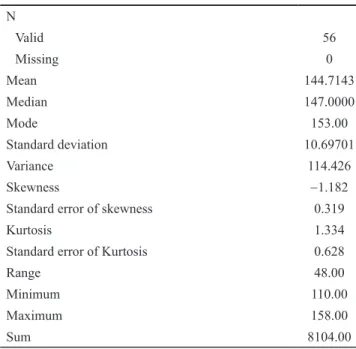
To ensure the main subjects of the study were approximately at the same level of language proficienc , PET was admin-istered to (N=56) EFL learners. The participants took four parts that included items related to reading comprehension, writing, listening, and speaking with a maximum possible score of 170 points. The results of the PET test for (N=56) students is available in table. 2:
Table.2 showed the results of group statistics and numer-ical information for the PET test scores which was adminis-tered for selecting homogeneous sample out of (N= 56) EFL students. Measures of central tendency including the mean (M= 144), the median (Md= 147.00), the mode (Mo= 153.00) and measures of dispersion namely the range (R= 48.00), the variance (V= 114.42), and the standard deviation (SD= 10.69) together with measures of distribution such as Skewness (-1.182) and Kurtosis (1.334) were displayed for the PET.
Checking the Normality Assumption
The assumption of T- Tests; namely, normality was examined before running the main statistical analyses for the pre-test scores. It was assessed by computing Skewness and kurtosis values and obtaining trimmed means. Table.3 presents the results of normality tests.
comprehen-sion test for both groups, the normality assumption was established. In other words, the 5 % trimmed means were within the range of lower bound and upper bound of 95% Confidence Interval for the Mean. Division of the statistic of Skewness and Kurtosis by the standard error established the results of the Skewness and Kurtosis analyses. The findings
revealed that they were all within the range of +2 suggesting that the distributions were all normal and symmetric.
Descriptive Statistics for the Pre -test Scores (Reading Comprehension Test)
Prior to the main study, all the participants took part in the pre-test. The purpose was to set up a baseline from which gains on the post-test could be examined and interpret-ed. Table.4 and.5 show the results of an independent samples t- test used to analyze the students’ scores in the pretests of reading comprehension.
The descriptive table displayed the sample size, mean, standard deviation, and standard error for both groups at the beginning of the study. For reading comprehension test, the mean scores for the control and experimental group were (X-
reading comprehension (control) =20.15) and (X- reading comprehension (experimen-tal) =21.55), respectively, and they varied some points (mean
difference= 1.40) around their average. When it comes to the degree of the variation of the scores around the mean score, the degree of variation for the pretest of reading comprehen-sion for the control group (SD reading comprehension (control) = 3.57) was smaller than that for the pretest of reading comprehension of experimental group (SD reading comprehension (experimental) =4.01).
Independent samples t- test were run to see if these differ-ences were statistically significant. The results of indepen-dent samples- t- test are presented in Table.5.
For The Levene statistic, that examined the equality of the variances, the significance value of the statistic for pre-test of reading comprehension was higher than (.05). Since these estimates were larger than 0.05, it could be conclud-ed that the groups had equal variances and thus the findings of first row were reported. Based on Table.5, there was no significant difference between the mean scores of the two groups in pre-test of reading comprehension (p≥.05). In oth-er words, the control and expoth-erimental groups woth-ere almost at the same level of proficiency in terms of their reading
com-Table 1. Reliability statistics for reading comprehension test
Cronbach’s
alpha N of items N of sample
Reading comprehension test
0.714 38 20 EFL
students
Table 2. Statistics for the results of PET test
N
Valid 56
Missing 0
Mean 144.7143
Median 147.0000
Mode 153.00
Standard deviation 10.69701
Variance 114.426
Skewness −1.182
Standard error of skewness 0.319
Kurtosis 1.334
Standard error of Kurtosis 0.628
Range 48.00
Minimum 110.00
Maximum 158.00
Sum 8104.00
Table 3. Statistics for the reading comprehension
Statistic Standard error
Groups Groups
Control Experimental Control Experimental
Reading comprehension test scores 1
Mean 20.1500 21.5500 0.79893 0.89876
95% Confidence interval for mean
Lower bound 18.4778 19.6689
Upper bound 21.8222 23.4311
5% Trimmed mean 20.1111 21.4444
Median 21.0000 21.0000
Variance 12.766 16.155
Standard deviation 3.57292 4.01936
Minimum 14.00 16.00
Maximum 27.00 29.00
Skewness 0.002 0.324 0.512 0.512
prehension at the beginning of the study before introducing the specific treatment
Research Question
RQ. Does teaching critical thinking skills through problem solving have any statistically significant effect on male and female EFL learners’ reading comprehension?
The following null hypothesis was suggested:
H. Teaching critical thinking skills through problem solv-ing does not has significant effect on male and female EFL learners’ reading comprehension.
In order to answer the first research question, The GLM Univariate procedure was run to the results of the posttest of reading comprehension. The GLM Univariate procedure provided analysis of variance for the dependent variable
(reading comprehension) by the two variables (gender and type of treatment). The factor variables divided the popu-lation into groups including males vs. females and experi-mental vs. control groups. Using this General Linear Model procedure, the null hypothesis about the possible effects of gender and treatment variables (traditional vs. Teaching crit-ical thinking skills through problem solving) on the means of the dependent variable (reading comprehension) was ex-amined. The interactions between factors (gender * type of treatment) as well as the effects of individual factors (gender and type of treatment) were inspected. The results are shown in the following section.
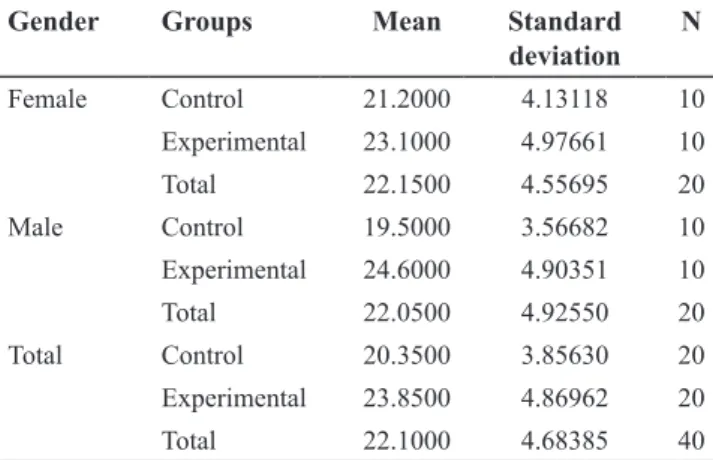
The above table displayed descriptive statistics for the combination of factors in the model. There were equal cell sizes (10 participants in each group) and the standard devia-tions were somewhat similar. The findings showed that there
was a treatment effect and the participants of the
experimen-tal group performed better than the control group. The toexperimen-tal mean of the control group came to (20.35) and for the exper-imental group equaled (23.85). The findings also disclosed
that there was a gender effect. In fact, male participants in
the experimental group performed better compared to fe-male participants. Therefore, the possible interaction effect
between gender and types of treatmentwas examined since
the mean differeences in reading comprehension scores for the experimental group differ across gender.
Following descriptive statistics, Levene’s test was also examined for the posttest of reading comprehension to en-sure the homogeneity of the distributions.
Since the significance value of the Levene’s test, (sig=.716), was higher than (.05), the equal variances as-sumption was met. It meant that, the slight variations in stan-dard deviations observed in the descriptive statistics table were simply due to random variation.
After establishing the homogeneity of the variances,
the possible interaction effect between gender and types of
treatmentwas inspected through computing model-estimat-ed marginal means. The findings are presentmodel-estimat-ed in Table.8.
Table.8 shows an interaction effect between gender and types of treatment. If there were no interaction, the
Table 4. Group statistics for the pre-test scores of the reading for the control and experimental groups
Groups N Mean Standard deviation Standard error mean
Reading comprehension test scores 1 Control 20 20.1500 3.57292 0.79893
Experimental 20 21.5500 4.01936 0.89876
Table 5. Independent samples test for the pre-test scores of the control and experimental groups
Levene’s test for equality of
variances
t‑test for equality of means
F Sig. t df Sig. (2-tailed) Mean
difference 95% confidence interval of the difference
Lower Upper
Reading comprehension test scores 1
Equal variances assumed 0.39 0.53 −1.16 38 0.25 −1.40 −3.83 1.03
Table 6.Descriptive statistics for the posttest of reading comprehension
Gender Groups Mean Standard
deviation N
Female Control 21.2000 4.13118 10
Experimental 23.1000 4.97661 10
Total 22.1500 4.55695 20
Male Control 19.5000 3.56682 10
Experimental 24.6000 4.90351 10
Total 22.0500 4.92550 20
Total Control 20.3500 3.85630 20
Experimental 23.8500 4.86962 20
Total 22.1000 4.68385 40
Table 7.Levene’s test of equality of error variances for the reading comprehension test
F df1 df2 Sig.
0.455 3 36 0.716
difference between types of treatment for male and female participants was constant. Profile plot was presented to show the interaction effect.
The profile plot visually represented the marginal means.
The factor levels of gender is shown shown along the
hori-zontal axis. Separate lines were produced for each types of group (control & experimental).
Since the lines in Figure.1 were not parallel, there was in-teraction effect. It was revealed that the difference in posttest of reading comprehension was greater for male participants of the experimental group, as the line for female participants dropped downward and that for male participants dropped upward. This was an interaction effect and the tests of be-tween-subjects effects were run to see if the interaction effect was statistically significant or it was simply due to chance
variation. The results of tests of between-subjects effects are presented in Table.9.
In Table.9, an analysis of variance was run and each factor in the model as well as the model as a whole, was examined for its ability to account for variation in the depen-dent variable namely male and female EFL learners’ reading comprehension scores. The significance value for the whole mode was less than (.05). Therefore, teaching critical think-ing skills through problem solvthink-ing had significant effect on EFL learners’ reading comprehension. However, the effect of gender factor was not statistically significant (P>.05). Moreover, the interaction effect between gender and types of treatment was not statistically significant (P>.05)
The partial eta squared statistic reported the practical sig-nificance of each factor, based upon the ratio of the variation (sum of squares) accounted for by the factor, to the sum of the variation accounted for by the factor and the variation left to error. Larger values of partial eta squared indicated a greater amount of variation explained by the model factor, to a max-imum of one. The findings of partial eta squared showed that simply the group (types of treatment) had the greatest effect
on the value of post reading comprehension scores (r=.148).
The two other factors including gender and interaction of group and gender were not statistically significant and consequently did not have great effect on the value of post
reading comprehension scores. The findings of the analysis
partially rejected the first null hypothesis and implied that teaching critical thinking skills through problem solving had statistically significant effect on EFL learners’ reading comprehension. Nevertheless, no statistically significant dif-ference was reported between the mean scores of reading comprehension for the male and female participants in the experimental group.
Table 8. Estimated marginal means for group * Gender (Reading comprehension test scores 2)
Dependent variable
Gender Groups Mean Standard error 95% confidence interval
Lower bound Upper bound
Female Control 21.200 1.402 18.357 24.043
Experimental 23.100 1.402 20.257 25.943
Male Control 19.500 1.402 16.657 22.343
Experimental 24.600 1.402 21.757 27.443
Table 9. Tests of between-subjects effects for the reading comprehension test
Source Type III sum of squares df Mean square F Sig. Partial Eta squared
Corrected model 148.200a 3 49.400 2.514 0.074 0.173
Intercept 19536.400 1 19536.400 994.219 0.000 0.965
Gender 0.100 1 0.100 0.005 0.944 0.000
Groups 122.500 1 122.500 6.234 0.017 0.148
Gender * Groups 25.600 1 25.600 1.303 0.261 0.035
Error 707.400 36 19.650
Total 20392.000 40
Corrected total 855.600 39
a. R squared=0.173 (Adjusted R squared=0.104)
DISCUSSION
This study set out with the aim of examining the effect of teaching CT through problem solving on Iranian male and female EFL learners’ reading comprehension. The results of this study indicated that the problem solving technique had a statistically significant effect on the learners’ reading comprehension. This study produced results which cor-roborate the findings of a great deal of the previous work in this field. This finding is in agreement with Facione’s (1992) view that believed there is a significant relation-ship between reading comprehension and CT. in addition, the result is consistent with Grabe’s (1991) who suggest-ed adopting some CT kills ussuggest-ed in reading comprehension (inference, analysis, synthesis, evaluation) can help the learners promote their reading comprehension. Moreover, the result of this study agrees with the findings of studies carried out by Barjasteh and Vaseghi (2012), Hassani, Rah-mani, and Babaei (2013), and Danaye Tous, Tahriri, and Haghighi (2015) in which instructing CT had a statistically significant effect on Iranian EFL learners’ reading compre-hension and teaching CT brought better understanding of the text. Indeed, the current study supports the idea that there is positive correlation between CT and reading com-prehension.
The findings of the current study also indicated the effects of gender factor was not statistically significant. Indeed, the same mean score changes across gender for both control and experimental groups was observed. The findings of this study do not support the previous research carried out by Walsh (1996) in which females outperformed males in terms of CT. This result also differs from King Mines and Wood’s (1990) study in which the male outperformed the female in terms of CT. This finding is consistent with those of Clay-tor (1997) and Danaye Tous, Tahriri, and Haghighi (2015) in which there was no significance difference between male and female performance regarding their CT ability. In fact, this result showed there was no relationship between CT and gender.
CONCLUSION
This study has examined the effect of teaching critical think-ing on readthink-ing comprehension performance of EFL learners. Problem solving as a technique of CT instruction was adopt-ed to improve EFL learners’ reading comprehension. It was found that instructing CT through problem solving brought better understanding of the text. Actually, the current study supports the idea that there is positive correlation between CT and reading comprehension.
Since critical thinking has a key role in developing ef-fective language learning, it needs to be improved among EFL learners. Waters (2000) suggested using CT activities in English classroom can help learners enhance their level of thinking and also understand the main meanings of the text. Indeed, Waters (2000) believed adopting CT activities has a significant role in English language classrooms and teachers take it into consideration in their classes. In this study, prob-lem solving as a technique of teaching CT has brought better
understanding of the text and as a significant technique can be used by teachers in their English classes to improve the learners’ reading comprehension. To conclude, English lan-guage teachers need to put more emphasis on CT tasks to enable students to make decisions and solve problems effec-tively in their real lives.
The generalizability of this study is subject to certain lim-itations. This study was carried out with a small size forty students aging between 17-26 participated in this study. As a result, the result of the study might not be generalized to oth-er learnoth-ers in Iranian English language institutes. In addition, this study lasted for one month and a half with 10 thirty min-utes of treatment. Therefore, future studies might investigate the effect of teaching CT through problem-solving with large number of students and long period of treatment.
Implications of the Study
Drawn upon this study, problem based texts in EFL class-es can improve the students’ reading comprehension. It has been suggested problem solving as a technique of CT in-struction can be used in classes to enhance the students’ level of thinking and encourage them to learn effectively. In fact, students can be engaged with learning because of the chal-lenge of the task. In order to engage students, the instructors use problem-based activities which are learner-centered and involve the higher-order cognitive intellectual skills (Lai, 2011).
Therefore, the teachers who would like to apply critical thinking in their classes should be aware of the point that they need to choose the right technique of instructing CT skills. Problem solving is one of those techniques can be used in teaching critical thinking to help the students pro-mote their overall learning achievement. Furthermore, if the teachers implement problem-solving technique, they should select appropriate activities, steps and texts to promote the students’ reading comprehension. First, they should identify the problems students may have in the classroom or outside of the classroom. Afterwards, the students should be intro-duced to the problems. Later, the students would be asked to find cause of the problems and discuss the pro’s and con’s. Finally, the students should list some solutions for the intro-duced problems. In addition, the materials selected to teach problem solving are to be consistent with the level of the students.
REFERENCES
Aloqaili, A.S. (2011). The relationship between reading comprehension and critical thinking: A theoretical study,
Journal of King Saud University-Languages and Trans-lation, 24, 35-41.
Barjesteh, H., & Vaseghi, R. (2012). Critical thinking: A reading strategy in developing English reading
com-prehension performance. Sheikhbahaee EFL Journal,
1(2), 21-33.
Claytor, K.L. (1997). The development and validation of an adult medical nursing critical thinking instrument (andragogy). Doctoral dissertation, Indiana University, Bloomington. Cohen, J. (1988). Statistical power anal-ysis for the behavioral sciences. Second Edition. Hills-dale, NJ: Lawrence Erlbaum Associates, Publishers. Danaye Tous, M., & Tahriri, A., & Haghighi, S. (2015). The
Effect of Instructing Critical Thinking through Debate on Male and Female EFL Learners’ Reading
Comprehen-sion. Journal of the Scholarship ofTeaching and
Learn-ing, Vol. 15, No. 4. doi: 10.14434/josotl. v15i4.13191.
Facione, P.A. (1992). The California critical thinking skills test-college level. Millbrae, CA: California Academic Press. Facione, P.A., & Facione, N.C. (1994). The California Critical
thinking skills test and national league for nursing accred-itation requirement. Millbrae, CA: California academic. Fahim, M., &Ahmadian, M. (2012). Critical thinking and
Iranian EFL context. Journal of Language Teaching and
Research, 3(4), 793-800.
Grabe, W. (1991). Current developmentin second language
readingresearch. TESOL Quarterly 25(3), 375-406.
Halvorsen, A. (2004). Incorporating critical thinking skills development into ESL/EFL courses. The Internet TESL Journal, XI (3).
Hassani, M.T., Rahmani, R., & Babaei, M. (2013). The rela-tionship between Iranian EFL Learners’ critical thinking and reading comprehension performance in journalistic texts. Theory and Practice in Language studies, 3(10), 1873-1878.
Healy, j. (1990). Encouraged minds why our children don’t think. New York: Simon &Schuster.
King, P.M., Mines, R.A., & Wood, P.K. (1990). Critical
thinking among college and graduate students. The
Re-view of Higher Education, 13(2), 167-186.
Lai, E.R. (2011). Critical thinking: A literature review. Pear-son’s Research Reports, 6, 40-41.
NurMohammadi, E., &Heidari, F., &DehghanNiry, N. (2012). The relationship between critical thinking abil-ity and reading strategies used by Iranian EFL learners.
English Lannguage Teaching, 5 (10), 192-201.
Paul. R. (1990). Critical thinking: What every person needs to survive in a rapidly changing world. Retrieved Oc-tober 5, 2013, from http: www.amazone.com/Criti-cal-Thinking -rapidly-Changing/dp/0944583075. Walsh, C. M. (1996). Critical thinking disposition of
univer-sity students in practice disciplines (nursing, education, and business) and non-practice disciplines (English, history, and psychology): An exploratory study. College Park, MD, University of Maryland. Waters, A. (2000). Thinking and language learning. English Language Teaching Journal, 60(4), 237-319.
Waters, A. (2000). Thinking and language learning. English
Language Teaching Journal, 60(4), 237-319.