Address for correspondence Dr. Sudip Das, Associate Professor, Dermatology & Venereology Department, N.R.S. Medical College and Hospital, 138, AJC Bose Road, Kolkata 700014, India Email: [email protected]
Original Article
An
introspection
into
the
cutaneous
manifestations
of
chronic
arsenicosis
as
reported in a tertiary care centre in Kolkata
Sudip Das, Joyeeta Chowdhury, Loknath Ghoshal
N.R.S. Medical College and Hospital, Kolkata, West Bengal, India
Abstract
Objective To study different patterns of skin manifestations of arsenicosis.Methods A cross-sectional observational study was done on 110 patients of clinically suspected arsenicosis attending the dermatology outdoor of a tertiary care centre in eastern India over a period of one year. Cutaneous indicators like keratosis over palms and soles, melanosis and hypopigmentation over trunk in patients coming from endemic zones were included. Arsenic level estimation was done in drinking water, hair and nails. Systemic evaluation was done in symptomatic cases.
Results Majority of the patients hailed from Nadia, North 24 Parganas and Murshidabad districts. Males and females presented equally. Skin pigmentation was present in almost all patients (95%). Raindrop pigmentation was the commonest cutaneous manifestation (71%) followed by punctuate palmar keratosis (49%). Bowen’s disease was found in 21% patients whereas squamous cell carcinoma was the commonest cutaneous malignancy (5%). Raindrop pigmentation was found more in males than females. Peak incidence was found in patients exposed to arsenic containing drinking water for a minimum of 5 years. There was strong correlation of severity of skin manifestations and level of arsenic in drinking water.
Conclusion The most common presentation of arsenicosis was raindrop pigmentation and it was found more in males. The incidence of cutaneous malignancy was 3% with premalignant Bowen’s disease being quite high (21%).
Key words
Arsenicosis, leucomelanosis, Bowen’s disease, raindrop pigmentation.
Introduction
Arsenicosis has been defined by the World Health Organization (WHO) working group as a "chronic health condition arising from prolonged ingestion (not less than 6 months) of arsenic above a safe dose, usually manifested by characteristic skin lesions, with or without involvement of internal organs."1 Man can be
exposed to the arsenic through inhalation, ingestion and/ or dermal absorption. The maximum permissible limit recommended by WHO in ground water is 10 µg/L; however, in India, the accepted level is <50 µg/L.2,3
High levels of arsenic in the subsoil water have been reported from all over the world and globally many areas with high arsenic content have been identified by the WHO. These include areas surrounded by the Great Ganga Basin in India where 25% of the wells have been found to have high arsenics content, as reported by
as well.5 Most of the registered cases are from
the district of Nadia, and the maximum number of deaths due to arsenicosis is from the district
of South 24 Paraganas.6
Arsenic contamination in ground water is mainly of natural origin and is the prime reason behind arsenicosis. Arsenic contamination of ground water may be due to geochemical processes or industrial pollution. Contamination of drinking water in West Bengal is mainly geogenic in nature.2
Whatever the sources and the modes of exposure are, the total impact depends upon the duration of absorption, excretion and retention in the body as well as the concentration and the
chemical nature of the element.7
Chronic arsenic toxicity may affect any organ of the body but skin and nervous system are the most common and early to be involved. Peripheral vascular disease (blackfoot disease),
hypertension, ischemic heart disease,
noncirrhotic portal hypertension, hepatomegaly, peripheral neuropathy, respiratory and renal
involvement, hematological abnormality
anorexia, weight loss may occur. Arsenic can also be passed from a pregnant woman to her unborn child.8
Skin lesions are found to be the commonest and earliest manifestation in arsenicosis patients.9,10
In one study, 20.6% persons in Bangladesh and 9.8% persons in West Bengal living in
arsenic-affected districts were found to show
dermatological features of arsenicosis11 and in a
study conducted in the arsenic-prevalent districts of Bangladesh, all the patients suffering from
arsenicosis showed pigmentary changes.12
Prolonged ingestion of arsenic results in
arsenical hyperkeratosis which appears
predominantly on the palms and soles, and it has
been found that keratosis on the soles is the most sensitive marker for the detection of arsenicosis at an early stage.13
A wide variety of cutaneous manifestations have
been described ranging from raindrop
pigmentation or hypopigmented lesions on the trunk and extremities, mild to severe diffused hyperpigmentation or melanosis. Melanosis is found to be the earliest and the commonest of all
dermatological manifestations.14,12 Pigmentation,
most intense on the trunk, can be diffuse16,17 or localized particularly affecting skin folds.15,16,17 Fine freckles of spotted pigmentary changes are
also seen, known as 'rain-drop pigmentation'.16,17
Sometimes macular areas of depigmentation may appear on normal skin or hyperpigmented
background. This is known as
leucomelanosis. Blotchy pigmentation may also involve mucous membranes such as the
undersurface of the tongue or buccal mucosa.
Hyperkeratosis of palms and soles is considered to be pathognomic of chronic arsenicosis. Keratoses may be graded as mild, moderate, or
severe depending on the extent and severity.2 In
the early stages of keratosis (mildvariety), the involved skin has an indurated, gritty character with papules less than 2 mm in size that can be
best appreciated by palpation. In
the moderate variety, the lesions usually advance to form raised, punctate, wartlike keratoses with diameter 2-5 mm in size that are readily visible.
When the keratosis becomes severe, it may form
keratotic elevations more than 5 mm in size and sometimes become confluent and diffuse and sometimes result in cracks and fissures
too. Thus it can act as an early marker of
carcinogenicity.
clinical signs after the exposure to high levels of arsenic have been described and can be as short as less than 1 year.18
Hyperpigmentation was reported to occur after 6 months by Rattner et al.19 with hyperkeratosis occurring about 3 years after exposure to 4.75 mg/day of arsnic. Arsenic exposure has been associated with 3 types of skin cancers, namely, Bowen's disease, basal cell carcinoma , and
squamous cell carcinoma.
Arsenic poisoning can be diagnosed through samples of blood, urine, hair, and fingernails. Tests on hair and fingernails can measure exposure to high levels of arsenic over the past
6-12 months.20 The aim of our study was to
observe the different patterns of skin
manifestations in clinically suspected patients of arsenicosis attending dermatology outdoor of a tertiary care hospital of Eastern India.
Methods
A cross-sectional study was done on 110 patients of clinically suspected arsenicosis attending the dermatology outdoor of a tertiary care centre in Eastern India over a period of one year. Patients of all age group were included. Cutaneous indicators like keratosis over palms and soles, melanosis and hypopigmentation over trunk in patients coming from endemic zones were included. Thorough clinical history including residence, drinking water source (with duration), homeopathy drug intake for asthma, psoriasis or chronic diarrhoea were taken. In them arsenic level estimation was done in drinking water, hair and nails. Only those persons who were consuming drinking water containing more than permissible level of arsenic for at least 6 months were included. Skin biopsy was done in lesions suspected of Bowen’s disease, or cutaneous malignancy.
Systemic evaluation was done in symptomatic cases. Arsenic levels were measured by an atomic absorption spectrophotometer with flow-injection hydride generation system.
Statistical analysis: Data are reported as means ± S.D. Statistical significance between groups was determined by analysis of variance with significance set at p<0.05.
Results
Initially 114 patients coming from arsenic endemic zones were included in our study. But 2 patients were excluded after normal level of arsenic in drinking water and two were excluded as lost to follow-up cases.
Majority of the patients hailed from Nadia
(34%), North 24 Parganas (32%) and
Murshidabad (30%) districts. Males and females were almost equally affected (1.03:1). The age group of presentation was between 25 years to 70 years with the mean age of presentation being 43.48±16.51 years. Increased levels of arsenic in drinking water were found in all cases and the source of drinking water was tubewells. Arsenic
water concentrations ranged from 50 g/l to 208
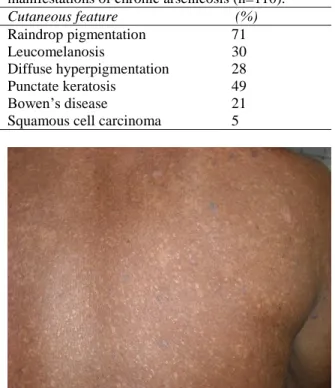
g/l. Arsenic levels in hair and nail was found in 45% and 34% patients, respectively. Skin lesions manifested after a minimum period of three years of arsenic ingestion whereas the peak incidence was found in patients exposed to arsenic containing drinking water for a minimum of 5 years. Skin pigmentation was present in almost all patients (95%), [Table 1]. Raindrop pigmentation (Figure 1) was the commonest cutaneous manifestation (71%).
Other pigmentary manifestations were
leucomelanosis (30%) and diffuse
hyperpigmentation (28%). Raindrop
Table 1 Incidence of different cutaneous manifestations of chronic arsenicosis (n=110).
Cutaneous feature (%)
Raindrop pigmentation 71
Leucomelanosis 30
Diffuse hyperpigmentation 28
Punctate keratosis 49
Bowen’s disease 21
Squamous cell carcinoma 5
Figure 1 Raindrop pigmentation with occasional keratosis.
Figure 2 Palmar pits.
Figure 3 Bowen’s disease on palm.
females. After pigmentation, punctuate palmar keratosis (49%), [Figure 2] was the next common skin manifestation and it appeared after a minimum period of four years. Severe hyperkeratosis of palms and soles was found in
10 patients. Keratosis has been almost always
present in association with pigmentation.
However, in absence of pigmentation, only keratosis was found in 2% of the cases in this study. Bowen’s disease (Figure 3) was found in 21% patients, whereas squamous cell carcinoma was the commonest cutaneous malignancy (5%). These were confirmed by histopathology. The mean period for development of Bowen’s disease was 4±6.5 years. There was no correlation of age with severity of skin manifestations. In three (2%) of our patients hepatomegaly was found and in them the level or arsenic in drinking water was high.
Discussion
the different arsenic affected zones of West Bengal. The average age of presentation was middle age which is quite similar to other studies. In our study the prevalence rate of skin lesions were more in males, though this was statistically insignificant (p>0.05). In our study the males showed an increased rate of raindrop pigmentation than females and this was statistically significant (p=0.03). Symptoms of arsenical toxicity may develop insidiously after 6 months to 2 years or more, depending on the amount of water intake and the arsenic concentration in the water sample. The higher the concentration of arsenic in water and the higher the amount of daily water intake, the earlier one of clinical features may appear. The minimum age for cutaneous manifestation was three years which is quite late than a study by
Guha Majumder where the median age was.21
Darkening of skin (diffuse melanosis) in the whole body or on the palm of the hand is the
earliest symptom. Pigmentary changes were
found in almost all patients and this was comparable to studies elsewhere. Raindrop pigmentation was the commonest skin finding (71%) followed by palmoplantar keratosis.
Other skin presentations were diffuse
pigmentation and leucomelanosis. Palmoplantar keratosis varied from small pits to diffuse keratosis and this was present more or less equally among males and females. Keratosis has been almost always present in association with
pigmentation. However in absence of
pigmentation, only keratosis was found in 2% of the cases in this study. This was also observed in
cases of arsenicosis in Cambodia.21,22
The incidence of premalignant Bowen’s disease was quite high (21%). The average latent period for malignant change was 7.2 years. The commonest cutaneous malignancy observed was squamous cell carcinoma (5%) followed by
basal cell carcinoma. There was dose
relationship between level of arsenic in drinking water and skin changes. The average peak arsenic concentration in drinking water was 300
g/l. This was similar to a survey done by
Haque, Majumder et al in West Bengal where the peak arsenic concentration in drinking water
was 325 /l. We found strong dose-response
gradients with both peak and average arsenic water concentrations.
The age-adjusted prevalence of keratosis and pigmentation was strongly related to water arsenic levels, rising from zero and 0.3 in the lowest exposure level (50 microg/l), to 8.3 and 11.5 per 100 respectively for females drinking water containing 300 microg/l, and increasing from 0.2 and 0.4 per 100 in the lowest exposure category to 10.7 and 22.7 per 100 respectively for males in the highest exposure level (300
g/l). The incidence of hepatomegaly was 2% in
our patients which is quite low as compared to a study done at Bangaladesh.10
Conclusion
Raindrop pigmentation was found to be the
commonest cutaneous manifestation of
arsenicosis. No relation was found between keratoses and malignancy.
References
1. Arsenicosis case-detection, management and surveillance. Report of a Regional Consultation. New Delhi: WHO Regional Office for South-East Asia; June 2003
2. Ghosh P, Roy C, Das NK, Sengupta SR.
Epidemiology and prevention of chronic arsenicosis: An Indian perspective. Indian J Dermatol Venereol Leprol. 2008;74:582-93. 3. Audit report (civil) for the year ended 31
4. Shah B. Report of an Interregional Workshop, Simla, India. Indian Council of Medical Research: 2005.
5. Chakraborty D, Rahman MM, Paul K, Chowdhury UK et al . Arsenic Calamity in the Indian subcontinent: What lessons have been learned? Talanta. 2002;58:3-22.
6. Health on the March 2006-07. State bureau of health intelligence. Directorate of Health services. Kolkata: Government of West Bengal; p. 190.
7. Adamsen RK, Pokharel A. The arsenic contamination of the drinking water in Nepal. 2002; Available at: http://www.bvsde.ops-oms.org/bvsacd/arsenico/nepal.pdf. Accessed March 24, 2012.
8. Shing WW. AHRC Letter: Nepal: Government Should Prioritize Dalits' Food Security. 2011; Available at: http://idsn.org/news- resources/idsn-news/read/article/ahrc-letter- nepal-government-should-give-prioritize-dalits-food-security/128/. Accessed March 24, 2012.
9. Hsueh YM, Chiou HY, Huang YL et al. Serum beta carotene level, arsenic methylation capability and incidence of arsenic induced skin cancer. Cancer Epidemiol Biomark Preven. 1997;6:589-96.
10. Kadono,T., Inaoka, T., Murayama, N et al. Skin manifestations of arsenicosis in two villages in Bangladesh. Int J Dermatol. 2002;41 841-6.
11. Gomez-Caminero A, Howe P, Hughes M et al. Sources and occurrence of arsenic in the environment. Arsenic and arsenic compound. Environmental health criteria 224. International programme on chemical safety. Geneva: World Health Organization; 2001. P. 28-33.
12. Cheng CN, Focht DD. Production of arsenic and methylarsines in soil and in culture. Appl Environ Microbiol. 1979;38:494-8.
13. Woolson EA. Biological and environmental effects of arsenic. In: Fowler BA, editor. Amsterdam: Elsevier Science; 1983. P.51-139.
14. Nakamura M, Matsuzono Y, Tanaka S, Hashimoto Y. Chemical form of arsenic compounds and distribution of their concentrations in the atmosphere. Appl Organomet Chem. 1990;4:223-30.
15. Kapaj S, Peterson H, Liber K, Bhattacharya P. Human health effects from chronic arsenic poisoning: A review. Part A. J Environ Sci Health. 2006;41:2399-428.
16. Coles DG, Ragaini RC, Ondov JM et al. Chemical studies of stack fly ash from a coal fired power plant. Environ Sci Technol. 1979;13:455-9.
17. Chilvers DC, Peterson PJ. Global cycling of arsenic. In: Hutchinson TC, Meema KM, editors. Lead, Mercury, Cadmium and Arsenic in the Environment. Chichester: John Wiley and Sons; 1987. P. 279-303.
18. Garai R, Chakraborty AK, Dey SB, Saha KC. Chronic arsenic poisoning from tubewell water. J Indian Med Assoc. 1984;82:34-5. 19. Rattner H, Dorne M. Arsenical pigmentation
and keratoses. Arch Dermatol Syphilol. 1943;48:458-60
20. Takagi Y, Matsuda S, Imai S, JA et al. Survey of trace elements in human nails: An international comparison. Bull Environ Contam Toxicol. 1988;41:690-5.
21. Guo X, Fujino Y, Kaneko S et al. Arsenic contamination of ground water and prevalence of arsenical dermatosis in the Hetao plain area, Inner Mongolia, China. Mol Cell Biochem. 2001;222:137-40.
22. Guha Mazumder DN, Majumdar KK et al. Occurrence of arsenicosis in a rural village of Cambodia. J Environ Sci Health A Tox Hazard Subst Environ Eng. 2009;44:1-9.