Assessing the Risk Factors for Musculoskeletal Disorders in Construction
Workers Using PATH, Case Study: Construction Project
Shabnam Parham
1, Ramazan Mirzaei*2, Hussein Ansari3
1) Dept. of Health, Safety and Environment (HSE), Faculty of Engineering and Technology, Islamic Azad University, Zahedan Branch, Zahedan, Iran.
2) Department of Occupational Health Engineering, School of Health, Mashhad University of Medical sciences Mashhad, Ira n and health promotion research center, Zahedan University of Medical Sciences, Zahedan, Iran.
3) Health Promotion Research Center, Dept. of Epidemiology and Biostatistics, Zahedan University of Medical Sciences, Zahedan, Iran
*Author for Correspondence: [email protected]
Received: 22 June 2016, Revised: 25 Oct. 2016, Accepted: 25 Dec. 2016
ABSTRACT
Construction workers experience a high risk of developing musculoskeletal disorders due to the nature of their jobs. This article aimed to evaluate the risk factors of musculoskeletal disorders among construction workers using Posture, Activity Tools and Handling (PATH). This is a sectional, descriptive-analytical study in a construction site in Tehran, Iran. Certain factors were identified namely body posture, weight of carried tools and objects, activities and tools, and their tasks and activities using PATH. PATH sheets were coded for a certain job. Descriptive data and Chi-square test were employed to analyze the data using SPSS.19. Identification and evaluation were performed in three most important stages of construction: foundation, carcass, finishing (elaborate work). The mean age was 33.08±8.97. Body posture included gentle bending posture (21.2%), severe bending (8.2%), bending and twisting (7% and 1.9%, respectively). Body positions, feet, hands, and weight of tools and objects were significantly different in the working stages (P<0.05). The highest weight was in less-than-5kg group. Strong grip was observed in 64.5% of cases. Ergonomic interventions are essential in construction jobs (Bricklaying, reinforcement, etc.) in order to reduce the adverse positions. The evaluation of working tools is also necessary to improve the ergonomic conditions, tools and reduce musculoskeletal disorders of construction workers.
Key words:
Risk, Musculoskeletal, Disorders, PATH, Construction, Worker.INTRODUCTION
Musculoskeletal Disorders (MSD) are among the common factors in occupational injuries in developing and industrialized countries [1, 2]. According to the studies, in this field, these disorders may be brought about by gradual long-term exposure to the etiologic factors. Also, they might suddenly be caused as a result of major trauma on the part of the skeletal – muscular organ. Since the progression of the disease is slow, individuals do not take any step forward to deal with. According to figures released by the Iranian Statistical Center and the Ministry of Health, 76% of workers have poor body condition. It means that there is no compatibility between the worker's body and tools [3]. Currently, there are 16 million workers working in two million workshops in Iran that have very high overhead costs. According to the report of the Social Security Organization,
musculoskeletal diseases have been the cause of 14.4% overall disability from 1991 to 1994 in Iran. They were ranked the fourth after neurological diseases (16.8%) and cancers (16%) [4]. According to the Bureau of Labor Statistics in America, 44% of
Work related diseases are caused by skeletal– muscular organ [5].
load lifting and carrying, and work with repetitive, psychological, organizational, and individual movements [10, 11]. Much physical effort by construction workers is associated with certain factors such as transportation of building materials and the use of tools and machinery. Poor working conditions, frequent use of different body parts, and vibration and long-standing are sources of Physical Work Load. Physical Work Load is known as the reason of musculoskeletal injuries to construction workers [12]. Construction is among the non-repetitive work and is dangerous in terms of ergonomics. Therefore, MSDs are frequently seen in construction jobs [13]. Damlund et al. reported 65% back pain prevalence in a 12-month period among semi-skilled construction workers [14]. Haubelin reported 80% back pain prevalence in reinforcement construction workers during their lives. Over the years, most of constructional
activities have not changed much. Most
c o n s t r u c t i o n a l activities still require high levels of physical ability. Most of construction tasks are performed in bending body posture. Due to its nature in terms of ergonomics and compared to other working groups, construction jobs have a higher risk of musculoskeletal disorders resulting from working in the back, upper and lower extremities. In addition to poor posture, these workers use various manual and electric tools and carry heavy loads by hands. These conditions increase the risk of developing MSDs. Few studies have been conducted in Iran concerning MSDs and their direct and indirect consequences. Therefore, a study is essential to determine the working condition of these people. This article aimed to identify and evaluate the risk factors for work- related MSDs using PATH. Recommendations are finally made to improve working conditions of construction workers.
MATERIALS AND METHODS
A sectional and descriptive-analytical study was
performed in a recreational-commercial
construction site with a concrete frame. The statistical population consisted of 420 workers. A total of 391 workers agreed to participate in the study as the sample. In the study, certain factors were identified namely Posture, Activity, Tools, and Handling. They were coded for a certain job using PATH sheet. After coding, the SPSS was
employed to analyze the data. PATH
ergonomically evaluates postures, activities, tools, and handling for non-repetitive tasks.
Non-repetitive tasks refer to those not repeated in regular working cycles, or in long-term working cycles. PATH is based on codes used in OWAS method Like OWAS, this method is a direct observation one. Observations are carried out at fixed time intervals. This method has been recently employed in agriculture, mining, and other non-repetitive jobs. In PATH, jobs break into the task (duties). Therefore, this method creates a systematic link b e t w e e n postures and duties. Establishing such link, tasks, in which the risk of musculoskeletal disorders is high, can be easily identified. PATH also uses a hierarchy ranking to identify the operations (jobs), task, and activities. In this way, a project is broken into several stages. Each stage consists of one or multiple operations (jobs) and each operation consists of some tasks performed by a certain group of workers. Each task consists of a group of activities performed by a certain worker. Activities are essential to complete and meet tasks. Prior to PATH sampling, stages and operations need to be determined in a running project. This stage is identified and described by interviews with engineers, project supervisors, and workers. Tasks and activities, performed by a certain group of workers, are identified through interviews and direct observation in each operation. The weights of items are to be determined at this stage. If a tool is accidentally carried during observation and the accurate weight is no accessible, the weight is then estimated. Using collected information, PATH sheets are ready for a specific job for coding. After data collection, SPSS. 22 is employed. A chi-square test and general linear models are utilized for the data analysis.
RESULTS
position accounts for 57% of body posture in foundation, 55% in the carcass, and 63.8% in finishing stage. In other words, most body`s neutral positions were observed in foundation. Gentle bending posture was reported 21.2%. This posture was mainly observed in the carcass stage. Severe bending posture was 8.2%. This posture
was significantly less in other two stages. "Sideway bending or twisting" and "bending and twisting" were reported 7% and 1.9% of body posture, respectively. A significant difference was observed in f o o t postures in working stages (P=0.03).
Table 1: Mean and frequency of age and working experience for construction workers (n=391)
Age (Mean±SD) 33.08±8.97 Working Experience (Mean±SD) 9.58±7.59
Age group (Year) Percentage (number) Working experience groups (Percentage) number
Younger than 25 14.3 (56) Less than 7 years 159 (40.7)
25-35 47.3 (185) 7-14 131 (33.5)
Older than 35 38.4 (150) More than 14 years 101 (25.8)
Table 2: Frequency of observations according to body postures in three stages in construction (N=Frequency)
Postures /stage Neutral (%) N
Gentle bending (%) N
Severe bending (%) N
Sideway bending or twisting (%) N
Bending or twisting (%) N
Total (%) N
Foundation 404 (57.7) 166 (23.7) 78(11.2) 41 (5.8) 11(1.6) 700(100)
Carcass 110 (55) 51(25.5) 25(12.5) 14(7) 0(0) 200(100)
Finishing 1277(63.8) 400 (20) 131(6.5) 148(7.4) 44(2.2) 2000(100)
Total (%) N 1791 (61.7) 617 (21.2) 234 (8.2) 203 (7) 55 (1.9) 2900 (100)
P value P= 0.02
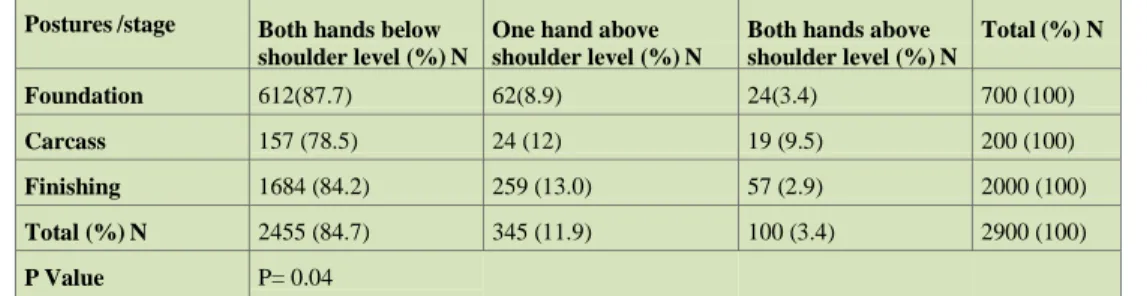
Generally, neutral postures made up of 51.5% of total postures related to the feet (Table 3). This posture was mainly seen in finishing (55.5%). "One leg in the air posture" accounted for the highest frequency in finishing (20.5%). "Kneeling posture" was reported higher in foundation than other two postures (14.4%). On the other hand, "neutral posture of foot" was the highest in all three stages compared to other postures (51.5%). "One leg in the air posture" accounted for the lowest frequency (2.0%). Table 4 shows the hand-related results. Although "both hands below shoulder level" posture was the highest frequency compared to other postures, it was significantly higher in the foundation (87%). It was the lowest in the carcass (78.5%). "One hand above shoulder level" posture was the lowest frequency in the foundation (8.9%). "Both hands below shoulder level" was the highest frequency in the carcass (9.5%). Generally, "Both hands below shoulder level" had the lowest frequency (3.4%).
In all working stages, "less than 5kg" weight was significantly (P=0.03) higher than other modes
(59.8%). "10-15kg" mode was the lowest frequency (2.2%). "Less than 5kg" was less in foundation compared to other two stages (41.2%). "5-10", "10- 15", and "heavier than 15" accounted for a significantly lower frequency in foundation than other stages.
The results showed a significant difference in Manual Material Handling (P<0.001). Manual Material Handling accounted for 69.5% of observations. It was significantly higher in finishing than other stages (73%)."Strong hand grip" accounted for the highest frequency (64.5%). "Strong hand grip" was significantly higher in foundation compared to other stages (70%). "One strong and one weak hand grip" had a higher frequency in finishing than other stages (5.4%). "Empty-handed grip" was of the highest frequency in finishing (14.4%).
As stated, variables in PATH had significant differences in foundation, carcass, and finishing (P<0.05). This significant difference is associated with diversity of jobs and tasks.
Table 3: Frequency of observations according to foot postures in three stages in construction (N=Frequency)
Posture/stage
Neutral (%) N
One leg in the air (%) N
One or two curved feet (%) N
Quart (%) N
Walking (%) N
Kneeling (%) N
Sitting on the ground (%) N
Crawling (%) N
Total (%) N Foundation (42.7) 299 (1.0) 7 (21.15) 148 (8.6)60 (17.9) 125 (4.14) 29 (4.5) 32 0(0) (100) 700
Carcass (42.5) 85 (4.5) 9 (22.0) 44 (9.5) 19 (16.0) 32 (3.5)7 (2.0) 4 0(0) (100) 200
Finishing (55.5) 1109 (2.05) 41 (12.2) 244 (7.3) 146 (15.2) 303 (3.7) 74 (4.15) 83 0(0) (100) 2000
Total (%) N (51.5) 1493 (2.0) 57 (15.0) 436 (7.8) 225 (15.9) 460 (3.8) 110 (4.1) 119 0(0) (100) 2900
Table 4: Frequency of observations according to foot postures in three stages in construction (N=Frequency)
Postures /stage Both hands below shoulder level (%) N
One hand above shoulder level (%) N
Both hands above shoulder level (%) N
Total (%) N
Foundation 612(87.7) 62(8.9) 24(3.4) 700 (100)
Carcass 157 (78.5) 24 (12) 19 (9.5) 200 (100)
Finishing 1684 (84.2) 259 (13.0) 57 (2.9) 2000 (100)
Total (%) N 2455 (84.7) 345 (11.9) 100 (3.4) 2900 (100)
P Value P= 0.04
DISCUSSION
Studying body postures, weight of items and tools, manual activities, and hand grip in three stages including foundation, carcass, and finishing, we realized that a significantly statistical difference was found in these stages (P<0.05). The difference is associated with variables under consideration among jobs and tasks. Such difference causes workers to be exposed to different levels of risk factors for musculoskeletal disorders in different stages of work. Construction workers in this study spend more than 60% of working time in neutral positions. The maximum time spent in non-neutral position was reported in carcass (45%). Dominant body`s neutral mode has been pointed out in most construction activities. In this vein, studies by Hajiaghazadeh et al., and Hokm Abadi et al. showed that "neutral body posture" was the highest reported body position. They stated almost similar percentages for body`s non-neutral position in carcass [12, 15]. This difference lies in work requirements and environment arrangement [16]. In carcass jobs, the percentage of body`s non-neutral posture was higher in bricklaying than in preparation (46% opposed to 44%). Although "gentle bending" non-neutral posture accounted for the highest frequency in preparation than in bricklaying (32% opposed to 19%), workers experienced the highest body movements (severe bending, sideway bending, bending, and twisting) as a result of work nature. They almost had the highest percentage compared to preparation because workers were exposed to constantly varying severe bending, sideway bending, and sometimes twisting to carry the brick and mortar. In constructional material procurement stage, workers, however, performed most of activities by gentle bending. In bricklaying, when they worked on trestle, walking movements were limited and they used to experience the highest level of body movement. Therefore, they had to perform almost all tasks with body and hand movements in a fixed position. They also had to consider the body
bending and outstretched hands in more distant places. After carcass, the second ranked body`s non-neutral posture was the foundation (42.3%). In reinforcement, the percentage of body`s non-neutral posture was higher in bar bending than in cutting bars which were consistent with results of studies by Hajiaghazadeh [3]. In bar bending, workers used their body weight and "gentle bending" to apply force for bending. This led the body to be out of the neutral position. Bar workers employed squatting and bending positions (usually "severe" and "gentle" bending with less force) to connect the bars by rod. In finishing, the highest percentage of non- neutral position belonged to cement work (57%). Of this percentage, the highest share was for "body`s gentle bending". In cement work, bending and body postures were seen during mortar [17]. Although listed adverse positions accounted for a little percentage than neutral positions, they can be considered important risk factors for the development of MSDs in back [18, 19]. In carcass, "foot`s non- neutral" posture was higher in constructional material preparation than in bricklaying (73% opposed to 42%). In constructional material preparation, workers performed their tasks in the squat (curved leg) and sitting positions on the ground. Hokm Abadi also showed that "one or two curved feet" non-neutral mode accounted for the highest percentage in carcass among other neutral positions [15]. Workers under consideration spent 84.7% of their working time with hands below shoulder level and it was significantly different in the mentioned stages. In this regard, foundation accounted for the highest frequency (87.7%). In foundation, most
non-neutral posture was observable in
location of workers in ties and bracing and working with above shoulder level, especially in implementation of columns and panel. The posture of hands, however, was more important in carcass because the highest non-neutral frequency (21.5%) was observable. It was mainly associated with bricklaying. As stated earlier, bricklaying required the involvement of body and hand. When trestle was not used, hands were above shoulder level. In finishing stage, patching in painting had the highest percentage in non-neutral position (61%).
Painting was mainly involved with hand
movements. The work is sometimes located above the worker`s height in activities such as surface sanding, applying especial paste for leveling, and painting (ceiling). Plastering, non-neutral posture was not observed in the plaster preparation, however, it was observed in plastering (42%). This was mainly associated with the fact that plaster was applied with trowel above the worker`s height. When changing the height of trestle was not possible and ceiling plastering, jobs in which shoulder and neck were involved due to inappropriate positions and static loads cause MSDs increase [19]. Since different types of tools with various weights were used, a significant difference was found in the weight of tools. The highest frequency was observed in "less- than- 5kg" group, showing the application of lighter tools. In almost 59.8% of observations, workers were working with tools less than 5 kg. Hokm Abadi also reported that most workers either did not carry any item or carried tools less than 5kg (almost 87%) [20]. Although the percentage of adverse physical conditions mentioned little about the neutral accounted for Emami be important risk factors for musculoskeletal disorders in the lumbar region [21].Manual handling was different in foundation, carcass, and finishing. Finishing accounted for the highest level of manual handling (73%). In foundation, workers had the highest level of strong grip (70% of time). In concrete placing and reinforcement, the highest hand grip belonged to a strong grip. Smoothing concrete and bending bars accounted for the highest percentage of strong grip (83% and 82%, respectively). After strong grip in this job, weak grip accounted for the highest hand grip percentage. Cutting the bar accounted for the highest percentage of empty hand during the work. While cutting the bars, strong grip was observable due to the use of hickey and the need for force for bending. In this case, finishing ranked the second (64.3%). The
highest strong grip was observable in cement work (90%).
CONCLUSION
Work- related musculoskeletal disorders
(WMSDs) is major problems in modern societies [19] Non-neutral modes are the most important MSD risk factors in various activities. They can lead to an adverse impact on health. Therefore, ergonomic interventions seem essential to decrease the complications of such positions. Due to the construction boom in Iran, the results of this study can be used to prevent MSDs in this industry, which has a significant number of human resources. Ergonomic interventions seem essential in various jobs such as bricklaying, reinforcement, bending bars, and painting to reduce the inappropriate positions. Similar to other jobs, tools are widely used in construction jobs. More studies are proposed to conduct in order to recommend ergonomic solutions to re-design these tools and replace them with others. For example, using plastic mold is proposed in false work or winding hook in winding. Such interventions can reduce MSDs among workers. Training concerning correct techniques for lifting load is also effective in reducing physical stress.
ETHICAL ISSUES
The study was approved by the ethics committee of Islamic Azad University, Zahedan Branch.
CONFLICT OF INTEREST
Authors of the manuscript did not have a conflict of interest.
AUTHORS’ CONTIBUTION
All authors have made a contribution into the review and finalization of this manuscript. All authors read and approved the manuscript.
FUNDING/ SUPPORTS
Islamic Azad University, Zahedan Branch
supported this study.
ACKNOWLEDGEMENT
The authors would like to thank Islamic Azad University, Zahedan Branch for technical and financial support of this work.
REFERENCES
for the prevention of occupational muscular-skeletal injuries.. Solna [etc.]: National Institute of Occupational Health [etc.] 1994; 346.
[2] Shnavaz H. Workplace injuries in the developing countries. Ergonomics, 1987; 30(2): 397-04.
[3] Sadeghi F, Asilian H, and Barati L. Evaluation of the body posture of factory workers in Ahwaz Rolling In dustry. Behbood Journal. 2006; 6(1): 34-41.
[4] Soltani, R., The welders' posture assessment by
OWAS technique. Occupational Medicine
Quarterly Journal. 2011; 3(1): 34-39.
[5] Nasl Saraji, J, Ghaffari M, and Shahtaheri SJ, Survey of Correlation between Two Evaluation
Method of Work Related Musculoskeletal
Disorders Risk Factors REBA& RULA. Iran Occupational Health, 2006; 3(2): 25-32.
[6] Chubineh, A, Methods of assessment Posture in occupational Ergonomic. Tehran: Fanavaran, 2003.
[7] Bernard BP, Musculoskeletal disorders and workplace factors: a critical review of
epidemiologic evidence for work-related
musculoskeletal disorders of the neck, upper extremity, and low back, in Musculoskeletal disorders and workplace factors: a critical review of epidemiologic evidence for work- related musculoskeletal disorders of the neck, upper extremity, and low back. NIOSH,1997
[8] Ghasemkhani M, Rahimi M, Mosayeb Zadeh M. Musculoskeletal symptom survey among cement drillers. Iran Occupational Health. 2005; 2(1): 28-31.
[9] Habibi H, Ahmadinejad M. Evaluation of the body posture in Mahyaman Industry by OWAS. Iran Occupational Health Journal. 2005; 2 (1): 32-35. [Persian].
[10] Kee D, Karwowski W. LUBA: an assessment technique for postural loading on the upper body based on joint motion discomfort and maximum holding time. Applied Ergonomics. 2001; 32(4): 357-66.
[11] Mirmohamadi M. Evaluation of risk factors causing musculoskeletal disorders using QEC method in a furniture producing unite. Iranian J Publ Health, 2004. 33(2): 24-27.
[12] Hajaghazadeh M, Ergonomic assessment of musculoskeletal disorder risk factors in construction workers by PATH method. Journal of School of Public Health and Institute of Public Health Research. 2008; 6(1): 37-45.
[13] Jeong BY, Occupational deaths and injuries
in the construction industry. Applied ergonomics. 1998; 29(5): 355-60.
[14] Li KW, Lee CL. Postural analysis of four jobs on two building construction sites: an experience of using the OWAS method in Taiwan. Journal of Occupational Health. 1999; 41(3): 183-90.
[15] Hokmabadi R, H Fallah, Ergonomic
assessment of musculoskeletal disorders risk factors in construction workers by PATH Method. Journal of North Khorasan University of Medical Sciences. 2013; 5(1): 55-61
[16] Buchholz B. Quantification of ergonomic hazards for ironworkers performing concrete reinforcement tasks during heavy highway construction. AIHA journal. 2003; 64(2): 243-50. [17] Hajaghazadeh M Nasl saraji J, Hosseini M, Adl J. Ergonomic assessment of musculoskeletal disorder risk factors in construction workers by PATH method, Journal of School of Public Health and Institute of Public Health Research. 2008; 6(1): 37-45.
[18] Jones G. Predicting the onset of knee pain: results from a 2-year prospective study of new workers. Annals of the rheumatic diseases. 2007; 66(3): 400-06.
[19] Bernard BP. Musculoskeletal disorders and workplace factors: a critical review of
epidemiologic evidence for work-related
musculoskeletal disorders of the neck, upper extremity, and low back. 1997: US Department of Health and Human Services, Public Health Service, Centers for Disease Control and Prevention, National Institute for Occupational Safety and Health Cincinnati, OH, USA.