Enhanced Time-Bound Ticket-Based Mutual Authentication Scheme for Cloud
Computing
Ravi Singh Pippal
Radharaman Institute of Research and Technology, Bhopal, India E-mail: [email protected]
Jaidhar C. D.
Defence Institute of Advanced Technology, Girinagar, Pune, India E-mail: [email protected]
Shashikala Tapaswi
ABV-Indian Institute of Information Technology and Management, Gwalior, India E-mail: [email protected]
Keywords:authentication, cloud computing, cryptanalysis, impersonation attack, smart card
Received:December 3, 2012
Cloud computing is a recently developed technology for complex systems with services sharing among various registered users. Therefore, proper mutual authentication is needed between users and cloud server prior to avail the services provided by cloud servers. Recently, Hao et al. [26] proposed time-bound ticket-based mutual authentication scheme for cloud computing. However, this paper shows that their scheme is vulnerable to Denial-of-Service attack and insecure password change phase. Besides, enhanced scheme is proposed to overcome these security pitfalls. Moreover, performance comparison of both the schemes proves that the enhanced scheme is more efficient in comparison with Hao et al.’s scheme.
Povzetek: V tem ˇclanku je predlagana okrepljena shema medsebojne avtentifikacije aplikacij v oblaku, ki odpravi nekatere varnostne slabosti.
1
Introduction
Cloud computing is a new computing paradigm and got wide popularity from both industries as well as academia since 2007. It is employed because of its powerful com-puting and storage capabilities necessary in a distributed environment [1]. Its attractive characteristics include on-demand self-service, measured service, location indepen-dent resource pooling, ubiquitous network access and rapid elasticity. Three types of service offered by cloud comput-ing are Software as a Service (SaaS), Platform as a Service (PaaS) and Infrastructure as a Service (IaaS). Several firms like Google, Amazon, Microsoft, IBM and Yahoo are the ancestors that offer services for Internet users. Some more firms like Facebook, Salesforce, Myspace, Youtube, etc. are also started offering cloud computing services.
Users who are acquainted to use Internet can avail the computing resources, storage space and software services as per their demands to solve their problems. Further, users can also store their data in cloud servers and the same can be accessed from anywhere over the Internet as on-demand. This offers great flexibility for remote users.
Although, it provides a number of advantages such as cost reduction, dynamic resource provisioning, increased
flexibility, low capital expenditures and time saving for new service deployment. However, still it is not matured enough to preserve data confidentiality as well as integrity. Many security issues, like data security either in store form or transmission form, application security, monitoring and metering need to be addressed and so on. Number of se-curity issues have been discussed [2, 3, 4, 5, 6] and few research works address the security issues [7, 8, 9, 10].
One of the primary security needs is user authentication. Several authentication schemes have been proposed in the literature but most widely used one is password based au-thentication scheme [11, 12, 13, 14]. However, single fac-tor password based authentication is not secure enough in the present scenario. Two factor authentication is a better option using password as one and smart card as other fac-tor. Smart card is a tamper resistant integrated circuit card with memory to store personal information and a processor capable of performing computations [15].
150 Informatica37(2013) 149–156 R.S. Pippal et al.
[23], authentication in multi-server environment [24], wire-less sensor networks [25] and many more.
1.1
Contribution of this Paper
Cloud servers authenticate the remote users prior to offer any services to them. Recently, Haoet al. [26] proposed time-bound ticket-based mutual authentication scheme for cloud computing. It is claimed that the scheme resists lost smart card attacks, offline password guessing attack, lost ticket attack, masquerade attack and replay attack. In ad-dition, it provides mutual authentication and secure session key generation. This paper shows vulnerabilities of Hao
et al.’s scheme, i.e. vulnerable to Denial-of-Service attack and insecure password change phase. To resist these weak-nesses, this paper proposes an enhancement to Haoet al.’s scheme.
The rest of this paper is organized as follows. Sec-tion 2 gives review of Hao et al.’s scheme. Security pit-falls of Hao et al.’s scheme is shown in section 3. Sec-tion 4 describes the proposed enhanced mutual authenti-cation scheme. An in-depth security analysis and perfor-mance comparison is discussed in section 5. Finally, sec-tion 6 concludes the paper.
2
Review of Hao
et al.
’s Scheme
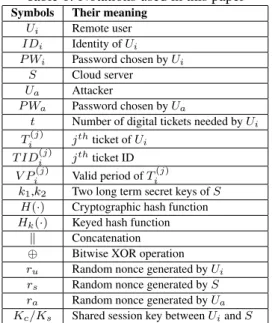
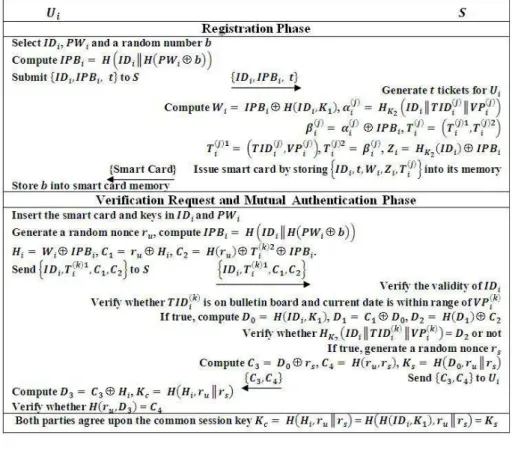
This section describes Haoet al.’s time-bound ticket-based mutual authentication scheme for cloud computing [26] (see Figure 1). The scheme consists of four phases: Reg-istration phase, Verification request phase, Mutual authen-tication phase and Password change phase. The notations used throughout this paper are summarized in Table 1.
Table 1: Notations used in this paper
Symbols Their meaning
Ui Remote user
IDi Identity ofUi
P Wi Password chosen byUi
S Cloud server Ua Attacker
P Wa Password chosen byUa
t Number of digital tickets needed byUi
Ti(j) jthticket ofU i
T IDi(j) jthticket ID
V Pi(j) Valid period ofTi(j)
k1,k2 Two long term secret keys ofS
H(·) Cryptographic hash function Hk(·) Keyed hash function
k Concatenation
⊕ Bitwise XOR operation ru Random nonce generated byUi
rs Random nonce generated byS
ra Random nonce generated byUa
Kc/Ks Shared session key betweenUiandS
2.1
Registration Phase
This phase is invoked when a new user registers with the cloud server. The cloud server issues ‘t’ tickets, in which each ticket can be used only once. In this phase,Uiselects
IDi, P Wi and a random number b, computesIP Bi =
H(IDikH(P Wi⊕b))and submits{IDi, IP Bi, t}toS
over a secure channel, where ‘t’ is the number of digital tickets needed byUi.
Upon receiving the registration request and ticket fee fromUi,Sgeneratesttickets forUi.jthticket ofUiand its
validity is represented as{(T IDi(j), V Pi(j)), j= 1,2, ..t}.
Scomputes
Wi=IP Bi⊕H(IDi, K1)
α(ij)=HK2(IDikT ID
(j)
i kV P
(j)
i )
βi(j)=α(ij)⊕IP Bi
Ti(j)has two parts,
Ti(j)= (Ti(j)1, Ti(j)2)
in which
Ti(j)1= (T IDi(j), V Pi(j))
Ti(j)2=βi(j)
Salso computesZi=HK2(IDi)⊕IP Biand issues a smart
card toUiby storing{IDi, t, Wi, Zi, T
(j)
i }into smart card
memory over secure channel. After receiving,Uistoresb
into smart card memory.
2.2
Verification Request Phase
AsUi receivest tickets, these tickets can be used to
per-form data verification at most t times. Suppose, for kth
verification request, Ui inserts the smart card to the card
reader and keys inIDi andP Wi. The smart card
gener-ates a nonceruand computes
IP Bi=H(IDikH(P Wi⊕b))
Hi=Wi⊕IP Bi
C1=ru⊕Hi
C2=H(ru)⊕Ti(k)2⊕IP Bi
Uisends the verification request{IDi, T
(k)1
i , C1, C2}toS in order to pass the mutual authentication phase.
2.3
Mutual Authentication Phase
Once the verification request has been received, S first checks the validity ofIDito accept/reject the verification
request. S rejects the request when it finds invalidity oth-erwise checks whetherT IDi(k)is on the bulletin board or not. If it’s on the bulletin board,SrejectsUi’s request and
terminates the process. Schecks whether the current date is within the range ofV Pi(k)or not. If not,SrejectsUi’s
request and terminates the process. If all these conditions hold,Scomputes
Figure 1: Haoet al.’s Scheme
D1=C1⊕D0
D2=H(D1)⊕C2
S computes HK2(IDi k T ID
(k)
i k V P
(k)
i )and checks
whether it is equal to D2 or not. If true, S generates a random noncers, computesC3=D0⊕rs,C4=H(ru, rs)
and sends the message{C3, C4}toUi. S also computes
Ks=H(D0, rukrs)as the session key.
After getting the message {C3, C4} from S, Ui
com-putesD3=C3⊕Hiand comparesH(ru, D3)withC4. If true,Ui authenticatesS successfully otherwise terminates
the session. Subsequently,UicomputesKc =H(Hi, ru k
rs). Both parties agree upon the common session keyKc
=H(Hi, rukrs)=H(H(IDi, K1), rukrs)=Ks.
2.4
Password Change Phase
This phase is invoked whenUi wants to change the
pass-word. Uiinserts the smart card to the card reader and keys
the credentials such asIDiandP Wi. The smart card
gen-erates a nonceruand computes
IP Bi=H(IDikH(P Wi⊕b))
C1=ru⊕Wi⊕IP Bi
C2=H(ru)⊕Zi⊕IP Bi
The smart card sends {update, IDi, C1, C2} to S, in which, update denotes that it’s a password change re-quest. After receiving,Schecks the validity ofIDito
ac-cept/reject the request. If it is invalid, then S rejects the
request otherwise computes
D1=C1⊕H(IDi, K1)
D2=H(D1)⊕C2
S computes HK2(IDi)and checks whether it is equal to D2or not. If true,S generates a random noncers,
com-putesC3 = H(IDi, K1)⊕rs,C4= H(ru, rs)and sends
the message{C3, C4}toUi. Upon receiving the message {C3, C4}, smart card computesD3 = C3⊕Wi⊕IP Bi
and comparesH(ru, D3)withC4. If true,Uiauthenticates
S successfully otherwise terminates the session. Subse-quently, smart card prompts Ui to enter a new password
P Wnew
i . Then, smart card computes
IP Bnewi =H(IDikH(P Winew⊕b))
Winew=Wi⊕IP Bi⊕IP Binew=H(IDi, K1)⊕IP Bnewi Zinew=Zi⊕IP Bi⊕IP Binew=HK2(IDi)⊕IP B
new i
The smart card updatesTi(j)2toTi(j)2⊕IP Bi⊕IP Bnewi
for all remaining tickets which yieldsα(ij)⊕IP Bnew i .
3
Weakness in Hao
et al.
’s Scheme
This section provides security flaws in Haoet al.’s scheme. They are (a) exposed to Denial-of-Service attack due to lack of early wrong password detection prior to verifica-tion request creaverifica-tion and (b) inefficient password change phase. It is assumed that the attackerUais able to intercept
152 Informatica37(2013) 149–156 R.S. Pippal et al.
3.1
Denial-of-Service Attack
To check whether or not the requested user is a legitimate bearer of smart card, entered password must be verified at the smart card level before login request creation [27]. In this scheme, ifUa getsUi’s smart card by any means, he
or she can create invalid login request by entering wrong password which is verified only at the cloud server side not at the user side.
Assume,Uagets/stealsUi’s smart card, inserts the smart
card into the card reader and enters the wrong password
P Wa as well asIDa. Smart card creates an invalid login
request without verifying the correctness of entered pass-word or identifier. The smart card generates a nonceraand
computes
IP Ba=H(IDakH(P Wa⊕b))
Ha=Wi⊕IP Ba=IP Bi⊕H(IDi, K1)⊕IP Ba C1a=ra⊕Ha=ra⊕IP Bi⊕H(IDi, K1)⊕IP Ba
C2a=H(ra)⊕Ti(k)2⊕IP Ba
Uasends the verification request{IDi, T
(k)1
i , C1a, C2a}to
S. This request fails to pass the authentication phase at the cloud server side. As a result, load onS increases which leads to Denial-of-Service attack. To overcome this attack, both password and identifier must be verified at the user side prior to compute verification request.
3.2
Insecure Password Change Phase
Communication is needed between S andUi during the
password change phase. Password change at the user side without interacting withS strengthen the security and re-duces the load onS. Further, password change phase leads to Denial-of-Service attack because of non existence of ear-lier password as well as identifier verification before the update request creation [27].
4
Proposed Enhanced Mutual
Authentication Scheme
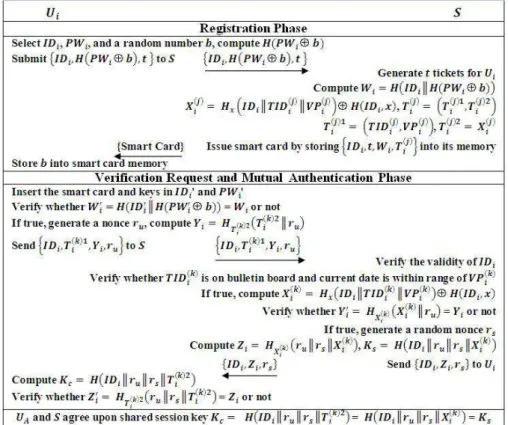
This section describes proposed enhanced mutual authenti-cation scheme over Haoet al.’s scheme (see Figure 2). The scheme consists of four phases: Registration phase, Ver-ification request phase, Mutual authentication phase and Password change phase. The details of these phases are as follows:
4.1
Registration Phase
In this phase,UiselectsIDi,P Wiand a random numberb,
computesH(P Wi⊕b)and submits{IDi, H(P Wi⊕b), t}
to S over a secure channel, where ‘t’ is the number of digital tickets needed byUi. Upon receiving the
registra-tion request and ticket fee fromUi, S generates ttickets
for Ui. jth ticket ofUi and its validity is represented as {(T IDi(j), V Pi(j)), j= 1,2, ..t}.Scomputes
Wi=H(IDikH(P Wi⊕b))
Xi(j)=Hx(IDikT IDi(j)kV P
(j)
i )⊕H(IDi, x)
where ‘x’ is long term secret key ofS.Ti(j)has two parts,
Ti(j)= (T
(j)1
i , T
(j)2
i )
in which
Ti(j)1= (T ID
(j)
i , V P
(j)
i )
Ti(j)2=Xi(j)
Sissues a smart card over secure channel toUiby storing {IDi, t, Wi, T
(j)
i }into smart card memory. After
receiv-ing,Uistoresbinto smart card memory.
4.2
Verification Request Phase
AsUi receivest tickets, these tickets can be used to
per-form data verification at mostttimes. Assume forkth
veri-fication request,Uiinserts the smart card to the card reader
and keys the credentials, ID0i andP Wi0. The smart card computesWi0 =H(ID0i k H(P Wi0⊕b))and compares it with the storedWi. If true,Uiis the valid owner of smart
card.
The smart card generates a nonce ru and computes
Yi=HT(k)2
i
(Ti(k)2kru).Uisends the verification request
{IDi, T
(k)1
i , Yi, ru}toS.
4.3
Mutual Authentication Phase
Upon receiving the verification request {IDi, T
(k)1
i , Yi, ru}; S first checks the validity of
IDi to accept/reject the verification request. Srejects the
request when it finds invalidity otherwise checks whether
T IDi(k) is on the bulletin board or not. If it’s on the bulletin board, S rejects Ui’s request and terminates the
process. S checks whether the current date is within the range ofV Pi(k)or not. If not,S rejectsUi’s request and
terminates the process.
If all these conditions hold, S computes Xi(k) =
Hx(IDi k T ID
(k)
i k V P
(k)
i )⊕H(IDi, x). S
com-putes Yi0 = HX(k)
i
(Xi(k) k ru) and checks whether it is equal to receivedYior not. If true,SauthenticatesUi
oth-erwise rejects the request. S generates a random nonce
rs, computes Zi = HX(k)
i
(ru k rs k X
(k)
i ) and sends
the message {IDi, Zi, rs}toUi. S also computesKs =
H(IDikrukrskX
(k)
i )as the session key.
After getting the message{IDi, Zi, rs}fromS,Ui
com-putesZi0=HT(k)2
i
(ru k rs kT
(k)2
i )and compares it with
the received Zi. If true, Ui authenticatesS successfully
otherwise terminates the session. Subsequently, Ui
com-putesKc=H(IDikruk rskT
(k)2
i ). Both parties agree
upon the common session keyKc =H(IDi k ru k rs k
Ti(k)2)=H(IDikrukrskX
(k)
Figure 2: Proposed Enhanced Mutual Authentication Scheme
4.4
Password Change Phase
This phase is invoked whenUi wants to change the
pass-word. Uiinserts the smart card to the card reader and keys
the credentials such asID0
iandP Wi0. The smart card
com-putesW0
i =H(ID0ikH(P Wi0⊕b))and compares it with
the storedWi. If true,Uiis the legitimate bearer of smart
card.
Subsequently, smart card prompts Ui to enter a new
passwordP Wnew
i . Then, smart card computesWinew =
H(IDikH(P Winew⊕b)). The smart card updatesWito
Wnew
i in the smart card memory.
5
Security Analysis and
Performance Comparison
This section discusses security analysis of the proposed en-hanced mutual authentication scheme and provides perfor-mance analysis in comparison with Haoet al.’s scheme.
5.1
Impersonation Attack
Suppose, Ua has complete hold on the insecure
commu-nication channel and can intercept all the communicating messages transmitted between Ui andS. Ua is unable to
create a forged verification request as the value of Ti(k)2
is needed to compute fakeYi. Further, it is not possible
to getTi(k)2from interceptedTi(k)1 without knowing ‘x’,
long term secret key of S. Moreover, without the infor-mation aboutTi(k)2,Uacannot masquerade as a legitimate
S. Hence,Uais unable to forge the verification request to
impersonate a valid Ui or forge the response message to
impersonate a legitimateS.
5.2
Password Guessing Attack
One of the most important features provided by any au-thentication scheme is the security of passwords of users. The scheme must be structured in such a way that no one can guess the password. In the proposed scheme, password is used only in the card holder verification. It is not used in the calculation of any of the verification request parame-ters. Hence, there is no chance of offline password guessing attack. To resist online password guessing attack, the num-ber of attempts made by user can be limited to some fixed value.
5.3
Replay Attack
An adversary may try to act as an authentic user by resend-ing previously intercepted messages. This scheme uses unique ticket IDT IDiand random noncesruandrswhich
are different from session to session. As a consequence,Ua
cannot enter the system by resending previously transmit-ted messages to impersonate legalUi.
154 Informatica37(2013) 149–156 R.S. Pippal et al.
{IDi, T
(k)1
i , Yi, ru}is replayed to pass the mutual
authen-tication phase. Upon receiving the verification request,S
first checks the validity of IDi and then checks whether
T IDi(k)is on the bulletin board or not. Obviously,S will
find that T ID(ik) is on the bulletin board. S rejects the service request and terminates the process.
5.4
Reflection and Parallel Session Attack
To resist reflection and parallel session attacks, the given scheme employs asymmetric structure of communicat-ing messages, i.e.,{IDi, T
(k)1
i , Yi, ru}and{IDi, Zi, rs}.
There is no symmetry in the values ofYi=HT(k)2
i
(Ti(k)2k
ru)andZi = HX(k)
i
(ru k rs k X
(k)
i ). Hence, Ua is
un-able to launch parallel session attack by replaying cloud server response message as the user verification request or reflection attack by resending user verification request as the cloud server response message.
5.5
Privileged Insider Attack
For remembrance, many users employ same password to access different servers. Nevertheless, a privileged in-sider of server can get this password and then try to uti-lize it for personal benefit. In the given scheme,Ui sends
H(P Wi⊕b)toS instead ofP Wito resist privileged
in-sider attack. Hence, this scheme provides security against privileged insider attack.
5.6
Valid Period Extending Attack
In the proposed scheme, no one can use the ticket after the expiration date. It helps to control the database growth maintained byS. Let us suppose,Uiwants to reuse thekth
ticketTi(k).UichangesV P
(k)
i toV P
(k0)
i (by including the
current date) and sends{IDi, T
(k0)1
i , Yi, ru}toS.
Once received, S computes Xi(k0) = Hx(IDi k
T IDi(k) k V Pi(k0))⊕H(IDi, x). Obviously,S findsYi0
=H
Xi(k0)(X
(k0)
i kru)6=Yiand rejects the request. Hence,
the enhanced scheme is able to prevent the user from ex-tending the expiration date of any ticket.
5.7
Early Wrong Password Detection
To provide security against Denial-of-Service attack, iden-tity of users must be verified at the user side prior to cre-ation of verificcre-ation request. The enhanced scheme verifies the entered password and identifier by comparingWi0with the storedWiduring the verification request phase. IfUi
enters either password or identifier incorrect, the smart card promptUito re-enter correct password as well as correct
identifier. In addition, it is infeasible to guess correct iden-tifier and password simultaneously by using stolen smart card. Hence, there is no chance for Denial-of-Service at-tack.
5.8
Efficient Password Change Phase
In the proposed scheme, Ui can choose and change the
password without any support from S. The smart card compares the computed Wi0 with the storedWi to verify
the legitimacy of Ui before the update of new password.
If it holds, smart card asks Ui to enter a new password
P Wnew
i , computesWinewand updatesWitoWinewin the
smart card memory. It eliminates the role ofSduring pass-word change phase which diminishes burden onS.
5.9
Performance Comparison
In order to measure the security in terms of possible at-tacks, proposed scheme is compared with Hao et al.’s scheme. From Table 2, it can be clearly seen that the pro-posed scheme is more secure in comparison with Haoet al.’s scheme. It includes early wrong password and wrong identifier detection which resists Denial-of-Service attack either during verification request phase or password change phase.
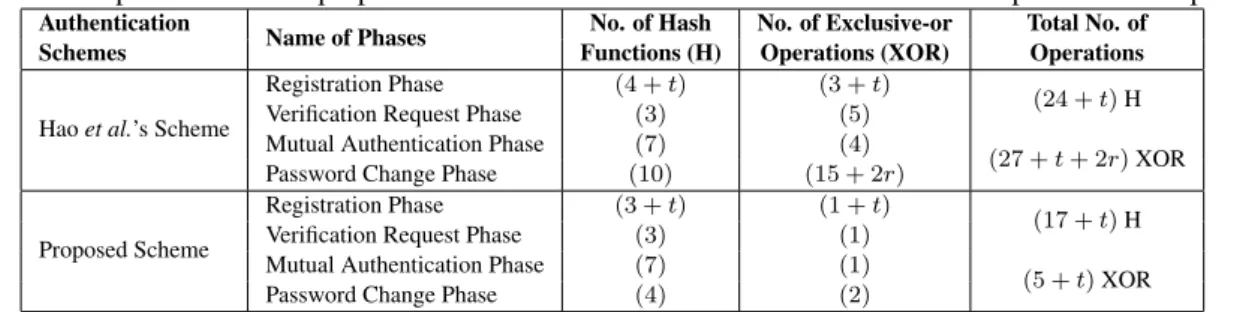
Table 3 shows comparative results for Hao et al.’s scheme and the proposed enhanced scheme in terms of computational complexity. In this table,tdenotes the num-ber of tickets issued to userUiandrdenotes the number of
tickets remaining. From both the tables, it is clear that the proposed scheme is more efficient in comparison with Hao
et al.’s scheme.
6
Conclusion
Nowadays, cloud has become one of the most popular busi-ness transaction platform. However, the growing security threat emerging due to the present security attacks obfus-cates this powerful network. Weak authentication of re-sponses and requests allows the attackers to compromise the cloud infrastructure. Hence, authentication of both the users and the cloud servers is a vital issue. To address this aforementioned issue, Haoet al.[26] proposed time-bound ticket-based mutual authentication scheme for cloud com-puting.
This paper pointed out that Haoet al.’s scheme is inade-quate to provide security against Denial-of-Service attack. Further, password change phase is also insecure. To over-come these security flaws, this paper proposes an enhanced scheme over Hao et al.’s scheme. The enhanced scheme inherits all the merits of Haoet al.’s scheme and resists the identified security attacks. In addition, user can choose and change the password securely without any assistance from the cloud server.
Acknowledgement
Table 2: Comparison between proposed scheme and Haoet al.’s scheme in terms of security properties
Security Properties Haoet al.’s Proposed Scheme Scheme
User is allowed to choose and change the password Yes Yes
Provides mutual authentication Yes Yes
Provides secure session key generation Yes Yes
Resists replay attack Yes Yes
Resists guessing attack Yes Yes
Resists parallel session attack Yes Yes
Resists reflection attack Yes Yes
Resists privileged insider attack Yes Yes
Resists valid period extending attack Yes Yes
Resists impersonation attack Yes Yes
Resists Denial-of-Service attack No Yes
Free from cloud server involvement during password change No Yes
Provides early wrong password detection No Yes
Provides early wrong identifier detection No Yes
Table 3: Comparison between proposed scheme and Haoet al.’s scheme in terms of computational complexity
Authentication
Name of Phases No. of Hash No. of Exclusive-or Total No. of Schemes Functions (H) Operations (XOR) Operations
Haoet al.’s Scheme
Registration Phase (4 +t) (3 +t)
(24 +t)H
Verification Request Phase (3) (5)
Mutual Authentication Phase (7) (4)
(27 +t+ 2r)XOR
Password Change Phase (10) (15 + 2r)
Proposed Scheme
Registration Phase (3 +t) (1 +t)
(17 +t)H
Verification Request Phase (3) (1)
Mutual Authentication Phase (7) (1)
(5 +t)XOR
Password Change Phase (4) (2)
References
[1] Li, Z., Chen, C. and Wang, K. (2011). Cloud com-puting for agent-based urban transportation systems.
IEEE Intelligent Systems, 26(1), pp. 73–79.
[2] Zhou, M., Zhang, R., Xie, W., Qian, W. and Zhou, A. (2010). Security and privacy in cloud computing: A survey.In Proceedings of 6thInternational Confer-ence on Semantics, Knowledge and Grid, Shanghai, China, pp. 105–112.
[3] Subashini, S. and Kavitha, V. (2011). A survey on se-curity issues in service delivery models of cloud com-puting.Journal of Network and Computer Applica-tions, 34(1), pp. 1–11.
[4] Pearson, S. and Benameur, A. (2010). Privacy, secu-rity and trust issues arising from cloud computing.In Proceedings of 2nd IEEE International Conference on Cloud Computing Technology and Science, Bris-tol, U.K., pp. 693–702.
[5] Jensen, M., Schwenk, J., Gruschka, N. and Iacono, L. (2009). On technical security issues in cloud comput-ing.In Proceedings of IEEE International Conference on Cloud Computing, Bangalore, India, pp. 109–116.
[6] Kandukuri, B.R., Ramakrishna, P.V. and Rakshit, A. (2009). Cloud security issues.In Proceedings of
IEEE International Conference on Services Comput-ing, Bangalore, India, pp. 517–520.
[7] Takabi, H., Joshi, J.B.D. and Ahn, G.J. (2010). Se-cureCloud: Towards a comprehensive security frame-work for cloud computing environments.In Proceed-ings of34thAnnual IEEE Computer Software and Ap-plications Conference Workshops, P.A., U.S.A., pp. 393–398.
[8] Wang, C. and Yan, H. (2010). Study of cloud com-puting security based on private face recognition.In Proceedings of International Conference on Compu-tational Intelligence and Software Engineering, Bei-jing, China, pp. 1–5.
[9] Shen, Z. and Tong, Q. (2010). The security of cloud computing system enabled by trusted computing tech-nology.In Proceedings of2ndInternational Confer-ence on Signal Processing Systems, Wuhan, China, pp. 11–14.
[10] Zech, P. (2011). Risk-based security testing in cloud computing environments.In Proceedings of4thIEEE International Conference on Software Testing, Verifi-cation and Validation, Innsbruck, Austria, pp. 411– 414.
156 Informatica37(2013) 149–156 R.S. Pippal et al.
[12] Yang, C.C., Chang, T.Y. and Hwang, M.S. (2003). Security of improvement on methods for protecting password transmission.Informatica, 14(4), pp. 551– 558.
[13] Yoon, E.J., Ryu, E.K. and Yoo, K.Y. (2005). At-tacks and solutions of Yanget al.’s protected pass-word changing scheme.Informatica, 16(2), pp. 285– 294.
[14] Ku, W.C. and Tsai, H.C. (2005). Weaknesses and improvements of Yang-Chang-Hwang’s password au-thentication scheme. Informatica, 16(2), pp. 203– 212.
[15] http://en.wikipedia.org/wiki/Smart_card.
[16] Chang, C.C. and Wu, T.C. (1991). Remote password authentication with smart cards.IEE Proceedings E: Computers and Digital Techniques, 138, pp. 165– 168.
[17] Chen, T.H., Horng, G. and Wu, K.C. (2007). A se-cure YS-like user authentication scheme. Informat-ica, 18(1), pp. 27–36.
[18] Liao, C.H., Chen, H.C. and Wang, C.T. (2009). An exquisite mutual authentication scheme with key agreement using smart card.Informatica, 33(2), pp. 125–132.
[19] Pippal, R.S., Jaidhar, C.D. and Tapaswi, S. (2012). Highly secured remote user authentication scheme us-ing smart cards.In Proceedings of7thIEEE Interna-tional Conference on Industrial Electronics and Ap-plications, Singapore, pp. 988–992.
[20] Hu, J., Chen, H.H. and Hou, T.W. (2010). A hy-brid public key infrastructure solution (HPKI) for HIPAA privacy/security regulations.Computer Stan-dards and Interfaces, 32(5-6), pp. 274–280.
[21] Yoon, E.J. and Yoo, K.Y. (2009). Robust key ex-change protocol between set-top box and smart card in DTV broadcasting. Informatica, 20(1), pp. 139– 150.
[22] Pippal, R.S., Tapaswi, S. and Jaidhar, C.D. (2012). Secure key exchange scheme for IPTV broadcasting.
Informatica, 36(1), pp. 47–52.
[23] He, D., Ma, M., Zhang, Y., Chen, C. and Bu, J. (2011). A strong user authentication scheme with smart cards for wireless communications.Computer Communications, 34(3), pp. 367–374.
[24] Pippal, R.S., Jaidhar, C.D. and Tapaswi, S. (2013). Robust Smart Card Authentication Scheme for Multi-server Architecture.Wireless Personal Communica-tions. DOI: 10.1007/s11277-013-1039-6.
[25] Fan, R., He, D., Pan, X. and Ping, L. (2011). An ef-ficient and DoS-resistant user authentication scheme for two-tiered wireless sensor networks.Journal of Zhejiang University-SCIENCE C (Computers and Electronics), 12(7), pp. 550–560.
[26] Hao, Z., Zhong, S. and Yu, N. (2011). A time-bound ticket-based mutual authentication scheme for cloud computing.International Journal of Comput-ers, Communications and Control, 6(2), pp. 227–235.